China AI-Aided GI Diagnostics Market Size & Growth Rate
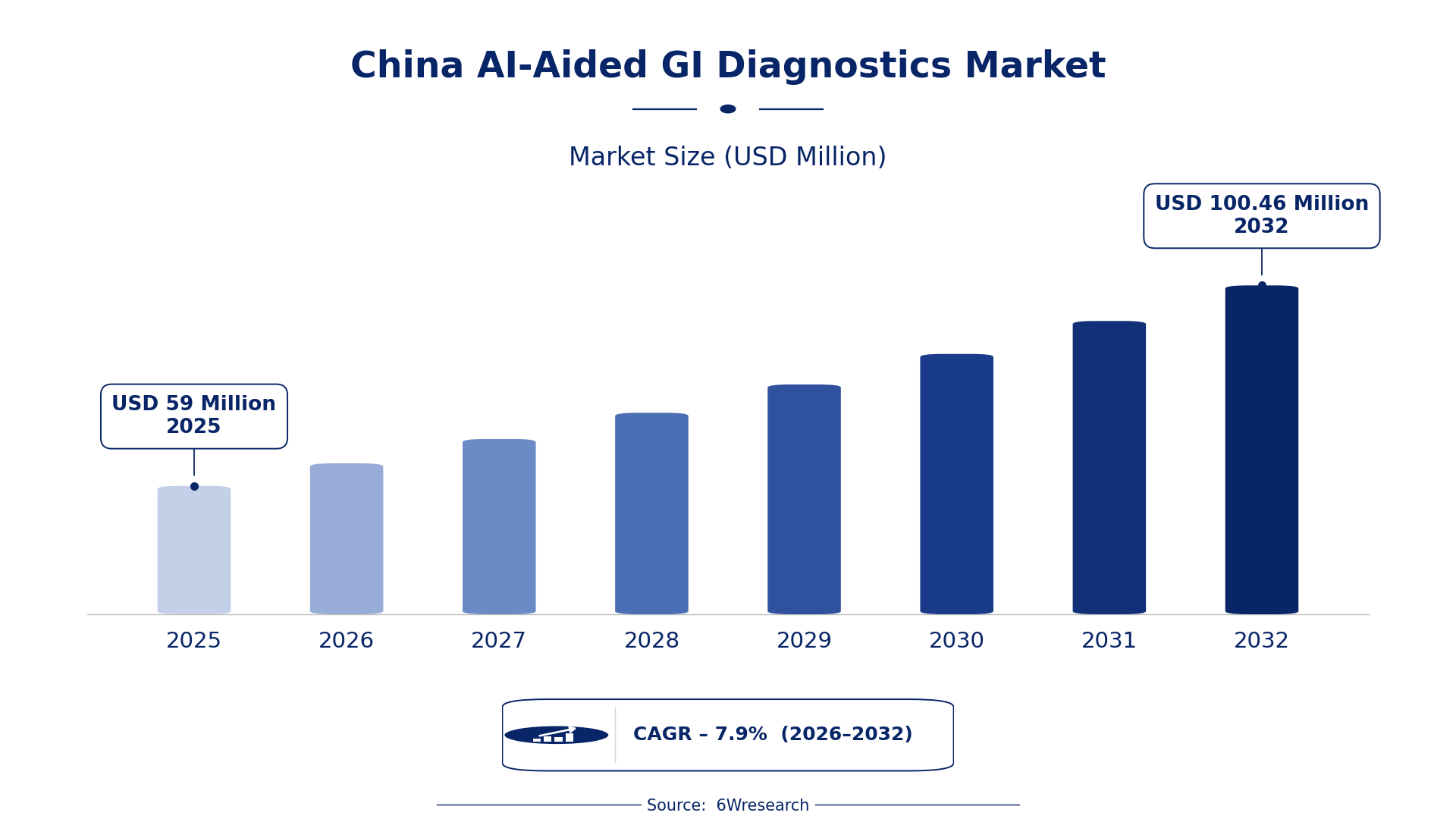
According to 6Wresearch internal database and industry insights, the China AI-Aided GI Diagnostics Market was valued at USD 59.0 million in 2025 and is projected to reach USD 100.46 million by 2032, growing at a CAGR of approximately 7.9% during 2026–2032.
China AI-Aided GI Diagnostics Market Highlights
| Report Metric | Details |
| Report Name | China AI-Aided GI Diagnostics Market |
| Market Size 2025 | USD 59.0 million |
| Market Size 2032 | USD 100.46 million |
| Absolute Growth 2025–2032 | USD 41.46 million |
| CAGR 2026–2032 | 7.9% |
| Peak Annual Growth | 10.1% in 2027 |
| Forecast Period | 2026–2032 |
| Historical Data | 2022–2025 |
| Base Year | 2025 |
| Leading GI Condition, 2025 | GI Cancer Screening (39% share) |
| Leading AI Model Type, 2025 | Vision AI (42% share) |
| Leading Distribution Channel, 2025 | Endoscopy Equipment Vendors (39% share) |
| Leading End User, 2025 | Gastroenterology Clinics (44% share) |
| Fastest-Growing GI Condition | Inflammatory Bowel Disease (9.4% CAGR) |
| Fastest-Growing Distribution Channel | Imaging Software Suites (9.5% CAGR) |
| Fastest-Growing End User | GI Physicians (10.0% CAGR) |
| Growing Sector | Gastroenterology |
| Key End Users | Gastroenterology Clinics, Hospital Networks, GI Physicians, Liver Health Specialists |
China AI-Aided GI Diagnostics Market Year-wise Growth Rate and Key Drivers (2022–2032)
This graph illustrates the annual growth rates of the market from 2022 to 2032, highlighting a steady upward trajectory and projected market expansion over the forecast period.
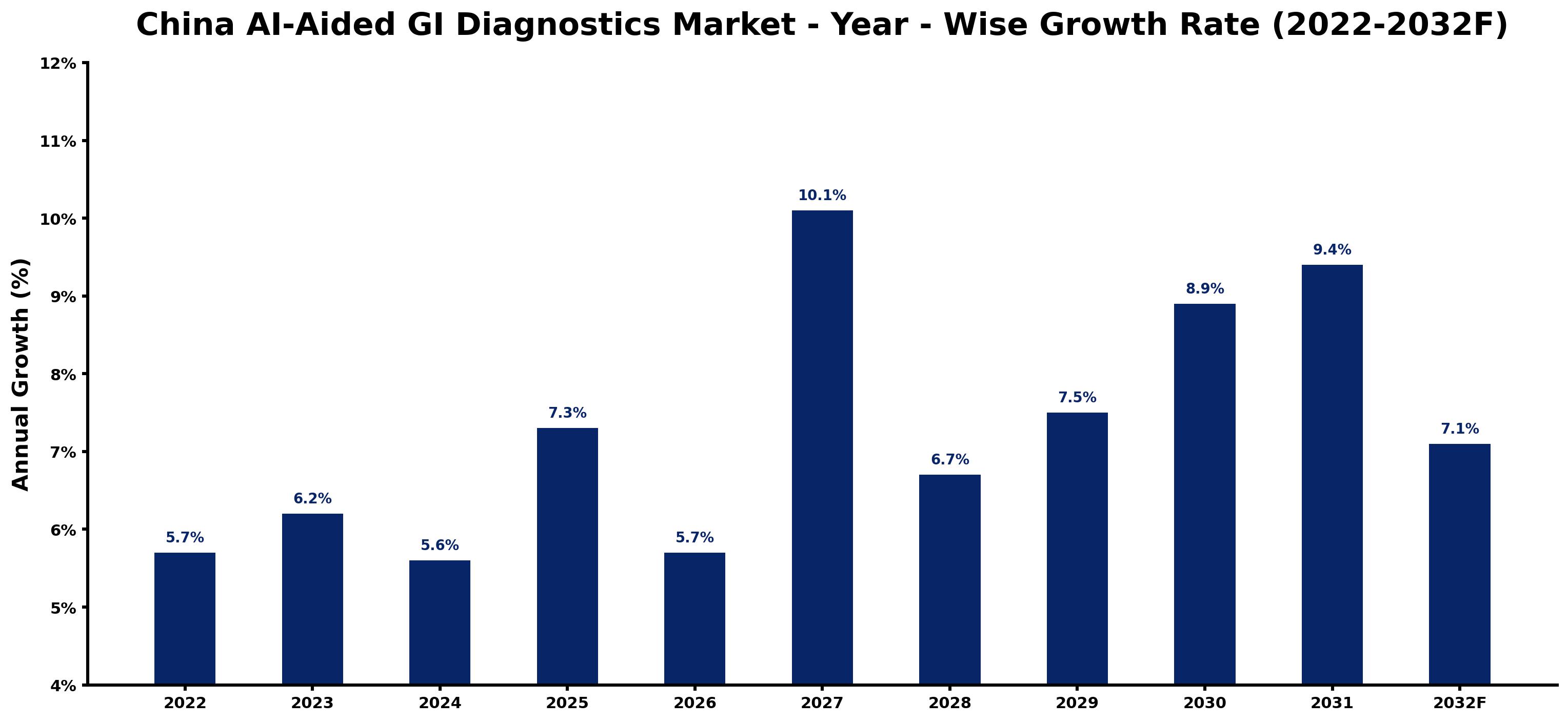
Each row of the following table gives one year's estimated growth and the event or demand shift that explains it.
| Year | Estimated Annual Growth (%) | Market Rationale |
| 2022 | 5.7 | The market exhibited steady growth due to increasing healthcare investments in AI technologies. |
| 2023 | 6.2 | Demand accelerated as healthcare facilities expanded their AI diagnostic capabilities through new initiatives. |
| 2024 | 5.6 | Growth slowed as integration challenges emerged in some hospitals adopting new technologies. |
| 2025 | 7.3 | Market performance improved with the introduction of the 'AI in Healthcare Development Plan'. |
| 2026 | 5.7 | A slowdown occurred as hospitals adjusted to updated regulations for AI diagnostics. |
| 2027 | 10.1 | Growth surged due to the integration of AI in 500 hospitals as planned by the Ministry of Health. |
| 2028 | 6.7 | The market experienced a slowdown as competition intensified among existing providers. |
| 2029 | 7.5 | Demand increased as more gastroenterology clinics adopted AI tools for improved diagnostics. |
| 2030 | 8.9 | Growth accelerated with rising awareness of AI benefits in diagnostics among healthcare providers. |
| 2031 | 9.4 | The market continued to grow as technology adoption expanded across healthcare facilities. |
| 2032 | 7.1 | A slowdown was noted as the market matured and competition increased among suppliers. |
Note: Market size estimations and growth projections presented in this report are based on 6Wresearch's proprietary forecasting methodology, utilizing the latest available industry data, government publications, and primary research inputs.
China AI-Aided GI Diagnostics Market Synopsis
AI-Aided GI Diagnostics in China refers to the use of artificial intelligence technologies to improve gastrointestinal diagnostics. This includes applications such as detecting colon polyps and analyzing liver diseases. The China AI-Aided GI Diagnostics Market is expanding due to investments in healthcare technologies and the increasing prevalence of gastrointestinal diseases. With over 30 million patients diagnosed annually, the demand for advanced diagnostic tools is rising. Initiatives such as the 'Healthy China 2030' programme are further driving this growth.
Market Dynamics Impact Analysis (2026–2032)
| Factor | Type | Impact | Primary Segment Affected |
| Increasing healthcare expenditure drives demand for advanced diagnostic tools. | Driver | High | GI Cancer Screening |
| The integration of AI in healthcare facilities presents new opportunities for suppliers. | Opportunity | High | Endoscopy Equipment Vendors |
| Regulatory challenges may hinder the speed of AI tool adoption. | Restraint | High | Vision AI |
| The growing number of gastroenterology clinics creates a demand for AI diagnostics. | Driver | High | Gastroenterology Clinics |
| The need for improved diagnostic accuracy offers opportunities for innovative solutions. | Opportunity | Medium | Imaging Software Suites |
| Limited awareness among healthcare providers may restrict market growth. | Restraint | Medium | Liver Disease Analysis |
| Technological integration challenges can delay implementation timelines. | Challenge | High | Health SaaS Platforms |
| Competition from traditional diagnostic methods poses a challenge. | Challenge | Medium | GI Physicians |
Evaluation of Drivers in China AI-Aided GI Diagnostics Market (2026–2032)
The main growth drivers and the segments they affect most are set out below.
| Drivers | Primary Segment Affected | Why It Matters (Evidence) |
| Rising healthcare expenditure supports the purchase of advanced diagnostic tools. | GI Cancer Screening | China's healthcare expenditure reached 6.6 trillion CNY in 2022, leading to increased investments in AI diagnostics. |
| The integration of AI in hospitals improves diagnostic accuracy. | Vision AI | The Ministry of Health's initiative to integrate AI in 500 hospitals by 2025 encourages adoption of advanced technologies. |
| Growing patient numbers create demand for efficient diagnostic solutions. | Gastroenterology Clinics | Over 30 million patients are diagnosed with GI diseases annually, prompting clinics to seek advanced diagnostic tools. |
| Technological advancements in AI drive innovation in diagnostics. | Imaging Software Suites | Research efforts by the Chinese Academy of Medical Sciences are pushing the boundaries of AI applications in diagnostics. |
| Government initiatives promote AI integration in healthcare. | Endoscopy Equipment Vendors | The 'Healthy China 2030' initiative aims to improve healthcare quality, driving demand for AI tools. |
In 2022, China's healthcare expenditure reached 6.6 trillion CNY, facilitating investments in advanced diagnostic tools. With over 30 million patients diagnosed with GI diseases annually, clinics are motivated to adopt AI technologies. Ongoing research is advancing AI applications and driving progress in diagnostics.
Evaluation of Restraints in China AI-Aided GI Diagnostics Market
The table below lists the restraints and the evidence behind each.
| Market Restraint | Primary Segment Affected | Why It Matters (Evidence) |
| Regulatory challenges may slow down the approval process for new AI tools. | Vision AI | The State Administration for Market Regulation updated standards for medical AI devices in 2022, impacting timelines for new product launches. |
| Limited awareness among healthcare providers can restrict market growth. | Liver Disease Analysis | Many healthcare providers are still unfamiliar with AI diagnostic capabilities, affecting adoption rates across facilities. |
| Integration challenges within existing healthcare infrastructure may hinder implementation. | Health SaaS Platforms | Hospitals face difficulties in integrating new AI systems with legacy technologies, delaying deployment. |
| High costs associated with AI technology can deter smaller clinics from adoption. | Gastroenterology Clinics | Investments in AI diagnostics may be prohibitive for clinics with limited budgets, restricting their ability to upgrade. |
| Competition from traditional diagnostic methods poses a challenge. | GI Cancer Screening | Established practices may resist transitioning to AI-based solutions due to perceived risks and uncertainties. |
China AI-Aided GI Diagnostics Market Challenges
The China AI-Aided GI Diagnostics market encounters several practical problems, with the first being fierce competition among local providers. Over 3,000 gastroenterology clinics compete for market share, leading to price reductions that squeeze margins for suppliers. Rapid technological advancements create hurdles in adopting new diagnostic tools, delaying their availability in hospitals. Supply chain disruptions arise from dependency on imported components, which can postpone equipment delivery and hinder healthcare facilities' ability to treat patients efficiently. A lack of skilled professionals in AI technologies restricts effective implementation, limiting improvements in patient outcomes for clinics.
Trends in the China AI-Aided GI Diagnostics Market
The trends below show where the China AI-Aided GI Diagnostics Market is heading.
- Shift towards AI Integration in Gastroenterology Clinics: Gastroenterology clinics are increasingly embracing AI technologies for diagnostics, with over 3,000 clinics operating in China. This shift is motivated by the need for greater diagnostic accuracy and efficiency, resulting in better patient outcomes.
- Expansion of AI Standards in Healthcare: The National Health Commission has established standards for AI in healthcare diagnostics, enhancing the regulatory framework. This initiative is set to improve safety and efficacy in AI applications, benefiting both producers and buyers.
- Growth in Advanced Medical Technology Hubs: The Shanghai region is emerging as a centre for advanced medical technology development, promoting innovation in AI diagnostics. This is evident in the growing number of research projects and collaborations focused on AI applications.
- Increase in AI Diagnostic Tools Usage: With over 30 million patients diagnosed with GI diseases annually in China, there is a notable increase in the usage of AI diagnostic tools. This trend underscores the growing reliance on technology for effective healthcare delivery.
Investment Opportunities in the China AI-Aided GI Diagnostics Market
Some of the investment opportunities in the China AI-Aided GI Diagnostics Market are mentioned below.
- Investment in AI Diagnostic Tools: With China's healthcare expenditure reaching 6.6 trillion CNY, there is a promising opportunity to supply AI diagnostic tools to hospitals. The 'Healthy China 2030' initiative encourages partnerships with healthcare providers to enhance service delivery.
- Supply of Imaging Software Suites: The demand for advanced imaging software is on the rise as healthcare facilities seek efficient solutions. Collaborating with hospital networks can facilitate market entry and expansion in this burgeoning sector.
- Expansion of Endoscopy Equipment Vendors: The increasing number of gastroenterology clinics presents opportunities for endoscopy equipment vendors. Establishing local partnerships can strengthen market presence and distribution channels in this competitive environment.
- Development of AI Training Programs: As awareness of AI benefits grows, there is a pressing need for training programs for healthcare providers. Collaborating with educational institutions can help bridge the knowledge gap and improve adoption rates.
Government Initiatives in the China AI-Aided GI Diagnostics Market
The 'Healthy China 2030' initiative, launched by the National Health Commission in 2020, aims to enhance healthcare access and quality, including the integration of AI diagnostics. This initiative encourages healthcare facilities to adopt advanced technologies, improving overall patient care. In 2021, the Ministry of Industry and Information Technology approved the 'AI in Healthcare Development Plan', focusing on advancing AI technologies in medical diagnostics. This plan supports research and development in AI applications, promoting progress in the sector. In 2022, the State Administration for Market Regulation updated standards for medical AI devices, ensuring safety and efficacy in AI tools.
The National Medical Products Administration oversees the approval of AI diagnostic tools and introduced a fast-track approval pathway in 2023 to stimulate innovation. This pathway allows for quicker market access for new technologies, benefiting both producers and healthcare providers. Additionally, the Ministry of Health's 'Digital Health Strategy 2022-2025' emphasises the integration of AI in healthcare services across China, ensuring that healthcare facilities receive the necessary support for implementation. This strategy aims to improve the quality of healthcare delivery through technology, ultimately benefiting patients and providers alike.
Future Insight of the China AI-Aided GI Diagnostics Market
By 2032, the China AI-Aided GI Diagnostics market is expected to undergo substantial evolution, driven by several key factors. The Ministry of Health's initiative to integrate AI in 500 hospitals will enhance diagnostic accuracy and patient management. The 'Healthy China 2030' plan will further propel advancements in healthcare technology. By 2025, the installed base of endoscopy equipment is projected to exceed 25,000 units, improving diagnostic capabilities across facilities. Ongoing research by the Chinese Academy of Medical Sciences will continue to expand the potential of AI applications, benefiting both buyers and suppliers.
Market Segmentation Analysis
The report offers a comprehensive study of the following market segments and their leading categories in the market.
By GI Condition – GI Cancer Screening Dominated, Inflammatory Bowel Disease Expected to Grow Fastest
According to Shubham Padhi, Research Analyst at 6Wresearch, GI Cancer Screening held a 39% share of the China AI-Aided GI Diagnostics Market by gi condition in 2025. GI Cancer Screening holds the largest share in the China AI-Aided GI Diagnostics Market due to the high prevalence of gastrointestinal cancers, with over 30 million patients diagnosed annually. This segment benefits from established standards set by the National Health Commission, facilitating its implementation across numerous healthcare facilities. The quickest growth will come from Inflammatory Bowel Disease, forecast to expand at a CAGR of 9.4% between 2026 and 2032. The Inflammatory Bowel Disease segment is experiencing rapid growth as awareness of the need for early detection and management of this chronic condition rises. Government initiatives, including the 'Healthy China 2030' plan, are promoting advancements in diagnostic technologies, which will sustain this segment's growth. This trend suggests that suppliers should focus on developing solutions for early detection to meet the increasing demand from healthcare providers.
By AI Model Type – Vision AI Dominated and Is Expected to Record the Fastest Growth
With a 42% revenue share in 2025, Vision AI was the largest ai model type category. Vision AI dominates the market share as it is directly employed for image analysis in diagnostics, making it essential for accurate identification of GI conditions. Its widespread application in gastroenterology clinics contributes to its leading position. Vision AI is also forecast to expand faster than any other category, at a CAGR of 10.2% over 2026–2032. Vision AI is also the fastest-growing segment, as advancements in machine learning techniques continuously improve diagnostic accuracy and efficiency. The ongoing integration of AI in healthcare settings ensures that Vision AI's lead will keep widening. Buyers should invest in the latest Vision AI technologies to stay competitive and improve diagnostic outcomes.
By Distribution Channel – Endoscopy Equipment Vendors Dominated, Imaging Software Suites Expected to Grow Fastest
In 2025, Endoscopy Equipment Vendors led the distribution channel split with a 39% share. Endoscopy Equipment Vendors lead the distribution channel due to their critical role in supplying the hardware necessary for effective gastrointestinal diagnostics. With over 20,000 units of endoscopy equipment installed in hospitals, their market share is reinforced by the growing demand for advanced diagnostic capabilities. Imaging Software Suites are set to record the highest CAGR in this split, 9.5% over 2026–2032. Imaging Software Suites are the fastest-growing channel as they are essential for processing and analysing imaging data, which is increasingly important in gastrointestinal diagnostics. The rising demand for efficient data management solutions is driving the rapid expansion of this segment. Suppliers should concentrate on building partnerships with imaging software developers to address the increasing need for advanced diagnostic tools.
By End User – Gastroenterology Clinics Dominated, GI Physicians Expected to Grow Fastest
The largest end user category in 2025 was Gastroenterology Clinics, with a 44% share of total revenue. Gastroenterology Clinics lead the market share as they are the primary end-users of AI-Aided GI Diagnostics, catering to the high volume of patients with GI diseases. The concentration of over 3,000 clinics across China facilitates widespread adoption of these technologies. Over 2026–2032, GI Physicians are expected to post the fastest growth, at a CAGR of 10.0%. GI Physicians are the fastest-growing end-user group as they increasingly utilise AI tools for patient diagnosis, driven by the need for improved diagnostic accuracy. This trend is expected to continue as more physicians adopt AI technologies in their practices. Healthcare providers should prioritise training for GI Physicians to maximise the benefits of AI-Aided GI Diagnostics.
Key Attractiveness of the Report
- 10 Years of Market Numbers
- Historical Data Starting from 2022 to 2025
- Base Year 2025
- Forecast Data until 2032
- Key Performance Indicators Impacting the Market
- Major Upcoming Developments and Projects
Key Highlights of the Report:
- China AI-Aided GI Diagnostics Market Outlook
- Market Size of China AI-Aided GI Diagnostics Market, 2025
- Forecast of China AI-Aided GI Diagnostics Market, 2032
- Historical Data and Forecast of China AI-Aided GI Diagnostics Revenues & Volume for the Period 2022 - 2032F
- China AI-Aided GI Diagnostics Market Trend Evolution
- China AI-Aided GI Diagnostics Market Drivers and Challenges
- China AI-Aided GI Diagnostics Price Trends
- China AI-Aided GI Diagnostics Porter's Five Forces
- China AI-Aided GI Diagnostics Industry Life Cycle
- Historical Data and Forecast of China AI-Aided GI Diagnostics Market Revenues & Volume By GI Condition for the Period 2022 - 2032F
- Historical Data and Forecast of China AI-Aided GI Diagnostics Market Revenues & Volume By Colon Polyp Detection for the Period 2022 - 2032F
- Historical Data and Forecast of China AI-Aided GI Diagnostics Market Revenues & Volume By Liver Disease Analysis for the Period 2022 - 2032F
- Historical Data and Forecast of China AI-Aided GI Diagnostics Market Revenues & Volume By Inflammatory Bowel Disease for the Period 2022 - 2032F
- Historical Data and Forecast of China AI-Aided GI Diagnostics Market Revenues & Volume By GI Cancer Screening for the Period 2022 - 2032F
- Historical Data and Forecast of China AI-Aided GI Diagnostics Market Revenues & Volume By AI Model Type for the Period 2022 - 2032F
- Historical Data and Forecast of China AI-Aided GI Diagnostics Market Revenues & Volume By Vision AI for the Period 2022 - 2032F
- Historical Data and Forecast of China AI-Aided GI Diagnostics Market Revenues & Volume By Predictive Modeling for the Period 2022 - 2032F
- Historical Data and Forecast of China AI-Aided GI Diagnostics Market Revenues & Volume By Pattern Detection for the Period 2022 - 2032F
- Historical Data and Forecast of China AI-Aided GI Diagnostics Market Revenues & Volume By Deep Learning Classifiers for the Period 2022 - 2032F
- Historical Data and Forecast of China AI-Aided GI Diagnostics Market Revenues & Volume By Distribution Channel for the Period 2022 - 2032F
- Historical Data and Forecast of China AI-Aided GI Diagnostics Market Revenues & Volume By Endoscopy Equipment Vendors for the Period 2022 - 2032F
- Historical Data and Forecast of China AI-Aided GI Diagnostics Market Revenues & Volume By Imaging Software Suites for the Period 2022 - 2032F
- Historical Data and Forecast of China AI-Aided GI Diagnostics Market Revenues & Volume By Health SaaS Platforms for the Period 2022 - 2032F
- Historical Data and Forecast of China AI-Aided GI Diagnostics Market Revenues & Volume By Hospital Networks for the Period 2022 - 2032F
- Historical Data and Forecast of China AI-Aided GI Diagnostics Market Revenues & Volume By End User for the Period 2022 - 2032F
- Historical Data and Forecast of China AI-Aided GI Diagnostics Market Revenues & Volume By Gastroenterology Clinics for the Period 2022 - 2032F
- Historical Data and Forecast of China AI-Aided GI Diagnostics Market Revenues & Volume By Liver Health Specialists for the Period 2022 - 2032F
- Historical Data and Forecast of China AI-Aided GI Diagnostics Market Revenues & Volume By GI Physicians for the Period 2022 - 2032F
- Historical Data and Forecast of China AI-Aided GI Diagnostics Market Revenues & Volume By Oncology Departments for the Period 2022 - 2032F
- China AI-Aided GI Diagnostics Import Export Trade Statistics
- Market Opportunity Assessment By GI Condition
- Market Opportunity Assessment By AI Model Type
- Market Opportunity Assessment By Distribution Channel
- Market Opportunity Assessment By End User
- China AI-Aided GI Diagnostics Top Companies Market Share
- China AI-Aided GI Diagnostics Competitive Benchmarking By Technical and Operational Parameters
- China AI-Aided GI Diagnostics Company Profiles
- China AI-Aided GI Diagnostics Key Strategic Recommendations
Market Covered
Segments analysed in this report are listed below.
By GI Condition
- Colon Polyp Detection
- Liver Disease Analysis
- Inflammatory Bowel Disease
- GI Cancer Screening
By AI Model Type
- Vision AI
- Predictive Modeling
- Pattern Detection
- Deep Learning Classifiers
By Distribution Channel
- Endoscopy Equipment Vendors
- Imaging Software Suites
- Health SaaS Platforms
- Hospital Networks
By End User
- Gastroenterology Clinics
- Liver Health Specialists
- GI Physicians
- Oncology Departments































