China AI-Based CBT Tools Market Size & Growth Rate
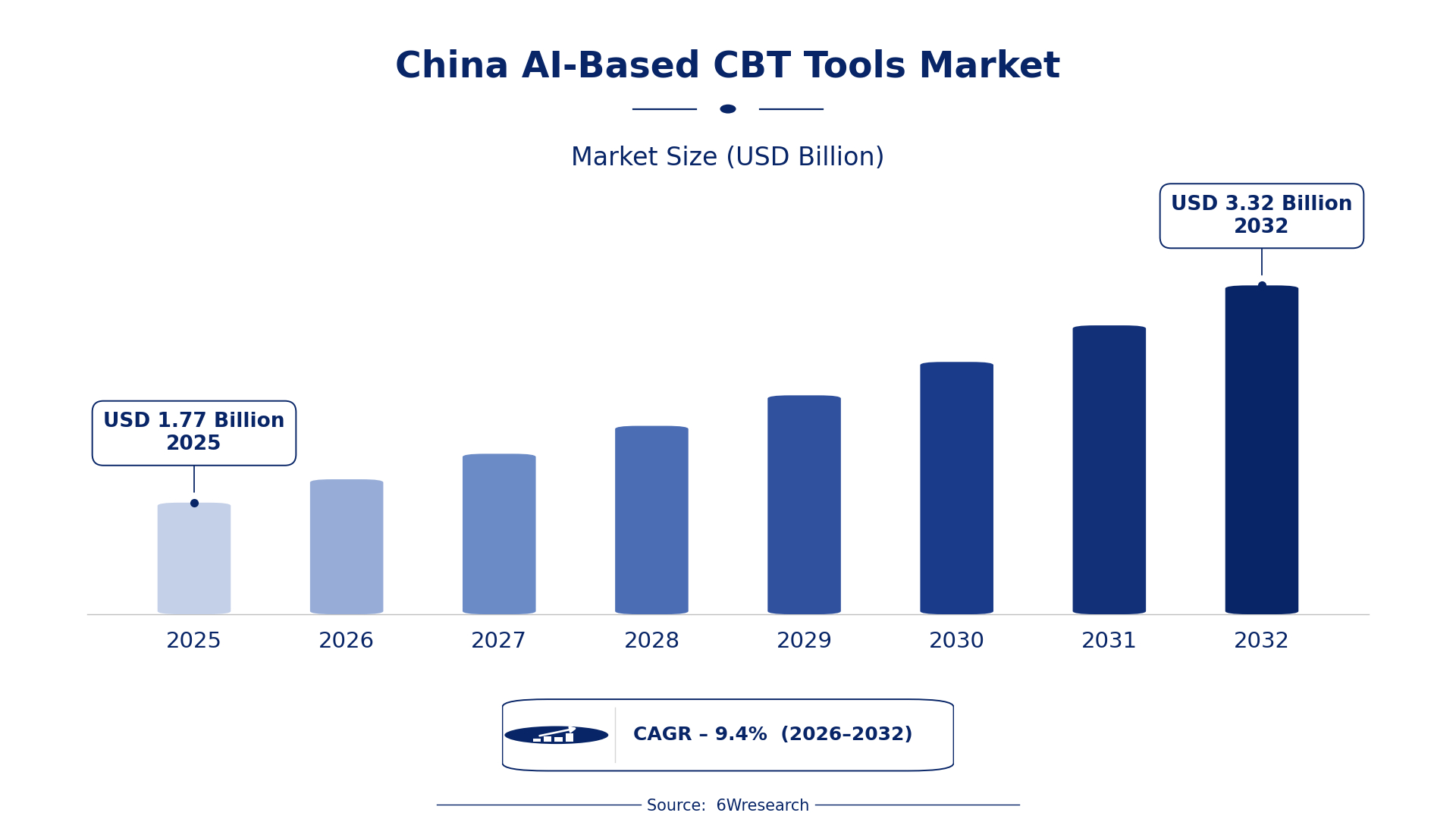
According to 6Wresearch internal database and industry insights, the China AI-Based CBT Tools Market was valued at USD 1.77 billion in 2025 and is projected to reach USD 3.32 billion by 2032, growing at a CAGR of approximately 9.4% during 2026–2032.
China AI-Based CBT Tools Market Highlights
| Report Metric | Details |
| Report Name | China AI-Based CBT Tools Market |
| Market Size 2025 | USD 1.77 billion |
| Market Size 2032 | USD 3.32 billion |
| Absolute Growth 2025–2032 | USD 1.55 billion |
| CAGR 2026–2032 | 9.4% |
| Peak Annual Growth | 11.8% in 2026 |
| Forecast Period | 2026–2032 |
| Historical Data | 2022–2025 |
| Base Year | 2025 |
| Leading CBT Type, 2025 | Anxiety & Depression (44% share) |
| Leading AI Enhancement, 2025 | Adaptive Chatbots (52% share) |
| Leading Distribution Channel, 2025 | Mental Health Apps (36% share) |
| Leading End User, 2025 | Therapists & Users (53% share) |
| Fastest-Growing CBT Type | Stress Management (10.6% CAGR) |
| Fastest-Growing Distribution Channel | CBT SaaS Tools (11.1% CAGR) |
| Fastest-Growing End User | Corporate Wellness Coaches (11.8% CAGR) |
| Growing Sector | Mental Health |
| Key End Users | Therapists, Corporate Wellness Coaches, Mental Health App Users, Clinical Psychologists |
China AI-Based CBT Tools Market Year-wise Growth Rate and Key Drivers (2022–2032)
This graph illustrates the annual growth rates of the market from 2022 to 2032, highlighting a steady upward trajectory and projected market expansion over the forecast period.
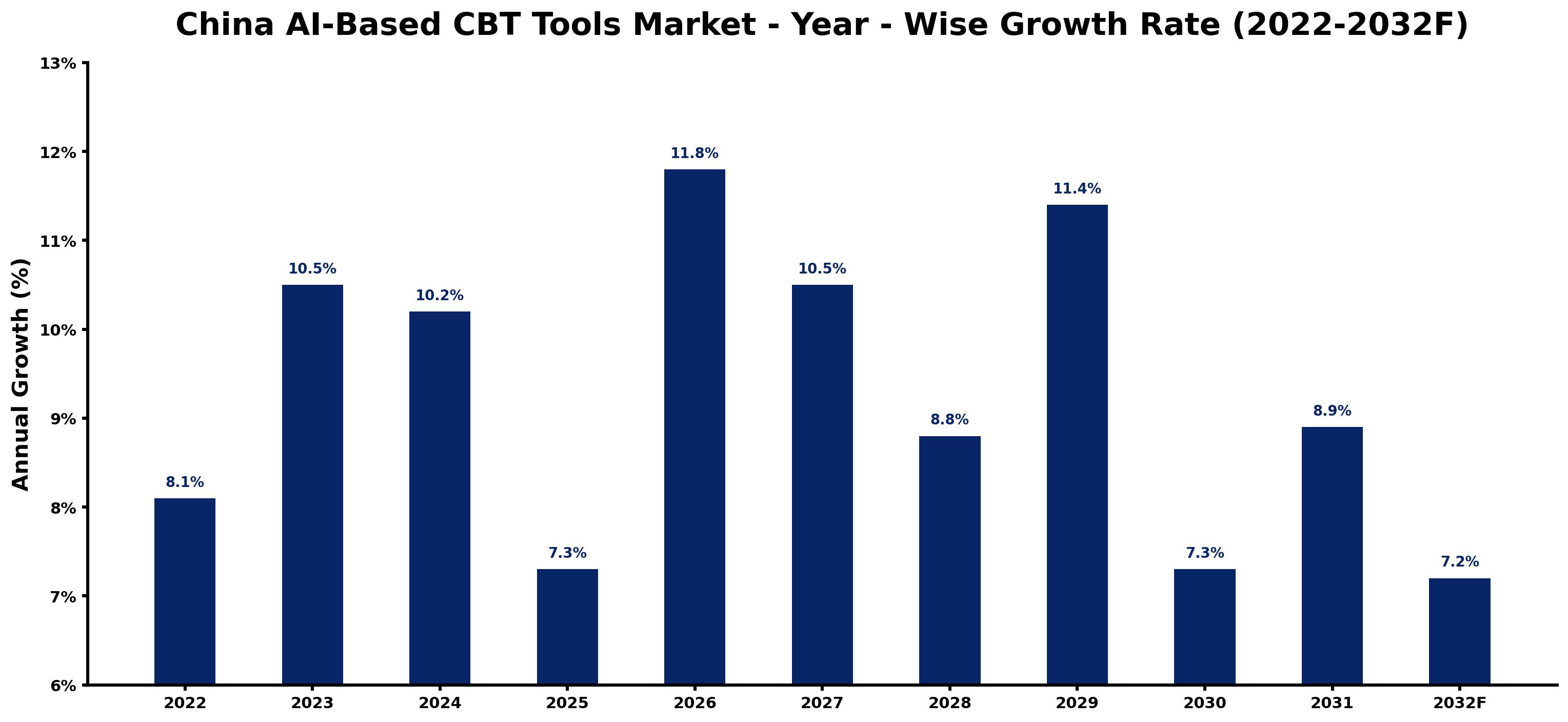
Each row of the following table gives one year's estimated growth and the event or demand shift that explains it.
| Year | Estimated Annual Growth (%) | Market Rationale |
| 2022 | 8.1 | The user base for mental health apps reached 300 million, indicating strong initial demand. |
| 2023 | 10.5 | The National Health Commission's initiatives boosted mental health service accessibility. |
| 2024 | 10.2 | Growth slowed as the market adjusted to increased competition among digital therapy providers. |
| 2025 | 7.3 | Demand continued to grow, driven by the ongoing integration of AI tools in therapy. |
| 2026 | 11.8 | The peak growth year is driven by the implementation of the Digital Health Strategy. |
| 2027 | 10.5 | Increased adoption of AI tools in therapy sessions contributed to sustained growth. |
| 2028 | 8.8 | Growth slowed as market saturation began to affect new user acquisition. |
| 2029 | 11.4 | The introduction of new mental health programs revitalised demand for AI-based tools. |
| 2030 | 7.3 | Demand growth slowed as the market matured and competition intensified. |
| 2031 | 8.9 | The market saw renewed interest due to advancements in AI technology and user engagement. |
| 2032 | 7.2 | A slight slowdown in growth is anticipated as the market stabilises. |
Note: Market size estimations and growth projections presented in this report are based on 6Wresearch's proprietary forecasting methodology, utilizing the latest available industry data, government publications, and primary research inputs.
China AI-Based CBT Tools Market Synopsis
AI-Based CBT Tools in China are digital applications that utilise artificial intelligence to improve cognitive behavioral therapy. These tools target mental health conditions such as anxiety, depression, and PTSD. The China AI-Based CBT Tools Market is growing due to rising mental health awareness, government initiatives, and increased adoption by healthcare providers and corporate wellness programs. The mental health app user base reached 300 million in 2022, indicating strong demand for these solutions. As mental health literacy improves, the need for effective tools continues to rise.
Market Dynamics Impact Analysis (2026–2032)
| Factor | Type | Impact | Primary Segment Affected |
| Government initiatives promoting mental health services | Driver | High | Mental Health Apps |
| Growing corporate wellness programs integrating mental health solutions | Driver | High | Corporate Wellness Coaches |
| Increasing demand for AI tools in therapy | Opportunity | High | AI Guided Journaling |
| Expansion of mental health programs in educational institutions | Opportunity | High | Therapists & Users |
| Competition among digital therapy providers affecting pricing | Restraint | Medium | Digital Therapy Providers |
| Limited awareness of AI-based solutions among some user groups | Restraint | Medium | Mental Health Apps |
| Technological integration challenges in existing healthcare systems | Challenge | High | CBT SaaS Tools |
| Regulatory hurdles for new AI applications in therapy | Challenge | Medium | Anxiety & Depression |
Evaluation of Drivers in China AI-Based CBT Tools Market (2026–2032)
Below mentioned are some major drivers and their influence on market dynamics.
| Drivers | Primary Segment Affected | Why It Matters (Evidence) |
| Government support for mental health initiatives | Mental Health Apps | The National Health Commission's 'Mental Health Work Plan (2021-2025)' aims to improve mental health services, driving demand for apps. |
| Increased corporate investment in employee wellness | Corporate Wellness Coaches | Corporate programs are integrating AI tools to improve employee mental health, leading to higher adoption rates. |
| Growing user base for mental health apps | Digital Therapy Providers | With 300 million users in 2022, demand for accessible mental health solutions is surging. |
| Rising awareness of mental health issues | Therapists & Users | The 'Healthy China 2030' initiative promotes mental health literacy, increasing the need for effective tools. |
| Technological advancements in AI | AI Guided Journaling | Recent developments in AI improve the effectiveness of journaling tools, attracting more users seeking personalised therapy. |
In 2023, the user base for mental health apps reached 300 million, reflecting strong demand. The 'National Mental Health Work Plan (2021-2025)' promotes the integration of AI tools, driving further adoption. Technological advancements in AI are enhancing the effectiveness of these tools, encouraging more users to seek digital therapy options.
Evaluation of Restraints in China AI-Based CBT Tools Market
Below mentioned are some major restraints and their influence on market dynamics.
| Market Restraint | Primary Segment Affected | Why It Matters (Evidence) |
| High competition among digital therapy providers | Digital Therapy Providers | Intense competition leads to price wars, affecting profitability and investment in new solutions. |
| Limited understanding of AI tools among some users | Mental Health Apps | Some potential users are hesitant to adopt AI-based solutions due to lack of awareness. |
| Regulatory challenges for new AI applications | Anxiety & Depression | Strict regulations can delay the introduction of new tools into the market. |
| Integration issues with existing healthcare systems | CBT SaaS Tools | Technological challenges hinder the adoption of AI tools in traditional therapy settings. |
| Skepticism about the effectiveness of AI in therapy | Therapists & Users | Concerns about AI's ability to deliver personalised therapy may limit user acceptance. |
China AI-Based CBT Tools Market Challenges
The China AI-Based CBT Tools market faces a few practical problems, and the first is cost. High development expenses for AI-based applications can raise prices for healthcare providers, limiting their ability to adopt these solutions. Next, technology integration presents challenges; many mental health professionals lack the necessary training to effectively use AI tools, delaying their implementation in therapy sessions. Competition from traditional therapy methods also hinders market growth, as 70% of users still prefer in-person interactions. Supply chain issues arise from reliance on software updates and data management, which can disrupt service continuity for end users.
Trends in the China AI-Based CBT Tools Market
Below mentioned are some of the trends shaping the China AI-Based CBT Tools Market growth.
- Shift towards AI-Driven Mental Health Solutions: The 'National Mental Health Work Plan (2021-2025)' is driving the adoption of AI tools in therapy, focusing on improving service delivery and accessibility.
- Increase in Mental Health Programs in Education: In 2023, the Ministry of Education reported a 30% increase in mental health programs in universities, highlighting the growing emphasis on student mental health.
- Corporate Wellness Programs Embracing Digital Tools: Corporate wellness coaches are increasingly integrating AI-based CBT tools into their strategies, driven by the need to support employee mental health effectively.
- Expansion of AI Tools in Clinical Settings: In 2023, the Shanghai Mental Health Center implemented AI tools in therapy sessions, showcasing a trend towards technology integration in clinical practice.
Investment Opportunities in the China AI-Based CBT Tools Market
Several openings in the China AI-Based CBT Tools Market merit attention from investors.
- AI-Based CBT Tools for Corporate Wellness: With a projected 10 billion RMB budget for mental health services, companies can invest in AI tools to improve employee wellness programs, targeting corporate wellness coaches as key buyers.
- Mental Health Apps for University Students: The 30% increase in mental health programs in universities presents an opportunity to supply tailored mental health apps, focusing on students' needs in educational institutions.
- Digital Therapy Providers Expanding Offerings: The growing user base of mental health apps indicates a gap in digital therapy solutions, allowing providers to improve their offerings and attract more users.
- AI Guided Journaling for Personal Development: The rising interest in self-help tools creates an opportunity to supply AI guided journaling applications, targeting individual users seeking personal growth and emotional processing.
Government Initiatives in the China AI-Based CBT Tools Market
The 'National Mental Health Work Plan (2021-2025)' focuses on improving mental health services across China. This plan promotes the integration of digital tools, including AI-based solutions, to improve accessibility and effectiveness in therapy. The initiative aims to reduce mental health disorders by 20% by 2025, encouraging investment in advanced mental health technologies. Additionally, the 'Healthy China Action (2019-2030)' prioritises mental health literacy, driving demand for effective tools and services.
In 2023, the State Council approved the 'Digital Health Strategy', with a budget of 10 billion RMB for mental health technology development. This strategy aims to incorporate AI in healthcare, including mental health services, improving accessibility for users. The Ministry of Education's 'Mental Health Education Implementation Plan' mandates mental health education in universities, promoting the use of digital tools in educational settings. These measures are expected to improve service delivery across the country.
Future Insight of the China AI-Based CBT Tools Market
The outlook for the China AI-Based CBT Tools market by 2032 is promising, driven by several key factors. The 'Healthy China 2030' initiative prioritises mental health, encouraging the adoption of AI tools across various sectors. In 2023, Beijing launched a pilot program for AI-based mental health interventions in schools, signalling a shift towards digital solutions. The National Health Commission aims to reduce mental health disorders by 20% by 2025, which will further boost demand for innovative therapeutic options.
Market Segmentation Analysis
The analysis below covers each segmentation, its leading category in 2025 and its fastest-growing category through 2032.
By CBT Type – Anxiety & Depression Dominated, Stress Management Expected to Grow Fastest
According to Shubham Padhi, Research Analyst at 6Wresearch, Anxiety & Depression took a 44% share of cbt type in 2025, more than any other category. The Anxiety & Depression segment holds the largest market share due to its direct relevance to over 50 million individuals in China suffering from anxiety disorders. This widespread need is further reinforced by the National Health Commission's focus on mental health services, making it a primary target for healthcare initiatives. The quickest growth will come from Stress Management, forecast to expand at a CAGR of 10.6% between 2026 and 2032. The Stress Management segment is experiencing the fastest growth as increasing awareness of mental well-being drives user engagement with these tools. The 'Healthy China 2030' initiative has catalysed this trend, leading to a heightened demand for solutions that effectively address stress management. Suppliers should focus on enhancing features that cater to both anxiety and stress management to align with the growing user demand in the market.
By AI Enhancement – Adaptive Chatbots Dominated and Is Expected to Record the Fastest Growth
The largest ai enhancement category in 2025 was Adaptive Chatbots, with a 52% share of total revenue. Adaptive Chatbots dominate the market share as they provide real-time support and guidance, making them highly effective for users seeking immediate assistance. Their integration into therapy sessions, as seen in facilities like the Shanghai Mental Health Center, underscores their importance. The same category are also set to grow fastest, at a CAGR of 10.4% during 2026–2032. The Adaptive Chatbots segment is not only leading but also growing rapidly due to their ability to offer personalised interactions based on user data. This continuous improvement in AI capabilities ensures that their market position will strengthen over time. Suppliers must prioritise the development of adaptive chatbot technologies to maintain a competitive edge in the market.
By Distribution Channel – Mental Health Apps Dominated, CBT SaaS Tools Expected to Grow Fastest
Mental Health Apps held a 36% share of the China AI-Based CBT Tools Market by distribution channel in 2025. Mental Health Apps capture the largest market share as they are widely adopted for various mental health interventions, appealing to a broad user base. The installed base of approximately 200 million devices in China highlights their extensive reach and accessibility. CBT SaaS Tools are projected to grow fastest, at a CAGR of 11.1% during 2026–2032. CBT SaaS Tools are growing quickly as they are increasingly used by professionals for delivering therapy online, meeting the rising demand for remote mental health services. The push for digital therapy solutions aligns with the national focus on improving mental health services. Buyers should consider integrating CBT SaaS tools into their offerings to meet the evolving needs of mental health professionals.
By End User – Therapists & Users Dominated, Corporate Wellness Coaches Expected to Grow Fastest
With a 53% revenue share in 2025, Therapists & Users was the largest end user category. Therapists & Users represent the largest share of the market as they are the primary users of AI-Based CBT Tools for therapy delivery. Their reliance on these tools for effective treatment underscores the importance of this segment in the overall market. Corporate Wellness Coaches are set to record the highest CAGR in this split, 11.8% over 2026–2032. Corporate Wellness Coaches are experiencing the fastest growth as companies increasingly integrate mental health solutions into their wellness strategies. This trend is driven by a heightened awareness of mental health's impact on employee productivity and well-being. Suppliers should tailor their products to meet the specific needs of corporate wellness programs to capture this growing segment.
Key Attractiveness of the Report
- 10 Years of Market Numbers
- Historical Data Starting from 2022 to 2025
- Base Year 2025
- Forecast Data until 2032
- Key Performance Indicators Impacting the Market
- Major Upcoming Developments and Projects
Key Highlights of the Report:
- China AI-Based CBT Tools Market Outlook
- Market Size of China AI-Based CBT Tools Market, 2025
- Forecast of China AI-Based CBT Tools Market, 2032
- Historical Data and Forecast of China AI-Based CBT Tools Revenues & Volume for the Period 2022 - 2032F
- China AI-Based CBT Tools Market Trend Evolution
- China AI-Based CBT Tools Market Drivers and Challenges
- China AI-Based CBT Tools Price Trends
- China AI-Based CBT Tools Porter's Five Forces
- China AI-Based CBT Tools Industry Life Cycle
- Historical Data and Forecast of China AI-Based CBT Tools Market Revenues & Volume By CBT Type for the Period 2022 - 2032F
- Historical Data and Forecast of China AI-Based CBT Tools Market Revenues & Volume By Anxiety & Depression for the Period 2022 - 2032F
- Historical Data and Forecast of China AI-Based CBT Tools Market Revenues & Volume By PTSD Therapy for the Period 2022 - 2032F
- Historical Data and Forecast of China AI-Based CBT Tools Market Revenues & Volume By Stress Management for the Period 2022 - 2032F
- Historical Data and Forecast of China AI-Based CBT Tools Market Revenues & Volume By Phobia Treatment for the Period 2022 - 2032F
- Historical Data and Forecast of China AI-Based CBT Tools Market Revenues & Volume By AI Enhancement for the Period 2022 - 2032F
- Historical Data and Forecast of China AI-Based CBT Tools Market Revenues & Volume By Adaptive Chatbots for the Period 2022 - 2032F
- Historical Data and Forecast of China AI-Based CBT Tools Market Revenues & Volume By AI Guided Journaling for the Period 2022 - 2032F
- Historical Data and Forecast of China AI-Based CBT Tools Market Revenues & Volume By Emotion Tracking for the Period 2022 - 2032F
- Historical Data and Forecast of China AI-Based CBT Tools Market Revenues & Volume By VR + AI Interventions for the Period 2022 - 2032F
- Historical Data and Forecast of China AI-Based CBT Tools Market Revenues & Volume By Distribution Channel for the Period 2022 - 2032F
- Historical Data and Forecast of China AI-Based CBT Tools Market Revenues & Volume By Mental Health Apps for the Period 2022 - 2032F
- Historical Data and Forecast of China AI-Based CBT Tools Market Revenues & Volume By CBT SaaS Tools for the Period 2022 - 2032F
- Historical Data and Forecast of China AI-Based CBT Tools Market Revenues & Volume By Wellness Platforms for the Period 2022 - 2032F
- Historical Data and Forecast of China AI-Based CBT Tools Market Revenues & Volume By Digital Therapy Providers for the Period 2022 - 2032F
- Historical Data and Forecast of China AI-Based CBT Tools Market Revenues & Volume By End User for the Period 2022 - 2032F
- Historical Data and Forecast of China AI-Based CBT Tools Market Revenues & Volume By Therapists & Users for the Period 2022 - 2032F
- Historical Data and Forecast of China AI-Based CBT Tools Market Revenues & Volume By Military & Veteran Programs for the Period 2022 - 2032F
- Historical Data and Forecast of China AI-Based CBT Tools Market Revenues & Volume By Corporate Wellness Coaches for the Period 2022 - 2032F
- Historical Data and Forecast of China AI-Based CBT Tools Market Revenues & Volume By Clinical Psychologists for the Period 2022 - 2032F
- China AI-Based CBT Tools Import Export Trade Statistics
- Market Opportunity Assessment By CBT Type
- Market Opportunity Assessment By AI Enhancement
- Market Opportunity Assessment By Distribution Channel
- Market Opportunity Assessment By End User
- China AI-Based CBT Tools Top Companies Market Share
- China AI-Based CBT Tools Competitive Benchmarking By Technical and Operational Parameters
- China AI-Based CBT Tools Company Profiles
- China AI-Based CBT Tools Key Strategic Recommendations
Market Covered
This report examines the market across the segments below.
By CBT Type
- Anxiety & Depression
- PTSD Therapy
- Stress Management
- Phobia Treatment
By AI Enhancement
- Adaptive Chatbots
- AI Guided Journaling
- Emotion Tracking
- VR + AI Interventions
By Distribution Channel
- Mental Health Apps
- CBT SaaS Tools
- Wellness Platforms
- Digital Therapy Providers
By End User
- Therapists & Users
- Military & Veteran Programs
- Corporate Wellness Coaches
- Clinical Psychologists































