China AI-Based Defense Systems Market Size & Growth Rate
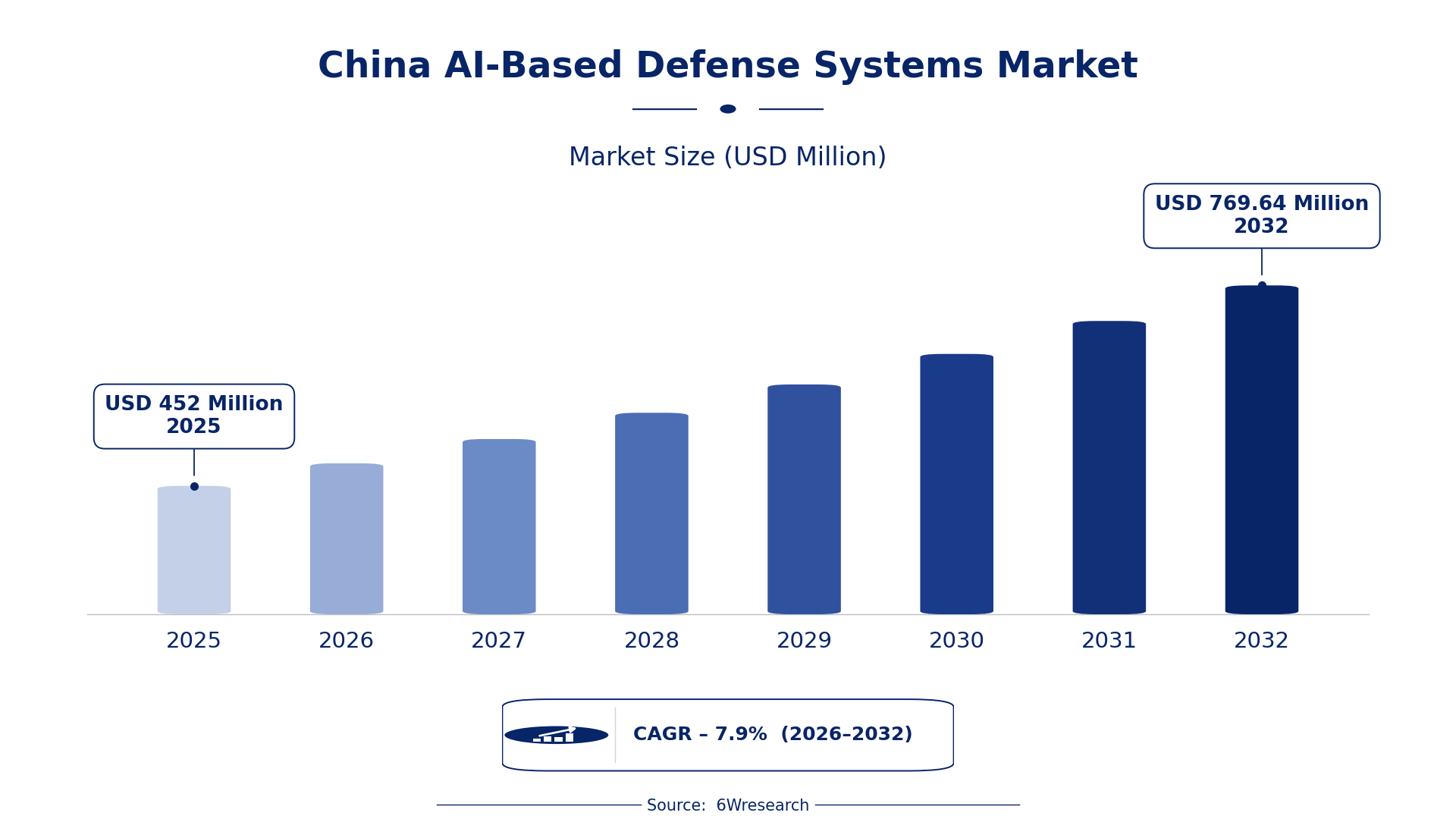
According to 6Wresearch internal database and industry insights, the China AI-Based Defense Systems Market was valued at USD 452.0 million in 2025 and is projected to reach USD 769.64 million by 2032, growing at a CAGR of approximately 7.9% during 2026–2032.
China AI-Based Defense Systems Market Highlights
| Report Metric | Details |
| Report Name | China AI-Based Defense Systems Market |
| Market Size 2025 | USD 452.0 million |
| Market Size 2032 | USD 769.64 million |
| Absolute Growth 2025–2032 | USD 317.64 million |
| CAGR 2026–2032 | 7.9% |
| Peak Annual Growth | 10.4% in 2029 |
| Forecast Period | 2026–2032 |
| Historical Data | 2022–2025 |
| Base Year | 2025 |
| Leading System Type, 2025 | Autonomous Drones (39% share) |
| Leading AI Use Case, 2025 | Target Tracking AI (42% share) |
| Leading Distribution Channel, 2025 | Defense Contractors (47% share) |
| Leading End User, 2025 | Military Surveillance Units (45% share) |
| Fastest-Growing System Type | Battlefield Robots (9.0% CAGR) |
| Fastest-Growing Distribution Channel | Military Tech Vendors (10.0% CAGR) |
| Fastest-Growing End User | Air Force Divisions (9.3% CAGR) |
| Growing Sector | Military Surveillance |
| Key End Users | Military Surveillance Units, Air Force Divisions, Defense IT Departments |
China AI-Based Defense Systems Market Year-wise Growth Rate and Key Drivers (2022–2032)
This graph illustrates the annual growth rates of the market from 2022 to 2032, highlighting a steady upward trajectory and projected market expansion over the forecast period.
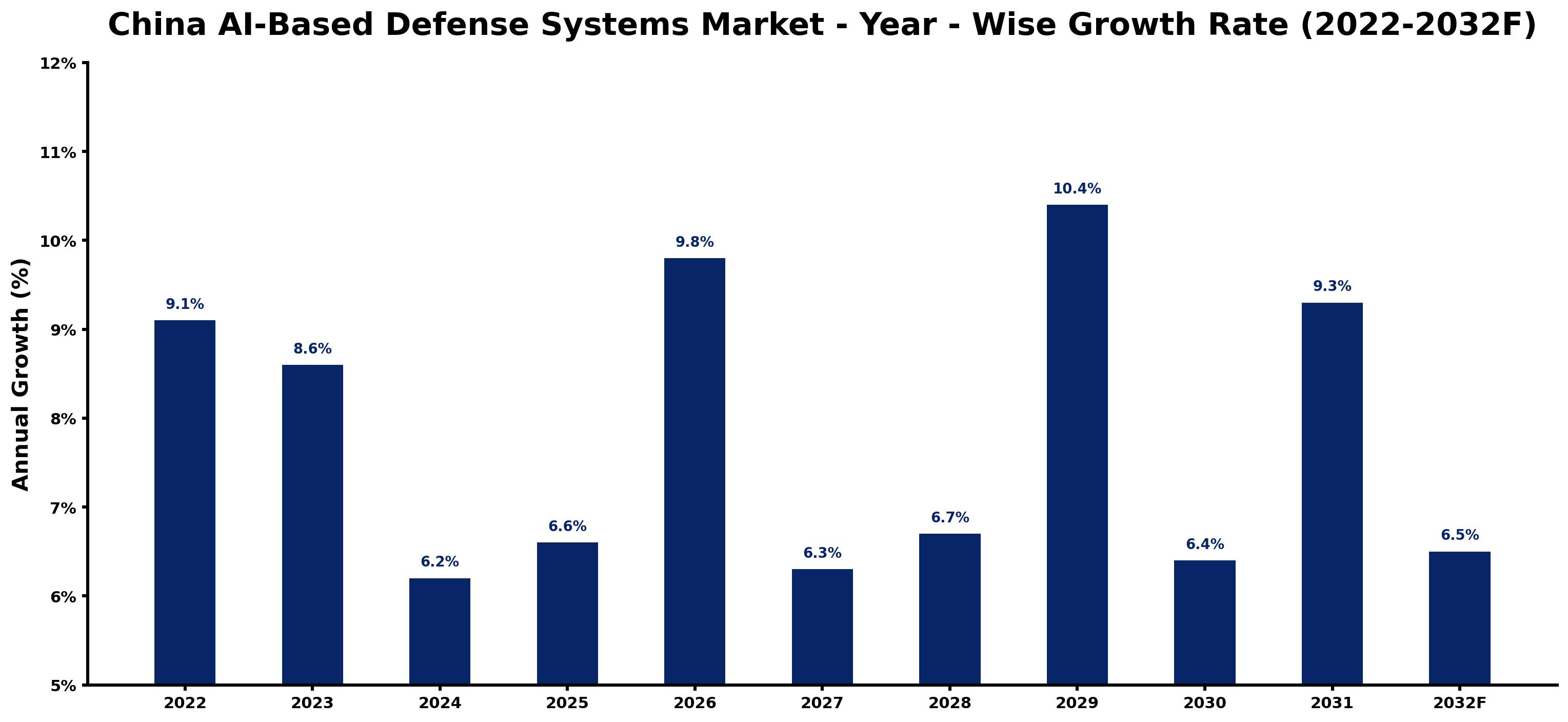
Year by year, the estimates below pair each growth rate with the development that shaped it.
| Year | Estimated Annual Growth (%) | Market Rationale |
| 2022 | 9.1 | The military budget focused on technological advancements, driving demand for AI systems. |
| 2023 | 8.6 | Investment in AI technologies slowed slightly, impacting growth compared to the previous year. |
| 2024 | 6.2 | Demand for advanced systems continued to grow, albeit at a slower rate than before. |
| 2025 | 6.6 | Military modernization efforts spurred an increase in AI-based defense system purchases. |
| 2026 | 9.8 | A renewed focus on AI integration in military projects boosted demand significantly. |
| 2027 | 6.3 | Growth moderated as the market adjusted to previous high investment levels. |
| 2028 | 6.7 | Increased military exercises incorporating AI technologies led to a rise in demand. |
| 2029 | 10.4 | The peak growth rate was driven by extensive military modernization initiatives. |
| 2030 | 6.4 | Growth slowed as procurement cycles adjusted to earlier investments in AI systems. |
| 2031 | 9.3 | Demand increased again as military units expanded their AI capabilities. |
| 2032 | 6.5 | Growth moderated, reflecting a balance between supply and demand in the market. |
Note: Market size estimations and growth projections presented in this report are based on 6Wresearch's proprietary forecasting methodology, utilizing the latest available industry data, government publications, and primary research inputs.
China AI-Based Defense Systems Market Synopsis
AI-Based Defense Systems in China encompass advanced technologies designed for military applications, including autonomous drones and cyber warfare tools. These systems improve battlefield capabilities and support military operations through surveillance and reconnaissance. The China AI-Based Defense Systems Market is expanding due to substantial investments in military modernisation and government initiatives prioritising AI integration. The military budget for 2023 is approximately 1.55 trillion yuan, which further fuels demand for advanced technologies. Furthermore, the integration of AI in 80% of new defense projects is generating fresh opportunities for suppliers and buyers alike.
Market Dynamics Impact Analysis (2026–2032)
| Factor | Type | Impact | Primary Segment Affected |
| Growing military budget prioritising technological advancements | Driver | High | Autonomous Drones |
| Increased integration of AI in military operations | Driver | High | Target Tracking AI |
| Rising demand for advanced surveillance capabilities | Opportunity | High | Military Surveillance Units |
| Expansion of military exercises incorporating AI technologies | Opportunity | High | Battlefield Robots |
| Complex approval processes for new technologies | Restraint | Medium | Cyber Warfare Tools |
| High costs associated with AI integration | Restraint | Medium | Missile Guidance |
| Limited supply chain for advanced AI components | Challenge | High | Defense Contractors |
| Regulatory hurdles slowing down procurement processes | Challenge | Medium | Government Suppliers |
Evaluation of Drivers in China AI-Based Defense Systems Market (2026–2032)
The table below links each growth driver to the segment it affects and the evidence for it.
| Drivers | Primary Segment Affected | Why It Matters (Evidence) |
| Increased military budget for technological advancements | Autonomous Drones | China's military budget for 2023 is approximately 1.55 trillion yuan, leading to higher investments in AI technologies. |
| High integration rate of AI in defense projects | Target Tracking AI | The PLA has integrated AI in 80% of its new defense projects, increasing demand for tracking systems. |
| Growing need for advanced surveillance systems | Military Surveillance Units | The total number of military surveillance units in China exceeds 300, driving demand for AI-based technologies. |
| Expansion of military exercises incorporating AI | Battlefield Robots | The military is expected to conduct over 100 AI-related drills in 2023, increasing the need for battlefield robots. |
| Support from government initiatives for AI integration | Cyber Warfare Tools | The National Defense Technology Innovation Plan encourages AI integration in military applications, boosting demand for cyber tools. |
Growth across the AI-Based Defense Systems market in China is anchored in increased military budget allocations, high integration rates of AI in defense projects, and growing needs for advanced surveillance systems. The military budget for 2023 is approximately 1.55 trillion yuan, which drives higher investments in AI technologies. The PLA has integrated AI in 80% of its new defense projects, boosting demand for tracking systems. Increased military exercises incorporating AI technologies will lead to a rise in demand for battlefield robots. The National Defense Technology Innovation Plan encourages further AI integration in military applications, driving demand for cyber warfare tools.
Evaluation of Restraints in China AI-Based Defense Systems Market
The following restraints limit how fast demand can grow.
| Market Restraint | Primary Segment Affected | Why It Matters (Evidence) |
| Complex approval processes for new technologies | Cyber Warfare Tools | Approval pathways for AI technologies can delay deployment, impacting military readiness and operational capabilities. |
| High costs associated with AI integration | Missile Guidance | Integration of advanced AI systems requires substantial investment, limiting procurement by smaller military units. |
| Limited supply chain for advanced AI components | Defense Contractors | Supply chain issues can lead to delays in acquiring necessary components for AI systems, affecting project timelines. |
| Regulatory hurdles slowing down procurement processes | Government Suppliers | Strict regulations can prolong the approval process for new AI technologies, hindering timely implementation. |
| Inadequate training for personnel on new systems | Battlefield Robots | Lack of trained personnel can limit the effective deployment of advanced robotic systems in military operations. |
China AI-Based Defense Systems Market Challenges
The China AI-Based Defense Systems market faces regulatory challenges that slow down project approvals, primarily due to the Cybersecurity Law of 2017. Compliance with this law can lead to project delays of up to 30% for producers, impacting their ability to meet demand. High development costs burden suppliers, with research and development expenses consuming around 15% of total project budgets, which can deter investment. A shortage of skilled AI and robotics professionals limits producers' capacity for innovation, resulting in longer product rollout times for buyers. Rapid technological advancements further complicate matters, as frequent updates can increase operational costs by 20% for military units deploying these systems.
Trends in the China AI-Based Defense Systems Market
Four trends stand out in the China AI-Based Defense Systems Market.
- Shift from Traditional to AI-Driven Defense: Since 2021, China's military has increasingly adopted AI technologies, with 80% of new defense projects incorporating AI. This shift improves operational efficiency and situational awareness across military units.
- Rise of Autonomous Drones in Military Operations: The use of autonomous drones for surveillance and reconnaissance has surged since 2022, with the AI-based autonomous drone market projected to reach significant adoption levels by 2025. This trend supports enhanced intelligence gathering.
- Integration of AI in Military Exercises: In 2023, the military is expected to conduct over 100 AI-related drills, reflecting a growing emphasis on AI technologies in operational readiness. This integration improves tactical decision-making capabilities.
- Focus on Cyber Warfare Capabilities: The Cybersecurity Law of 2017 has driven the adoption of AI in national defense, enhancing security against cyber threats. This focus is vital as cyber warfare becomes increasingly prominent.
Investment Opportunities in the China AI-Based Defense Systems Market
The following opportunities in the China AI-Based Defense Systems Market pair current demand with a clear way in.
- Gap in AI-based Surveillance Systems: With over 300 military surveillance units, there is a pressing need for advanced AI technologies. Investment in these systems can meet the demand for enhanced intelligence capabilities.
- Demand from Military Surveillance Units: Military Surveillance Units are actively seeking advanced AI solutions. Suppliers can enter this market by partnering with local defense contractors to provide tailored technologies.
- Expansion of AI Capabilities in Air Force Divisions: Air Force Divisions are increasing their investment in AI-based missile guidance systems. Suppliers can benefit by offering innovative solutions that meet the evolving requirements of aerial operations.
- Alignment with Government Initiatives: The National AI Development Plan emphasises military applications, creating opportunities for investment. Collaborating with local firms can facilitate entry into this expanding market.
Government Initiatives in the China AI-Based Defense Systems Market
The Cybersecurity Law of 2017 mandates the use of AI in national defense, requiring producers to integrate AI technologies into their systems. This law ensures that military applications are equipped with advanced capabilities to counter cyber threats, influencing procurement decisions.
In 2022, the National Development and Reform Commission initiated the 'Defense Technology Innovation Program' with a budget of 500 million yuan, focusing on AI integration. This programme supports research and development initiatives aimed at improving military capabilities through AI technologies.
Future Insight of the China AI-Based Defense Systems Market
Several forward-looking factors should drive growth in the China AI-Based Defense Systems market by 2032. The Ministry of National Defense's emphasis on AI in its 14th Five-Year Plan will promote investment in cutting-edge military technologies. By 2025, the AI-based autonomous drone segment is set to achieve significant adoption, enhancing operational capabilities for military forces. The National Defense Technology Innovation Plan will encourage collaboration between military and technology sectors, improving AI integration in defense applications. Increased military drills involving AI systems will further enhance readiness and operational effectiveness.
Market Segmentation Analysis
The report offers a comprehensive study of the following market segments and their leading categories in the market.
By System Type – Autonomous Drones Dominated, Battlefield Robots Expected to Grow Fastest
According to Shubham Padhi, Research Analyst at 6Wresearch, with a 39% revenue share in 2025, Autonomous Drones was the largest system type category. Autonomous drones hold the largest market share in China's AI-based defense systems due to their critical role in surveillance and reconnaissance missions across numerous military surveillance units. Their integration into 80% of new defense projects demonstrates their significance in enhancing military capabilities. Over 2026–2032, Battlefield Robots are expected to post the fastest growth, at a CAGR of 9.0%. The battlefield robots segment is witnessing rapid growth as they are increasingly deployed for logistics and support in combat scenarios, with military exercises across various provinces expected to drive their adoption. The ongoing advancements in autonomous drones will further complement the capabilities of battlefield robots, solidifying their importance. This suggests that suppliers should focus on enhancing autonomous drone capabilities while also investing in battlefield robot technologies to meet military demands.
By AI Use Case – Target Tracking AI Dominated and Is Expected to Record the Fastest Growth
In 2025, Target Tracking AI led the ai use case split with a 42% share. Target tracking AI commands the largest market share as it is vital for real-time tracking of enemy movements, which is essential for operational success in military engagements. Its prioritisation in the Ministry of National Defense's 14th Five-Year Plan highlights its critical role in defence strategies. Its lead should widen, with a projected CAGR of 10.3% during 2026–2032, the highest in this split. Target tracking AI is also the fastest-growing segment, with applications expanding across various military operations to improve situational awareness. The sustained emphasis on AI integration in defence projects will likely maintain this growth rate, further solidifying its market position. This indicates that suppliers should prioritise advancements in target tracking AI to align with military strategies and operational needs.
By Distribution Channel – Defense Contractors Dominated, Military Tech Vendors Expected to Grow Fastest
Defense Contractors took a 47% share of distribution channel in 2025, more than any other category. Defense contractors capture the largest market share as they are the primary suppliers of AI-based defense technologies, directly engaging with military units for procurement. Their established relationships and expertise in delivering complex systems make them essential in the supply chain. Military Tech Vendors are set to record the highest CAGR in this split, 10.0% over 2026–2032. Military tech vendors are the fastest-growing channel, providing essential components and services that enhance the functionality of defense systems. As the demand for advanced technologies rises, this segment is expected to expand rapidly, complementing the role of defense contractors. This highlights the need for suppliers to strengthen partnerships with both defense contractors and military tech vendors to capture a larger market share.
By End User – Military Surveillance Units Dominated, Air Force Divisions Expected to Grow Fastest
Military Surveillance Units held a 45% share of the China AI-Based Defense Systems Market by end user in 2025. Military surveillance units represent the largest share of the end user segment, actively utilising AI systems for intelligence gathering, which is crucial for national security. Their extensive deployment underscores their reliance on advanced technologies for operational effectiveness. Air Force Divisions are projected to grow fastest, at a CAGR of 9.3% during 2026–2032. Air force divisions are the fastest-growing end user group, increasingly integrating AI technologies into aerial operations to enhance mission capabilities. As military surveillance units continue to lead, the air force's growing focus on AI will further drive growth in this segment. This indicates that suppliers should tailor their offerings to meet the specific needs of military surveillance units while also addressing the emerging requirements of air force divisions.
Key Attractiveness of the Report
- 10 Years of Market Numbers
- Historical Data Starting from 2022 to 2025
- Base Year 2025
- Forecast Data until 2032
- Key Performance Indicators Impacting the Market
- Major Upcoming Developments and Projects
Key Highlights of the Report:
- China AI-Based Defense Systems Market Outlook
- Market Size of China AI-Based Defense Systems Market, 2025
- Forecast of China AI-Based Defense Systems Market, 2032
- Historical Data and Forecast of China AI-Based Defense Systems Revenues & Volume for the Period 2022 - 2032F
- China AI-Based Defense Systems Market Trend Evolution
- China AI-Based Defense Systems Market Drivers and Challenges
- China AI-Based Defense Systems Price Trends
- China AI-Based Defense Systems Porter's Five Forces
- China AI-Based Defense Systems Industry Life Cycle
- Historical Data and Forecast of China AI-Based Defense Systems Market Revenues & Volume By System Type for the Period 2022 - 2032F
- Historical Data and Forecast of China AI-Based Defense Systems Market Revenues & Volume By Autonomous Drones for the Period 2022 - 2032F
- Historical Data and Forecast of China AI-Based Defense Systems Market Revenues & Volume By Missile Guidance for the Period 2022 - 2032F
- Historical Data and Forecast of China AI-Based Defense Systems Market Revenues & Volume By Cyber Warfare Tools for the Period 2022 - 2032F
- Historical Data and Forecast of China AI-Based Defense Systems Market Revenues & Volume By Battlefield Robots for the Period 2022 - 2032F
- Historical Data and Forecast of China AI-Based Defense Systems Market Revenues & Volume By AI Use Case for the Period 2022 - 2032F
- Historical Data and Forecast of China AI-Based Defense Systems Market Revenues & Volume By Object Identification for the Period 2022 - 2032F
- Historical Data and Forecast of China AI-Based Defense Systems Market Revenues & Volume By Target Tracking AI for the Period 2022 - 2032F
- Historical Data and Forecast of China AI-Based Defense Systems Market Revenues & Volume By AI Threat Detection for the Period 2022 - 2032F
- Historical Data and Forecast of China AI-Based Defense Systems Market Revenues & Volume By Terrain Navigation for the Period 2022 - 2032F
- Historical Data and Forecast of China AI-Based Defense Systems Market Revenues & Volume By Distribution Channel for the Period 2022 - 2032F
- Historical Data and Forecast of China AI-Based Defense Systems Market Revenues & Volume By Defense Contractors for the Period 2022 - 2032F
- Historical Data and Forecast of China AI-Based Defense Systems Market Revenues & Volume By Government Suppliers for the Period 2022 - 2032F
- Historical Data and Forecast of China AI-Based Defense Systems Market Revenues & Volume By Military Tech Vendors for the Period 2022 - 2032F
- Historical Data and Forecast of China AI-Based Defense Systems Market Revenues & Volume By Robotics OEMs for the Period 2022 - 2032F
- Historical Data and Forecast of China AI-Based Defense Systems Market Revenues & Volume By End User for the Period 2022 - 2032F
- Historical Data and Forecast of China AI-Based Defense Systems Market Revenues & Volume By Military Surveillance Units for the Period 2022 - 2032F
- Historical Data and Forecast of China AI-Based Defense Systems Market Revenues & Volume By Air Force Divisions for the Period 2022 - 2032F
- Historical Data and Forecast of China AI-Based Defense Systems Market Revenues & Volume By Defense IT Departments for the Period 2022 - 2032F
- Historical Data and Forecast of China AI-Based Defense Systems Market Revenues & Volume By Tactical Units for the Period 2022 - 2032F
- China AI-Based Defense Systems Import Export Trade Statistics
- Market Opportunity Assessment By System Type
- Market Opportunity Assessment By AI Use Case
- Market Opportunity Assessment By Distribution Channel
- Market Opportunity Assessment By End User
- China AI-Based Defense Systems Top Companies Market Share
- China AI-Based Defense Systems Competitive Benchmarking By Technical and Operational Parameters
- China AI-Based Defense Systems Company Profiles
- China AI-Based Defense Systems Key Strategic Recommendations
Market Covered
The report offers an extensive study of the following market segments.
By System Type
- Autonomous Drones
- Missile Guidance
- Cyber Warfare Tools
- Battlefield Robots
By AI Use Case
- Object Identification
- Target Tracking AI
- AI Threat Detection
- Terrain Navigation
By Distribution Channel
- Defense Contractors
- Government Suppliers
- Military Tech Vendors
- Robotics OEMs
By End User
- Military Surveillance Units
- Air Force Divisions
- Defense IT Departments
- Tactical Units































