China AI-Based Imaging Market Size & Growth Rate
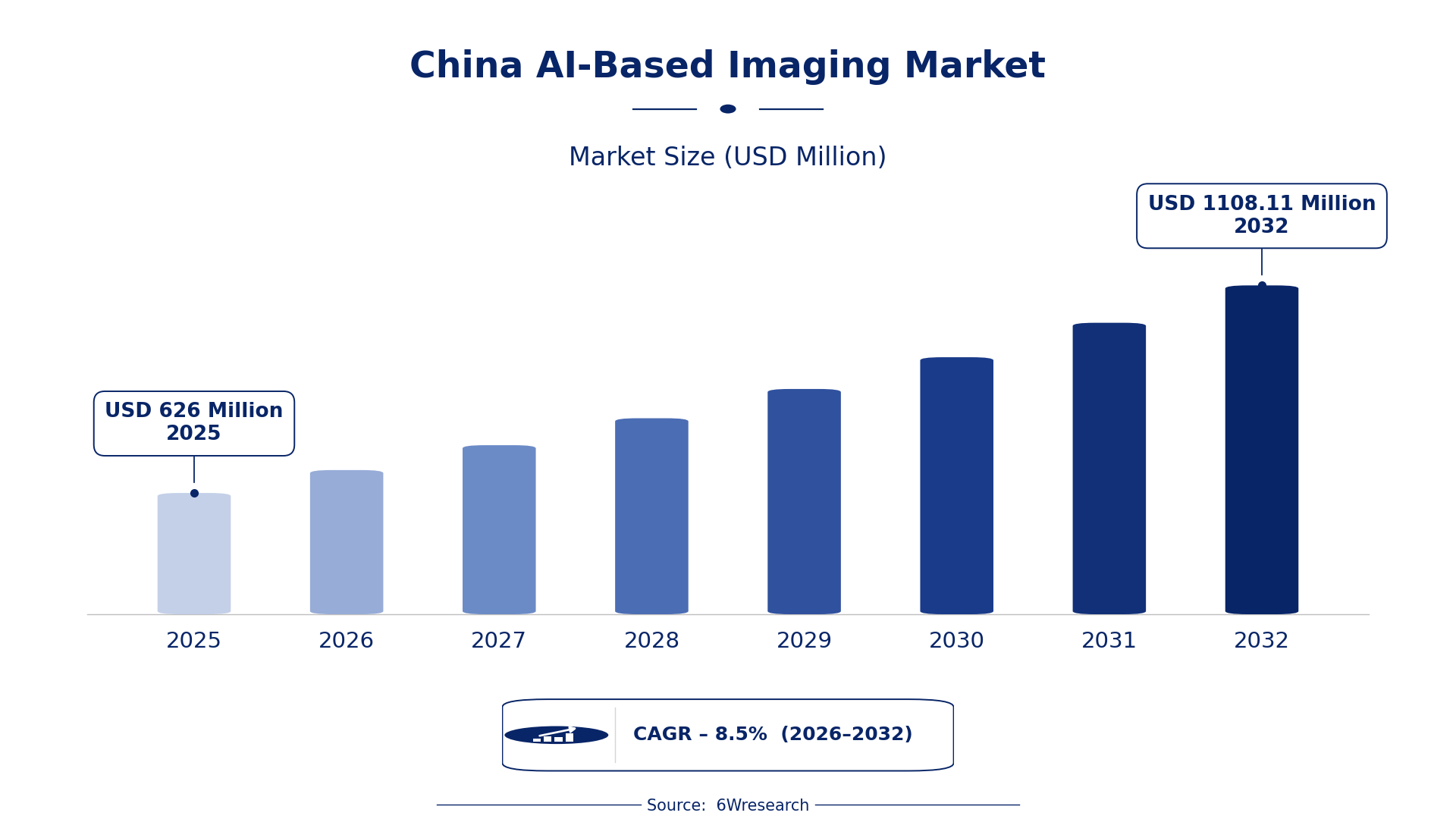
According to 6Wresearch internal database and industry insights, the China AI-Based Imaging Market was valued at USD 626.0 million in 2025 and is projected to reach USD 1,108.11 million by 2032, growing at a CAGR of approximately 8.5% during 2026–2032.
China AI-Based Imaging Market Highlights
| Report Metric | Details |
| Report Name | China AI-Based Imaging Market |
| Market Size 2025 | USD 626.0 million |
| Market Size 2032 | USD 1,108.11 million |
| Absolute Growth 2025–2032 | USD 482.11 million |
| CAGR 2026–2032 | 8.5% |
| Peak Annual Growth | 10.9% in 2031 |
| Forecast Period | 2026–2032 |
| Historical Data | 2022–2025 |
| Base Year | 2025 |
| Leading Imaging Type, 2025 | Medical Imaging (44% share) |
| Leading AI Feature, 2025 | Pattern Recognition (49% share) |
| Leading Distribution Channel, 2025 | Imaging Software Vendors (39% share) |
| Leading End User, 2025 | Radiology Centers (44% share) |
| Fastest-Growing Imaging Type | Retail Imaging (10.8% CAGR) |
| Fastest-Growing AI Feature | Defect Detection (10.0% CAGR) |
| Fastest-Growing Distribution Channel | Geospatial Tech Providers (9.9% CAGR) |
| Fastest-Growing End User | Manufacturing Plants (10.7% CAGR) |
| Growing Sector | Healthcare |
| Key End Users | Healthcare providers, defense agencies, manufacturing plants, urban planners |
China AI-Based Imaging Market Year-wise Growth Rate and Key Drivers (2022–2032)
This graph illustrates the annual growth rates of the market from 2022 to 2032, highlighting a steady upward trajectory and projected market expansion over the forecast period.
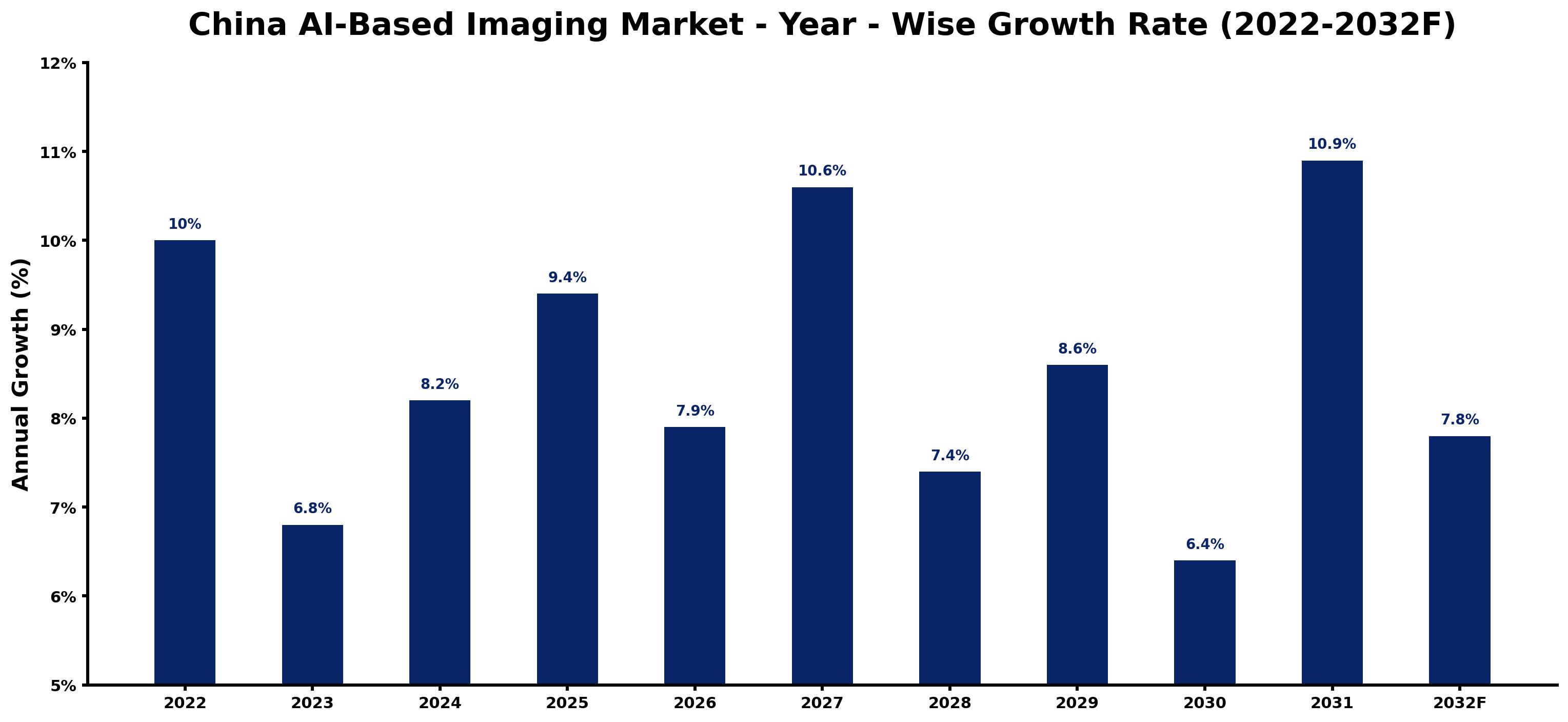
Annual growth estimates for each year appear below with the principal reason behind them, explaining the shifts that set the pace of the market.
| Year | Estimated Annual Growth (%) | Market Rationale |
| 2022 | 10.0 | The market experienced strong demand from healthcare facilities implementing AI technologies. |
| 2023 | 6.8 | Growth slowed due to adjustments in technology adoption rates across sectors. |
| 2024 | 8.2 | Increased investment in healthcare AI drove faster growth compared to the previous year. |
| 2025 | 9.4 | The expansion of radiology centers boosted demand for AI-based imaging solutions. |
| 2026 | 7.9 | Growth slowed as the market adjusted to new technology integration challenges. |
| 2027 | 10.6 | Rising demand from defense agencies for advanced imaging technology accelerated growth. |
| 2028 | 7.4 | The market faced a slowdown as competition intensified among imaging software vendors. |
| 2029 | 8.6 | Increased adoption of AI in manufacturing led to faster growth in imaging applications. |
| 2030 | 6.4 | Growth slowed as the market matured and demand stabilised across sectors. |
| 2031 | 10.9 | The peak growth rate was driven by significant investments in healthcare imaging technologies. |
| 2032 | 7.8 | Growth slowed as the market reached a more stable phase of development. |
Note: Market size estimations and growth projections presented in this report are based on 6Wresearch's proprietary forecasting methodology, utilizing the latest available industry data, government publications, and primary research inputs.
China AI-Based Imaging Market Synopsis
AI-Based Imaging in China involves the integration of artificial intelligence technologies into imaging processes, improving accuracy and efficiency. This technology finds applications in medical diagnostics, satellite surveillance, and industrial quality control. The China AI-Based Imaging Market is growing, driven by a vast user base in healthcare, serving over 1 billion patients annually. The National Health Commission's standards for AI in medical imaging and the Ministry of Industry and Information Technology's backing for AI integration in manufacturing are pivotal to this growth. Consequently, the demand for effective imaging solutions is on the rise across multiple sectors.
Market Dynamics Impact Analysis (2026–2032)
| Factor | Type | Impact | Primary Segment Affected |
| Growing investment in healthcare AI technologies | Driver | High | Medical Imaging |
| Increasing adoption of AI in manufacturing processes | Driver | High | Industrial Imaging |
| Rising demand for AI imaging solutions in urban planning | Opportunity | Medium | Satellite Imaging |
| Investment in AI technologies for defense applications | Opportunity | High | Medical Imaging |
| Challenges in standardising AI imaging technologies | Restraint | High | Medical Imaging |
| High costs associated with AI technology integration | Restraint | Medium | Medical Imaging |
| AI-Based Imaging in China faces regulatory hurdles | Challenge | High | Medical Imaging |
| Limited access to advanced AI technologies in rural areas | Challenge | Medium | Medical Imaging |
Evaluation of Drivers in China AI-Based Imaging Market (2026–2032)
The table below links each growth driver to the segment it affects and the evidence for it.
| Drivers | Primary Segment Affected | Why It Matters (Evidence) |
| Increased investment in defense imaging technologies | Medical Imaging | The Chinese government allocated 300 million RMB for AI projects in defense imaging, boosting sector growth. |
| Rising demand for AI in healthcare diagnostics | Medical Imaging | The National Health Commission's standards for AI in medical imaging enhance diagnostic accuracy for over 1 billion patients annually. |
| Growing applications in environmental monitoring | Satellite Imaging | The Ministry of Science and Technology's AI for Smart Cities program supports advancements in urban imaging capabilities. |
| Expansion of AI in manufacturing processes | Industrial Imaging | The Ministry of Industry and Information Technology's AI Innovation Action Plan promotes AI integration, driving demand for industrial imaging solutions. |
| Increased adoption of AI in retail analytics | Retail Imaging | The emergence of over 1,000 smart stores utilizing AI imaging for customer insights reflects a growing trend. |
Growth across the AI-Based Imaging market in China is anchored in increased funding for healthcare technologies, rising demand for efficient manufacturing processes, and expanding applications in environmental monitoring. The National Health Commission's allocation of resources supports over 1 billion patients annually, enhancing diagnostic accuracy in medical imaging. The establishment of over 5,000 radiology centers adopting AI technologies further fuels market growth. Investments in defense imaging technologies, supported by a 300 million RMB allocation, contribute significantly to the sector's expansion.
Evaluation of Restraints in China AI-Based Imaging Market
The key brakes on demand, and where they bite hardest, are shown below.
| Market Restraint | Primary Segment Affected | Why It Matters (Evidence) |
| Competition among imaging software vendors | Imaging Software Vendors | Intense competition can drive down prices, affecting profitability for providers and limiting innovation. |
| Regulatory hurdles delaying product approvals | Medical Imaging | The National Health Commission's standards take over a year to implement, limiting healthcare providers' access to new technologies. |
| Skills shortages in AI and imaging technologies | Medical Imaging | Training programs have not kept pace with market evolution, resulting in a potential 20% decrease in productivity. |
| Outdated infrastructure in many facilities | Industrial Imaging | This leads to a 15% increase in operational costs for clinics adopting AI solutions. |
| Inflated prices for AI-based imaging services | Retail Imaging | These can be 25% higher than traditional methods due to limited competition among suppliers. |
China AI-Based Imaging Market Challenges
The China AI-Based Imaging market encounters regulatory challenges that slow down the approval process for new technologies, with the National Health Commission's standards often taking over a year to implement, restricting healthcare providers' access to advanced solutions. Suppliers face a skills gap in AI and imaging technologies, as training programs have not evolved alongside market demands, potentially causing a 20% drop in productivity. Many facilities struggle with outdated infrastructure, leading to a 15% rise in operational costs for clinics trying to adopt AI solutions. Buyers experience inflated costs for AI-based imaging services, which can be 25% higher than traditional methods due to limited competition among suppliers.
Trends in the China AI-Based Imaging Market
The trends below show where the China AI-Based Imaging Market is heading.
- Shift from Traditional Imaging to AI-Based Solutions: Since 2021, the National Health Commission has encouraged the adoption of AI in medical imaging, resulting in a 30% increase in applications. This shift allows healthcare providers to improve diagnostic accuracy and efficiency.
- Emergence of AI in Smart City Initiatives: The AI for Smart Cities program, initiated in 2021, has improved urban imaging capabilities. As of 2023, over 1,000 smart stores are utilising AI imaging for customer insights, reflecting a growing trend in retail analytics.
- Increased Focus on Industrial Quality Control: The integration of AI in manufacturing processes has gained traction since 2023, with a reported 30% increase in AI imaging applications. This trend supports quality assurance efforts in various manufacturing plants across China.
- Expansion of AI Imaging in Defense Applications: The National Defense Authorization Act of 2021 has prioritised AI technologies in defense imaging. The Chinese government allocated 300 million RMB in 2023 to support advancements in this sector, indicating strong growth potential.
Investment Opportunities in the China AI-Based Imaging Market
The following opportunities in the China AI-Based Imaging Market pair current demand with a clear way in.
- Timing for Investment in Healthcare AI: With over 1 billion patients annually, there is an excellent opportunity to invest in AI-based imaging solutions for healthcare facilities. The National Health Commission's standards for AI in medical imaging create a conducive environment for new entrants.
- Growth in Urban Imaging Solutions: The AI for Smart Cities programme offers a timely opportunity to provide AI imaging technologies for urban planning. Major cities in China are actively seeking advanced solutions to improve their imaging capabilities.
- Supply of AI Technologies for Manufacturing Plants: The increasing demand for AI integration in manufacturing processes highlights a gap in the market. Investing in AI imaging solutions for manufacturing plants can yield substantial returns as the sector expands.
- Expansion of AI in Defense Imaging: The allocation of 200 million RMB for AI projects in defence imaging presents a prime opportunity for suppliers. Engaging with defence agencies can facilitate entry into this growing market.
Government Initiatives in the China AI-Based Imaging Market
The National AI Development Plan, issued by the State Council in 2021, aims to improve AI applications in healthcare, including imaging technologies, by 2025. This plan builds on previous regulations by establishing a framework for integrating AI into medical diagnostics, ensuring better patient outcomes. Additionally, the AI Innovation Action Plan launched by the Ministry of Industry and Information Technology in 2022 focuses on incorporating AI in industrial imaging processes, promoting efficiency and productivity in manufacturing. These measures aim to standardise AI applications and improve the overall quality of imaging technologies in China.
The Ministry of Industry and Information Technology plays a crucial role in approving and funding AI projects, particularly in industrial imaging. In 2023, it announced funding of 300 million RMB for AI projects in defence imaging technologies, supporting advancements in surveillance and reconnaissance. Furthermore, the National Health Commission's 'AI in Healthcare Initiative' promotes AI-based imaging for improved patient outcomes, ensuring that healthcare providers can access the latest technologies. These initiatives reflect the government's commitment to promoting innovation in AI-based imaging across various sectors.
Future Insight of the China AI-Based Imaging Market
By 2032, buyers and suppliers in the China AI-Based Imaging market will benefit from the AI for Smart Cities programme, which will enhance urban imaging capabilities. The government's allocation of 200 million RMB for defence applications will drive innovation and create new opportunities for suppliers. The updated AI Imaging Technology Standard will ensure uniformity and safety, benefiting healthcare providers and patients alike. With a projected increase in applications across various sectors, the demand for efficient imaging solutions will lead to a robust market for AI-based imaging technologies.
Market Segmentation Analysis
Each segment group is reviewed below, with the leader by share and the fastest grower by CAGR.
By Imaging Type – Medical Imaging Dominated, Retail Imaging Expected to Grow Fastest
According to Shubham Padhi, Research Analyst at 6Wresearch, Medical Imaging held a 44% share of the China AI-Based Imaging Market by imaging type in 2025. Medical Imaging holds the largest share in China's AI-based imaging market due to its critical role in diagnostics and treatment planning. With over 1 billion patients annually, healthcare facilities heavily rely on accurate imaging solutions to address patient needs effectively. Over 2026–2032, Retail Imaging is expected to post the fastest growth, at a CAGR of 10.8%. Retail Imaging is experiencing rapid growth, particularly with its application in over 1,000 smart stores across major cities. This trend signifies a shift towards leveraging AI for customer insights, indicating a bright future for this segment. Suppliers should customise their offerings to cater to the unique needs of both medical and retail sectors to capture increasing market share.
By AI Feature – Pattern Recognition Dominated, Defect Detection Expected to Grow Fastest
Pattern Recognition accounted for a 49% market share by ai feature in 2025. Pattern Recognition leads the AI feature segment in imaging as it is fundamental for data analysis across various applications. Its widespread use in medical diagnostics highlights its crucial importance in enhancing imaging accuracy. The quickest growth will come from Defect Detection, forecast to expand at a CAGR of 10.0% between 2026 and 2032. Defect Detection is the fastest-growing feature, vital for identifying flaws in manufacturing processes. As industries increasingly adopt advanced technologies, the demand for effective defect detection solutions will continue to rise. Buyers must prioritise AI features that improve accuracy and efficiency to maintain a competitive edge in their respective markets.
By Distribution Channel – Imaging Software Vendors Dominated, Geospatial Tech Providers Expected to Grow Fastest
Imaging Software Vendors took a 39% share of distribution channel in 2025, more than any other category. Imaging Software Vendors dominate the distribution channel, serving as key providers of essential imaging solutions across diverse sectors. Their established relationships with healthcare and industrial clients bolster their leading market position. Geospatial Tech Providers are set to record the highest CAGR in this split, 9.9% over 2026–2032. Geospatial Tech Providers are witnessing the fastest growth due to rising demand for AI in satellite imaging applications. This segment's expansion is further encouraged by government initiatives promoting AI integration across various sectors. Suppliers should enhance collaborations with geospatial tech providers to capitalise on the growing demand for advanced imaging solutions.
By End User – Radiology Centers Dominated, Manufacturing Plants Expected to Grow Fastest
In 2025, Radiology Centers led the end user split with a 44% share. Radiology Centers are the largest end users of AI-based imaging technologies, serving as primary users in medical diagnostics and treatment planning. The extensive network of over 5,000 radiology centers in China highlights their substantial market share. Manufacturing Plants are projected to grow fastest, at a CAGR of 10.7% during 2026–2032. Manufacturing Plants represent the fastest-growing end user, increasingly adopting AI imaging for quality control processes. This trend reflects a broader industrial shift towards automation and precision, suggesting strong future growth in this area. Buyers in manufacturing should invest in AI imaging technologies to improve quality assurance and operational efficiency.
Key Attractiveness of the Report
- 10 Years of Market Numbers
- Historical Data Starting from 2022 to 2025
- Base Year 2025
- Forecast Data until 2032
- Key Performance Indicators Impacting the Market
- Major Upcoming Developments and Projects
Key Highlights of the Report:
- China AI-Based Imaging Market Outlook
- Market Size of China AI-Based Imaging Market, 2025
- Forecast of China AI-Based Imaging Market, 2032
- Historical Data and Forecast of China AI-Based Imaging Revenues & Volume for the Period 2022 - 2032F
- China AI-Based Imaging Market Trend Evolution
- China AI-Based Imaging Market Drivers and Challenges
- China AI-Based Imaging Price Trends
- China AI-Based Imaging Porter's Five Forces
- China AI-Based Imaging Industry Life Cycle
- Historical Data and Forecast of China AI-Based Imaging Market Revenues & Volume By Imaging Type for the Period 2022 - 2032F
- Historical Data and Forecast of China AI-Based Imaging Market Revenues & Volume By Medical Imaging for the Period 2022 - 2032F
- Historical Data and Forecast of China AI-Based Imaging Market Revenues & Volume By Satellite Imaging for the Period 2022 - 2032F
- Historical Data and Forecast of China AI-Based Imaging Market Revenues & Volume By Industrial Imaging for the Period 2022 - 2032F
- Historical Data and Forecast of China AI-Based Imaging Market Revenues & Volume By Retail Imaging for the Period 2022 - 2032F
- Historical Data and Forecast of China AI-Based Imaging Market Revenues & Volume By AI Feature for the Period 2022 - 2032F
- Historical Data and Forecast of China AI-Based Imaging Market Revenues & Volume By Pattern Recognition for the Period 2022 - 2032F
- Historical Data and Forecast of China AI-Based Imaging Market Revenues & Volume By Resolution Enhancement for the Period 2022 - 2032F
- Historical Data and Forecast of China AI-Based Imaging Market Revenues & Volume By Defect Detection for the Period 2022 - 2032F
- Historical Data and Forecast of China AI-Based Imaging Market Revenues & Volume By Facial Recognition for the Period 2022 - 2032F
- Historical Data and Forecast of China AI-Based Imaging Market Revenues & Volume By Distribution Channel for the Period 2022 - 2032F
- Historical Data and Forecast of China AI-Based Imaging Market Revenues & Volume By Imaging Software Vendors for the Period 2022 - 2032F
- Historical Data and Forecast of China AI-Based Imaging Market Revenues & Volume By Geospatial Tech Providers for the Period 2022 - 2032F
- Historical Data and Forecast of China AI-Based Imaging Market Revenues & Volume By Vision System Suppliers for the Period 2022 - 2032F
- Historical Data and Forecast of China AI-Based Imaging Market Revenues & Volume By AI SaaS Platforms for the Period 2022 - 2032F
- Historical Data and Forecast of China AI-Based Imaging Market Revenues & Volume By End User for the Period 2022 - 2032F
- Historical Data and Forecast of China AI-Based Imaging Market Revenues & Volume By Radiology Centers for the Period 2022 - 2032F
- Historical Data and Forecast of China AI-Based Imaging Market Revenues & Volume By Defense & Aerospace Agencies for the Period 2022 - 2032F
- Historical Data and Forecast of China AI-Based Imaging Market Revenues & Volume By Manufacturing Plants for the Period 2022 - 2032F
- Historical Data and Forecast of China AI-Based Imaging Market Revenues & Volume By Smart Stores for the Period 2022 - 2032F
- China AI-Based Imaging Import Export Trade Statistics
- Market Opportunity Assessment By Imaging Type
- Market Opportunity Assessment By AI Feature
- Market Opportunity Assessment By Distribution Channel
- Market Opportunity Assessment By End User
- China AI-Based Imaging Top Companies Market Share
- China AI-Based Imaging Competitive Benchmarking By Technical and Operational Parameters
- China AI-Based Imaging Company Profiles
- China AI-Based Imaging Key Strategic Recommendations
Market Covered
The report offers an extensive study of the following market segments.
By Imaging Type
- Medical Imaging
- Satellite Imaging
- Industrial Imaging
- Retail Imaging
By AI Feature
- Pattern Recognition
- Resolution Enhancement
- Defect Detection
- Facial Recognition
By Distribution Channel
- Imaging Software Vendors
- Geospatial Tech Providers
- Vision System Suppliers
- AI SaaS Platforms
By End User
- Radiology Centers
- Defense & Aerospace Agencies
- Manufacturing Plants
- Smart Stores































