China AI-based Intrusion Detection Market Size & Growth Rate
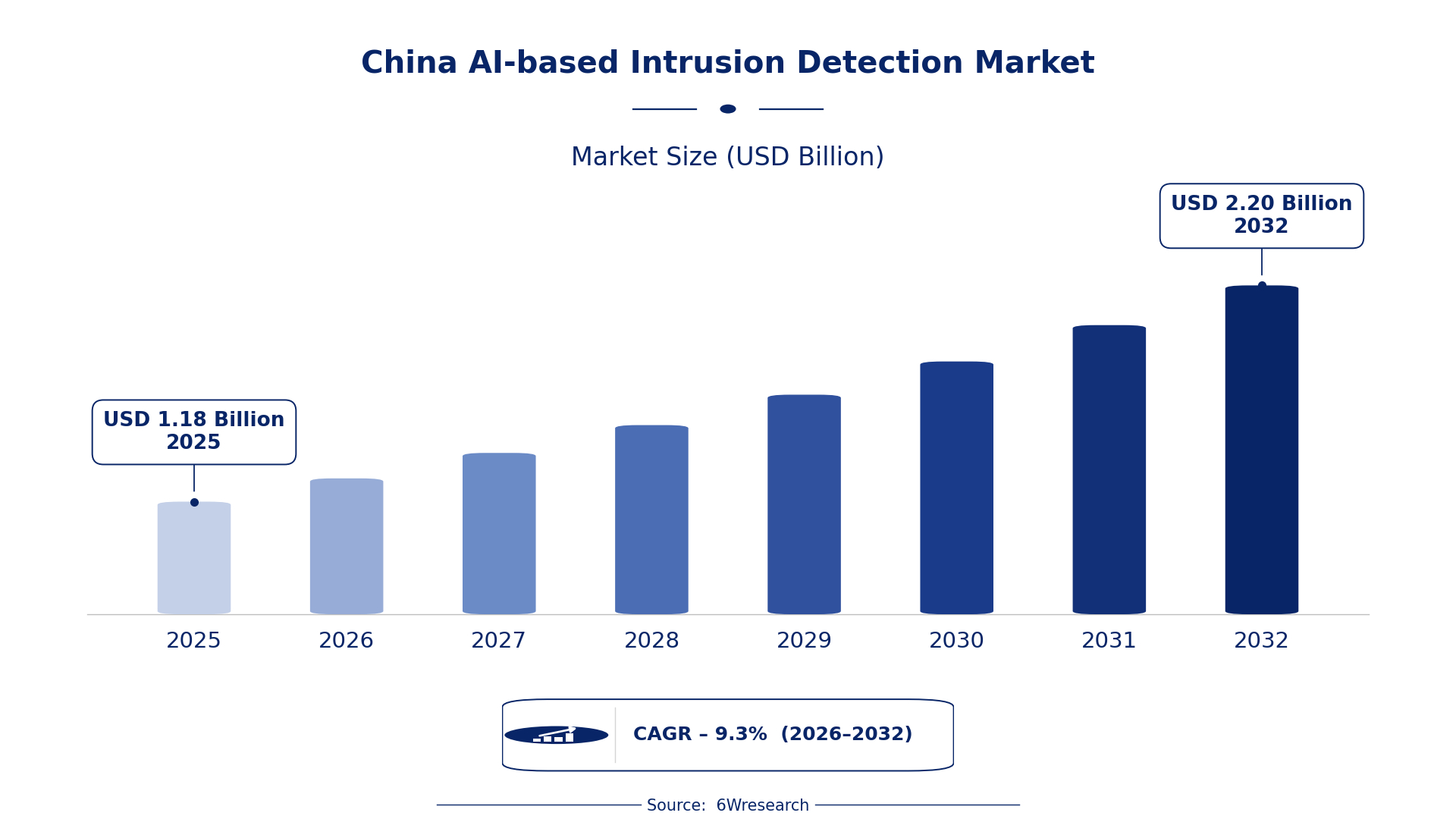
According to 6Wresearch internal database and industry insights, the China AI-based Intrusion Detection Market was valued at USD 1.18 billion in 2025 and is projected to reach USD 2.20 billion by 2032, growing at a CAGR of approximately 9.3% during 2026–2032.
China AI-based Intrusion Detection Market Highlights
| Report Metric | Details |
| Report Name | China AI-based Intrusion Detection Market |
| Market Size 2025 | USD 1.18 billion |
| Market Size 2032 | USD 2.20 billion |
| Absolute Growth 2025–2032 | USD 1.02 billion |
| CAGR 2026–2032 | 9.3% |
| Peak Annual Growth | 10.7% in 2026 |
| Forecast Period | 2026–2032 |
| Historical Data | 2022–2025 |
| Base Year | 2025 |
| Leading Threat Type, 2025 | Network Intrusion (39% share) |
| Leading Detection Technique, 2025 | Behavior Analysis (47% share) |
| Leading Distribution Channel, 2025 | Cybersecurity Platforms (41% share) |
| Leading End User, 2025 | IT Security Teams (42% share) |
| Fastest-Growing Threat Type | Physical Intrusion (11.5% CAGR) |
| Fastest-Growing Detection Technique | Facial/Activity Recognition (11.0% CAGR) |
| Fastest-Growing Distribution Channel | Security Solution Providers (12.0% CAGR) |
| Fastest-Growing End User | Airports & Government Facilities (10.7% CAGR) |
| Growing Sector | Airports & Government Facilities |
| Key End Users | IT Security Teams, Airports & Government Facilities, Smart Building Managers, Enterprise Tech Teams |
China AI-based Intrusion Detection Market Year-wise Growth Rate and Key Drivers (2022–2032)
This graph illustrates the annual growth rates of the market from 2022 to 2032, highlighting a steady upward trajectory and projected market expansion over the forecast period.
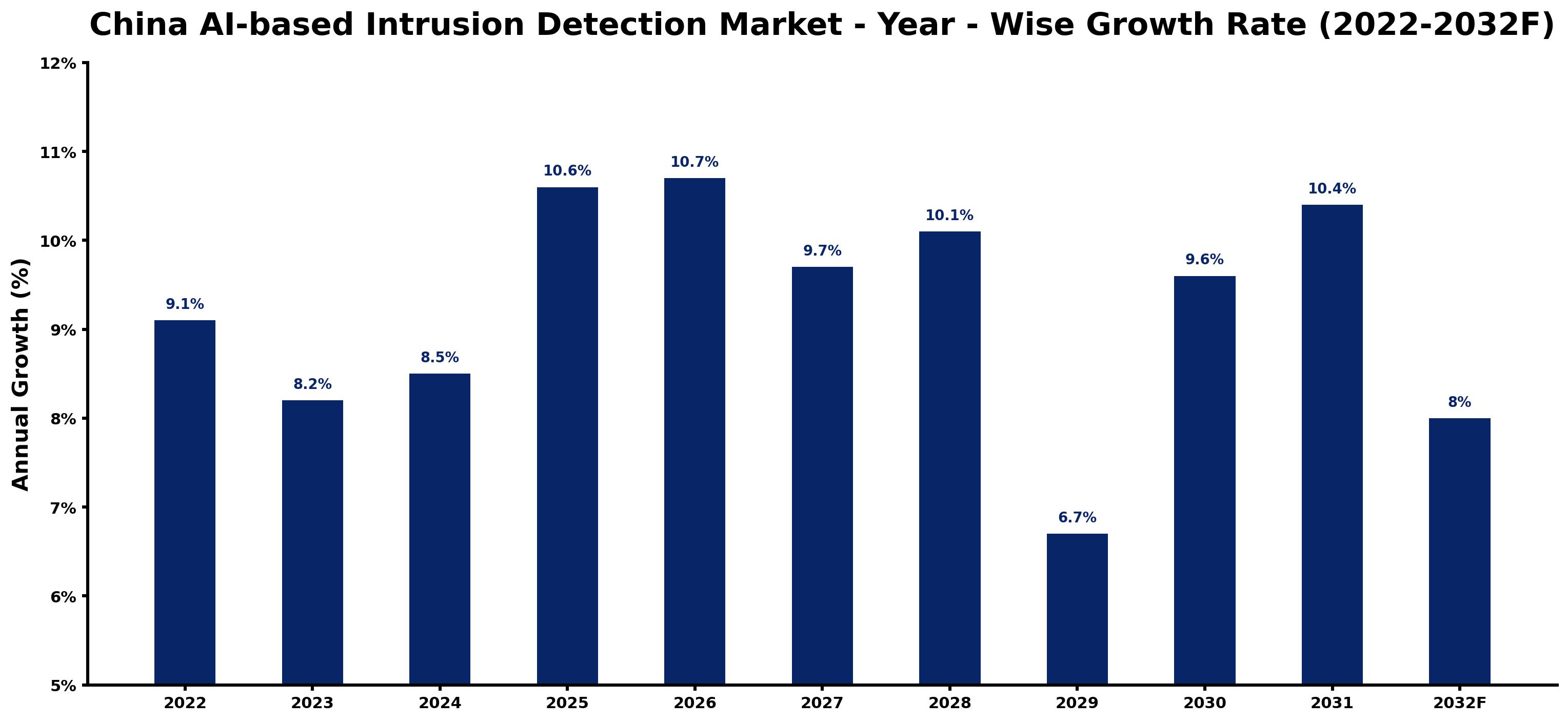
Each row of the following table gives one year's estimated growth and the event or demand shift that explains it.
| Year | Estimated Annual Growth (%) | Market Rationale |
| 2022 | 9.1 | The market experienced strong demand from domestic users and government initiatives. |
| 2023 | 8.2 | Growth slowed as scrutiny on cybersecurity measures increased, impacting enterprise investments. |
| 2024 | 8.5 | Demand increased as more enterprises adopted AI-based security solutions for better protection. |
| 2025 | 10.6 | The market grew as the National Cybersecurity Strategy was updated, boosting investments. |
| 2026 | 10.7 | The peak growth year is driven by heightened awareness of network intrusions and data breaches, prompting investments. |
| 2027 | 9.7 | Growth slowed as companies faced challenges in implementing advanced AI technologies and skilled workforce shortages. |
| 2028 | 10.1 | Demand surged again with the integration of AI-based systems into smart city projects, enhancing urban security. |
| 2029 | 6.7 | A slowdown occurred as the market adjusted to new regulatory requirements, affecting compliance efforts. |
| 2030 | 9.6 | Growth accelerated as IT security teams expanded their budgets for advanced solutions, responding to rising threats. |
| 2031 | 10.4 | Demand increased due to ongoing investments in cybersecurity infrastructure and talent development initiatives. |
| 2032 | 8.0 | Growth slowed as the market reached maturity, focusing on efficiency and compliance with established standards. |
Note: Market size estimations and growth projections presented in this report are based on 6Wresearch's proprietary forecasting methodology, utilizing the latest available industry data, government publications, and primary research inputs.
China AI-based Intrusion Detection Market Synopsis
AI-based Intrusion Detection in China encompasses systems that identify security threats in real-time. These systems protect networks, physical premises, IoT devices, and cloud infrastructures. The China AI-based Intrusion Detection Market is expanding, driven by over 70% of enterprises adopting AI-based solutions as of 2023. Factors such as the updated National Cybersecurity Strategy and increased investment in cybersecurity infrastructure are propelling this growth. The integration of AI into smart city projects further boosts demand for these systems.
Market Dynamics Impact Analysis (2026–2032)
| Factor | Type | Impact | Primary Segment Affected |
| Growing adoption of AI technologies among enterprises | Driver | High | Network Intrusion |
| Increased focus on securing IoT devices against cyber threats | Driver | High | IoT Intrusion |
| Investment in cybersecurity infrastructure by government initiatives | Opportunity | High | Cloud Infrastructure |
| Emerging demand for advanced security solutions in smart city projects | Opportunity | High | Physical Intrusion |
| Skills shortages in the cybersecurity workforce | Restraint | High | Network Intrusion |
| High costs associated with implementing AI-based systems | Restraint | Medium | Network Intrusion |
| Regulatory compliance challenges for companies | Challenge | High | Network Intrusion |
| Rapid technological advancements leading to obsolescence | Challenge | Medium | IoT Intrusion |
Evaluation of Drivers in China AI-based Intrusion Detection Market (2026–2032)
Below mentioned are some major drivers and their influence on market dynamics.
| Drivers | Primary Segment Affected | Why It Matters (Evidence) |
| Increased cybersecurity investments by enterprises | Network Intrusion | Over 70% of Chinese enterprises have adopted AI-based security solutions as of 2023, driving demand for network protection. |
| Rising IoT device usage across sectors | IoT Intrusion | The surge in connected devices necessitates security measures to protect against cyber threats. |
| Government initiatives promoting AI in cybersecurity | Cloud Infrastructure | The program to promote AI in cybersecurity boosts investments in AI-based solutions for cloud security. |
| Growing concerns over data breaches | Physical Intrusion | In 2022, 60% of data breaches in China were attributed to network intrusions, increasing demand for physical security. |
| Integration of AI in smart city projects | Real-Time Monitoring | AI-based intrusion detection systems are increasingly integrated into smart city projects across China, improving security. |
Growth in the AI-based Intrusion Detection market in China comes from increased cybersecurity investments by enterprises, with over 70% adopting AI-based solutions as of 2023. Rising IoT device usage necessitates security measures, driving demand for IoT intrusion protection. Concerns over data breaches, with 60% attributed to network intrusions in 2022, further fuel demand for physical intrusion solutions. The integration of AI in smart city projects improves real-time monitoring capabilities, solidifying market growth.
Evaluation of Restraints in China AI-based Intrusion Detection Market
The key brakes on demand, and where they bite hardest, are shown below.
| Market Restraint | Primary Segment Affected | Why It Matters (Evidence) |
| Skills shortages in the cybersecurity workforce | Network Intrusion | The Cybersecurity Talent Cultivation Program aims to address skills shortages, yet gaps remain, affecting implementation timelines. |
| High costs associated with implementing AI-based systems | Network Intrusion | Investment in AI technologies can be substantial, limiting adoption among smaller enterprises. |
| Regulatory compliance challenges for companies | Network Intrusion | The Cybersecurity Law of 2017 mandates strict data protection measures, complicating compliance for many businesses. |
| Technological obsolescence due to rapid advancements | IoT Intrusion | The fast pace of technology evolution can render existing systems outdated, deterring investment in new solutions. |
| Limited integration capabilities with legacy systems | Cloud Infrastructure | Many organizations struggle to integrate AI-based solutions with existing infrastructure, hindering market growth. |
China AI-based Intrusion Detection Market Challenges
Producers in the China AI-based Intrusion Detection market face rising costs due to the need for continuous updates mandated by the Cybersecurity Law of 2017, which can increase operational expenses by up to 20% for smaller firms. Distributors encounter intense competition as over 70% of enterprises have adopted AI-based security solutions, leading to price wars that erode profit margins. Buyers struggle with skills shortages, as the Cybersecurity Talent Cultivation Program has not sufficiently addressed the demand for qualified professionals, resulting in project delays and increased costs. Technology gaps persist, with many firms unable to effectively integrate AI into their systems, causing inefficiencies that hinder responsiveness for buyers.
Trends in the China AI-based Intrusion Detection Market
Four trends stand out in the China AI-based Intrusion Detection Market.
- Shift towards Smart City Integration: The Beijing-Tianjin-Hebei region is increasingly integrating AI-based intrusion detection systems into smart city projects, improving urban security measures. In 2023, over 30% of new projects incorporated these technologies.
- Growing Adoption of AI Standards: As of 2023, 60% of enterprises reference ISO/IEC 27001 for information security management, reflecting a shift towards standardised practices in cybersecurity across China.
- Rise of Behaviour Analysis Techniques: Since 2022, Behaviour Analysis has become the leading detection technique, capturing 47% of the market share as organisations prioritise proactive threat detection.
- Increased Focus on Cloud Security Solutions: In 2023, 41% of AI-based intrusion detection systems were delivered through Cybersecurity Platforms, indicating a trend towards cloud-based security solutions.
Investment Opportunities in the China AI-based Intrusion Detection Market
Investors looking at the China AI-based Intrusion Detection Market should consider the following areas.
- Investment in Cybersecurity Infrastructure: With the government allocating $500 million for cybersecurity infrastructure in 2023, there is an opportunity for suppliers to improve security systems in critical sectors.
- Partnerships in Smart City Projects: The integration of AI-based systems into smart city projects presents opportunities for collaboration with local governments, particularly in urban areas like Beijing.
- Expansion of AI Training Programs: The Cybersecurity Talent Cultivation Program creates opportunities for educational institutions to develop training programs, addressing the skills gap in the industry.
- Development of Advanced Security Solutions: With over 70% of enterprises adopting AI solutions, there is a growing demand for innovative security technologies, particularly among IT Security Teams.
Government Initiatives in the China AI-based Intrusion Detection Market
The Cybersecurity Law of 2017 mandates strict data protection measures for companies operating in China. This law requires organisations to implement security protocols, impacting how they manage data and cybersecurity practices. Additionally, the National Cybersecurity Strategy updated in 2021 aims to improve security measures across sectors, further reinforcing the need for compliance and investment in cybersecurity solutions. The updated strategy has led to increased funding for advanced security technologies, benefiting AI-based Intrusion Detection systems.
The Ministry of Industry and Information Technology oversees the promotion of AI in cybersecurity, funding initiatives that improve technological capabilities. The MIIT's programmes support the development of AI-based solutions, helping organisations strengthen their security frameworks. In 2023, the government allocated $500 million for improving cybersecurity infrastructure, benefiting various sectors, particularly those with high-security needs. These measures enable producers to enhance their offerings and comply with evolving standards.
Future Insight of the China AI-based Intrusion Detection Market
The China AI-based Intrusion Detection market is set to undergo transformative changes by 2032, driven by government initiatives like the allocation of $500 million for enhancing cybersecurity infrastructure. The integration of AI into smart city projects will expand the application of these systems, drawing interest from urban planners and local governments. The updated National Cybersecurity Strategy will reinforce the regulatory framework, encouraging more enterprises to invest in advanced security solutions. Adoption of ISO/IEC 27001 standards will become more prevalent, ensuring robust security measures across various sectors.
Market Segmentation Analysis
The report offers a comprehensive study of the following market segments and their leading categories in the market.
By Threat Type – Network Intrusion Dominated, Physical Intrusion Expected to Grow Fastest
According to Shubham Padhi, Research Analyst at 6Wresearch, with a 39% revenue share in 2025, Network Intrusion was the largest threat type category. Network Intrusion commands the largest share because it is essential for protecting sensitive data and systems from unauthorized access, particularly in sectors such as finance and healthcare. With over 70% of enterprises in China adopting security solutions, the demand for network protection remains strong. Over 2026–2032, Physical Intrusion is expected to post the fastest growth, at a CAGR of 11.5%. Physical Intrusion is rapidly growing as security requirements increase in high-risk locations like airports and government facilities. The integration of advanced security systems into smart city initiatives further accelerates this segment's expansion. Suppliers should prioritise developing solutions for physical intrusion to address the increasing demand in secure environments.
By Detection Technique – Behavior Analysis Dominated, Facial/Activity Recognition Expected to Grow Fastest
Behavior Analysis accounted for a 47% market share by detection technique in 2025. Behavior Analysis commands the largest share as it is essential for identifying unusual patterns that signal potential security breaches, making it indispensable for effective threat management. Its application across various sectors, including finance and healthcare, underscores its importance in the AI-based intrusion detection market. The quickest growth will come from Facial/Activity Recognition, forecast to expand at a CAGR of 11.0% between 2026 and 2032. Facial/Activity Recognition is rapidly gaining traction, particularly in high-traffic environments such as airports where security needs are paramount. This technique's ability to provide real-time identification and response to threats is driving its swift adoption across the industry. Suppliers should focus on integrating advanced detection techniques like facial recognition to meet the growing demand for robust security solutions.
By Distribution Channel – Cybersecurity Platforms Dominated, Security Solution Providers Expected to Grow Fastest
The largest distribution channel category in 2025 was Cybersecurity Platforms, with a 41% share of total revenue. Cybersecurity Platforms lead the market as they are the primary means of delivering AI-based security solutions, ensuring comprehensive coverage of diverse security needs. Their established infrastructure and user familiarity facilitate widespread adoption among enterprises seeking reliable protection. Security Solution Providers are projected to grow fastest, at a CAGR of 12.0% during 2026–2032. Security Solution Providers are witnessing the fastest growth due to their pivotal role in customising and managing security systems tailored to specific client needs. The increasing complexity of cyber threats is propelling demand for their specialised expertise. Vendors must strengthen collaborations with security solution providers to enhance their market presence and improve service offerings.
By End User – IT Security Teams Dominated, Airports & Government Facilities Expected to Grow Fastest
IT Security Teams held a 42% share of the China AI-based Intrusion Detection Market by end user in 2025. IT Security Teams represent the largest share of end users, as they are primarily responsible for managing cybersecurity measures within organisations. Their expertise is vital for the effective deployment of intrusion detection systems. Airports & Government Facilities are set to record the highest CAGR in this split, 10.7% over 2026–2032. Airports & Government Facilities are the fastest-growing end users, driven by the necessity for advanced intrusion detection in high-security environments. The emphasis on improving security protocols in these areas accelerates demand for solutions. Suppliers must tailor their offerings to meet the specific security needs of high-stakes environments like airports and government facilities.
Key Attractiveness of the Report
- 10 Years of Market Numbers
- Historical Data Starting from 2022 to 2025
- Base Year 2025
- Forecast Data until 2032
- Key Performance Indicators Impacting the Market
- Major Upcoming Developments and Projects
Key Highlights of the Report:
- China AI-based Intrusion Detection Market Outlook
- Market Size of China AI-based Intrusion Detection Market, 2025
- Forecast of China AI-based Intrusion Detection Market, 2032
- Historical Data and Forecast of China AI-based Intrusion Detection Revenues & Volume for the Period 2022 - 2032F
- China AI-based Intrusion Detection Market Trend Evolution
- China AI-based Intrusion Detection Market Drivers and Challenges
- China AI-based Intrusion Detection Price Trends
- China AI-based Intrusion Detection Porter's Five Forces
- China AI-based Intrusion Detection Industry Life Cycle
- Historical Data and Forecast of China AI-based Intrusion Detection Market Revenues & Volume By Threat Type for the Period 2022 - 2032F
- Historical Data and Forecast of China AI-based Intrusion Detection Market Revenues & Volume By Network Intrusion for the Period 2022 - 2032F
- Historical Data and Forecast of China AI-based Intrusion Detection Market Revenues & Volume By Physical Intrusion for the Period 2022 - 2032F
- Historical Data and Forecast of China AI-based Intrusion Detection Market Revenues & Volume By IoT Intrusion for the Period 2022 - 2032F
- Historical Data and Forecast of China AI-based Intrusion Detection Market Revenues & Volume By Cloud Infrastructure for the Period 2022 - 2032F
- Historical Data and Forecast of China AI-based Intrusion Detection Market Revenues & Volume By Detection Technique for the Period 2022 - 2032F
- Historical Data and Forecast of China AI-based Intrusion Detection Market Revenues & Volume By Behavior Analysis for the Period 2022 - 2032F
- Historical Data and Forecast of China AI-based Intrusion Detection Market Revenues & Volume By Facial/Activity Recognition for the Period 2022 - 2032F
- Historical Data and Forecast of China AI-based Intrusion Detection Market Revenues & Volume By Device Behavior Mapping for the Period 2022 - 2032F
- Historical Data and Forecast of China AI-based Intrusion Detection Market Revenues & Volume By Real-Time Monitoring for the Period 2022 - 2032F
- Historical Data and Forecast of China AI-based Intrusion Detection Market Revenues & Volume By Distribution Channel for the Period 2022 - 2032F
- Historical Data and Forecast of China AI-based Intrusion Detection Market Revenues & Volume By Cybersecurity Platforms for the Period 2022 - 2032F
- Historical Data and Forecast of China AI-based Intrusion Detection Market Revenues & Volume By Security Solution Providers for the Period 2022 - 2032F
- Historical Data and Forecast of China AI-based Intrusion Detection Market Revenues & Volume By IoT Security Vendors for the Period 2022 - 2032F
- Historical Data and Forecast of China AI-based Intrusion Detection Market Revenues & Volume By Cloud Security Suites for the Period 2022 - 2032F
- Historical Data and Forecast of China AI-based Intrusion Detection Market Revenues & Volume By End User for the Period 2022 - 2032F
- Historical Data and Forecast of China AI-based Intrusion Detection Market Revenues & Volume By IT Security Teams for the Period 2022 - 2032F
- Historical Data and Forecast of China AI-based Intrusion Detection Market Revenues & Volume By Airports & Government Facilities for the Period 2022 - 2032F
- Historical Data and Forecast of China AI-based Intrusion Detection Market Revenues & Volume By Smart Building Managers for the Period 2022 - 2032F
- Historical Data and Forecast of China AI-based Intrusion Detection Market Revenues & Volume By Enterprise Tech Teams for the Period 2022 - 2032F
- China AI-based Intrusion Detection Import Export Trade Statistics
- Market Opportunity Assessment By Threat Type
- Market Opportunity Assessment By Detection Technique
- Market Opportunity Assessment By Distribution Channel
- Market Opportunity Assessment By End User
- China AI-based Intrusion Detection Top Companies Market Share
- China AI-based Intrusion Detection Competitive Benchmarking By Technical and Operational Parameters
- China AI-based Intrusion Detection Company Profiles
- China AI-based Intrusion Detection Key Strategic Recommendations
Market Covered
This report examines the market across the segments below.
By Threat Type
- Network Intrusion
- Physical Intrusion
- IoT Intrusion
- Cloud Infrastructure
By Detection Technique
- Behavior Analysis
- Facial/Activity Recognition
- Device Behavior Mapping
- Real-Time Monitoring
By Distribution Channel
- Cybersecurity Platforms
- Security Solution Providers
- IoT Security Vendors
- Cloud Security Suites
By End User
- IT Security Teams
- Airports & Government Facilities
- Smart Building Managers
- Enterprise Tech Teams































