China AI-Based Predictive Maintenance Market Size & Growth Rate
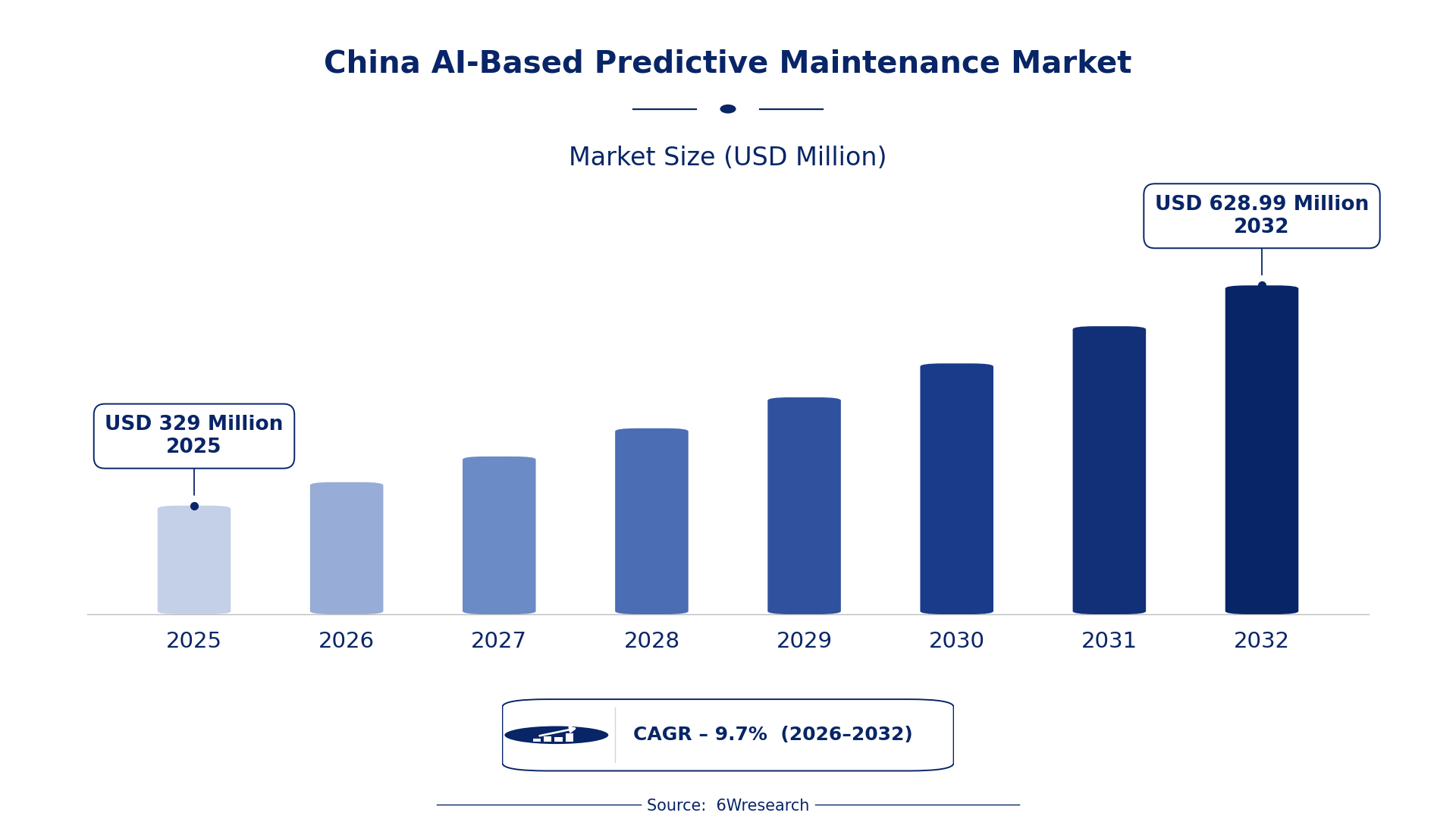
According to 6Wresearch internal database and industry insights, the China AI-Based Predictive Maintenance Market was valued at USD 329.0 million in 2025 and is projected to reach USD 628.99 million by 2032, growing at a CAGR of approximately 9.7% during 2026–2032.
China AI-Based Predictive Maintenance Market Highlights
| Report Metric | Details |
| Report Name | China AI-Based Predictive Maintenance Market |
| Market Size 2025 | USD 329.0 million |
| Market Size 2032 | USD 628.99 million |
| Absolute Growth 2025–2032 | USD 299.99 million |
| CAGR 2026–2032 | 9.7% |
| Peak Annual Growth | 12.1% in 2031 |
| Forecast Period | 2026–2032 |
| Historical Data | 2022–2025 |
| Base Year | 2025 |
| Leading Equipment Type, 2025 | Manufacturing Machines (46% share) |
| Leading AI Use Case, 2025 | Failure Prediction (49% share) |
| Leading Distribution Channel, 2025 | Industrial AI Vendors (48% share) |
| Leading End User, 2025 | Production Plants (40% share) |
| Fastest-Growing Equipment Type | HVAC Systems (11.0% CAGR) |
| Fastest-Growing AI Use Case | Vibration Analysis (11.7% CAGR) |
| Fastest-Growing Distribution Channel | Energy Maintenance SaaS (12.4% CAGR) |
| Fastest-Growing End User | Utility Companies (11.8% CAGR) |
| Growing Sector | Manufacturing sector |
| Key End Users | Production Plants, Utility Companies, HVAC Providers, Energy Firms |
China AI-Based Predictive Maintenance Market Year-wise Growth Rate and Key Drivers (2022–2032)
This graph illustrates the annual growth rates of the market from 2022 to 2032, highlighting a steady upward trajectory and projected market expansion over the forecast period.
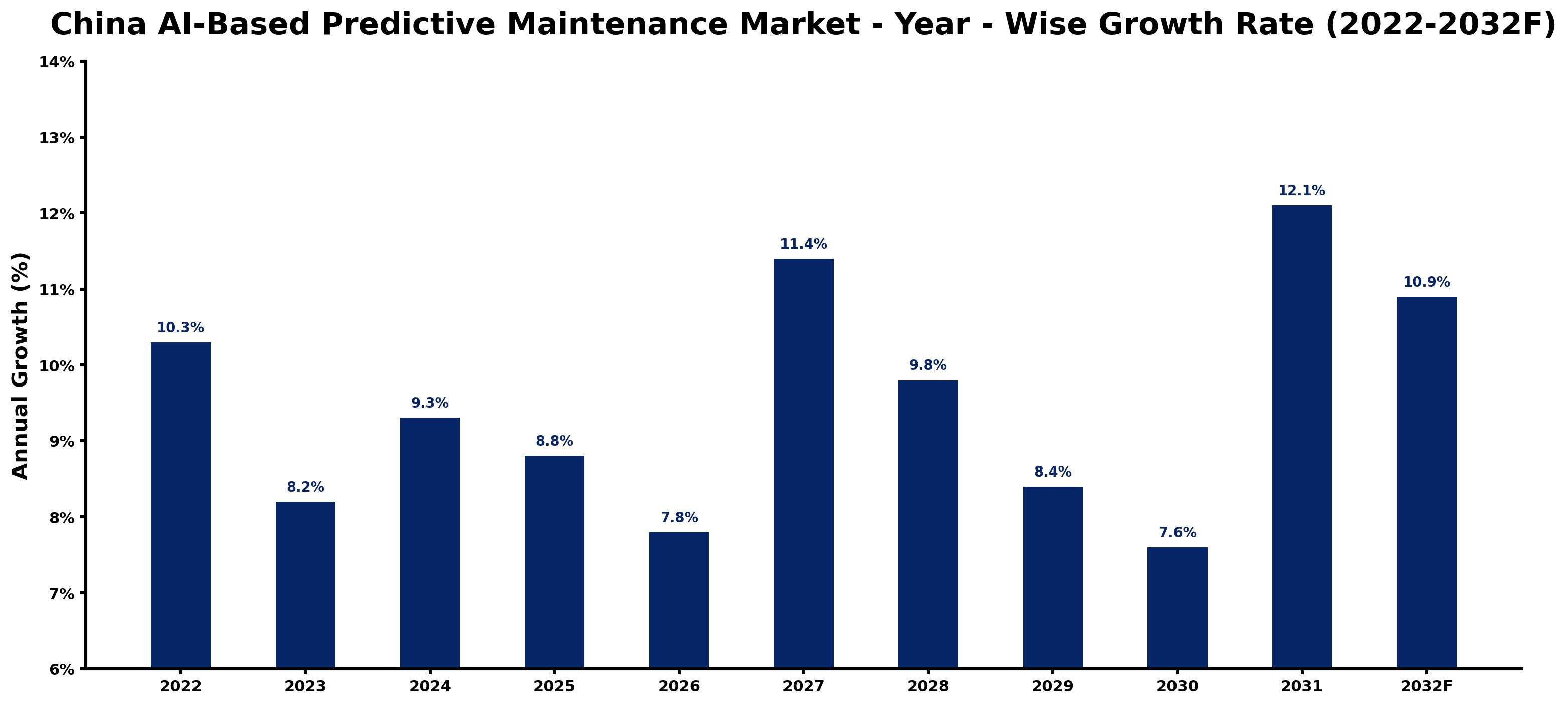
Year by year, the estimates below pair each growth rate with the development that shaped it.
| Year | Estimated Annual Growth (%) | Market Rationale |
| 2022 | 10.3 | The manufacturing sector's strong performance drove significant demand for predictive maintenance solutions. |
| 2023 | 8.2 | Growth slowed as companies adjusted to previous investments in AI technologies. |
| 2024 | 9.3 | Increased adoption of predictive maintenance technologies in manufacturing boosted growth rates. |
| 2025 | 8.8 | Demand remained steady, but growth was slower due to market saturation in some areas. |
| 2026 | 7.8 | The market experienced a slowdown as companies focused on optimising existing systems. |
| 2027 | 11.4 | A resurgence in investments in AI technologies led to a notable increase in growth. |
| 2028 | 9.8 | Growth slowed again as companies consolidated their predictive maintenance strategies. |
| 2029 | 8.4 | Demand continued to grow, but at a slower pace as competition intensified. |
| 2030 | 7.6 | The market grew more slowly as companies prioritised cost management and efficiency. |
| 2031 | 12.1 | A spike in AI integration initiatives drove significant growth in predictive maintenance solutions. |
| 2032 | 10.9 | Growth slowed as the market matured, with companies focusing on refining their strategies. |
Note: Market size estimations and growth projections presented in this report are based on 6Wresearch's proprietary forecasting methodology, utilizing the latest available industry data, government publications, and primary research inputs.
China AI-Based Predictive Maintenance Market Synopsis
AI-Based Predictive Maintenance in China utilises advanced algorithms to forecast equipment failures, developed through data collection and analysis. This technology is crucial for reducing downtime and maintenance costs across various industries, particularly in manufacturing and energy sectors. The China AI-Based Predictive Maintenance Market is expanding due to the increasing demand from production plants and utility companies, along with substantial investments in smart technologies. The installed base of manufacturing machines exceeds 10 million units, creating a vast market for these solutions.
Market Dynamics Impact Analysis (2026–2032)
| Factor | Type | Impact | Primary Segment Affected |
| Rising demand from the manufacturing sector drives the need for predictive maintenance solutions. | Driver | High | Manufacturing Machines |
| Investment in smart grid technologies enhances predictive maintenance applications in energy. | Driver | High | Power Generators |
| The HVAC market's projected growth creates opportunities for predictive maintenance solutions. | Opportunity | High | HVAC Systems |
| Utility companies are increasingly adopting predictive maintenance to improve infrastructure reliability. | Opportunity | High | Utility Companies |
| High initial setup costs can deter smaller companies from adopting predictive maintenance. | Restraint | Medium | Manufacturing Machines |
| Limited awareness of predictive maintenance benefits among some sectors restricts growth. | Restraint | Medium | HVAC Systems |
| Buyers face challenges in integrating new technologies into existing systems. | Challenge | High | Power Generators |
| Suppliers encounter difficulties in meeting evolving regulatory standards for AI applications. | Challenge | Medium | Manufacturing Machines |
Evaluation of Drivers in China AI-Based Predictive Maintenance Market (2026–2032)
The main growth drivers and the segments they affect most are set out below.
| Drivers | Primary Segment Affected | Why It Matters (Evidence) |
| Increased efficiency and reduced downtime in production processes. | Manufacturing Machines | In 2022, the manufacturing sector accounted for 27% of GDP, driving demand for predictive maintenance. |
| Investment in smart technologies improves operational reliability. | Power Generators | China's energy sector has invested over 500 billion CNY in smart grid technologies. |
| Growing HVAC market necessitates predictive maintenance for energy optimisation. | HVAC Systems | The HVAC market in China is projected to reach 300 billion CNY by 2025. |
| Utility companies are adopting predictive maintenance for infrastructure reliability. | Utility Companies | There are over 1,500 utility companies in China that can benefit from predictive maintenance. |
| The rise of AI technologies in manufacturing boosts predictive maintenance adoption. | Production Plants | The Ministry of Industry and Information Technology launched a program to improve AI integration in manufacturing in 2023. |
The AI-Based Predictive Maintenance market in China is growing on the back of increased efficiency and reduced downtime in production processes, alongside substantial investments in smart technologies. In 2022, the manufacturing sector accounted for 27% of GDP, driving demand for predictive maintenance solutions. The energy sector has invested over 500 billion CNY in smart grid technologies, improving operational reliability. The HVAC market is expanding rapidly, necessitating predictive maintenance for energy optimisation.
Evaluation of Restraints in China AI-Based Predictive Maintenance Market
The key brakes on demand, and where they bite hardest, are shown below.
| Market Restraint | Primary Segment Affected | Why It Matters (Evidence) |
| High initial setup costs deter smaller companies from adopting predictive maintenance. | Manufacturing Machines | The installed base of manufacturing machines exceeds 10 million units, but initial costs are a barrier. |
| Limited awareness of predictive maintenance benefits restricts growth in certain sectors. | HVAC Systems | Many companies in the HVAC sector are not fully aware of predictive maintenance advantages. |
| Integration challenges arise when adopting new technologies into existing systems. | Power Generators | Existing infrastructure may not support advanced predictive maintenance technologies easily. |
| Regulatory compliance can be complex and costly for suppliers. | Manufacturing Machines | New standards for AI technologies in predictive maintenance were issued in 2023. |
| Competition among suppliers can lead to pricing pressures. | Utility Companies | As more companies enter the market, pricing strategies become more aggressive. |
China AI-Based Predictive Maintenance Market Challenges
Buyers and suppliers in the China AI-Based Predictive Maintenance market face high initial costs, with implementation expenses often exceeding 1 million CNY per facility. This financial burden delays adoption among smaller manufacturers, limiting their competitiveness in a rapidly evolving sector. Supply chain disruptions occur due to reliance on imported components, which can lead to project delays and affect production schedules for manufacturers. Competition from established local firms complicates market entry for new entrants, making it challenging to differentiate their offerings and capture market share. Skills shortages in AI and data analytics hinder operational efficiency, preventing effective deployment of predictive maintenance solutions across industries.
Trends in the China AI-Based Predictive Maintenance Market
The trends below show where the China AI-Based Predictive Maintenance Market is heading.
- Shift Towards Smart Manufacturing: Manufacturing plants are increasingly adopting AI technologies to improve operational efficiency, as seen in the 'Smart Manufacturing Development Plan' launched in 2021. This initiative aims to integrate AI into manufacturing processes, promoting predictive maintenance.
- Growing Demand for Energy Efficiency: The National Development and Reform Commission's '14th Five-Year Plan for Digital Economy Development' initiated in 2021 promotes AI applications across sectors, including predictive maintenance. This plan aims to improve energy efficiency in various industries.
- Increased Focus on Environmental Sustainability: In 2023, the Ministry of Ecology and Environment launched a program to support the adoption of predictive maintenance in energy sectors. This initiative aims to enhance environmental sustainability through better maintenance practices.
- Rise of AI Innovation in Maintenance: The Ministry of Science and Technology's 'AI Innovation Action Plan' initiated in 2022 supports AI use in predictive maintenance across industries. This plan focuses on energy and manufacturing, driving further adoption.
Investment Opportunities in the China AI-Based Predictive Maintenance Market
Several openings in the China AI-Based Predictive Maintenance Market merit attention from investors.
- Investment in Smart Manufacturing Facilities: China's manufacturing sector is rapidly expanding, with over 10 million machines installed, creating a demand for predictive maintenance solutions. Investing in smart manufacturing facilities can yield high returns as companies seek efficiency.
- Utility Companies Seeking Reliability: With over 1,500 utility companies in China, there is a growing need for predictive maintenance solutions to ensure infrastructure reliability. Suppliers can enter this market through partnerships or local certifications.
- HVAC Market Expansion: The HVAC market is projected to reach 300 billion CNY by 2025, creating opportunities for predictive maintenance solutions. Suppliers should focus on this sector to meet the rising need for energy efficiency.
- Growing Logistics Sector Needs Fleet Management Solutions: The logistics sector is expected to grow to 12 trillion CNY by 2025, increasing demand for fleet management solutions. Investing in predictive maintenance technologies can help logistics companies optimise their operations.
Government Initiatives in the China AI-Based Predictive Maintenance Market
The 'Smart Manufacturing Development Plan' launched by the Ministry of Industry and Information Technology in 2021 aims to integrate AI technologies, including predictive maintenance, into manufacturing processes. This initiative encourages companies to adopt advanced technologies to improve efficiency and reduce costs. Additionally, the '14th Five-Year Plan for Digital Economy Development' introduced by the National Development and Reform Commission promotes AI applications across various sectors, including maintenance, to drive innovation and competitiveness. In 2022, the Ministry of Science and Technology initiated the 'AI Innovation Action Plan' to improve the use of AI in predictive maintenance across industries, focusing on energy and manufacturing.
In 2023, the State Administration for Market Regulation issued new standards for AI technologies in predictive maintenance to ensure safety and reliability in industrial applications. The Ministry of Ecology and Environment also launched a program to support the adoption of predictive maintenance in energy sectors, focusing on improving environmental sustainability and operational efficiency. This program aims to provide funding for projects that implement predictive maintenance technologies, benefiting both producers and buyers. The China Association of Automation supports initiatives for AI-based technologies in industrial applications, facilitating the integration of these solutions.
Future Insight of the China AI-Based Predictive Maintenance Market
Several forward-looking factors are expected to support the China AI-Based Predictive Maintenance market over the coming years. The National Energy Administration's promotion of AI in energy efficiency will drive advancements in predictive maintenance technologies. The HVAC market's projected growth to 300 billion CNY by 2025 will create significant demand for predictive maintenance solutions. The State Council's strategy to boost AI adoption in traditional industries will enhance operational capabilities across manufacturing. These developments will open new opportunities for both buyers and suppliers in the market.
Market Segmentation Analysis
The analysis below covers each segmentation, its leading category in 2025 and its fastest-growing category through 2032.
By Equipment Type – Manufacturing Machines Dominated, HVAC Systems Expected to Grow Fastest
According to Shubham Padhi, Research Analyst at 6Wresearch, with a 46% revenue share in 2025, Manufacturing Machines was the largest equipment type category. Manufacturing machines lead the China AI-Based Predictive Maintenance Market due to their extensive installed base of over 10 million units. These machines are crucial for monitoring production efficiency, making them indispensable for manufacturers across various sectors. The quickest growth will come from HVAC Systems, forecast to expand at a CAGR of 11.0% between 2026 and 2032. HVAC systems are witnessing rapid growth, driven by their importance in optimising energy use and maintenance schedules, particularly as the HVAC market is projected to reach 300 billion CNY by 2025. This surge is further encouraged by government initiatives promoting energy efficiency. Suppliers should focus on enhancing their HVAC solutions to leverage this swift growth.
By AI Use Case – Failure Prediction Dominated, Vibration Analysis Expected to Grow Fastest
Failure Prediction took a 49% share of ai use case in 2025, more than any other category. Failure prediction stands out as the leading use case, vital for preventing unexpected equipment failures across various sectors. This proactive approach significantly minimises downtime, making it a preferred strategy for industries prioritising operational efficiency. Vibration Analysis is set to record the highest CAGR in this split, 11.7% over 2026–2032. Vibration analysis is the fastest-growing use case, effectively identifying anomalies in machinery performance, which is increasingly critical in sectors like manufacturing and energy. The growing adoption of advanced monitoring techniques propels this segment's growth. Buyers should consider investing in vibration analysis tools to bolster their predictive maintenance capabilities.
By Distribution Channel – Industrial AI Vendors Dominated, Energy Maintenance SaaS Expected to Grow Fastest
The largest distribution channel category in 2025 was Industrial AI Vendors, with a 48% share of total revenue. Industrial AI vendors command the largest market share as they provide essential technology and solutions for predictive maintenance applications. Their established relationships with manufacturers facilitate the widespread adoption of these solutions. Over 2026–2032, Energy Maintenance SaaS are expected to post the fastest growth, at a CAGR of 12.4%. Energy maintenance SaaS is the fastest-growing distribution channel, delivering software solutions tailored for predictive maintenance in the energy sector. This growth is propelled by the rising demand for cloud-based solutions that enhance operational efficiency. Suppliers should explore partnerships with SaaS providers to broaden their reach in the energy maintenance market.
By End User – Production Plants Dominated, Utility Companies Expected to Grow Fastest
In 2025, Production Plants led the end user split with a 40% share. Production plants account for the largest share of end users in the China AI-Based Predictive Maintenance Market, as they are significant consumers of predictive maintenance solutions aimed at ensuring operational efficiency. This sector's substantial investment in technology underscores its commitment to minimising downtime. Utility Companies are projected to grow fastest, at a CAGR of 11.8% during 2026–2032. Utility companies represent the fastest-growing end users, relying heavily on predictive maintenance for infrastructure reliability, especially with over 1,500 utility companies in China. Their increasing focus on efficiency drives the demand for advanced maintenance solutions. Suppliers should tailor their offerings to meet the specific requirements of utility companies to capture this emerging market.
Key Attractiveness of the Report
- 10 Years of Market Numbers
- Historical Data Starting from 2022 to 2025
- Base Year 2025
- Forecast Data until 2032
- Key Performance Indicators Impacting the Market
- Major Upcoming Developments and Projects
Key Highlights of the Report:
- China AI-Based Predictive Maintenance Market Outlook
- Market Size of China AI-Based Predictive Maintenance Market, 2025
- Forecast of China AI-Based Predictive Maintenance Market, 2032
- Historical Data and Forecast of China AI-Based Predictive Maintenance Revenues & Volume for the Period 2022 - 2032F
- China AI-Based Predictive Maintenance Market Trend Evolution
- China AI-Based Predictive Maintenance Market Drivers and Challenges
- China AI-Based Predictive Maintenance Price Trends
- China AI-Based Predictive Maintenance Porter's Five Forces
- China AI-Based Predictive Maintenance Industry Life Cycle
- Historical Data and Forecast of China AI-Based Predictive Maintenance Market Revenues & Volume By Equipment Type for the Period 2022 - 2032F
- Historical Data and Forecast of China AI-Based Predictive Maintenance Market Revenues & Volume By Manufacturing Machines for the Period 2022 - 2032F
- Historical Data and Forecast of China AI-Based Predictive Maintenance Market Revenues & Volume By Power Generators for the Period 2022 - 2032F
- Historical Data and Forecast of China AI-Based Predictive Maintenance Market Revenues & Volume By Vehicles for the Period 2022 - 2032F
- Historical Data and Forecast of China AI-Based Predictive Maintenance Market Revenues & Volume By HVAC Systems for the Period 2022 - 2032F
- Historical Data and Forecast of China AI-Based Predictive Maintenance Market Revenues & Volume By AI Use Case for the Period 2022 - 2032F
- Historical Data and Forecast of China AI-Based Predictive Maintenance Market Revenues & Volume By Failure Prediction for the Period 2022 - 2032F
- Historical Data and Forecast of China AI-Based Predictive Maintenance Market Revenues & Volume By Vibration Analysis for the Period 2022 - 2032F
- Historical Data and Forecast of China AI-Based Predictive Maintenance Market Revenues & Volume By Real-Time Monitoring for the Period 2022 - 2032F
- Historical Data and Forecast of China AI-Based Predictive Maintenance Market Revenues & Volume By Sensor-Based Analysis for the Period 2022 - 2032F
- Historical Data and Forecast of China AI-Based Predictive Maintenance Market Revenues & Volume By Distribution Channel for the Period 2022 - 2032F
- Historical Data and Forecast of China AI-Based Predictive Maintenance Market Revenues & Volume By Industrial AI Vendors for the Period 2022 - 2032F
- Historical Data and Forecast of China AI-Based Predictive Maintenance Market Revenues & Volume By Energy Maintenance SaaS for the Period 2022 - 2032F
- Historical Data and Forecast of China AI-Based Predictive Maintenance Market Revenues & Volume By Fleet Tech Providers for the Period 2022 - 2032F
- Historical Data and Forecast of China AI-Based Predictive Maintenance Market Revenues & Volume By Building Tech Distributors for the Period 2022 - 2032F
- Historical Data and Forecast of China AI-Based Predictive Maintenance Market Revenues & Volume By End User for the Period 2022 - 2032F
- Historical Data and Forecast of China AI-Based Predictive Maintenance Market Revenues & Volume By Production Plants for the Period 2022 - 2032F
- Historical Data and Forecast of China AI-Based Predictive Maintenance Market Revenues & Volume By Utility Companies for the Period 2022 - 2032F
- Historical Data and Forecast of China AI-Based Predictive Maintenance Market Revenues & Volume By Logistics Companies for the Period 2022 - 2032F
- Historical Data and Forecast of China AI-Based Predictive Maintenance Market Revenues & Volume By Facility Management Firms for the Period 2022 - 2032F
- China AI-Based Predictive Maintenance Import Export Trade Statistics
- Market Opportunity Assessment By Equipment Type
- Market Opportunity Assessment By AI Use Case
- Market Opportunity Assessment By Distribution Channel
- Market Opportunity Assessment By End User
- China AI-Based Predictive Maintenance Top Companies Market Share
- China AI-Based Predictive Maintenance Competitive Benchmarking By Technical and Operational Parameters
- China AI-Based Predictive Maintenance Company Profiles
- China AI-Based Predictive Maintenance Key Strategic Recommendations
Market Covered
Segments analysed in this report are listed below.
By Equipment Type
- Manufacturing Machines
- Power Generators
- Vehicles
- HVAC Systems
By AI Use Case
- Failure Prediction
- Vibration Analysis
- Real-Time Monitoring
- Sensor-Based Analysis
By Distribution Channel
- Industrial AI Vendors
- Energy Maintenance SaaS
- Fleet Tech Providers
- Building Tech Distributors
By End User
- Production Plants
- Utility Companies
- Logistics Companies
- Facility Management Firms































