China AI-based Quality Inspection Market Size & Growth Rate
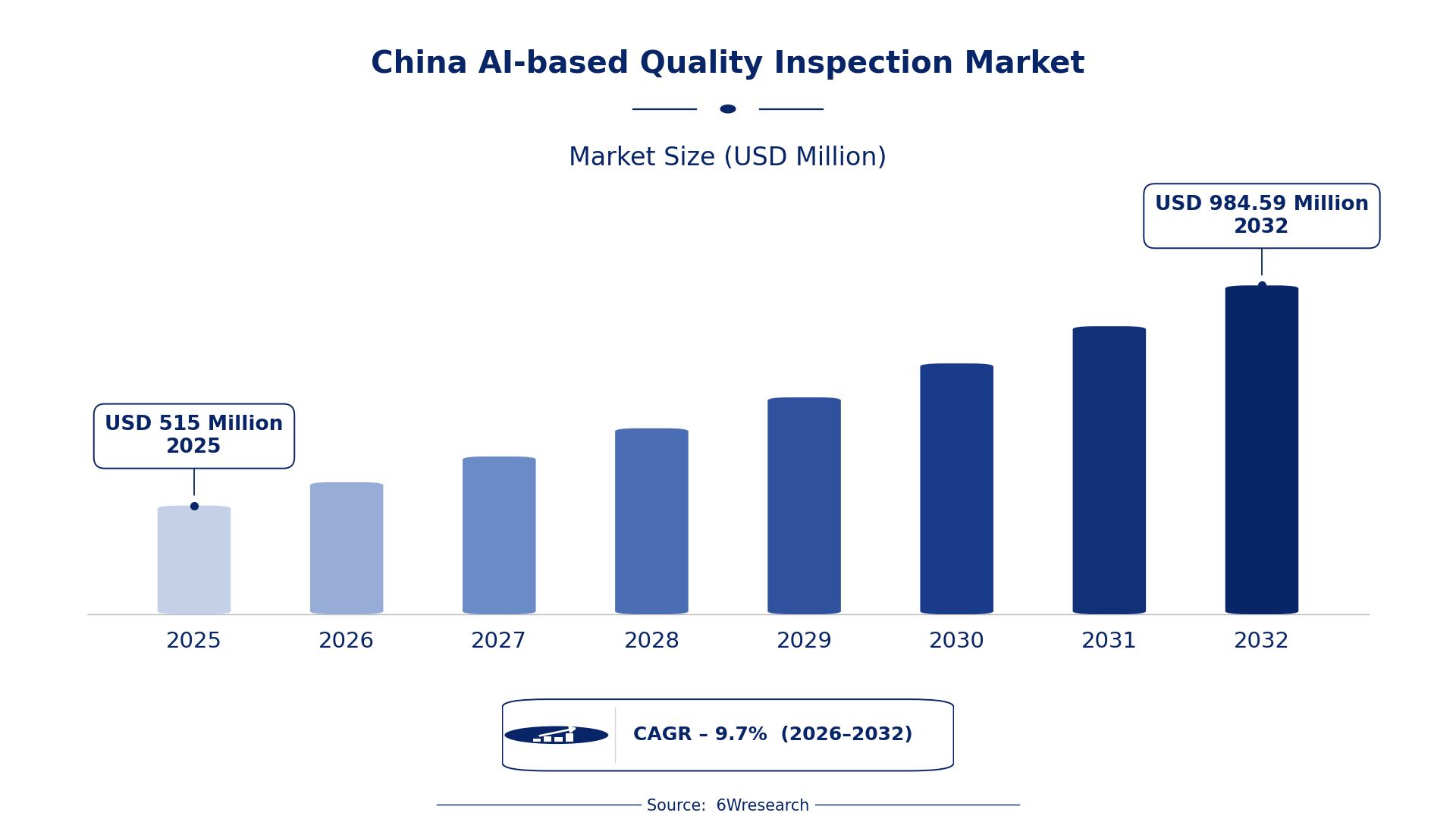
According to 6Wresearch internal database and industry insights, the China AI-based Quality Inspection Market was valued at USD 515.0 million in 2025 and is projected to reach USD 984.59 million by 2032, growing at a CAGR of approximately 9.7% during 2026–2032.
China AI-based Quality Inspection Market Highlights
| Report Metric | Details |
| Report Name | China AI-based Quality Inspection Market |
| Market Size 2025 | USD 515.0 million |
| Market Size 2032 | USD 984.59 million |
| Absolute Growth 2025–2032 | USD 469.59 million |
| CAGR 2026–2032 | 9.7% |
| Peak Annual Growth | 11.8% in 2031 |
| Forecast Period | 2026–2032 |
| Historical Data | 2022–2025 |
| Base Year | 2025 |
| Leading Inspection Area, 2025 | Automotive Components (48% share) |
| Leading AI Functionality, 2025 | Surface Defect Detection (48% share) |
| Leading Distribution Channel, 2025 | Vision System Providers (49% share) |
| Leading End User, 2025 | Car Manufacturers (35% share) |
| Fastest-Growing Inspection Area | Food Processing (11.7% CAGR) |
| Fastest-Growing AI Functionality | Contaminant Detection (12.0% CAGR) |
| Fastest-Growing Distribution Channel | Smart Food Tech Vendors (10.8% CAGR) |
| Fastest-Growing End User | Food & Beverage Companies (11.7% CAGR) |
| Growing Sector | Food & Beverage Companies |
| Key End Users | Car Manufacturers, PCB Manufacturing Units, Food & Beverage Companies, Consumer Goods Plants |
China AI-based Quality Inspection Market Year-wise Growth Rate and Key Drivers (2022–2032)
This graph illustrates the annual growth rates of the market from 2022 to 2032, highlighting a steady upward trajectory and projected market expansion over the forecast period.
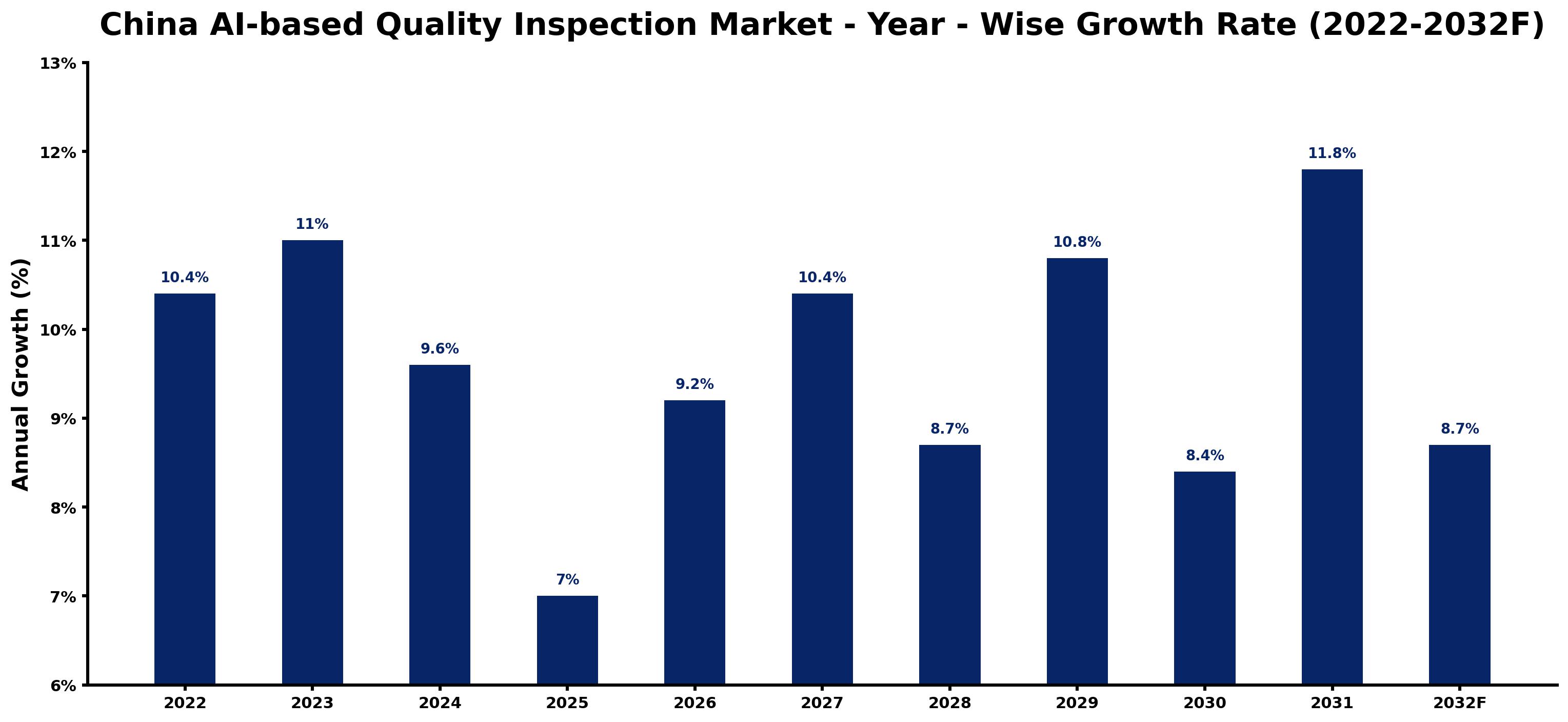
The following table presents the estimated annual growth rate for each year together with the principal factor influencing market performance.
| Year | Estimated Annual Growth (%) | Market Rationale |
| 2022 | 10.4 | The automotive industry experienced high production levels, driving quality inspection demand. |
| 2023 | 11.0 | Continued growth in vehicle production and electronics manufacturing increased the need for inspection technologies. |
| 2024 | 9.6 | Demand for AI-based inspection slowed as manufacturers adjusted to previous growth rates. |
| 2025 | 7.0 | A slight slowdown in growth occurred as industries began to stabilise after rapid expansion. |
| 2026 | 9.2 | Investment in AI technologies is expected to surge, boosting demand for quality inspection in manufacturing. |
| 2027 | 10.4 | The automotive sector's ongoing expansion will further accelerate the adoption of inspection technologies. |
| 2028 | 8.7 | Growth is projected to slow slightly as manufacturers focus on optimising existing processes. |
| 2029 | 10.8 | Increased production in the electronics sector is expected to lead to a rise in quality inspection needs. |
| 2030 | 8.4 | The market is projected to continue growing, albeit at a slower pace as competition intensifies. |
| 2031 | 11.8 | A peak in growth is expected as AI integration becomes essential in quality control. |
| 2032 | 8.7 | The market will stabilise with sustained demand from automotive manufacturers and electronics producers. |
Note: Market size estimations and growth projections presented in this report are based on 6Wresearch's proprietary forecasting methodology, utilizing the latest available industry data, government publications, and primary research inputs.
China AI-based Quality Inspection Market Synopsis
AI-based Quality Inspection in China refers to the use of artificial intelligence technologies to automate inspection processes across various industries. This technology is developed through machine learning algorithms that identify defects and improve production efficiency. The China AI-based Quality Inspection Market is expanding due to rising demand from automotive and electronics manufacturers, driven by the need for quality assurance and compliance with national standards. With over 26 million vehicles produced in 2022 and a large electronics workforce, the market is set to thrive as industries adopt AI technologies for quality control.
Market Dynamics Impact Analysis (2026–2032)
| Factor | Type | Impact | Primary Segment Affected |
| Rising production levels in the automotive sector drive demand for quality assurance technologies. | Driver | High | Automotive Components |
| The electronics manufacturing sector's growth fuels the need for efficient inspection solutions. | Driver | High | Electronics Assembly |
| The increasing focus on food safety creates opportunities for AI-based inspection in processing facilities. | Opportunity | High | Food Processing |
| The demand for compliance in packaging drives investment in AI inspection technologies. | Opportunity | High | Packaging Lines |
| High initial investment costs can limit adoption among smaller manufacturers. | Restraint | Medium | Food Processing |
| The complexity of AI integration may deter some companies from adopting new technologies. | Restraint | Medium | Electronics Assembly |
| Limited skilled workforce in AI technologies poses challenges for effective implementation. | Challenge | High | Automotive Components |
| Rapid technological advancements may outpace current industry standards, causing compliance issues. | Challenge | High | Electronics Assembly |
Evaluation of Drivers in China AI-based Quality Inspection Market (2026–2032)
Key forces behind demand, with the segment each one moves most, are listed below.
| Drivers | Primary Segment Affected | Why It Matters (Evidence) |
| Increased vehicle production necessitates stringent quality checks, leading to higher demand for AI inspection. | Automotive Components | Over 26 million vehicles were produced in China in 2022, driving quality assurance needs. |
| The electronics sector's expansion requires efficient inspection systems to maintain production standards. | Electronics Assembly | Approximately 10 million workers are employed in China's electronics manufacturing, increasing inspection demands. |
| Growing consumer awareness of food safety drives the need for reliable inspection technologies. | Food Processing | The food processing industry in China is valued at over $1 trillion, highlighting the importance of quality assurance. |
| Regulatory compliance in packaging necessitates advanced inspection solutions to meet standards. | Packaging Lines | The food safety law mandates strict quality checks in food processing facilities, boosting inspection technology demand. |
| Investment in AI technologies improves manufacturing efficiency and inspection capabilities. | Food Processing | Annual investment in AI technologies in manufacturing is projected to exceed $15 billion by 2025. |
Growth in the AI-based Quality Inspection market in China stems from rising vehicle production, the expansion of electronics manufacturing, and heightened consumer safety awareness. Over 26 million vehicles were produced in 2022, creating a need for rigorous quality checks. The electronics sector, employing around 10 million workers, fuels the demand for efficient inspection systems. The food processing industry, valued at over $1 trillion, highlights the necessity for dependable quality assurance technologies. Investment in AI technologies is projected to exceed $15 billion by 2025, improving manufacturing capabilities.
Evaluation of Restraints in China AI-based Quality Inspection Market
The following restraints limit how fast demand can grow.
| Market Restraint | Primary Segment Affected | Why It Matters (Evidence) |
| High initial costs of AI technologies can deter smaller manufacturers from adoption. | Food Processing | Many small food processing companies struggle to afford advanced inspection systems, limiting their competitiveness. |
| Complex integration processes may hinder the adoption of AI inspection technologies. | Electronics Assembly | The intricate nature of AI systems can lead to delays and increased costs in implementation. |
| Limited availability of skilled personnel in AI technologies affects effective implementation. | Automotive Components | The automotive sector faces challenges in finding qualified workers to operate advanced inspection systems. |
| Regulatory compliance can be burdensome for manufacturers implementing new technologies. | Packaging Lines | Strict regulations may require extensive testing and validation, delaying technology adoption. |
| Rapid technological advancements may create gaps in compliance with current industry standards. | Electronics Assembly | Manufacturers may struggle to keep up with evolving technologies, risking non-compliance. |
China AI-based Quality Inspection Market Challenges
The China AI-based Quality Inspection market faces several pressing issues, starting with competition. Intense rivalry among local producers drives prices down, which compresses profit margins for manufacturers. Technology adoption varies considerably, with only 60% of urban manufacturers implementing quality inspection solutions, resulting in inconsistent product standards for buyers. Regulatory compliance adds complexity, as multiple standards like GB/T 19001-2016 complicate quality management, delaying product launches for suppliers. A skills gap exists, as the rapid evolution of AI technology outpaces available training, restricting innovation for producers.
Trends in the China AI-based Quality Inspection Market
Four trends stand out in the China AI-based Quality Inspection Market.
- Shift from Manual to Automated Inspection: Since 2021, manufacturers in China have increasingly adopted automated inspection technologies to improve efficiency. The automotive sector, producing over 26 million vehicles in 2022, leads this shift, resulting in higher quality standards.
- Transition to AI-Driven Quality Control: In 2022, the integration of AI technologies in quality control processes gained momentum. The electronics sector, employing around 10 million workers, is at the forefront, ensuring compliance with stringent production standards.
- Emergence of Smart Food Safety Solutions: In 2023, the Smart Food Safety Program was launched to implement AI technologies in food processing inspections. This initiative aims to improve safety measures in a food industry valued at over $1 trillion.
- Focus on Compliance and Quality Assurance: Since 2022, there has been a growing emphasis on compliance in packaging. The food safety law mandates strict quality checks, driving the adoption of AI inspection technologies across processing facilities.
Investment Opportunities in the China AI-based Quality Inspection Market
The following opportunities in the China AI-based Quality Inspection Market pair current demand with a clear way in.
- Rising Demand for AI Technologies: With the food processing industry valued at over $1 trillion, there is a chance for suppliers of AI-based inspection systems. Partnering with local food manufacturers can facilitate market entry.
- Investment in Automotive Quality Control: Now presents an ideal opportunity to invest in AI inspection solutions for automotive manufacturers, given the production of over 26 million vehicles in 2022. Collaborating with regional automotive hubs can enhance market presence.
- Electronics Sector Expansion: The growing electronics workforce of approximately 10 million workers offers a chance to supply AI inspection technologies. Establishing relationships with electronics manufacturers in Guangdong and Jiangsu can boost sales.
- Compliance in Packaging: As regulatory requirements tighten, there is a pressing need for advanced inspection solutions in packaging lines. Engaging with packaging manufacturers can lead to fruitful partnerships.
Government Initiatives in the China AI-based Quality Inspection Market
The 2021 AI Development Plan by the Ministry of Industry and Information Technology aims to promote AI technology in manufacturing sectors, focusing on quality inspection. This initiative encourages manufacturers to adopt AI solutions, ensuring compliance with national standards while improving production efficiency. The plan outlines specific targets for AI integration, promoting innovation and competitiveness in the industry. By fostering collaboration between technology providers and manufacturers, the government aims to create a more efficient and quality-driven manufacturing environment in China.
In 2022, the National Quality Supervision and Inspection Center's initiative emphasised the integration of AI in quality control processes across industries. This program funds projects aimed at enhancing inspection capabilities, ensuring manufacturers can meet stringent quality standards. Additionally, the Ministry of Agriculture launched the Smart Food Safety Program in 2023 to implement AI technologies in food processing inspections, further supporting compliance and safety measures in the food industry.
Future Insight of the China AI-based Quality Inspection Market
Several forward-looking factors should support the China AI-based Quality Inspection market over the coming years. Annual investment in AI technologies in manufacturing is expected to exceed $15 billion by 2025, enabling advancements in inspection processes. The 2022 National AI Strategy aims to enhance AI integration in manufacturing, which will streamline operations for suppliers. The Smart Manufacturing Innovation Strategy, launched in 2021, will further promote AI technologies, improving quality assurance for buyers. These initiatives will drive efficiency and reduce waste across various sectors.
Market Segmentation Analysis
The analysis below covers each segmentation, its leading category in 2025 and its fastest-growing category through 2032.
By Inspection Area – Automotive Components Dominated, Food Processing Expected to Grow Fastest
According to Shubham Padhi, Research Analyst at 6Wresearch, with a 48% revenue share in 2025, Automotive Components was the largest inspection area category. The automotive components segment holds the largest share due to the production of over 26 million vehicles in 2022, necessitating rigorous quality checks. This high volume creates a substantial installed base for AI-based quality inspection technologies in automotive manufacturing. The quickest growth will come from Food Processing, forecast to expand at a CAGR of 11.7% between 2026 and 2032. The food processing segment is experiencing rapid growth driven by the food safety law mandating strict quality checks in processing facilities. This regulatory pressure ensures that food processing companies increasingly adopt AI-based inspection solutions to maintain compliance. Suppliers should focus on developing tailored AI solutions for the food processing sector to capture emerging opportunities.
By AI Functionality – Surface Defect Detection Dominated, Contaminant Detection Expected to Grow Fastest
The largest ai functionality category in 2025 was Surface Defect Detection, with a 48% share of total revenue. Surface defect detection commands the largest market share because it plays a vital role in identifying flaws on product surfaces, crucial for upholding quality standards. This functionality is particularly important in the automotive sector, where maintaining high surface quality is essential for vehicle performance and consumer satisfaction. Contaminant Detection is set to record the highest CAGR in this split, 12.0% over 2026–2032. Contaminant detection is witnessing the fastest growth as food manufacturers increasingly prioritise safety and compliance with stringent regulations. The heightened focus on food safety laws and quality checks is propelling the demand for advanced inspection technologies in the food processing industry. This trend indicates that suppliers must enhance their capabilities in contaminant detection to align with the rising safety standards in the food and beverage sector.
By Distribution Channel – Vision System Providers Dominated, Smart Food Tech Vendors Expected to Grow Fastest
In 2025, Vision System Providers led the distribution channel split with a 49% share. Vision system providers lead the market by integrating inspection systems into their products, catering to diverse industries. Their established relationships with manufacturers facilitate the adoption of quality inspection technologies across various sectors. Over 2026–2032, Smart Food Tech Vendors are expected to post the fastest growth, at a CAGR of 10.8%. Smart food tech vendors are rapidly expanding as they utilise advanced technologies to improve food safety in response to stringent regulations. This growth reflects a shift towards more specialised solutions that address the unique challenges of the food processing industry. Suppliers should explore collaborations with smart food tech vendors to strengthen their position in the evolving food processing market.
By End User – Car Manufacturers Dominated, Food & Beverage Companies Expected to Grow Fastest
Car Manufacturers took a 35% share of end user in 2025, more than any other category. Car manufacturers represent the largest share of the market, relying heavily on AI inspection for quality assurance in their production processes. The automotive industry's scale and complexity necessitate advanced inspection technologies to maintain high standards. Food & Beverage Companies are projected to grow fastest, at a CAGR of 11.7% during 2026–2032. Food and beverage companies are the fastest-growing end users, driven by the need for compliance and quality assurance in a highly regulated environment. This growth reflects the increasing importance of quality in food production and safety. Suppliers should tailor their offerings to meet the specific quality assurance needs of food and beverage companies to capture this growing market.
Key Attractiveness of the Report
- 10 Years of Market Numbers
- Historical Data Starting from 2022 to 2025
- Base Year 2025
- Forecast Data until 2032
- Key Performance Indicators Impacting the Market
- Major Upcoming Developments and Projects
Key Highlights of the Report:
- China AI-based Quality Inspection Market Outlook
- Market Size of China AI-based Quality Inspection Market, 2025
- Forecast of China AI-based Quality Inspection Market, 2032
- Historical Data and Forecast of China AI-based Quality Inspection Revenues & Volume for the Period 2022 - 2032F
- China AI-based Quality Inspection Market Trend Evolution
- China AI-based Quality Inspection Market Drivers and Challenges
- China AI-based Quality Inspection Price Trends
- China AI-based Quality Inspection Porter's Five Forces
- China AI-based Quality Inspection Industry Life Cycle
- Historical Data and Forecast of China AI-based Quality Inspection Market Revenues & Volume By Inspection Area for the Period 2022 - 2032F
- Historical Data and Forecast of China AI-based Quality Inspection Market Revenues & Volume By Automotive Components for the Period 2022 - 2032F
- Historical Data and Forecast of China AI-based Quality Inspection Market Revenues & Volume By Electronics Assembly for the Period 2022 - 2032F
- Historical Data and Forecast of China AI-based Quality Inspection Market Revenues & Volume By Food Processing for the Period 2022 - 2032F
- Historical Data and Forecast of China AI-based Quality Inspection Market Revenues & Volume By Packaging Lines for the Period 2022 - 2032F
- Historical Data and Forecast of China AI-based Quality Inspection Market Revenues & Volume By AI Functionality for the Period 2022 - 2032F
- Historical Data and Forecast of China AI-based Quality Inspection Market Revenues & Volume By Surface Defect Detection for the Period 2022 - 2032F
- Historical Data and Forecast of China AI-based Quality Inspection Market Revenues & Volume By Fault Prediction for the Period 2022 - 2032F
- Historical Data and Forecast of China AI-based Quality Inspection Market Revenues & Volume By Contaminant Detection for the Period 2022 - 2032F
- Historical Data and Forecast of China AI-based Quality Inspection Market Revenues & Volume By Shape & Label Validation for the Period 2022 - 2032F
- Historical Data and Forecast of China AI-based Quality Inspection Market Revenues & Volume By Distribution Channel for the Period 2022 - 2032F
- Historical Data and Forecast of China AI-based Quality Inspection Market Revenues & Volume By Vision System Providers for the Period 2022 - 2032F
- Historical Data and Forecast of China AI-based Quality Inspection Market Revenues & Volume By SMT Equipment Providers for the Period 2022 - 2032F
- Historical Data and Forecast of China AI-based Quality Inspection Market Revenues & Volume By Smart Food Tech Vendors for the Period 2022 - 2032F
- Historical Data and Forecast of China AI-based Quality Inspection Market Revenues & Volume By Robotics Integrators for the Period 2022 - 2032F
- Historical Data and Forecast of China AI-based Quality Inspection Market Revenues & Volume By End User for the Period 2022 - 2032F
- Historical Data and Forecast of China AI-based Quality Inspection Market Revenues & Volume By Car Manufacturers for the Period 2022 - 2032F
- Historical Data and Forecast of China AI-based Quality Inspection Market Revenues & Volume By PCB Manufacturing Units for the Period 2022 - 2032F
- Historical Data and Forecast of China AI-based Quality Inspection Market Revenues & Volume By Food & Beverage Companies for the Period 2022 - 2032F
- Historical Data and Forecast of China AI-based Quality Inspection Market Revenues & Volume By Consumer Goods Plants for the Period 2022 - 2032F
- China AI-based Quality Inspection Import Export Trade Statistics
- Market Opportunity Assessment By Inspection Area
- Market Opportunity Assessment By AI Functionality
- Market Opportunity Assessment By Distribution Channel
- Market Opportunity Assessment By End User
- China AI-based Quality Inspection Top Companies Market Share
- China AI-based Quality Inspection Competitive Benchmarking By Technical and Operational Parameters
- China AI-based Quality Inspection Company Profiles
- China AI-based Quality Inspection Key Strategic Recommendations
Market Covered
Segments analysed in this report are listed below.
By Inspection Area
- Automotive Components
- Electronics Assembly
- Food Processing
- Packaging Lines
By AI Functionality
- Surface Defect Detection
- Fault Prediction
- Contaminant Detection
- Shape & Label Validation
By Distribution Channel
- Vision System Providers
- SMT Equipment Providers
- Smart Food Tech Vendors
- Robotics Integrators
By End User
- Car Manufacturers
- PCB Manufacturing Units
- Food & Beverage Companies
- Consumer Goods Plants































