China AI-based Surgical Navigation Market Size & Growth Rate
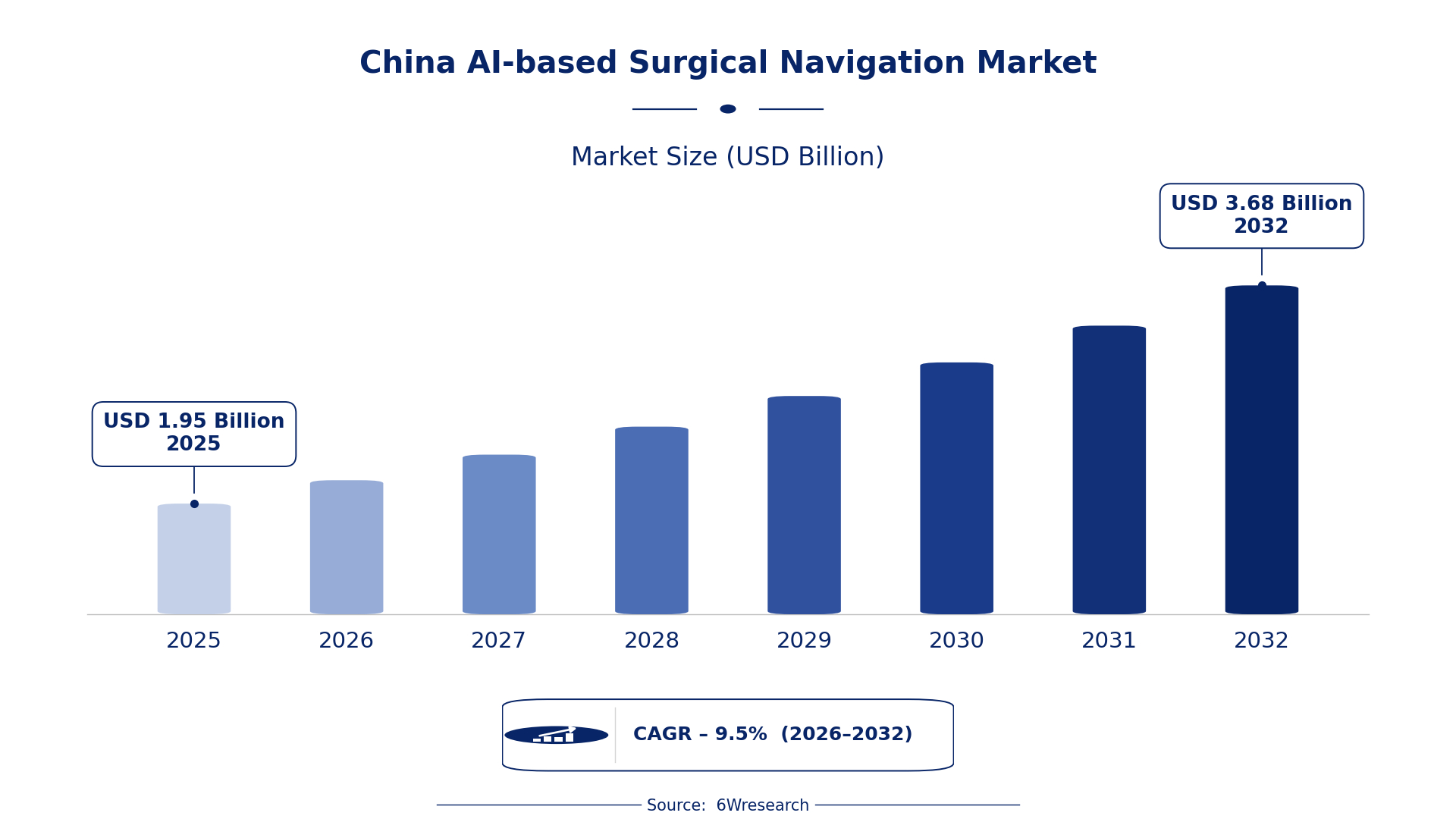
According to 6Wresearch internal database and industry insights, the China AI-based Surgical Navigation Market was valued at USD 1.95 billion in 2025 and is projected to reach USD 3.68 billion by 2032, growing at a CAGR of approximately 9.5% during 2026–2032.
China AI-based Surgical Navigation Market Highlights
| Report Metric | Details |
| Report Name | China AI-based Surgical Navigation Market |
| Market Size 2025 | USD 1.95 billion |
| Market Size 2032 | USD 3.68 billion |
| Absolute Growth 2025–2032 | USD 1.73 billion |
| CAGR 2026–2032 | 9.5% |
| Peak Annual Growth | 11.6% in 2027 |
| Forecast Period | 2026–2032 |
| Historical Data | 2022–2025 |
| Base Year | 2025 |
| Leading Surgery Type, 2025 | Orthopedic Surgery (40% share) |
| Leading AI Use Case, 2025 | Real-Time Navigation (43% share) |
| Leading Distribution Channel, 2025 | Medical Robotics Vendors (38% share) |
| Leading End User, 2025 | Specialty Surgery Hospitals (47% share) |
| Fastest-Growing Surgery Type | Brain Surgery (10.7% CAGR) |
| Fastest-Growing Distribution Channel | Neuro Navigation Providers (11.9% CAGR) |
| Fastest-Growing End User | Neurological Clinics (10.9% CAGR) |
| Growing Sector | Specialty Surgery Hospitals |
| Key End Users | Specialty Surgery Hospitals, Neurological Clinics, Surgeons, Medical Robotics Vendors |
China AI-based Surgical Navigation Market Year-wise Growth Rate and Key Drivers (2022–2032)
This graph illustrates the annual growth rates of the market from 2022 to 2032, highlighting a steady upward trajectory and projected market expansion over the forecast period.
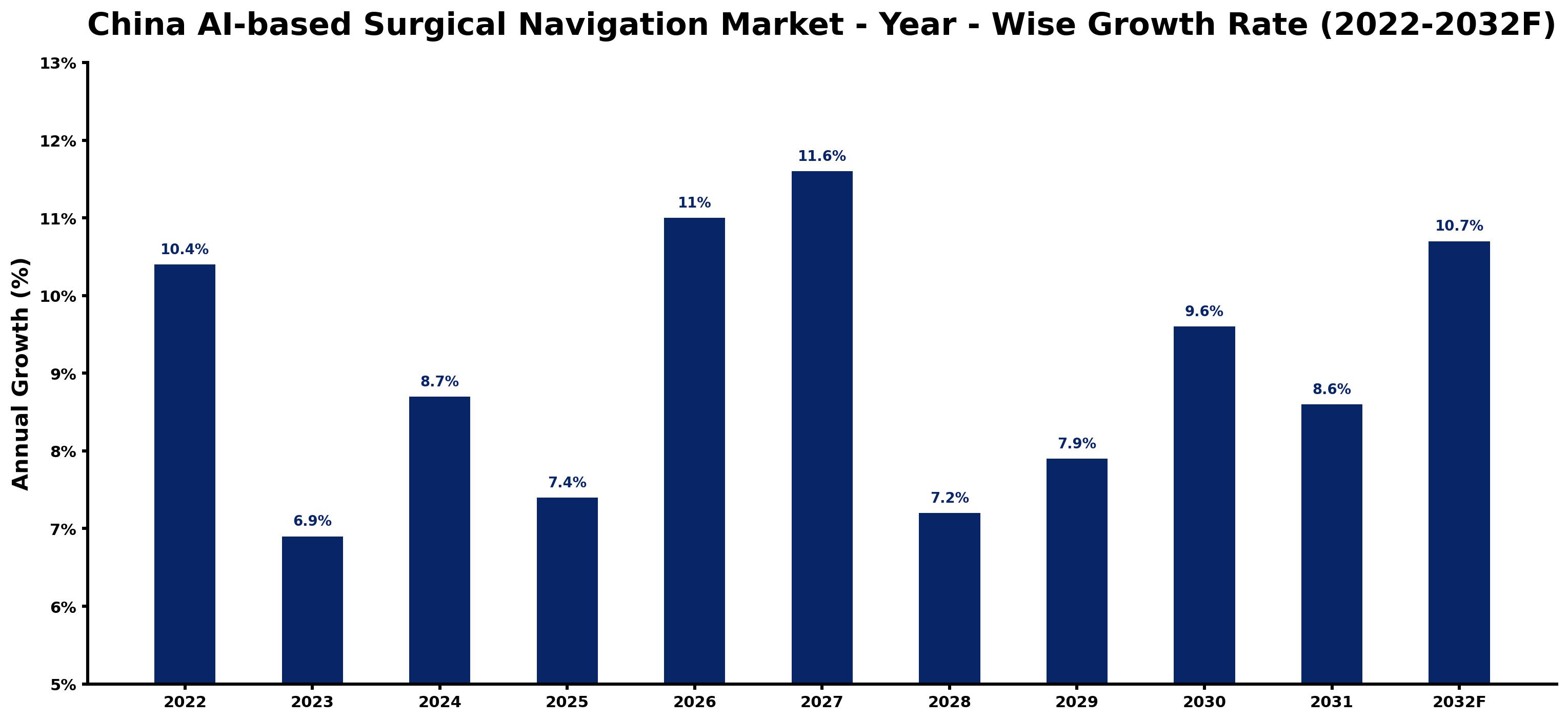
The following table presents the estimated annual growth rate for each year together with the principal factor influencing market performance.
| Year | Estimated Annual Growth (%) | Market Rationale |
| 2022 | 10.4 | The market experienced strong adoption driven by advancements in surgical technologies. |
| 2023 | 6.9 | Growth slowed as hospitals adjusted to new technologies and training requirements. |
| 2024 | 8.7 | Increased investments in surgical innovations spurred faster adoption rates. |
| 2025 | 7.4 | Demand continued to rise as healthcare facilities expanded their technological capabilities. |
| 2026 | 11.0 | A surge in AI integration in healthcare led to renewed growth momentum. |
| 2027 | 11.6 | The peak growth rate was driven by significant investments in surgical navigation systems. |
| 2028 | 7.2 | Growth slowed as the market began to stabilise after rapid advancements. |
| 2029 | 7.9 | Increased demand from neurological clinics contributed to a recovery in growth. |
| 2030 | 9.6 | The integration of AI technologies continued to enhance surgical precision and outcomes. |
| 2031 | 8.6 | Growth moderated as the market matured and adoption levels stabilised. |
| 2032 | 10.7 | A resurgence in demand from specialty surgery hospitals drove growth upward. |
Note: Market size estimations and growth projections presented in this report are based on 6Wresearch's proprietary forecasting methodology, utilizing the latest available industry data, government publications, and primary research inputs.
China AI-based Surgical Navigation Market Synopsis
AI-based Surgical Navigation in China encompasses advanced technologies that enhance surgical precision through real-time imaging and data analysis. These systems are crucial for guiding surgeons, improving patient outcomes, and reducing operation times. The market is projected to grow significantly, reaching USD 3.68 billion by 2032, driven by factors such as a large population and increasing investments in healthcare technology. The National Health Commission's promotion of advanced surgical technologies under the 14th Five-Year Plan further supports this growth.
Market Dynamics Impact Analysis (2026–2032)
| Factor | Type | Impact | Primary Segment Affected |
| Growing healthcare investments in advanced surgical technologies | Driver | High | Orthopedic Surgery |
| Increasing number of specialty surgery hospitals adopting innovative solutions | Driver | High | Specialty Surgery Hospitals |
| Expansion of neurological clinics requiring advanced navigation systems | Opportunity | High | Neurological Clinics |
| Rising demand for real-time navigation in surgical procedures | Opportunity | High | Real-Time Navigation |
| High costs associated with implementing advanced surgical technologies | Restraint | Medium | Orthopedic Surgery |
| Regulatory challenges in the approval process for new technologies | Restraint | Medium | Orthopedic Surgery |
| Limited access to training for healthcare professionals on new systems | Challenge | High | Specialty Surgery Hospitals |
| Competition from traditional surgical methods affecting adoption rates | Challenge | Medium | Orthopedic Surgery |
Evaluation of Drivers in China AI-based Surgical Navigation Market (2026–2032)
The factors lifting demand, and the evidence behind each, are summarised below.
| Drivers | Primary Segment Affected | Why It Matters (Evidence) |
| Increased healthcare expenditure | Orthopedic Surgery | China's healthcare spending reached 10 billion yuan in 2023, driving demand for advanced surgical technologies. |
| Growing number of specialty surgery hospitals | Specialty Surgery Hospitals | Over 200 specialty surgery hospitals in China adopted AI-based systems, leading to higher demand. |
| Rising population and surgical needs | Neurological Clinics | China's population of over 1.4 billion creates a high demand for surgical innovations. |
| Support from government initiatives | Orthopedic Surgery | The 'Smart Healthcare Development Plan' aims to integrate AI technologies by 2025, boosting market growth. |
| Technological advancements in AI and robotics | Medical Robotics Vendors | The installed base of surgical navigation systems is over 5,000 units, indicating strong market adoption. |
Market growth in China for AI-based Surgical Navigation hinges on increased healthcare expenditure, the expansion of specialty surgery hospitals, and rising population demands. Healthcare spending hit 10 billion yuan in 2023, significantly boosting the need for advanced surgical technologies. Over 200 specialty surgery hospitals are now adopting AI-based systems, further improving market prospects. The integration of AI technologies is backed by the 'Smart Healthcare Development Plan', which aims to incorporate AI into surgical practices by 2025. Furthermore, the installed base of surgical navigation systems has exceeded 5,000 units, indicating strong market adoption.
Evaluation of Restraints in China AI-based Surgical Navigation Market
The key brakes on demand, and where they bite hardest, are shown below.
| Market Restraint | Primary Segment Affected | Why It Matters (Evidence) |
| High costs of advanced surgical navigation systems | Orthopedic Surgery | The initial investment for AI-based systems can be prohibitive for many healthcare facilities, limiting their adoption. |
| Regulatory hurdles in the approval process | Orthopedic Surgery | The National Medical Products Administration's stringent approval process can delay market entry for new technologies, affecting availability. |
| Limited training opportunities for healthcare professionals | Specialty Surgery Hospitals | Healthcare professionals often lack access to training programs for new surgical navigation technologies, hindering effective use. |
| Competition from traditional surgical methods | Orthopedic Surgery | Surgeons may prefer established techniques over newer AI-based systems, affecting adoption rates and market growth. |
| Concerns over data security and privacy | Orthopedic Surgery | Healthcare providers are cautious about implementing AI technologies due to potential data breaches, impacting their willingness to adopt. |
China AI-based Surgical Navigation Market Challenges
Buyers and suppliers in the China AI-based Surgical Navigation market encounter significant supply issues due to a limited number of local manufacturers, resulting in delays that can extend delivery times by up to six months for hospitals. High costs burden buyers as the National Medical Products Administration's approval process can take up to 12 months, restricting access to new technologies for clinics. Regulatory compliance with ISO 13485 standards imposes hefty costs on producers, which can inflate prices for hospitals. Rapid advancements in technology compel hospitals to frequently upgrade their systems, risking operational inefficiencies and increased expenses.
Trends in the China AI-based Surgical Navigation Market
Four trends stand out in the China AI-based Surgical Navigation Market.
- Shift towards Real-Time Navigation in Surgery: Since 2021, there has been a marked shift towards real-time navigation systems in surgical procedures. The adoption of these systems has surged, with over 43% of surgeries in specialty hospitals employing real-time navigation technologies.
- Increased Investment in AI Technologies: The Chinese government allocated a budget of 10 billion yuan in 2023 for advancements in healthcare technology. This funding supports the integration of AI technologies into surgical practices, improving precision and efficiency across the sector.
- Growing Demand from Neurological Clinics: In 2022, around 1,000 neurological clinics operated in China, driving the demand for advanced surgical navigation systems. This trend is expected to persist as clinics strive to improve surgical outcomes through technology.
- Expansion of Specialty Surgery Hospitals: The number of specialty surgery hospitals in China has grown, with over 200 adopting AI-based surgical navigation systems. This expansion reflects the increasing demand for advanced surgical technologies in the healthcare sector.
Investment Opportunities in the China AI-based Surgical Navigation Market
Investors looking at the China AI-based Surgical Navigation Market should consider the following areas.
- Investment in Specialty Surgery Hospitals: The Shanghai region is witnessing a surge in investments in specialty surgery hospitals, with over 200 facilities adopting AI-based surgical navigation systems. This trend is supported by a healthcare budget of 10 billion yuan allocated in 2023, creating a demand for advanced surgical technologies.
- Supply of AI-based Surgical Navigation Systems: Healthcare providers are increasingly seeking AI-based surgical navigation systems to enhance surgical precision. The National Health Commission's 14th Five-Year Plan aims to integrate advanced surgical technologies, projecting a demand increase in over 5,000 units by 2025.
- Partnerships with Medical Robotics Vendors: Collaborations with medical robotics vendors are essential for hospitals looking to implement AI-based surgical navigation. The market's growth potential is highlighted by a 10.4% increase in demand in 2022, encouraging hospitals to invest in advanced technologies.
- Expansion of Neurological Clinics: Neurological clinics are expanding their services to incorporate AI-based surgical navigation systems, driven by the approximately 1,000 clinics operating in China. This growth is supported by government initiatives, aiming for a 30% increase in technology adoption by 2025.
Government Initiatives in the China AI-based Surgical Navigation Market
In 2023, the State Administration for Market Regulation updated the 'Regulations on Medical Device Supervision', streamlining the approval process for AI-based surgical technologies. This measure builds upon previous regulations, improving efficiency and lowering barriers for new technologies. The updated regulations aim to support the integration of advanced solutions in the healthcare sector, ensuring timely access to surgical navigation systems for hospitals and clinics. By simplifying the approval process, the government promotes the adoption of AI technologies in surgical practices, ultimately improving patient outcomes.
The 'AI in Medicine Program' initiated by the Ministry of Science and Technology in 2022 focuses on enhancing surgical navigation capabilities. This program allocates a budget of 5 billion yuan to support research and development in AI technologies. Healthcare facilities can apply for funding to implement AI solutions, aiding them in adopting advanced navigation systems. The program also provides guidelines for integrating AI into surgical practices, ensuring that healthcare providers can effectively utilise these technologies.
Future Insight of the China AI-based Surgical Navigation Market
By 2032, buyers and suppliers in the China AI-based Surgical Navigation market can expect substantial changes driven by government initiatives, including a dedicated budget for healthcare technology advancements. The integration of AI will improve surgical precision and operational efficiency, leading to better patient outcomes. The number of specialty surgery hospitals is projected to rise, further driving demand for navigation systems. Support from the Ministry of Industry and Information Technology will facilitate smoother adoption of new technologies in medical practices.
Market Segmentation Analysis
The report offers a comprehensive study of the following market segments and their leading categories in the market.
By Surgery Type – Orthopedic Surgery Dominated, Brain Surgery Expected to Grow Fastest
According to Shubham Padhi, Research Analyst at 6Wresearch, with a 40% revenue share in 2025, Orthopedic Surgery was the largest surgery type category. Orthopedic surgery holds the largest share in China's surgical navigation market due to its frequent use in joint surgeries performed in numerous specialty surgery hospitals. The substantial presence of navigation systems in over 200 hospitals underscores the strong demand for this type of surgery. Brain Surgery is set to record the highest CAGR in this split, 10.7% over 2026–2032. Brain surgery is experiencing rapid growth as it requires precise navigation for complex procedures, supported by around 1,000 neurological clinics operating in China. This segment's growth is expected to continue as surgical technologies advance, further enhancing its importance. Suppliers should focus on developing solutions specifically for orthopedic and brain surgeries to effectively capture increasing market share.
By AI Use Case – Real-Time Navigation Dominated and Is Expected to Record the Fastest Growth
Real-Time Navigation took a 43% share of ai use case in 2025, more than any other category. Real-time navigation captures the largest share in the surgical navigation market because it provides immediate feedback during procedures, which is crucial for improving surgical precision. This capability significantly contributes to better patient outcomes and reduced operation times, making it highly favoured among surgeons. The same category is also set to grow fastest, at a CAGR of 11.4% during 2026–2032. Real-time navigation is also the fastest-growing segment, with its adoption accelerating across various surgical specialties, ensuring that surgeons receive instant data during operations. As this technology becomes more integral to surgical practices, its growth lead is expected to widen. Buyers should prioritise systems that offer real-time navigation to enhance surgical performance and ensure patient safety.
By Distribution Channel – Medical Robotics Vendors Dominated, Neuro Navigation Providers Expected to Grow Fastest
The largest distribution channel category in 2025 was Medical Robotics Vendors, with a 38% share of total revenue. Medical robotics vendors dominate the market share as they supply robotic systems that effectively integrate surgical navigation technology, catering to the needs of specialty surgery hospitals. Their established expertise and presence facilitate the widespread adoption of these advanced systems. Over 2026–2032, Neuro Navigation Providers are expected to post the fastest growth, at a CAGR of 11.9%. Neuro navigation providers are the fastest-growing segment, providing specialised navigation solutions designed for the complexities of neurosurgery. The increasing demand for advanced neurosurgical procedures is driving this growth, allowing these providers to expand their market presence. Suppliers should consider partnerships with neuro navigation providers to enhance their offerings and capitalise on the growing market.
By End User – Specialty Surgery Hospitals Dominated, Neurological Clinics Expected to Grow Fastest
In 2025, Specialty Surgery Hospitals led the end user split with a 47% share. Specialty surgery hospitals account for the largest share in the surgical navigation market as they focus on advanced surgical technologies, utilising navigation systems to improve surgical outcomes. Their commitment to adopting cutting-edge solutions ensures a steady demand for these technologies. Neurological Clinics are projected to grow fastest, at a CAGR of 10.9% during 2026–2032. Neurological clinics represent the fastest-growing end-user segment, driven by the rising incidence of neurological conditions requiring advanced surgical interventions. As these clinics increasingly adopt navigation systems, their growth will further accelerate the overall market. Suppliers must tailor their marketing strategies to address the specific needs of specialty surgery hospitals and neurological clinics to maximise market share.
Key Attractiveness of the Report
- 10 Years of Market Numbers
- Historical Data Starting from 2022 to 2025
- Base Year 2025
- Forecast Data until 2032
- Key Performance Indicators Impacting the Market
- Major Upcoming Developments and Projects
Key Highlights of the Report:
- China AI-based Surgical Navigation Market Outlook
- Market Size of China AI-based Surgical Navigation Market, 2025
- Forecast of China AI-based Surgical Navigation Market, 2032
- Historical Data and Forecast of China AI-based Surgical Navigation Revenues & Volume for the Period 2022 - 2032F
- China AI-based Surgical Navigation Market Trend Evolution
- China AI-based Surgical Navigation Market Drivers and Challenges
- China AI-based Surgical Navigation Price Trends
- China AI-based Surgical Navigation Porter's Five Forces
- China AI-based Surgical Navigation Industry Life Cycle
- Historical Data and Forecast of China AI-based Surgical Navigation Market Revenues & Volume By Surgery Type for the Period 2022 - 2032F
- Historical Data and Forecast of China AI-based Surgical Navigation Market Revenues & Volume By Orthopedic Surgery for the Period 2022 - 2032F
- Historical Data and Forecast of China AI-based Surgical Navigation Market Revenues & Volume By Brain Surgery for the Period 2022 - 2032F
- Historical Data and Forecast of China AI-based Surgical Navigation Market Revenues & Volume By ENT Surgery for the Period 2022 - 2032F
- Historical Data and Forecast of China AI-based Surgical Navigation Market Revenues & Volume By Spine Surgery for the Period 2022 - 2032F
- Historical Data and Forecast of China AI-based Surgical Navigation Market Revenues & Volume By AI Use Case for the Period 2022 - 2032F
- Historical Data and Forecast of China AI-based Surgical Navigation Market Revenues & Volume By Bone Mapping for the Period 2022 - 2032F
- Historical Data and Forecast of China AI-based Surgical Navigation Market Revenues & Volume By Real-Time Navigation for the Period 2022 - 2032F
- Historical Data and Forecast of China AI-based Surgical Navigation Market Revenues & Volume By Anatomical Tracking for the Period 2022 - 2032F
- Historical Data and Forecast of China AI-based Surgical Navigation Market Revenues & Volume By Path Planning for the Period 2022 - 2032F
- Historical Data and Forecast of China AI-based Surgical Navigation Market Revenues & Volume By Distribution Channel for the Period 2022 - 2032F
- Historical Data and Forecast of China AI-based Surgical Navigation Market Revenues & Volume By Medical Robotics Vendors for the Period 2022 - 2032F
- Historical Data and Forecast of China AI-based Surgical Navigation Market Revenues & Volume By Neuro Navigation Providers for the Period 2022 - 2032F
- Historical Data and Forecast of China AI-based Surgical Navigation Market Revenues & Volume By ENT Tech Distributors for the Period 2022 - 2032F
- Historical Data and Forecast of China AI-based Surgical Navigation Market Revenues & Volume By MedTech Startups for the Period 2022 - 2032F
- Historical Data and Forecast of China AI-based Surgical Navigation Market Revenues & Volume By End User for the Period 2022 - 2032F
- Historical Data and Forecast of China AI-based Surgical Navigation Market Revenues & Volume By Specialty Surgery Hospitals for the Period 2022 - 2032F
- Historical Data and Forecast of China AI-based Surgical Navigation Market Revenues & Volume By Neurological Clinics for the Period 2022 - 2032F
- Historical Data and Forecast of China AI-based Surgical Navigation Market Revenues & Volume By ENT Surgeons for the Period 2022 - 2032F
- Historical Data and Forecast of China AI-based Surgical Navigation Market Revenues & Volume By Spine Specialists for the Period 2022 - 2032F
- China AI-based Surgical Navigation Import Export Trade Statistics
- Market Opportunity Assessment By Surgery Type
- Market Opportunity Assessment By AI Use Case
- Market Opportunity Assessment By Distribution Channel
- Market Opportunity Assessment By End User
- China AI-based Surgical Navigation Top Companies Market Share
- China AI-based Surgical Navigation Competitive Benchmarking By Technical and Operational Parameters
- China AI-based Surgical Navigation Company Profiles
- China AI-based Surgical Navigation Key Strategic Recommendations
Market Covered
The report offers an extensive study of the following market segments.
By Surgery Type
- Orthopedic Surgery
- Brain Surgery
- ENT Surgery
- Spine Surgery
By AI Use Case
- Bone Mapping
- Real-Time Navigation
- Anatomical Tracking
- Path Planning
By Distribution Channel
- Medical Robotics Vendors
- Neuro Navigation Providers
- ENT Tech Distributors
- MedTech Startups
By End User
- Specialty Surgery Hospitals
- Neurological Clinics
- ENT Surgeons
- Spine Specialists































