China AI-Based Voice Assistants Market Size & Growth Rate
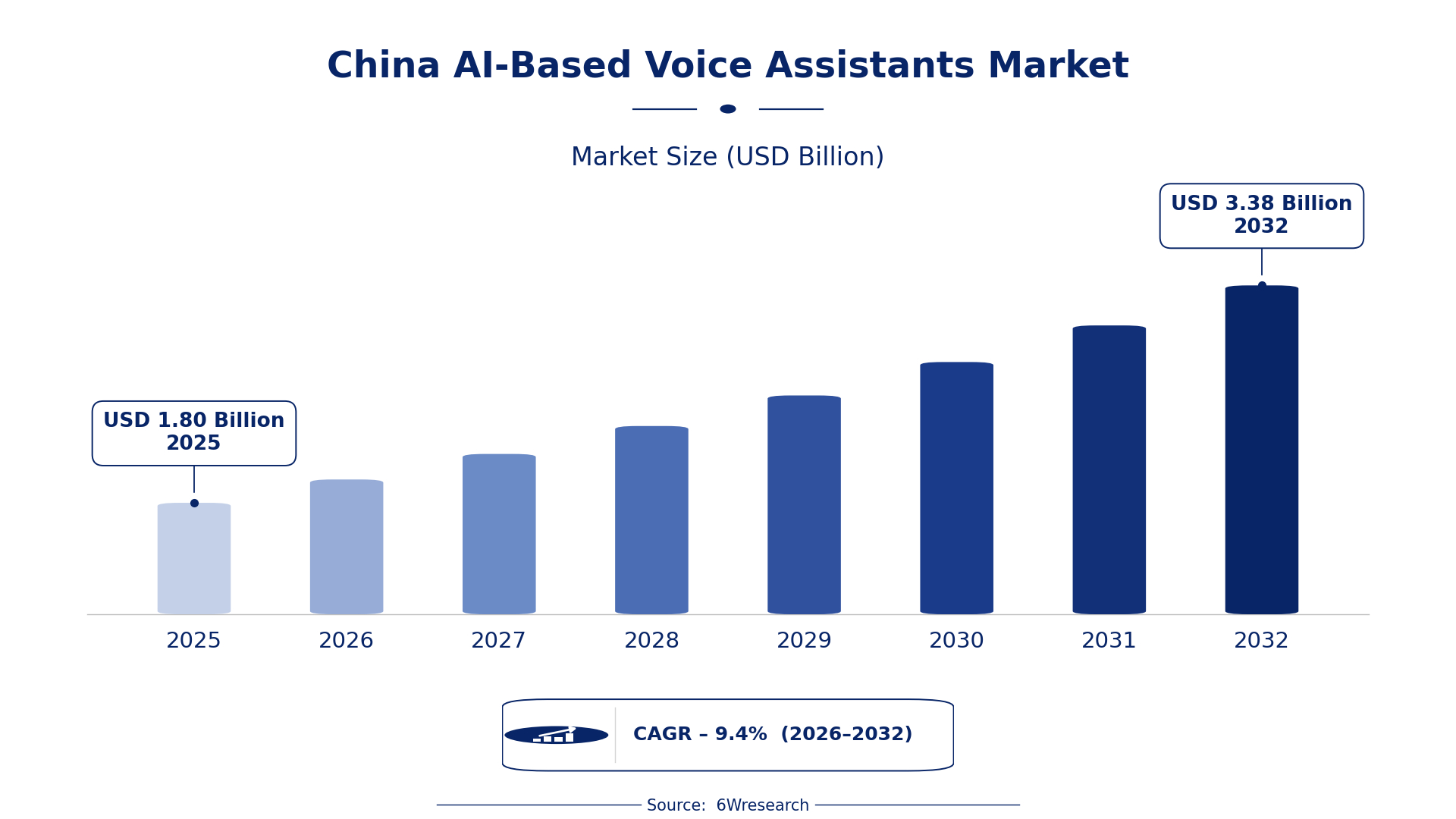
According to 6Wresearch internal database and industry insights, the China AI-Based Voice Assistants Market was valued at USD 1.80 billion in 2025 and is projected to reach USD 3.38 billion by 2032, growing at a CAGR of approximately 9.4% during 2026–2032.
China AI-Based Voice Assistants Market Highlights
| Report Metric | Details |
| Report Name | China AI-Based Voice Assistants Market |
| Market Size 2025 | USD 1.80 billion |
| Market Size 2032 | USD 3.38 billion |
| Absolute Growth 2025–2032 | USD 1.58 billion |
| CAGR 2026–2032 | 9.4% |
| Peak Annual Growth | 11.8% in 2028 |
| Forecast Period | 2026–2032 |
| Historical Data | 2022–2025 |
| Base Year | 2025 |
| Leading Assistant Type, 2025 | Smart Home Assistants (49% share) |
| Leading AI Feature, 2025 | Natural Language Processing (45% share) |
| Leading Distribution Channel, 2025 | Consumer Electronics Stores (52% share) |
| Leading End User, 2025 | Homeowners (51% share) |
| Fastest-Growing Assistant Type | Healthcare Voice Aides (11.6% CAGR) |
| Fastest-Growing AI Feature | AI Customer Support (11.2% CAGR) |
| Fastest-Growing Distribution Channel | CRM Software Vendors (11.6% CAGR) |
| Fastest-Growing End User | Elderly Care Homes (11.4% CAGR) |
| Growing Sector | Healthcare |
| Key End Users | Homeowners, Car Manufacturers, Corporates, Elderly Care Homes |
China AI-Based Voice Assistants Market Year-wise Growth Rate and Key Drivers (2022–2032)
This graph illustrates the annual growth rates of the market from 2022 to 2032, highlighting a steady upward trajectory and projected market expansion over the forecast period.
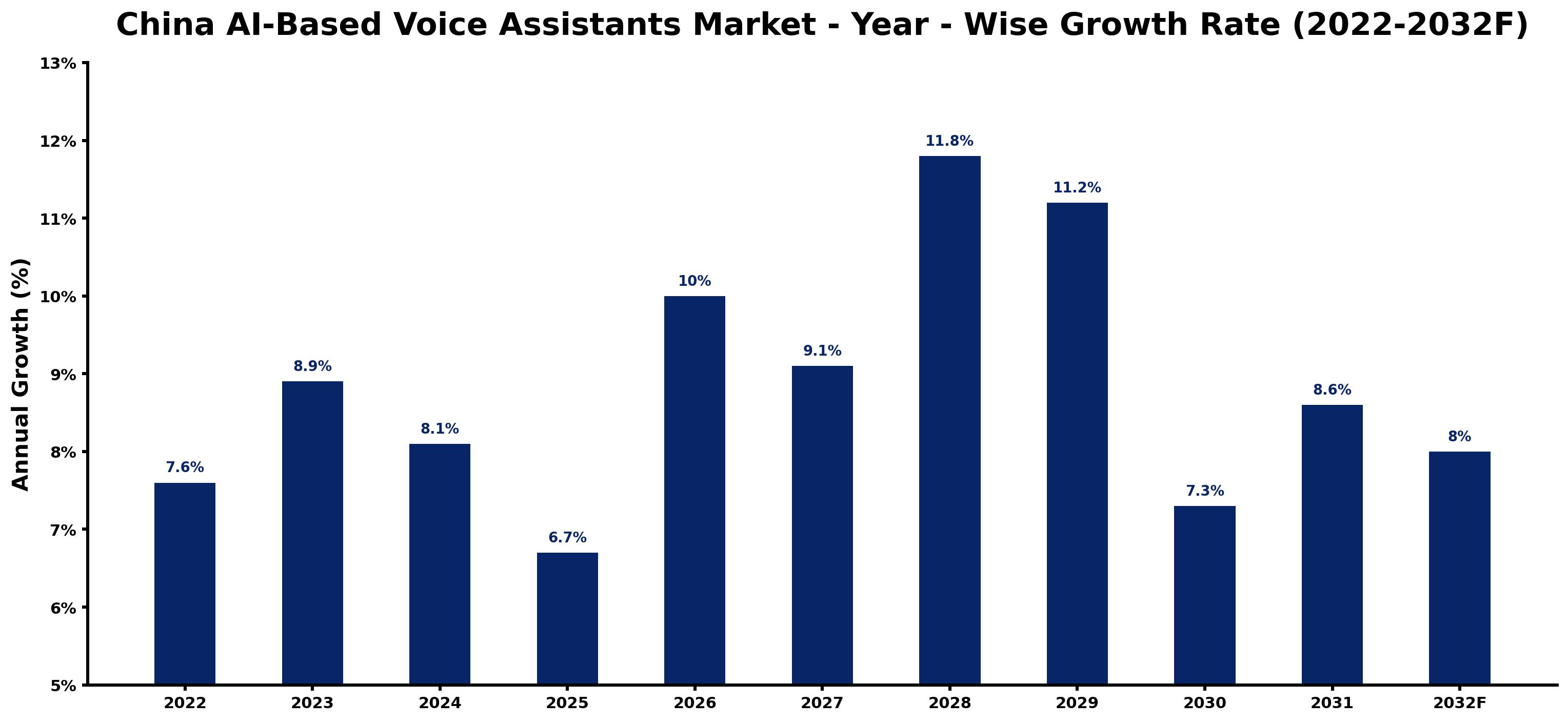
The following table presents the estimated annual growth rate for each year together with the principal factor influencing market performance.
| Year | Estimated Annual Growth (%) | Market Rationale |
| 2022 | 7.6 | The market experienced steady growth due to increasing adoption of smart home technologies, supported by the 'AI Innovation Action Plan' launched in 2021. |
| 2023 | 8.9 | Demand surged as consumer electronics expenditure rose in urban areas, driven by the integration of AI in daily devices. |
| 2024 | 8.1 | A slowdown occurred as the market adjusted to previous high growth rates, influenced by emerging technologies in the sector. |
| 2025 | 6.7 | Continued demand for smart home assistants contributed to further growth, as the automotive sector prepared to integrate AI voice assistants in new vehicles. |
| 2026 | 10.0 | Growth is expected to rebound as the automotive sector increases integration of voice assistants, aiming for 80% adoption in new vehicles by 2025. |
| 2027 | 9.1 | Demand is projected to slow slightly as the market matures and competition intensifies, particularly among consumer electronics. |
| 2028 | 11.8 | A peak in growth is anticipated as healthcare voice aides gain traction in elderly care, addressing the needs of approximately 10 million residents. |
| 2029 | 11.2 | Growth is expected to moderate as the market stabilises after rapid expansion, influenced by regulatory approvals and technological advancements. |
| 2030 | 7.3 | A slowdown is projected as the market adjusts to new technological standards, particularly in natural language processing. |
| 2031 | 8.6 | Growth is expected to resume as consumer interest in AI voice technology revitalises demand, especially in smart home applications. |
| 2032 | 8.0 | The market is projected to stabilise as integration becomes standard across sectors, influenced by ongoing advancements in AI technology. |
Note: Market size estimations and growth projections presented in this report are based on 6Wresearch's proprietary forecasting methodology, utilizing the latest available industry data, government publications, and primary research inputs.
China AI-Based Voice Assistants Market Synopsis
AI-Based Voice Assistants in China are software applications that utilise artificial intelligence for voice recognition and user interaction. These technologies are primarily employed for smart home automation, in-car navigation, and healthcare support. The China AI-Based Voice Assistants Market is growing due to rising consumer electronics expenditure and the increasing adoption of smart home technologies, with over 300 million smart home assistants in use as of 2022. The automotive sector is projected to integrate AI voice assistants in 80% of new vehicles by 2025, further driving demand.
Market Dynamics Impact Analysis (2026–2032)
| Factor | Type | Impact | Primary Segment Affected |
| Increasing consumer electronics expenditure drives demand for AI-based voice assistants. | Driver | High | Smart Home Assistants |
| The automotive sector's integration of voice assistants enhances user experience. | Driver | High | In-Car Assistants |
| Growing elderly population creates demand for healthcare voice aides. | Opportunity | High | Healthcare Voice Aides |
| Rising smart home technology adoption in urban areas presents investment opportunities. | Opportunity | High | Smart Home Assistants |
| Competition from alternative smart technologies may limit market growth. | Restraint | Medium | Enterprise Voice Bots |
| High costs of advanced AI integration can deter smaller enterprises. | Restraint | Medium | Healthcare Voice Aides |
| Regulatory approvals can delay product launches in the market. | Challenge | High | In-Car Assistants |
| Supply chain disruptions may impact availability of components for AI systems. | Challenge | Medium | Smart Home Assistants |
Evaluation of Drivers in China AI-Based Voice Assistants Market (2026–2032)
The factors lifting demand, and the evidence behind each, are summarised below.
| Drivers | Primary Segment Affected | Why It Matters (Evidence) |
| Rising consumer electronics expenditure boosts demand for smart home assistants. | Smart Home Assistants | The average consumer electronics expenditure in China is around 3,000 CNY per household annually. |
| Integration of voice assistants in vehicles improves user experience. | In-Car Assistants | The automotive sector in China is projected to integrate AI voice assistants in 80% of new vehicles by 2025. |
| Growing elderly population increases demand for healthcare voice aides. | Healthcare Voice Aides | The population of elderly care homes in China is approximately 10 million. |
| Smart home technology adoption in urban areas drives market growth. | Smart Home Assistants | Smart home technology adoption in urban areas of China is over 60% as of 2023. |
| Advancements in natural language processing improve user interactions. | Natural Language Processing | Natural Language Processing standards are defined by the Chinese National Standards (GB/T 35273-2020). |
Expansion of the AI-Based Voice Assistants market in China is backed by rising consumer electronics expenditure, averaging around 3,000 CNY per household annually. This increase fuels demand for smart home assistants, with over 300 million units in use as of 2022. The automotive sector is expected to integrate AI voice assistants in 80% of new vehicles by 2025, improving user experience. The elderly population, with approximately 10 million residing in care homes, drives demand for healthcare voice aides. Smart home technology adoption in urban areas exceeding 60% as of 2023 further supports market growth.
Evaluation of Restraints in China AI-Based Voice Assistants Market
The key brakes on demand, and where they bite hardest, are shown below.
| Market Restraint | Primary Segment Affected | Why It Matters (Evidence) |
| Competition from alternative smart technologies limits market growth. | Enterprise Voice Bots | Emerging technologies may divert consumer interest away from traditional voice assistants, leading to reduced sales. |
| High costs of advanced AI integration deter smaller enterprises. | Healthcare Voice Aides | Many smaller healthcare providers struggle to afford the necessary technology investments, hindering adoption. |
| Regulatory approvals delay product launches in the market. | In-Car Assistants | Stringent regulations can prolong the time to market for new voice assistant technologies, affecting availability. |
| Supply chain disruptions affect availability of components for AI systems. | Smart Home Assistants | Global supply chain issues have led to shortages of essential electronic components, impacting production timelines. |
| Consumer hesitation to adopt new technologies slows market penetration. | Healthcare Voice Aides | Concerns about data privacy and security can deter potential users from adopting AI solutions, limiting growth. |
China AI-Based Voice Assistants Market Challenges
The China AI-Based Voice Assistants market faces delays due to regulatory compliance with the National Standards, costing buyers approximately 15% in project timelines. Intense competition among local developers results in price wars, which can reduce margins by 20% for suppliers. A lack of integration standards hampers technological advancements, causing product launch delays of up to six months for producers. High development costs, with AI research averaging 5 billion CNY, strain startups financially, limiting their capacity to innovate and compete effectively.
Trends in the China AI-Based Voice Assistants Market
Four trends stand out in the China AI-Based Voice Assistants Market.
- Shift from Basic to Advanced Voice Recognition: Since 2022, the trend towards advanced voice recognition capabilities has gained momentum, particularly in smart home devices. Over 300 million smart home assistants in China are now equipped with improved natural language processing features, enhancing user interaction.
- Rise of AI in Healthcare: In 2023, the healthcare sector began integrating AI voice aides into patient management systems, with a target to improve efficiency by 2025. This shift is expected to enhance patient engagement and adherence to treatment plans.
- Increased Adoption of Voice-Activated Commands: As of 2023, voice-activated command systems have become standard in 70% of new consumer electronics products in China. This trend reflects a growing consumer preference for hands-free technology in everyday devices.
- Growth of AI Customer Support Solutions: Starting in 2023, AI customer support solutions have been rapidly adopted across various industries. The demand for AI customer support is anticipated to grow at a CAGR of 11.2% through 2032.
Investment Opportunities in the China AI-Based Voice Assistants Market
The following opportunities in the China AI-Based Voice Assistants Market pair current demand with a clear way in.
- Investment in Smart Home Technologies: With smart home technology adoption exceeding 60% in urban areas, there is a strong opportunity to invest in related AI voice assistant products. Homeowners are the primary buyers, and partnerships with local retailers can facilitate market entry.
- Supply of Healthcare Voice Aides: The increasing elderly population, projected at around 10 million in care homes, presents a strong opportunity to supply healthcare voice aides. Collaborating with healthcare providers can improve market penetration.
- Expansion into Automotive Sector: With 80% of new vehicles integrating AI voice assistants by 2025, there is a clear opportunity to supply automotive OEMs. Engaging in joint ventures with manufacturers can streamline entry into this growing market.
- Focus on AI Customer Support Solutions: The demand for AI customer support is set to rise, offering an opportunity to supply innovative solutions. Targeting corporates looking to improve operational efficiency can lead to successful market entry.
Government Initiatives in the China AI-Based Voice Assistants Market
The 'AI Innovation Action Plan' launched by the Ministry of Industry and Information Technology in 2021 focuses on promoting AI technology integration in sectors like smart homes and healthcare. This initiative aims to support the development of AI capabilities, encouraging producers to innovate and adopt new technologies. Additionally, the 'Artificial Intelligence Industry Development Plan' approved in 2020 aims to boost AI applications in consumer electronics and automotive industries, providing a framework for growth and investment in these sectors.
In 2023, the Ministry of Science and Technology initiated the 'AI for Good' program, with a budget of 5 billion CNY, focusing on healthcare applications of AI technologies, including voice assistants. This funding supports research and development projects that aim to improve patient care through practical AI solutions. Furthermore, the National Health Commission updated the 'Guidelines for the Use of AI in Healthcare' in 2021, promoting the adoption of AI voice aides in medical settings, ensuring that healthcare providers can effectively utilise these technologies.
Future Insight of the China AI-Based Voice Assistants Market
By 2032, the China AI-Based Voice Assistants market will undergo notable changes, driven by the integration of AI voice assistants in 80% of new vehicles and the adoption of smart home technologies exceeding 60% in urban areas. The Ministry of Industry and Information Technology's initiatives will promote advancements in voice recognition technology. The National Development and Reform Commission's programme will boost healthcare applications, catering to the needs of around 10 million elderly residents. These shifts will open new avenues for buyers and suppliers.
Market Segmentation Analysis
The report offers a comprehensive study of the following market segments and their leading categories in the market.
By Assistant Type – Smart Home Assistants Dominated, Healthcare Voice Aides Expected to Grow Fastest
According to Shubham Padhi, Research Analyst at 6Wresearch, the largest assistant type category in 2025 was Smart Home Assistants, with a 49% share of total revenue. Smart Home Assistants dominate the market due to their extensive use for home automation, with over 300 million units deployed across China. Their popularity is particularly strong among urban consumers seeking convenience in managing household tasks. The quickest growth will come from Healthcare Voice Aides, forecast to expand at a CAGR of 11.6% between 2026 and 2032. Healthcare Voice Aides are experiencing rapid growth as the need for support in elderly care homes increases, with approximately 10 million residents benefiting from these technologies. The government's initiatives to enhance healthcare through AI by 2025 are further propelling this segment's expansion. Suppliers should focus on developing features specifically for healthcare applications to effectively meet the rising demand in this area.
By AI Feature – Natural Language Processing Dominated, AI Customer Support Expected to Grow Fastest
Natural Language Processing took a 45% share of ai feature in 2025, more than any other category. Natural Language Processing holds the largest market share as it is crucial for accurately interpreting user commands and delivering appropriate responses. Its widespread integration across various applications ensures a seamless user experience, making it vital in the market. AI Customer Support is projected to grow fastest, at a CAGR of 11.2% during 2026–2032. AI Customer Support is the fastest-growing feature, primarily due to its essential role in customer service for efficiently addressing inquiries. The rise in e-commerce and digital services has significantly increased the demand for effective support solutions. Buyers should prioritise solutions that incorporate advanced AI Customer Support functionalities to improve service efficiency and enhance overall user satisfaction.
By Distribution Channel – Consumer Electronics Stores Dominated, CRM Software Vendors Expected to Grow Fastest
In 2025, Consumer Electronics Stores led the distribution channel split with a 52% share. Consumer Electronics Stores lead the market as the primary retail channels for AI-Based Voice Assistants, facilitating direct access for consumers. Their established presence in urban areas aligns with the high demand for smart home technology. Over 2026–2032, CRM Software Vendors are expected to post the fastest growth, at a CAGR of 11.6%. CRM Software Vendors are the fastest-growing distribution channel, as they increasingly incorporate voice assistant functionalities into their offerings. This trend reflects the growing integration of AI solutions within customer relationship management systems. Suppliers must consider partnerships with CRM Software Vendors to expand their reach and tap into the growing demand for integrated voice assistant solutions.
By End User – Homeowners Dominated, Elderly Care Homes Expected to Grow Fastest
Homeowners held a 51% share of the China AI-Based Voice Assistants Market by end user in 2025. Homeowners represent the largest end-user segment for AI-Based Voice Assistants, utilising these technologies for smart home applications. With over 60% adoption of smart home technologies in urban areas, this group's market share is poised for continued growth. Elderly Care Homes are set to record the highest CAGR in this split, 11.4% over 2026–2032. Elderly Care Homes are the fastest-growing end-user segment, increasingly adopting voice assistants to provide better support for elderly residents. The rising population in these facilities highlights the urgent need for effective healthcare solutions. Providers should concentrate on creating customised voice assistant solutions tailored for elderly care homes to address the escalating demand in this sector.
Key Attractiveness of the Report
- 10 Years of Market Numbers
- Historical Data Starting from 2022 to 2025
- Base Year 2025
- Forecast Data until 2032
- Key Performance Indicators Impacting the Market
- Major Upcoming Developments and Projects
Key Highlights of the Report:
- China AI-Based Voice Assistants Market Outlook
- Market Size of China AI-Based Voice Assistants Market, 2025
- Forecast of China AI-Based Voice Assistants Market, 2032
- Historical Data and Forecast of China AI-Based Voice Assistants Revenues & Volume for the Period 2022 - 2032F
- China AI-Based Voice Assistants Market Trend Evolution
- China AI-Based Voice Assistants Market Drivers and Challenges
- China AI-Based Voice Assistants Price Trends
- China AI-Based Voice Assistants Porter's Five Forces
- China AI-Based Voice Assistants Industry Life Cycle
- Historical Data and Forecast of China AI-Based Voice Assistants Market Revenues & Volume By Assistant Type for the Period 2022 - 2032F
- Historical Data and Forecast of China AI-Based Voice Assistants Market Revenues & Volume By Smart Home Assistants for the Period 2022 - 2032F
- Historical Data and Forecast of China AI-Based Voice Assistants Market Revenues & Volume By In-Car Assistants for the Period 2022 - 2032F
- Historical Data and Forecast of China AI-Based Voice Assistants Market Revenues & Volume By Enterprise Voice Bots for the Period 2022 - 2032F
- Historical Data and Forecast of China AI-Based Voice Assistants Market Revenues & Volume By Healthcare Voice Aides for the Period 2022 - 2032F
- Historical Data and Forecast of China AI-Based Voice Assistants Market Revenues & Volume By AI Feature for the Period 2022 - 2032F
- Historical Data and Forecast of China AI-Based Voice Assistants Market Revenues & Volume By Natural Language Processing for the Period 2022 - 2032F
- Historical Data and Forecast of China AI-Based Voice Assistants Market Revenues & Volume By Voice-Activated Commands for the Period 2022 - 2032F
- Historical Data and Forecast of China AI-Based Voice Assistants Market Revenues & Volume By AI Customer Support for the Period 2022 - 2032F
- Historical Data and Forecast of China AI-Based Voice Assistants Market Revenues & Volume By Medication Reminders for the Period 2022 - 2032F
- Historical Data and Forecast of China AI-Based Voice Assistants Market Revenues & Volume By Distribution Channel for the Period 2022 - 2032F
- Historical Data and Forecast of China AI-Based Voice Assistants Market Revenues & Volume By Consumer Electronics Stores for the Period 2022 - 2032F
- Historical Data and Forecast of China AI-Based Voice Assistants Market Revenues & Volume By Automotive OEMs for the Period 2022 - 2032F
- Historical Data and Forecast of China AI-Based Voice Assistants Market Revenues & Volume By CRM Software Vendors for the Period 2022 - 2032F
- Historical Data and Forecast of China AI-Based Voice Assistants Market Revenues & Volume By MedTech Retailers for the Period 2022 - 2032F
- Historical Data and Forecast of China AI-Based Voice Assistants Market Revenues & Volume By End User for the Period 2022 - 2032F
- Historical Data and Forecast of China AI-Based Voice Assistants Market Revenues & Volume By Homeowners for the Period 2022 - 2032F
- Historical Data and Forecast of China AI-Based Voice Assistants Market Revenues & Volume By Car Manufacturers for the Period 2022 - 2032F
- Historical Data and Forecast of China AI-Based Voice Assistants Market Revenues & Volume By Corporates for the Period 2022 - 2032F
- Historical Data and Forecast of China AI-Based Voice Assistants Market Revenues & Volume By Elderly Care Homes for the Period 2022 - 2032F
- China AI-Based Voice Assistants Import Export Trade Statistics
- Market Opportunity Assessment By Assistant Type
- Market Opportunity Assessment By AI Feature
- Market Opportunity Assessment By Distribution Channel
- Market Opportunity Assessment By End User
- China AI-Based Voice Assistants Top Companies Market Share
- China AI-Based Voice Assistants Competitive Benchmarking By Technical and Operational Parameters
- China AI-Based Voice Assistants Company Profiles
- China AI-Based Voice Assistants Key Strategic Recommendations
Market Covered
Segments analysed in this report are listed below.
By Assistant Type
- Smart Home Assistants
- In-Car Assistants
- Enterprise Voice Bots
- Healthcare Voice Aides
By AI Feature
- Natural Language Processing
- Voice-Activated Commands
- AI Customer Support
- Medication Reminders
By Distribution Channel
- Consumer Electronics Stores
- Automotive OEMs
- CRM Software Vendors
- MedTech Retailers
By End User
- Homeowners
- Car Manufacturers
- Corporates
- Elderly Care Homes































