China AI-driven Quality Control Market Size & Growth Rate
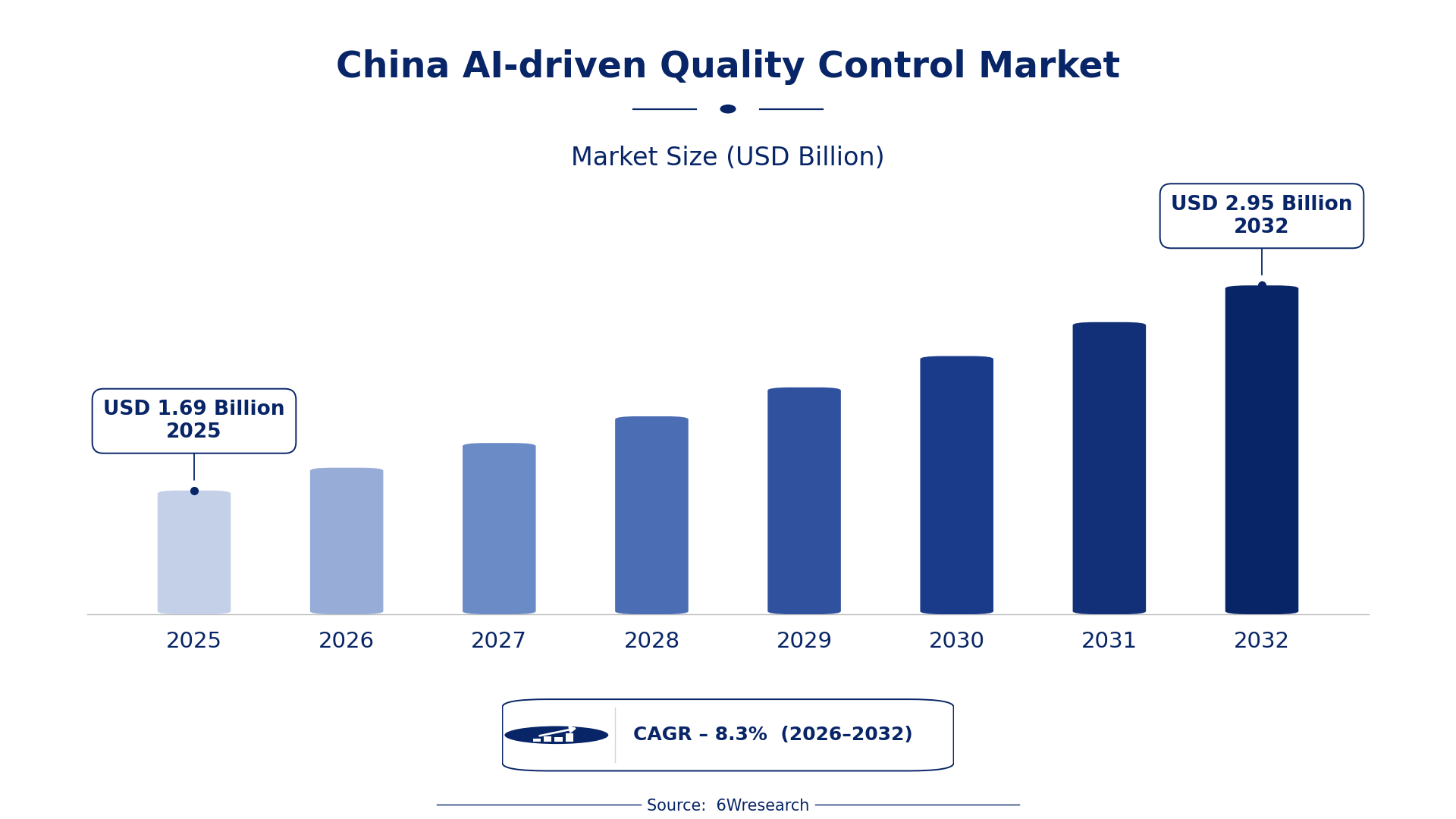
According to 6Wresearch internal database and industry insights, the China AI-driven Quality Control Market was valued at USD 1.69 billion in 2025 and is projected to reach USD 2.95 billion by 2032, growing at a CAGR of approximately 8.3% during 2026–2032.
China AI-driven Quality Control Market Highlights
| Report Metric | Details |
| Report Name | China AI-driven Quality Control Market |
| Market Size 2025 | USD 1.69 billion |
| Market Size 2032 | USD 2.95 billion |
| Absolute Growth 2025–2032 | USD 1.26 billion |
| CAGR 2026–2032 | 8.3% |
| Peak Annual Growth | 10.8% in 2027 |
| Forecast Period | 2026–2032 |
| Historical Data | 2022–2025 |
| Base Year | 2025 |
| Leading Product Segment, 2025 | Electronics Assembly (39% share) |
| Leading AI Technology, 2025 | Defect Detection (38% share) |
| Leading Distribution Channel, 2025 | Inspection System Providers (37% share) |
| Leading End User, 2025 | PCB Manufacturers (45% share) |
| Fastest-Growing Product Segment | Food & Beverage (10.9% CAGR) |
| Fastest-Growing AI Technology | Vision-Based Inspection (10.4% CAGR) |
| Fastest-Growing Distribution Channel | Quality Automation Vendors (9.8% CAGR) |
| Fastest-Growing End User | FMCG Processing Units (9.4% CAGR) |
| Growing Sector | FMCG Processing Units |
| Key End Users | PCB Manufacturers, Car Manufacturers, FMCG Processing Units, Pharmaceutical Plants |
China AI-driven Quality Control Market Year-wise Growth Rate and Key Drivers (2022–2032)
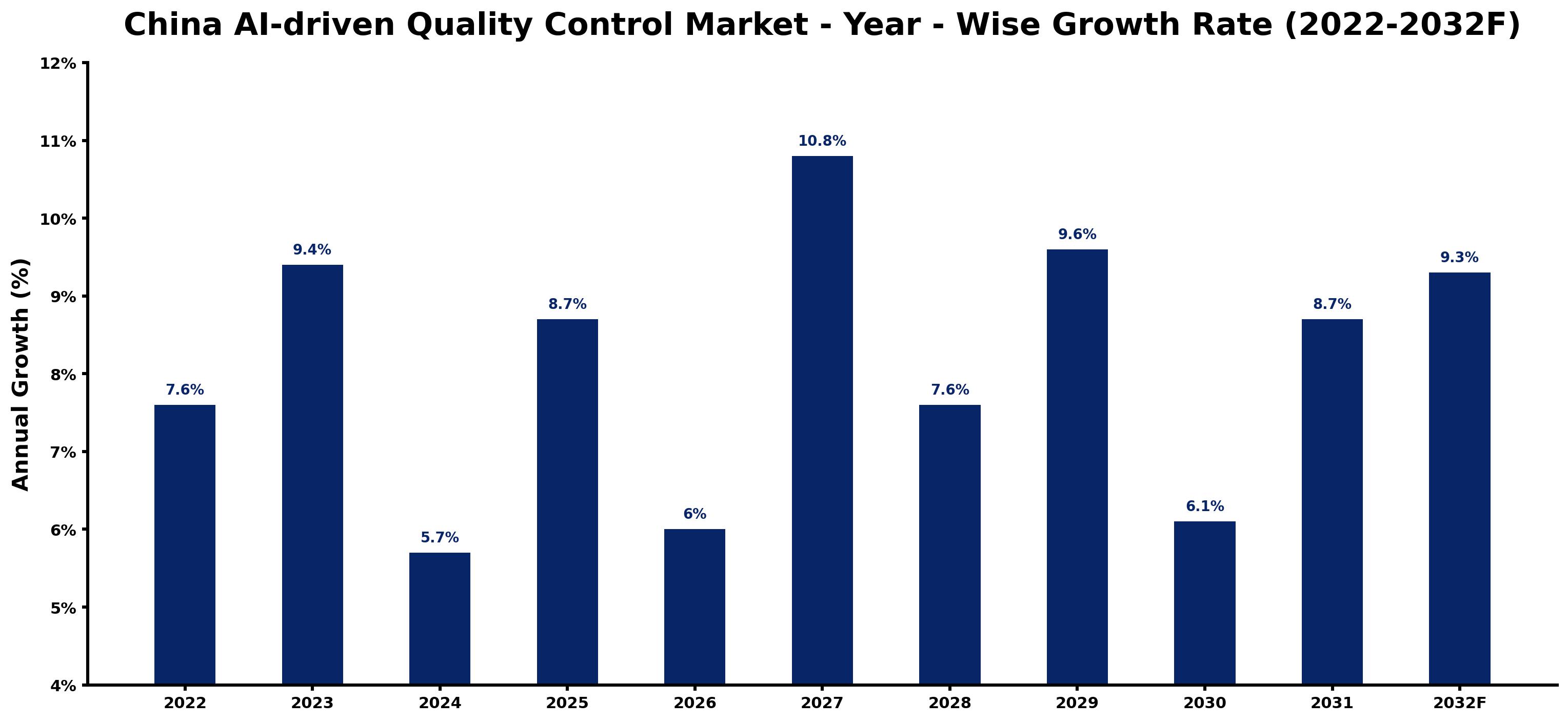
This graph illustrates the annual growth rates of the market from 2022 to 2032, highlighting a steady upward trajectory and projected market expansion over the forecast period.
Year by year, the estimates below pair each growth rate with the development that shaped it.
| Year | Estimated Annual Growth (%) | Market Rationale |
| 2022 | 7.6 | The market experienced steady growth due to increased adoption of AI technologies in manufacturing. |
| 2023 | 9.4 | Demand surged as the electronics assembly sector expanded its use of AI-driven quality control solutions. |
| 2024 | 5.7 | Growth slowed as manufacturers adjusted to new technologies and standards in quality control. |
| 2025 | 8.7 | The automotive sector's production increase drove higher demand for AI quality control systems. |
| 2026 | 6.0 | A slowdown occurred as the market adjusted to the previous year's rapid growth. |
| 2027 | 10.8 | Demand accelerated as manufacturers sought to enhance quality assurance through AI integration. |
| 2028 | 7.6 | Growth slowed again as the market stabilised after the peak in 2027. |
| 2029 | 9.6 | The electronics sector's continued expansion led to renewed interest in AI-driven quality control solutions. |
| 2030 | 6.1 | Growth slowed as the market faced challenges in technology integration and standard compliance. |
| 2031 | 8.7 | An increase in production across various sectors revitalised demand for quality control technologies. |
| 2032 | 9.3 | Demand remained strong as industries continued to invest in AI-driven quality assurance systems. |
Note: Market size estimations and growth projections presented in this report are based on 6Wresearch's proprietary forecasting methodology, utilizing the latest available industry data, government publications, and primary research inputs.
China AI-driven Quality Control Market Synopsis
AI-driven Quality Control in China utilises advanced algorithms and machine learning to improve manufacturing processes. This technology integrates seamlessly with traditional quality control systems, concentrating on defect detection and process optimisation. The China AI-driven Quality Control Market is expanding due to increasing domestic production and export demands, particularly from the electronics and automotive sectors. In 2022, the automotive sector produced over 26 million vehicles, creating a strong need for effective quality control solutions. Furthermore, the food and beverage industry is expected to reach a market size of approximately 5 trillion yuan by 2025, further driving investment in AI technologies.
Market Dynamics Impact Analysis (2026–2032)
| Factor | Type | Impact | Primary Segment Affected |
| Growing demand for defect detection in electronics assembly | Driver | High | Electronics Assembly |
| Increased production in automotive sector | Driver | High | Automotive Components |
| Expanding food and beverage market | Opportunity | High | Food & Beverage |
| Investment in pharmaceutical plants for compliance | Opportunity | High | Pharma Packaging |
| High initial costs of AI integration | Restraint | Medium | Automotive Components |
| Skills shortages in AI technologies | Restraint | Medium | Electronics Assembly |
| Competition among quality control providers | Challenge | High | Inspection System Providers |
| Rapid pace of technology advancement | Challenge | High | Quality Automation Vendors |
Evaluation of Drivers in China AI-driven Quality Control Market (2026–2032)
The main growth drivers and the segments they affect most are set out below.
| Drivers | Primary Segment Affected | Why It Matters (Evidence) |
| Increased investment in AI technologies | Defect Detection | This investment enhances defect detection capabilities, leading to higher quality assurance in electronics assembly, which accounted for 39% of the market in 2025. |
| Rising production in the automotive sector | Automotive Components | The production of over 26 million vehicles in 2022 increased demand for quality control solutions, driving investment in AI technologies for automotive components. |
| Expansion in the food and beverage market | Food & Beverage | With the food and beverage industry projected to reach a market size of approximately 5 trillion yuan by 2025, demand for AI-driven quality control systems is set to rise significantly. |
| Government initiatives promoting AI adoption | Pharma Packaging | The 'New Generation Artificial Intelligence Development Plan' encourages pharmaceutical plants to adopt AI technologies, ensuring compliance with strict packaging regulations. |
| Growing adoption of quality automation solutions | Quality Automation Vendors | As the fastest-growing distribution channel, quality automation vendors are expanding their offerings, driving demand for AI-driven quality control systems across various sectors. |
Market growth in China for AI-driven Quality Control is driven by heightened investment in AI technologies, increased production in the automotive sector, and expansion in the food and beverage market. In 2022, the automotive sector produced over 26 million vehicles, resulting in a greater demand for effective quality control solutions. The food and beverage industry is projected to reach a market size of approximately 5 trillion yuan by 2025, increasing the need for quality assurance systems.
Evaluation of Restraints in China AI-driven Quality Control Market
The table below lists the restraints and the evidence behind each.
| Market Restraint | Primary Segment Affected | Why It Matters (Evidence) |
| High initial costs of AI integration | Automotive Components | The substantial investment required deters smaller manufacturers from adopting AI-driven quality control systems, limiting their operational efficiency. |
| Skills shortages in AI technologies | Electronics Assembly | A lack of skilled personnel delays the effective implementation of AI quality control systems, impacting productivity and compliance. |
| Intense competition among quality control providers | Inspection System Providers | Fierce competition drives down prices, affecting profit margins for suppliers in the market and limiting investment in innovation. |
| Rapid pace of technology advancement | Quality Automation Vendors | The swift evolution of AI technologies creates a gap between current capabilities and industry needs, complicating integration efforts. |
| Integration challenges with existing systems | Pharma Packaging | Difficulties in integrating AI with traditional quality control systems can slow down adoption rates and increase operational costs. |
China AI-driven Quality Control Market Challenges
In 2022, intense competition among quality control providers in China led to price reductions, threatening profit margins for suppliers in the AI-driven quality control market. A shortage of skilled professionals in AI technologies complicates the implementation of these systems, resulting in project delays and increased training costs for manufacturers. Rapid advancements in technology create a gap between current capabilities and industry requirements, forcing producers to invest heavily in upgrades that may not yield immediate returns. High initial costs associated with adopting AI-driven quality control systems can deter smaller manufacturers from implementing these essential technologies, limiting their operational efficiency.
Trends in the China AI-driven Quality Control Market
Buyers and suppliers in the China AI-driven Quality Control Market are adjusting to the following trends.
- Shift Towards Real-Time Quality Monitoring: In 2023, electronics manufacturers increasingly embraced real-time quality monitoring systems, enhancing defect detection capabilities. This shift is particularly notable in Guangdong province, where investments in AI technologies have surged, improving production efficiency.
- Growing Adoption of Vision-Based Inspection: By 2025, the automotive sector began prioritising vision-based inspection technologies for quality assurance. This trend is apparent in Shanghai, where advanced AI systems are being implemented to ensure compliance with stringent standards.
- Increased Focus on Compliance in Pharmaceuticals: Since 2021, pharmaceutical plants have intensified their focus on compliance with national regulations, driving demand for AI-driven quality control solutions. The updated 'Quality Management System Standards' in 2023 reflect this shift towards improved quality assurance.
- Expansion of AI in Food Production: The food and beverage industry is projected to reach 5 trillion yuan by 2025, leading to a surge in AI-driven quality control adoption. This trend is particularly evident in processing units across China, where safety standards are paramount.
Investment Opportunities in the China AI-driven Quality Control Market
Below are the investment opportunities with the strongest case in the China AI-driven Quality Control Market.
- Investment Gap in AI Technologies: With the AI industry expected to reach 1 trillion yuan by 2030, there is an investment opportunity in AI-driven quality control technologies. Targeting electronics manufacturers in Guangdong province can yield substantial returns as they seek to enhance quality assurance.
- Timing for AI Integration: As the automotive sector continues to grow, now is the ideal time to supply AI-driven quality control solutions. Collaborating with local automotive manufacturers in Shanghai can facilitate market entry and expansion, addressing their compliance needs.
- Supply of Advanced Quality Control Systems: The increasing demand for compliance in pharmaceuticals presents an opportunity to supply AI technologies. Engaging with pharmaceutical plants in China will enable access to this growing market, ensuring adherence to regulatory standards.
- Entry through Joint Ventures: Establishing joint ventures with inspection system providers can enhance market penetration. This strategy is particularly effective in the electronics assembly sector, where AI adoption is rapidly increasing.
Government Initiatives in the China AI-driven Quality Control Market
The 'New Generation Artificial Intelligence Development Plan' launched by the Ministry of Industry and Information Technology in 2021 aims to promote AI integration in manufacturing processes. This initiative encourages manufacturers to adopt AI-driven quality control technologies, ensuring compliance with industry standards and improving operational efficiency. The plan outlines specific targets for AI adoption, aiming for 30% integration in quality control by 2025, which will significantly impact production capabilities across various sectors.
The National Development and Reform Commission oversees the 'AI Quality Control Initiative', which allocated 5 billion yuan in 2022 to enhance manufacturing standards. This funding supports the development and implementation of AI-driven quality control systems, particularly in the automotive and electronics sectors, ensuring that manufacturers meet stringent quality requirements. Additionally, the Ministry of Science and Technology's 'AI for Manufacturing' program initiated in 2023 focuses on improving quality control technologies, facilitating AI adoption in these industries.
Future Insight of the China AI-driven Quality Control Market
Several forward-looking factors should support the AI-driven quality control market in China over the coming years. The Ministry of Industry and Information Technology's 'Smart Manufacturing Development Plan' will promote AI integration across various sectors. By 2030, China's AI industry is set to reach a value of 1 trillion yuan, with quality control being a significant application area. Increased investments in the automotive manufacturing sector will drive innovation, while the food and beverage industry is expected to reach a market size of approximately 5 trillion yuan by 2025, further elevating the demand for effective quality control solutions.
Market Segmentation Analysis
The analysis below covers each segmentation, its leading category in 2025 and its fastest-growing category through 2032.
By Product Segment – Electronics Assembly Dominated, Food & Beverage Expected to Grow Fastest
According to Shubham Padhi, Research Analyst at 6Wresearch, Electronics Assembly accounted for a 39% market share by product segment in 2025. The electronics assembly sector commands the largest share in the China AI-driven quality control market due to its critical reliance on advanced technologies for defect detection and process optimisation. The Guangdong province exemplifies this trend, showcasing substantial investments in AI to enhance manufacturing practices. Food & Beverage is set to record the highest CAGR in this split, 10.9% over 2026–2032. The food and beverage segment is rapidly expanding as the demand for quality control solutions grows to ensure compliance with safety and quality standards. With the market projected to reach approximately 5 trillion yuan by 2025, this sector's growth is set to accelerate further. Suppliers should prioritise developing specialised solutions to address the unique needs of both the electronics and food sectors, capitalising on their growth trajectories.
By AI Technology – Defect Detection Dominated, Vision-Based Inspection Expected to Grow Fastest
Defect Detection held a 38% share of the China AI-driven Quality Control Market by ai technology in 2025. Defect detection holds the largest share in the AI technology segment as it is a fundamental application in quality control processes across various industries. This focus on defect detection is crucial for ensuring product reliability and compliance with industry standards. Over 2026–2032, Vision-Based Inspection is expected to post the fastest growth, at a CAGR of 10.4%. Vision-based inspection is experiencing the fastest growth due to its effectiveness in conducting visual assessments of product quality in real-time. As manufacturers increasingly adopt this technology, its application will likely expand, further driving market growth. This indicates that suppliers should invest in vision-based inspection technologies to meet the rising demand for efficient quality control solutions.
By Distribution Channel – Inspection System Providers Dominated, Quality Automation Vendors Expected to Grow Fastest
With a 37% revenue share in 2025, Inspection System Providers was the largest distribution channel category. Inspection system providers dominate the distribution channel segment, as they are essential for implementing solutions that ensure quality assurance in manufacturing processes. Their direct involvement in deploying these technologies makes them a vital component of the market. Quality Automation Vendors are projected to grow fastest, at a CAGR of 9.8% during 2026–2032. Quality automation vendors are witnessing the fastest growth as they increasingly supply technologies that automate quality control processes across various sectors. This shift towards automation is expected to enhance operational efficiency and accuracy in quality management. Suppliers should focus on partnerships with quality automation vendors to leverage the growing trend towards automated quality control solutions.
By End User – PCB Manufacturers Dominated, FMCG Processing Units Expected to Grow Fastest
In 2025, PCB Manufacturers led the end user split with a 45% share. PCB manufacturers represent the largest share of end users in the AI-driven quality control market, as they heavily rely on advanced technologies for conducting quality checks on printed circuit boards. Their critical need for precision and reliability drives the demand for these solutions. The quickest growth will come from FMCG Processing Units, forecast to expand at a CAGR of 9.4% between 2026 and 2032. FMCG processing units are experiencing the fastest growth in adopting quality control technologies, as they seek to enhance efficiency and maintain high standards in fast-moving consumer goods production. This sector's rapid expansion will continue to fuel demand for quality control innovations. This suggests that suppliers should tailor their offerings to meet the specific requirements of PCB manufacturers and FMCG processing units to capture market opportunities.
Key Attractiveness of the Report
- 10 Years of Market Numbers
- Historical Data Starting from 2022 to 2025
- Base Year 2025
- Forecast Data until 2032
- Key Performance Indicators Impacting the Market
- Major Upcoming Developments and Projects
Key Highlights of the Report:
- China AI-driven Quality Control Market Outlook
- Market Size of China AI-driven Quality Control Market, 2025
- Forecast of China AI-driven Quality Control Market, 2032
- Historical Data and Forecast of China AI-driven Quality Control Revenues & Volume for the Period 2022 - 2032F
- China AI-driven Quality Control Market Trend Evolution
- China AI-driven Quality Control Market Drivers and Challenges
- China AI-driven Quality Control Price Trends
- China AI-driven Quality Control Porter's Five Forces
- China AI-driven Quality Control Industry Life Cycle
- Historical Data and Forecast of China AI-driven Quality Control Market Revenues & Volume By Product Segment for the Period 2022 - 2032F
- Historical Data and Forecast of China AI-driven Quality Control Market Revenues & Volume By Electronics Assembly for the Period 2022 - 2032F
- Historical Data and Forecast of China AI-driven Quality Control Market Revenues & Volume By Automotive Components for the Period 2022 - 2032F
- Historical Data and Forecast of China AI-driven Quality Control Market Revenues & Volume By Food & Beverage for the Period 2022 - 2032F
- Historical Data and Forecast of China AI-driven Quality Control Market Revenues & Volume By Pharma Packaging for the Period 2022 - 2032F
- Historical Data and Forecast of China AI-driven Quality Control Market Revenues & Volume By AI Technology for the Period 2022 - 2032F
- Historical Data and Forecast of China AI-driven Quality Control Market Revenues & Volume By Defect Detection for the Period 2022 - 2032F
- Historical Data and Forecast of China AI-driven Quality Control Market Revenues & Volume By Vision-Based Inspection for the Period 2022 - 2032F
- Historical Data and Forecast of China AI-driven Quality Control Market Revenues & Volume By Contaminant Detection for the Period 2022 - 2032F
- Historical Data and Forecast of China AI-driven Quality Control Market Revenues & Volume By Anomaly Detection for the Period 2022 - 2032F
- Historical Data and Forecast of China AI-driven Quality Control Market Revenues & Volume By Distribution Channel for the Period 2022 - 2032F
- Historical Data and Forecast of China AI-driven Quality Control Market Revenues & Volume By Inspection System Providers for the Period 2022 - 2032F
- Historical Data and Forecast of China AI-driven Quality Control Market Revenues & Volume By Quality Automation Vendors for the Period 2022 - 2032F
- Historical Data and Forecast of China AI-driven Quality Control Market Revenues & Volume By Smart Sensors Suppliers for the Period 2022 - 2032F
- Historical Data and Forecast of China AI-driven Quality Control Market Revenues & Volume By Pharma Equipment Vendors for the Period 2022 - 2032F
- Historical Data and Forecast of China AI-driven Quality Control Market Revenues & Volume By End User for the Period 2022 - 2032F
- Historical Data and Forecast of China AI-driven Quality Control Market Revenues & Volume By PCB Manufacturers for the Period 2022 - 2032F
- Historical Data and Forecast of China AI-driven Quality Control Market Revenues & Volume By Car Manufacturers for the Period 2022 - 2032F
- Historical Data and Forecast of China AI-driven Quality Control Market Revenues & Volume By FMCG Processing Units for the Period 2022 - 2032F
- Historical Data and Forecast of China AI-driven Quality Control Market Revenues & Volume By Pharmaceutical Plants for the Period 2022 - 2032F
- China AI-driven Quality Control Import Export Trade Statistics
- Market Opportunity Assessment By Product Segment
- Market Opportunity Assessment By AI Technology
- Market Opportunity Assessment By Distribution Channel
- Market Opportunity Assessment By End User
- China AI-driven Quality Control Top Companies Market Share
- China AI-driven Quality Control Competitive Benchmarking By Technical and Operational Parameters
- China AI-driven Quality Control Company Profiles
- China AI-driven Quality Control Key Strategic Recommendations
Market Covered
Segments analysed in this report are listed below.
By Product Segment
- Electronics Assembly
- Automotive Components
- Food & Beverage
- Pharma Packaging
By AI Technology
- Defect Detection
- Vision-Based Inspection
- Contaminant Detection
- Anomaly Detection
By Distribution Channel
- Inspection System Providers
- Quality Automation Vendors
- Smart Sensors Suppliers
- Pharma Equipment Vendors
By End User
- PCB Manufacturers
- Car Manufacturers
- FMCG Processing Units
- Pharmaceutical Plants































