China AI-enabled Automotive Systems Market Size & Growth Rate
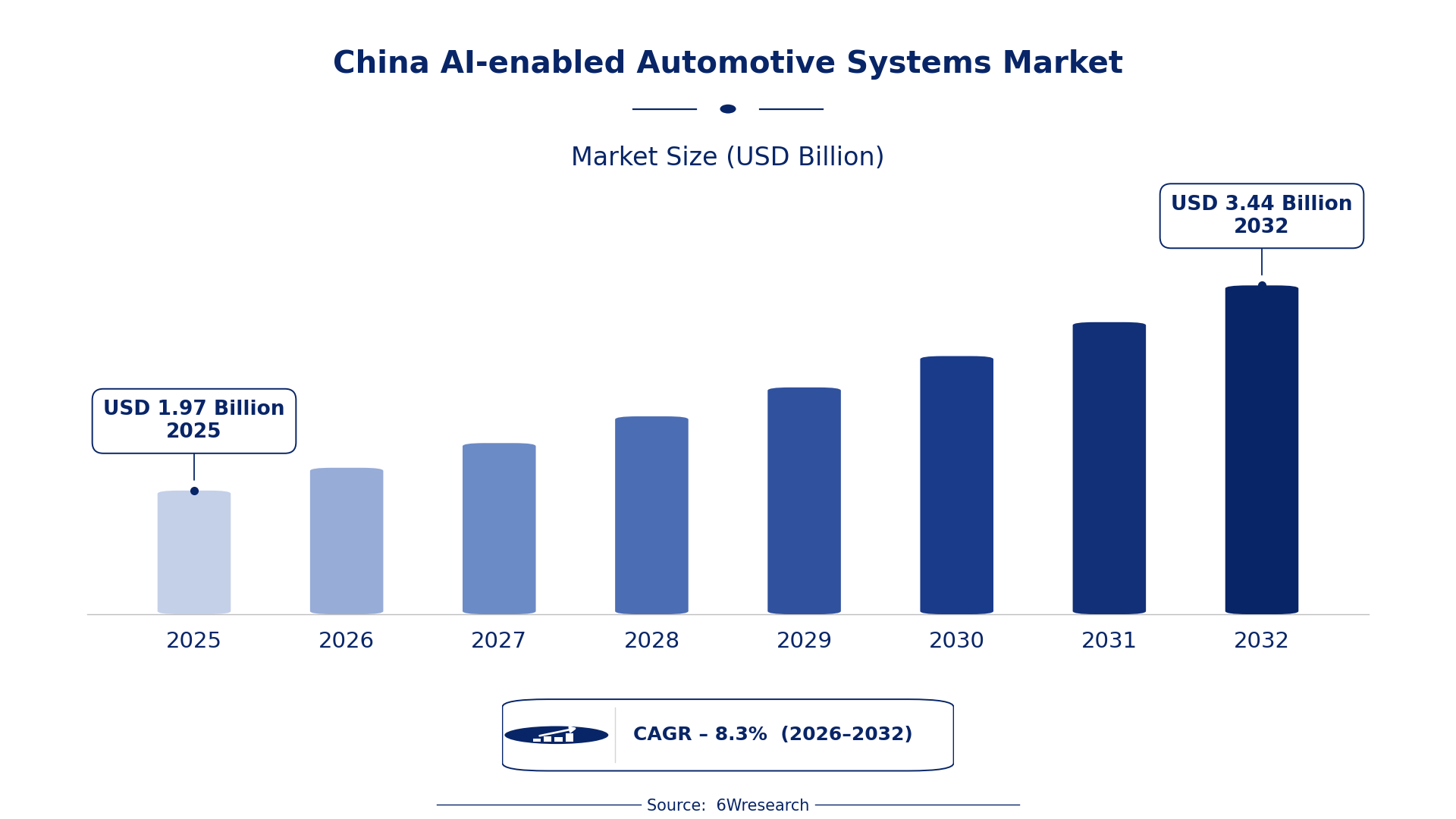
According to 6Wresearch internal database and industry insights, the China AI-enabled Automotive Systems Market was valued at USD 1.97 billion in 2025 and is projected to reach USD 3.44 billion by 2032, growing at a CAGR of approximately 8.3% during 2026–2032.
China AI-enabled Automotive Systems Market Highlights
| Report Metric | Details |
| Report Name | China AI-enabled Automotive Systems Market |
| Market Size 2025 | USD 1.97 billion |
| Market Size 2032 | USD 3.44 billion |
| Absolute Growth 2025–2032 | USD 1.47 billion |
| CAGR 2026–2032 | 8.3% |
| Peak Annual Growth | 10.1% in 2028 |
| Forecast Period | 2026–2032 |
| Historical Data | 2022–2025 |
| Base Year | 2025 |
| Leading System Type, 2025 | ADAS (Driver Assist) (50% share) |
| Leading AI Functionality, 2025 | Object Detection (44% share) |
| Leading Distribution Channel, 2025 | Automotive OEMs (54% share) |
| Leading End User, 2025 | Car Manufacturers (35% share) |
| Fastest-Growing System Type | Predictive Maintenance (9.6% CAGR) |
| Fastest-Growing AI Functionality | Condition Monitoring (10.8% CAGR) |
| Fastest-Growing Distribution Channel | Vehicle Software Vendors (10.6% CAGR) |
| Fastest-Growing End User | Connected Vehicle Developers (9.5% CAGR) |
| Growing Sector | ADAS (Driver Assist) |
| Key End Users | Car Manufacturers, Automotive OEMs, Vehicle Software Vendors, Connected Vehicle Developers |
China AI-enabled Automotive Systems Market Year-wise Growth Rate and Key Drivers (2022–2032)
This graph illustrates the annual growth rates of the market from 2022 to 2032, highlighting a steady upward trajectory and projected market expansion over the forecast period.
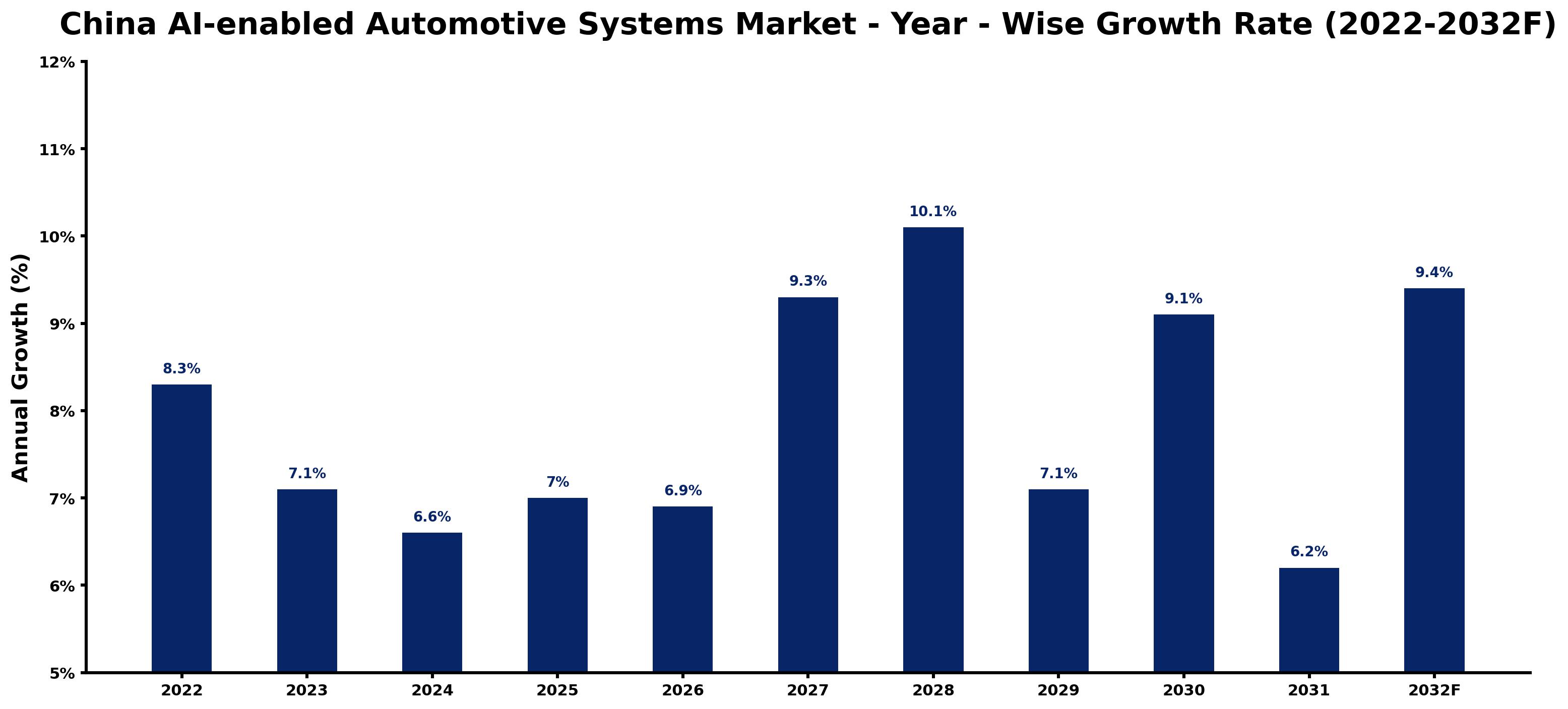
Annual growth estimates for each year appear below with the principal reason behind them, explaining the shifts that set the pace of the market.
| Year | Estimated Annual Growth (%) | Market Rationale |
| 2022 | 8.3 | The market experienced strong demand from domestic car manufacturers and technology developers. |
| 2023 | 7.1 | Growth slowed as the market adjusted to increased competition and supply chain challenges. |
| 2024 | 6.6 | Market expansion continued but at a slower pace due to regulatory adjustments in AI technologies. |
| 2025 | 7.0 | Demand increased as the ADAS segment gained significant market share among consumers. |
| 2026 | 6.9 | Growth slowed as manufacturers faced challenges in integrating advanced AI functionalities. |
| 2027 | 9.3 | The market rebounded with rising investments in predictive maintenance technologies. |
| 2028 | 10.1 | Peak growth was achieved as consumer interest surged in AI-enhanced safety features. |
| 2029 | 7.1 | Growth slowed again as the market faced saturation in certain segments. |
| 2030 | 9.1 | Demand accelerated with government initiatives targeting AI integration in new vehicles. |
| 2031 | 6.2 | Growth moderated as the market stabilised following rapid expansion in previous years. |
| 2032 | 9.4 | Demand is expected to rise again as new technologies are adopted in the automotive sector. |
Note: Market size estimations and growth projections presented in this report are based on 6Wresearch's proprietary forecasting methodology, utilizing the latest available industry data, government publications, and primary research inputs.
China AI-enabled Automotive Systems Market Synopsis
AI-enabled Automotive Systems in China integrate artificial intelligence to improve vehicle safety, infotainment, and maintenance. These systems utilise advanced algorithms and data from various sensors to enhance driver assistance and vehicle performance. The China AI-enabled Automotive Systems Market is expanding due to increasing demand from domestic car manufacturers and technology developers, along with government initiatives like the 'New Energy Vehicle Development Plan'. With over 300 million registered vehicles, the potential for AI integration is substantial, driving considerable investment in the sector.
Market Dynamics Impact Analysis (2026–2032)
| Factor | Type | Impact | Primary Segment Affected |
| Rising demand for advanced safety features in vehicles drives growth in ADAS technologies. | Driver | High | ADAS (Driver Assist) |
| Increased consumer preference for smart infotainment solutions boosts demand for in-vehicle systems. | Driver | High | In-Vehicle Infotainment |
| Growing investment in predictive maintenance technologies presents opportunities for suppliers. | Opportunity | High | Predictive Maintenance |
| The push for AI integration in electric vehicles creates new market avenues for developers. | Opportunity | High | AI ECU Systems |
| High costs of AI system integration may deter smaller manufacturers from adopting technology. | Restraint | Medium | AI ECU Systems |
| Regulatory compliance challenges can slow down the deployment of AI technologies in vehicles. | Restraint | Medium | ADAS (Driver Assist) |
| Limited availability of skilled workforce in AI technologies poses a challenge for manufacturers. | Challenge | High | Automotive OEMs |
| Supply chain disruptions can delay the production of AI-enabled components for vehicles. | Challenge | High | Vehicle Software Vendors |
Evaluation of Drivers in China AI-enabled Automotive Systems Market (2026–2032)
Below mentioned are some major drivers and their influence on market dynamics.
| Drivers | Primary Segment Affected | Why It Matters (Evidence) |
| Increased consumer demand for safety features drives ADAS adoption. | ADAS (Driver Assist) | The ADAS segment is projected to capture a notable market share by 2025, reflecting consumer priorities. |
| Consumer interest in infotainment systems boosts in-vehicle technology sales. | In-Vehicle Infotainment | The automotive electronics market is anticipated to grow considerably in the next decade, driven by evolving consumer preferences. |
| Investment in predictive maintenance reduces vehicle downtime and improves performance. | Predictive Maintenance | The growing number of vehicles in China creates a demand for maintenance solutions, enhancing operational efficiency. |
| Government initiatives promote AI integration in new vehicle models. | AI ECU Systems | The government aims for 50% of new vehicles to be equipped with AI systems by 2030, stimulating market growth. |
| The rise of connected vehicles enhances demand for advanced automotive technologies. | Connected Vehicle Developers | The National Intelligent Connected Vehicle Innovation Center supports AI in automotive, encouraging innovation and investment. |
Expansion of the AI-enabled Automotive Systems market in China is backed by rising consumer demand for safety features, infotainment systems, and predictive maintenance technologies. The ADAS segment is projected to capture a notable market share by 2025, reflecting the growing number of registered vehicles, which exceeds 300 million. Investment in predictive maintenance reduces vehicle downtime, improving overall performance across the automotive sector. The establishment of the National Intelligent Connected Vehicle Innovation Center promotes AI integration, stimulating market growth and innovation.
Evaluation of Restraints in China AI-enabled Automotive Systems Market
The main factors holding the market back are set out below.
| Market Restraint | Primary Segment Affected | Why It Matters (Evidence) |
| High integration costs deter smaller manufacturers from adopting AI technologies. | AI ECU Systems | The average cost of integrating AI systems can exceed several million yuan, limiting adoption among smaller firms. |
| Regulatory compliance can slow down the deployment of AI technologies in vehicles. | ADAS (Driver Assist) | Manufacturers must adhere to stringent standards set by the Ministry of Industry and Information Technology, which can delay product launches. |
| Limited availability of skilled workforce hampers AI technology development. | Automotive OEMs | The automotive industry employs millions, but skilled AI professionals are in short supply, restricting innovation. |
| Supply chain disruptions impact the availability of AI-enabled components. | Vehicle Software Vendors | Global supply chain issues have delayed component deliveries by several months, affecting production schedules. |
| Market saturation in certain segments limits growth potential. | In-Vehicle Infotainment | The rapid adoption of infotainment systems has led to intense competition among suppliers, constraining profit margins. |
China AI-enabled Automotive Systems Market Challenges
The China AI-enabled Automotive Systems market still faces several challenges, starting with supply chain disruptions. These disruptions stem from reliance on imported components, causing production delays of up to three months for manufacturers. Regulatory challenges follow, as compliance with standards like ISO/IEC 27001 can increase operational costs by 15% for suppliers. High integration costs of AI technologies further limit smaller manufacturers, restricting their ability to compete effectively in a market where 50% of new vehicles must be AI-equipped by 2030. Lastly, buyers encounter difficulties with rapidly evolving technology, complicating their purchasing decisions and raising investment uncertainty.
Trends in the China AI-enabled Automotive Systems Market
Buyers and suppliers in the China AI-enabled Automotive Systems Market are adjusting to the following trends.
- Shift from Traditional to AI-Driven Safety Systems: China is moving from traditional safety features to AI-driven systems in vehicles. The 'Guidelines for the Development of Intelligent Connected Vehicles' issued in 2022 promote this transition, aiming for improved safety. This trend is likely to increase demand for advanced ADAS technologies.
- Emergence of Predictive Maintenance Solutions: Predictive maintenance technologies are gaining traction among car manufacturers in China. With a projected CAGR of 9.6% for predictive maintenance from 2026 to 2032, this trend reflects the industry's focus on reducing downtime and improving vehicle reliability.
- Growing Integration of AI in Electric Vehicles: The integration of AI technologies in electric vehicles is becoming a priority. The 'New Energy Vehicle Development Plan' launched in 2023 targets 20% market penetration for AI technologies by 2025, indicating a strong push towards smarter vehicles.
- Increased Demand for Voice and Touch Interfaces: Car manufacturers are prioritising the development of voice and touch AI interfaces. With a growing consumer preference for interactive engagement, this trend is expected to improve user experience in vehicles, driving demand for innovative infotainment solutions.
Investment Opportunities in the China AI-enabled Automotive Systems Market
Some of the investment opportunities in the China AI-enabled Automotive Systems Market are mentioned below.
- Supply of AI ECU Systems: With the government targeting 50% AI-equipped vehicles by 2030, there is a notable opportunity for suppliers of AI ECU systems. The automotive sector in Guangdong province is a key area for investment.
- Investment in Predictive Maintenance Technologies: The growing number of registered vehicles creates a demand for predictive maintenance solutions. Suppliers can target car manufacturers looking to improve vehicle reliability and reduce downtime.
- Development of Advanced Infotainment Systems: As consumer preferences shift towards smarter infotainment, there is a gap in the market for innovative solutions. Automotive OEMs are seeking partnerships to develop advanced technologies.
- Expansion of Connected Vehicle Technologies: The rise of connected vehicles presents opportunities for suppliers of advanced AI systems. The National Intelligent Connected Vehicle Innovation Center encourages investment in this area.
Government Initiatives in the China AI-enabled Automotive Systems Market
The Ministry of Industry and Information Technology oversees the implementation of automotive technology standards, ensuring compliance with regulations. The '14th Five-Year Plan for the Development of the Automotive Industry' launched in 2021 promotes AI integration in vehicles, targeting advancements in safety and performance. Additionally, the National Intelligent Connected Vehicle Innovation Center supports research and development in AI technologies, funding various projects aimed at improving vehicle connectivity and safety. The 'New Energy Vehicle Development Plan' introduced in 2023 facilitates partnerships between technology developers and car manufacturers, promoting the integration of AI in electric vehicles.
The 'Guidelines for the Development of Intelligent Connected Vehicles' issued in 2022 standardise AI applications in automotive systems. This initiative helps manufacturers navigate compliance requirements while improving the safety and functionality of vehicles. The government also provides funding for projects that align with national goals for AI integration, ensuring that car manufacturers can access the necessary resources for development. By fostering collaboration between stakeholders, these measures aim to accelerate the adoption of AI technologies in the automotive sector.
Future Insight of the China AI-enabled Automotive Systems Market
The China AI-enabled Automotive Systems market is expected to evolve significantly by 2032, driven by several key initiatives. The government's 'New Energy Vehicle Development Plan' will accelerate AI integration across the industry. The establishment of the National Intelligent Connected Vehicle Innovation Center will foster collaboration among technology developers and manufacturers, leading to enhanced innovation. The automotive electronics market is projected to expand, creating more job opportunities across various provinces. These developments will provide both suppliers and buyers with new avenues for growth and adaptation.
Market Segmentation Analysis
Each segment group is reviewed below, with the leader by share and the fastest grower by CAGR.
By System Type – ADAS (Driver Assist) Dominated, Predictive Maintenance Expected to Grow Fastest
According to Shubham Padhi, Research Analyst at 6Wresearch, ADAS (Driver Assist) took a 50% share of system type in 2025, more than any other category. ADAS holds the largest share due to its critical role in enhancing vehicle safety, with features such as lane-keeping assistance becoming standard in many new models. The government's target for 50% of new vehicles to incorporate AI systems by 2030 underscores the importance of ADAS in the automotive landscape. The quickest growth will come from Predictive Maintenance, forecast to expand at a CAGR of 9.6% between 2026 and 2032. Predictive Maintenance is experiencing rapid growth, driven by the increasing need to minimise vehicle downtime through accurate predictions of potential failures. The surge in the number of registered vehicles, exceeding 300 million in 2023, further propels this segment's expansion. Suppliers should focus on developing predictive maintenance solutions to meet the rising demand from automotive manufacturers.
By AI Functionality – Object Detection Dominated, Condition Monitoring Expected to Grow Fastest
Object Detection accounted for a 44% market share by ai functionality in 2025. Object Detection leads the market share because of its crucial role in safety systems, enabling features like automatic emergency braking that consumers increasingly expect. The integration of such technologies is essential for car manufacturers to comply with stringent safety regulations. Condition Monitoring is projected to grow fastest, at a CAGR of 10.8% during 2026–2032. Condition Monitoring is the fastest-growing segment, spurred by the necessity to maintain optimal vehicle performance while reducing operational costs. The expanding automotive electronics market will continue to drive the demand for effective condition monitoring systems. Buyers should prioritise AI functionalities that enhance safety and performance to remain competitive in the automotive sector.
By Distribution Channel – Automotive OEMs Dominated, Vehicle Software Vendors Expected to Grow Fastest
In 2025, Automotive OEMs led the distribution channel split with a 54% share. Automotive OEMs dominate the market share as they are the primary manufacturers integrating AI-enabled systems into new vehicles, ensuring compliance with industry standards. Their established relationships with technology providers facilitate the seamless incorporation of advanced features into production processes. Vehicle Software Vendors are set to record the highest CAGR in this split, 10.6% over 2026–2032. Vehicle Software Vendors are witnessing rapid growth, reflecting the increasing reliance on software solutions to enhance vehicle capabilities. This trend aligns with the ongoing digital transformation in the automotive sector, where software is essential for vehicle functionality. Suppliers must strengthen partnerships with vehicle software vendors to capitalise on the growing demand for software-driven automotive solutions.
By End User – Car Manufacturers Dominated, Connected Vehicle Developers Expected to Grow Fastest
With a 35% revenue share in 2025, Car Manufacturers was the largest end user category. Car Manufacturers hold the largest market share as they are the primary entities integrating AI systems into their vehicle models, responding to consumer expectations for advanced safety features. Their investments in AI technologies are crucial for maintaining competitiveness in the automotive market. Over 2026–2032, Connected Vehicle Developers are expected to post the fastest growth, at a CAGR of 9.5%. Connected Vehicle Developers are the fastest-growing segment, driven by rising consumer demand for enhanced vehicle connectivity and smart features. As the automotive industry shifts towards more connected solutions, this segment is poised for significant growth. Buyers should consider partnerships with connected vehicle developers to innovate and enhance the functionality of their automotive offerings.
Key Attractiveness of the Report
- 10 Years of Market Numbers
- Historical Data Starting from 2022 to 2025
- Base Year 2025
- Forecast Data until 2032
- Key Performance Indicators Impacting the Market
- Major Upcoming Developments and Projects
Key Highlights of the Report:
- China AI-enabled Automotive Systems Market Outlook
- Market Size of China AI-enabled Automotive Systems Market, 2025
- Forecast of China AI-enabled Automotive Systems Market, 2032
- Historical Data and Forecast of China AI-enabled Automotive Systems Revenues & Volume for the Period 2022 - 2032F
- China AI-enabled Automotive Systems Market Trend Evolution
- China AI-enabled Automotive Systems Market Drivers and Challenges
- China AI-enabled Automotive Systems Price Trends
- China AI-enabled Automotive Systems Porter's Five Forces
- China AI-enabled Automotive Systems Industry Life Cycle
- Historical Data and Forecast of China AI-enabled Automotive Systems Market Revenues & Volume By System Type for the Period 2022 - 2032F
- Historical Data and Forecast of China AI-enabled Automotive Systems Market Revenues & Volume By ADAS (Driver Assist) for the Period 2022 - 2032F
- Historical Data and Forecast of China AI-enabled Automotive Systems Market Revenues & Volume By In-Vehicle Infotainment for the Period 2022 - 2032F
- Historical Data and Forecast of China AI-enabled Automotive Systems Market Revenues & Volume By Predictive Maintenance for the Period 2022 - 2032F
- Historical Data and Forecast of China AI-enabled Automotive Systems Market Revenues & Volume By AI ECU Systems for the Period 2022 - 2032F
- Historical Data and Forecast of China AI-enabled Automotive Systems Market Revenues & Volume By AI Functionality for the Period 2022 - 2032F
- Historical Data and Forecast of China AI-enabled Automotive Systems Market Revenues & Volume By Object Detection for the Period 2022 - 2032F
- Historical Data and Forecast of China AI-enabled Automotive Systems Market Revenues & Volume By Voice/Touch AI Interface for the Period 2022 - 2032F
- Historical Data and Forecast of China AI-enabled Automotive Systems Market Revenues & Volume By Condition Monitoring for the Period 2022 - 2032F
- Historical Data and Forecast of China AI-enabled Automotive Systems Market Revenues & Volume By Behavior Optimization for the Period 2022 - 2032F
- Historical Data and Forecast of China AI-enabled Automotive Systems Market Revenues & Volume By Distribution Channel for the Period 2022 - 2032F
- Historical Data and Forecast of China AI-enabled Automotive Systems Market Revenues & Volume By Automotive OEMs for the Period 2022 - 2032F
- Historical Data and Forecast of China AI-enabled Automotive Systems Market Revenues & Volume By Vehicle Software Vendors for the Period 2022 - 2032F
- Historical Data and Forecast of China AI-enabled Automotive Systems Market Revenues & Volume By Fleet Tech Providers for the Period 2022 - 2032F
- Historical Data and Forecast of China AI-enabled Automotive Systems Market Revenues & Volume By Tier-1 Auto Suppliers for the Period 2022 - 2032F
- Historical Data and Forecast of China AI-enabled Automotive Systems Market Revenues & Volume By End User for the Period 2022 - 2032F
- Historical Data and Forecast of China AI-enabled Automotive Systems Market Revenues & Volume By Car Manufacturers for the Period 2022 - 2032F
- Historical Data and Forecast of China AI-enabled Automotive Systems Market Revenues & Volume By Connected Vehicle Developers for the Period 2022 - 2032F
- Historical Data and Forecast of China AI-enabled Automotive Systems Market Revenues & Volume By Vehicle Maintenance Teams for the Period 2022 - 2032F
- Historical Data and Forecast of China AI-enabled Automotive Systems Market Revenues & Volume By Automotive Electronics Firms for the Period 2022 - 2032F
- China AI-enabled Automotive Systems Import Export Trade Statistics
- Market Opportunity Assessment By System Type
- Market Opportunity Assessment By AI Functionality
- Market Opportunity Assessment By Distribution Channel
- Market Opportunity Assessment By End User
- China AI-enabled Automotive Systems Top Companies Market Share
- China AI-enabled Automotive Systems Competitive Benchmarking By Technical and Operational Parameters
- China AI-enabled Automotive Systems Company Profiles
- China AI-enabled Automotive Systems Key Strategic Recommendations
Market Covered
The report offers an extensive study of the following market segments.
By System Type
- ADAS (Driver Assist)
- In-Vehicle Infotainment
- Predictive Maintenance
- AI ECU Systems
By AI Functionality
- Object Detection
- Voice/Touch AI Interface
- Condition Monitoring
- Behavior Optimization
By Distribution Channel
- Automotive OEMs
- Vehicle Software Vendors
- Fleet Tech Providers
- Tier-1 Auto Suppliers
By End User
- Car Manufacturers
- Connected Vehicle Developers
- Vehicle Maintenance Teams
- Automotive Electronics Firms































