China AI-Enabled Vehicles Market Size & Growth Rate
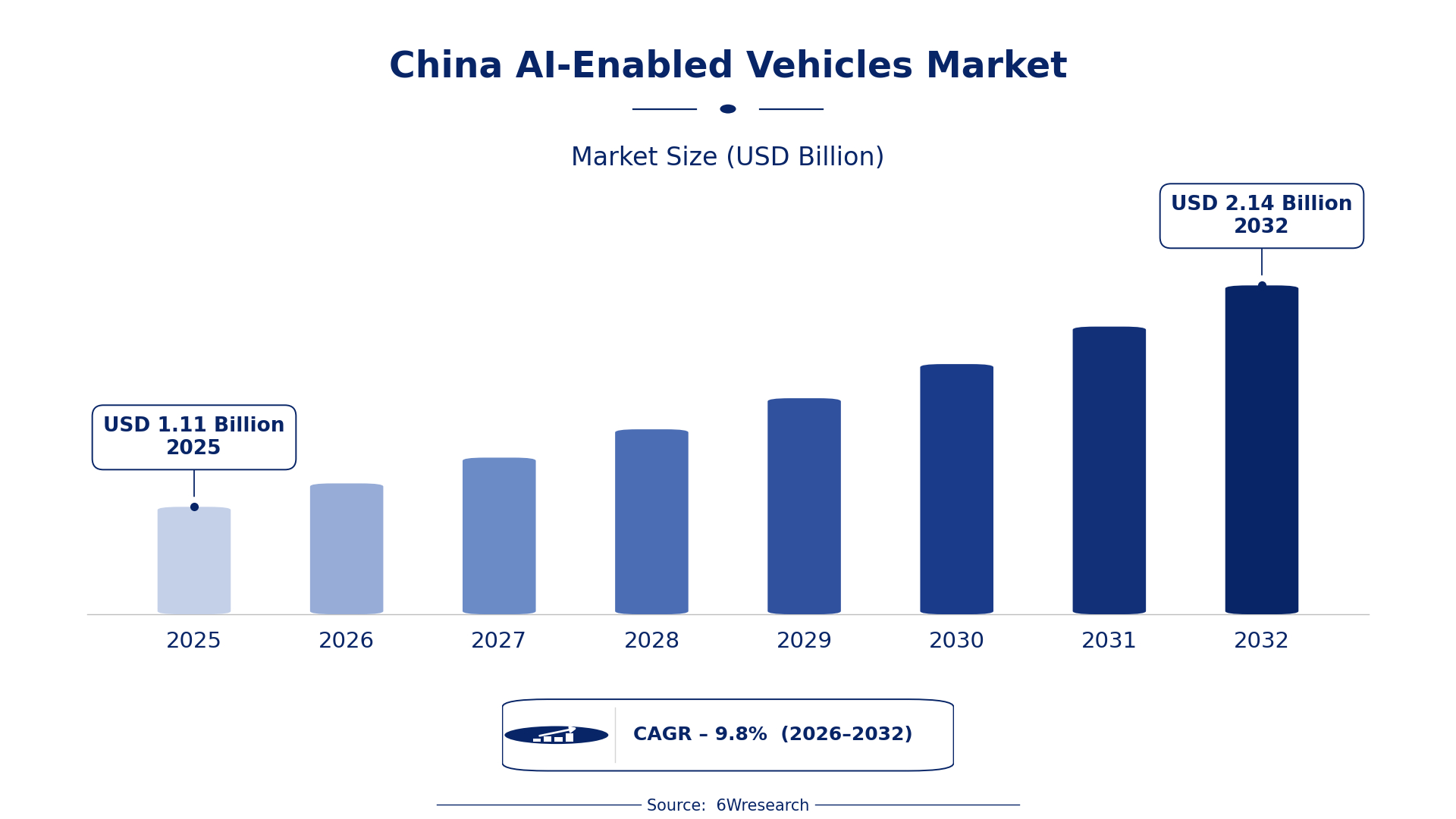
According to 6Wresearch internal database and industry insights, the China AI-Enabled Vehicles Market was valued at USD 1.11 billion in 2025 and is projected to reach USD 2.14 billion by 2032, growing at a CAGR of approximately 9.8% during 2026–2032.
China AI-Enabled Vehicles Market Highlights
| Report Metric | Details |
| Report Name | China AI-Enabled Vehicles Market |
| Market Size 2025 | USD 1.11 billion |
| Market Size 2032 | USD 2.14 billion |
| Absolute Growth 2025–2032 | USD 1.03 billion |
| CAGR 2026–2032 | 9.8% |
| Peak Annual Growth | 12.3% in 2031 |
| Forecast Period | 2026–2032 |
| Historical Data | 2022–2025 |
| Base Year | 2025 |
| Leading Vehicle Type, 2025 | Passenger Vehicles (39% share) |
| Leading AI Capability, 2025 | Self-driving Features (39% share) |
| Leading Distribution Channel, 2025 | Automotive OEMs (41% share) |
| Leading End User, 2025 | Ride-sharing Services (35% share) |
| Fastest-Growing Vehicle Type | Public Buses (11.9% CAGR) |
| Fastest-Growing AI Capability | Predictive Routing (12.2% CAGR) |
| Fastest-Growing Distribution Channel | Smart Logistics Providers (11.0% CAGR) |
| Fastest-Growing End User | Fleet Management Companies (12.1% CAGR) |
| Growing Sector | Fleet Management Companies |
| Key End Users | Ride-sharing Services, Fleet Management Companies, Government Transport Agencies, Scooter/E-bike Manufacturers |
China AI-Enabled Vehicles Market Year-wise Growth Rate and Key Drivers (2022–2032)
This graph illustrates the annual growth rates of the market from 2022 to 2032, highlighting a steady upward trajectory and projected market expansion over the forecast period.
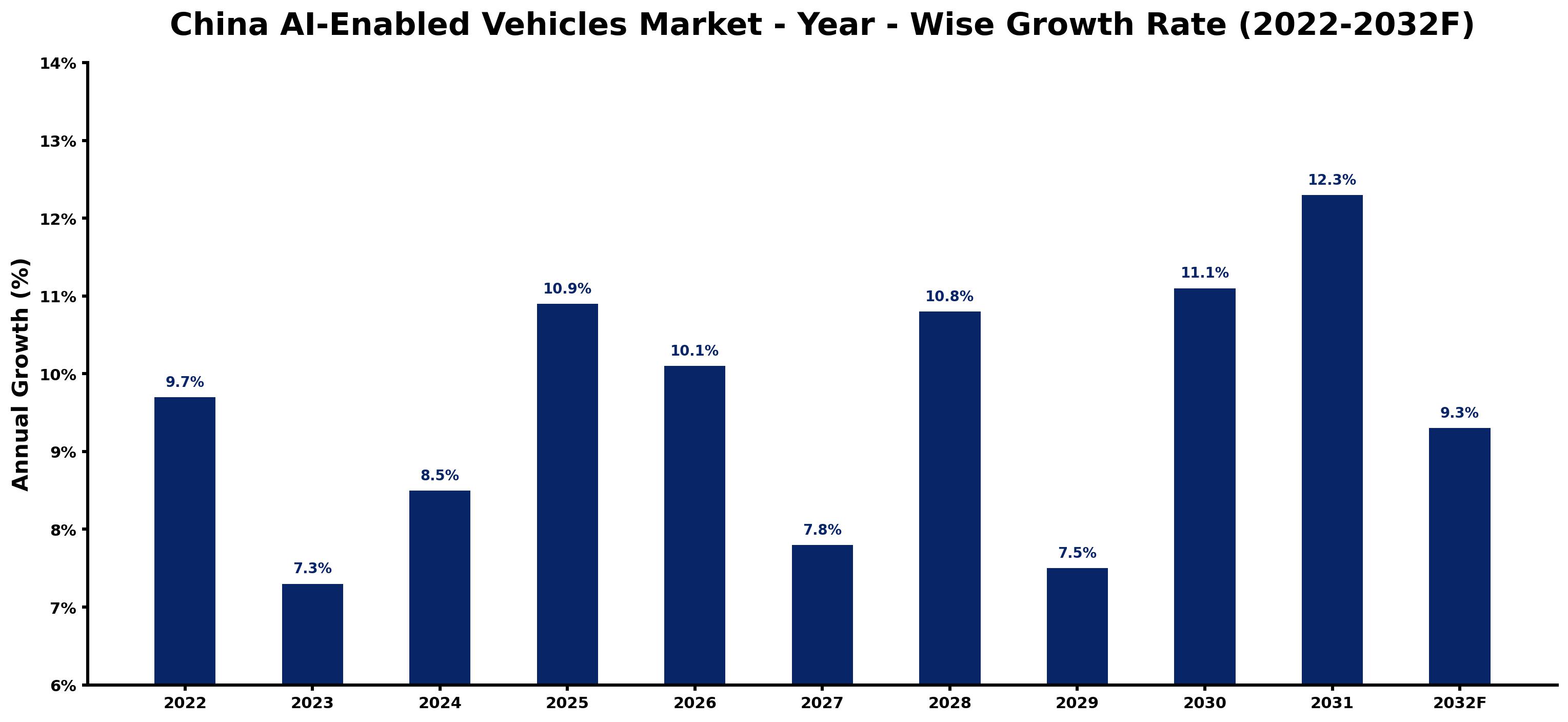
Year by year, the estimates below pair each growth rate with the development that shaped it.
| Year | Estimated Annual Growth (%) | Market Rationale |
| 2022 | 9.7 | The passenger vehicle market showed strong demand for AI-enabled models, reflecting consumer interest. |
| 2023 | 7.3 | Growth slowed due to supply chain challenges impacting production timelines and availability of components. |
| 2024 | 8.5 | Increased adoption of AI features in public buses contributed to a faster growth rate. |
| 2025 | 10.9 | The peak growth was driven by the government's 'Made in China 2025' initiative boosting AI integration. |
| 2026 | 10.1 | Growth is expected to slow as manufacturers face challenges in scaling AI technologies across various vehicle types. |
| 2027 | 7.8 | Demand for AI in fleet management companies is projected to moderate growth as market saturation begins to appear. |
| 2028 | 10.8 | Public buses are expected to see a resurgence in demand, driving faster growth through improved AI applications. |
| 2029 | 7.5 | Growth is anticipated to slow due to market consolidation and increased competition among manufacturers. |
| 2030 | 11.1 | A renewed focus on smart transportation systems will lead to higher growth rates in AI-enabled vehicles. |
| 2031 | 12.3 | The peak growth rate will be supported by investments in AI infrastructure by the government. |
| 2032 | 9.3 | Growth is projected to slow as the market stabilises, but demand for upgrades in urban areas will remain strong. |
Note: Market size estimations and growth projections presented in this report are based on 6Wresearch's proprietary forecasting methodology, utilizing the latest available industry data, government publications, and primary research inputs.
China AI-Enabled Vehicles Market Synopsis
AI-Enabled Vehicles in China are technologically advanced vehicles equipped with artificial intelligence systems for improved functionality. These vehicles utilise machine learning algorithms and sensor integration to improve safety and traffic management. The China AI-Enabled Vehicles Market is expanding due to urbanisation and government initiatives supporting smart transportation. With the passenger vehicle market reaching 23 million units in 2022, demand for AI-enabled models is increasing. The government's goal for 50% of new vehicles to be AI-enabled by 2025 underscores this growth.
Market Dynamics Impact Analysis (2026–2032)
| Factor | Type | Impact | Primary Segment Affected |
| Urbanisation drives demand for smart transportation solutions. | Driver | High | Passenger Vehicles |
| Government initiatives promote AI integration in public transport. | Driver | High | Public Buses |
| Investment in AI infrastructure creates opportunities for suppliers. | Opportunity | High | Smart Logistics Providers |
| Growing urban population increases demand for AI upgrades. | Opportunity | High | Fleet Management Companies |
| Supply chain challenges hinder timely production of AI-enabled vehicles. | Restraint | High | Passenger Vehicles |
| Market saturation limits growth potential for existing manufacturers. | Restraint | Medium | Public Buses |
| The AI-Enabled Vehicles market faces regulatory hurdles that slow adoption. | Challenge | High | Self-driving Features |
| High R&D costs for AI technologies deter smaller manufacturers from entering the market. | Challenge | Medium | Smart Logistics Providers |
Evaluation of Drivers in China AI-Enabled Vehicles Market (2026–2032)
Key forces behind demand, with the segment each one moves most, are listed below.
| Drivers | Primary Segment Affected | Why It Matters (Evidence) |
| Increasing urban population drives demand for smart transportation solutions. | Passenger Vehicles | China's urban population is projected to exceed 1 billion by 2030, leading to higher vehicle demand. |
| Government initiatives support AI integration in public transport systems. | Public Buses | The 'Smart Transportation Development Action Plan' promotes AI applications in major cities. |
| Rising consumer demand for advanced features boosts AI-Powered Dash Systems. | AI-Powered Dash Systems | The market for AI-Powered Dash Systems is growing due to consumer preferences for advanced features. |
| Investment in AI infrastructure enhances efficiency in logistics and transportation. | Smart Logistics Providers | The National Development and Reform Commission's $1 billion investment plan supports AI in transportation. |
| Technological advancements in self-driving features improve vehicle safety. | Self-driving Features | The Ministry of Industry and Information Technology's standards for AI integration promote safety improvements. |
The urban population is expected to surpass 1 billion by 2030, creating a demand for efficient transport solutions. The market for AI-Powered Dash Systems is poised for growth as consumer preferences shift towards advanced features. The National Development and Reform Commission's $1 billion investment in AI infrastructure will improve logistics and transportation efficiency, further driving demand.
Evaluation of Restraints in China AI-Enabled Vehicles Market
The table below lists the restraints and the evidence behind each.
| Market Restraint | Primary Segment Affected | Why It Matters (Evidence) |
| Supply chain challenges hinder timely production of AI-enabled vehicles. | Passenger Vehicles | Manufacturers face delays due to component shortages, affecting production schedules. |
| High R&D costs for AI technologies deter smaller manufacturers from entering the market. | Smart Logistics Providers | The financial burden of developing AI technologies limits participation from smaller firms. |
| Regulatory hurdles slow the adoption of self-driving features in vehicles. | Self-driving Features | Strict regulations and testing protocols delay the rollout of autonomous vehicles. |
| Market saturation limits growth potential for existing manufacturers. | Public Buses | As competition increases, manufacturers struggle to differentiate their offerings. |
| Consumer hesitation towards new technologies affects market uptake. | AI-Powered Dash Systems | Concerns about reliability and safety lead to slower adoption rates among buyers. |
China AI-Enabled Vehicles Market Challenges
The China AI-Enabled Vehicles market faces high development costs, as integrating advanced AI systems requires substantial financial resources from buyers, potentially delaying adoption by up to two years. Suppliers are also dealing with supply chain disruptions due to reliance on specific components, which can lead to production delays extending lead times by 3-6 months. Regulatory challenges persist, particularly with standards set by the Ministry of Industry and Information Technology, where compliance can cost smaller manufacturers over $100,000. Competition is intensifying as more than 1,000 AI startups enter the market, pushing established players to innovate quickly to maintain their market position.
Trends in the China AI-Enabled Vehicles Market
The trends below show where the China AI-Enabled Vehicles Market is heading.
- Shift towards AI-Enabled Public Transport: Shanghai is leading the shift towards AI-enabled public transport with over 200,000 electric buses equipped with AI technologies for route optimization. This initiative reflects a growing commitment to smart transportation solutions.
- Transition from Traditional to AI-Powered Dash Systems: The rise of AI-Powered Dash Systems in China is clear with increasing consumer demand for advanced features. This segment is expected to grow as preferences shift towards enhanced user experiences.
- Emergence of Predictive Routing Technologies: Predictive Routing has emerged as a key technology in AI-Enabled Vehicles, with a projected CAGR of 12.2% from 2026 to 2032. This trend is driven by the need for efficient travel paths and congestion reduction.
- Increased Focus on Autonomous Driving: The focus on self-driving features is intensifying, supported by government standards for AI integration. This trend is likely to drive advancements in vehicle safety and functionality.
Investment Opportunities in the China AI-Enabled Vehicles Market
Below are the investment opportunities with the strongest case in the China AI-Enabled Vehicles Market.
- Collaborations with Local Governments: Establishing partnerships with local governments can facilitate entry into the AI-Enabled Vehicles market. With a projected urban population exceeding 1 billion by 2030, there is a strong demand for smart transportation solutions.
- Investment in AI-Powered Dash Systems: The AI-Powered Dash Systems market is set to grow as consumer demand for advanced features increases. Suppliers can target ride-sharing services that require enhanced user experiences.
- Supply of AI Technologies for Public Buses: With over 200,000 electric buses equipped with AI technologies, there is a growing need for suppliers of AI systems. Collaborating with public transport vendors can enhance market entry opportunities.
- Development of Predictive Routing Solutions: The demand for predictive routing technologies is increasing, with a projected CAGR of 12.2%. Suppliers can focus on fleet management companies looking to optimise delivery routes.
Government Initiatives in the China AI-Enabled Vehicles Market
The 'New Energy Vehicle Industry Development Plan' by the Ministry of Industry and Information Technology, launched in 2020, aims to promote AI integration in vehicles. This plan sets the framework for manufacturers to develop AI-enabled models, ensuring compliance with national standards. The 'Smart Transportation Development Action Plan' introduced in 2022 supports AI applications in public transport systems, driving innovation and efficiency. This initiative encourages the integration of AI technologies across various vehicle types, driving market growth. The '2023 Intelligent Transportation System Plan' emphasises AI for traffic management and safety improvements, further enhancing the market for AI-enabled vehicles.
The National Development and Reform Commission oversees the approval of standards for AI integration in vehicles. The China Automotive Technology and Research Center is responsible for testing protocols, ensuring that AI-enabled vehicles meet safety and performance criteria. The National Development and Reform Commission funds initiatives aimed at enhancing AI infrastructure, with a significant $1 billion investment announced in 2023. This funding is directed towards improving urban transport systems, thereby increasing the efficiency and safety of AI-enabled vehicles.
Future Insight of the China AI-Enabled Vehicles Market
By 2032, the China AI-Enabled Vehicles market will evolve significantly, driven by urbanisation, government initiatives, and technological advancements. The 'Made in China 2025' initiative aims for 50% of new vehicles to be AI-enabled by 2025, enhancing access to smart transportation solutions. The National Development and Reform Commission's $1 billion investment in AI transportation infrastructure will support wider adoption. With China's urban population projected to exceed 1 billion by 2030, demand for AI-Enabled Vehicles will surge, encouraging suppliers to expand their offerings.
Market Segmentation Analysis
Each segment group is reviewed below, with the leader by share and the fastest grower by CAGR.
By Vehicle Type – Passenger Vehicles Dominated, Public Buses Expected to Grow Fastest
According to Shubham Padhi, Research Analyst at 6Wresearch, Passenger Vehicles held a 39% share of the China AI-Enabled Vehicles Market by vehicle type in 2025. Passenger vehicles dominate the China AI-enabled vehicles market due to their widespread use among consumers seeking improved safety and functionality. With 23 million units sold in 2022, they represent the primary focus for integrating advanced technologies. Over 2026–2032, Public Buses are expected to post the fastest growth, at a CAGR of 11.9%. Public buses are experiencing rapid growth as urban areas increasingly invest in technologies to enhance operational efficiency and passenger safety. The deployment of over 200,000 electric buses equipped with advanced systems is significantly driving this segment's expansion. Suppliers should concentrate on developing tailored solutions for public transport to seize this emerging market opportunity.
By AI Capability – Self-driving Features Dominated, Predictive Routing Expected to Grow Fastest
Self-driving Features accounted for a 39% market share by ai capability in 2025. Self-driving features lead the AI capability segment as they are critical for developing autonomous vehicles, appealing to consumers who prioritise safety and convenience. This core component is vital for manufacturers aiming to comply with regulatory standards and meet consumer expectations. The quickest growth will come from Predictive Routing, forecast to expand at a CAGR of 12.2% between 2026 and 2032. Predictive routing is gaining traction as cities seek to optimise traffic flow and reduce congestion, making it essential for modern transportation systems. The increasing urban population in China is a significant factor driving the demand for these capabilities. Buyers should focus on solutions that enhance predictive routing to maintain competitiveness in the evolving market.
By Distribution Channel – Automotive OEMs Dominated, Smart Logistics Providers Expected to Grow Fastest
In 2025, Automotive OEMs led the distribution channel split with a 41% share. Automotive OEMs hold the largest share in the distribution channel due to their crucial role in manufacturing and integrating advanced technologies into vehicles. Their established relationships with consumers and suppliers facilitate effective delivery of AI-enabled vehicles. Smart Logistics Providers are set to record the highest CAGR in this split, 11.0% over 2026–2032. Smart logistics providers are experiencing the fastest growth as AI becomes essential for optimising delivery and fleet operations in a competitive environment. The demand for efficiency in logistics is propelling this segment forward. Suppliers should consider partnerships with smart logistics providers to strengthen their distribution strategies.
By End User – Ride-sharing Services Dominated, Fleet Management Companies Expected to Grow Fastest
The largest end user category in 2025 was Ride-sharing Services, with a 35% share of total revenue. Ride-sharing services lead the end user segment as they heavily rely on technology for operational efficiency and enhancing user experience. The growing popularity of ride-sharing platforms in urban areas drives the demand for AI-enabled vehicles. Fleet Management Companies are projected to grow fastest, at a CAGR of 12.1% during 2026–2032. Fleet management companies are witnessing rapid growth as technology becomes crucial for monitoring and optimising fleet performance. The push for efficiency in fleet operations is accelerating this segment's expansion. Buyers in fleet management should invest in technology solutions to improve operational efficiency and reduce costs.
Key Attractiveness of the Report
- 10 Years of Market Numbers
- Historical Data Starting from 2022 to 2025
- Base Year 2025
- Forecast Data until 2032
- Key Performance Indicators Impacting the Market
- Major Upcoming Developments and Projects
Key Highlights of the Report:
- China AI-Enabled Vehicles Market Outlook
- Market Size of China AI-Enabled Vehicles Market, 2025
- Forecast of China AI-Enabled Vehicles Market, 2032
- Historical Data and Forecast of China AI-Enabled Vehicles Revenues & Volume for the Period 2022 - 2032F
- China AI-Enabled Vehicles Market Trend Evolution
- China AI-Enabled Vehicles Market Drivers and Challenges
- China AI-Enabled Vehicles Price Trends
- China AI-Enabled Vehicles Porter's Five Forces
- China AI-Enabled Vehicles Industry Life Cycle
- Historical Data and Forecast of China AI-Enabled Vehicles Market Revenues & Volume By Vehicle Type for the Period 2022 - 2032F
- Historical Data and Forecast of China AI-Enabled Vehicles Market Revenues & Volume By Passenger Vehicles for the Period 2022 - 2032F
- Historical Data and Forecast of China AI-Enabled Vehicles Market Revenues & Volume By Commercial Trucks for the Period 2022 - 2032F
- Historical Data and Forecast of China AI-Enabled Vehicles Market Revenues & Volume By Two-wheelers for the Period 2022 - 2032F
- Historical Data and Forecast of China AI-Enabled Vehicles Market Revenues & Volume By Public Buses for the Period 2022 - 2032F
- Historical Data and Forecast of China AI-Enabled Vehicles Market Revenues & Volume By AI Capability for the Period 2022 - 2032F
- Historical Data and Forecast of China AI-Enabled Vehicles Market Revenues & Volume By Self-driving Features for the Period 2022 - 2032F
- Historical Data and Forecast of China AI-Enabled Vehicles Market Revenues & Volume By Predictive Routing for the Period 2022 - 2032F
- Historical Data and Forecast of China AI-Enabled Vehicles Market Revenues & Volume By AI-Powered Dash Systems for the Period 2022 - 2032F
- Historical Data and Forecast of China AI-Enabled Vehicles Market Revenues & Volume By Traffic Pattern AI for the Period 2022 - 2032F
- Historical Data and Forecast of China AI-Enabled Vehicles Market Revenues & Volume By Distribution Channel for the Period 2022 - 2032F
- Historical Data and Forecast of China AI-Enabled Vehicles Market Revenues & Volume By Automotive OEMs for the Period 2022 - 2032F
- Historical Data and Forecast of China AI-Enabled Vehicles Market Revenues & Volume By Smart Logistics Providers for the Period 2022 - 2032F
- Historical Data and Forecast of China AI-Enabled Vehicles Market Revenues & Volume By Vehicle Parts Distributors for the Period 2022 - 2032F
- Historical Data and Forecast of China AI-Enabled Vehicles Market Revenues & Volume By Public Transport Vendors for the Period 2022 - 2032F
- Historical Data and Forecast of China AI-Enabled Vehicles Market Revenues & Volume By End User for the Period 2022 - 2032F
- Historical Data and Forecast of China AI-Enabled Vehicles Market Revenues & Volume By Ride-sharing Services for the Period 2022 - 2032F
- Historical Data and Forecast of China AI-Enabled Vehicles Market Revenues & Volume By Fleet Management Companies for the Period 2022 - 2032F
- Historical Data and Forecast of China AI-Enabled Vehicles Market Revenues & Volume By Scooter/E-bike Manufacturers for the Period 2022 - 2032F
- Historical Data and Forecast of China AI-Enabled Vehicles Market Revenues & Volume By Government Transport Agencies for the Period 2022 - 2032F
- China AI-Enabled Vehicles Import Export Trade Statistics
- Market Opportunity Assessment By Vehicle Type
- Market Opportunity Assessment By AI Capability
- Market Opportunity Assessment By Distribution Channel
- Market Opportunity Assessment By End User
- China AI-Enabled Vehicles Top Companies Market Share
- China AI-Enabled Vehicles Competitive Benchmarking By Technical and Operational Parameters
- China AI-Enabled Vehicles Company Profiles
- China AI-Enabled Vehicles Key Strategic Recommendations
Market Covered
Segments analysed in this report are listed below.
By Vehicle Type
- Passenger Vehicles
- Commercial Trucks
- Two-wheelers
- Public Buses
By AI Capability
- Self-driving Features
- Predictive Routing
- AI-Powered Dash Systems
- Traffic Pattern AI
By Distribution Channel
- Automotive OEMs
- Smart Logistics Providers
- Vehicle Parts Distributors
- Public Transport Vendors
By End User
- Ride-sharing Services
- Fleet Management Companies
- Scooter/E-bike Manufacturers
- Government Transport Agencies































