China AI-Powered Educational Toys Market Size & Growth Rate
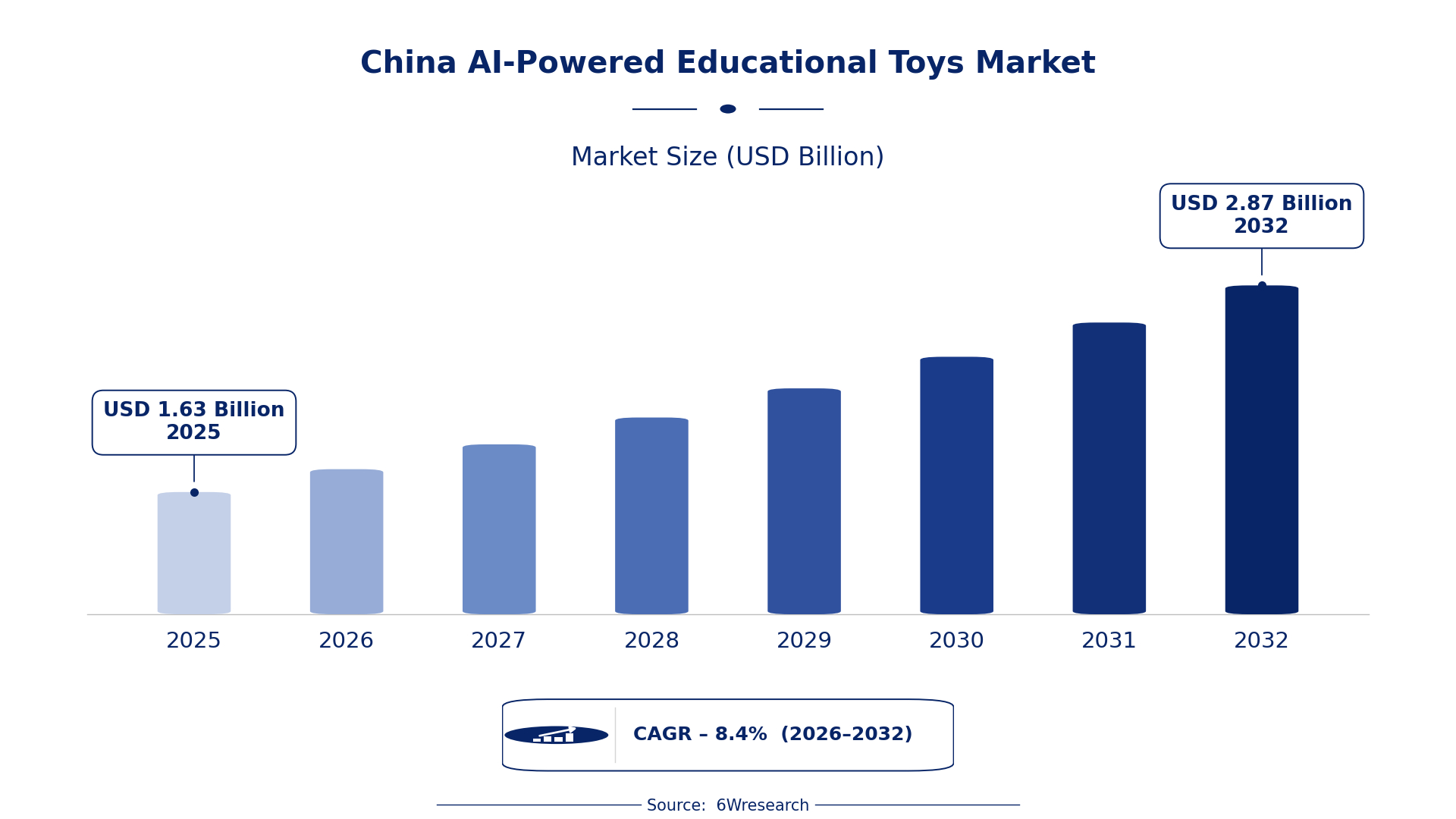
According to 6Wresearch internal database and industry insights, the China AI-Powered Educational Toys Market was valued at USD 1.63 billion in 2025 and is projected to reach USD 2.87 billion by 2032, growing at a CAGR of approximately 8.4% during 2026–2032.
China AI-Powered Educational Toys Market Highlights
| Report Metric | Details |
| Report Name | China AI-Powered Educational Toys Market |
| Market Size 2025 | USD 1.63 billion |
| Market Size 2032 | USD 2.87 billion |
| Absolute Growth 2025–2032 | USD 1.24 billion |
| CAGR 2026–2032 | 8.4% |
| Peak Annual Growth | 10.4% in 2032 |
| Forecast Period | 2026–2032 |
| Historical Data | 2022–2025 |
| Base Year | 2025 |
| Leading Toy Type, 2025 | Language Learning Toys (50% share) |
| Leading AI Feature, 2025 | NLP-Based Conversation (54% share) |
| Leading Distribution Channel, 2025 | E-commerce Platforms (45% share) |
| Leading End User, 2025 | Children (3–10 years) (36% share) |
| Fastest-Growing Toy Type | STEM Robots (9.6% CAGR) |
| Fastest-Growing AI Feature | Adaptive Learning Engines (11.1% CAGR) |
| Fastest-Growing Distribution Channel | EdTech Vendors (10.2% CAGR) |
| Fastest-Growing End User | Early Education Centers (10.7% CAGR) |
| Growing Sector | early childhood education |
| Key End Users | parents, schools, early education centres, toy retailers |
China AI-Powered Educational Toys Market Year-wise Growth Rate and Key Drivers (2022–2032)
This graph illustrates the annual growth rates of the market from 2022 to 2032, highlighting a steady upward trajectory and projected market expansion over the forecast period.
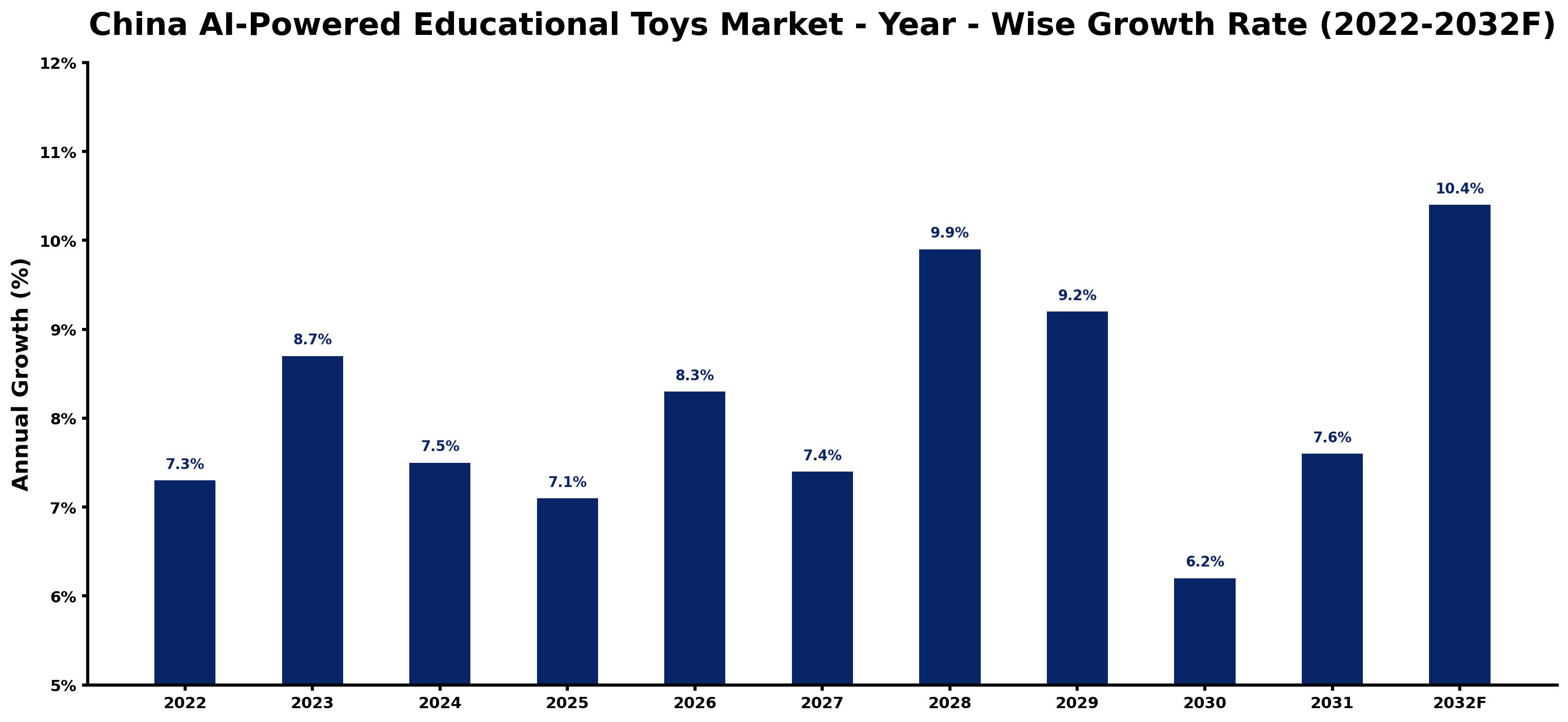
Below, each year's estimated growth is shown next to the factor that most influenced it.
| Year | Estimated Annual Growth (%) | Market Rationale |
| 2022 | 7.3 | The market experienced steady growth as parents sought educational solutions for their children, driven by the National Medium- and Long-Term Education Reform and Development Plan (2010-2020). |
| 2023 | 8.7 | Increased interest in language learning toys drove higher sales in urban areas, particularly in first-tier cities like Beijing and Shanghai. |
| 2024 | 7.5 | Growth slowed as consumers adjusted to the rising prices of educational toys amid economic fluctuations. |
| 2025 | 7.1 | The market continued to grow, albeit at a slower pace, as disposable incomes remained stable. |
| 2026 | 8.3 | A renewed focus on STEM education initiatives is expected to boost demand for educational toys among schools and parents. |
| 2027 | 7.4 | Demand is projected to slow slightly due to market saturation in major urban centres, affecting new purchases of educational toys. |
| 2028 | 9.9 | Interest in adaptive learning technologies is expected to surge, leading to increased sales in early education centres, particularly in urban areas. |
| 2029 | 9.2 | A slight slowdown is projected as competition intensifies among educational toy manufacturers in major cities. |
| 2030 | 6.2 | Growth is expected to decelerate as consumers become more selective in their purchases, focusing on quality and value in educational toys. |
| 2031 | 7.6 | The market is projected to rebound with renewed interest in AI-powered toys, driven by educational reforms and increased parental engagement. |
| 2032 | 10.4 | A peak in growth is expected as the integration of AI tools in curricula gains momentum, particularly in urban educational settings. |
Note: Market size estimations and growth projections presented in this report are based on 6Wresearch's proprietary forecasting methodology, utilizing the latest available industry data, government publications, and primary research inputs.
China AI-Powered Educational Toys Market Synopsis
AI-Powered Educational Toys in China are interactive learning tools designed for children aged 3-10. These toys utilise advanced technology, including machine learning algorithms, to promote language skills and STEM education. The market is growing due to rising disposable incomes and educational spending, with parents and schools increasingly seeking effective solutions to improve learning outcomes. Government initiatives supporting early childhood education further fuel demand, particularly in urban areas like Beijing and Shanghai.
Market Dynamics Impact Analysis (2026–2032)
| Factor | Type | Impact | Primary Segment Affected |
| Rising disposable incomes drive parents to invest in educational toys for their children. | Driver | High | Language Learning Toys |
| The increasing popularity of STEM education initiatives encourages schools to adopt educational toys. | Driver | High | STEM Robots |
| A gap in the market for innovative educational solutions presents opportunities for new entrants. | Opportunity | High | Adaptive Learning Engines |
| The growing trend of integrating AI in education opens avenues for product development. | Opportunity | High | NLP-Based Conversation |
| High competition among manufacturers can lead to price wars, affecting profit margins. | Restraint | High | Puzzle Games |
| Consumer preferences for quality over quantity may limit market growth in certain segments. | Restraint | Medium | Storytelling Devices |
| Supply chain disruptions can delay product availability, impacting sales for retailers. | Challenge | High | E-commerce Platforms |
| Regulatory approvals for new educational toys can be lengthy, slowing market entry for new products. | Challenge | Medium | Toy Retailers |
Evaluation of Drivers in China AI-Powered Educational Toys Market (2026–2032)
Key forces behind demand, with the segment each one moves most, are listed below.
| Drivers | Primary Segment Affected | Why It Matters (Evidence) |
| Increased awareness of the importance of early childhood education drives purchases of educational toys. | Interactive Voice AI | The push for preschool education is set to increase enrollment rates to 85% by 2025. |
| Growing disposable income among families encourages spending on educational toys. | Language Learning Toys | In 2022, the population of children aged 3-10 in China was approximately 150 million. |
| The rise of e-commerce platforms facilitates easier access to educational toys for consumers. | E-commerce Platforms | Over 60% of toy sales in China occur online, reflecting changing consumer preferences. |
| Government support for STEM education initiatives boosts demand for related toys. | STEM Robots | The Ministry of Education's initiatives have spurred interest in STEM robots and learning tools. |
| The adoption of adaptive learning technologies enhances personalised learning experiences. | Adaptive Learning Engines | Adaptive learning technologies are being adopted in over 30% of early education centers across major cities. |
Expansion of the AI-Powered Educational Toys market in China is backed by increased disposable income among families, growing support for early childhood education, and the rise of e-commerce platforms. In 2022, approximately 150 million children aged 3-10 in China drive demand for educational solutions. E-commerce accounts for over 60% of toy sales in China, reflecting changing consumer preferences. Adoption of adaptive learning technologies is seen in over 30% of early education centres across major cities, personalising learning experiences for children.
Evaluation of Restraints in China AI-Powered Educational Toys Market
The key brakes on demand, and where they bite hardest, are shown below.
| Market Restraint | Primary Segment Affected | Why It Matters (Evidence) |
| Economic fluctuations can affect consumer spending on non-essential items like educational toys. | STEM Robots | In uncertain economic times, families may prioritise essential goods over educational toys, impacting sales. |
| High production costs associated with advanced technology inflate prices, making these toys less affordable for families. | Language Learning Toys | As production costs rise, prices increase, limiting access for many consumers, especially in urban areas. |
| Regulatory compliance can delay product launches for manufacturers in the educational toy sector. | Interactive Voice AI | Producers face up to six months to meet the National Standards for Educational Toys, affecting market entry. |
| Technological disparities exist, limiting market reach in rural areas. | Adaptive Learning Engines | Many rural areas lack the necessary infrastructure, increasing costs for parents and limiting access to educational toys. |
| Market saturation in major urban centres can slow demand for new educational toys. | E-commerce Platforms | As competition intensifies, manufacturers may struggle to differentiate their products, impacting sales. |
China AI-Powered Educational Toys Market Challenges
The China AI-Powered Educational Toys market faces a notable skills shortage, as only 30% of early education centres have adopted adaptive learning technologies. This gap exists due to the difficulty in finding qualified educators proficient in AI, which hampers the effective use of these toys in classrooms. Compliance with the National Standards for Educational Toys presents another challenge; producers may spend up to six months obtaining necessary approvals, delaying product availability. Many rural areas lack adequate technological infrastructure, limiting access and raising costs for parents. Finally, high production costs tied to advanced technology make these toys less affordable for families, particularly in urban centres where demand is highest.
Trends in the China AI-Powered Educational Toys Market
Below mentioned are some of the trends shaping the China AI-Powered Educational Toys Market growth.
- Shift towards E-commerce for Toy Sales: China is experiencing a shift towards online purchasing for educational toys, particularly through e-commerce platforms. In 2022, over 60% of toy sales occurred online, reflecting changing consumer habits.
- Growing Adoption of Adaptive Learning Technologies: The trend of integrating adaptive learning technologies into educational toys is gaining traction, especially in urban areas. Over 30% of early education centres are now adopting these technologies to personalise learning experiences.
- Increased Focus on STEM Education: The emphasis on STEM education in China is leading to a surge in demand for related educational toys. The Ministry of Education's initiatives have spurred interest in STEM robots and learning tools.
- Integration of AI in Early Education: The integration of AI tools in early education curricula is becoming more common, with the Ministry of Education launching initiatives to support this trend. In 2023, new guidelines were introduced to improve learning outcomes.
Investment Opportunities in the China AI-Powered Educational Toys Market
Investors looking at the China AI-Powered Educational Toys Market should consider the following areas.
- Gap in Educational Solutions for Preschoolers: With rising disposable incomes, there is a significant gap for educational solutions in China. The government aims to increase preschool enrollment to 85% by 2025, creating demand for new products.
- Investment in STEM Educational Toys: The focus on STEM education creates a promising opportunity for suppliers of educational toys. Schools and parents are investing in STEM robots and learning tools to support children's education.
- Collaboration with E-commerce Platforms: With e-commerce accounting for over 60% of toy sales, partnering with online platforms offers a strategic entry route for suppliers. This approach can improve visibility and accessibility for educational toys.
- Development of AI-Based Learning Tools: The rise of AI technologies presents an opportunity for suppliers to create advanced educational tools. Schools and early education centres are seeking products that integrate AI for improved learning experiences.
Government Initiatives in the China AI-Powered Educational Toys Market
In 2023, the Ministry of Industry and Information Technology announced a subsidy program for companies developing AI educational products, aiming to boost innovation in the sector. This initiative complements earlier measures like the 'Smart Education Development Plan' from 2021, which focused on integrating AI technologies in educational tools. Together, these policies encourage manufacturers to innovate and improve product offerings, ensuring compliance with national standards and enhancing learning outcomes for children.
The 'National Plan for the Development of Artificial Intelligence' approved by the National Development and Reform Commission in 2020 promotes AI in education, particularly for early childhood. The Ministry of Education's initiatives support the integration of educational toys in learning environments, providing funding for projects that improve educational outcomes. These efforts aim to create a more engaging and effective learning experience for children, with a target to increase preschool enrollment rates to 85% by 2025.
Future Insight of the China AI-Powered Educational Toys Market
By 2032, buyers and suppliers in the China AI-Powered Educational Toys market can expect a more integrated approach to early education, driven by government initiatives promoting AI tools in learning. The Ministry of Education's commitment to enhancing STEM education will likely increase the appeal of these toys, encouraging broader adoption in schools. E-commerce will significantly improve accessibility, enabling families in diverse regions to acquire these educational tools. With preschool enrollment rates projected to reach 90% by 2025, demand for innovative learning solutions is set to grow, creating new opportunities for producers.
Market Segmentation Analysis
Each segment group is reviewed below, with the leader by share and the fastest grower by CAGR.
By Toy Type – Language Learning Toys Dominated, STEM Robots Expected to Grow Fastest
According to Shubham Padhi, Research Analyst at 6Wresearch, Language Learning Toys took a 50% share of toy type in 2025, more than any other category. Language learning toys hold the largest share in the market because they directly teach language skills, appealing to parents eager for effective educational solutions. Their prominence is particularly notable in first-tier cities like Beijing and Shanghai, where demand for quality learning tools is substantial. STEM Robots are set to record the highest CAGR in this split, 9.6% over 2026–2032. STEM robots are rapidly gaining traction as they engage children in science, technology, engineering, and math learning, which aligns with national educational priorities. The Ministry of Education's emphasis on STEM initiatives is likely to drive further adoption in early education settings, widening the gap with other toy types. Suppliers should prioritise the development of language learning toys while also investing in STEM robots to capture emerging opportunities in the market.
By AI Feature – NLP-Based Conversation Dominated, Adaptive Learning Engines Expected to Grow Fastest
With a 54% revenue share in 2025, NLP-Based Conversation was the largest ai feature category. NLP-based conversation toys hold the largest share as they facilitate language learning through interactive natural language processing, appealing to parents prioritising language skills. Their effectiveness in engaging children makes them a preferred choice in educational settings. Over 2026–2032, Adaptive Learning Engines are expected to post the fastest growth, at a CAGR of 11.1%. Adaptive learning engines are growing quickly because they personalise learning experiences based on individual progress, catering to diverse learning needs. This trend is supported by the increasing adoption of adaptive technologies in over 30% of early education centres. Suppliers should invest in NLP-based toys while also innovating adaptive learning features to meet the evolving demands of the market.
By Distribution Channel – E-commerce Platforms Dominated, EdTech Vendors Expected to Grow Fastest
E-commerce Platforms accounted for a 45% market share by distribution channel in 2025. E-commerce platforms lead the distribution channel with their extensive range of products, meeting the preferences of parents who increasingly shop online. With over 60% of toy sales occurring through these platforms, they are pivotal in reaching a broad customer base across China. The quickest growth will come from EdTech Vendors, forecast to expand at a CAGR of 10.2% between 2026 and 2032. EdTech vendors are rapidly growing as they integrate educational toys into their offerings, appealing directly to educational institutions. This growth is further supported by government initiatives promoting technology in early education, ensuring EdTech vendors will continue to gain market share. Suppliers must strengthen their online presence through e-commerce platforms and explore partnerships with EdTech vendors to enhance distribution effectiveness.
By End User – Children (3–10 years) Dominated, Early Education Centers Expected to Grow Fastest
The largest end user category in 2025 was Children (3–10 years), with a 36% share of total revenue. Children aged 3-10 years are the primary users of AI-powered educational toys, making this demographic crucial for market growth. With approximately 150 million children in this age group in China, the demand for these toys is substantial and continues to rise. Early Education Centers are projected to grow fastest, at a CAGR of 10.7% during 2026–2032. Early education centres are increasingly incorporating these toys to improve learning experiences, spurred by government initiatives focused on enhancing preschool education. This trend indicates a growing reliance on innovative educational tools within early education centres, further driving market demand. Suppliers should tailor their products to meet the specific needs of early education centres while ensuring they remain appealing to the primary user group of children.
Key Attractiveness of the Report
- 10 Years of Market Numbers
- Historical Data Starting from 2022 to 2025
- Base Year 2025
- Forecast Data until 2032
- Key Performance Indicators Impacting the Market
- Major Upcoming Developments and Projects
Key Highlights of the Report:
- China AI-Powered Educational Toys Market Outlook
- Market Size of China AI-Powered Educational Toys Market, 2025
- Forecast of China AI-Powered Educational Toys Market, 2032
- Historical Data and Forecast of China AI-Powered Educational Toys Revenues & Volume for the Period 2022 - 2032F
- China AI-Powered Educational Toys Market Trend Evolution
- China AI-Powered Educational Toys Market Drivers and Challenges
- China AI-Powered Educational Toys Price Trends
- China AI-Powered Educational Toys Porter's Five Forces
- China AI-Powered Educational Toys Industry Life Cycle
- Historical Data and Forecast of China AI-Powered Educational Toys Market Revenues & Volume By Toy Type for the Period 2022 - 2032F
- Historical Data and Forecast of China AI-Powered Educational Toys Market Revenues & Volume By Language Learning Toys for the Period 2022 - 2032F
- Historical Data and Forecast of China AI-Powered Educational Toys Market Revenues & Volume By STEM Robots for the Period 2022 - 2032F
- Historical Data and Forecast of China AI-Powered Educational Toys Market Revenues & Volume By Puzzle Games for the Period 2022 - 2032F
- Historical Data and Forecast of China AI-Powered Educational Toys Market Revenues & Volume By Storytelling Devices for the Period 2022 - 2032F
- Historical Data and Forecast of China AI-Powered Educational Toys Market Revenues & Volume By AI Feature for the Period 2022 - 2032F
- Historical Data and Forecast of China AI-Powered Educational Toys Market Revenues & Volume By NLP-Based Conversation for the Period 2022 - 2032F
- Historical Data and Forecast of China AI-Powered Educational Toys Market Revenues & Volume By Adaptive Learning Engines for the Period 2022 - 2032F
- Historical Data and Forecast of China AI-Powered Educational Toys Market Revenues & Volume By AI-Based Difficulty Scaling for the Period 2022 - 2032F
- Historical Data and Forecast of China AI-Powered Educational Toys Market Revenues & Volume By Interactive Voice AI for the Period 2022 - 2032F
- Historical Data and Forecast of China AI-Powered Educational Toys Market Revenues & Volume By Distribution Channel for the Period 2022 - 2032F
- Historical Data and Forecast of China AI-Powered Educational Toys Market Revenues & Volume By Toy Retailers for the Period 2022 - 2032F
- Historical Data and Forecast of China AI-Powered Educational Toys Market Revenues & Volume By E-commerce Platforms for the Period 2022 - 2032F
- Historical Data and Forecast of China AI-Powered Educational Toys Market Revenues & Volume By EdTech Vendors for the Period 2022 - 2032F
- Historical Data and Forecast of China AI-Powered Educational Toys Market Revenues & Volume By Specialty Toy Stores for the Period 2022 - 2032F
- Historical Data and Forecast of China AI-Powered Educational Toys Market Revenues & Volume By End User for the Period 2022 - 2032F
- Historical Data and Forecast of China AI-Powered Educational Toys Market Revenues & Volume By Children (3 10 years) for the Period 2022 - 2032F
- Historical Data and Forecast of China AI-Powered Educational Toys Market Revenues & Volume By Schools & Parents for the Period 2022 - 2032F
- Historical Data and Forecast of China AI-Powered Educational Toys Market Revenues & Volume By Early Education Centers for the Period 2022 - 2032F
- Historical Data and Forecast of China AI-Powered Educational Toys Market Revenues & Volume By Preschool Kids for the Period 2022 - 2032F
- China AI-Powered Educational Toys Import Export Trade Statistics
- Market Opportunity Assessment By Toy Type
- Market Opportunity Assessment By AI Feature
- Market Opportunity Assessment By Distribution Channel
- Market Opportunity Assessment By End User
- China AI-Powered Educational Toys Top Companies Market Share
- China AI-Powered Educational Toys Competitive Benchmarking By Technical and Operational Parameters
- China AI-Powered Educational Toys Company Profiles
- China AI-Powered Educational Toys Key Strategic Recommendations
Market Covered
Segments analysed in this report are listed below.
By Toy Type
- Language Learning Toys
- STEM Robots
- Puzzle Games
- Storytelling Devices
By AI Feature
- NLP-Based Conversation
- Adaptive Learning Engines
- AI-Based Difficulty Scaling
- Interactive Voice AI
By Distribution Channel
- Toy Retailers
- E-commerce Platforms
- EdTech Vendors
- Specialty Toy Stores
By End User
- Children (3–10 years)
- Schools & Parents
- Early Education Centers
- Preschool Kids































