China AI-Powered Fleet Systems Market Size & Growth Rate
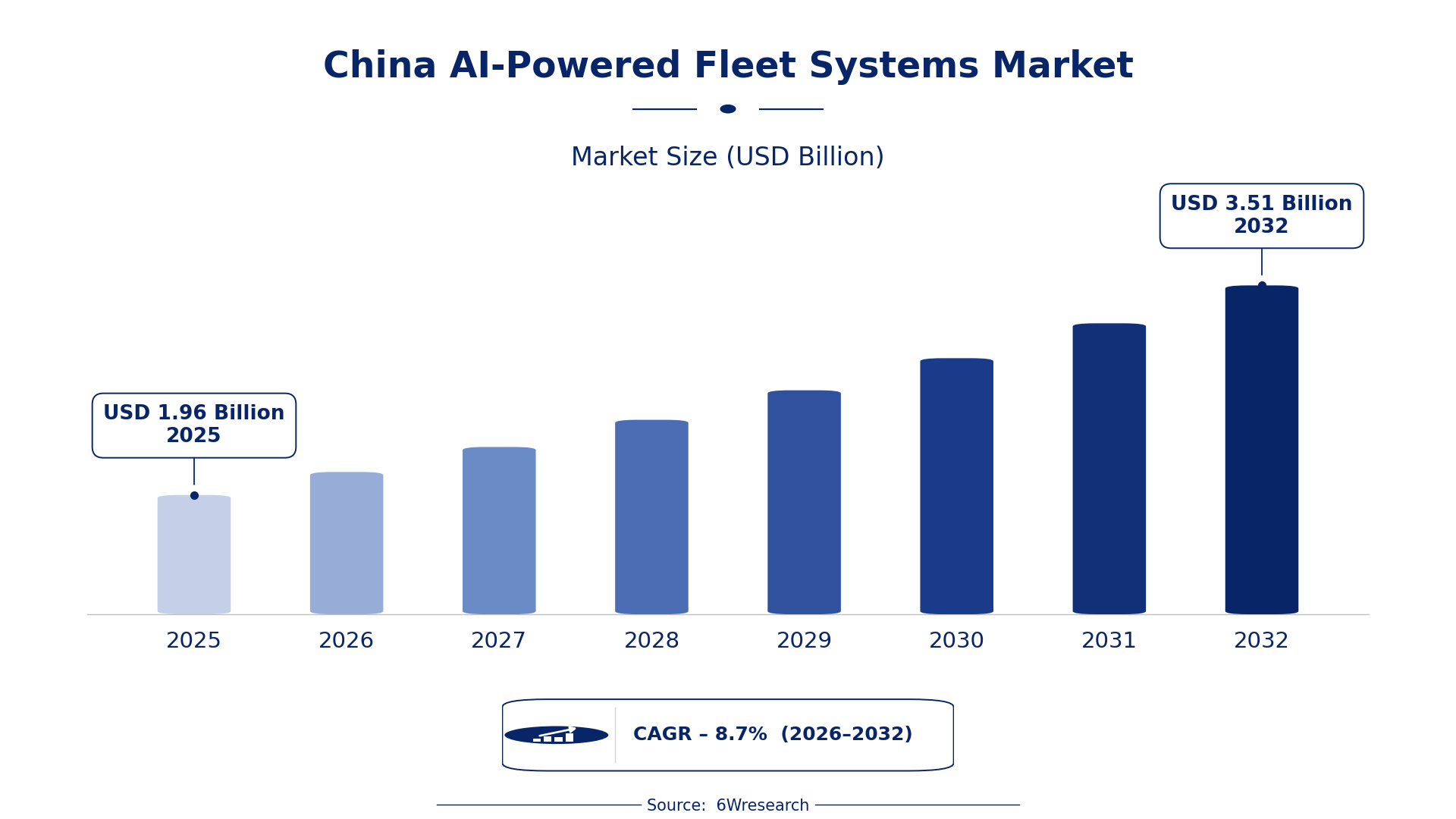
According to 6Wresearch internal database and industry insights, the China AI-Powered Fleet Systems Market was valued at USD 1.96 billion in 2025 and is projected to reach USD 3.51 billion by 2032, growing at a CAGR of approximately 8.7% during 2026–2032.
China AI-Powered Fleet Systems Market Highlights
| Report Metric | Details |
| Report Name | China AI-Powered Fleet Systems Market |
| Market Size 2025 | USD 1.96 billion |
| Market Size 2032 | USD 3.51 billion |
| Absolute Growth 2025–2032 | USD 1.55 billion |
| CAGR 2026–2032 | 8.7% |
| Peak Annual Growth | 10.7% in 2030 |
| Forecast Period | 2026–2032 |
| Historical Data | 2022–2025 |
| Base Year | 2025 |
| Leading Fleet Type, 2025 | Logistics Fleets (39% share) |
| Leading AI Optimization, 2025 | Route Planning AI (54% share) |
| Leading Distribution Channel, 2025 | Fleet Management SaaS (44% share) |
| Leading End User, 2025 | Courier Services (36% share) |
| Fastest-Growing Fleet Type | Public Transit Fleets (11.4% CAGR) |
| Fastest-Growing AI Optimization | Demand Prediction (10.7% CAGR) |
| Fastest-Growing End User | Municipal Transit Offices (9.9% CAGR) |
| Growing Sector | Logistics |
| Key End Users | Logistics companies, public transit authorities, courier services, municipal transit offices |
China AI-Powered Fleet Systems Market Year-wise Growth Rate and Key Drivers (2022–2032)
This graph illustrates the annual growth rates of the market from 2022 to 2032, highlighting a steady upward trajectory and projected market expansion over the forecast period.
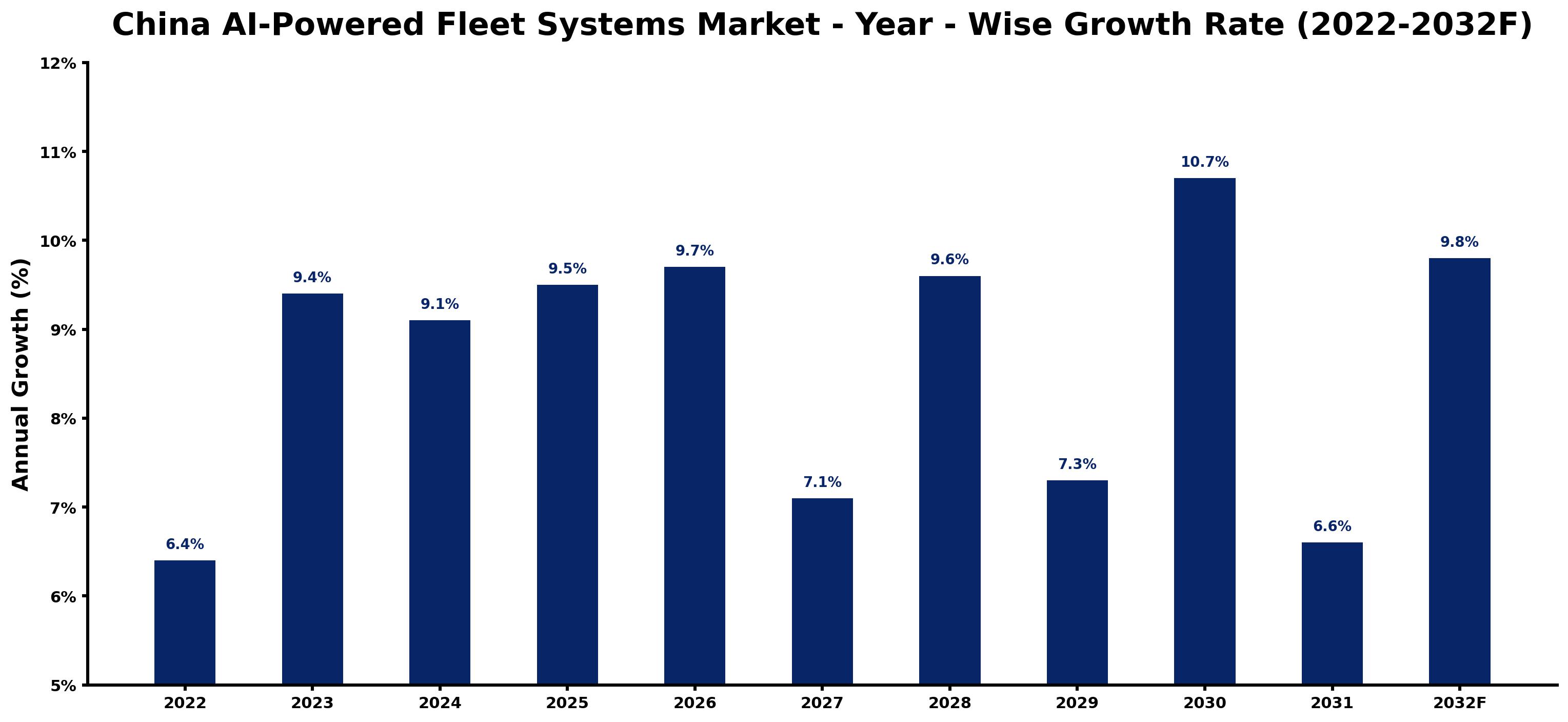
Annual growth estimates for each year appear below with the principal reason behind them, explaining the shifts that set the pace of the market.
| Year | Estimated Annual Growth (%) | Market Rationale |
| 2022 | 6.4 | The market experienced steady growth, supported by increasing AI adoption in logistics. |
| 2023 | 9.4 | Growth accelerated as 60% of logistics firms reported using AI for route optimization. |
| 2024 | 9.1 | The market saw a slight slowdown due to the maturing technology landscape. |
| 2025 | 9.5 | Demand surged as logistics companies focused on enhancing operational efficiency. |
| 2026 | 9.7 | Growth continued as public transit systems integrated AI for improved service. |
| 2027 | 7.1 | A slowdown occurred as market saturation began in urban areas. |
| 2028 | 9.6 | Demand rebounded as urbanisation increased, driving transit efficiency needs. |
| 2029 | 7.3 | Growth slowed again as competition intensified among technology providers. |
| 2030 | 10.7 | A peak year driven by significant investments in AI technologies. |
| 2031 | 6.6 | Growth moderated as the market began to stabilise after rapid expansion. |
| 2032 | 9.8 | Demand remains strong as urban populations continue to rise. |
Note: Market size estimations and growth projections presented in this report are based on 6Wresearch's proprietary forecasting methodology, utilizing the latest available industry data, government publications, and primary research inputs.
China AI-Powered Fleet Systems Market Synopsis
AI-Powered Fleet Systems in China represent sophisticated solutions that optimise fleet operations through artificial intelligence. These systems improve operational efficiency, lower costs, and enhance service delivery in logistics and public transportation. The China AI-Powered Fleet Systems Market is growing due to increasing demand from logistics companies and public transit authorities. With the logistics sector valued at over 10 trillion yuan, the market is experiencing strong expansion. Government initiatives are further encouraging the integration of AI technologies, leading to greater adoption among domestic users.
Market Dynamics Impact Analysis (2026–2032)
| Factor | Type | Impact | Primary Segment Affected |
| Increased investment in AI technologies for logistics optimization | Driver | High | Logistics Fleets |
| Growing demand for efficient public transit solutions | Driver | High | Public Transit Fleets |
| Expansion of AI applications in fleet management | Opportunity | High | Logistics Fleets |
| Rising urban population necessitating improved transit systems | Opportunity | High | Public Transit Fleets |
| High initial investment costs for AI systems | Restraint | Medium | Logistics Fleets |
| Regulatory compliance requirements for AI integration | Restraint | Medium | Public Transit Fleets |
| Limited awareness among smaller firms about AI benefits | Challenge | Medium | Logistics Fleets |
| Technological integration challenges with existing systems | Challenge | Medium | Public Transit Fleets |
Evaluation of Drivers in China AI-Powered Fleet Systems Market (2026–2032)
The table below links each growth driver to the segment it affects and the evidence for it.
| Drivers | Primary Segment Affected | Why It Matters (Evidence) |
| Investment in AI technologies | Logistics Fleets | The logistics sector, valued at over 10 trillion yuan, drives demand for AI solutions to improve operational efficiency. |
| Integration of AI in public transit | Public Transit Fleets | With over 1 billion passengers served annually, public transit systems are adopting AI for improved service reliability. |
| Route optimization capabilities of AI | Logistics Fleets | 60% of logistics companies reported using AI for route optimization, leading to reduced operational costs. |
| Fleet Management SaaS adoption | Fleet Management SaaS | Fleet Management SaaS is adopted by 70% of logistics firms in major cities, streamlining operations and reducing costs. |
| Demand prediction technologies | Demand Prediction | Demand prediction technologies help manage fleet capacity effectively, improving service delivery in logistics. |
The AI-Powered Fleet Systems market in China is growing on the back of substantial investments in AI technologies and increasing end-use demand from logistics and public transit sectors. The logistics sector, valued at over 10 trillion yuan, is rapidly adopting AI solutions, with 60% of firms using AI for route optimization. Public transit systems serving over 1 billion passengers annually are integrating AI to improve service reliability. Fleet Management SaaS is adopted by 70% of logistics firms in major cities, streamlining operations and reducing costs. Demand prediction technologies are also helping firms manage fleet capacity effectively, driving further purchases.
Evaluation of Restraints in China AI-Powered Fleet Systems Market
The following restraints limit how fast demand can grow.
| Market Restraint | Primary Segment Affected | Why It Matters (Evidence) |
| High initial investment costs for AI systems | Logistics Fleets | Many logistics companies face challenges in justifying the upfront costs of AI integration, impacting adoption rates. |
| Regulatory compliance requirements for AI integration | Public Transit Fleets | Public transit authorities must navigate complex regulations, which can delay AI implementation by several months. |
| Limited awareness among smaller firms about AI benefits | Logistics Fleets | Many smaller logistics companies lack knowledge about the advantages of AI, hindering market growth. |
| Technological integration challenges with existing systems | Public Transit Fleets | Legacy systems in public transit can complicate the integration of new AI technologies, delaying upgrades. |
| Concerns over data privacy and security | Logistics Fleets | Firms are wary of potential data breaches, which can deter investment in AI solutions. |
China AI-Powered Fleet Systems Market Challenges
Buyers in the China AI-Powered Fleet Systems market are contending with rising costs, as advanced technology solutions can increase operational expenses by 20% for logistics companies. Regulatory compliance presents challenges, with standards from the Ministry of Transport potentially delaying implementation timelines by six months, affecting the timely delivery of services. A shortage of skilled workers complicates matters; only 30% of firms report having adequate expertise in AI integration, resulting in inefficiencies in fleet management. Rapid technological advancements create uncertainty, compelling producers to invest heavily in R&D without guaranteed returns, which can hinder progress.
Trends in the China AI-Powered Fleet Systems Market
Buyers and suppliers in the China AI-Powered Fleet Systems Market are adjusting to the following trends.
- Shift towards AI-Driven Route Optimization: In 2023, 60% of logistics companies reported using AI for route optimisation, which improves delivery efficiency and reduces operational costs.
- Emergence of Fleet Management SaaS: Fleet Management SaaS is increasingly adopted, with 70% of logistics firms in major cities utilising it to streamline operations and boost efficiency.
- Public Transit Systems Embracing AI: The 'Smart Transportation' initiative launched in 2022 aims to integrate AI technologies into public transit systems, targeting a 30% efficiency improvement by 2025.
- Growing Demand for Demand Prediction Technologies: Demand prediction technologies are becoming crucial, assisting logistics firms in anticipating customer needs and managing fleet capacity effectively, driving further adoption.
Investment Opportunities in the China AI-Powered Fleet Systems Market
Investors looking at the China AI-Powered Fleet Systems Market should consider the following areas.
- Urban Transit Systems: With China's urban population expected to reach 1 billion by 2030, there is an opportunity to supply AI-powered solutions to municipal transit offices, improving service efficiency and reliability.
- Logistics Hubs: The logistics sector's value exceeding 10 trillion yuan presents opportunities for AI integration in logistics hubs, requiring partnerships with local firms for effective implementation.
- Public Transit Fleet Upgrades: With 60% of logistics companies using AI for route optimization, there is a growing need for AI optimization services, particularly among smaller logistics firms.
- Investment in AI Technologies: As AI adoption grows, there is a need for suppliers to provide tailored solutions for fleet management, particularly in urban areas with high transit demands.
Government Initiatives in the China AI-Powered Fleet Systems Market
The Ministry of Transport's 'Smart Transportation' initiative, launched in 2022, aims to integrate AI technologies into public transit systems, targeting a 30% efficiency improvement by 2025. This initiative complements the 14th Five-Year Plan for National Economic and Social Development, which emphasises AI in transportation, issued by the National Development and Reform Commission in 2021. Together, these measures strengthen the regulatory framework for AI applications in fleet management, facilitating smoother integration for producers and buyers.
The National Development and Reform Commission oversees the implementation of the 14th Five-Year Plan, promoting investment in AI technologies for fleet management. The Ministry of Industry and Information Technology approved guidelines for AI applications in logistics in 2023, enhancing regulatory frameworks for fleet systems. These agencies support the integration of AI technologies, facilitating funding and approvals for projects that improve operational efficiency and service delivery.
Future Insight of the China AI-Powered Fleet Systems Market
Several forward-looking factors should support the China AI-Powered Fleet Systems market over the coming years. By 2030, urban population growth will drive the demand for efficient transit solutions, with over 1 billion passengers relying on public transport annually. The Ministry of Industry and Information Technology's initiatives will encourage deeper AI integration in logistics, while telematics is projected to grow at 15% annually, indicating a robust market for advanced fleet management solutions. The National Development and Reform Commission's support for AI under the 14th Five-Year Plan will further propel technological advancements.
Market Segmentation Analysis
The analysis below covers each segmentation, its leading category in 2025 and its fastest-growing category through 2032.
By Fleet Type – Logistics Fleets Dominated, Public Transit Fleets Expected to Grow Fastest
According to Shubham Padhi, Research Analyst at 6Wresearch, in 2025, Logistics Fleets led the fleet type split with a 39% share. Logistics fleets command the largest market share as they are crucial for enhancing route efficiency and lowering operational costs. The extensive use of AI-Powered Fleet Systems by over 60% of logistics companies highlights their importance in this sector. Over 2026–2032, Public Transit Fleets are expected to post the fastest growth, at a CAGR of 11.4%. Public transit fleets are experiencing rapid growth due to their increasing implementation of technologies that improve service reliability and enhance passenger experience. The projected urban population growth in China to 1 billion by 2030 will further drive demand for these systems. This indicates that suppliers should concentrate on creating solutions that cater specifically to the logistics and public transit sectors to capitalise on growth opportunities.
By AI Optimization – Route Planning AI Dominated, Demand Prediction Expected to Grow Fastest
Route Planning AI held a 54% share of the China AI-Powered Fleet Systems Market by ai optimization in 2025. Route planning AI commands the largest market share as it is essential for optimising fleet routes and reducing delivery times, making it a core function in fleet management. This capability is critical for logistics firms aiming to improve operational efficiency and service delivery. Demand Prediction is set to record the highest CAGR in this split, 10.7% over 2026–2032. Demand prediction is the fastest-growing segment as it allows companies to anticipate customer needs and manage fleet capacity effectively. The increasing complexity of logistics operations is fuelling the demand for such predictive capabilities. Suppliers must invest in advanced capabilities to meet the rising expectations for efficiency and responsiveness in fleet management.
By Distribution Channel – Fleet Management SaaS Dominated and Is Expected to Record the Fastest Growth
The largest distribution channel category in 2025 was Fleet Management SaaS, with a 44% share of total revenue. Fleet management SaaS leads the market share due to its efficient model for delivering fleet management solutions, appealing to a broad range of users. Its flexibility and scalability make it the preferred choice among logistics companies seeking effective fleet management. The same category are also set to grow fastest, at a CAGR of 10.3% during 2026–2032. Fleet management SaaS is also the fastest-growing segment, reflecting the increasing preference for cloud-based solutions that provide real-time data access and analytics. This trend is expected to continue as more companies transition to digital platforms. Suppliers should prioritise the development of SaaS solutions to remain competitive and meet the growing demand for accessible fleet management tools.
By End User – Courier Services Dominated, Municipal Transit Offices Expected to Grow Fastest
Courier Services accounted for a 36% market share by end user in 2025. Courier services hold the largest market share as they depend significantly on AI-Powered Fleet Systems for efficient delivery operations, which require advanced route optimisation and real-time tracking. This sector's reliance on these systems underscores their critical role in operational success. Municipal Transit Offices are projected to grow fastest, at a CAGR of 9.9% during 2026–2032. Municipal transit offices are the fastest-growing end user, leveraging these systems to enhance public transportation services and improve the overall passenger experience. The increasing demand for smarter urban transit solutions is a key factor in this growth. This suggests that suppliers should focus on tailoring their offerings to address the specific requirements of courier services and municipal transit offices to seize market opportunities.
Key Attractiveness of the Report
- 10 Years of Market Numbers
- Historical Data Starting from 2022 to 2025
- Base Year 2025
- Forecast Data until 2032
- Key Performance Indicators Impacting the Market
- Major Upcoming Developments and Projects
Key Highlights of the Report:
- China AI-Powered Fleet Systems Market Outlook
- Market Size of China AI-Powered Fleet Systems Market, 2025
- Forecast of China AI-Powered Fleet Systems Market, 2032
- Historical Data and Forecast of China AI-Powered Fleet Systems Revenues & Volume for the Period 2022 - 2032F
- China AI-Powered Fleet Systems Market Trend Evolution
- China AI-Powered Fleet Systems Market Drivers and Challenges
- China AI-Powered Fleet Systems Price Trends
- China AI-Powered Fleet Systems Porter's Five Forces
- China AI-Powered Fleet Systems Industry Life Cycle
- Historical Data and Forecast of China AI-Powered Fleet Systems Market Revenues & Volume By Fleet Type for the Period 2022 - 2032F
- Historical Data and Forecast of China AI-Powered Fleet Systems Market Revenues & Volume By Logistics Fleets for the Period 2022 - 2032F
- Historical Data and Forecast of China AI-Powered Fleet Systems Market Revenues & Volume By Public Transit Fleets for the Period 2022 - 2032F
- Historical Data and Forecast of China AI-Powered Fleet Systems Market Revenues & Volume By Utility Vehicles for the Period 2022 - 2032F
- Historical Data and Forecast of China AI-Powered Fleet Systems Market Revenues & Volume By Rental Fleets for the Period 2022 - 2032F
- Historical Data and Forecast of China AI-Powered Fleet Systems Market Revenues & Volume By AI Optimization for the Period 2022 - 2032F
- Historical Data and Forecast of China AI-Powered Fleet Systems Market Revenues & Volume By Route Planning AI for the Period 2022 - 2032F
- Historical Data and Forecast of China AI-Powered Fleet Systems Market Revenues & Volume By Demand Prediction for the Period 2022 - 2032F
- Historical Data and Forecast of China AI-Powered Fleet Systems Market Revenues & Volume By Maintenance Scheduling for the Period 2022 - 2032F
- Historical Data and Forecast of China AI-Powered Fleet Systems Market Revenues & Volume By Usage Analytics AI for the Period 2022 - 2032F
- Historical Data and Forecast of China AI-Powered Fleet Systems Market Revenues & Volume By Distribution Channel for the Period 2022 - 2032F
- Historical Data and Forecast of China AI-Powered Fleet Systems Market Revenues & Volume By Transportation Software for the Period 2022 - 2032F
- Historical Data and Forecast of China AI-Powered Fleet Systems Market Revenues & Volume By Fleet Management SaaS for the Period 2022 - 2032F
- Historical Data and Forecast of China AI-Powered Fleet Systems Market Revenues & Volume By Telematics Vendors for the Period 2022 - 2032F
- Historical Data and Forecast of China AI-Powered Fleet Systems Market Revenues & Volume By Rental Service Platforms for the Period 2022 - 2032F
- Historical Data and Forecast of China AI-Powered Fleet Systems Market Revenues & Volume By End User for the Period 2022 - 2032F
- Historical Data and Forecast of China AI-Powered Fleet Systems Market Revenues & Volume By Courier Services for the Period 2022 - 2032F
- Historical Data and Forecast of China AI-Powered Fleet Systems Market Revenues & Volume By Municipal Transit Offices for the Period 2022 - 2032F
- Historical Data and Forecast of China AI-Powered Fleet Systems Market Revenues & Volume By Energy Providers for the Period 2022 - 2032F
- Historical Data and Forecast of China AI-Powered Fleet Systems Market Revenues & Volume By Automotive Leasing Firms for the Period 2022 - 2032F
- China AI-Powered Fleet Systems Import Export Trade Statistics
- Market Opportunity Assessment By Fleet Type
- Market Opportunity Assessment By AI Optimization
- Market Opportunity Assessment By Distribution Channel
- Market Opportunity Assessment By End User
- China AI-Powered Fleet Systems Top Companies Market Share
- China AI-Powered Fleet Systems Competitive Benchmarking By Technical and Operational Parameters
- China AI-Powered Fleet Systems Company Profiles
- China AI-Powered Fleet Systems Key Strategic Recommendations
Market Covered
Segments analysed in this report are listed below.
By Fleet Type
- Logistics Fleets
- Public Transit Fleets
- Utility Vehicles
- Rental Fleets
By AI Optimization
- Route Planning AI
- Demand Prediction
- Maintenance Scheduling
- Usage Analytics AI
By Distribution Channel
- Transportation Software
- Fleet Management SaaS
- Telematics Vendors
- Rental Service Platforms
By End User
- Courier Services
- Municipal Transit Offices
- Energy Providers
- Automotive Leasing Firms































