China AI-Powered Merchandising Market Size & Growth Rate
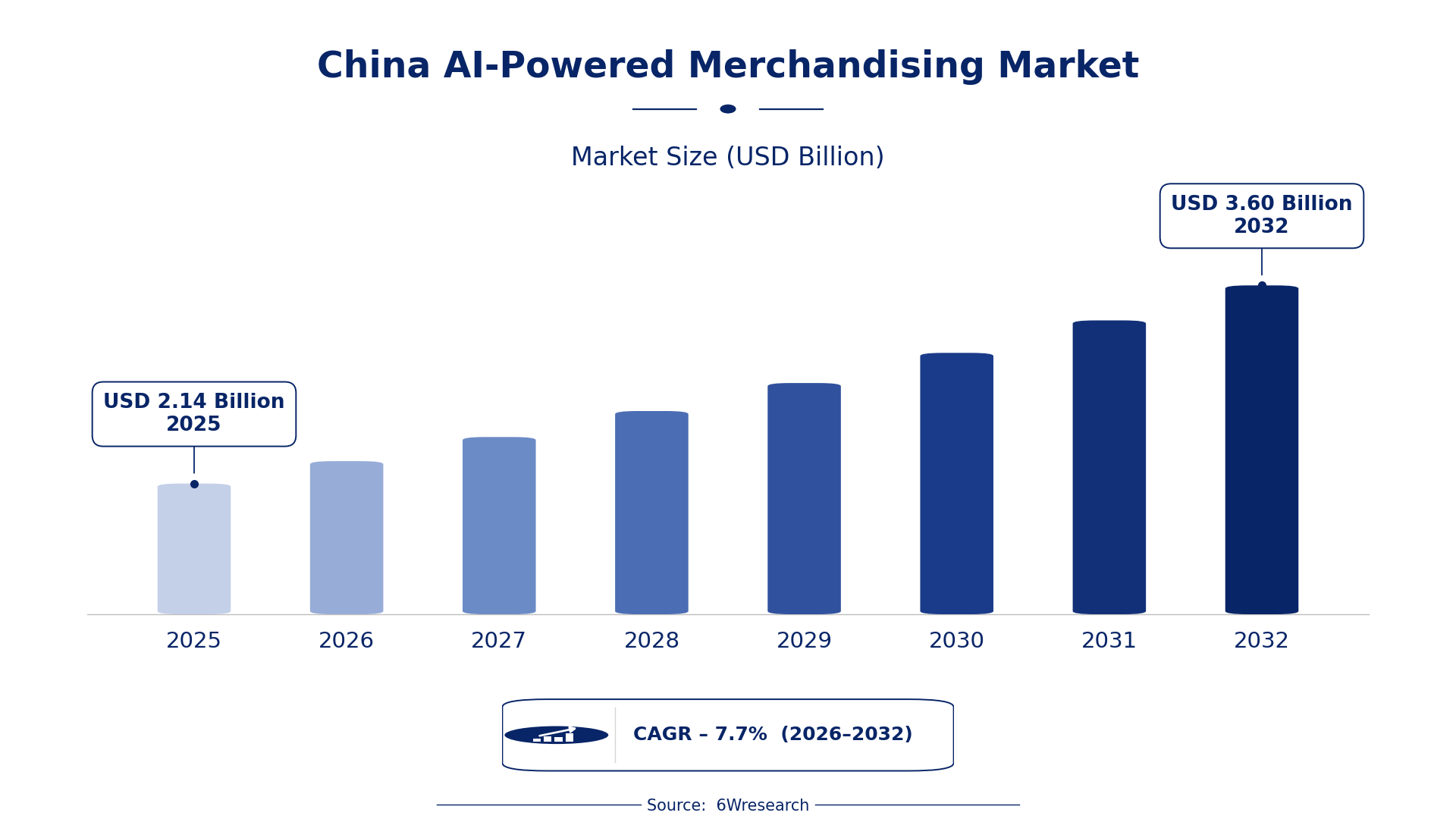
According to 6Wresearch internal database and industry insights, the China AI-Powered Merchandising Market was valued at USD 2.14 billion in 2025 and is projected to reach USD 3.60 billion by 2032, growing at a CAGR of approximately 7.7% during 2026–2032.
China AI-Powered Merchandising Market Highlights
| Report Metric | Details |
| Report Name | China AI-Powered Merchandising Market |
| Market Size 2025 | USD 2.14 billion |
| Market Size 2032 | USD 3.60 billion |
| Absolute Growth 2025–2032 | USD 1.46 billion |
| CAGR 2026–2032 | 7.7% |
| Peak Annual Growth | 10.2% in 2031 |
| Forecast Period | 2026–2032 |
| Historical Data | 2022–2025 |
| Base Year | 2025 |
| Leading Retail Type, 2025 | E-Commerce (35% share) |
| Leading AI Capability, 2025 | Demand Forecasting AI (35% share) |
| Leading Distribution Channel, 2025 | Retail AI SaaS Providers (44% share) |
| Leading End User, 2025 | Apparel Brands (42% share) |
| Fastest-Growing Retail Type | Grocery Chains (9.1% CAGR) |
| Fastest-Growing AI Capability | Dynamic Pricing Engine (10.1% CAGR) |
| Fastest-Growing Distribution Channel | Online Merchandising Tools (8.9% CAGR) |
| Fastest-Growing End User | Supermarkets (10.2% CAGR) |
| Growing Sector | E-Commerce |
| Key End Users | Apparel Brands, Grocery Chains, Supermarkets, Online Marketplaces |
China AI-Powered Merchandising Market Year-wise Growth Rate and Key Drivers (2022–2032)
This graph illustrates the annual growth rates of the market from 2022 to 2032, highlighting a steady upward trajectory and projected market expansion over the forecast period.
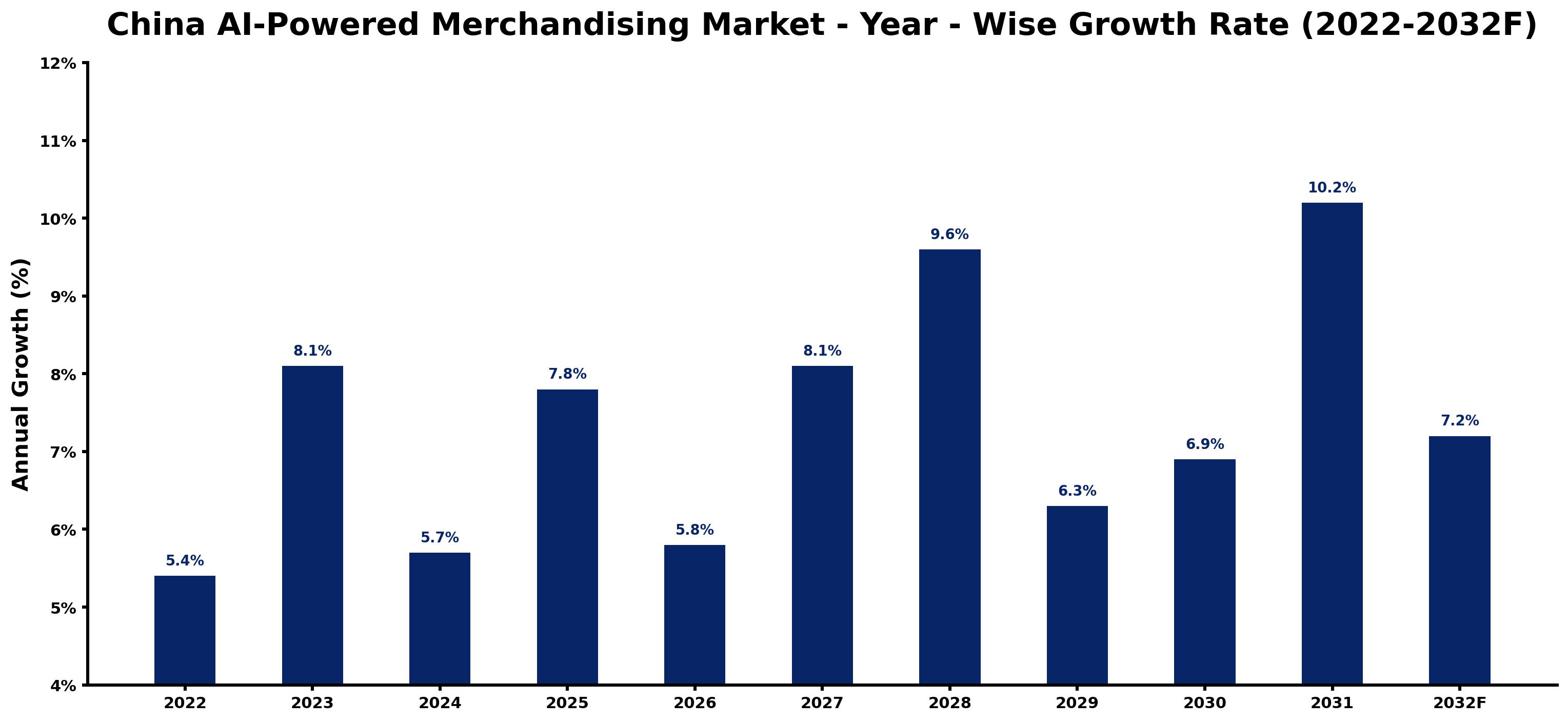
Annual growth estimates for each year appear below with the principal reason behind them, explaining the shifts that set the pace of the market.
| Year | Estimated Annual Growth (%) | Market Rationale |
| 2022 | 5.4 | The market experienced moderate growth as AI adoption began to gain traction among retailers. |
| 2023 | 8.1 | Growth accelerated due to increased investments in AI technologies by major retail players. |
| 2024 | 5.7 | A slowdown occurred as some retailers reassessed their AI integration strategies. |
| 2025 | 7.8 | Demand surged as e-commerce platforms expanded their AI capabilities for better customer engagement. |
| 2026 | 5.8 | Growth is expected to slow as market saturation affects new AI solution deployments. |
| 2027 | 8.1 | Growth will be driven by new AI applications in inventory management. |
| 2028 | 9.6 | Strong demand is projected to continue as dynamic pricing strategies become more prevalent among retailers. |
| 2029 | 6.3 | Growth is expected to slow as competition intensifies and innovation cycles lengthen. |
| 2030 | 6.9 | A slight increase in growth will occur as retailers adapt to changing consumer preferences. |
| 2031 | 10.2 | The market will peak with substantial investments in advanced AI solutions for merchandising. |
| 2032 | 7.2 | Growth is projected to slow as the market stabilises, reflecting maturity in AI adoption across retail. |
Note: Market size estimations and growth projections presented in this report are based on 6Wresearch's proprietary forecasting methodology, utilizing the latest available industry data, government publications, and primary research inputs.
China AI-Powered Merchandising Market Synopsis
AI-Powered Merchandising in China optimises retail operations through advanced algorithms and machine learning, improving customer experiences and inventory management. The China AI-Powered Merchandising Market is driven by strong demand from e-commerce platforms and domestic retailers. With the retail AI market projected to exceed 100 billion yuan by 2025, initiatives like the 'New Generation Artificial Intelligence Development Plan' are propelling further growth. The increasing adoption of AI solutions by over 70% of apparel brands underscores the expanding opportunities in this sector.
Market Dynamics Impact Analysis (2026–2032)
| Factor | Type | Impact | Primary Segment Affected |
| Growing e-commerce transaction volume | Driver | High | E-Commerce |
| Increasing adoption of AI for demand forecasting | Driver | High | Demand Forecasting AI |
| High demand for AI-driven dynamic pricing solutions | Opportunity | High | Dynamic Pricing Engine |
| Expansion of AI applications in grocery chains | Opportunity | Medium | Grocery Chains |
| Challenges in integrating AI with existing systems | Restraint | High | Retail AI SaaS Providers |
| Data security concerns affecting consumer trust | Restraint | Medium | Apparel Brands |
| The AI-Powered Merchandising market in China faces regulatory hurdles | Challenge | High | AI Retail Partners |
| Limited access to skilled AI professionals hampers growth | Challenge | Medium | Supply Chain Software Firms |
Evaluation of Drivers in China AI-Powered Merchandising Market (2026–2032)
The main growth drivers and the segments they affect most are set out below.
| Drivers | Primary Segment Affected | Why It Matters (Evidence) |
| Increased investment in AI technologies | Retail AI SaaS Providers | The retail AI market is projected to exceed 100 billion yuan by 2025, driving demand for software solutions. |
| Growing e-commerce transaction volume | E-Commerce | China's e-commerce sector reached over 39 trillion yuan in 2022, boosting demand for AI-driven merchandising. |
| High adoption rates of dynamic pricing strategies | Dynamic Pricing Engine | Over 50% of major retailers in China now use AI for dynamic pricing, improving revenue management. |
| Rising consumer expectations for personalised experiences | Product Personalization | With over 70% of apparel brands adopting AI, demand for tailored recommendations is increasing. |
| Expansion of AI capabilities in inventory management | Inventory Prediction | AI-driven inventory solutions are critical for reducing waste and optimising stock levels. |
Expansion of the AI-Powered Merchandising market in China is backed by rising e-commerce transaction volumes, increasing investments in AI technologies, and growing consumer expectations for personalised experiences. The retail AI market is projected to exceed 100 billion yuan by 2025, stimulating demand for AI-driven solutions. More than 70% of apparel brands are adopting AI for demand forecasting and inventory management, leading to improved operational efficiency. Dynamic pricing strategies are now employed by over 50% of major retailers, further driving revenue growth. These factors create a strong foundation for sustained market expansion.
Evaluation of Restraints in China AI-Powered Merchandising Market
Below mentioned are some major restraints and their influence on market dynamics.
| Market Restraint | Primary Segment Affected | Why It Matters (Evidence) |
| Concerns over data security and privacy | Apparel Brands | Data security issues can undermine consumer trust, affecting sales and brand loyalty. |
| Limited understanding of AI capabilities among smaller retailers | Grocery Chains | Smaller chains may lack the resources to fully adopt AI, hindering their competitiveness. |
| High initial investment costs for AI technologies | Dynamic Pricing Engine | The cost of implementing AI solutions can deter smaller retailers from adopting these technologies. |
| Regulatory compliance complexities | AI Retail Partners | Navigating regulatory requirements can be challenging, impacting the speed of AI adoption. |
| Lack of skilled workforce in AI technologies | Apparel Brands | Only 30% of retail employees are trained in AI, limiting operational efficiency for suppliers. |
China AI-Powered Merchandising Market Challenges
The AI-Powered Merchandising market in China faces regulatory hurdles that slow down adoption for buyers. Compliance with the Ministry of Industry and Information Technology's guidelines can delay AI implementation by up to six months, hindering retailers from optimising their operations. High integration costs create barriers; initial investments often exceed 1 million yuan, deterring smaller retailers from adopting AI technologies. Supply chain issues, particularly in sourcing essential tech components, can cause deployment delays, complicating inventory management for retailers. A skills gap remains, with only 30% of retail employees trained in AI, limiting operational efficiency for suppliers.
Trends in the China AI-Powered Merchandising Market
Four trends stand out in the China AI-Powered Merchandising Market.
- Launch of the AI for Retail Program: In 2023, the Ministry of Industry and Information Technology initiated the 'AI for Retail Program' to support SMEs in adopting AI solutions. This program aims to improve operational efficiency, with funding allocated for technology integration.
- Growing adoption of AI in Apparel Brands: Over 70% of apparel brands in China are now using AI for demand forecasting. This trend reflects the need for improved inventory management and customer engagement, driving further investments in AI technologies.
- Shift towards AI-driven dynamic pricing: AI-driven dynamic pricing strategies have been adopted by over 50% of major retailers in China. This shift allows retailers to adjust prices based on real-time market conditions, improving revenue management.
- Expansion of AI applications in Grocery Chains: Grocery chains are increasingly implementing AI solutions for inventory management and pricing strategies. With a projected CAGR of 9.1%, this trend highlights the growing importance of AI in improving operational efficiency.
Investment Opportunities in the China AI-Powered Merchandising Market
Some of the investment opportunities in the China AI-Powered Merchandising Market are mentioned below.
- Gap in AI adoption among smaller retailers: With over 30% of total retail sales coming from e-commerce, there is an opportunity to supply AI solutions to smaller retailers. Collaborating with local partners can facilitate market entry.
- Demand for AI-driven inventory management solutions: The need for effective inventory management is rising among grocery chains, presenting an opportunity to supply AI technologies. Targeting grocery chains in urban areas can improve market penetration.
- Growth in AI-driven personalised marketing: The increasing focus on personalised marketing strategies offers opportunities to supply AI tools. Apparel brands seeking to improve customer engagement represent a key buyer group.
- Expansion of AI certification programs: The launch of the 'AI Standards and Certification Program' in 2023 creates opportunities for companies to develop certified AI solutions. Engaging with the AI Retail Association can facilitate access to this market.
Government Initiatives in the China AI-Powered Merchandising Market
The 'AI for Retail Program' initiated by the Ministry of Industry and Information Technology in 2023 aims to support small and medium enterprises in adopting AI solutions. This program builds on the 'New Generation Artificial Intelligence Development Plan' from 2021, which improved AI capabilities across various sectors, including retail. By providing funding and resources, the program encourages retailers to integrate AI technologies, improving operational efficiency and competitiveness.
The National Development and Reform Commission oversees the 'Retail Digital Transformation Strategy', approved in 2023, which supports the integration of AI into retail operations. This strategy aims to drive innovation and growth in the market by encouraging the adoption of AI technologies. Additionally, the AI Retail Association's 'AI Standards and Certification Program' launched in 2023 ensures quality in AI applications, benefiting both producers and buyers.
Future Insight of the China AI-Powered Merchandising Market
The AI-Powered Merchandising market in China is poised for transformation by 2032, driven by technological advancements and supportive regulations. By 2025, the retail AI market will exceed 100 billion yuan, indicating robust growth opportunities. The updated National Standards of AI in Retail will improve data security, building consumer trust and encouraging wider adoption among retailers. Certification programs for AI solutions will enhance quality assurance, benefiting both buyers and suppliers. Increased collaboration among tech startups in regions like Guangdong will foster innovation in retail applications.
Market Segmentation Analysis
The report offers a comprehensive study of the following market segments and their leading categories in the market.
By Retail Type – E-Commerce Dominated, Grocery Chains Expected to Grow Fastest
According to Shubham Padhi, Research Analyst at 6Wresearch, with a 35% revenue share in 2025, E-Commerce was the largest retail type category. E-Commerce commands the largest share in China's AI-Powered Merchandising Market due to its ability to reach a vast audience and improve shopping experiences through tailored solutions. With a transaction volume exceeding 39 trillion yuan in 2022, it showcases its dominant market position. Grocery Chains are set to record the highest CAGR in this split, 9.1% over 2026–2032. Grocery Chains are witnessing rapid growth as they adopt advanced inventory management and pricing strategies to cater to evolving consumer needs. This segment's expansion is driven by the increasing demand for efficient grocery shopping solutions in a competitive market. Suppliers should concentrate on creating tailored solutions for e-commerce and grocery chains to effectively capture market share.
By AI Capability – Demand Forecasting AI Dominated, Dynamic Pricing Engine Expected to Grow Fastest
The largest ai capability category in 2025 was Demand Forecasting AI, with a 35% share of total revenue. Demand Forecasting AI leads the market due to its critical role in helping retailers accurately predict consumer needs and manage stock levels effectively. With over 70% of apparel brands utilising this capability, its importance in retail operations is clear. Dynamic Pricing Engine is projected to grow fastest, at a CAGR of 10.1% during 2026–2032. The Dynamic Pricing Engine is the fastest-growing segment, driven by its capacity to adjust prices in real-time according to market fluctuations. This technology is being increasingly adopted, with over 50% of major retailers implementing these strategies. Buyers should invest in advanced capabilities like dynamic pricing to remain competitive and responsive to market shifts.
By Distribution Channel – Retail AI SaaS Providers Dominated, Online Merchandising Tools Expected to Grow Fastest
Retail AI SaaS Providers held a 44% share of the China AI-Powered Merchandising Market by distribution channel in 2025. Retail AI SaaS Providers lead the market by delivering crucial software solutions that enhance retail operations and boost efficiency. Their significance is underscored by the growing reliance of retailers on technology to streamline processes and improve performance. The quickest growth will come from Online Merchandising Tools, forecast to expand at a CAGR of 8.9% between 2026 and 2032. Online Merchandising Tools are rapidly gaining traction as they facilitate effective online sales strategies and promotions, which are essential in the expanding e-commerce landscape. The shift towards digital shopping is propelling this segment's growth. Suppliers must prioritise the development of comprehensive online merchandising tools to align with the needs of a digital-first retail environment.
By End User – Apparel Brands Dominated, Supermarkets Expected to Grow Fastest
In 2025, Apparel Brands led the end user split with a 42% share. Apparel Brands dominate the market as they effectively leverage technology for trend analysis and inventory management, which are critical in today's dynamic retail landscape. Their widespread adoption of advanced solutions highlights the necessity for competitiveness in the sector. Over 2026–2032, Supermarkets are expected to post the fastest growth, at a CAGR of 10.2%. Supermarkets represent the fastest-growing end-user segment, utilising technology to improve operational efficiency and gain insights into customer behaviour. This trend reflects the increasing complexity of consumer preferences and the need for effective inventory management. Buyers in the supermarket sector should adopt advanced technologies to optimise operations and enhance customer satisfaction.
Key Attractiveness of the Report
- 10 Years of Market Numbers
- Historical Data Starting from 2022 to 2025
- Base Year 2025
- Forecast Data until 2032
- Key Performance Indicators Impacting the Market
- Major Upcoming Developments and Projects
Key Highlights of the Report:
- China AI-Powered Merchandising Market Outlook
- Market Size of China AI-Powered Merchandising Market, 2025
- Forecast of China AI-Powered Merchandising Market, 2032
- Historical Data and Forecast of China AI-Powered Merchandising Revenues & Volume for the Period 2022 - 2032F
- China AI-Powered Merchandising Market Trend Evolution
- China AI-Powered Merchandising Market Drivers and Challenges
- China AI-Powered Merchandising Price Trends
- China AI-Powered Merchandising Porter's Five Forces
- China AI-Powered Merchandising Industry Life Cycle
- Historical Data and Forecast of China AI-Powered Merchandising Market Revenues & Volume By Retail Type for the Period 2022 - 2032F
- Historical Data and Forecast of China AI-Powered Merchandising Market Revenues & Volume By Fashion Retail for the Period 2022 - 2032F
- Historical Data and Forecast of China AI-Powered Merchandising Market Revenues & Volume By Grocery Chains for the Period 2022 - 2032F
- Historical Data and Forecast of China AI-Powered Merchandising Market Revenues & Volume By E-Commerce for the Period 2022 - 2032F
- Historical Data and Forecast of China AI-Powered Merchandising Market Revenues & Volume By Convenience Stores for the Period 2022 - 2032F
- Historical Data and Forecast of China AI-Powered Merchandising Market Revenues & Volume By AI Capability for the Period 2022 - 2032F
- Historical Data and Forecast of China AI-Powered Merchandising Market Revenues & Volume By Demand Forecasting AI for the Period 2022 - 2032F
- Historical Data and Forecast of China AI-Powered Merchandising Market Revenues & Volume By Dynamic Pricing Engine for the Period 2022 - 2032F
- Historical Data and Forecast of China AI-Powered Merchandising Market Revenues & Volume By Product Personalization for the Period 2022 - 2032F
- Historical Data and Forecast of China AI-Powered Merchandising Market Revenues & Volume By Inventory Prediction for the Period 2022 - 2032F
- Historical Data and Forecast of China AI-Powered Merchandising Market Revenues & Volume By Distribution Channel for the Period 2022 - 2032F
- Historical Data and Forecast of China AI-Powered Merchandising Market Revenues & Volume By Retail AI SaaS Providers for the Period 2022 - 2032F
- Historical Data and Forecast of China AI-Powered Merchandising Market Revenues & Volume By Supply Chain Software Firms for the Period 2022 - 2032F
- Historical Data and Forecast of China AI-Powered Merchandising Market Revenues & Volume By Online Merchandising Tools for the Period 2022 - 2032F
- Historical Data and Forecast of China AI-Powered Merchandising Market Revenues & Volume By AI Retail Partners for the Period 2022 - 2032F
- Historical Data and Forecast of China AI-Powered Merchandising Market Revenues & Volume By End User for the Period 2022 - 2032F
- Historical Data and Forecast of China AI-Powered Merchandising Market Revenues & Volume By Apparel Brands for the Period 2022 - 2032F
- Historical Data and Forecast of China AI-Powered Merchandising Market Revenues & Volume By Supermarkets for the Period 2022 - 2032F
- Historical Data and Forecast of China AI-Powered Merchandising Market Revenues & Volume By Online Marketplaces for the Period 2022 - 2032F
- Historical Data and Forecast of China AI-Powered Merchandising Market Revenues & Volume By Quick-Service Retailers for the Period 2022 - 2032F
- China AI-Powered Merchandising Import Export Trade Statistics
- Market Opportunity Assessment By Retail Type
- Market Opportunity Assessment By AI Capability
- Market Opportunity Assessment By Distribution Channel
- Market Opportunity Assessment By End User
- China AI-Powered Merchandising Top Companies Market Share
- China AI-Powered Merchandising Competitive Benchmarking By Technical and Operational Parameters
- China AI-Powered Merchandising Company Profiles
- China AI-Powered Merchandising Key Strategic Recommendations
Market Covered
The report offers an extensive study of the following market segments.
By Retail Type
- Fashion Retail
- Grocery Chains
- E-Commerce
- Convenience Stores
By AI Capability
- Demand Forecasting AI
- Dynamic Pricing Engine
- Product Personalization
- Inventory Prediction
By Distribution Channel
- Retail AI SaaS Providers
- Supply Chain Software Firms
- Online Merchandising Tools
- AI Retail Partners
By End User
- Apparel Brands
- Supermarkets
- Online Marketplaces
- Quick-Service Retailers































