China AI Threat Detection Market Size & Growth Rate
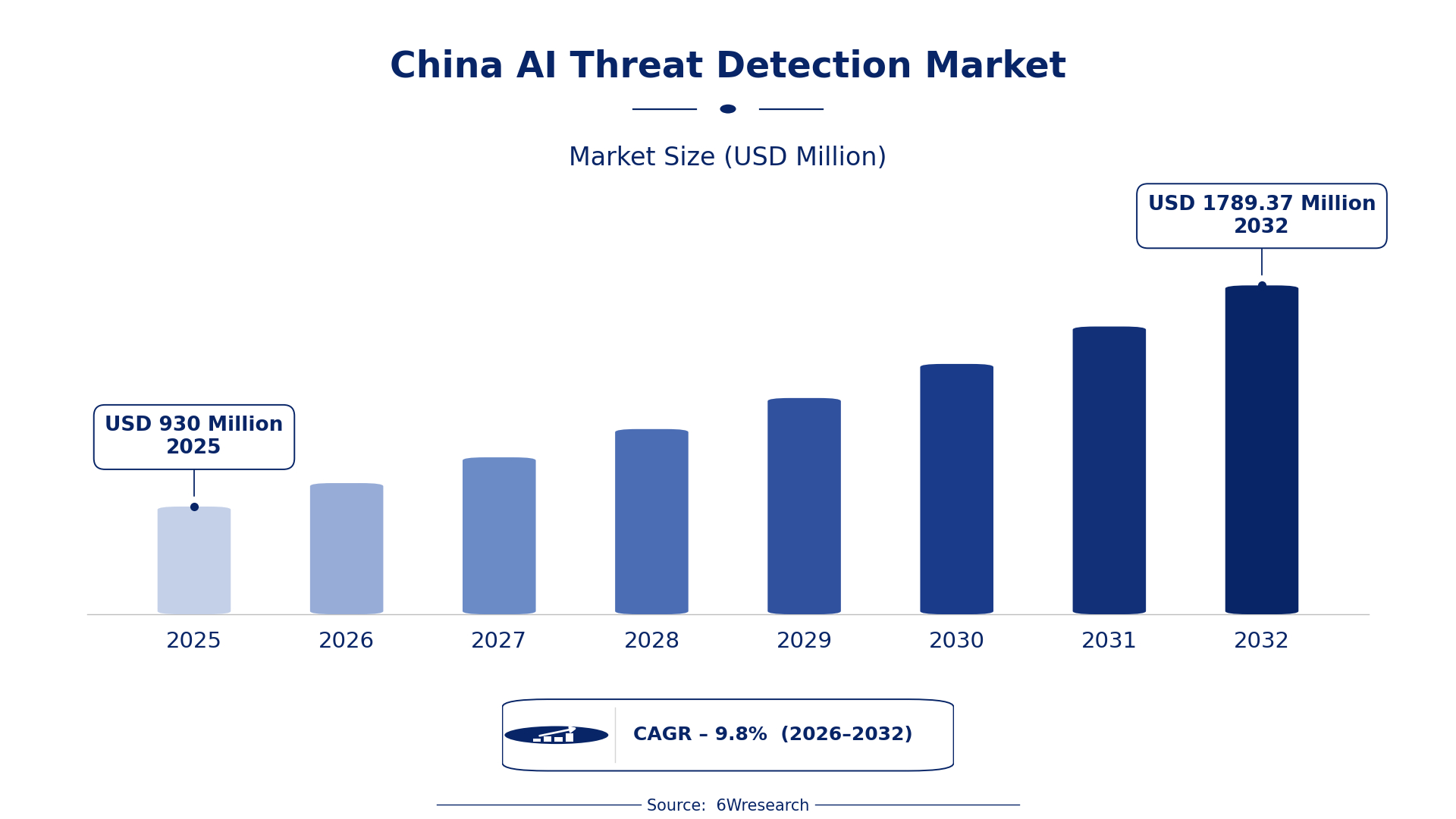
According to 6Wresearch internal database and industry insights, the China AI Threat Detection Market was valued at USD 930.0 million in 2025 and is projected to reach USD 1,789.37 million by 2032, growing at a CAGR of approximately 9.8% during 2026–2032.
China AI Threat Detection Market Highlights
| Report Metric | Details |
| Report Name | China AI Threat Detection Market |
| Market Size 2025 | USD 930.0 million |
| Market Size 2032 | USD 1,789.37 million |
| Absolute Growth 2025–2032 | USD 859.37 million |
| CAGR 2026–2032 | 9.8% |
| Peak Annual Growth | 11.8% in 2031 |
| Forecast Period | 2026–2032 |
| Historical Data | 2022–2025 |
| Base Year | 2025 |
| Leading Threat Type, 2025 | Network Intrusions (40% share) |
| Leading AI Detection Feature, 2025 | Anomaly Detection (45% share) |
| Leading Distribution Channel, 2025 | Cybersecurity Platforms (53% share) |
| Leading End User, 2025 | IT Security Teams (46% share) |
| Fastest-Growing Threat Type | Fraudulent Transactions (11.3% CAGR) |
| Fastest-Growing AI Detection Feature | Behavior Analytics (11.5% CAGR) |
| Fastest-Growing Distribution Channel | Security SaaS Providers (12.1% CAGR) |
| Fastest-Growing End User | Banks & Payment Gateways (11.3% CAGR) |
| Growing Sector | Cybersecurity |
| Key End Users | Banks, IT Security Teams, Enterprises |
China AI Threat Detection Market Year-wise Growth Rate and Key Drivers (2022–2032)
This graph illustrates the annual growth rates of the market from 2022 to 2032, highlighting a steady upward trajectory and projected market expansion over the forecast period.
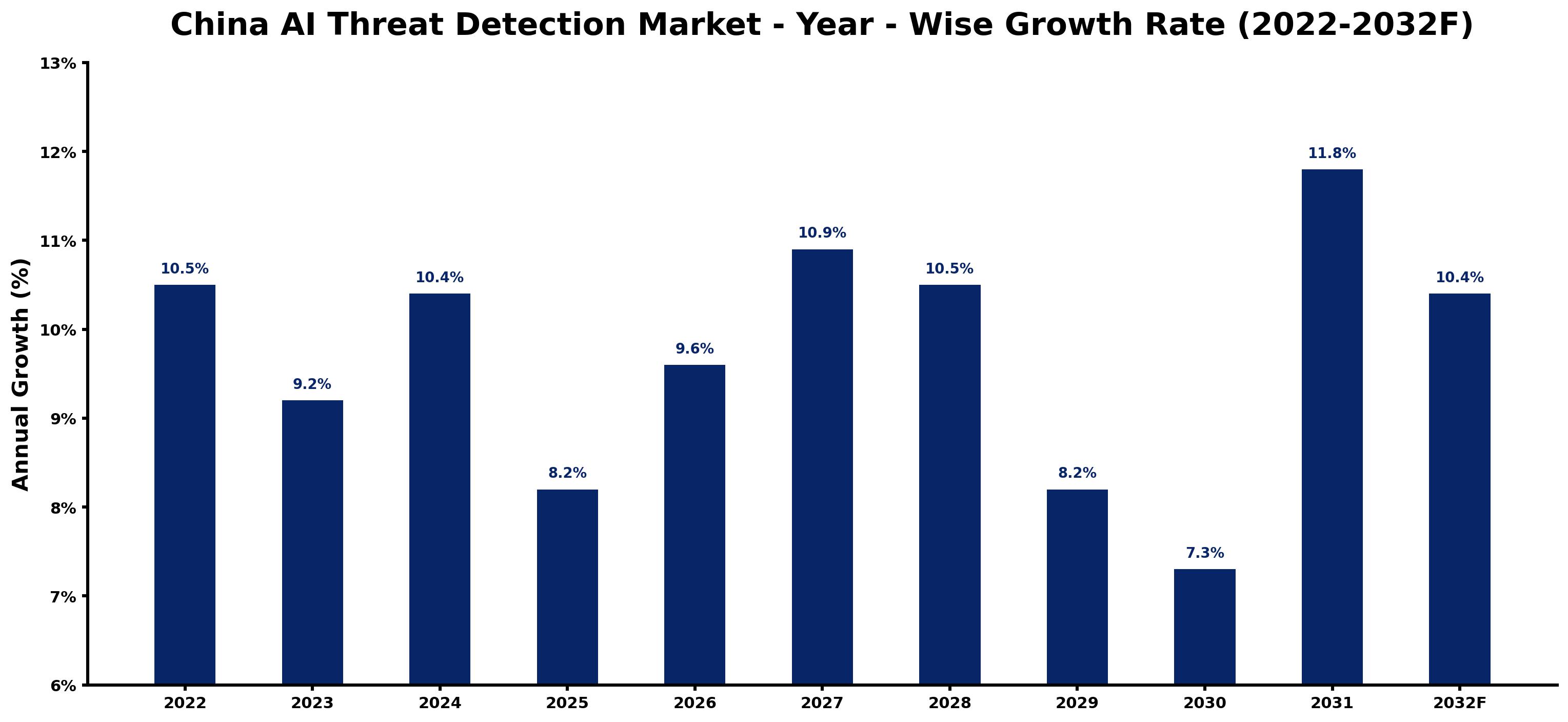
The table below sets out the estimated growth rate for each year and the main factor behind it.
| Year | Estimated Annual Growth (%) | Market Rationale |
| 2022 | 10.5 | The market experienced strong demand due to increasing cybersecurity threats across various sectors. |
| 2023 | 9.2 | Growth slowed as the market adjusted to new standards and regulations in cybersecurity. |
| 2024 | 10.4 | Demand rose as financial institutions adopted AI threat detection technologies to combat fraud. |
| 2025 | 8.2 | The market saw slower growth as businesses faced challenges in integrating new technologies. |
| 2026 | 9.6 | Increased investments in cybersecurity infrastructure boosted market growth as firms upgraded systems. |
| 2027 | 10.9 | Demand accelerated as organizations expanded their IT security teams to address rising threats. |
| 2028 | 10.5 | Growth slowed as the market matured and competition intensified among cybersecurity providers. |
| 2029 | 8.2 | The market continued to grow, albeit at a slower pace, due to evolving threat landscapes. |
| 2030 | 7.3 | Growth decelerated as companies focused on optimizing existing cybersecurity solutions amid rising costs. |
| 2031 | 11.8 | A surge in demand was driven by the implementation of advanced AI security standards in financial institutions. |
| 2032 | 10.4 | Growth slowed as the market stabilised, reflecting a mature cybersecurity environment with established players. |
Note: Market size estimations and growth projections presented in this report are based on 6Wresearch's proprietary forecasting methodology, utilizing the latest available industry data, government publications, and primary research inputs.
China AI Threat Detection Market Synopsis
AI Threat Detection in China utilises advanced algorithms and machine learning to identify security threats in real-time. This technology protects networks, financial transactions, and sensitive data from cyber threats. The China AI Threat Detection Market is expanding due to rising cyber incidents and increased investments in cybersecurity infrastructure. With over 1.4 billion internet users, demand from sectors like finance and healthcare is substantial. The updated National Cybersecurity Strategy and various talent cultivation programs are driving market growth.
Market Dynamics Impact Analysis (2026–2032)
| Factor | Type | Impact | Primary Segment Affected |
| Increasing cyber incidents drive demand for effective threat detection solutions. | Driver | High | Network Intrusions |
| The rise of financial technology firms necessitates stringent security measures. | Driver | High | Fraudulent Transactions |
| Growing demand for AI threat detection in financial institutions presents investment opportunities. | Opportunity | High | Banks & Payment Gateways |
| The shift towards cloud-based security solutions opens new markets for suppliers. | Opportunity | High | Security SaaS Providers |
| High costs associated with implementing advanced AI technologies can limit adoption. | Restraint | Medium | Cybersecurity Platforms |
| Complex regulatory requirements may hinder market entry for new players. | Restraint | Medium | IT Security Teams |
| Talent shortages in cybersecurity can delay project implementations. | Challenge | High | Corporations |
| Rapid technological changes require constant updates to existing systems. | Challenge | Medium | Enterprises |
Evaluation of Drivers in China AI Threat Detection Market (2026–2032)
The main growth drivers and the segments they affect most are set out below.
| Drivers | Primary Segment Affected | Why It Matters (Evidence) |
| Rising cyber incidents necessitate stronger security measures. | Network Intrusions | In 2022, reported cyber incidents increased by 20%, prompting firms to invest in AI threat detection. |
| Financial institutions are increasingly adopting AI technologies to prevent fraud. | Fraudulent Transactions | With monetary losses at stake, banks are integrating AI solutions to enhance security. |
| The expansion of the digital economy boosts demand for cybersecurity solutions. | Cybersecurity Platforms | China's 14th Five-Year Plan emphasises cybersecurity, leading to increased investments in this sector. |
| The growing number of internet users creates a larger attack surface for cyber threats. | Malware & Ransomware | With over 1.4 billion users, the need for effective protection is paramount. |
| Government initiatives are fostering talent development in cybersecurity. | IT Security Teams | The Cybersecurity Talent Cultivation Program aims to train 100,000 professionals by 2025. |
Growth across the AI Threat Detection market in China is anchored in rising cyber incidents, increased investments in cybersecurity infrastructure, and the expansion of the digital economy. In 2022, reported cyber incidents surged by 20%, driving firms to strengthen their security measures. Financial institutions are increasingly adopting AI technologies to combat fraudulent transactions, with significant monetary losses at stake. The National Development and Reform Commission's Digital Economy Development Plan highlights the importance of cybersecurity, leading to substantial investments in this sector. With over 1.4 billion internet users, the demand for effective protection against malware and ransomware is critical.
Evaluation of Restraints in China AI Threat Detection Market
The key brakes on demand, and where they bite hardest, are shown below.
| Market Restraint | Primary Segment Affected | Why It Matters (Evidence) |
| High implementation costs can deter smaller firms from adopting advanced AI solutions. | Cybersecurity Platforms | Many small businesses lack the budget to invest in sophisticated threat detection technologies. |
| Regulatory complexities may slow down market entry for new providers. | IT Security Teams | Stringent compliance requirements can create barriers for new entrants in the market. |
| Limited availability of skilled professionals hampers growth in cybersecurity capabilities. | Corporations | Talent shortages in cybersecurity lead to project delays and increased operational risks. |
| Rapid technological advancements necessitate continuous updates, increasing costs. | Fraudulent Transactions | Companies must frequently upgrade their systems to stay ahead of evolving threats. |
| Market saturation in certain segments may limit growth opportunities. | Network Intrusions | As competition intensifies, differentiation becomes increasingly challenging for providers. |
China AI Threat Detection Market Challenges
Buyers and suppliers in the China AI Threat Detection market encounter significant supply chain disruptions due to a 20% increase in reported cyber incidents in 2022, which complicates technology procurement for financial institutions and government agencies. Skills shortages create another obstacle, as the Cybersecurity Talent Cultivation Program initiated in 2023 does not produce enough qualified professionals, limiting firms' ability to implement effective solutions. Competition among cybersecurity firms escalates, driving up service costs and straining budgets for smaller organisations that need essential protection. Rapid technological advancements create a gap, making it difficult for buyers to keep pace with evolving threats and solutions.
Trends in the China AI Threat Detection Market
Four trends stand out in the China AI Threat Detection Market.
- Shift Towards AI-Driven Cybersecurity Solutions: The National Cybersecurity Strategy emphasises the adoption of AI technologies, resulting in a surge in demand for AI threat detection solutions. In 2023, new standards for AI security were published, establishing a clearer framework for implementation.
- Increase in Cybersecurity Talent Development: The Cybersecurity Talent Cultivation Program aims to train 100,000 professionals by 2025, addressing the skills gap in the industry. This initiative is vital as the demand for skilled cybersecurity personnel continues to rise.
- Growing Adoption of Cloud-Based Security Solutions: As organizations increasingly migrate to cloud environments, the demand for Security SaaS Providers is on the rise. In 2026, this segment is projected to grow at a CAGR of 12.1%, reflecting a shift in security strategies.
- Expansion of Financial Sector Security Measures: Banks and payment gateways are increasingly adopting AI threat detection technologies to mitigate risks. In 2023, the financial sector accounted for a significant portion of AI threat detection investments.
Investment Opportunities in the China AI Threat Detection Market
Below are the investment opportunities with the strongest case in the China AI Threat Detection Market.
- Financial Institutions Seeking Advanced Security Solutions: Banks and payment gateways are actively looking for advanced AI threat detection technologies. With the cybersecurity market reaching approximately 200 billion CNY in 2022, suppliers can target this growing sector.
- Investment in AI Threat Detection Technologies: The demand for AI threat detection solutions is surging, particularly in the finance sector. Suppliers can enter this market by forming partnerships with local fintech firms to enhance their offerings.
- Collaboration with Educational Institutions for Talent Development: To address the skills gap, partnerships with universities for cybersecurity training programs are essential. The Cybersecurity Talent Cultivation Program is a key initiative that can facilitate such collaborations.
- Expansion into Emerging Markets: The Beijing region is a major hub for cybersecurity innovation, presenting opportunities for suppliers. Establishing a presence in this region can enhance market reach and access to potential clients.
Government Initiatives in the China AI Threat Detection Market
The Cybersecurity Law of 2017 was updated in 2021 to strengthen data protection measures, impacting producers and buyers of AI threat detection technologies. This law mandates that companies implement security protocols to safeguard sensitive data, ensuring compliance with national standards. Additionally, the National Development and Reform Commission initiated the Digital Economy Development Plan in 2023, which aims to enhance cybersecurity across various industries, driving demand for advanced solutions.
In 2023, the Ministry of Industry and Information Technology launched the Cybersecurity Talent Cultivation Program, aiming to train 100,000 cybersecurity professionals by 2025. This initiative is crucial for addressing the skills gap in the industry and ensuring a steady supply of qualified personnel. The program is expected to fund various educational institutions and training programs, promoting best practices in cybersecurity.
Future Insight of the China AI Threat Detection Market
The China AI Threat Detection market will experience transformative changes by 2032, driven by the updated National Cybersecurity Strategy and new AI security standards introduced in 2023. Buyers will benefit from enhanced data protection as reinforced Cybersecurity Law measures increase trust in online transactions. Suppliers will leverage advanced algorithms to improve threat detection accuracy, supported by collaborations between national agencies and local organisations. The Beijing region will strengthen its position as a key hub for cybersecurity innovation, fostering a competitive environment that accelerates the development of cutting-edge solutions.
Market Segmentation Analysis
Each segment group is reviewed below, with the leader by share and the fastest grower by CAGR.
By Threat Type – Network Intrusions Dominated, Fraudulent Transactions Expected to Grow Fastest
According to Shubham Padhi, Research Analyst at 6Wresearch, Network Intrusions took a 40% share of threat type in 2025, more than any other category. Network intrusions account for a substantial portion of cyber threats in China, making them vital for safeguarding IT infrastructure. The sheer volume of over 1.4 billion internet users amplifies the necessity for solutions that prevent unauthorized access. Fraudulent Transactions are projected to grow fastest, at a CAGR of 11.3% during 2026–2032. Fraudulent transactions are escalating, particularly in the finance sector where banks and payment gateways are increasingly vulnerable. The 20% increase in reported cyber incidents in 2022 underscores the urgent demand for effective fraud prevention measures. This situation suggests that suppliers should focus on enhancing solutions for network intrusions while buyers must prioritise investments in fraud detection capabilities.
By AI Detection Feature – Anomaly Detection Dominated, Behavior Analytics Expected to Grow Fastest
The largest ai detection feature category in 2025 was Anomaly Detection, with a 45% share of total revenue. Anomaly detection plays a pivotal role in identifying unusual patterns within data, establishing it as a leading feature in cybersecurity solutions. Its effectiveness in protecting sensitive information across sectors such as finance and healthcare drives its widespread adoption. The quickest growth will come from Behavior Analytics, forecast to expand at a CAGR of 11.5% between 2026 and 2032. Behaviour analytics is gaining traction as organisations aim to comprehend user behaviour to proactively identify potential threats. The growing complexity of cyber threats necessitates advanced analytics to complement existing security measures. This trend indicates that suppliers should innovate in anomaly detection while buyers need to incorporate behaviour analytics into their security frameworks for more comprehensive protection.
By Distribution Channel – Cybersecurity Platforms Dominated, Security SaaS Providers Expected to Grow Fastest
Cybersecurity Platforms accounted for a 53% market share by distribution channel in 2025. Cybersecurity platforms serve as the primary channel for delivering threat detection solutions, ensuring extensive coverage for various end users. Their established market presence facilitates the effective deployment of advanced security technologies. Over 2026–2032, Security SaaS Providers are expected to post the fastest growth, at a CAGR of 12.1%. Security SaaS providers are experiencing rapid growth due to the increasing adoption of cloud technologies in security. This reflects a broader shift towards flexible, scalable security solutions that align with modern business demands. This trend implies that suppliers must enhance their offerings on cybersecurity platforms while buyers should consider SaaS options for more adaptable security solutions.
By End User – IT Security Teams Dominated, Banks & Payment Gateways Expected to Grow Fastest
IT Security Teams held a 46% share of the China AI Threat Detection Market by end user in 2025. IT security teams are the principal users of threat detection technologies, tasked with protecting organisational assets against cyber threats. Their expertise and direct involvement in security operations are crucial to the successful implementation of these technologies. Banks & Payment Gateways are set to record the highest CAGR in this split, 11.3% over 2026–2032. Banks and payment gateways are quickly adopting advanced security measures to combat the rising threat of cyber fraud. Their critical role in financial transactions necessitates robust security solutions to safeguard sensitive data. This indicates that suppliers should tailor their products for IT security teams while buyers in the finance sector must invest in advanced threat detection technologies.
Key Attractiveness of the Report
- 10 Years of Market Numbers
- Historical Data Starting from 2022 to 2025
- Base Year 2025
- Forecast Data until 2032
- Key Performance Indicators Impacting the Market
- Major Upcoming Developments and Projects
Key Highlights of the Report:
- China AI Threat Detection Market Outlook
- Market Size of China AI Threat Detection Market, 2025
- Forecast of China AI Threat Detection Market, 2032
- Historical Data and Forecast of China AI Threat Detection Revenues & Volume for the Period 2022 - 2032F
- China AI Threat Detection Market Trend Evolution
- China AI Threat Detection Market Drivers and Challenges
- China AI Threat Detection Price Trends
- China AI Threat Detection Porter's Five Forces
- China AI Threat Detection Industry Life Cycle
- Historical Data and Forecast of China AI Threat Detection Market Revenues & Volume By Threat Type for the Period 2022 - 2032F
- Historical Data and Forecast of China AI Threat Detection Market Revenues & Volume By Network Intrusions for the Period 2022 - 2032F
- Historical Data and Forecast of China AI Threat Detection Market Revenues & Volume By Fraudulent Transactions for the Period 2022 - 2032F
- Historical Data and Forecast of China AI Threat Detection Market Revenues & Volume By Malware & Ransomware for the Period 2022 - 2032F
- Historical Data and Forecast of China AI Threat Detection Market Revenues & Volume By Insider Threat Monitoring for the Period 2022 - 2032F
- Historical Data and Forecast of China AI Threat Detection Market Revenues & Volume By AI Detection Feature for the Period 2022 - 2032F
- Historical Data and Forecast of China AI Threat Detection Market Revenues & Volume By Anomaly Detection for the Period 2022 - 2032F
- Historical Data and Forecast of China AI Threat Detection Market Revenues & Volume By Predictive Models for the Period 2022 - 2032F
- Historical Data and Forecast of China AI Threat Detection Market Revenues & Volume By Pattern Recognition for the Period 2022 - 2032F
- Historical Data and Forecast of China AI Threat Detection Market Revenues & Volume By Behavior Analytics for the Period 2022 - 2032F
- Historical Data and Forecast of China AI Threat Detection Market Revenues & Volume By Distribution Channel for the Period 2022 - 2032F
- Historical Data and Forecast of China AI Threat Detection Market Revenues & Volume By Cybersecurity Platforms for the Period 2022 - 2032F
- Historical Data and Forecast of China AI Threat Detection Market Revenues & Volume By Fintech Solutions for the Period 2022 - 2032F
- Historical Data and Forecast of China AI Threat Detection Market Revenues & Volume By Antivirus Suites for the Period 2022 - 2032F
- Historical Data and Forecast of China AI Threat Detection Market Revenues & Volume By Security SaaS Providers for the Period 2022 - 2032F
- Historical Data and Forecast of China AI Threat Detection Market Revenues & Volume By End User for the Period 2022 - 2032F
- Historical Data and Forecast of China AI Threat Detection Market Revenues & Volume By IT Security Teams for the Period 2022 - 2032F
- Historical Data and Forecast of China AI Threat Detection Market Revenues & Volume By Banks & Payment Gateways for the Period 2022 - 2032F
- Historical Data and Forecast of China AI Threat Detection Market Revenues & Volume By Enterprises for the Period 2022 - 2032F
- Historical Data and Forecast of China AI Threat Detection Market Revenues & Volume By Corporations for the Period 2022 - 2032F
- China AI Threat Detection Import Export Trade Statistics
- Market Opportunity Assessment By Threat Type
- Market Opportunity Assessment By AI Detection Feature
- Market Opportunity Assessment By Distribution Channel
- Market Opportunity Assessment By End User
- China AI Threat Detection Top Companies Market Share
- China AI Threat Detection Competitive Benchmarking By Technical and Operational Parameters
- China AI Threat Detection Company Profiles
- China AI Threat Detection Key Strategic Recommendations
Market Covered
Segments analysed in this report are listed below.
By Threat Type
- Network Intrusions
- Fraudulent Transactions
- Malware & Ransomware
- Insider Threat Monitoring
By AI Detection Feature
- Anomaly Detection
- Predictive Models
- Pattern Recognition
- Behavior Analytics
By Distribution Channel
- Cybersecurity Platforms
- Fintech Solutions
- Antivirus Suites
- Security SaaS Providers
By End User
- IT Security Teams
- Banks & Payment Gateways
- Enterprises
- Corporations































