China AI Trading Market Size & Growth Rate
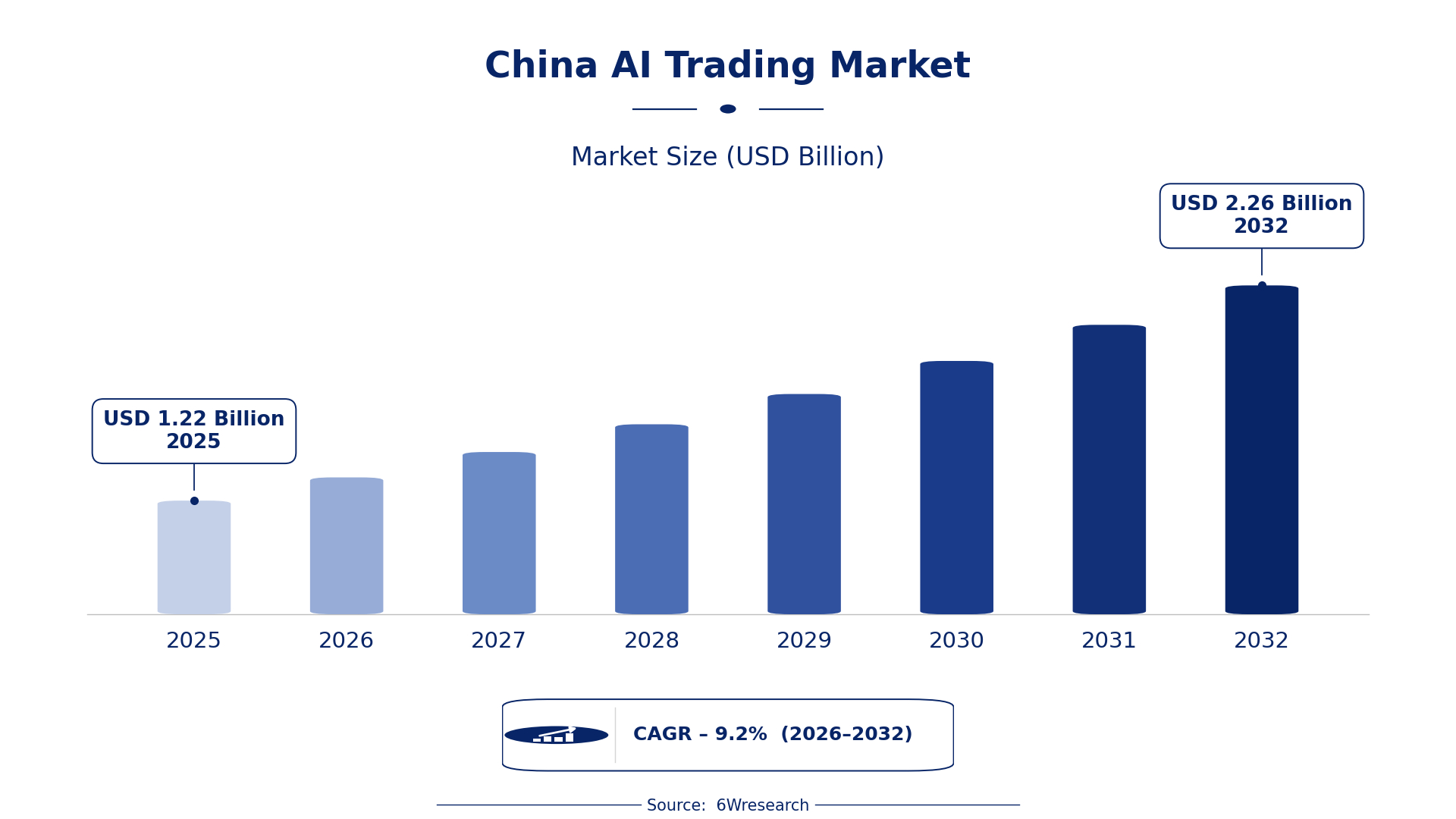
According to 6Wresearch internal database and industry insights, the China AI Trading Market was valued at USD 1.22 billion in 2025 and is projected to reach USD 2.26 billion by 2032, growing at a CAGR of approximately 9.2% during 2026–2032.
China AI Trading Market Highlights
| Report Metric | Details |
| Report Name | China AI Trading Market |
| Market Size 2025 | USD 1.22 billion |
| Market Size 2032 | USD 2.26 billion |
| Absolute Growth 2025–2032 | USD 1.04 billion |
| CAGR 2026–2032 | 9.2% |
| Peak Annual Growth | 11.1% in 2028 |
| Forecast Period | 2026–2032 |
| Historical Data | 2022–2025 |
| Base Year | 2025 |
| Leading Trading Strategy, 2025 | Algorithmic Trading (43% share) |
| Leading AI Model Type, 2025 | Predictive Analytics (49% share) |
| Leading Distribution Channel, 2025 | Online Trading Platforms (45% share) |
| Leading End User, 2025 | Institutional Investors (38% share) |
| Fastest-Growing Trading Strategy | Crypto Trading (11.9% CAGR) |
| Fastest-Growing AI Model Type | Reinforcement Learning (10.3% CAGR) |
| Fastest-Growing Distribution Channel | FinTech Marketplaces (10.8% CAGR) |
| Fastest-Growing End User | Individual Traders (11.1% CAGR) |
| Growing Sector | Financial Services |
| Key End Users | Institutional Investors, Individual Traders, Hedge Funds, Investment Banks |
China AI Trading Market Year-wise Growth Rate and Key Drivers (2022–2032)
This graph illustrates the annual growth rates of the market from 2022 to 2032, highlighting a steady upward trajectory and projected market expansion over the forecast period.
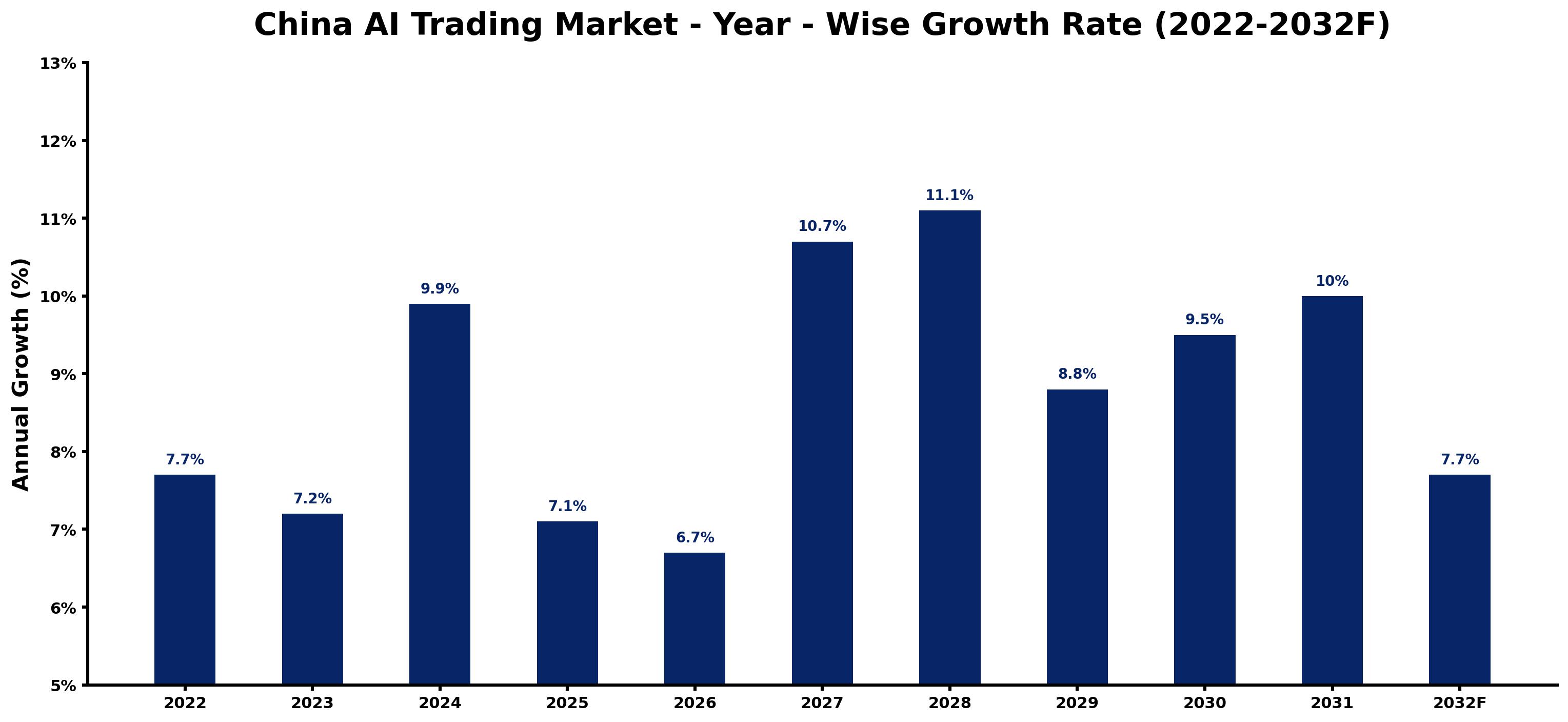
Below, each year's estimated growth is shown next to the factor that most influenced it.
| Year | Estimated Annual Growth (%) | Market Rationale |
| 2022 | 7.7 | The market experienced steady growth, driven by increasing adoption of AI technologies in trading. |
| 2023 | 7.2 | Growth slowed due to market adjustments and the impact of regulatory updates on trading strategies. |
| 2024 | 9.9 | A surge in algorithmic trading led to faster growth as institutional investors increased their AI investments. |
| 2025 | 7.1 | Growth decelerated as market saturation began to affect new user acquisition in trading platforms. |
| 2026 | 6.7 | A slowdown occurred as the market adjusted to regulatory changes and competitive pressures intensified. |
| 2027 | 10.7 | Demand surged again as individual traders increasingly adopted AI tools for personal trading strategies. |
| 2028 | 11.1 | Growth peaked as advancements in predictive analytics and algorithmic trading technologies gained traction. |
| 2029 | 8.8 | A slowdown was noted as the market matured and competition among platforms intensified. |
| 2030 | 9.5 | Growth accelerated again, driven by renewed interest in AI-driven trading solutions among institutional investors. |
| 2031 | 10.0 | Demand continued to rise as more hedge funds reported using AI strategies to enhance returns. |
| 2032 | 7.7 | Growth slowed as the market stabilised, reflecting a more mature adoption of AI trading technologies. |
Note: Market size estimations and growth projections presented in this report are based on 6Wresearch's proprietary forecasting methodology, utilizing the latest available industry data, government publications, and primary research inputs.
China AI Trading Market Synopsis
AI Trading in China involves the application of artificial intelligence technologies to refine trading strategies within financial markets. Valued at approximately 1.5 billion USD in 2022, the China AI Trading Market is expanding due to strong demand from both individual traders and institutional investors. In 2023, the average daily trading volume on AI-driven platforms reached 50 billion USD, highlighting the growing dependence on AI technologies for financial decision-making.
Market Dynamics Impact Analysis (2026–2032)
| Factor | Type | Impact | Primary Segment Affected |
| Increased adoption of algorithmic trading strategies among institutional investors drives demand for AI trading technologies. | Driver | High | Algorithmic Trading |
| The rise of FinTech marketplaces enhances access to AI trading tools for individual traders. | Driver | Medium | FinTech Marketplaces |
| The growing population of individual traders seeking advanced trading tools presents opportunities for AI trading platforms. | Opportunity | High | Individual Traders |
| The establishment of online trading platforms facilitates easier access to AI trading technologies. | Opportunity | Medium | Online Trading Platforms |
| Compliance with updated regulations may increase operational costs for AI trading firms. | Restraint | Medium | Algorithmic Trading |
| Data security concerns can deter potential users from adopting AI trading solutions. | Restraint | Medium | FinTech Marketplaces |
| The complexity of market conditions can limit the effectiveness of AI trading algorithms. | Challenge | High | Algorithmic Trading |
| High competition among trading platforms can lead to price wars, affecting profitability. | Challenge | Medium | Online Trading Platforms |
Evaluation of Drivers in China AI Trading Market (2026–2032)
The table below links each growth driver to the segment it affects and the evidence for it.
| Drivers | Primary Segment Affected | Why It Matters (Evidence) |
| Growing demand for algorithmic trading solutions among institutional investors boosts AI trading adoption. | Algorithmic Trading | Algorithmic trading accounts for over 60% of all trades executed in major Chinese exchanges. |
| The rise in individual traders adopting AI tools for personal strategies fuels market growth. | Individual Traders | China's population of individual traders has surpassed 200 million, contributing to AI trading demand. |
| Advancements in predictive analytics improve market forecasting capabilities for investment banks. | Predictive Analytics | Investment banks in China are increasingly using predictive analytics for market forecasting. |
| Support from government initiatives promotes the integration of AI in financial services. | Algorithmic Trading | The National Development and Reform Commission initiated a plan to promote AI in financial services by 2025. |
| The establishment of online trading platforms facilitates easier access to AI trading technologies. | Online Trading Platforms | AI trading platforms are available in over 80% of major financial institutions in China. |
Growth in the AI Trading market in China comes from increased adoption of algorithmic trading solutions, a growing population of individual traders, and advancements in predictive analytics. The average daily trading volume in AI-driven platforms reached 50 billion USD in 2023, reflecting strong demand from both institutional investors and individual traders. With algorithmic trading accounting for over 60% of all trades executed in major exchanges, the market is witnessing a surge in AI technology adoption. The establishment of online trading platforms has made AI trading technologies more accessible, increasing user engagement and participation in the market.
Evaluation of Restraints in China AI Trading Market
Below mentioned are some major restraints and their influence on market dynamics.
| Market Restraint | Primary Segment Affected | Why It Matters (Evidence) |
| Compliance with updated regulations may increase operational costs for AI trading firms. | Algorithmic Trading | The China Securities Regulatory Commission updated regulations in 2022 to facilitate the use of AI in trading. |
| The complexity of market conditions can limit the effectiveness of AI trading algorithms. | Algorithmic Trading | As market conditions change rapidly, AI algorithms may struggle to adapt effectively. |
| Data security concerns can deter potential users from adopting AI trading solutions. | FinTech Marketplaces | ISO 27001 is a standard adopted by many AI trading firms for data security. |
| High competition among trading platforms can lead to price wars, affecting profitability. | Online Trading Platforms | The market is saturated with numerous platforms offering similar AI trading solutions. |
| Limited understanding of AI technologies among traditional investors may hinder market growth. | Individual Traders | Some individual traders may lack the technical knowledge to effectively use AI trading tools. |
China AI Trading Market Challenges
In the China AI Trading Market, many firms face hurdles with technological integration, especially in deploying complex algorithms capable of analysing extensive market data. This issue is compounded by a shortage of skilled personnel, which hampers the implementation of effective AI trading strategies and weakens competitive advantages for hedge funds. As over 200 hedge funds adopt similar AI strategies, competition intensifies, leading to market saturation and diminished returns for individual traders. Compliance with regulations from the China Securities Regulatory Commission can consume up to 10% of operational budgets, straining resources for smaller firms and limiting their growth potential.
Trends in the China AI Trading Market
Buyers and suppliers in the China AI Trading Market are adjusting to the following trends.
- Shift from Traditional to AI-Driven Trading: Institutional investors are increasingly embracing AI-driven trading strategies, with over 30% reporting usage in 2023. This shift reflects a growing reliance on technology for informed decision-making.
- Emergence of FinTech Marketplaces: FinTech marketplaces are rapidly expanding, with a projected growth rate of 10.8% for 2026-2032. These platforms are facilitating access to advanced trading tools for individual traders.
- Rise of Predictive Analytics in Investment Banking: Investment banks are increasingly utilising predictive analytics for market forecasting, with notable advancements reported in 2023. This trend is reshaping how financial institutions approach trading strategies.
- Growth of Individual Traders in AI Trading: The number of individual traders in China has surpassed 200 million, driving demand for AI trading solutions. This demographic shift is influencing the development of user-friendly trading platforms.
Investment Opportunities in the China AI Trading Market
The following opportunities in the China AI Trading Market pair current demand with a clear way in.
- Partnerships with FinTech Startups: Now is an ideal time to invest in partnerships with FinTech startups developing AI trading solutions. The Beijing FinTech Innovation Center supports such initiatives, providing opportunities for market entry.
- Investment in AI Trading Technologies: With the market valued at 1.5 billion USD in 2022, there is an opportunity to invest in AI trading technologies. Institutional investors are increasingly seeking advanced tools to optimise trading strategies.
- Development of User-Friendly Trading Platforms: The growing population of individual traders presents an opportunity to develop user-friendly AI trading platforms. This segment is expanding rapidly, with a projected growth rate of 11.1% for 2026-2032.
- Certification for Data Security Standards: Investing in certifications like ISO 27001 can build trust among users. This is particularly important for AI trading firms looking to attract individual traders concerned about data security.
Government Initiatives in the China AI Trading Market
In 2021, the National Development and Reform Commission launched the 'AI Financial Services Development Plan' to promote AI integration in finance by 2025. This initiative aims to support the development of AI trading technologies and improve the overall financial services sector. Additionally, the China Securities Regulatory Commission updated regulations in 2022 to facilitate the use of AI in trading, ensuring transparency and investor protection. Their efforts to streamline approval processes for new AI trading tools further facilitate market growth.
The Ministry of Finance initiated the 'Digital Finance Innovation Program' in 2023 to support AI-driven trading technologies with a budget of 500 million CNY. This program aims to fund projects that improve the capabilities of AI trading platforms. The Ministry of Industry and Information Technology's 'FinTech Innovation Strategy' also focuses on boosting AI adoption in financial services, particularly in trading technologies by 2025.
Future Insight of the China AI Trading Market
Transformative changes are anticipated in the China AI Trading Market by 2032, driven by advancements in AI technologies and supportive regulatory frameworks. The National Development and Reform Commission's initiatives will improve AI capabilities in financial services, enhancing trading efficiency across platforms. By 2025, over 30% of institutional investors are projected to utilise AI for trading decisions, indicating a notable shift in market practices. The establishment of the Beijing FinTech Innovation Center will nurture startups, fostering a more competitive and innovative market environment.
Market Segmentation Analysis
The report offers a comprehensive study of the following market segments and their leading categories in the market.
By Trading Strategy – Algorithmic Trading Dominated, Crypto Trading Expected to Grow Fastest
According to Shubham Padhi, Research Analyst at 6Wresearch, the largest trading strategy category in 2025 was Algorithmic Trading, with a 43% share of total revenue. Algorithmic trading captures the largest market share in China due to its widespread implementation among institutional investors, who execute over 60% of trades on major exchanges. The Shanghai Stock Exchange exemplifies the vital role of algorithmic trading in enhancing transaction efficiency. Crypto Trading is set to record the highest CAGR in this split, 11.9% over 2026–2032. Crypto trading is experiencing rapid growth as individual traders engage more with digital currencies, with over 200 million traders in China contributing to this trend. This segment's expansion is propelled by its unique integration of blockchain technologies into trading practices. Suppliers should focus on refining algorithmic trading solutions while also capitalising on the rising interest in crypto trading.
By AI Model Type – Predictive Analytics Dominated, Reinforcement Learning Expected to Grow Fastest
Predictive Analytics held a 49% share of the China AI Trading Market by ai model type in 2025. Predictive analytics leads the market as it is widely applied for forecasting market trends, making it essential for institutional investors aiming to optimise their trading strategies. Its effectiveness in analysing vast data sets positions it as a critical tool in the financial services sector. The quickest growth will come from Reinforcement Learning, forecast to expand at a CAGR of 10.3% between 2026 and 2032. Reinforcement learning is gaining traction due to its ability to refine trading strategies based on historical data, which appeals to both institutional and individual traders seeking improved performance. The increasing sophistication of AI models is driving this segment's growth. Buyers should consider investing in predictive analytics tools while remaining vigilant about the advancements in reinforcement learning technologies.
By Distribution Channel – Online Trading Platforms Dominated, FinTech Marketplaces Expected to Grow Fastest
Online Trading Platforms accounted for a 45% market share by distribution channel in 2025. Online trading platforms dominate the market share, acting as the primary gateway for both individual and institutional trading activities. Their extensive adoption across major financial institutions highlights their critical function in facilitating seamless trading experiences. Over 2026–2032, FinTech Marketplaces are expected to post the fastest growth, at a CAGR of 10.8%. FinTech marketplaces are emerging as the fastest-growing distribution channel, providing users with access to a wide array of trading tools and resources that enhance their trading strategies. This growth reflects the increasing demand for comprehensive solutions within the financial services sector. Suppliers must prioritise the development of features tailored for online trading platforms while also addressing the evolving needs of FinTech marketplaces.
By End User – Institutional Investors Dominated, Individual Traders Expected to Grow Fastest
With a 38% revenue share in 2025, Institutional Investors was the largest end user category. Institutional investors hold a significant market share as they extensively utilise AI trading technologies for large-scale investments, which greatly impacts overall trading volumes. Their reliance on sophisticated tools for informed decision-making underscores the importance of this segment in the market. Individual Traders are projected to grow fastest, at a CAGR of 11.1% during 2026–2032. Individual traders are increasingly adopting AI tools for their personal trading strategies, driven by better accessibility and a quest for improved trading results. This trend is likely to accelerate as educational resources become more prevalent. Suppliers should customise their offerings to meet the specific requirements of institutional investors while also catering to the growing demand from individual traders.
Key Attractiveness of the Report
- 10 Years of Market Numbers
- Historical Data Starting from 2022 to 2025
- Base Year 2025
- Forecast Data until 2032
- Key Performance Indicators Impacting the Market
- Major Upcoming Developments and Projects
Key Highlights of the Report:
- China AI Trading Market Outlook
- Market Size of China AI Trading Market, 2025
- Forecast of China AI Trading Market, 2032
- Historical Data and Forecast of China AI Trading Revenues & Volume for the Period 2022 - 2032F
- China AI Trading Market Trend Evolution
- China AI Trading Market Drivers and Challenges
- China AI Trading Price Trends
- China AI Trading Porter's Five Forces
- China AI Trading Industry Life Cycle
- Historical Data and Forecast of China AI Trading Market Revenues & Volume By Trading Strategy for the Period 2022 - 2032F
- Historical Data and Forecast of China AI Trading Market Revenues & Volume By Algorithmic Trading for the Period 2022 - 2032F
- Historical Data and Forecast of China AI Trading Market Revenues & Volume By Quantitative Trading for the Period 2022 - 2032F
- Historical Data and Forecast of China AI Trading Market Revenues & Volume By High-Frequency Trading for the Period 2022 - 2032F
- Historical Data and Forecast of China AI Trading Market Revenues & Volume By Crypto Trading for the Period 2022 - 2032F
- Historical Data and Forecast of China AI Trading Market Revenues & Volume By AI Model Type for the Period 2022 - 2032F
- Historical Data and Forecast of China AI Trading Market Revenues & Volume By Predictive Analytics for the Period 2022 - 2032F
- Historical Data and Forecast of China AI Trading Market Revenues & Volume By Reinforcement Learning for the Period 2022 - 2032F
- Historical Data and Forecast of China AI Trading Market Revenues & Volume By Real-Time Signal Processing for the Period 2022 - 2032F
- Historical Data and Forecast of China AI Trading Market Revenues & Volume By Sentiment Analysis for the Period 2022 - 2032F
- Historical Data and Forecast of China AI Trading Market Revenues & Volume By Distribution Channel for the Period 2022 - 2032F
- Historical Data and Forecast of China AI Trading Market Revenues & Volume By Online Trading Platforms for the Period 2022 - 2032F
- Historical Data and Forecast of China AI Trading Market Revenues & Volume By FinTech Marketplaces for the Period 2022 - 2032F
- Historical Data and Forecast of China AI Trading Market Revenues & Volume By Direct API Access for the Period 2022 - 2032F
- Historical Data and Forecast of China AI Trading Market Revenues & Volume By Crypto Exchanges for the Period 2022 - 2032F
- Historical Data and Forecast of China AI Trading Market Revenues & Volume By End User for the Period 2022 - 2032F
- Historical Data and Forecast of China AI Trading Market Revenues & Volume By Institutional Investors for the Period 2022 - 2032F
- Historical Data and Forecast of China AI Trading Market Revenues & Volume By Hedge Funds for the Period 2022 - 2032F
- Historical Data and Forecast of China AI Trading Market Revenues & Volume By Investment Banks for the Period 2022 - 2032F
- Historical Data and Forecast of China AI Trading Market Revenues & Volume By Individual Traders for the Period 2022 - 2032F
- China AI Trading Import Export Trade Statistics
- Market Opportunity Assessment By Trading Strategy
- Market Opportunity Assessment By AI Model Type
- Market Opportunity Assessment By Distribution Channel
- Market Opportunity Assessment By End User
- China AI Trading Top Companies Market Share
- China AI Trading Competitive Benchmarking By Technical and Operational Parameters
- China AI Trading Company Profiles
- China AI Trading Key Strategic Recommendations
Market Covered
The report offers an extensive study of the following market segments.
By Trading Strategy
- Algorithmic Trading
- Quantitative Trading
- High-Frequency Trading
- Crypto Trading
By AI Model Type
- Predictive Analytics
- Reinforcement Learning
- Real-Time Signal Processing
- Sentiment Analysis
By Distribution Channel
- Online Trading Platforms
- FinTech Marketplaces
- Direct API Access
- Crypto Exchanges
By End User
- Institutional Investors
- Hedge Funds
- Investment Banks
- Individual Traders































