China Air Defense Sensor Market Size & Growth Rate
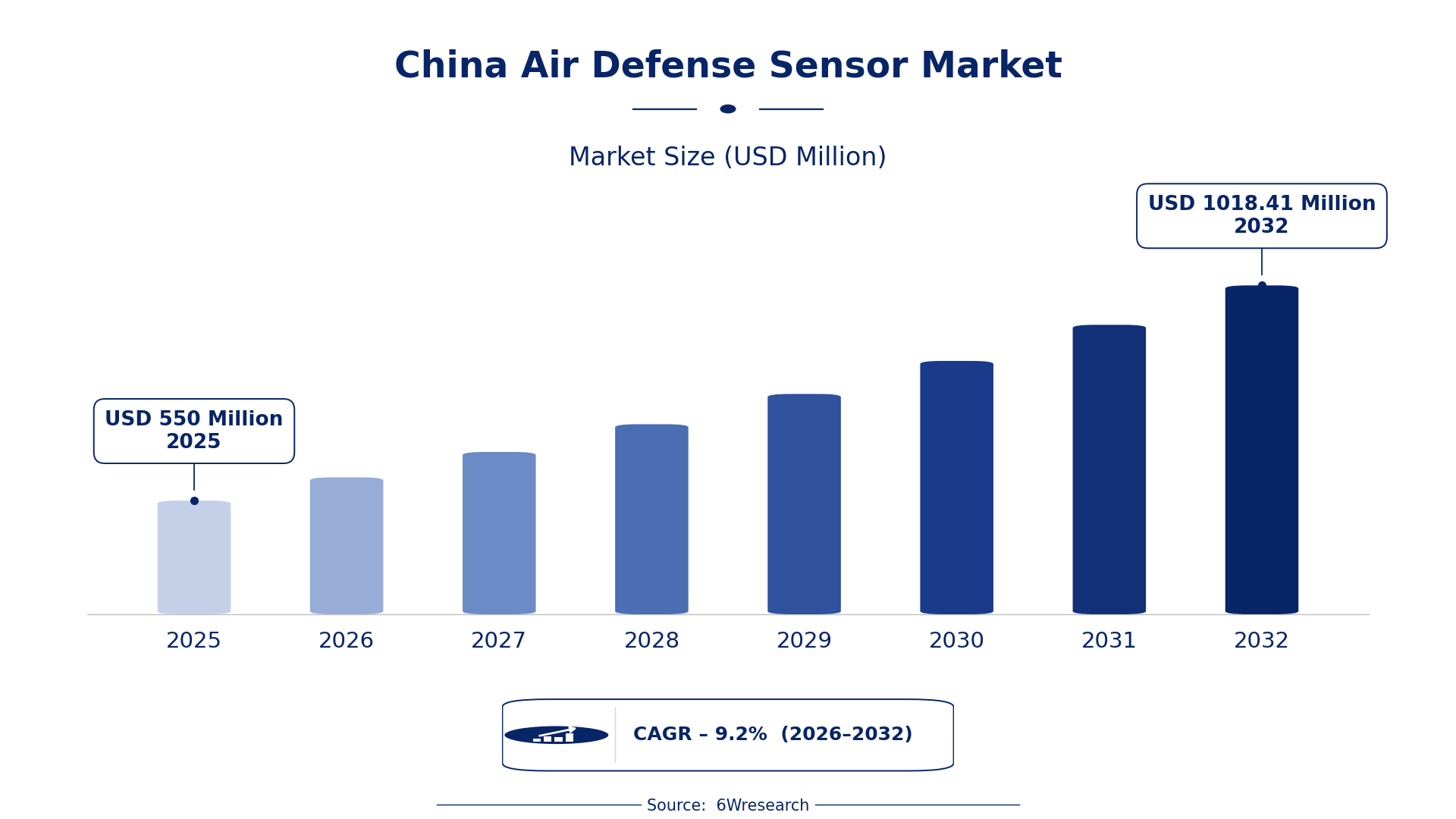
According to 6Wresearch internal database and industry insights, the China Air Defense Sensor Market was valued at USD 550.0 million in 2025 and is projected to reach USD 1,018.41 million by 2032, growing at a CAGR of approximately 9.2% during 2026–2032.
China Air Defense Sensor Market Highlights
| Report Metric | Details |
| Report Name | China Air Defense Sensor Market |
| Market Size 2025 | USD 550.0 million |
| Market Size 2032 | USD 1,018.41 million |
| Absolute Growth 2025–2032 | USD 468.41 million |
| CAGR 2026–2032 | 9.2% |
| Peak Annual Growth | 10.6% in 2027 |
| Forecast Period | 2026–2032 |
| Historical Data | 2022–2025 |
| Base Year | 2025 |
| Leading Sensor Type, 2025 | Radar Sensors (35% share) |
| Leading Detection Range, 2025 | Long-Range Targeting (43% share) |
| Leading Distribution Channel, 2025 | Defense OEMs (37% share) |
| Leading End User, 2025 | Air Force Units (55% share) |
| Fastest-Growing Sensor Type | IR Sensors (11.7% CAGR) |
| Fastest-Growing Detection Range | Heat Signature Tracking (11.3% CAGR) |
| Fastest-Growing Distribution Channel | Military Suppliers (10.8% CAGR) |
| Fastest-Growing End User | Missile Defense Systems (11.6% CAGR) |
| Growing Sector | Missile Defense Systems |
| Key End Users | Air Force Units, Missile Defense Systems, Battlefield Surveillance Units, National Defense Agencies |
China Air Defense Sensor Market Year-wise Growth Rate and Key Drivers (2022–2032)
This graph illustrates the annual growth rates of the market from 2022 to 2032, highlighting a steady upward trajectory and projected market expansion over the forecast period.
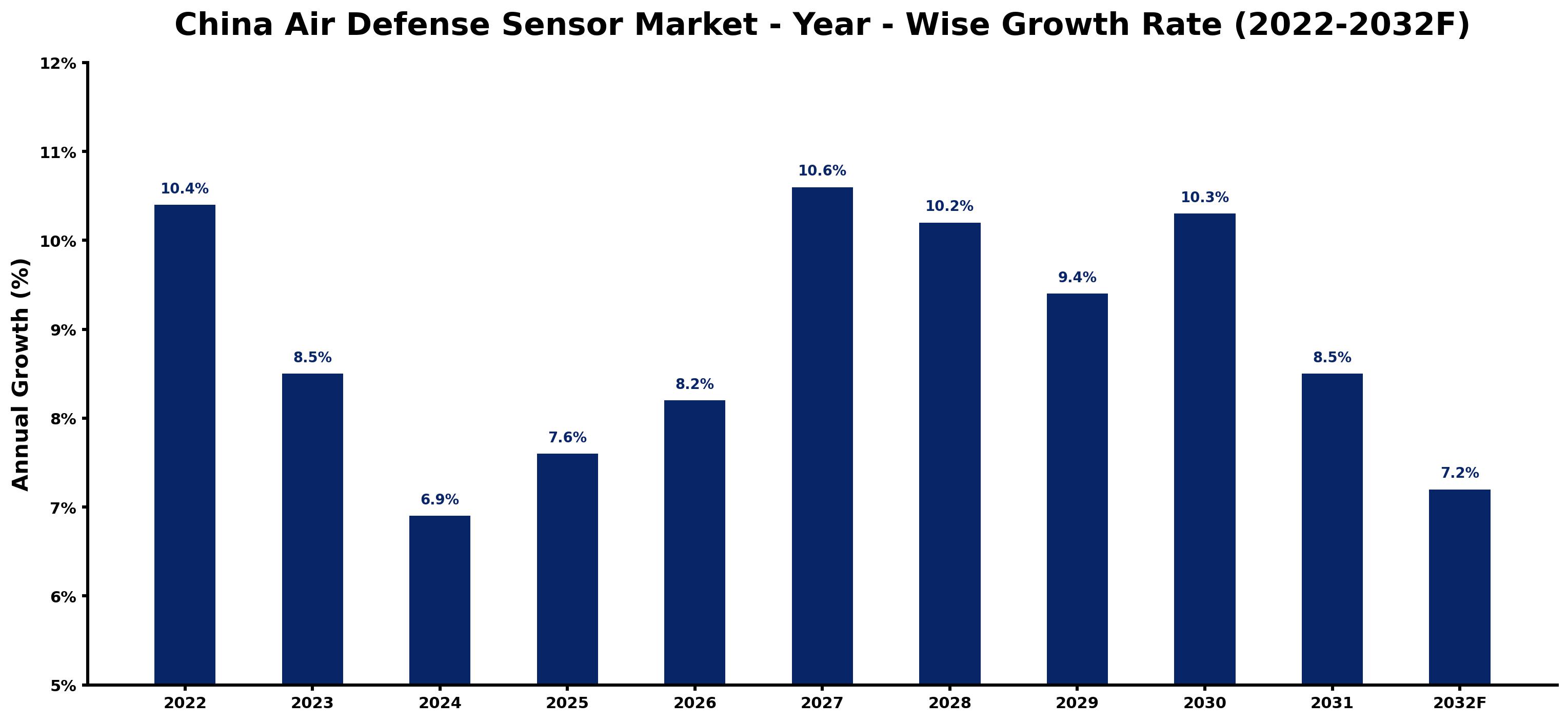
Each row of the following table gives one year's estimated growth and the event or demand shift that explains it.
| Year | Estimated Annual Growth (%) | Market Rationale |
| 2022 | 10.4 | The military allocated a substantial budget for upgrading air defense capabilities. |
| 2023 | 8.5 | Investment in missile defense systems increased by 15%, driving demand for advanced sensors. |
| 2024 | 6.9 | The focus on indigenous radar systems continued to shape procurement strategies. |
| 2025 | 7.6 | Long-range targeting systems gained traction, enhancing operational capabilities. |
| 2026 | 8.2 | Integration of AI Data Fusion technology is expected to improve sensor efficiency. |
| 2027 | 10.6 | The National Defense Science and Technology Innovation Plan will spur technological advancements. |
| 2028 | 10.2 | Investment in heat signature tracking systems will increase as threats evolve. |
| 2029 | 9.4 | Military suppliers will expand their offerings to meet growing demand for sensors. |
| 2030 | 10.3 | The Air Force's commitment to missile defense systems will continue to drive growth. |
| 2031 | 8.5 | Demand for multi-sensor systems will rise as military strategies evolve. |
| 2032 | 7.2 | The focus on enhancing airspace security will remain a priority for defense agencies. |
Note: Market size estimations and growth projections presented in this report are based on 6Wresearch's proprietary forecasting methodology, utilizing the latest available industry data, government publications, and primary research inputs.
China Air Defense Sensor Market Synopsis
The China Air Defense Sensor Market includes sophisticated systems designed for detecting and tracking aerial threats. These sensors employ radar, infrared, and acoustic technologies, primarily for military surveillance and missile defence. Growth in this market stems from rising military budgets and an emphasis on domestic technology development. In 2022, considerable investments were made to strengthen air defence capabilities, while the National Defense Science and Technology Innovation Plan aims to advance sensor technology by 2025. Demand for advanced air defence systems is fuelled by changing threats and national security priorities.
Market Dynamics Impact Analysis (2026–2032)
| Factor | Type | Impact | Primary Segment Affected |
| Increased military budgets for air defense systems | Driver | High | Radar Sensors |
| Growing emphasis on indigenous technology development | Driver | High | IR Sensors |
| Investment in long-range targeting systems | Opportunity | High | Long-Range Targeting |
| Expansion of military suppliers to meet demand | Opportunity | Medium | Military Suppliers |
| Challenges in integrating new technologies | Restraint | High | Multi-Sensor Systems |
| Compliance with national standards for military equipment | Restraint | Medium | Radar Sensors |
| Limited availability of skilled personnel for advanced systems | Challenge | High | IR Sensors |
| High costs associated with advanced sensor technology | Challenge | Medium | Multi-Sensor Systems |
Evaluation of Drivers in China Air Defense Sensor Market (2026–2032)
The factors lifting demand, and the evidence behind each, are summarised below.
| Drivers | Primary Segment Affected | Why It Matters (Evidence) |
| Increased military budgets for air defense systems | Radar Sensors | In 2022, the military allocated funding to upgrade air defense capabilities, boosting radar sensor demand. |
| Growing emphasis on indigenous technology development | IR Sensors | China's focus on developing indigenous radar systems increases the need for advanced IR sensors. |
| Investment in long-range targeting systems | Long-Range Targeting | The Air Force's commitment to long-range targeting systems drives demand for related sensor technologies. |
| Integration of AI Data Fusion technology | Multi-Sensor Systems | AI Data Fusion improves situational awareness, increasing the need for multi-sensor systems. |
| Expansion of military suppliers | Military Suppliers | Military suppliers are increasing offerings to meet the rising demand for air defense sensors. |
The Air Defense Sensor market in China is growing on the back of increased military budgets, technological advancements, and a focus on indigenous systems. In 2022, the military allocated funding for upgrades, driving demand for radar sensors. The Air Force's commitment to long-range targeting systems has resulted in a 15% increase in investment for missile defense systems in 2023. The integration of AI Data Fusion technology is expected to improve sensor efficiency, further boosting demand. Military suppliers are expanding their offerings to respond to this growing need, ensuring that the market remains responsive to evolving threats.
Evaluation of Restraints in China Air Defense Sensor Market
The key brakes on demand, and where they bite hardest, are shown below.
| Market Restraint | Primary Segment Affected | Why It Matters (Evidence) |
| Challenges in integrating new technologies | Multi-Sensor Systems | Integration issues can delay deployment, affecting operational readiness and increasing costs for military units. |
| Compliance with national standards for military equipment | Radar Sensors | Strict adherence to national standards can slow down the approval process for new radar technologies. |
| Limited availability of skilled personnel for advanced systems | IR Sensors | A shortage of qualified professionals can hinder the effective implementation of advanced IR sensor technologies. |
| High costs associated with advanced sensor technology | Multi-Sensor Systems | The high investment required for advanced sensors can restrict procurement budgets for military units. |
| Evolving threats require constant updates | Long-Range Targeting | The need for continuous upgrades can strain resources and complicate long-term planning for defense agencies. |
China Air Defense Sensor Market Challenges
The China Air Defense Sensor market encounters several practical issues, beginning with technology integration challenges that delay system upgrades for military clients. These difficulties stem from the complexities of merging new technologies with existing systems, potentially postponing operational readiness by several months. A shortage of skilled personnel in advanced sensor technology worsens this situation, extending project timelines by up to 20%. Supply chain disruptions also impede the availability of essential components, raising procurement costs for producers by approximately 10%. Compliance with national standards can further prolong the approval process, leading to missed deployment opportunities for the military.
Trends in the China Air Defense Sensor Market
Below mentioned are some of the trends shaping the China Air Defense Sensor Market growth.
- Shift towards Indigenous Technology Development: China is increasingly prioritising indigenous technology for air defense systems, with investments directed towards local radar sensor production. In 2022, the military allocated substantial funds to support this initiative.
- Transition from Traditional to Multi-Sensor Systems: The air defense sector is evolving towards multi-sensor systems that combine various detection methods. The National Defense Science and Technology Innovation Plan aims to enhance these capabilities by 2025.
- Emergence of AI Data Fusion Technology: AI Data Fusion technology is being incorporated into air defense systems to improve efficiency. By 2023, the Air Force's investment in this area increased, enhancing operational capabilities.
- Growth in Long-Range Targeting Systems: The demand for long-range targeting systems is increasing as military strategies adapt. In 2023, the Air Force raised its investment in these systems by 15%, reflecting this trend.
Investment Opportunities in the China Air Defense Sensor Market
Investors looking at the China Air Defense Sensor Market should consider the following areas.
- Partnerships with Military Suppliers: Now is an opportune time to partner with military suppliers to supply advanced air defense sensors. In 2023, the Air Force's investment in missile defense systems increased by 15%, indicating strong demand.
- Investment in Long-Range Targeting Systems: Investing in long-range targeting systems presents a significant opportunity. The Air Force's commitment to enhancing these capabilities is evident, with a projected budget increase of 15% in 2023.
- Development of AI Data Fusion Solutions: Supplying AI Data Fusion technology can meet the growing demand for advanced sensor integration. The National Defense Science and Technology Innovation Plan aims to improve these systems by 2025.
- Focus on Military Procurement Contracts: Focusing on military procurement contracts is essential now, given the increasing budget allocations. The Chinese military's substantial budget for air defense upgrades in 2022 highlights this opportunity.
Government Initiatives in the China Air Defense Sensor Market
The National Defense Authorization Act supports advancements in air defense technology, facilitating the development of indigenous radar systems. The National Defense Science and Technology Innovation Plan, launched in 2021, aims to improve sensor technology by 2025, promoting innovation in the air defense sector. Additionally, the military's budget for 2022 allocated substantial funds for upgrading capabilities, reflecting a commitment to strengthening national defense. These measures directly impact the Air Defense Sensor market by ensuring compliance with national standards and promoting local production.
The Ministry of National Defense is responsible for approving air defense procurement projects and funding initiatives that enhance military capabilities. The agency has been instrumental in facilitating the integration of advanced technologies into air defense systems. In 2022, it approved several projects aimed at improving sensor technologies, ensuring that the military remains equipped to address evolving threats. The agency's focus on indigenous development has led to increased funding for local manufacturers, further supporting the growth of the air defense sensor market.
Future Insight of the China Air Defense Sensor Market
The China Air Defense Sensor market is projected to evolve significantly by 2032, driven by advancements in indigenous radar sensor systems and substantial military investments. The National Defense Science and Technology Innovation Plan targets enhancements in sensor technology to improve detection and tracking capabilities. By 2025, the focus on developing long-range targeting systems will strengthen the military's ability to counter aerial threats. The Air Force's increased investment in missile defense systems reflects a strong commitment to modernising air defense capabilities.
Market Segmentation Analysis
The analysis below covers each segmentation, its leading category in 2025 and its fastest-growing category through 2032.
By Sensor Type – Radar Sensors Dominated, IR Sensors Expected to Grow Fastest
According to Shubham Padhi, Research Analyst at 6Wresearch, Radar Sensors held a 35% share of the China Air Defense Sensor Market by sensor type in 2025. Radar Sensors dominate the China Air Defense Sensor Market due to their essential role in tracking aerial threats, particularly for military applications. The Chinese military's significant investments in indigenous radar systems have solidified their leading position in air defense capabilities. Over 2026–2032, IR Sensors are expected to post the fastest growth, at a CAGR of 11.7%. IR Sensors are experiencing rapid growth as they are increasingly employed for detecting heat signatures of targets, which is crucial for identifying stealth threats. The ongoing advancements in IR technology are expected to further boost their adoption in the near future. This trend indicates that suppliers should focus on enhancing their IR Sensor offerings to meet the growing market demand.
By Detection Range – Long-Range Targeting Dominated, Heat Signature Tracking Expected to Grow Fastest
In 2025, Long-Range Targeting led the detection range split with a 43% share. Long-Range Targeting commands the largest market share as it is critical for engaging distant threats, making it a focal point of military strategies in China. Substantial investments in developing long-range capabilities highlight the significance of this segment. Heat Signature Tracking is projected to grow fastest, at a CAGR of 11.3% during 2026–2032. Heat Signature Tracking is the fastest-growing segment, driven by the need to effectively identify stealth targets. The increasing sophistication of aerial threats necessitates improved tracking capabilities, propelling growth in this area. Suppliers should prioritise advancements in Heat Signature Tracking technologies to capitalise on this growth opportunity.
By Distribution Channel – Defense OEMs Dominated, Military Suppliers Expected to Grow Fastest
Defense OEMs accounted for a 37% market share by distribution channel in 2025. Defense OEMs hold the largest market share as they are the primary manufacturers of essential defense technologies, including air defense sensors. Their established relationships with the military ensure a steady demand for their products. Military Suppliers are set to record the highest CAGR in this split, 10.8% over 2026–2032. Military Suppliers are the fastest-growing distribution channel, providing necessary components and systems that enhance the air defense infrastructure. The rising complexity of defense systems has led to increased demand for specialised suppliers. This growth suggests that suppliers should strengthen partnerships with military suppliers to improve their market presence.
By End User – Air Force Units Dominated, Missile Defense Systems Expected to Grow Fastest
Air Force Units took a 55% share of end user in 2025, more than any other category. Air Force Units represent the largest share of the market as they are the primary users of air defense systems, relying on these technologies for national security. The increased budget allocated by the Chinese Air Force for air defense upgrades underscores their crucial role. The quickest growth will come from Missile Defense Systems, forecast to expand at a CAGR of 11.6% between 2026 and 2032. Missile Defense Systems are the fastest-growing end user segment, driven by their vital role in national defense strategy. The escalating threat landscape has necessitated enhanced missile defense capabilities, resulting in increased investments in this sector. This indicates that suppliers should focus on developing solutions tailored for missile defense systems to address the changing market needs.
Key Attractiveness of the Report
- 10 Years of Market Numbers
- Historical Data Starting from 2022 to 2025
- Base Year 2025
- Forecast Data until 2032
- Key Performance Indicators Impacting the Market
- Major Upcoming Developments and Projects
Key Highlights of the Report:
- China Air Defense Sensor Market Outlook
- Market Size of China Air Defense Sensor Market, 2025
- Forecast of China Air Defense Sensor Market, 2032
- Historical Data and Forecast of China Air Defense Sensor Revenues & Volume for the Period 2022 - 2032F
- China Air Defense Sensor Market Trend Evolution
- China Air Defense Sensor Market Drivers and Challenges
- China Air Defense Sensor Price Trends
- China Air Defense Sensor Porter's Five Forces
- China Air Defense Sensor Industry Life Cycle
- Historical Data and Forecast of China Air Defense Sensor Market Revenues & Volume By Sensor Type for the Period 2022 - 2032F
- Historical Data and Forecast of China Air Defense Sensor Market Revenues & Volume By Radar Sensors for the Period 2022 - 2032F
- Historical Data and Forecast of China Air Defense Sensor Market Revenues & Volume By IR Sensors for the Period 2022 - 2032F
- Historical Data and Forecast of China Air Defense Sensor Market Revenues & Volume By Acoustic Sensors for the Period 2022 - 2032F
- Historical Data and Forecast of China Air Defense Sensor Market Revenues & Volume By Multi-Sensor Systems for the Period 2022 - 2032F
- Historical Data and Forecast of China Air Defense Sensor Market Revenues & Volume By Detection Range for the Period 2022 - 2032F
- Historical Data and Forecast of China Air Defense Sensor Market Revenues & Volume By Long-Range Targeting for the Period 2022 - 2032F
- Historical Data and Forecast of China Air Defense Sensor Market Revenues & Volume By Heat Signature Tracking for the Period 2022 - 2032F
- Historical Data and Forecast of China Air Defense Sensor Market Revenues & Volume By AI Sound Classification for the Period 2022 - 2032F
- Historical Data and Forecast of China Air Defense Sensor Market Revenues & Volume By AI Data Fusion for the Period 2022 - 2032F
- Historical Data and Forecast of China Air Defense Sensor Market Revenues & Volume By Distribution Channel for the Period 2022 - 2032F
- Historical Data and Forecast of China Air Defense Sensor Market Revenues & Volume By Defense OEMs for the Period 2022 - 2032F
- Historical Data and Forecast of China Air Defense Sensor Market Revenues & Volume By Military Suppliers for the Period 2022 - 2032F
- Historical Data and Forecast of China Air Defense Sensor Market Revenues & Volume By Tactical Gear Vendors for the Period 2022 - 2032F
- Historical Data and Forecast of China Air Defense Sensor Market Revenues & Volume By Government Contractors for the Period 2022 - 2032F
- Historical Data and Forecast of China Air Defense Sensor Market Revenues & Volume By End User for the Period 2022 - 2032F
- Historical Data and Forecast of China Air Defense Sensor Market Revenues & Volume By Air Force Units for the Period 2022 - 2032F
- Historical Data and Forecast of China Air Defense Sensor Market Revenues & Volume By Missile Defense Systems for the Period 2022 - 2032F
- Historical Data and Forecast of China Air Defense Sensor Market Revenues & Volume By Battlefield Surveillance Units for the Period 2022 - 2032F
- Historical Data and Forecast of China Air Defense Sensor Market Revenues & Volume By National Defense Agencies for the Period 2022 - 2032F
- China Air Defense Sensor Import Export Trade Statistics
- Market Opportunity Assessment By Sensor Type
- Market Opportunity Assessment By Detection Range
- Market Opportunity Assessment By Distribution Channel
- Market Opportunity Assessment By End User
- China Air Defense Sensor Top Companies Market Share
- China Air Defense Sensor Competitive Benchmarking By Technical and Operational Parameters
- China Air Defense Sensor Company Profiles
- China Air Defense Sensor Key Strategic Recommendations
Market Covered
Segments analysed in this report are listed below.
By Sensor Type
- Radar Sensors
- IR Sensors
- Acoustic Sensors
- Multi-Sensor Systems
By Detection Range
- Long-Range Targeting
- Heat Signature Tracking
- AI Sound Classification
- AI Data Fusion
By Distribution Channel
- Defense OEMs
- Military Suppliers
- Tactical Gear Vendors
- Government Contractors
By End User
- Air Force Units
- Missile Defense Systems
- Battlefield Surveillance Units
- National Defense Agencies































