China Air Purification Wearables Market Size & Growth Rate
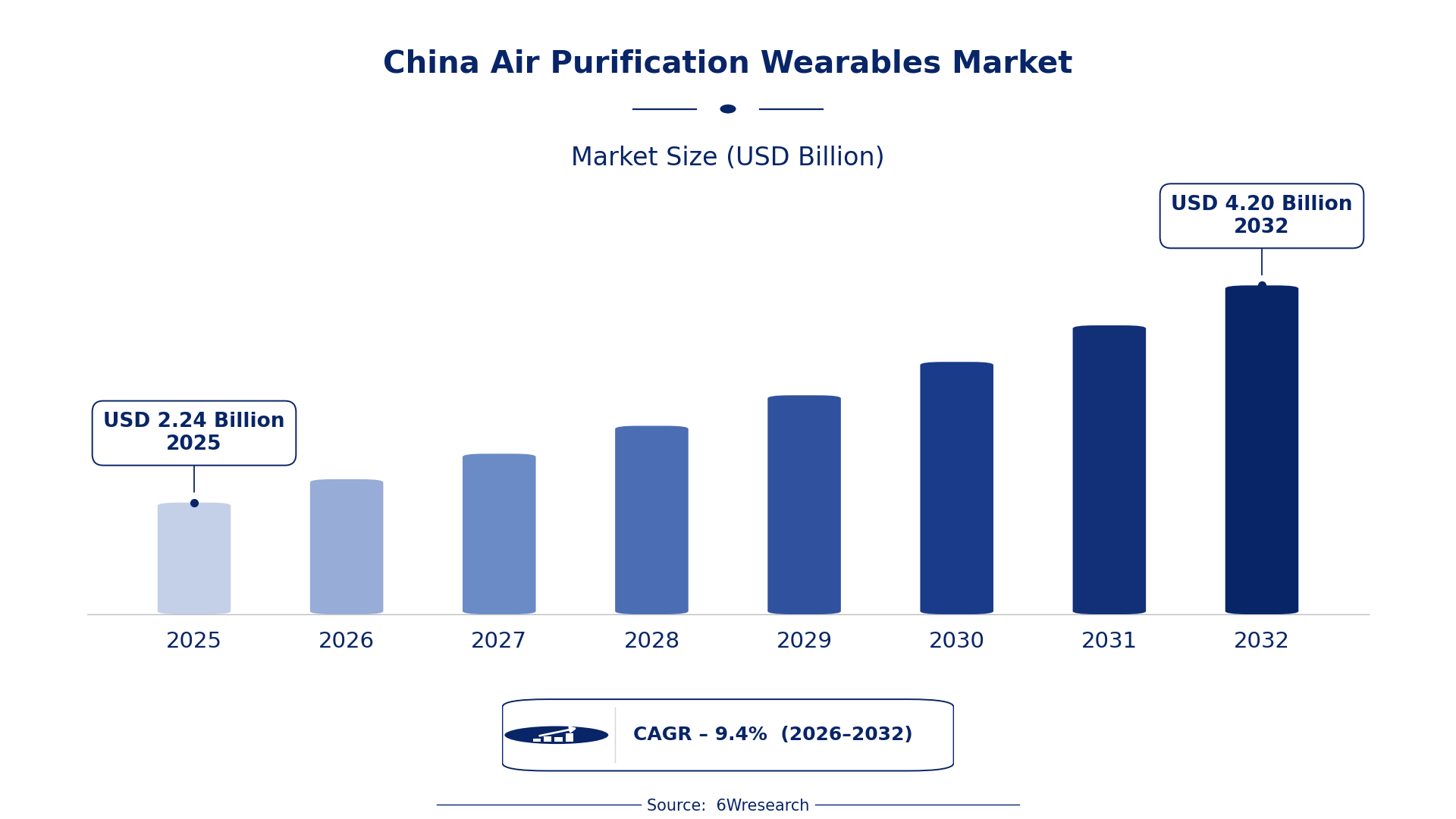
According to 6Wresearch internal database and industry insights, the China Air Purification Wearables Market was valued at USD 2.24 billion in 2025 and is projected to reach USD 4.20 billion by 2032, growing at a CAGR of approximately 9.4% during 2026–2032.
China Air Purification Wearables Market Highlights
| Report Metric | Details |
| Report Name | China Air Purification Wearables Market |
| Market Size 2025 | USD 2.24 billion |
| Market Size 2032 | USD 4.20 billion |
| Absolute Growth 2025–2032 | USD 1.96 billion |
| CAGR 2026–2032 | 9.4% |
| Peak Annual Growth | 11.3% in 2030 |
| Forecast Period | 2026–2032 |
| Historical Data | 2022–2025 |
| Base Year | 2025 |
| Leading Wearable Type, 2025 | Mask Devices (44% share) |
| Leading Purification Method, 2025 | HEPA/Carbon Filters (52% share) |
| Leading Distribution Channel, 2025 | E-commerce Sites (39% share) |
| Leading End User, 2025 | Urban Commuters (46% share) |
| Fastest-Growing Wearable Type | Clip-on Purifiers (11.2% CAGR) |
| Fastest-Growing Purification Method | Ion-Based Air Flow (11.7% CAGR) |
| Fastest-Growing Distribution Channel | Smart Wearable Distributors (11.0% CAGR) |
| Fastest-Growing End User | Outdoor Workers (11.1% CAGR) |
| Growing Sector | Health and Wellness |
| Key End Users | Urban Commuters, Outdoor Workers, Allergy-Prone Individuals |
China Air Purification Wearables Market Year-wise Growth Rate and Key Drivers (2022–2032)
This graph illustrates the annual growth rates of the market from 2022 to 2032, highlighting a steady upward trajectory and projected market expansion over the forecast period.
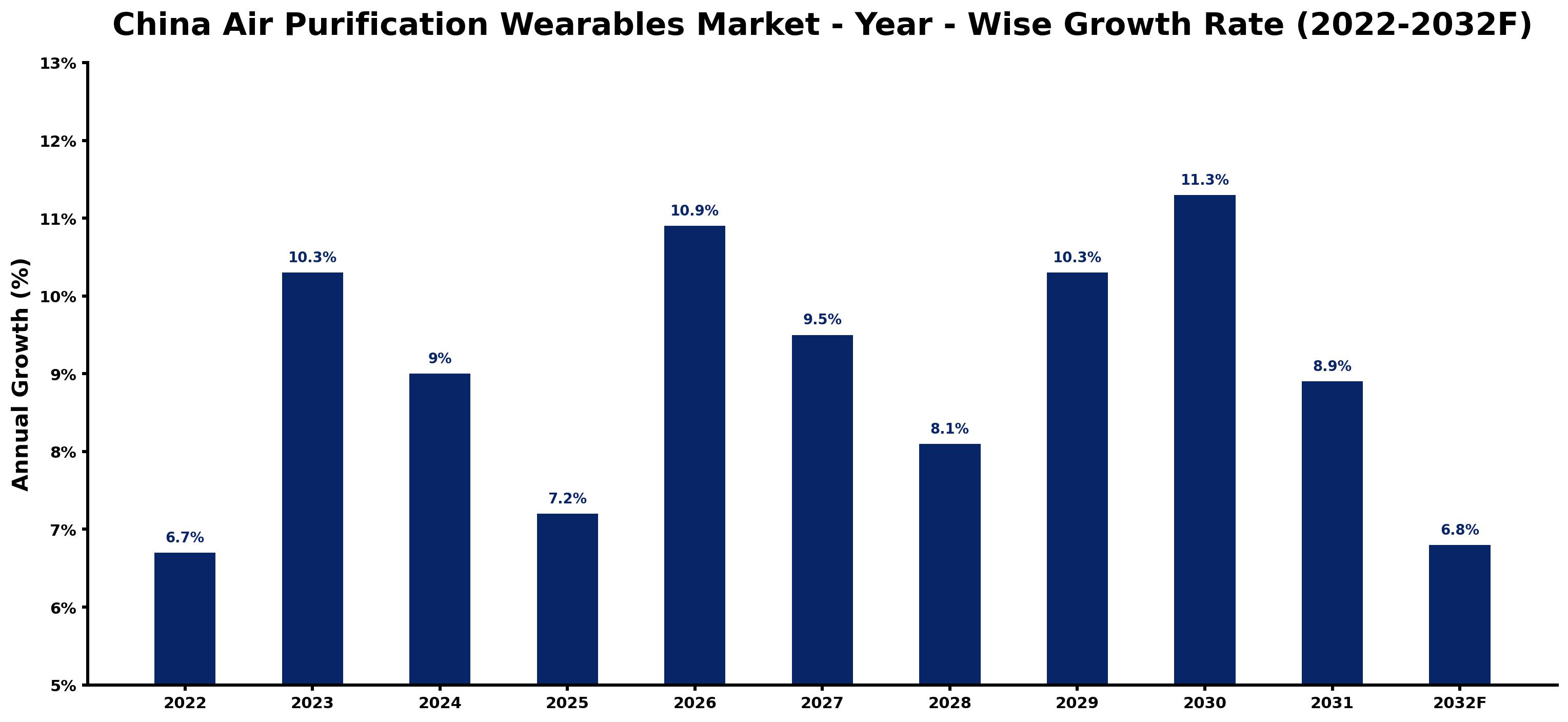
The following table presents the estimated annual growth rate for each year together with the principal factor influencing market performance.
| Year | Estimated Annual Growth (%) | Market Rationale |
| 2022 | 6.7 | Urban air pollution impacted over 300 million people, driving demand for air purification wearables. |
| 2023 | 10.3 | The Ministry of Ecology and Environment launched a campaign to promote air quality awareness, boosting market interest. |
| 2024 | 9.0 | Growth slowed as consumers adjusted to new health product trends and market conditions. |
| 2025 | 7.2 | Market growth continued to decelerate as competition among distribution channels intensified. |
| 2026 | 10.9 | A surge in health-conscious consumers is expected to lead to increased adoption of air purification technologies. |
| 2027 | 9.5 | Demand will stabilise as urban commuters seek effective solutions for air quality improvement. |
| 2028 | 8.1 | Growth is projected to slow as market saturation begins to affect new product introductions. |
| 2029 | 10.3 | Health Product Retailers expanded offerings, renewing interest in air purification wearables. |
| 2030 | 11.3 | The Clean Air Action Plan's initiatives will spur growth in air quality technologies. |
| 2031 | 8.9 | Market growth is expected to decelerate as consumer spending patterns shift towards other health products. |
| 2032 | 6.8 | Demand will remain steady as urban air quality issues continue to drive consumer purchases. |
Note: Market size estimations and growth projections presented in this report are based on 6Wresearch's proprietary forecasting methodology, utilizing the latest available industry data, government publications, and primary research inputs.
China Air Purification Wearables Market Synopsis
Air purification wearables are personal devices designed to filter and clean the air around users in China. These devices cater primarily to urban commuters and outdoor workers seeking to improve air quality in polluted environments. The China Air Purification Wearables Market is growing as urban air pollution affects over 300 million people, alongside a health-conscious population of approximately 1.4 billion. Initiatives like the Clean Air Action Plan are driving demand as consumers look for effective solutions to address pollution-related health issues.
Market Dynamics Impact Analysis (2026–2032)
| Factor | Type | Impact | Primary Segment Affected |
| Urban air pollution impacts over 300 million people, driving demand for personal air filtration devices. | Driver | High | Mask Devices |
| Health Product Retailers account for approximately 30% of distribution channels, facilitating wider access to wearables. | Driver | High | E-commerce Sites |
| The average consumer is willing to spend around 500 RMB on personal air purification devices, indicating strong purchasing power. | Opportunity | High | Clip-on Purifiers |
| The prevalence of allergies in urban areas is increasing, creating a larger market for air purification wearables. | Opportunity | High | Neckband Purifiers |
| The market faces challenges in educating consumers about the benefits of air purification wearables. | Restraint | Medium | AI-Controlled Devices |
| Competition among distribution channels may limit the growth of specific product types in the market. | Restraint | Medium | Health Product Retailers |
| Technological advancements may outpace current product offerings, leading to consumer dissatisfaction. | Challenge | High | Mask Devices |
| Regulatory compliance can be burdensome for new entrants, delaying product launches. | Challenge | Medium | Clip-on Purifiers |
Evaluation of Drivers in China Air Purification Wearables Market (2026–2032)
The main growth drivers and the segments they affect most are set out below.
| Drivers | Primary Segment Affected | Why It Matters (Evidence) |
| Increasing urban air pollution drives demand for effective air purification solutions. | Mask Devices | In 2022, the average urban PM2.5 concentration was around 35 µg/m³, prompting more consumers to seek wearables. |
| Growing health awareness among consumers leads to higher adoption rates of air purification technologies. | Clip-on Purifiers | The health-conscious population of approximately 1.4 billion in China is increasingly prioritising air quality. |
| E-commerce sales of health products grew by 25% in 2022, boosting market accessibility. | E-commerce Sites | This growth enables consumers to easily purchase air purification wearables online. |
| The National Health Commission promotes air quality improvement programs, boosting consumer interest. | Neckband Purifiers | Such initiatives encourage individuals to invest in personal air purification devices. |
| The Clean Air Action Plan aims to improve urban air quality, increasing demand for wearables. | AI-Controlled Devices | The government's commitment to reducing PM2.5 levels by 10% by 2025 supports market growth. |
Growth in the Air Purification Wearables market in China comes from increasing urban air pollution, health awareness, and strong e-commerce sales. In 2022, the average urban PM2.5 concentration was around 35 µg/m³, prompting consumers to seek effective solutions. The health-conscious population prioritises air quality, leading to higher adoption rates. E-commerce sales of health products grew by 25% in 2022, improving accessibility for consumers.
Evaluation of Restraints in China Air Purification Wearables Market
Below mentioned are some major restraints and their influence on market dynamics.
| Market Restraint | Primary Segment Affected | Why It Matters (Evidence) |
| Consumer education on air purification benefits remains limited, hindering market growth. | AI-Controlled Devices | Many potential buyers are unaware of the advantages of using air purification wearables. |
| Intense competition among distribution channels can limit market penetration for specific products. | Health Product Retailers | This competition may lead to price wars, affecting profitability for retailers. |
| Technological advancements may lead to rapid obsolescence of current products, affecting sales. | Mask Devices | Consumers may hesitate to invest in products that could quickly become outdated. |
| Regulatory compliance can be complex, delaying the introduction of new products. | Clip-on Purifiers | New entrants may struggle to meet safety and efficiency standards set by authorities. |
| Market saturation in urban areas may limit growth opportunities for new product types. | Neckband Purifiers | As more options become available, consumers may feel overwhelmed and delay purchases. |
China Air Purification Wearables Market Challenges
The China Air Purification Wearables Market still has to solve a few problems, with technology limitations being a primary concern. Many wearables rely on HEPA filters, which can be bulky and uncomfortable, discouraging usage among urban commuters. Cost presents another challenge; the average consumer's budget of 500 RMB often does not align with the prices of advanced models, limiting access for lower-income buyers. Skills shortages in manufacturing lead to production delays, impacting suppliers' ability to meet rising demand. Supply chain disruptions create risks, causing delays in component delivery that hinder retailers' sales efforts.
Trends in the China Air Purification Wearables Market
Buyers and suppliers in the China Air Purification Wearables Market are adjusting to the following trends.
- Launch of the Clean Air Action Plan: In 2023, the Ministry of Ecology and Environment initiated the 'Clean Air Action Plan', aiming to improve air quality in major cities by 2025. This initiative is expected to drive increased adoption of air purification technologies, particularly in urban areas.
- Shift towards AI-Controlled Devices: AI-Controlled Devices are gaining traction among tech-savvy consumers in urban areas, enhancing user experience. With the growing interest in smart technology, the market for these wearables is projected to expand, with an 11.0% CAGR from 2026 to 2032.
- Growth in E-commerce Sales: E-commerce sales of health products, including wearables, grew by 25% in 2022, reflecting a shift in consumer purchasing behaviour. This trend is likely to persist, making online platforms the primary channel for air purification wearables.
- Increasing Allergy Prevalence: The prevalence of allergies in urban areas has risen, creating a larger market for air purification wearables. This trend is particularly noticeable in cities like Beijing and Shanghai, where demand for effective air filtration solutions is high.
Investment Opportunities in the China Air Purification Wearables Market
Several openings in the China Air Purification Wearables Market merit attention from investors.
- Urban Commuters Seeking Solutions: Urban Commuters represent a significant buyer group, with an increasing need for personal air filtration solutions. The market is set to expand as urban air pollution continues to impact millions, with approximately 300 million people affected.
- Expansion of Health Product Retailers: Health Product Retailers, accounting for 30% of distribution channels, are poised to broaden their offerings of air purification wearables. This growth is supported by rising consumer awareness and demand for health-related products.
- Outdoor Workers in Industrial Regions: Outdoor Workers represent a crucial segment, particularly in industrial regions where air quality is poor. With growing health concerns, there is a strong opportunity to supply air purification devices tailored for this demographic.
- New Subsidy Program for Schools: The 2023 subsidy program introduced by the Ministry of Industry and Information Technology promotes the adoption of air purification technologies in schools. This initiative opens avenues for suppliers to collaborate with educational institutions.
Government Initiatives in the China Air Purification Wearables Market
In 2023, the Ministry of Ecology and Environment launched the 'Clean Air Action Plan', aiming to improve air quality in major cities by 2025. This measure requires local governments to implement strategies for reducing pollution levels, directly impacting the demand for air purification wearables. The plan encourages innovation in air quality technologies, creating a supportive environment for manufacturers and suppliers.
The 'Healthy China 2030' initiative promotes the use of air purification technologies in urban environments to combat pollution-related health issues. This initiative provides funding for health awareness campaigns and supports the development of standards for air purification devices, ensuring that buyers can trust the quality and effectiveness of the products.
Future Insight of the China Air Purification Wearables Market
By 2032, the China Air Purification Wearables Market will undergo significant changes, primarily driven by technological advancements and increased health awareness. The government's campaign to improve air quality will likely boost demand for effective air purification devices. E-commerce sales of health products, which grew by 25% in 2022, will continue to expand, enabling suppliers to reach more consumers. New subsidy programs for schools will promote adoption among younger demographics, creating a thriving market for air purification wearables.
Market Segmentation Analysis
The report offers a comprehensive study of the following market segments and their leading categories in the market.
By Wearable Type – Mask Devices Dominated, Clip-on Purifiers Expected to Grow Fastest
According to Shubham Padhi, Research Analyst at 6Wresearch, Mask Devices took a 44% share of wearable type in 2025, more than any other category. Mask devices hold the largest market share because they are specifically designed to filter the air inhaled by users, making them crucial for individuals in polluted urban environments. Their prominence is particularly evident among commuters in cities like Beijing and Shanghai, where air quality is a pressing concern. Clip-on Purifiers are set to record the highest CAGR in this split, 11.2% over 2026–2032. Clip-on purifiers are rapidly gaining popularity due to their portability and ease of attachment, appealing to consumers looking for convenient air purification solutions. As the health-conscious population continues to grow, this segment is expected to expand significantly, further widening the gap with mask devices. Suppliers should prioritise the development of clip-on purifiers to meet the increasing demand for user-friendly air purification options.
By Purification Method – HEPA/Carbon Filters Dominated, Ion-Based Air Flow Expected to Grow Fastest
The largest purification method category in 2025 was HEPA/Carbon Filters, with a 52% share of total revenue. HEPA and carbon filters dominate the market as they are the primary filtration method in air purification wearables, ensuring effective removal of pollutants. Their widespread adoption is evidenced by their use in various devices, making them a trusted choice for consumers. Ion-Based Air Flow is projected to grow fastest, at a CAGR of 11.7% during 2026–2032. Ion-based air flow technology is emerging as a rapidly growing method, attracting attention for its potential to enhance air quality. As consumers become increasingly aware of air pollution issues, the adoption of this method is expected to rise, indicating a shift in market preferences. Manufacturers should explore investments in ion-based technologies to remain competitive as consumer preferences shift towards more advanced solutions.
By Distribution Channel – E-commerce Sites Dominated, Smart Wearable Distributors Expected to Grow Fastest
E-commerce Sites accounted for a 39% market share by distribution channel in 2025. E-commerce sites lead the distribution of air purification wearables, providing consumers with easy access to a wide range of products. This channel's success is largely due to the convenience it offers to health-conscious buyers in urban areas, facilitating quick and efficient purchases. Over 2026–2032, Smart Wearable Distributors are expected to post the fastest growth, at a CAGR of 11.0%. Smart wearable distributors are experiencing rapid growth as they focus on the distribution of wearable technology, aligning with the increasing demand for advanced air purification solutions. Their specialised approach caters to a tech-savvy consumer base, driving their market expansion. Suppliers should consider forming strategic partnerships with smart wearable distributors to enhance their market reach and visibility.
By End User – Urban Commuters Dominated, Outdoor Workers Expected to Grow Fastest
Urban Commuters held a 46% share of the China Air Purification Wearables Market by end user in 2025. Urban commuters represent the largest user group for air purification wearables, as they are significantly affected by urban air pollution during their daily travels. Their demand for effective air filtration solutions drives substantial market growth, making them a key target for suppliers. The quickest growth will come from Outdoor Workers, forecast to expand at a CAGR of 11.1% between 2026 and 2032. Outdoor workers are the fastest-growing segment, as they require clean air in polluted environments, especially in industrial regions. The increasing prevalence of allergies among outdoor workers further boosts the demand for air purification wearables, highlighting their importance in these settings. Suppliers should tailor their marketing strategies to effectively target outdoor workers, emphasising the benefits of wearables in their specific environments.
Key Attractiveness of the Report
- 10 Years of Market Numbers
- Historical Data Starting from 2022 to 2025
- Base Year 2025
- Forecast Data until 2032
- Key Performance Indicators Impacting the Market
- Major Upcoming Developments and Projects
Key Highlights of the Report:
- China Air Purification Wearables Market Outlook
- Market Size of China Air Purification Wearables Market, 2025
- Forecast of China Air Purification Wearables Market, 2032
- Historical Data and Forecast of China Air Purification Wearables Revenues & Volume for the Period 2022 - 2032F
- China Air Purification Wearables Market Trend Evolution
- China Air Purification Wearables Market Drivers and Challenges
- China Air Purification Wearables Price Trends
- China Air Purification Wearables Porter's Five Forces
- China Air Purification Wearables Industry Life Cycle
- Historical Data and Forecast of China Air Purification Wearables Market Revenues & Volume By Wearable Type for the Period 2022 - 2032F
- Historical Data and Forecast of China Air Purification Wearables Market Revenues & Volume By Neckband Purifiers for the Period 2022 - 2032F
- Historical Data and Forecast of China Air Purification Wearables Market Revenues & Volume By Mask Devices for the Period 2022 - 2032F
- Historical Data and Forecast of China Air Purification Wearables Market Revenues & Volume By Clip-on Purifiers for the Period 2022 - 2032F
- Historical Data and Forecast of China Air Purification Wearables Market Revenues & Volume By AI-Controlled Devices for the Period 2022 - 2032F
- Historical Data and Forecast of China Air Purification Wearables Market Revenues & Volume By Purification Method for the Period 2022 - 2032F
- Historical Data and Forecast of China Air Purification Wearables Market Revenues & Volume By Ion-Based Air Flow for the Period 2022 - 2032F
- Historical Data and Forecast of China Air Purification Wearables Market Revenues & Volume By HEPA/Carbon Filters for the Period 2022 - 2032F
- Historical Data and Forecast of China Air Purification Wearables Market Revenues & Volume By Fan with UV-C for the Period 2022 - 2032F
- Historical Data and Forecast of China Air Purification Wearables Market Revenues & Volume By Air Quality Monitoring for the Period 2022 - 2032F
- Historical Data and Forecast of China Air Purification Wearables Market Revenues & Volume By Distribution Channel for the Period 2022 - 2032F
- Historical Data and Forecast of China Air Purification Wearables Market Revenues & Volume By E-commerce Sites for the Period 2022 - 2032F
- Historical Data and Forecast of China Air Purification Wearables Market Revenues & Volume By Health Product Retailers for the Period 2022 - 2032F
- Historical Data and Forecast of China Air Purification Wearables Market Revenues & Volume By Wellness Tech Startups for the Period 2022 - 2032F
- Historical Data and Forecast of China Air Purification Wearables Market Revenues & Volume By Smart Wearable Distributors for the Period 2022 - 2032F
- Historical Data and Forecast of China Air Purification Wearables Market Revenues & Volume By End User for the Period 2022 - 2032F
- Historical Data and Forecast of China Air Purification Wearables Market Revenues & Volume By Urban Commuters for the Period 2022 - 2032F
- Historical Data and Forecast of China Air Purification Wearables Market Revenues & Volume By Outdoor Workers for the Period 2022 - 2032F
- Historical Data and Forecast of China Air Purification Wearables Market Revenues & Volume By Allergy-Prone Individuals for the Period 2022 - 2032F
- Historical Data and Forecast of China Air Purification Wearables Market Revenues & Volume By Fitness & Travel Users for the Period 2022 - 2032F
- China Air Purification Wearables Import Export Trade Statistics
- Market Opportunity Assessment By Wearable Type
- Market Opportunity Assessment By Purification Method
- Market Opportunity Assessment By Distribution Channel
- Market Opportunity Assessment By End User
- China Air Purification Wearables Top Companies Market Share
- China Air Purification Wearables Competitive Benchmarking By Technical and Operational Parameters
- China Air Purification Wearables Company Profiles
- China Air Purification Wearables Key Strategic Recommendations
Market Covered
The report offers an extensive study of the following market segments.
By Wearable Type
- Neckband Purifiers
- Mask Devices
- Clip-on Purifiers
- AI-Controlled Devices
By Purification Method
- Ion-Based Air Flow
- HEPA/Carbon Filters
- Fan with UV-C
- Air Quality Monitoring
By Distribution Channel
- E-commerce Sites
- Health Product Retailers
- Wellness Tech Startups
- Smart Wearable Distributors
By End User
- Urban Commuters
- Outdoor Workers
- Allergy-Prone Individuals
- Fitness & Travel Users































