China Air Traffic Control Systems Market Size & Growth Rate
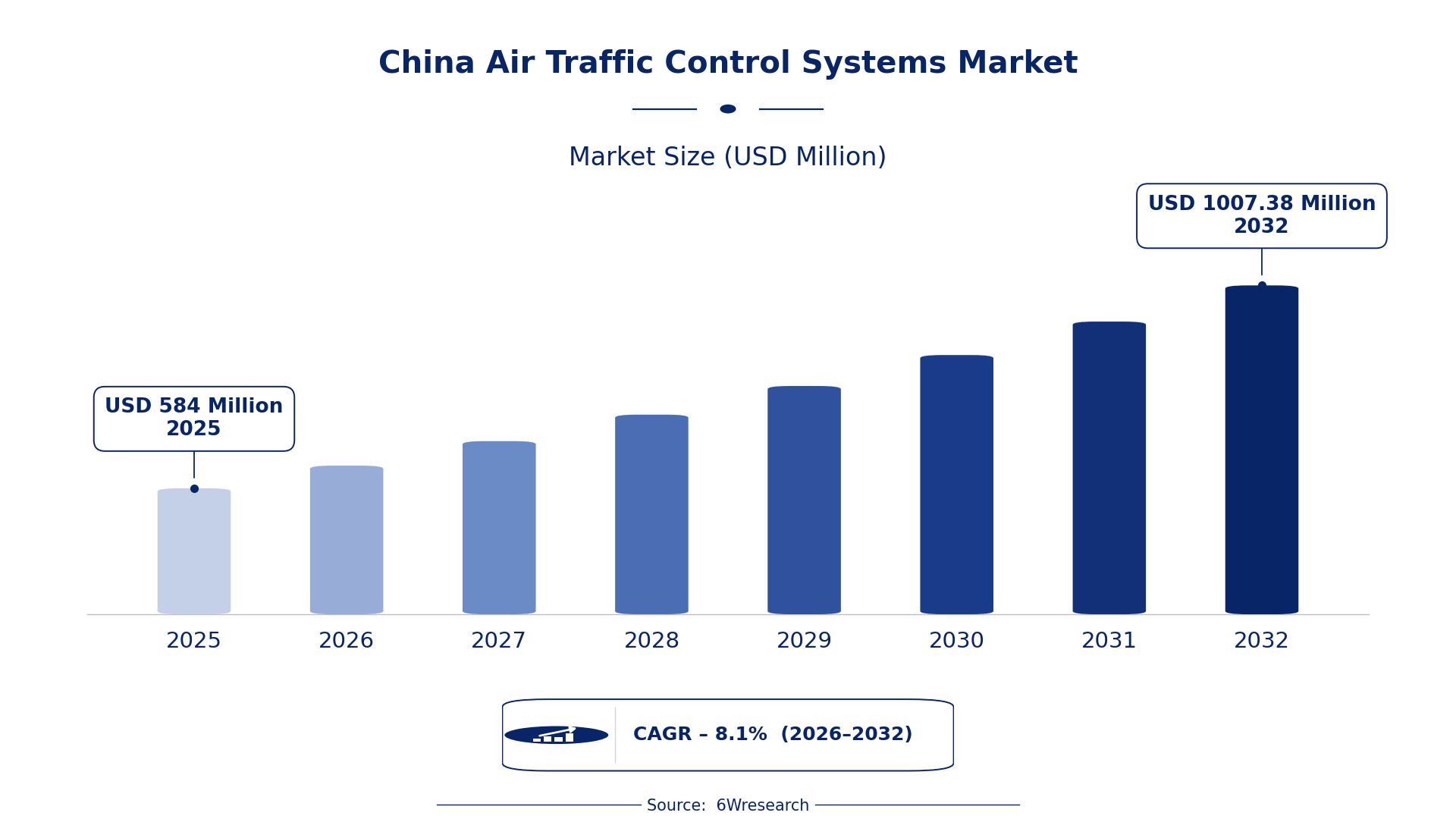
According to 6Wresearch internal database and industry insights, the China Air Traffic Control Systems Market was valued at USD 584.0 million in 2025 and is projected to reach USD 1,007.38 million by 2032, growing at a CAGR of approximately 8.1% during 2026–2032.
China Air Traffic Control Systems Market Highlights
| Report Metric | Details |
| Report Name | China Air Traffic Control Systems Market |
| Market Size 2025 | USD 584.0 million |
| Market Size 2032 | USD 1,007.38 million |
| Absolute Growth 2025–2032 | USD 423.38 million |
| CAGR 2026–2032 | 8.1% |
| Peak Annual Growth | 10.1% in 2028 |
| Forecast Period | 2026–2032 |
| Historical Data | 2022–2025 |
| Base Year | 2025 |
| Leading System Type, 2025 | Automation Systems (49% share) |
| Leading Technology Type, 2025 | AI-Powered Tools (49% share) |
| Leading Distribution Channel, 2025 | Government Contracts (46% share) |
| Leading End User, 2025 | Civil Aviation Authorities (38% share) |
| Fastest-Growing Technology Type | Real-Time Data Integration (9.7% CAGR) |
| Fastest-Growing Distribution Channel | Aerospace OEMs (10.6% CAGR) |
| Fastest-Growing End User | National Air Navigation Units (10.8% CAGR) |
| Growing Sector | Civil Aviation |
| Key End Users | Civil Aviation Authorities, National Air Navigation Units, ATC Service Providers, Airport Authorities |
China Air Traffic Control Systems Market Year-wise Growth Rate and Key Drivers (2022–2032)
This graph illustrates the annual growth rates of the market from 2022 to 2032, highlighting a steady upward trajectory and projected market expansion over the forecast period.
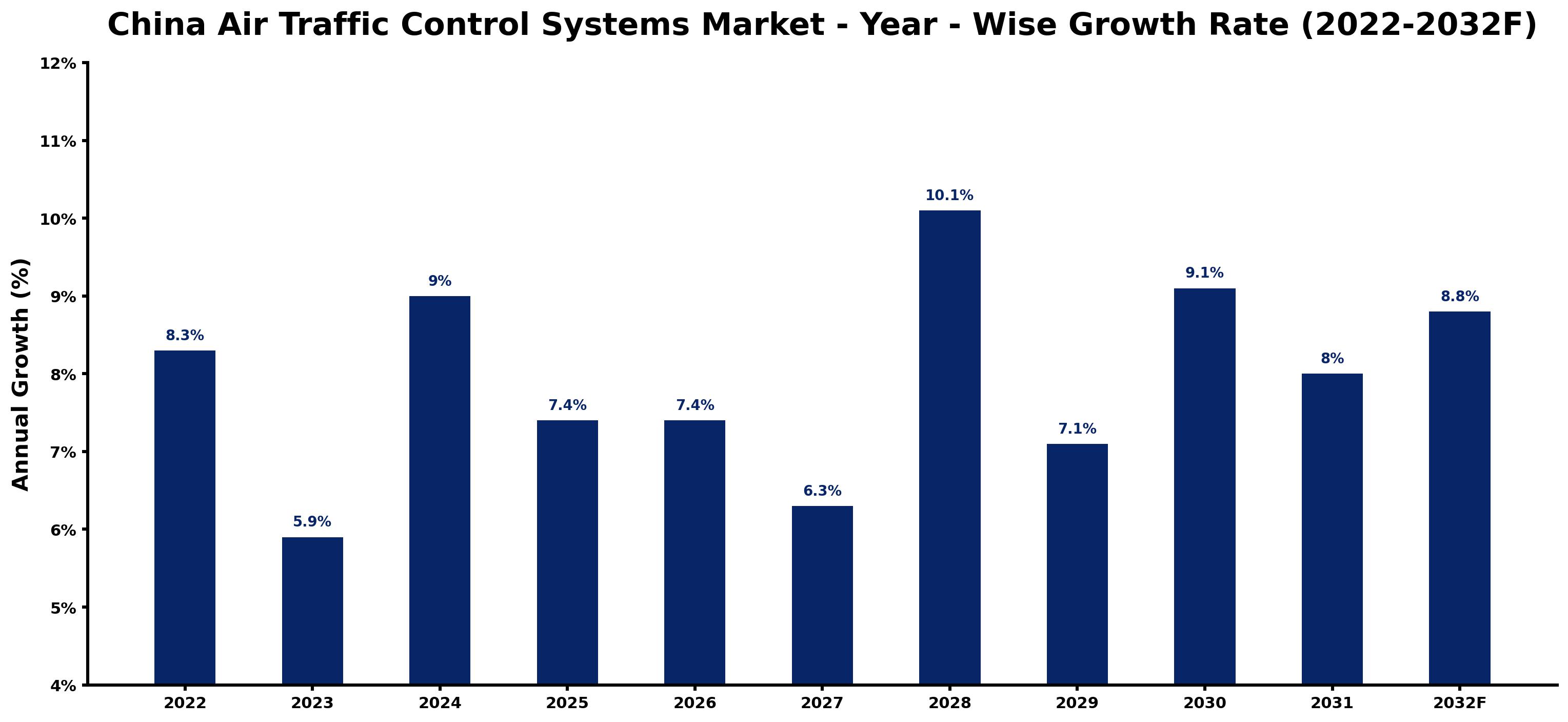
Each row of the following table gives one year's estimated growth and the event or demand shift that explains it.
| Year | Estimated Annual Growth (%) | Market Rationale |
| 2022 | 8.3 | The market experienced steady growth due to ongoing infrastructure investments in air traffic control systems. |
| 2023 | 5.9 | Growth slowed as the market adjusted to the completion of several major projects. |
| 2024 | 9.0 | Demand increased with the implementation of new safety regulations enhancing air traffic management. |
| 2025 | 7.4 | Growth slowed again as market saturation began to affect procurement rates. |
| 2026 | 7.4 | The market continued to grow, supported by the ongoing modernization of ATC systems nationwide. |
| 2027 | 6.3 | Growth slowed as the focus shifted to integrating advanced technologies into existing systems. |
| 2028 | 10.1 | Demand surged due to the full rollout of the Smart ATC initiative, boosting system capabilities. |
| 2029 | 7.1 | Growth slowed as the market stabilised after rapid advancements in technology. |
| 2030 | 9.1 | Demand increased again with rising passenger traffic and the need for efficient air traffic management. |
| 2031 | 8.0 | Growth slowed as the market adjusted to new operational standards and regulations. |
| 2032 | 8.8 | Demand is expected to rise as urban airports modernise their ATC systems. |
Note: Market size estimations and growth projections presented in this report are based on 6Wresearch's proprietary forecasting methodology, utilizing the latest available industry data, government publications, and primary research inputs.
China Air Traffic Control Systems Market Synopsis
Air Traffic Control Systems in China encompass advanced technologies ensuring safe and efficient aircraft movement. These systems utilize radar, communication, and data processing technologies to manage air traffic and optimize flight operations. The China Air Traffic Control Systems Market is growing due to rising passenger traffic, with projections of over 1 billion passengers annually by 2035. Government contracts for modernization and the National Air Traffic Management Plan are driving demand for advanced ATC systems. Investments in infrastructure upgrades further support market expansion.
Market Dynamics Impact Analysis (2026–2032)
| Factor | Type | Impact | Primary Segment Affected |
| Increasing passenger traffic necessitates enhanced air traffic management. | Driver | High | Automation Systems |
| Government contracts for modernization projects provide significant funding. | Driver | High | Government Contracts |
| The need for AI integration in ATC systems presents a gap in the market. | Opportunity | High | AI-Powered Tools |
| Urban airports require upgraded systems to handle growing air traffic. | Opportunity | Medium | Radar-Based Systems |
| Budget constraints limit the scope of modernization projects. | Restraint | High | Voice Communication |
| Complex regulatory requirements can delay system upgrades. | Restraint | Medium | Flight Planning Tools |
| Buyers face challenges in securing funding for large-scale upgrades. | Challenge | High | Automation Systems |
| Suppliers struggle with integrating new technologies into existing systems. | Challenge | Medium | IP-Based Communication |
Evaluation of Drivers in China Air Traffic Control Systems Market (2026–2032)
The table below links each growth driver to the segment it affects and the evidence for it.
| Drivers | Primary Segment Affected | Why It Matters (Evidence) |
| Rising passenger traffic increases the demand for efficient air traffic management. | Automation Systems | China's civil aviation industry is projected to handle over 1 billion passengers annually by 2035. |
| Government contracts for ATC modernization drive procurement activity. | Government Contracts | The government has allocated 10 billion yuan for upgrading ATC infrastructure. |
| The integration of AI technologies improves operational efficiency in ATC systems. | AI-Powered Tools | The Smart ATC initiative aims for full implementation by 2025, improving predictive capabilities. |
| Upgrades in radar and communication systems are essential for safety. | Radar-Based Systems | China has invested significantly in upgrading its ATC infrastructure, ensuring compliance with national standards. |
| Automation systems improve air traffic flow and reduce delays. | Automation Systems | Advanced automation systems are being implemented in regions like Shanghai to manage increasing air traffic. |
China's civil aviation industry is expected to handle over 1 billion passengers annually by 2035, driving the need for efficient air traffic management. Advanced automation systems in regions like Shanghai are streamlining operations, leading to more effective air traffic management. Together, these elements create a strong demand for advanced air traffic control solutions.
Evaluation of Restraints in China Air Traffic Control Systems Market
Below mentioned are some major restraints and their influence on market dynamics.
| Market Restraint | Primary Segment Affected | Why It Matters (Evidence) |
| Budget constraints limit the scope of modernization projects. | Voice Communication | Limited funding affects the ability to upgrade essential communication systems for ATC. |
| Complex regulatory requirements can delay system upgrades. | Flight Planning Tools | Stringent regulations necessitate extensive testing and certification processes for new tools. |
| Shortage of skilled personnel hampers system implementation. | Automation Systems | The need for specialized training increases costs and delays project timelines. |
| Technological integration challenges slow down system upgrades. | IP-Based Communication | Existing infrastructure may not support new technologies, complicating upgrades. |
| Market saturation leads to reduced procurement rates. | Radar-Based Systems | Many airports have already implemented necessary radar systems, limiting new purchases. |
China Air Traffic Control Systems Market Challenges
A critical challenge in the China Air Traffic Control Systems market is outdated technology, as many existing systems cannot efficiently manage the anticipated increase of over 1 billion passengers annually by 2035, complicating operations for airports. Regulatory hurdles arise from strict mandates by the Civil Aviation Administration of China, requiring compliance with national standards, which may delay upgrades and escalate costs for airport authorities. Budget constraints further complicate the situation, as limited government funding for modernisation restricts buyers' ability to invest in advanced technologies, impacting their operational efficiency. Supply chain disruptions also present risks, as delays in essential component deliveries can lead to project setbacks and increased operational risks for airports.
Trends in the China Air Traffic Control Systems Market
Buyers and suppliers in the China Air Traffic Control Systems Market are adjusting to the following trends.
- Integration of AI in Air Traffic Control: The Smart ATC initiative, launched in 2022, is driving the integration of AI technologies into air traffic management systems. This shift aims for full implementation by 2025, improving predictive capabilities and operational efficiency.
- Shift to Automation Systems in Airports: The Shanghai region has adopted advanced automation systems to manage increasing air traffic. This trend is reflected in a projected CAGR of 9.4% for Automation Systems from 2026 to 2032, indicating a growing preference for automated solutions.
- Focus on Real-Time Data Integration: In 2023, China launched a pilot program for integrating real-time data into ATC operations. This initiative aims to improve decision-making and operational efficiency, with a projected growth of 9.7% for Real-Time Data Integration technologies.
- Modernization of Urban Airports: The Aviation Safety Enhancement Program introduced in 2023 targets improvements in ATC infrastructure nationwide. This initiative focuses on urban areas, with significant funding allocated to modernise systems in major airports.
Investment Opportunities in the China Air Traffic Control Systems Market
Below are the investment opportunities with the strongest case in the China Air Traffic Control Systems Market.
- Funding gap for modernization projects: The government has allocated 10 billion yuan for the National Air Traffic Management Plan, creating opportunities for suppliers to engage in modernisation projects. Partnering with local authorities can facilitate entry into this market.
- Civil Aviation Authorities require upgraded systems: With a projected 1 billion passengers by 2035, Civil Aviation Authorities need advanced ATC systems. Suppliers can enter this market through joint ventures with local firms to meet the demand.
- Entry through government contracts: Government contracts represent a primary source of funding for ATC systems. Suppliers should consider forming partnerships to navigate the procurement process effectively.
- Growing demand for AI-powered tools: The integration of AI technologies in ATC systems is gaining traction. Suppliers can capitalise on this trend by offering solutions that improve predictive capabilities.
Government Initiatives in the China Air Traffic Control Systems Market
The Civil Aviation Administration of China (CAAC) oversees air traffic control regulations and standards, ensuring compliance across all ATC systems. The National Air Traffic Management Plan, approved in 2021, focuses on improving air traffic safety and efficiency with a budget of 15 billion yuan. This plan mandates upgrades to existing systems and the implementation of new technologies to improve operational capabilities. Additionally, the CAAC has established national standards for ATC system performance and safety, ensuring that all systems meet rigorous operational requirements.
The CAAC has launched several initiatives to support ATC modernisation. The Smart ATC initiative, introduced in 2022, aims to integrate AI technologies into air traffic management systems, with a target for full implementation by 2025. Furthermore, the Aviation Safety Enhancement Program, initiated in 2023, focuses on improving ATC infrastructure nationwide, particularly in urban areas, ensuring that systems meet national safety standards. These measures provide funding and approval pathways for producers to enhance their offerings and comply with updated regulations.
Future Insight of the China Air Traffic Control Systems Market
The China Air Traffic Control Systems market is set to evolve significantly by 2032, driven by government initiatives and technological advancements. The National Air Traffic Management Plan 2021-2025 aims to enhance air traffic safety and efficiency, while the integration of real-time data into operations will streamline processes and improve decision-making. The anticipated rise in AI tools will boost predictive capabilities, enabling more effective management of air traffic. These developments will provide buyers with access to more reliable solutions, while suppliers will experience heightened demand for upgraded infrastructure across major urban airports.
Market Segmentation Analysis
The analysis below covers each segmentation, its leading category in 2025 and its fastest-growing category through 2032.
By System Type – Automation Systems Dominated and Is Expected to Record the Fastest Growth
According to Shubham Padhi, Research Analyst at 6Wresearch, in 2025, Automation Systems led the system type split with a 49% share. Automation Systems hold the largest share in China's Air Traffic Control Systems market because they are crucial for managing the increasing volume of air traffic efficiently. The extensive use of these systems at key facilities like Beijing Capital International Airport underscores their importance in ensuring safe aircraft operations. The same category are also set to grow fastest, at a CAGR of 9.4% during 2026–2032. The growth of Automation Systems is propelled by significant investments aimed at modernising ATC infrastructure, particularly in urban airports that are experiencing rising passenger traffic. This ongoing expansion in the aviation sector will likely further enhance the demand for these systems, solidifying their market dominance. Suppliers should focus on advancing automation technologies to meet the escalating requirements of the air traffic control sector.
By Technology Type – AI-Powered Tools Dominated, Real-Time Data Integration Expected to Grow Fastest
AI-Powered Tools accounted for a 49% market share by technology type in 2025. AI-Powered Tools command a substantial market share as they enhance predictive capabilities essential for effective traffic management and safety. Their integration aligns with the National Air Traffic Management Plan 2021-2025, which prioritises advanced technologies in air traffic control operations. Real-Time Data Integration is set to record the highest CAGR in this split, 9.7% over 2026–2032. Real-Time Data Integration is witnessing rapid growth due to its vital role in synthesising data from diverse sources, which is crucial for informed decision-making in air traffic management. The increasing reliance on this technology is set to significantly enhance the efficiency of ATC operations. Buyers should invest in AI and real-time data solutions to optimise their air traffic control systems and improve operational effectiveness.
By Distribution Channel – Government Contracts Dominated, Aerospace OEMs Expected to Grow Fastest
With a 46% revenue share in 2025, Government Contracts was the largest distribution channel category. Government Contracts account for the largest share of the distribution channel for Air Traffic Control Systems, acting as the primary funding source for procurement initiatives. The Chinese government's substantial investments in upgrading ATC infrastructure highlight the critical role these contracts play in the market. The quickest growth will come from Aerospace OEMs, forecast to expand at a CAGR of 10.6% between 2026 and 2032. Aerospace OEMs are emerging as the fastest-growing distribution channel, increasingly supplying equipment for ATC systems in response to heightened demand from civil aviation authorities. Their expanding involvement reflects the acceleration of modernisation efforts within the industry. Suppliers should establish strong relationships with government bodies and aerospace OEMs to secure contracts and strengthen their market position.
By End User – Civil Aviation Authorities Dominated, National Air Navigation Units Expected to Grow Fastest
Civil Aviation Authorities took a 38% share of end user in 2025, more than any other category. Civil Aviation Authorities command the largest market share as they are the regulatory bodies responsible for overseeing air traffic management and ensuring compliance with national safety standards. Their integral role in implementing air traffic control systems reinforces their dominant position in the market. National Air Navigation Units are projected to grow fastest, at a CAGR of 10.8% during 2026–2032. National Air Navigation Units are the fastest-growing end user segment, as they directly oversee the operation of ATC systems and are increasingly adopting advanced technologies. Their commitment to improving safety and efficiency will drive further growth in this segment. Vendors should tailor their offerings to meet the specific requirements of civil aviation authorities and national air navigation units to capture emerging market opportunities.
Key Attractiveness of the Report
- 10 Years of Market Numbers
- Historical Data Starting from 2022 to 2025
- Base Year 2025
- Forecast Data until 2032
- Key Performance Indicators Impacting the Market
- Major Upcoming Developments and Projects
Key Highlights of the Report:
- China Air Traffic Control Systems Market Outlook
- Market Size of China Air Traffic Control Systems Market, 2025
- Forecast of China Air Traffic Control Systems Market, 2032
- Historical Data and Forecast of China Air Traffic Control Systems Revenues & Volume for the Period 2022 - 2032F
- China Air Traffic Control Systems Market Trend Evolution
- China Air Traffic Control Systems Market Drivers and Challenges
- China Air Traffic Control Systems Price Trends
- China Air Traffic Control Systems Porter's Five Forces
- China Air Traffic Control Systems Industry Life Cycle
- Historical Data and Forecast of China Air Traffic Control Systems Market Revenues & Volume By System Type for the Period 2022 - 2032F
- Historical Data and Forecast of China Air Traffic Control Systems Market Revenues & Volume By Radar-Based Systems for the Period 2022 - 2032F
- Historical Data and Forecast of China Air Traffic Control Systems Market Revenues & Volume By Voice Communication for the Period 2022 - 2032F
- Historical Data and Forecast of China Air Traffic Control Systems Market Revenues & Volume By Flight Planning Tools for the Period 2022 - 2032F
- Historical Data and Forecast of China Air Traffic Control Systems Market Revenues & Volume By Automation Systems for the Period 2022 - 2032F
- Historical Data and Forecast of China Air Traffic Control Systems Market Revenues & Volume By Technology Type for the Period 2022 - 2032F
- Historical Data and Forecast of China Air Traffic Control Systems Market Revenues & Volume By Primary & Secondary Radar for the Period 2022 - 2032F
- Historical Data and Forecast of China Air Traffic Control Systems Market Revenues & Volume By IP-Based Communication for the Period 2022 - 2032F
- Historical Data and Forecast of China Air Traffic Control Systems Market Revenues & Volume By AI-Powered Tools for the Period 2022 - 2032F
- Historical Data and Forecast of China Air Traffic Control Systems Market Revenues & Volume By Real-Time Data Integration for the Period 2022 - 2032F
- Historical Data and Forecast of China Air Traffic Control Systems Market Revenues & Volume By Distribution Channel for the Period 2022 - 2032F
- Historical Data and Forecast of China Air Traffic Control Systems Market Revenues & Volume By Aerospace OEMs for the Period 2022 - 2032F
- Historical Data and Forecast of China Air Traffic Control Systems Market Revenues & Volume By Defense Contractors for the Period 2022 - 2032F
- Historical Data and Forecast of China Air Traffic Control Systems Market Revenues & Volume By Software Vendors for the Period 2022 - 2032F
- Historical Data and Forecast of China Air Traffic Control Systems Market Revenues & Volume By Government Contracts for the Period 2022 - 2032F
- Historical Data and Forecast of China Air Traffic Control Systems Market Revenues & Volume By End User for the Period 2022 - 2032F
- Historical Data and Forecast of China Air Traffic Control Systems Market Revenues & Volume By National Air Navigation Units for the Period 2022 - 2032F
- Historical Data and Forecast of China Air Traffic Control Systems Market Revenues & Volume By Civil Aviation Authorities for the Period 2022 - 2032F
- Historical Data and Forecast of China Air Traffic Control Systems Market Revenues & Volume By ATC Service Providers for the Period 2022 - 2032F
- Historical Data and Forecast of China Air Traffic Control Systems Market Revenues & Volume By Airport Authorities for the Period 2022 - 2032F
- China Air Traffic Control Systems Import Export Trade Statistics
- Market Opportunity Assessment By System Type
- Market Opportunity Assessment By Technology Type
- Market Opportunity Assessment By Distribution Channel
- Market Opportunity Assessment By End User
- China Air Traffic Control Systems Top Companies Market Share
- China Air Traffic Control Systems Competitive Benchmarking By Technical and Operational Parameters
- China Air Traffic Control Systems Company Profiles
- China Air Traffic Control Systems Key Strategic Recommendations
Market Covered
This report examines the market across the segments below.
By System Type
- Radar-Based Systems
- Voice Communication
- Flight Planning Tools
- Automation Systems
By Technology Type
- Primary & Secondary Radar
- IP-Based Communication
- AI-Powered Tools
- Real-Time Data Integration
By Distribution Channel
- Aerospace OEMs
- Defense Contractors
- Software Vendors
- Government Contracts
By End User
- National Air Navigation Units
- Civil Aviation Authorities
- ATC Service Providers
- Airport Authorities































