China Airborne Command & Control AI Market Size & Growth Rate
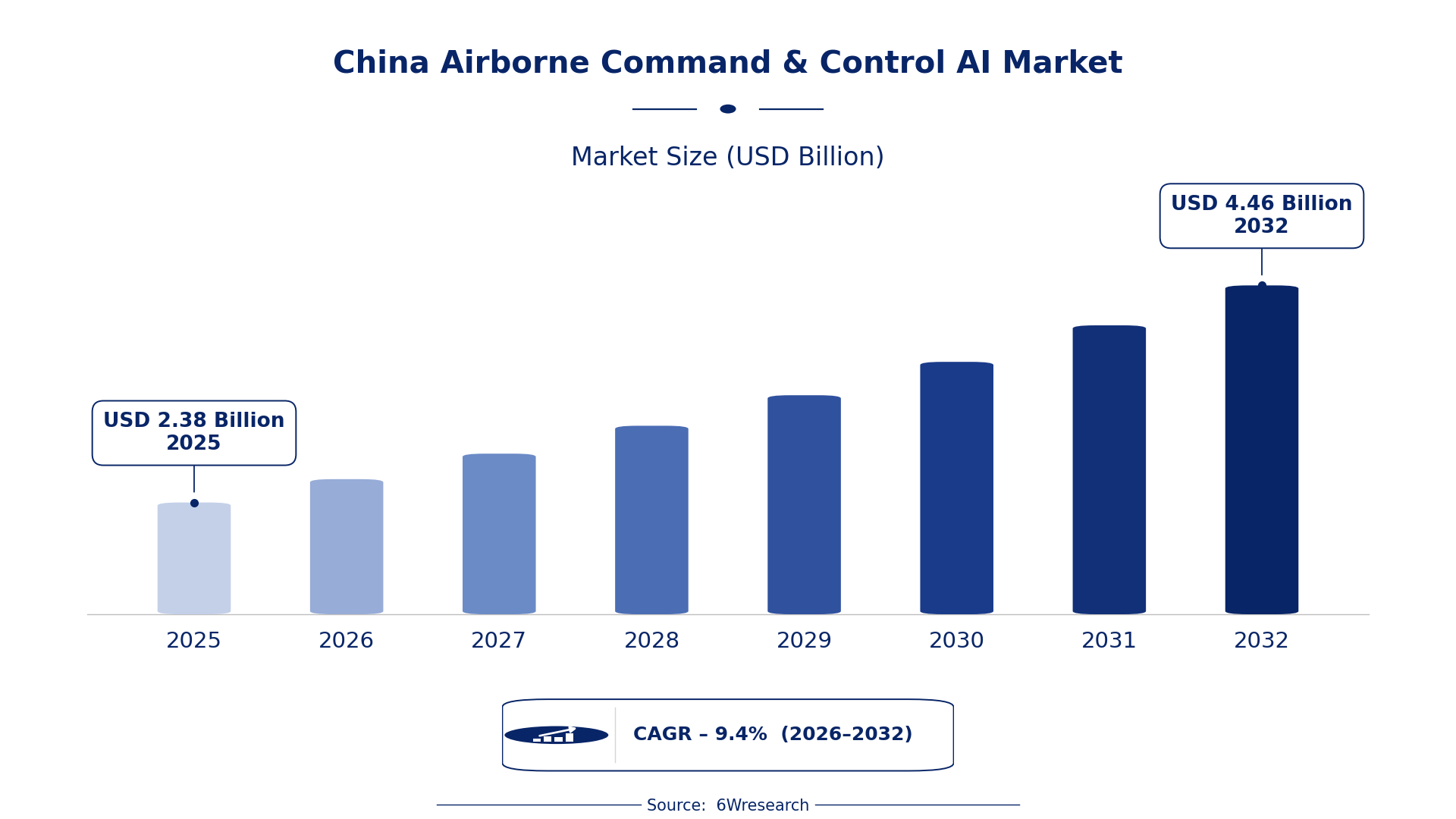
According to 6Wresearch internal database and industry insights, the China Airborne Command & Control AI Market was valued at USD 2.38 billion in 2025 and is projected to reach USD 4.46 billion by 2032, growing at a CAGR of approximately 9.4% during 2026–2032.
China Airborne Command & Control AI Market Highlights
| Report Metric | Details |
| Report Name | China Airborne Command & Control AI Market |
| Market Size 2025 | USD 2.38 billion |
| Market Size 2032 | USD 4.46 billion |
| Absolute Growth 2025–2032 | USD 2.08 billion |
| CAGR 2026–2032 | 9.4% |
| Peak Annual Growth | 12.0% in 2026 |
| Forecast Period | 2026–2032 |
| Historical Data | 2022–2025 |
| Base Year | 2025 |
| Leading Platform Type, 2025 | Fixed-Wing Aircraft (35% share) |
| Leading AI Capability, 2025 | Real-Time Threat Analysis (36% share) |
| Leading Distribution Channel, 2025 | Defense Contractors (40% share) |
| Leading End User, 2025 | National Security Forces (45% share) |
| Fastest-Growing Platform Type | Drones/UAVs (11.8% CAGR) |
| Fastest-Growing AI Capability | Autonomous Coordination (11.7% CAGR) |
| Fastest-Growing Distribution Channel | Military OEM Integrators (11.0% CAGR) |
| Fastest-Growing End User | Tactical Combat Units (10.6% CAGR) |
| Growing Sector | Military Technology |
| Key End Users | National Security Forces, Defense Contractors, Tactical Combat Units |
China Airborne Command & Control AI Market Year-wise Growth Rate and Key Drivers (2022–2032)
This graph illustrates the annual growth rates of the market from 2022 to 2032, highlighting a steady upward trajectory and projected market expansion over the forecast period.
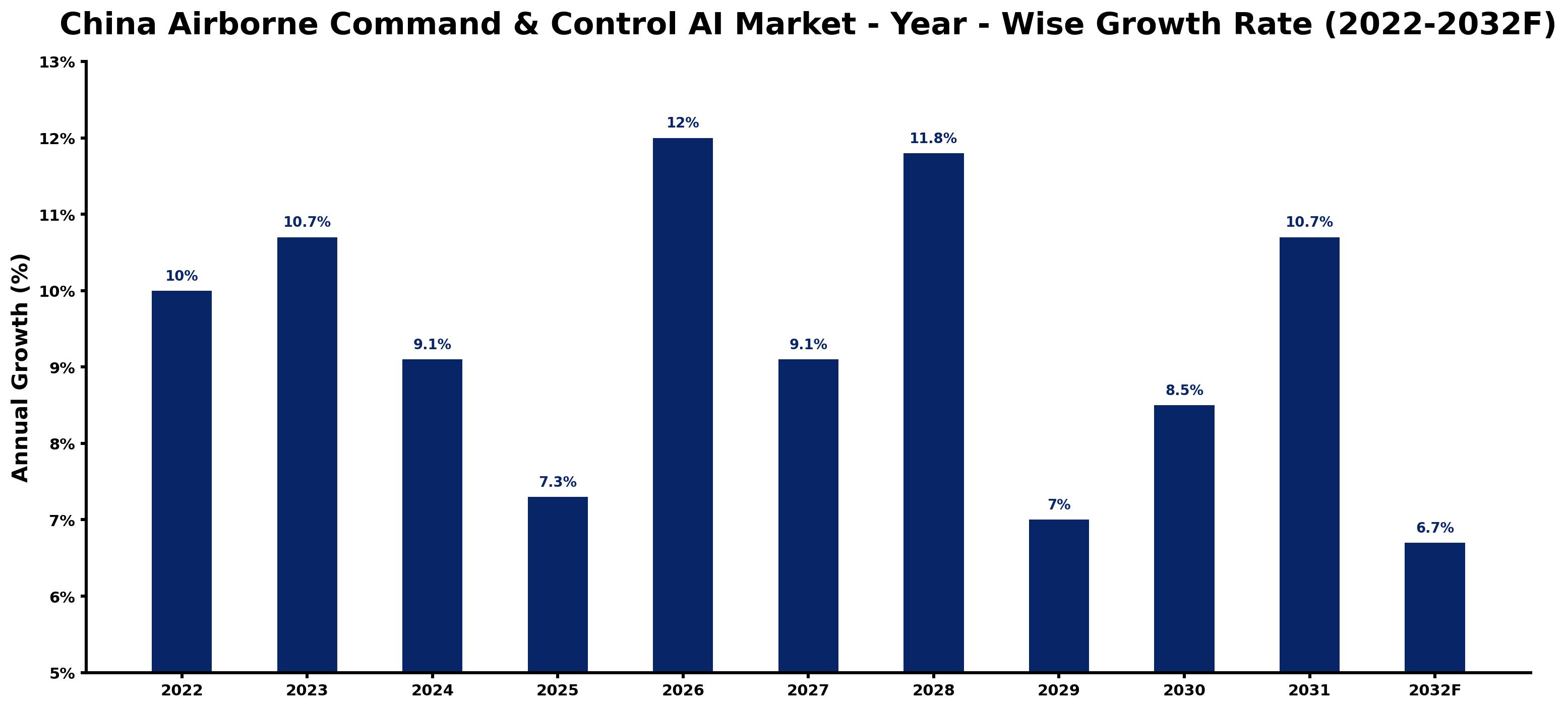
Annual growth estimates for each year appear below with the principal reason behind them, explaining the shifts that set the pace of the market.
| Year | Estimated Annual Growth (%) | Market Rationale |
| 2022 | 10.0 | The market experienced steady growth as military forces prioritised the integration of AI technologies through the National AI Development Plan. |
| 2023 | 10.7 | Demand accelerated due to increased defence budget allocations for modernisation efforts, particularly in the Beijing-Tianjin-Hebei region. |
| 2024 | 9.1 | Growth slowed as military procurement cycles adjusted to new technologies and standards, including the National Standard for Military AI Systems. |
| 2025 | 7.3 | The market continued to grow, albeit at a slower pace, reflecting ongoing investment in the AI Capability Development Plan. |
| 2026 | 12.0 | A surge in demand is expected as new AI capabilities are integrated into operations, driven by the Military AI Integration Initiative. |
| 2027 | 9.1 | Growth is projected to slow as initial integration challenges arise in the adoption of autonomous systems, particularly in Tactical Combat Units. |
| 2028 | 11.8 | An upswing in demand is anticipated as autonomous systems gain traction, particularly in Tactical Combat Units. |
| 2029 | 7.0 | The market is expected to slow again as competition increases among suppliers in the Drones/UAVs segment. |
| 2030 | 8.5 | Growth is expected to rise as military strategies evolve to include advanced AI applications, supported by the National Defense Science and Technology Innovation Program. |
| 2031 | 10.7 | Demand is projected to increase as the focus on technology-driven operations strengthens within National Security Forces. |
| 2032 | 6.7 | A slowdown in growth is anticipated as the market matures and stabilises, reflecting the integration of AI across military operations. |
Note: Market size estimations and growth projections presented in this report are based on 6Wresearch's proprietary forecasting methodology, utilizing the latest available industry data, government publications, and primary research inputs.
China Airborne Command & Control AI Market Synopsis
Airborne Command & Control AI in China encompasses sophisticated systems that leverage artificial intelligence to manage military operations from airborne platforms. Developed through software engineering and data analytics, these systems improve situational awareness and enable real-time decision-making. The China Airborne Command & Control AI Market is expanding, driven by substantial investments in AI technologies, with a defence budget of around 1.55 trillion yuan in 2023. The National Defense Science and Technology Innovation Program is set to advance AI research in defence sectors by 2025, propelling demand for these cutting-edge systems.
Market Dynamics Impact Analysis (2026–2032)
| Factor | Type | Impact | Primary Segment Affected |
| Increased military funding for AI integration | Driver | High | Real-Time Threat Analysis |
| Growing emphasis on autonomous systems in military operations | Driver | High | Drones/UAVs |
| Rising demand for advanced military capabilities | Opportunity | Medium | Fixed-Wing Aircraft |
| Investment in AI-driven defense technologies | Opportunity | Medium | Mobile Ground Terminals |
| Challenges in technology integration and training | Restraint | High | National Security Forces |
| Budget constraints affecting procurement cycles | Restraint | Medium | Defense Contractors |
| Airborne Command & Control AI in China faces integration challenges | Challenge | High | Military OEM Integrators |
| Competition among defense contractors is intensifying | Challenge | Medium | Government Procurement |
Evaluation of Drivers in China Airborne Command & Control AI Market (2026–2032)
The factors lifting demand, and the evidence behind each, are summarised below.
| Drivers | Primary Segment Affected | Why It Matters (Evidence) |
| Increased defense budget allocations | Drones/UAVs | China's defense budget for 2023 is approximately 1.55 trillion yuan, driving demand for UAV technologies. |
| Focus on real-time threat analysis capabilities | Real-Time Threat Analysis | The National Defense Science and Technology Innovation Program promotes AI research, improving operational efficiency in military applications. |
| Growing military personnel emphasising technology | National Security Forces | China's military employs over 2 million personnel, increasing the need for advanced command systems and AI integration. |
| Investment in autonomous systems and UAV technology | Mobile Ground Terminals | China's defense industry is increasingly focused on autonomous systems, reflecting a strategic shift in operational capabilities. |
| Integration of AI in military training programs | Fixed-Wing Aircraft | The Ministry of National Defense has launched initiatives to incorporate AI in military training since 2021. |
Market growth for Airborne Command & Control AI in China is underpinned by increased defense budget allocations, reaching approximately 1.55 trillion yuan in 2023. With over 2 million personnel in the military, there is a growing emphasis on technology-driven operations, further boosting demand for advanced command systems.
Evaluation of Restraints in China Airborne Command & Control AI Market
The key brakes on demand, and where they bite hardest, are shown below.
| Market Restraint | Primary Segment Affected | Why It Matters (Evidence) |
| Integration challenges with existing systems | Military OEM Integrators | Many military platforms require extensive modifications to incorporate new AI technologies, delaying implementation timelines by several months. |
| Budget constraints affecting procurement cycles | Defense Contractors | Tight budgets can result in longer procurement processes, impacting timely acquisitions and project delivery. |
| Limited skilled workforce for AI technologies | National Security Forces | A shortage of qualified personnel hampers effective implementation of AI systems, delaying operational readiness. |
| Regulatory hurdles in military technology adoption | Government Procurement | Strict regulations can slow down the approval process for new technologies, affecting timely deployment for military operations. |
| Competition among defense contractors increasing | Drones/UAVs | As more players enter the market, it can lead to pricing pressures and reduced profit margins for suppliers. |
China Airborne Command & Control AI Market Challenges
In the China Airborne Command & Control AI market, buyers face intense competition as emerging technologies rapidly evolve, making it difficult to secure the latest systems. Suppliers encounter a critical skills gap in AI and defense technologies, which can delay project timelines by up to six months for military procurement. Cost pressures arise as the defense budget, while substantial at approximately 1.55 trillion yuan, is increasingly directed towards modernization, forcing buyers to reassess their purchasing strategies. Compliance with the National Standard for Military AI Systems can also extend development cycles, impacting timely deployment for military operations.
Trends in the China Airborne Command & Control AI Market
The trends below show where the China Airborne Command & Control AI Market is heading.
- Shift from Traditional to AI-Integrated Command Systems: China is transitioning from traditional command systems to AI-integrated platforms, as seen in the National Defense Science and Technology Innovation Program, which aims to integrate AI capabilities by 2025.
- Emergence of Autonomous Systems in Military Operations: The focus on autonomous systems is growing, with significant investments in UAV technology, reflecting a strategic shift in military operations to improve efficiency and effectiveness, particularly in Tactical Combat Units.
- Increased Collaboration between Military and Tech Sectors: The Military AI Integration Initiative, approved in 2022, promotes collaboration between military and technology sectors, driving innovation in airborne command systems and enhancing operational capabilities through shared resources.
- Growing Emphasis on Real-Time Data Utilisation: The integration of real-time data in military operations is becoming critical, as highlighted by the AI Capability Development Plan, which aims to improve military AI applications by 2025.
Investment Opportunities in the China Airborne Command & Control AI Market
The following opportunities in the China Airborne Command & Control AI Market pair current demand with a clear way in.
- Supply of Advanced AI Command Systems: The demand for advanced AI command systems is on the rise, with a projected market size of USD 4.46 billion by 2032. Defence contractors can partner with local firms to broaden their offerings in this expanding market.
- Invest in Autonomous UAV Technologies: With substantial investments in UAV technology, there exists a gap in advanced systems. Collaborating with Military OEM Integrators can facilitate entry into this growing market, particularly in the Beijing-Tianjin-Hebei region.
- Focus on Real-Time Threat Analysis Solutions: The market for real-time threat analysis is expanding, driven by increasing military needs. Suppliers should consider engaging through government procurement channels to effectively meet this demand.
- Enhance Training Programs for AI Integration: As military training programmes increasingly incorporate AI, there is an opportunity to develop tailored training solutions, especially in the Beijing-Tianjin-Hebei region, where defence technology is a priority.
Government Initiatives in the China Airborne Command & Control AI Market
In 2020, the State Council introduced the 'National AI Development Plan', aiming to establish China as a global leader in AI technology, impacting military applications. This plan sets ambitious targets for AI integration in various sectors, including defence. Following this, the 'AI in Defense Strategy' was launched by the Ministry of National Defense in 2021, focusing on enhancing military capabilities through AI integration, with an emphasis on research and development funding.
The 'Defense Technology Innovation Program', announced by the Ministry of Industry and Information Technology in 2023, supports AI projects with a budget of 500 million yuan, facilitating the development of advanced military technologies. Additionally, the National Defense Science and Technology Innovation Program, updated in 2023, aims to promote AI advancements in military applications, encouraging collaboration between military and technology sectors.
Future Insight of the China Airborne Command & Control AI Market
The China Airborne Command & Control AI market is poised for transformation by 2032, driven by advancements in AI technologies and the integration of military training. Ongoing investments in AI are expected to enhance operational efficiency, enabling quicker decision-making for military personnel. By 2025, initiatives like the National Defense Science and Technology Innovation Program aim to introduce new AI applications, significantly altering defence strategies. Collaborations with universities will further accelerate research and development, creating a dynamic environment for advancements in airborne command systems.
Market Segmentation Analysis
The report offers a comprehensive study of the following market segments and their leading categories in the market.
By Platform Type – Fixed-Wing Aircraft Dominated, Drones/UAVs Expected to Grow Fastest
According to Shubham Padhi, Research Analyst at 6Wresearch, in 2025, Fixed-Wing Aircraft led the platform type split with a 35% share. Fixed-Wing Aircraft dominate market share because they are essential for command and control missions, offering a stable platform for military operations. The extensive use of these aircraft in China's military ensures a consistent demand for their advanced capabilities. Over 2026–2032, Drones/UAVs are expected to post the fastest growth, at a CAGR of 11.8%. Drones/UAVs are rapidly gaining traction due to their growing application in surveillance and reconnaissance, with military strategies increasingly favouring these agile platforms. Their adaptability in various operational contexts is driving their swift integration into military frameworks. Suppliers should prioritise the development of UAV technologies to align with the increasing operational demands of military forces.
By AI Capability – Real-Time Threat Analysis Dominated, Autonomous Coordination Expected to Grow Fastest
The largest ai capability category in 2025 was Real-Time Threat Analysis, with a 36% share of total revenue. Real-Time Threat Analysis holds the largest market share because it is essential for immediate threat assessment, enabling military personnel to respond swiftly to changing conditions. This capability is particularly important in the Beijing-Tianjin-Hebei region, where advanced defense technologies are being developed. Autonomous Coordination is set to record the highest CAGR in this split, 11.7% over 2026–2032. Autonomous Coordination is the fastest-growing segment, as it significantly improves mission execution efficiency, allowing military units to operate more cohesively. The increasing emphasis on technology-driven operations within China's military is driving its rapid adoption. This trend indicates that suppliers must prioritise the development of advanced capabilities to meet the evolving demands of military operations.
By Distribution Channel – Defense Contractors Dominated, Military OEM Integrators Expected to Grow Fastest
With a 40% revenue share in 2025, Defense Contractors was the largest distribution channel category. Defense Contractors dominate the market share due to their pivotal role in the development and integration of airborne command systems, providing the necessary expertise to meet military requirements. Their established relationships with military forces further solidify their leading position in the market. The quickest growth will come from Military OEM Integrators, forecast to expand at a CAGR of 11.0% between 2026 and 2032. Military OEM Integrators are witnessing the fastest growth as they focus on embedding advanced technologies into military platforms, responding to the rising demand for sophisticated airborne command solutions. Their strategic partnerships with defense contractors are enhancing their market presence. Suppliers should consider forming alliances with OEM integrators to broaden their reach and enhance service offerings in the market.
By End User – National Security Forces Dominated, Tactical Combat Units Expected to Grow Fastest
National Security Forces held a 45% share of the China Airborne Command & Control AI Market by end user in 2025. National Security Forces account for the largest market share as they are the primary users of airborne command and control AI technologies, utilising these systems for national defence operations. Their substantial personnel base and operational requirements drive consistent demand. Tactical Combat Units are projected to grow fastest, at a CAGR of 10.6% during 2026–2032. Tactical Combat Units are the fastest-growing segment, relying heavily on AI for operational success in fast-paced combat scenarios. The increasing focus on agile and responsive military strategies is propelling their adoption of advanced technologies. Buyers must prioritise the integration of AI systems to ensure tactical units remain effective and responsive in evolving combat situations.
Key Attractiveness of the Report
- 10 Years of Market Numbers
- Historical Data Starting from 2022 to 2025
- Base Year 2025
- Forecast Data until 2032
- Key Performance Indicators Impacting the Market
- Major Upcoming Developments and Projects
Key Highlights of the Report:
- China Airborne Command & Control AI Market Outlook
- Market Size of China Airborne Command & Control AI Market, 2025
- Forecast of China Airborne Command & Control AI Market, 2032
- Historical Data and Forecast of China Airborne Command & Control AI Revenues & Volume for the Period 2022 - 2032F
- China Airborne Command & Control AI Market Trend Evolution
- China Airborne Command & Control AI Market Drivers and Challenges
- China Airborne Command & Control AI Price Trends
- China Airborne Command & Control AI Porter's Five Forces
- China Airborne Command & Control AI Industry Life Cycle
- Historical Data and Forecast of China Airborne Command & Control AI Market Revenues & Volume By Platform Type for the Period 2022 - 2032F
- Historical Data and Forecast of China Airborne Command & Control AI Market Revenues & Volume By Fixed-Wing Aircraft for the Period 2022 - 2032F
- Historical Data and Forecast of China Airborne Command & Control AI Market Revenues & Volume By Drones/UAVs for the Period 2022 - 2032F
- Historical Data and Forecast of China Airborne Command & Control AI Market Revenues & Volume By Satellites for the Period 2022 - 2032F
- Historical Data and Forecast of China Airborne Command & Control AI Market Revenues & Volume By Mobile Ground Terminals for the Period 2022 - 2032F
- Historical Data and Forecast of China Airborne Command & Control AI Market Revenues & Volume By AI Capability for the Period 2022 - 2032F
- Historical Data and Forecast of China Airborne Command & Control AI Market Revenues & Volume By Real-Time Threat Analysis for the Period 2022 - 2032F
- Historical Data and Forecast of China Airborne Command & Control AI Market Revenues & Volume By Autonomous Coordination for the Period 2022 - 2032F
- Historical Data and Forecast of China Airborne Command & Control AI Market Revenues & Volume By Satellite Communication for the Period 2022 - 2032F
- Historical Data and Forecast of China Airborne Command & Control AI Market Revenues & Volume By Command Link Optimization for the Period 2022 - 2032F
- Historical Data and Forecast of China Airborne Command & Control AI Market Revenues & Volume By Distribution Channel for the Period 2022 - 2032F
- Historical Data and Forecast of China Airborne Command & Control AI Market Revenues & Volume By Defense Contractors for the Period 2022 - 2032F
- Historical Data and Forecast of China Airborne Command & Control AI Market Revenues & Volume By Military OEM Integrators for the Period 2022 - 2032F
- Historical Data and Forecast of China Airborne Command & Control AI Market Revenues & Volume By Space Defense Partners for the Period 2022 - 2032F
- Historical Data and Forecast of China Airborne Command & Control AI Market Revenues & Volume By Government Procurement for the Period 2022 - 2032F
- Historical Data and Forecast of China Airborne Command & Control AI Market Revenues & Volume By End User for the Period 2022 - 2032F
- Historical Data and Forecast of China Airborne Command & Control AI Market Revenues & Volume By National Security Forces for the Period 2022 - 2032F
- Historical Data and Forecast of China Airborne Command & Control AI Market Revenues & Volume By Tactical Combat Units for the Period 2022 - 2032F
- Historical Data and Forecast of China Airborne Command & Control AI Market Revenues & Volume By Defense Intelligence Agencies for the Period 2022 - 2032F
- Historical Data and Forecast of China Airborne Command & Control AI Market Revenues & Volume By Strategic Operations Centers for the Period 2022 - 2032F
- China Airborne Command & Control AI Import Export Trade Statistics
- Market Opportunity Assessment By Platform Type
- Market Opportunity Assessment By AI Capability
- Market Opportunity Assessment By Distribution Channel
- Market Opportunity Assessment By End User
- China Airborne Command & Control AI Top Companies Market Share
- China Airborne Command & Control AI Competitive Benchmarking By Technical and Operational Parameters
- China Airborne Command & Control AI Company Profiles
- China Airborne Command & Control AI Key Strategic Recommendations
Market Covered
Segments analysed in this report are listed below.
By Platform Type
- Fixed-Wing Aircraft
- Drones/UAVs
- Satellites
- Mobile Ground Terminals
By AI Capability
- Real-Time Threat Analysis
- Autonomous Coordination
- Satellite Communication
- Command Link Optimization
By Distribution Channel
- Defense Contractors
- Military OEM Integrators
- Space Defense Partners
- Government Procurement
By End User
- National Security Forces
- Tactical Combat Units
- Defense Intelligence Agencies
- Strategic Operations Centers































