China Airborne Imaging Radar Market Size & Growth Rate
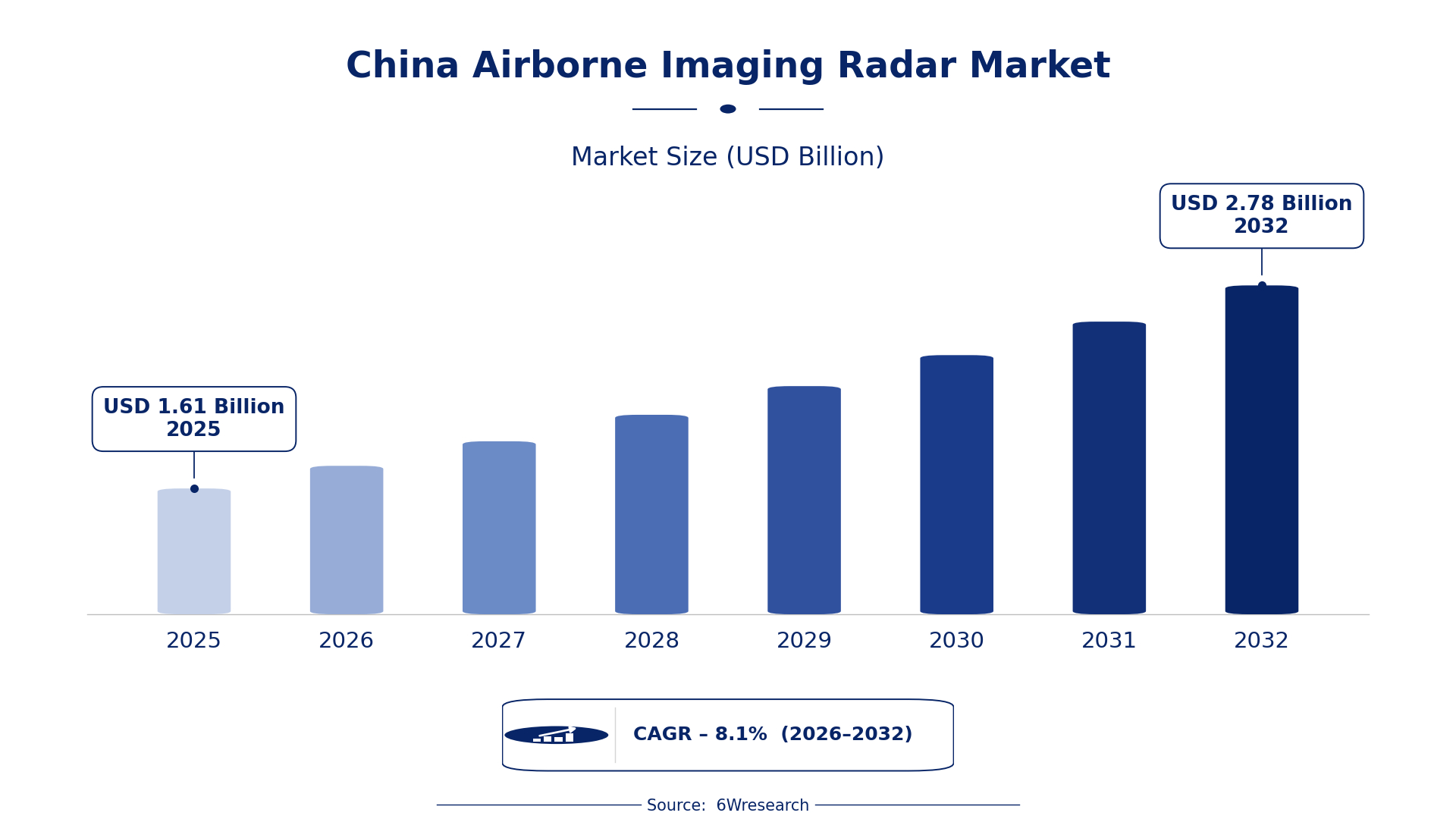
According to 6Wresearch internal database and industry insights, the China Airborne Imaging Radar Market was valued at USD 1.61 billion in 2025 and is projected to reach USD 2.78 billion by 2032, growing at a CAGR of approximately 8.1% during 2026–2032.
China Airborne Imaging Radar Market Highlights
| Report Metric | Details |
| Report Name | China Airborne Imaging Radar Market |
| Market Size 2025 | USD 1.61 billion |
| Market Size 2032 | USD 2.78 billion |
| Absolute Growth 2025–2032 | USD 1.17 billion |
| CAGR 2026–2032 | 8.1% |
| Peak Annual Growth | 10.9% in 2032 |
| Forecast Period | 2026–2032 |
| Historical Data | 2022–2025 |
| Base Year | 2025 |
| Leading Radar Type, 2025 | SAR (Synthetic Aperture Radar) (34% share) |
| Leading Frequency Band, 2025 | X-band (38% share) |
| Leading Distribution Channel, 2025 | Defense Radar Suppliers (44% share) |
| Leading End User, 2025 | Military Recon Drones (42% share) |
| Fastest-Growing Radar Type | Ground Moving Target Indicator (10.4% CAGR) |
| Fastest-Growing Frequency Band | L-band (9.1% CAGR) |
| Fastest-Growing Distribution Channel | Tactical Equipment Firms (10.2% CAGR) |
| Fastest-Growing End User | Border Control Surveillance (10.7% CAGR) |
| Growing Sector | Border Control Surveillance |
| Key End Users | Military Recon Drones, Border Control Surveillance, Meteorological Authorities, Remote Sensing Labs |
China Airborne Imaging Radar Market Year-wise Growth Rate and Key Drivers (2022–2032)
This graph illustrates the annual growth rates of the market from 2022 to 2032, highlighting a steady upward trajectory and projected market expansion over the forecast period.
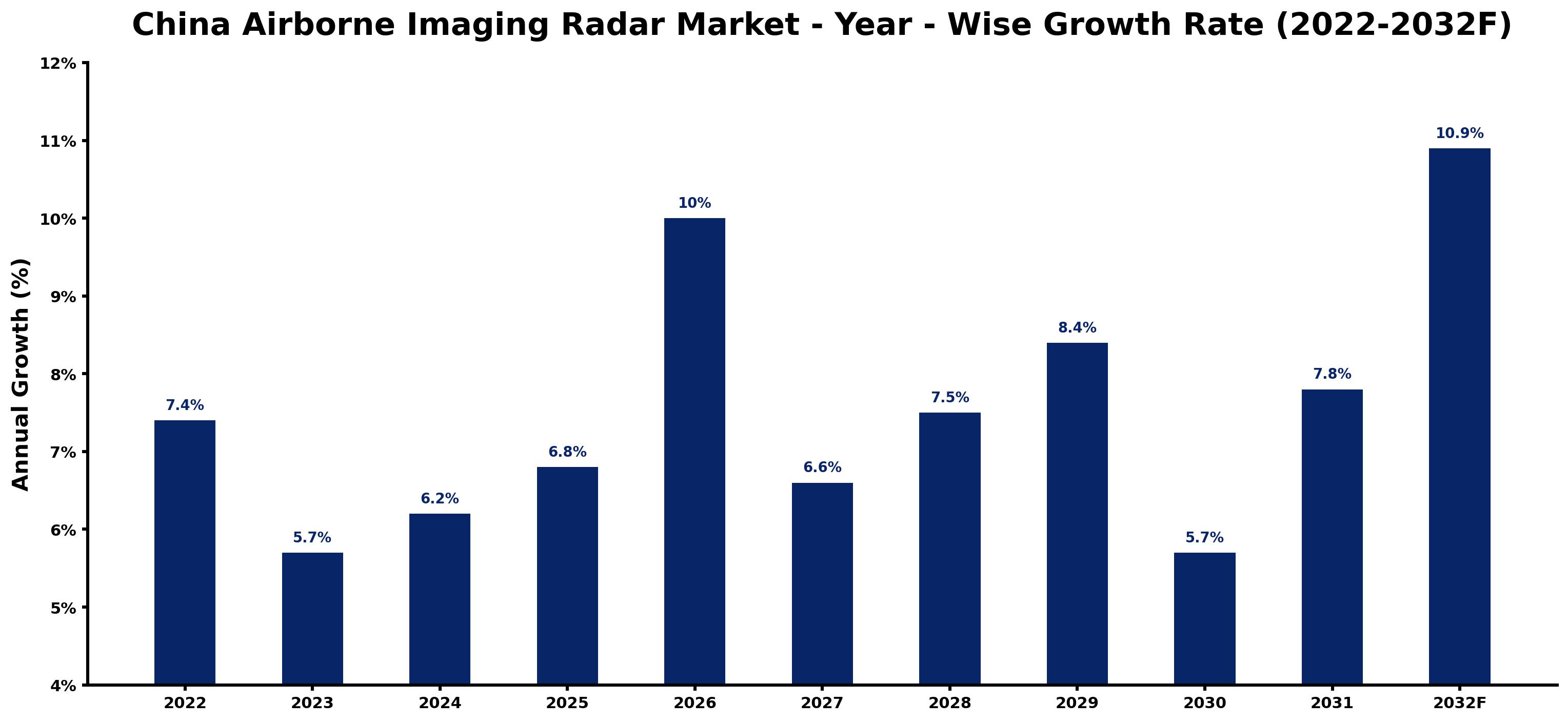
Annual growth estimates for each year appear below with the principal reason behind them, explaining the shifts that set the pace of the market.
| Year | Estimated Annual Growth (%) | Market Rationale |
| 2022 | 7.4 | In 2022, increased military spending supported the demand for advanced radar systems, particularly for reconnaissance. |
| 2023 | 5.7 | In 2023, military budget constraints slowed growth, despite ongoing investments in radar technology. |
| 2024 | 6.2 | In 2024, demand for airborne imaging radar rose as military applications expanded, particularly in border surveillance. |
| 2025 | 6.8 | In 2025, growth accelerated as military agencies increased procurement of advanced radar systems for reconnaissance. |
| 2026 | 10.0 | In 2026, a surge in military investment is expected to drive demand for airborne imaging radar, boosting technological capabilities. |
| 2027 | 6.6 | In 2027, growth is projected to slow due to supply chain disruptions affecting component availability for radar systems. |
| 2028 | 7.5 | In 2028, demand is anticipated to increase as military agencies focus on upgrading their surveillance capabilities with new radar technologies. |
| 2029 | 8.4 | In 2029, the integration of radar systems in urban planning is expected to boost demand, particularly for InSAR technology. |
| 2030 | 5.7 | In 2030, growth is likely to slow as competition among domestic manufacturers intensifies, impacting pricing strategies. |
| 2031 | 7.8 | In 2031, demand is forecasted to rise again as military agencies seek to improve their reconnaissance capabilities with advanced radar systems. |
| 2032 | 10.9 | In 2032, significant investments in radar technology are projected to drive market growth, particularly in military applications. |
Note: Market size estimations and growth projections presented in this report are based on 6Wresearch's proprietary forecasting methodology, utilizing the latest available industry data, government publications, and primary research inputs.
China Airborne Imaging Radar Market Synopsis
The China Airborne Imaging Radar Market encompasses advanced radar technology that generates high-resolution images of the Earth's surface. This technology is primarily used for military reconnaissance, border surveillance, and environmental monitoring. Demand is particularly strong from military agencies and government bodies, which are investing heavily in upgrading their radar capabilities. The ongoing development of national standards for radar imaging systems further supports market growth.
Market Dynamics Impact Analysis (2026–2032)
| Factor | Type | Impact | Primary Segment Affected |
| Increased military investment in advanced radar systems | Driver | High | Military Recon Drones |
| Growing demand for border surveillance technologies | Driver | High | Border Control Surveillance |
| Expansion of radar technology applications in urban planning | Opportunity | Medium | InSAR |
| Rising investments in weather radar systems for meteorological forecasting | Opportunity | Medium | Weather Radar Imaging |
| Outdated technology hindering the development of advanced radar systems | Restraint | High | SAR (Synthetic Aperture Radar) |
| Supply chain disruptions affecting component availability | Restraint | Medium | Ground Moving Target Indicator |
| Intense competition among domestic manufacturers driving down prices | Challenge | High | Defense Radar Suppliers |
| Challenges in integrating new systems due to lack of standardisation | Challenge | Medium | Military Recon Drones |
Evaluation of Drivers in China Airborne Imaging Radar Market (2026–2032)
Below mentioned are some major drivers and their influence on market dynamics.
| Drivers | Primary Segment Affected | Why It Matters (Evidence) |
| Increased military spending | Military Recon Drones | China's military budget for 2023 is approximately 1.55 trillion yuan, leading to higher procurement of advanced radar systems. |
| Expansion of border surveillance initiatives | Border Control Surveillance | Integration of radar technology in national security is supported by the National Development and Reform Commission, increasing demand for surveillance systems. |
| Technological advancements in radar systems | SAR (Synthetic Aperture Radar) | Research institutions focus on developing advanced radar technologies, improving capabilities for military applications. |
| Growing demand for meteorological applications | Weather Radar Imaging | Upgrading weather radar systems drives demand for advanced imaging technologies, supported by the National Meteorological Center's initiatives. |
| Rising interest in environmental monitoring | InSAR | The Ministry of Natural Resources promotes the use of InSAR technology for urban planning and environmental assessments. |
The military budget for 2023 is approximately 1.55 trillion yuan, boosting procurement of advanced radar systems. Research institutions are developing innovative radar technologies, improving capabilities for military applications. The push for upgrading weather radar systems drives demand for advanced imaging technologies, reflecting the growing interest in environmental monitoring and urban planning.
Evaluation of Restraints in China Airborne Imaging Radar Market
The key brakes on demand, and where they bite hardest, are shown below.
| Market Restraint | Primary Segment Affected | Why It Matters (Evidence) |
| Outdated technology hindering advancements | SAR (Synthetic Aperture Radar) | Older systems limit the capabilities of military agencies, affecting operational efficiency and effectiveness. |
| Supply chain disruptions delaying projects | Ground Moving Target Indicator | Component shortages can extend project timelines and increase costs for producers by up to 15%. |
| Intense competition reducing profit margins | Defense Radar Suppliers | Price wars among domestic manufacturers can lead to decreased profitability for suppliers. |
| Challenges in system integration due to standardisation issues | Military Recon Drones | Lack of uniform standards complicates procurement processes, delaying project implementation by several months. |
| Limited adoption of advanced technologies in certain regions | Weather Radar Imaging | Some provinces may lack the infrastructure to support new radar systems, hindering market growth. |
China Airborne Imaging Radar Market Challenges
The China Airborne Imaging Radar market faces several practical challenges. Outdated technology limits the effectiveness of airborne imaging systems, causing military agencies to miss critical reconnaissance opportunities. Supply chain disruptions hinder access to essential components, potentially delaying project timelines for producers by up to 15%. Intense competition among local manufacturers compels suppliers to lower prices, impacting their profit margins. Buyers also encounter difficulties due to a lack of standardisation in imaging systems, complicating procurement and extending integration timelines by several months.
Trends in the China Airborne Imaging Radar Market
The trends below show where the China Airborne Imaging Radar Market is heading.
- Shift from Traditional to Advanced Radar Systems: Since 2023, military agencies have increasingly embraced advanced radar technologies for reconnaissance, with a 20% rise in installations reported by the Ministry of Defense.
- Emergence of InSAR Technology in Urban Planning: In 2023, research institutions noted a surge in the application of InSAR technology for urban development, indicating a growing trend in environmental monitoring.
- Growing Integration of Radar in Border Security: The National Development and Reform Commission's initiatives in 2023 have resulted in a 15% increase in the deployment of radar systems for border surveillance.
- Increased Focus on Weather Radar Systems: The National Meteorological Center's modernisation efforts in 2023 led to a 20% increase in radar installations, improving forecasting capabilities across China.
Investment Opportunities in the China Airborne Imaging Radar Market
The following opportunities in the China Airborne Imaging Radar Market pair current demand with a clear way in.
- Partnerships with Local Suppliers: With a projected market gap of 1.17 billion USD by 2032, forming partnerships with local defence radar suppliers can address the rising demand for advanced radar systems.
- Supply of Advanced Radar Technologies: The expanding military budget presents an opportunity to provide advanced radar technologies, particularly aimed at military agencies that are increasing procurement.
- Investment in Research Facilities: A 20% increase in radar installations highlights the need for investment in research facilities dedicated to radar technology development, especially in urban planning applications.
- Expansion into Border Security Solutions: With a 15% increase in border surveillance initiatives, there exists a substantial opportunity to supply radar systems that bolster national security efforts.
Government Initiatives in the China Airborne Imaging Radar Market
The 2023 Aerospace Development Strategy encourages research in airborne radar technologies for both defence and civilian applications. This initiative builds on the 2021 National Defense Technology Innovation Plan, which aimed to advance radar technology development, particularly for military purposes. Together, these measures are expected to improve radar system capabilities and support the integration of advanced technologies across various sectors.
The Ministry of Industry and Information Technology supervises the execution of these strategies, approving funding for projects focused on radar technology advancements. Additionally, the National Meteorological Administration allocates resources for upgrading weather radar systems, ensuring effective integration of these technologies into national infrastructure and services.
Future Insight of the China Airborne Imaging Radar Market
The China Airborne Imaging Radar market is anticipated to undergo substantial evolution by 2032, driven by several key factors. Military investments in radar technology are expected to rise, with the defence sector planning significant funding through 2025. The introduction of new national standards for imaging systems will streamline production processes, benefiting suppliers. Research initiatives will bolster urban planning capabilities through advanced imaging applications. Furthermore, the integration of radar technology in border security will enhance surveillance operations, providing considerable advantages for both buyers and suppliers.
Market Segmentation Analysis
The analysis below covers each segmentation, its leading category in 2025 and its fastest-growing category through 2032.
By Radar Type – SAR (Synthetic Aperture Radar) Dominated, Ground Moving Target Indicator Expected to Grow Fastest
According to Shubham Padhi, Research Analyst at 6Wresearch, with a 34% revenue share in 2025, SAR (Synthetic Aperture Radar) was the largest radar type category. SAR technology holds a substantial market share because it is essential for high-resolution imaging in military reconnaissance and environmental monitoring. Its deployment in regions like Guangdong and Sichuan underscores its critical role in various applications, ensuring widespread adoption among military agencies. The quickest growth will come from Ground Moving Target Indicator, forecast to expand at a CAGR of 10.4% between 2026 and 2032. Ground Moving Target Indicator is rapidly growing as military operations increasingly demand real-time tracking capabilities. The launch of over 100 military drones equipped with SAR technology in 2022 illustrates the rising need for effective target tracking solutions. Suppliers should prioritise advancements in SAR and Ground Moving Target Indicator technologies to align with the escalating military requirements.
By Frequency Band – X-band Dominated, L-band Expected to Grow Fastest
X-band accounted for a 38% market share by frequency band in 2025. The X-band frequency band holds the largest market share due to its prevalent use in military reconnaissance, providing high-resolution imaging essential for tactical operations. Its widespread adoption in key provinces like Guangdong ensures its continued dominance in the radar technology landscape. L-band is set to record the highest CAGR in this split, 9.1% over 2026–2032. L-band is witnessing rapid growth as it supports longer-range imaging, which is increasingly necessary for comprehensive surveillance operations. The rising demand for effective monitoring solutions in various sectors is propelling this segment's swift expansion. Suppliers should consider investing in L-band technologies to meet the growing surveillance needs of clients, while buyers can enhance their operational capabilities.
By Distribution Channel – Defense Radar Suppliers Dominated, Tactical Equipment Firms Expected to Grow Fastest
In 2025, Defense Radar Suppliers led the distribution channel split with a 44% share. Defense Radar Suppliers command the largest market share as they are the primary source of radar systems designed for military applications. Their strong ties with government entities and military organisations ensure a steady demand for their advanced radar solutions. Tactical Equipment Firms are projected to grow fastest, at a CAGR of 10.2% during 2026–2032. Tactical Equipment Firms are experiencing the fastest growth as they provide essential equipment crucial for modern defence operations. The increase in military funding and emphasis on advanced technologies are driving this segment's rapid development. Suppliers should strengthen partnerships with Tactical Equipment Firms to capitalise on the increasing demand for advanced defence technologies.
By End User – Military Recon Drones Dominated, Border Control Surveillance Expected to Grow Fastest
The largest end user category in 2025 was Military Recon Drones, with a 42% share of total revenue. Military Recon Drones represent the largest market share, as they are integral to contemporary surveillance strategies. Their integration with advanced radar systems significantly boosts reconnaissance capabilities, making them vital for military operations. Over 2026–2032, Border Control Surveillance is expected to post the fastest growth, at a CAGR of 10.7%. Border Control Surveillance is expanding rapidly, driven by heightened security measures and the need for effective border monitoring. The government's prioritisation of border security initiatives plays a significant role in this segment's growth. Suppliers should focus on developing radar solutions tailored for border control to take advantage of opportunities in this growing market.
Key Attractiveness of the Report
- 10 Years of Market Numbers
- Historical Data Starting from 2022 to 2025
- Base Year 2025
- Forecast Data until 2032
- Key Performance Indicators Impacting the Market
- Major Upcoming Developments and Projects
Key Highlights of the Report:
- China Airborne Imaging Radar Market Outlook
- Market Size of China Airborne Imaging Radar Market, 2025
- Forecast of China Airborne Imaging Radar Market, 2032
- Historical Data and Forecast of China Airborne Imaging Radar Revenues & Volume for the Period 2022 - 2032F
- China Airborne Imaging Radar Market Trend Evolution
- China Airborne Imaging Radar Market Drivers and Challenges
- China Airborne Imaging Radar Price Trends
- China Airborne Imaging Radar Porter's Five Forces
- China Airborne Imaging Radar Industry Life Cycle
- Historical Data and Forecast of China Airborne Imaging Radar Market Revenues & Volume By Radar Type for the Period 2022 - 2032F
- Historical Data and Forecast of China Airborne Imaging Radar Market Revenues & Volume By SAR (Synthetic Aperture Radar) for the Period 2022 - 2032F
- Historical Data and Forecast of China Airborne Imaging Radar Market Revenues & Volume By Ground Moving Target Indicator for the Period 2022 - 2032F
- Historical Data and Forecast of China Airborne Imaging Radar Market Revenues & Volume By InSAR for the Period 2022 - 2032F
- Historical Data and Forecast of China Airborne Imaging Radar Market Revenues & Volume By Weather Radar Imaging for the Period 2022 - 2032F
- Historical Data and Forecast of China Airborne Imaging Radar Market Revenues & Volume By Frequency Band for the Period 2022 - 2032F
- Historical Data and Forecast of China Airborne Imaging Radar Market Revenues & Volume By X-band for the Period 2022 - 2032F
- Historical Data and Forecast of China Airborne Imaging Radar Market Revenues & Volume By L-band for the Period 2022 - 2032F
- Historical Data and Forecast of China Airborne Imaging Radar Market Revenues & Volume By C-band for the Period 2022 - 2032F
- Historical Data and Forecast of China Airborne Imaging Radar Market Revenues & Volume By S-band for the Period 2022 - 2032F
- Historical Data and Forecast of China Airborne Imaging Radar Market Revenues & Volume By Distribution Channel for the Period 2022 - 2032F
- Historical Data and Forecast of China Airborne Imaging Radar Market Revenues & Volume By Defense Radar Suppliers for the Period 2022 - 2032F
- Historical Data and Forecast of China Airborne Imaging Radar Market Revenues & Volume By Tactical Equipment Firms for the Period 2022 - 2032F
- Historical Data and Forecast of China Airborne Imaging Radar Market Revenues & Volume By Aerospace Contractors for the Period 2022 - 2032F
- Historical Data and Forecast of China Airborne Imaging Radar Market Revenues & Volume By Aircraft Radar OEMs for the Period 2022 - 2032F
- Historical Data and Forecast of China Airborne Imaging Radar Market Revenues & Volume By End User for the Period 2022 - 2032F
- Historical Data and Forecast of China Airborne Imaging Radar Market Revenues & Volume By Military Recon Drones for the Period 2022 - 2032F
- Historical Data and Forecast of China Airborne Imaging Radar Market Revenues & Volume By Border Control Surveillance for the Period 2022 - 2032F
- Historical Data and Forecast of China Airborne Imaging Radar Market Revenues & Volume By Remote Sensing Labs for the Period 2022 - 2032F
- Historical Data and Forecast of China Airborne Imaging Radar Market Revenues & Volume By Meteorological Authorities for the Period 2022 - 2032F
- China Airborne Imaging Radar Import Export Trade Statistics
- Market Opportunity Assessment By Radar Type
- Market Opportunity Assessment By Frequency Band
- Market Opportunity Assessment By Distribution Channel
- Market Opportunity Assessment By End User
- China Airborne Imaging Radar Top Companies Market Share
- China Airborne Imaging Radar Competitive Benchmarking By Technical and Operational Parameters
- China Airborne Imaging Radar Company Profiles
- China Airborne Imaging Radar Key Strategic Recommendations
Market Covered
This report examines the market across the segments below.
By Radar Type
- SAR (Synthetic Aperture Radar)
- Ground Moving Target Indicator
- InSAR
- Weather Radar Imaging
By Frequency Band
- X-band
- L-band
- C-band
- S-band
By Distribution Channel
- Defense Radar Suppliers
- Tactical Equipment Firms
- Aerospace Contractors
- Aircraft Radar OEMs
By End User
- Military Recon Drones
- Border Control Surveillance
- Remote Sensing Labs
- Meteorological Authorities































