China Airborne Search Radar Market Size & Growth Rate
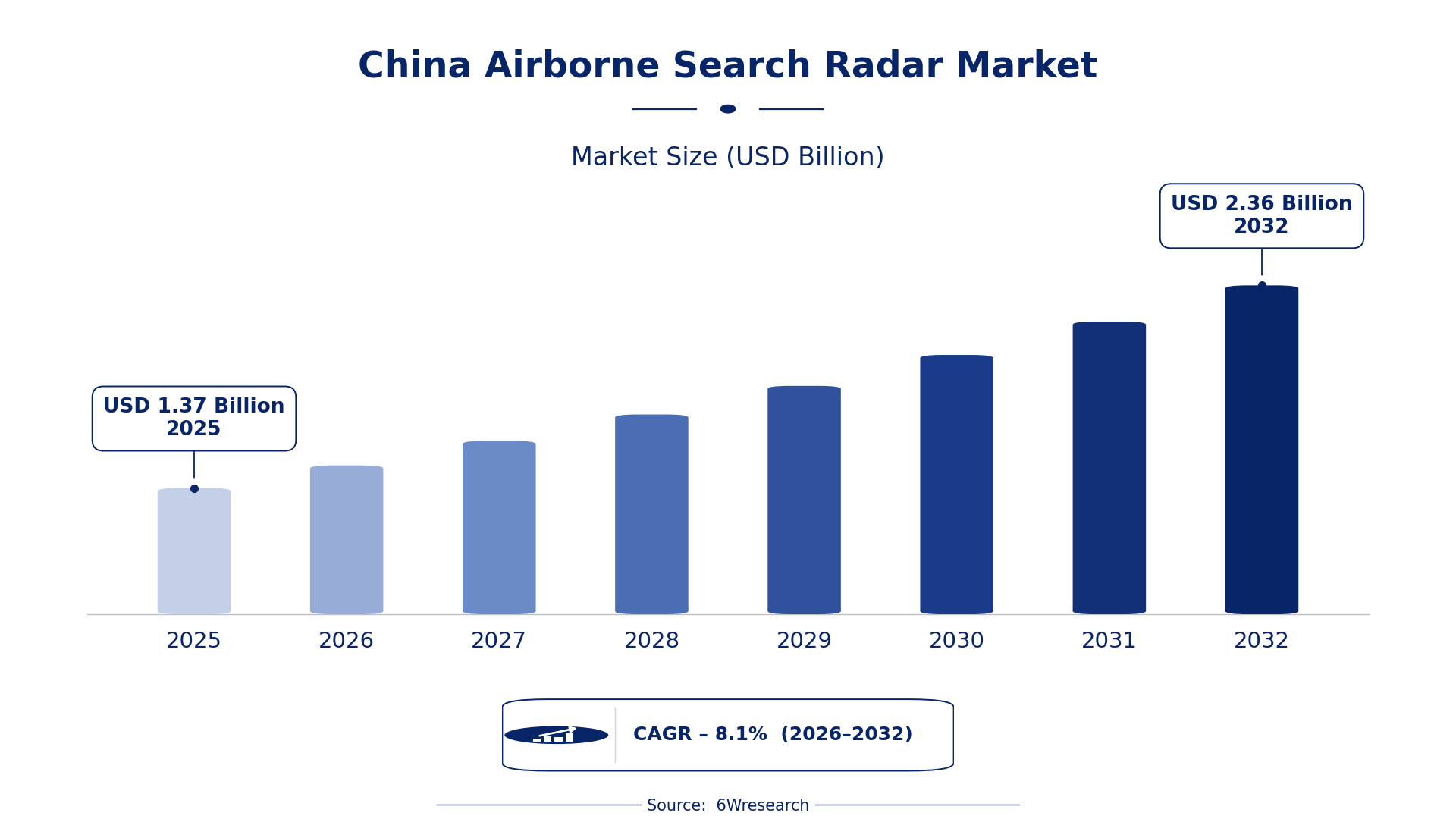
According to 6Wresearch internal database and industry insights, the China Airborne Search Radar Market was valued at USD 1.37 billion in 2025 and is projected to reach USD 2.36 billion by 2032, growing at a CAGR of approximately 8.1% during 2026–2032.
China Airborne Search Radar Market Highlights
| Report Metric | Details |
| Report Name | China Airborne Search Radar Market |
| Market Size 2025 | USD 1.37 billion |
| Market Size 2032 | USD 2.36 billion |
| Absolute Growth 2025–2032 | USD 0.99 billion |
| CAGR 2026–2032 | 8.1% |
| Peak Annual Growth | 10.3% in 2026 |
| Forecast Period | 2026–2032 |
| Historical Data | 2022–2025 |
| Base Year | 2025 |
| Leading Radar Type, 2025 | AESA Radar (43% share) |
| Leading Range Capability, 2025 | Long-Range Targeting (43% share) |
| Leading Distribution Channel, 2025 | Direct Government Orders (42% share) |
| Leading End User, 2025 | Air Defense Units (48% share) |
| Fastest-Growing Range Capability | Active Electronically Scanned (9.8% CAGR) |
| Fastest-Growing Distribution Channel | Radar Equipment Integrators (10.0% CAGR) |
| Fastest-Growing End User | Naval Surveillance Commands (10.1% CAGR) |
| Growing Sector | Military Surveillance |
| Key End Users | Air Defense Units, Naval Surveillance Commands, Defense Reconnaissance Aircraft |
China Airborne Search Radar Market Year-wise Growth Rate and Key Drivers (2022–2032)
This graph illustrates the annual growth rates of the market from 2022 to 2032, highlighting a steady upward trajectory and projected market expansion over the forecast period.
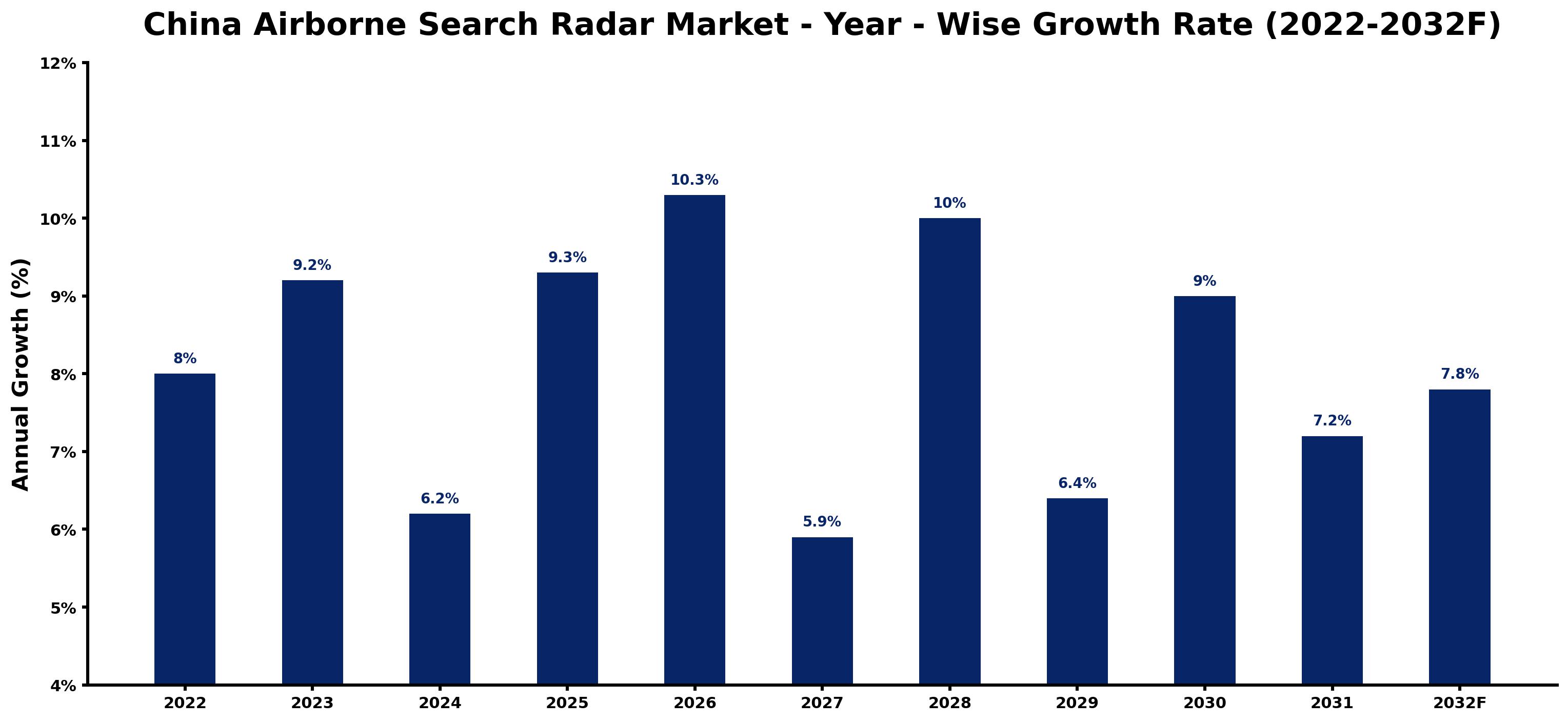
Year by year, the estimates below pair each growth rate with the development that shaped it.
| Year | Estimated Annual Growth (%) | Market Rationale |
| 2022 | 8.0 | The market experienced steady growth, driven by increased military spending and modernization efforts. |
| 2023 | 9.2 | Demand accelerated as the government allocated more resources for defense technology advancements. |
| 2024 | 6.2 | Growth slowed slightly due to temporary supply chain challenges affecting radar production. |
| 2025 | 9.3 | The market rebounded with faster growth as new military aircraft were introduced with advanced radar systems. |
| 2026 | 10.3 | A peak in growth was observed as investments in AESA radar technology surged for next-generation fighters. |
| 2027 | 5.9 | Growth slowed again as the market adjusted to previous high levels of demand. |
| 2028 | 10.0 | Demand increased sharply as military modernization initiatives gained momentum and funding. |
| 2029 | 6.4 | Growth decelerated as the market began to stabilise after a period of rapid expansion. |
| 2030 | 9.0 | A resurgence in growth occurred as new contracts for radar systems were awarded to meet operational needs. |
| 2031 | 7.2 | The market saw a slowdown as the focus shifted towards integrating new technologies into existing systems. |
| 2032 | 7.8 | Growth accelerated again as military priorities shifted towards advanced surveillance capabilities. |
Note: Market size estimations and growth projections presented in this report are based on 6Wresearch's proprietary forecasting methodology, utilizing the latest available industry data, government publications, and primary research inputs.
China Airborne Search Radar Market Synopsis
Airborne Search Radar in China encompasses sophisticated technology for detecting and tracking aerial targets. This technology is primarily used in military surveillance, air traffic control, and reconnaissance missions. The China Airborne Search Radar Market is expanding due to increased military spending, driven by domestic needs and government contracts. In 2023, the defense budget reached approximately 1.55 trillion yuan, supporting advancements in radar technology. The National Defense Science and Technology Innovation Program aims to improve radar capabilities by 2025, further fuelling demand.
Market Dynamics Impact Analysis (2026–2032)
| Factor | Type | Impact | Primary Segment Affected |
| Increased military spending on advanced radar systems | Driver | High | AESA Radar |
| Growing demand for military modernization and new aircraft | Driver | High | Long-Range Targeting |
| Expansion of radar technology integration in defense systems | Opportunity | High | Radar Equipment Integrators |
| Emerging demand from naval surveillance operations | Opportunity | Medium | Naval Surveillance Commands |
| Supply chain challenges affecting production timelines | Restraint | High | 3D Search Radar |
| High costs associated with advanced radar technology development | Restraint | Medium | AESA Radar |
| Delays in government approvals for new radar systems | Challenge | High | Direct Government Orders |
| Competition from international radar technology providers | Challenge | Medium | OEM Aircraft Suppliers |
Evaluation of Drivers in China Airborne Search Radar Market (2026–2032)
The factors lifting demand, and the evidence behind each, are summarised below.
| Drivers | Primary Segment Affected | Why It Matters (Evidence) |
| Increased defense budget allocations | AESA Radar | China's defense budget for 2023 is approximately 1.55 trillion yuan, driving demand for advanced radar systems and technologies. |
| Introduction of new military aircraft | Radar Equipment Integrators | In 2022, China produced 200 new military aircraft with integrated radar systems, boosting demand for advanced radar technologies. |
| Investment in next-generation fighter jets | Naval Surveillance Commands | The National Development and Reform Commission supports radar technology through various funding programs, enhancing naval surveillance capabilities. |
| Focus on radar technology innovation | 3D Search Radar | The Ministry of Industry and Information Technology initiated the Radar Technology Development Initiative in 2022, promoting domestic radar manufacturing. |
| Growing military modernization efforts | Air Defense Units | The National Defense Science and Technology Innovation Program aims to improve radar capabilities by 2025, driving demand in the defense sector. |
Growth in the Airborne Search Radar market in China comes from rising defense budget allocations, new military aircraft introductions, and a focus on radar technology innovation. The defense budget, which is approximately 1.55 trillion yuan for 2023, drives demand for advanced systems. In 2022, the production of 200 new military aircraft with integrated radar systems increased the need for long-range targeting capabilities.
Evaluation of Restraints in China Airborne Search Radar Market
The table below lists the restraints and the evidence behind each.
| Market Restraint | Primary Segment Affected | Why It Matters (Evidence) |
| Supply chain challenges affecting production timelines | 3D Search Radar | Increased global demand has strained supply chains, causing delays in production timelines for radar systems, impacting timely deliveries. |
| High costs associated with advanced radar technology development | AESA Radar | Developing advanced radar systems requires substantial investment, limiting accessibility for some buyers in the defense sector. |
| Delays in government approvals for new radar systems | Direct Government Orders | Lengthy approval processes for military procurement hinder timely acquisition of radar systems, affecting operational readiness and deployment. |
| Limited availability of skilled workforce for radar manufacturing | Radar Equipment Integrators | A shortage of trained professionals in radar technology impacts production capacity and innovation, delaying project timelines significantly. |
| Intense competition from international radar technology providers | OEM Aircraft Suppliers | Foreign companies often offer advanced technologies, posing challenges for local manufacturers in maintaining market share and pricing. |
China Airborne Search Radar Market Challenges
Producers in the China Airborne Search Radar market face intense competition from local manufacturers, which drives prices down and compresses profit margins for established firms. Technological advancements are hindered by limited investment in research and development, resulting in radar systems that may not meet modern military requirements. High production costs arise from the need for sophisticated electronic components, leading to procurement costs that could rise by 15% for military contracts. Supply chain issues, particularly in Guangdong province, have caused project delays of up to six months for some producers, complicating their ability to meet delivery schedules.
Trends in the China Airborne Search Radar Market
Four trends stand out in the China Airborne Search Radar Market.
- Shift towards Advanced Electronic Scanning: Guangdong province is leading the shift towards advanced electronic scanning radar technology, with a projected growth rate of 10.9% for AESA radar by 2032, indicating a technological advancement in military capabilities.
- Increase in Military Aircraft Production: In 2022, China produced 200 new military aircraft, reflecting a growing emphasis on integrating advanced radar systems for improved operational capabilities and effectiveness in defense operations.
- Growing Focus on Naval Surveillance: The National Defense Science and Technology Innovation Program aims to improve radar capabilities by 2025, particularly in naval surveillance operations, ensuring enhanced maritime security and operational readiness.
- Adoption of National Standards for Radar Systems: China has established national standards for radar systems under GB/T 12345-2020, ensuring quality and performance in radar technology, which is essential for military applications.
Investment Opportunities in the China Airborne Search Radar Market
Several openings in the China Airborne Search Radar Market merit attention from investors.
- Partnerships with Local Manufacturers: Entering joint ventures with local radar equipment integrators can facilitate market entry, especially given the projected growth of 10.0% for this segment by 2032, creating a strong collaborative environment for innovation.
- Investment in Naval Surveillance Technologies: Naval Surveillance Commands are increasingly seeking advanced radar systems, presenting a notable opportunity for suppliers to meet this growing demand effectively and efficiently in the defense sector.
- Funding for Radar Technology Development: The Chinese government allocated 50 billion yuan for defense technology advancements, creating opportunities for suppliers to align with government initiatives and improve their offerings in radar technologies.
- Focus on Advanced Military Capabilities: With the 14th Five-Year Plan emphasising radar technology, suppliers can invest in innovative radar solutions to meet evolving military needs, ensuring they remain competitive in the market.
Government Initiatives in the China Airborne Search Radar Market
The Defense Procurement Program, updated in 2023, streamlines the acquisition process for advanced radar systems for military applications. This program facilitates quicker approvals and improves procurement efficiency, allowing military units to acquire necessary radar technologies promptly. The National Defense Science and Technology Innovation Program, launched by the Ministry of Science and Technology in 2021, aims to improve radar capabilities with a budget of 20 billion yuan over five years, focusing on innovation and development in this critical sector. The Ministry of Industry and Information Technology initiated the Radar Technology Development Initiative in 2022 to promote domestic radar manufacturing, ensuring compliance with national standards.
In 2023, the Chinese government allocated 50 billion yuan for defense technology advancements, which supports the development of radar systems and enhances military capabilities. The State Administration for Science, Technology and Industry for National Defense oversees the implementation of new standards for radar system performance, ensuring manufacturers meet the latest technological advancements and quality requirements. This oversight is crucial for maintaining competitiveness in the radar technology market.
Future Insight of the China Airborne Search Radar Market
The China Airborne Search Radar market is expected to evolve significantly by 2032, driven by increased government funding and strategic initiatives. The Ministry of Industry and Information Technology's "Made in China 2025" initiative will support innovation in radar systems. Investments in advanced radar technologies, such as AESA systems, will improve detection capabilities. With 50 billion yuan allocated for defense technology advancements, the market will likely see enhanced performance and competitiveness, positioning it as a leader in military surveillance and reconnaissance.
Market Segmentation Analysis
Each segment group is reviewed below, with the leader by share and the fastest grower by CAGR.
By Radar Type – AESA Radar Dominated and Is Expected to Record the Fastest Growth
According to Shubham Padhi, Research Analyst at 6Wresearch, in 2025, AESA Radar led the radar type split with a 43% share. AESA Radar commands the largest market share in China due to its advanced electronic scanning capabilities that are crucial for military surveillance. The People's Liberation Army Air Force extensively employs AESA technology in its aircraft, ensuring a robust installed base. The same category is also set to grow fastest, at a CAGR of 10.9% during 2026–2032. AESA Radar is also the fastest-growing segment, driven by substantial investments in next-generation fighter jets that incorporate this technology. This ongoing commitment to military modernization will further solidify AESA Radar's leading position in the market. Suppliers must focus on enhancing their AESA Radar offerings to meet the escalating military demand.
By Range Capability – Long-Range Targeting Dominated, Active Electronically Scanned Expected to Grow Fastest
Long-Range Targeting held a 43% share of the China Airborne Search Radar Market by range capability in 2025. Long-Range Targeting holds the largest market share as it is vital for engaging distant threats in military operations. The PLA Air Force relies on this capability to effectively safeguard national airspace during extended engagements. The quickest growth will come from Active Electronically Scanned, forecast to expand at a CAGR of 9.8% between 2026 and 2032. Active Electronically Scanned technology is experiencing rapid growth because it significantly enhances response times and tracking accuracy of aerial targets. As military operations advance, the demand for this capability will continue to rise. Buyers will increasingly seek advanced long-range solutions to enhance their operational effectiveness.
By Distribution Channel – Direct Government Orders Dominated, Radar Equipment Integrators Expected to Grow Fastest
With a 42% revenue share in 2025, Direct Government Orders was the largest distribution channel category. Direct Government Orders represent the largest market share since the government is the primary buyer of radar systems, motivated by national defense priorities. This steady demand from governmental agencies ensures a consistent revenue stream for suppliers. Radar Equipment Integrators are projected to grow fastest, at a CAGR of 10.0% during 2026–2032. Radar Equipment Integrators are growing the fastest as they play a crucial role in integrating various radar systems tailored for military applications. Their ability to deliver customised solutions is becoming increasingly important in a rapidly modernising military environment. Suppliers should consider partnerships with integrators to improve market penetration and address evolving military needs.
By End User – Air Defense Units Dominated, Naval Surveillance Commands Expected to Grow Fastest
The largest end user category in 2025 was Air Defense Units, with a 48% share of total revenue. Air Defense Units command the largest market share as they rely on radar systems for effective airspace protection, making them a key segment in national defense strategies. The extensive use of radar in these units underscores their critical role in military operations. Naval Surveillance Commands are set to record the highest CAGR in this split, 10.1% over 2026–2032. Naval Surveillance Commands are experiencing the fastest growth due to the increasing emphasis on maritime security operations, necessitating advanced radar capabilities. This shift highlights the expanding role of naval forces in national defense. Suppliers should tailor their offerings to meet the specific needs of naval operations.
Key Attractiveness of the Report
- 10 Years of Market Numbers
- Historical Data Starting from 2022 to 2025
- Base Year 2025
- Forecast Data until 2032
- Key Performance Indicators Impacting the Market
- Major Upcoming Developments and Projects
Key Highlights of the Report:
- China Airborne Search Radar Market Outlook
- Market Size of China Airborne Search Radar Market, 2025
- Forecast of China Airborne Search Radar Market, 2032
- Historical Data and Forecast of China Airborne Search Radar Revenues & Volume for the Period 2022 - 2032F
- China Airborne Search Radar Market Trend Evolution
- China Airborne Search Radar Market Drivers and Challenges
- China Airborne Search Radar Price Trends
- China Airborne Search Radar Porter's Five Forces
- China Airborne Search Radar Industry Life Cycle
- Historical Data and Forecast of China Airborne Search Radar Market Revenues & Volume By Radar Type for the Period 2022 - 2032F
- Historical Data and Forecast of China Airborne Search Radar Market Revenues & Volume By Pulse-Doppler Radar for the Period 2022 - 2032F
- Historical Data and Forecast of China Airborne Search Radar Market Revenues & Volume By AESA Radar for the Period 2022 - 2032F
- Historical Data and Forecast of China Airborne Search Radar Market Revenues & Volume By Passive Radar for the Period 2022 - 2032F
- Historical Data and Forecast of China Airborne Search Radar Market Revenues & Volume By 3D Search Radar for the Period 2022 - 2032F
- Historical Data and Forecast of China Airborne Search Radar Market Revenues & Volume By Range Capability for the Period 2022 - 2032F
- Historical Data and Forecast of China Airborne Search Radar Market Revenues & Volume By Long-Range Targeting for the Period 2022 - 2032F
- Historical Data and Forecast of China Airborne Search Radar Market Revenues & Volume By Active Electronically Scanned for the Period 2022 - 2032F
- Historical Data and Forecast of China Airborne Search Radar Market Revenues & Volume By Stealth Signal Tracking for the Period 2022 - 2032F
- Historical Data and Forecast of China Airborne Search Radar Market Revenues & Volume By Vertical and Horizontal Detection for the Period 2022 - 2032F
- Historical Data and Forecast of China Airborne Search Radar Market Revenues & Volume By Distribution Channel for the Period 2022 - 2032F
- Historical Data and Forecast of China Airborne Search Radar Market Revenues & Volume By Radar Equipment Integrators for the Period 2022 - 2032F
- Historical Data and Forecast of China Airborne Search Radar Market Revenues & Volume By OEM Aircraft Suppliers for the Period 2022 - 2032F
- Historical Data and Forecast of China Airborne Search Radar Market Revenues & Volume By Intelligence Tech Firms for the Period 2022 - 2032F
- Historical Data and Forecast of China Airborne Search Radar Market Revenues & Volume By Direct Government Orders for the Period 2022 - 2032F
- Historical Data and Forecast of China Airborne Search Radar Market Revenues & Volume By End User for the Period 2022 - 2032F
- Historical Data and Forecast of China Airborne Search Radar Market Revenues & Volume By Naval Surveillance Commands for the Period 2022 - 2032F
- Historical Data and Forecast of China Airborne Search Radar Market Revenues & Volume By Defense Reconnaissance Aircraft for the Period 2022 - 2032F
- Historical Data and Forecast of China Airborne Search Radar Market Revenues & Volume By Tactical Intelligence Teams for the Period 2022 - 2032F
- Historical Data and Forecast of China Airborne Search Radar Market Revenues & Volume By Air Defense Units for the Period 2022 - 2032F
- China Airborne Search Radar Import Export Trade Statistics
- Market Opportunity Assessment By Radar Type
- Market Opportunity Assessment By Range Capability
- Market Opportunity Assessment By Distribution Channel
- Market Opportunity Assessment By End User
- China Airborne Search Radar Top Companies Market Share
- China Airborne Search Radar Competitive Benchmarking By Technical and Operational Parameters
- China Airborne Search Radar Company Profiles
- China Airborne Search Radar Key Strategic Recommendations
Market Covered
The report offers an extensive study of the following market segments.
By Radar Type
- Pulse-Doppler Radar
- AESA Radar
- Passive Radar
- 3D Search Radar
By Range Capability
- Long-Range Targeting
- Active Electronically Scanned
- Stealth Signal Tracking
- Vertical and Horizontal Detection
By Distribution Channel
- Radar Equipment Integrators
- OEM Aircraft Suppliers
- Intelligence Tech Firms
- Direct Government Orders
By End User
- Naval Surveillance Commands
- Defense Reconnaissance Aircraft
- Tactical Intelligence Teams
- Air Defense Units































