China Airborne Surveillance Sensor Market Size & Growth Rate
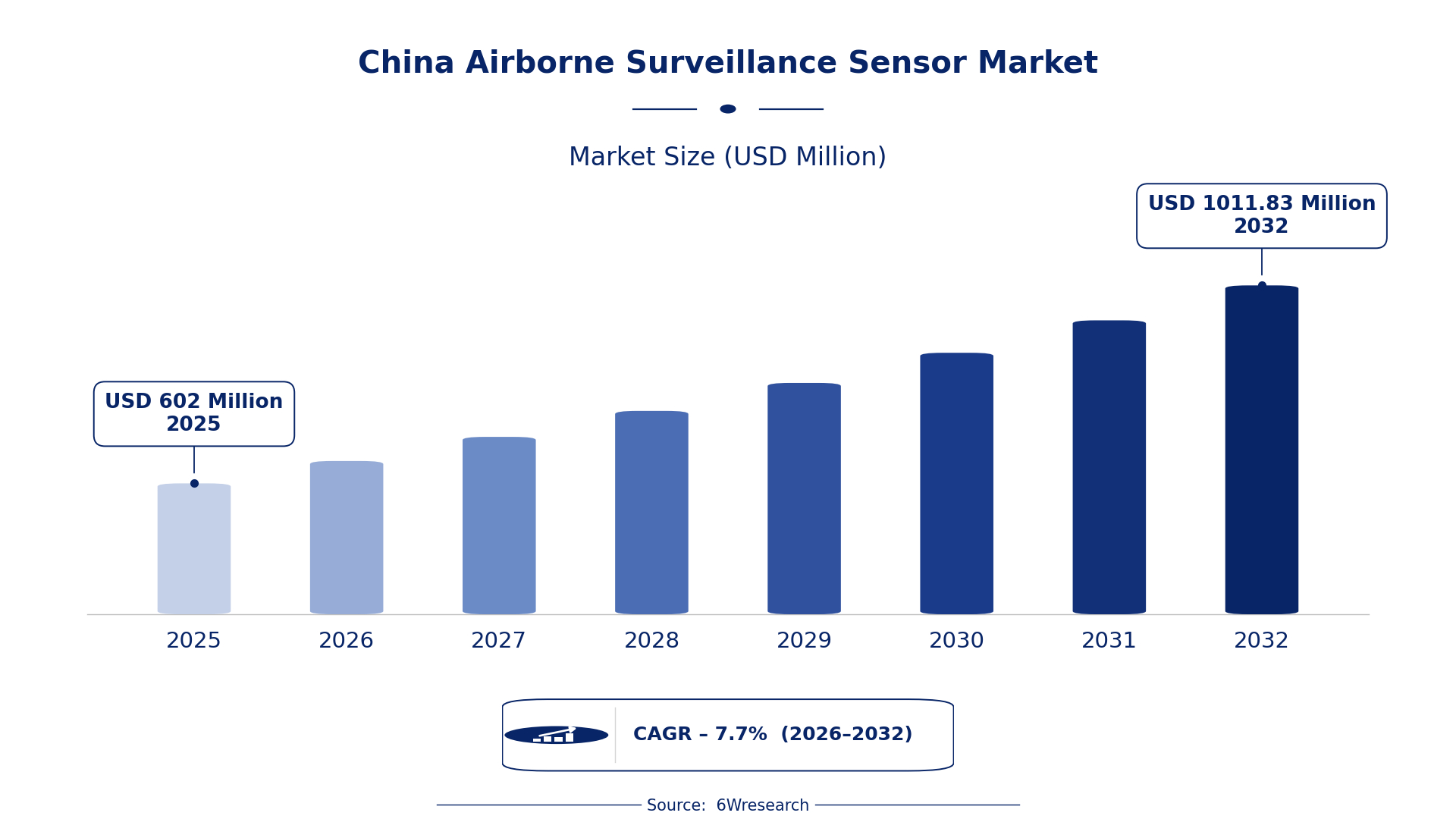
According to 6Wresearch internal database and industry insights, the China Airborne Surveillance Sensor Market was valued at USD 602.0 million in 2025 and is projected to reach USD 1,011.83 million by 2032, growing at a CAGR of approximately 7.7% during 2026–2032.
China Airborne Surveillance Sensor Market Highlights
| Report Metric | Details |
| Report Name | China Airborne Surveillance Sensor Market |
| Market Size 2025 | USD 602.0 million |
| Market Size 2032 | USD 1,011.83 million |
| Absolute Growth 2025–2032 | USD 409.83 million |
| CAGR 2026–2032 | 7.7% |
| Peak Annual Growth | 10.0% in 2026 |
| Forecast Period | 2026–2032 |
| Historical Data | 2022–2025 |
| Base Year | 2025 |
| Leading Sensor Type, 2025 | Optical Sensors (40% share) |
| Leading Monitoring Spectrum, 2025 | Day/Night Vision (39% share) |
| Leading Distribution Channel, 2025 | Military Contractors (43% share) |
| Leading End User, 2025 | Reconnaissance Aircraft Makers (34% share) |
| Fastest-Growing Sensor Type | LIDAR Sensors (9.9% CAGR) |
| Fastest-Growing Monitoring Spectrum | AI-Fused Sensor Arrays (9.8% CAGR) |
| Fastest-Growing Distribution Channel | Aerospace Tech Startups (8.7% CAGR) |
| Fastest-Growing End User | Topography Mapping Units (10.4% CAGR) |
| Growing Sector | Topography Mapping Units |
| Key End Users | Reconnaissance Aircraft Makers, Strategic Military Operations, Anti-Terror Surveillance Units, Topography Mapping Units |
China Airborne Surveillance Sensor Market Year-wise Growth Rate and Key Drivers (2022–2032)
This graph illustrates the annual growth rates of the market from 2022 to 2032, highlighting a steady upward trajectory and projected market expansion over the forecast period.
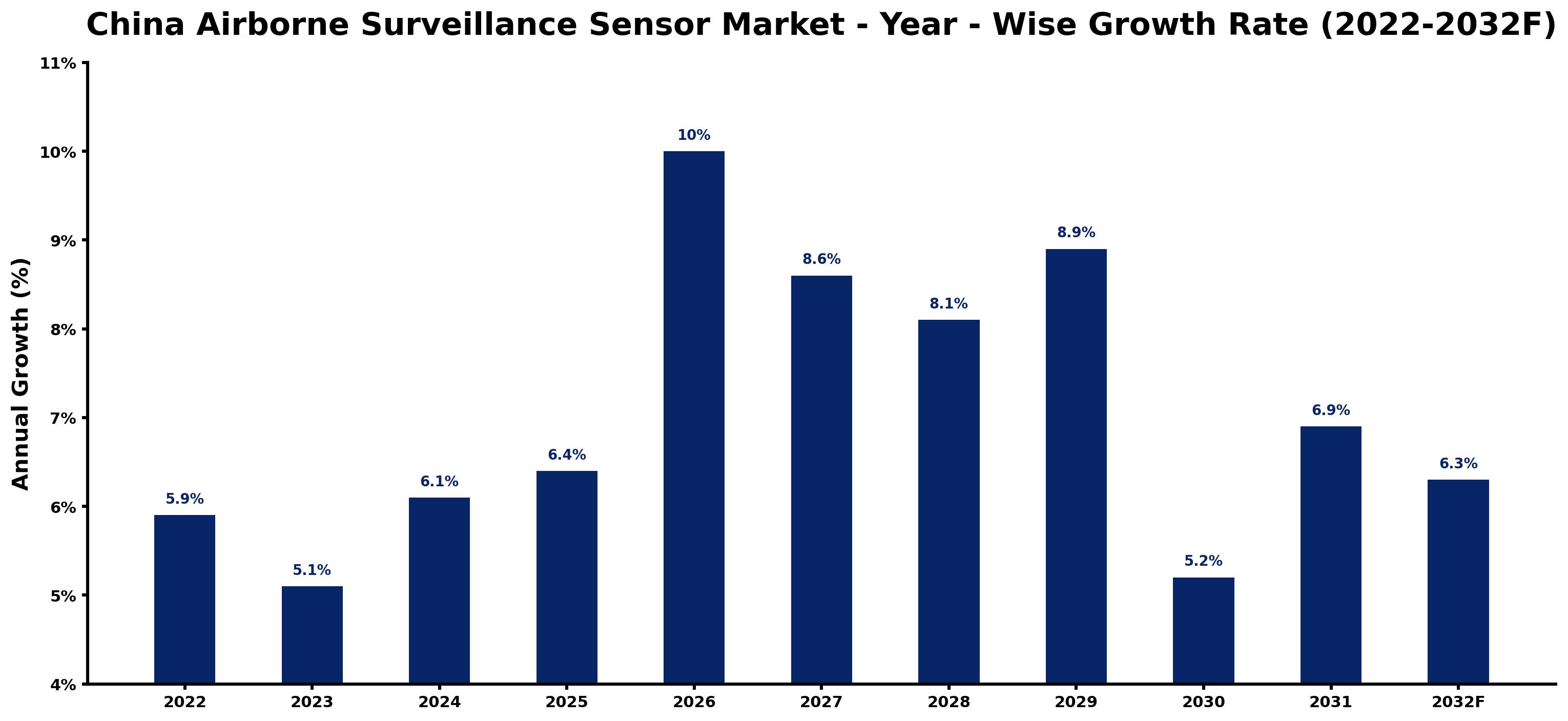
Below, each year's estimated growth is shown next to the factor that most influenced it.
| Year | Estimated Annual Growth (%) | Market Rationale |
| 2022 | 5.9 | The market experienced steady growth due to ongoing military modernization efforts. |
| 2023 | 5.1 | Growth slowed as the military budget faced adjustments amid economic pressures. |
| 2024 | 6.1 | Increased funding for surveillance capabilities led to a rise in demand for sensors. |
| 2025 | 6.4 | The market saw a boost from advancements in reconnaissance aircraft technology. |
| 2026 | 10.0 | A surge in AI integration initiatives is expected to accelerate market growth. |
| 2027 | 8.6 | Growth is projected to moderate as the market adjusts to new technology standards. |
| 2028 | 8.1 | Continued investment in military applications is expected to keep demand stable. |
| 2029 | 8.9 | A renewed focus on topographical mapping is projected to drive demand for specific sensor types. |
| 2030 | 5.2 | Growth is expected to slow as market saturation begins to affect purchasing decisions. |
| 2031 | 6.9 | Increased collaboration between military and civilian sectors will drive demand higher. |
| 2032 | 6.3 | The market is projected to stabilise as advancements in sensor technology continue to emerge. |
Note: Market size estimations and growth projections presented in this report are based on 6Wresearch's proprietary forecasting methodology, utilizing the latest available industry data, government publications, and primary research inputs.
China Airborne Surveillance Sensor Market Synopsis
The Airborne Surveillance Sensor Market in China encompasses sophisticated devices used for monitoring and reconnaissance from aircraft. These sensors are essential for military surveillance, border security, and environmental monitoring, made possible through advanced optics and electronics. The market is growing due to substantial investments from domestic military agencies and international collaborations, with a military budget of USD 602 million allocated for 2025. The National Defense Technology Innovation Program aims to improve sensor technology by 2025, further driving demand.
Market Dynamics Impact Analysis (2026–2032)
| Factor | Type | Impact | Primary Segment Affected |
| Increased military spending on advanced surveillance capabilities | Driver | High | Optical Sensors |
| Growing demand for AI integration in surveillance systems | Driver | High | AI-Fused Sensor Arrays |
| Rising need for enhanced reconnaissance capabilities | Opportunity | High | Reconnaissance Aircraft Makers |
| Expansion of military-civil fusion initiatives | Opportunity | Medium | Anti-Terror Surveillance Units |
| High costs associated with developing advanced sensor technologies | Restraint | High | Infrared Sensors |
| Limited domestic manufacturing capacity for specific sensor types | Restraint | Medium | LIDAR Sensors |
| Technological integration challenges for new sensor systems | Challenge | High | Synthetic Sensors |
| Regulatory hurdles in military procurement processes | Challenge | Medium | Military Contractors |
Evaluation of Drivers in China Airborne Surveillance Sensor Market (2026–2032)
The table below links each growth driver to the segment it affects and the evidence for it.
| Drivers | Primary Segment Affected | Why It Matters (Evidence) |
| Increased military budget allocations for surveillance technology | Optical Sensors | The military budget for 2023 allocated USD 602 million for surveillance capabilities, leading to higher purchases of optical sensors. |
| Demand for AI integration in military applications | AI-Fused Sensor Arrays | The 2023 initiative for AI integration in surveillance systems encourages military contractors to invest in advanced sensor technologies. |
| Expansion of reconnaissance aircraft capabilities | Reconnaissance Aircraft Makers | The installed base of over 200 reconnaissance aircraft in China drives demand for sophisticated airborne surveillance sensors. |
| Focus on border security enhancements | Anti-Terror Surveillance Units | Increased border security measures have led to higher demand for surveillance sensors used by anti-terror units. |
| Technological advancements in sensor integration | Synthetic Sensors | The National Defense Technology Innovation Program aims to improve sensor technology, boosting demand for integrated systems. |
Growth in the Airborne Surveillance Sensor market in China stems from increased military expenditure, technological progress, and a surge in demand for AI integration. The military budget for 2023 allocated USD 602 million for surveillance capabilities, resulting in greater procurement of optical sensors. With over 200 reconnaissance aircraft in operation, the need for advanced airborne surveillance sensors is pronounced, while heightened focus on border security has escalated demand for sensors utilised by anti-terror units.
Evaluation of Restraints in China Airborne Surveillance Sensor Market
The main factors holding the market back are set out below.
| Market Restraint | Primary Segment Affected | Why It Matters (Evidence) |
| High costs associated with developing advanced sensor technologies | Infrared Sensors | Development costs for advanced infrared sensors can exceed USD 1 million, limiting procurement by smaller units. |
| Limited domestic manufacturing capacity for specific sensor types | LIDAR Sensors | Manufacturing constraints in LIDAR sensor production can delay project timelines, affecting military readiness. |
| Technological integration challenges for new sensor systems | Synthetic Sensors | Integration of synthetic sensors into existing platforms often requires extensive testing, increasing project costs. |
| Regulatory hurdles in military procurement processes | Military Contractors | Complex procurement regulations can extend timelines for acquiring necessary surveillance technologies. |
| Market saturation affecting pricing strategies | Optical Sensors | An oversupply of optical sensors has led to price reductions, impacting profitability for manufacturers. |
China Airborne Surveillance Sensor Market Challenges
The China Airborne Surveillance Sensor Market still has to solve a few pressing issues, starting with supply chain reliability. The concentration of the aerospace industry in regions like Beijing and Sichuan can lead to production delays, causing producers to miss military contract deadlines. Buyers face escalating costs as military budgets for 2023 allocate significant funds for enhancing surveillance capabilities, compelling them to reassess their procurement strategies. Regulatory challenges arise from the Ministry of Industry and Information Technology's strict standards, which complicate the approval processes for new sensor technologies. A lack of skilled workers in advanced optics and electronics hampers producers' ability to innovate, delaying product development efforts.
Trends in the China Airborne Surveillance Sensor Market
Several trends are reshaping the China Airborne Surveillance Sensor Market; the most important are set out below.
- Shift Towards AI Integration in Surveillance Systems: China is increasingly incorporating AI technology into airborne surveillance systems, enhancing data analysis capabilities. The National Defense Technology Innovation Program aims for AI integration by 2025, with a budget of USD 602 million allocated for advancements.
- Growing Demand for LIDAR Technology: LIDAR sensors are gaining popularity for topographical mapping applications, driven by military modernisation. This segment is expected to grow at a CAGR of 9.9% from 2026 to 2032, reflecting heightened military investments.
- Expansion of Military-Civil Fusion Initiatives: The Military-Civil Fusion Development Plan promotes collaboration between military and civilian sectors, advancing sensor technology. This initiative aims to enhance domestic manufacturing capabilities for surveillance sensors.
- Rising Focus on Environmental Monitoring: Applications for environmental monitoring using airborne surveillance sensors are on the rise, driven by government initiatives. The Ministry of Industry and Information Technology has established standards for environmental monitoring systems.
Investment Opportunities in the China Airborne Surveillance Sensor Market
Investors looking at the China Airborne Surveillance Sensor Market should consider the following areas.
- Supply of Advanced Optical Sensors: The demand for advanced optical sensors is increasing, with the military budget projected at USD 602 million for 2025. Collaborating with military contractors can facilitate entry into this expanding market.
- Partnerships for LIDAR Technology: Investing in LIDAR sensor technology is timely as military modernisation drives demand. Partnering with aerospace tech startups in Sichuan can strengthen market presence and capabilities.
- Integration of AI-Fused Sensor Arrays: The need for AI-fused sensor arrays is on the rise, driven by military applications. Engaging with reconnaissance aircraft manufacturers can create opportunities for collaboration and technology sharing.
- Enhancing Border Security Solutions: The emphasis on border security is generating demand for advanced surveillance solutions. Establishing joint ventures with anti-terror surveillance units can help address this growing need.
Government Initiatives in the China Airborne Surveillance Sensor Market
In 2021, the Ministry of National Defense launched the 'Advanced Surveillance Technology Development Plan' to enhance military sensor capabilities with a focus on AI integration. This plan builds on previous initiatives by directing funding towards the development of next-generation surveillance systems, ensuring military applications benefit from advanced technology. The 2023 National Defense Budget allocated substantial resources for enhancing surveillance capabilities, further supporting producers in developing innovative solutions.
The 'Military-Civil Fusion Development Plan' encourages collaboration between military and civilian sectors for advancements in sensor technology. This initiative allows military contractors to access civilian innovations, facilitating the development of advanced surveillance systems. The Ministry of Industry and Information Technology oversees standards for military sensor systems, ensuring compliance and quality in production, which benefits buyers by providing reliable products.
Future Insight of the China Airborne Surveillance Sensor Market
Several forward-looking factors should support the China Airborne Surveillance Sensor Market in the coming years. The National Defense Technology Innovation Program is set to enhance sensor technology, which will strengthen military capabilities. A new initiative for AI integration in surveillance systems will likely lead to more advanced monitoring solutions. By 2032, the installed base of reconnaissance aircraft is projected to exceed 250 units, driving demand for sophisticated airborne sensors and encouraging further investment in the sector.
Market Segmentation Analysis
The analysis below covers each segmentation, its leading category in 2025 and its fastest-growing category through 2032.
By Sensor Type – Optical Sensors Dominated, LIDAR Sensors Expected to Grow Fastest
According to Shubham Padhi, Research Analyst at 6Wresearch, in 2025, Optical Sensors led the sensor type split with a 40% share. Optical sensors hold the largest share as they are essential for visual reconnaissance, widely used in military operations. The installed base of over 200 reconnaissance aircraft in China relies heavily on these sensors for effective surveillance. Over 2026–2032, LIDAR Sensors are expected to post the fastest growth, at a CAGR of 9.9%. LIDAR sensors are witnessing rapid growth due to their ability to provide precise topographical mapping, increasingly sought in military and environmental applications. The recent initiative for enhanced sensor technology will further drive the demand for LIDAR systems. Suppliers should prioritise the development of advanced optical and LIDAR technologies to cater to the rising demands of the Chinese military and security sectors.
By Monitoring Spectrum – Day/Night Vision Dominated, AI-Fused Sensor Arrays Expected to Grow Fastest
The largest monitoring spectrum category in 2025 was Day/Night Vision, with a 39% share of total revenue. Day/Night vision systems dominate market share as they enable continuous monitoring in various lighting conditions, which is crucial for military surveillance. Their extensive application in reconnaissance missions highlights their significance in current operations. AI-Fused Sensor Arrays are set to record the highest CAGR in this split, 9.8% over 2026–2032. Sensor arrays that integrate multiple data sources are rapidly gaining traction as they significantly improve data analysis and target identification, essential for modern surveillance requirements. This trend aligns with the military's focus on integrating advanced technologies into their operations. Buyers should consider investing in advanced sensor technologies to enhance the effectiveness of their surveillance operations.
By Distribution Channel – Military Contractors Dominated, Aerospace Tech Startups Expected to Grow Fastest
Military Contractors took a 43% share of distribution channel in 2025, more than any other category. Military contractors command the largest share of the market as they are the primary users of airborne surveillance sensors for defence contracts. Their established relationships with government agencies ensure a steady demand for these technologies. The quickest growth will come from Aerospace Tech Startups, forecast to expand at a CAGR of 8.7% between 2026 and 2032. Aerospace tech startups are emerging quickly, driven by innovation and the need for modern surveillance solutions, although they currently hold a smaller market share. Their agility allows them to adapt to new technologies and market demands effectively. Suppliers should consider partnerships with military contractors to secure long-term contracts while also exploring opportunities with emerging aerospace tech startups.
By End User – Reconnaissance Aircraft Makers Dominated, Topography Mapping Units Expected to Grow Fastest
Reconnaissance Aircraft Makers held a 34% share of the China Airborne Surveillance Sensor Market by end user in 2025. Reconnaissance aircraft makers lead market share as they incorporate airborne surveillance sensors into their aircraft designs, vital for military effectiveness. The substantial investment in military modernisation further strengthens their position in the market. Topography Mapping Units are projected to grow fastest, at a CAGR of 10.4% during 2026–2032. Topography mapping units are experiencing rapid growth as they increasingly depend on sensors for accurate geographical data collection, driven by the demand for precision across various applications. This trend indicates a broader utilisation of surveillance technologies beyond traditional military uses. Suppliers should focus on reconnaissance aircraft makers while also exploring opportunities in the expanding topography mapping sector.
Key Attractiveness of the Report
- 10 Years of Market Numbers
- Historical Data Starting from 2022 to 2025
- Base Year 2025
- Forecast Data until 2032
- Key Performance Indicators Impacting the Market
- Major Upcoming Developments and Projects
Key Highlights of the Report:
- China Airborne Surveillance Sensor Market Outlook
- Market Size of China Airborne Surveillance Sensor Market, 2025
- Forecast of China Airborne Surveillance Sensor Market, 2032
- Historical Data and Forecast of China Airborne Surveillance Sensor Revenues & Volume for the Period 2022 - 2032F
- China Airborne Surveillance Sensor Market Trend Evolution
- China Airborne Surveillance Sensor Market Drivers and Challenges
- China Airborne Surveillance Sensor Price Trends
- China Airborne Surveillance Sensor Porter's Five Forces
- China Airborne Surveillance Sensor Industry Life Cycle
- Historical Data and Forecast of China Airborne Surveillance Sensor Market Revenues & Volume By Sensor Type for the Period 2022 - 2032F
- Historical Data and Forecast of China Airborne Surveillance Sensor Market Revenues & Volume By Optical Sensors for the Period 2022 - 2032F
- Historical Data and Forecast of China Airborne Surveillance Sensor Market Revenues & Volume By Infrared Sensors for the Period 2022 - 2032F
- Historical Data and Forecast of China Airborne Surveillance Sensor Market Revenues & Volume By LIDAR Sensors for the Period 2022 - 2032F
- Historical Data and Forecast of China Airborne Surveillance Sensor Market Revenues & Volume By Synthetic Sensors for the Period 2022 - 2032F
- Historical Data and Forecast of China Airborne Surveillance Sensor Market Revenues & Volume By Monitoring Spectrum for the Period 2022 - 2032F
- Historical Data and Forecast of China Airborne Surveillance Sensor Market Revenues & Volume By Day/Night Vision for the Period 2022 - 2032F
- Historical Data and Forecast of China Airborne Surveillance Sensor Market Revenues & Volume By Thermal Infrared Band for the Period 2022 - 2032F
- Historical Data and Forecast of China Airborne Surveillance Sensor Market Revenues & Volume By Laser-Based Distance Sensing for the Period 2022 - 2032F
- Historical Data and Forecast of China Airborne Surveillance Sensor Market Revenues & Volume By AI-Fused Sensor Arrays for the Period 2022 - 2032F
- Historical Data and Forecast of China Airborne Surveillance Sensor Market Revenues & Volume By Distribution Channel for the Period 2022 - 2032F
- Historical Data and Forecast of China Airborne Surveillance Sensor Market Revenues & Volume By Sensor OEM Suppliers for the Period 2022 - 2032F
- Historical Data and Forecast of China Airborne Surveillance Sensor Market Revenues & Volume By Military Contractors for the Period 2022 - 2032F
- Historical Data and Forecast of China Airborne Surveillance Sensor Market Revenues & Volume By Technology Integrators for the Period 2022 - 2032F
- Historical Data and Forecast of China Airborne Surveillance Sensor Market Revenues & Volume By Aerospace Tech Startups for the Period 2022 - 2032F
- Historical Data and Forecast of China Airborne Surveillance Sensor Market Revenues & Volume By End User for the Period 2022 - 2032F
- Historical Data and Forecast of China Airborne Surveillance Sensor Market Revenues & Volume By Reconnaissance Aircraft Makers for the Period 2022 - 2032F
- Historical Data and Forecast of China Airborne Surveillance Sensor Market Revenues & Volume By Anti-Terror Surveillance Units for the Period 2022 - 2032F
- Historical Data and Forecast of China Airborne Surveillance Sensor Market Revenues & Volume By Topography Mapping Units for the Period 2022 - 2032F
- Historical Data and Forecast of China Airborne Surveillance Sensor Market Revenues & Volume By Strategic Military Operations for the Period 2022 - 2032F
- China Airborne Surveillance Sensor Import Export Trade Statistics
- Market Opportunity Assessment By Sensor Type
- Market Opportunity Assessment By Monitoring Spectrum
- Market Opportunity Assessment By Distribution Channel
- Market Opportunity Assessment By End User
- China Airborne Surveillance Sensor Top Companies Market Share
- China Airborne Surveillance Sensor Competitive Benchmarking By Technical and Operational Parameters
- China Airborne Surveillance Sensor Company Profiles
- China Airborne Surveillance Sensor Key Strategic Recommendations
Market Covered
This report examines the market across the segments below.
By Sensor Type
- Optical Sensors
- Infrared Sensors
- LIDAR Sensors
- Synthetic Sensors
By Monitoring Spectrum
- Day/Night Vision
- Thermal Infrared Band
- Laser-Based Distance Sensing
- AI-Fused Sensor Arrays
By Distribution Channel
- Sensor OEM Suppliers
- Military Contractors
- Technology Integrators
- Aerospace Tech Startups
By End User
- Reconnaissance Aircraft Makers
- Anti-Terror Surveillance Units
- Topography Mapping Units
- Strategic Military Operations































