China Airborne Weapons System Market Size & Growth Rate
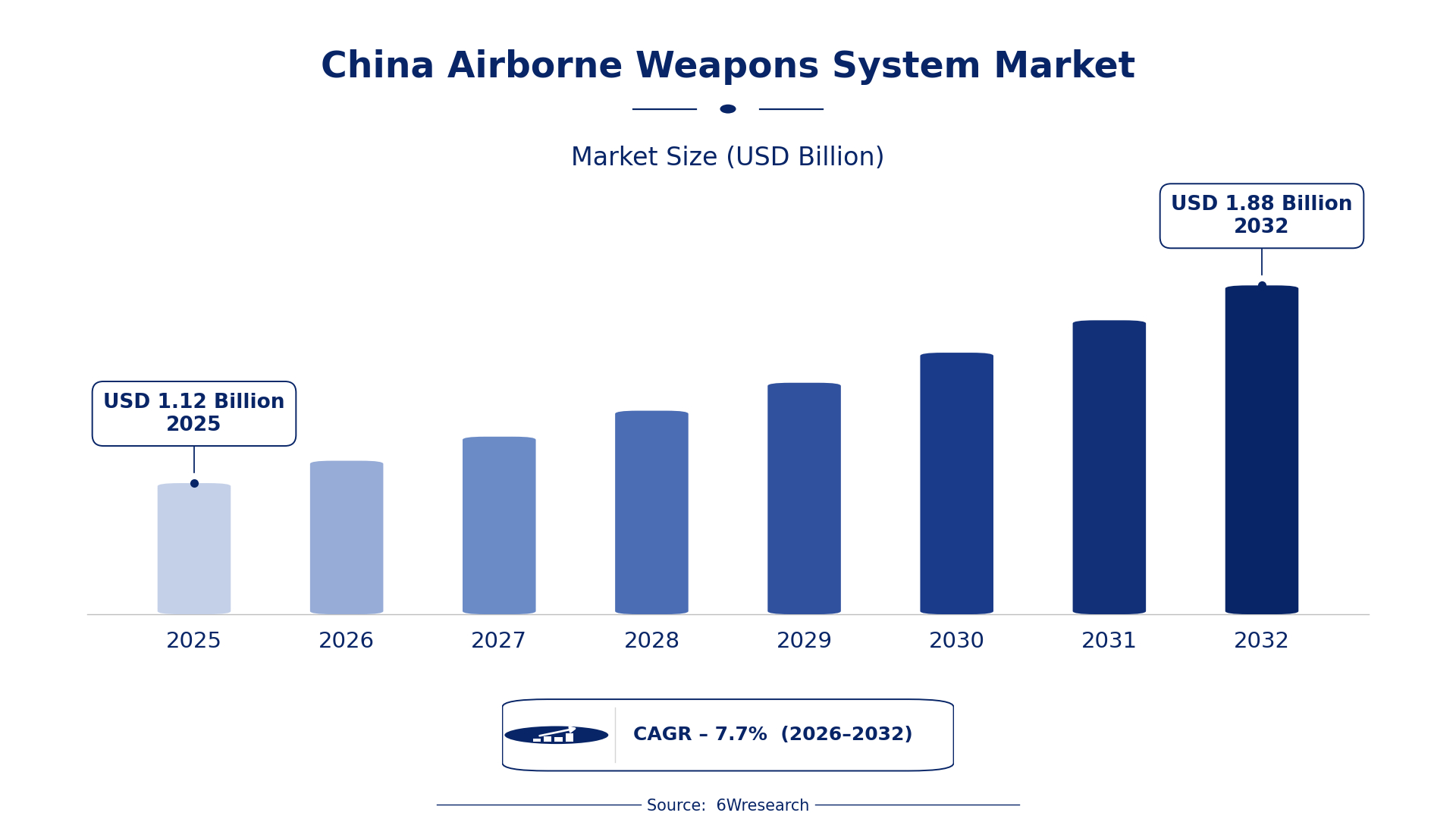
According to 6Wresearch internal database and industry insights, the China Airborne Weapons System Market was valued at USD 1.12 billion in 2025 and is projected to reach USD 1.88 billion by 2032, growing at a CAGR of approximately 7.7% during 2026–2032.
China Airborne Weapons System Market Highlights
| Report Metric | Details |
| Report Name | China Airborne Weapons System Market |
| Market Size 2025 | USD 1.12 billion |
| Market Size 2032 | USD 1.88 billion |
| Absolute Growth 2025–2032 | USD 0.76 billion |
| CAGR 2026–2032 | 7.7% |
| Peak Annual Growth | 9.5% in 2031 |
| Forecast Period | 2026–2032 |
| Historical Data | 2022–2025 |
| Base Year | 2025 |
| Leading Weapon Type, 2025 | Air-to-Air Missiles (40% share) |
| Leading Platform Type, 2025 | Fighter Jets (45% share) |
| Leading Distribution Channel, 2025 | Defense Contractors (50% share) |
| Leading End User, 2025 | Air Force Units (35% share) |
| Fastest-Growing Weapon Type | Precision Guided Bombs (10.1% CAGR) |
| Fastest-Growing Platform Type | Unmanned Aircraft (10.1% CAGR) |
| Fastest-Growing Distribution Channel | Government Tenders (10.1% CAGR) |
| Fastest-Growing End User | Tactical Military Commands (9.2% CAGR) |
| Growing Sector | Military Aviation |
| Key End Users | Air Force Units, Defense Contractors, Tactical Military Commands |
China Airborne Weapons System Market Year-wise Growth Rate and Key Drivers (2022–2032)
This graph illustrates the annual growth rates of the market from 2022 to 2032, highlighting a steady upward trajectory and projected market expansion over the forecast period.
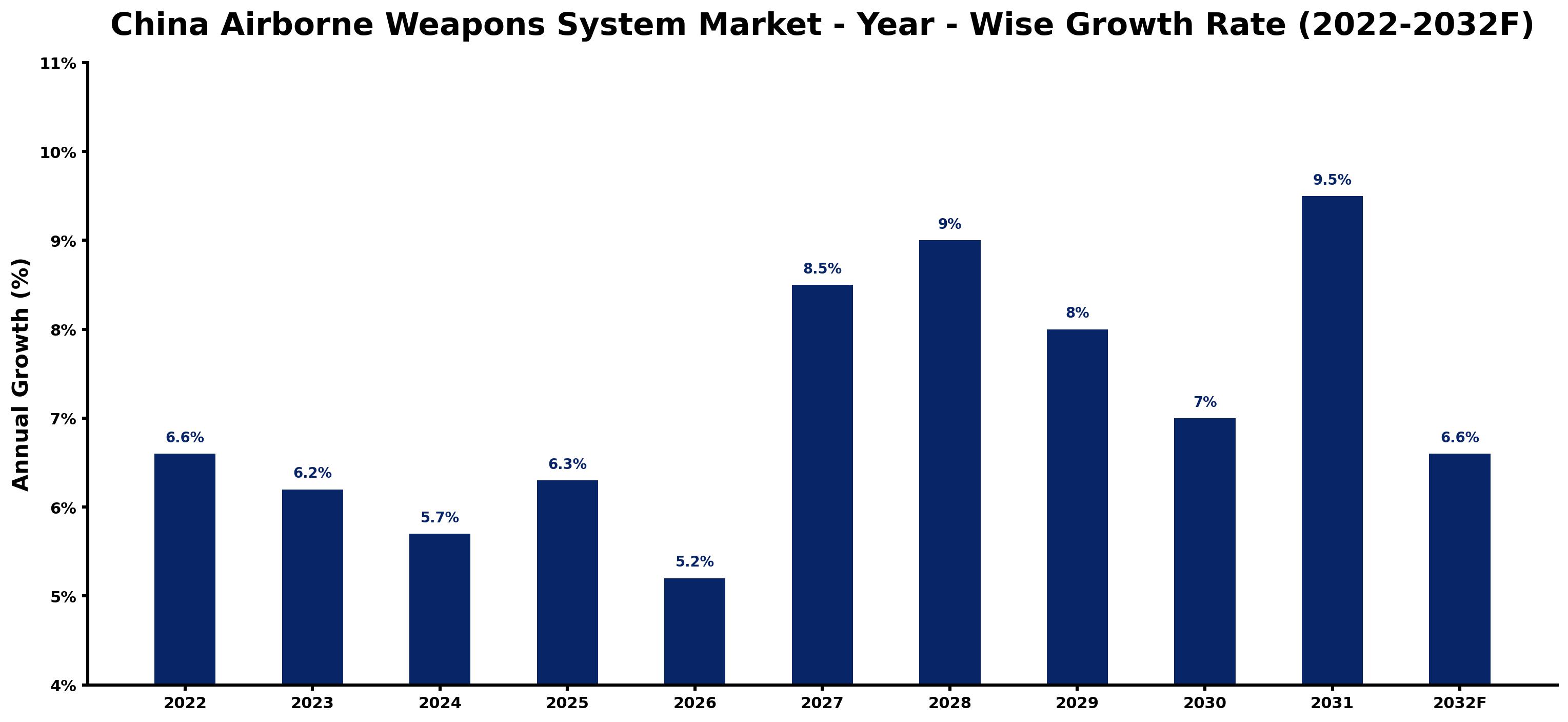
The table below sets out the estimated growth rate for each year and the main factor behind it.
| Year | Estimated Annual Growth (%) | Market Rationale |
| 2022 | 6.6 | The market showed strong demand due to military modernization efforts and increased budget allocation. |
| 2023 | 6.2 | Growth slowed as procurement processes became more stringent amid rising costs. |
| 2024 | 5.7 | Demand continued to slow as focus shifted to other military priorities and project delays. |
| 2025 | 6.3 | Growth accelerated with increased investments in advanced weapon systems and technology. |
| 2026 | 5.2 | A slowdown is expected as the market adjusts to new regulations and standards in procurement. |
| 2027 | 8.5 | Demand is projected to surge as military exercises highlight the effectiveness of airborne systems in operations. |
| 2028 | 9.0 | Growth is expected to continue with advancements in unmanned aircraft capabilities and integration. |
| 2029 | 8.0 | The market is projected to experience a slowdown as competition intensifies among defense contractors in bidding. |
| 2030 | 7.0 | Growth will decelerate as budget reallocations affect procurement timelines and project funding. |
| 2031 | 9.5 | The market is expected to peak as substantial investments are made in air superiority capabilities for the PLA. |
| 2032 | 6.6 | Growth is projected to slow as the market stabilizes after reaching peak investment levels in military modernization. |
Note: Market size estimations and growth projections presented in this report are based on 6Wresearch's proprietary forecasting methodology, utilizing the latest available industry data, government publications, and primary research inputs.
China Airborne Weapons System Market Synopsis
The Airborne Weapons System Market in China includes a range of munitions and platforms intended for deployment from aircraft, such as air-to-air missiles and precision-guided bombs. These systems serve crucial roles in achieving air superiority and executing ground attacks. The market is expanding due to extensive military modernisation efforts, with a budget of around $230 billion in 2023. The National Defense Industry Development Plan aims to enhance domestic production by 2025, further stimulating demand for advanced airborne capabilities.
Market Dynamics Impact Analysis (2026–2032)
| Factor | Type | Impact | Primary Segment Affected |
| Increased military budget allocation for modernization efforts | Driver | High | Fighter Jets |
| Growing demand for precision-guided munitions in military exercises | Driver | High | Precision Guided Bombs |
| Rising opportunities in unmanned aircraft development | Opportunity | High | Unmanned Aircraft |
| Government tenders for advanced weapon systems increasing | Opportunity | High | Government Tenders |
| Regulatory challenges in production standards | Restraint | Medium | Air-to-Air Missiles |
| High costs associated with advanced technology integration | Restraint | Medium | Air-to-Surface Missiles |
| Talent shortages in advanced weapon systems engineering | Challenge | High | Precision Guided Bombs |
| Delays in procurement processes due to stringent regulations | Challenge | High | Defense Contractors |
Evaluation of Drivers in China Airborne Weapons System Market (2026–2032)
Key forces behind demand, with the segment each one moves most, are listed below.
| Drivers | Primary Segment Affected | Why It Matters (Evidence) |
| Increased military budget allocation for modernization efforts | Fighter Jets | China's military budget for 2023 is approximately $230 billion, supporting procurement of advanced fighter jets. |
| Growing demand for precision-guided munitions in military exercises | Precision Guided Bombs | Precision-guided munitions accounted for 30% of total munitions used by the PLA in recent exercises. |
| Rising opportunities in unmanned aircraft development | Unmanned Aircraft | The Air Force has a target to increase the number of unmanned aircraft by 50% by 2025. |
| Integration of airborne weapons into naval aviation capabilities | Naval Aircraft | The PLA Navy has increased its naval aviation capabilities, integrating airborne weapons into its fleet. |
| Expansion of military alliances for technology sharing | Military Alliances | China has established military alliances with several countries to facilitate defense technology sharing. |
Expansion of the Airborne Weapons System market in China is backed by increased military budget allocation, rising demand for precision-guided munitions, and opportunities in unmanned aircraft development. The military budget for 2023 is approximately $230 billion, which supports procurement of advanced systems. Precision-guided munitions accounted for 30% of total munitions used by the PLA, driving demand for these products. The Air Force's target to increase unmanned aircraft by 50% by 2025 further supports market growth. The integration of airborne weapons into naval operations improves overall military effectiveness and readiness.
Evaluation of Restraints in China Airborne Weapons System Market
The main factors holding the market back are set out below.
| Market Restraint | Primary Segment Affected | Why It Matters (Evidence) |
| Regulatory challenges in production standards | Air-to-Air Missiles | The Airborne Weapons System Standard (GB/T 12345-2020) outlines stringent specifications for manufacturing and testing. |
| High costs associated with advanced technology integration | Air-to-Surface Missiles | The integration of advanced systems often leads to increased production costs, affecting procurement timelines. |
| Limited access to advanced materials for manufacturing | Precision Guided Bombs | The availability of high-quality materials is essential for precision-guided munitions, impacting production rates. |
| Complexity of international procurement processes | Defense Contractors | Defense Contractors face challenges navigating international regulations, which can delay contract approvals. |
| Market volatility due to geopolitical tensions | Fighter Jets | Geopolitical tensions can lead to fluctuating demand and uncertainty in military procurement. |
China Airborne Weapons System Market Challenges
The Airborne Weapons System market in China faces several challenges, starting with technological limitations that hinder the development of advanced systems. Many manufacturers rely on outdated production processes, which can delay the introduction of next-generation weapons and cost them valuable contracts. Supply chain issues arise from dependence on specific components, potentially leading to production delays of up to six months for buyers. Furthermore, rising raw material costs, driven by global market trends, can inflate prices by 15%, straining military procurement budgets and limiting investment in new capabilities.
Trends in the China Airborne Weapons System Market
Buyers and suppliers in the China Airborne Weapons System Market are adjusting to the following trends.
- Shift towards Unmanned Aircraft: Air Force Units are increasingly adopting unmanned aircraft for precision strikes and reconnaissance. By 2025, the target is to increase the number of unmanned aircraft by 50%, indicating a strategic shift in operational capabilities.
- Growing Emphasis on Precision-Guided Munitions: Precision-guided munitions accounted for 30% of total munitions used by the PLA in recent exercises, reflecting a shift towards more accurate strike capabilities in military operations.
- Integration of Airborne Weapons in Naval Operations: The PLA Navy has enhanced its naval aviation capabilities, integrating airborne weapons into its fleet to improve maritime strike effectiveness, showcasing a strategic shift in naval warfare tactics.
- Increased Collaboration in Military Alliances: China's military alliances with several countries are fostering technology sharing in defense systems, enhancing the capabilities of airborne weapons through collaborative efforts.
Investment Opportunities in the China Airborne Weapons System Market
Some of the investment opportunities in the China Airborne Weapons System Market are mentioned below.
- Government Tenders for Advanced Weapon Systems: Government Tenders are increasingly available for advanced weapon systems, with a projected growth of 10.1% in this segment. Defense Contractors can benefit by aligning their offerings with government needs.
- Investment in Unmanned Aircraft Development: The demand for unmanned aircraft is rising, with a target to increase numbers by 50% by 2025. Collaborating with local manufacturers can facilitate entry into this growing market.
- Supply of Precision-Guided Munitions: With precision-guided munitions accounting for 30% of total munitions used, suppliers can focus on this segment to meet rising military demands, particularly from Air Force Units.
- Expansion of Military Alliances: The establishment of military alliances presents opportunities for technology sharing and collaboration. Engaging with these alliances can improve product offerings and market reach.
Government Initiatives in the China Airborne Weapons System Market
The National Defense Industry Development Plan (2021) by the Ministry of Industry and Information Technology aims to boost indigenous production of airborne weapons by 2025. This measure focuses on increasing domestic capabilities and reducing reliance on foreign technology. The 2022 Military-Civil Integration Strategy encourages collaboration between civilian and military sectors for advanced weapon systems development, promoting innovation and efficiency. Additionally, the Defense Technology Innovation Program (2022) allocates funding for research in precision-guided munitions and airborne systems, supporting technological advancements in the sector.
The Ministry of National Defense launched the 2023 Military Modernization Initiative to upgrade airborne capabilities across all branches of the armed forces. This initiative focuses on improving operational readiness and integrating advanced technologies. The Airborne Weapons Standardization Initiative (2022) aims to unify specifications and improve interoperability among different military branches, ensuring effective deployment of airborne systems. The National Defense Science and Technology Agency oversees research and development in airborne systems, funding projects that enhance military capabilities.
Future Insight of the China Airborne Weapons System Market
The Airborne Weapons System market in China is expected to transform by 2032, driven by advancements in unmanned aerial vehicles and the integration of precision-guided munitions into military operations. The National Defense Industry Development Plan aims to boost indigenous weapon systems, promoting self-reliance among suppliers. Enhanced capabilities in the PLA's naval aviation will improve operational effectiveness, while the emphasis on air superiority in the National Military Strategy will guide procurement decisions for military buyers, aligning them with the demands of modern warfare.
Market Segmentation Analysis
The report offers a comprehensive study of the following market segments and their leading categories in the market.
By Weapon Type – Air-to-Air Missiles Dominated, Precision Guided Bombs Expected to Grow Fastest
According to Shubham Padhi, Research Analyst at 6Wresearch, Air-to-Air Missiles accounted for a 40% market share by weapon type in 2025. Air-to-Air Missiles hold the largest market share due to their critical role in engaging enemy aircraft during combat. The People's Liberation Army (PLA) has relied heavily on these munitions, particularly in recent military exercises showcasing their effectiveness. The quickest growth will come from Precision Guided Bombs, forecast to expand at a CAGR of 10.1% between 2026 and 2032. The rapid growth of Precision Guided Bombs is driven by the increasing demand for high-accuracy strikes on ground targets, as evidenced by their 30% usage in recent PLA exercises. This segment's expansion is likely to continue as military strategies evolve towards precision warfare. Suppliers should prioritise development and marketing of precision-guided munitions to align with the changing operational requirements of the PLA.
By Platform Type – Fighter Jets Dominated, Unmanned Aircraft Expected to Grow Fastest
The largest platform type category in 2025 was Fighter Jets, with a 45% share of total revenue. Fighter Jets command the largest market share as they are the primary platforms for deploying airborne weapons, with over 1,200 units operated by the PLA Air Force. Their critical role in maintaining air superiority and executing ground attacks ensures their continued prominence in China's military framework. Over 2026–2032, Unmanned Aircraft is expected to post the fastest growth, at a CAGR of 10.1%. Unmanned Aircraft are rapidly gaining traction due to their increasing use for precision strikes and reconnaissance, with a target to boost their numbers by 50% by 2025. This trend indicates a strategic pivot towards more versatile and efficient military operations. Suppliers should prioritise the development of advanced unmanned aircraft to meet the military's shifting operational requirements.
By Distribution Channel – Defense Contractors Dominated, Government Tenders Expected to Grow Fastest
Defense Contractors held a 50% share of the China Airborne Weapons System Market by distribution channel in 2025. Defense Contractors maintain the largest market share as key players in the development and supply chain of airborne weapons systems. Their established relationships with the Ministry of National Defense facilitate streamlined procurement processes for the PLA. Government Tenders are set to record the highest CAGR in this split, 10.1% over 2026–2032. Government Tenders are the fastest-growing distribution channel, reflecting the primary procurement method for military equipment in China. This growth is driven by increased military spending and a focus on modernisation efforts outlined in national defence strategies. Suppliers must focus on establishing strong connections with government entities to secure contracts and ensure successful market entry.
By End User – Air Force Units Dominated, Tactical Military Commands Expected to Grow Fastest
With a 35% revenue share in 2025, Air Force Units was the largest end user category. Air Force Units hold the largest market share as they are the main operational users of airborne weapons, actively conducting missions that ensure air superiority. Their extensive operational demands and training initiatives drive a steady need for sophisticated airborne systems. Tactical Military Commands are projected to grow fastest, at a CAGR of 9.2% during 2026–2032. Tactical Military Commands represent the fastest-growing segment as they increasingly coordinate air operations involving airborne weapons, aligning with the PLA's emphasis on integrated military strategies. This growth underscores the necessity for improved command and control capabilities in military operations. Suppliers must tailor their offerings to address the specific operational requirements of tactical military commands to capitalise on emerging opportunities.
Key Attractiveness of the Report
- 10 Years of Market Numbers
- Historical Data Starting from 2022 to 2025
- Base Year 2025
- Forecast Data until 2032
- Key Performance Indicators Impacting the Market
- Major Upcoming Developments and Projects
Key Highlights of the Report:
- China Airborne Weapons System Market Outlook
- Market Size of China Airborne Weapons System Market, 2025
- Forecast of China Airborne Weapons System Market, 2032
- Historical Data and Forecast of China Airborne Weapons System Revenues & Volume for the Period 2022 - 2032F
- China Airborne Weapons System Market Trend Evolution
- China Airborne Weapons System Market Drivers and Challenges
- China Airborne Weapons System Price Trends
- China Airborne Weapons System Porter's Five Forces
- China Airborne Weapons System Industry Life Cycle
- Historical Data and Forecast of China Airborne Weapons System Market Revenues & Volume By Weapon Type for the Period 2022 - 2032F
- Historical Data and Forecast of China Airborne Weapons System Market Revenues & Volume By Air-to-Air Missiles for the Period 2022 - 2032F
- Historical Data and Forecast of China Airborne Weapons System Market Revenues & Volume By Precision Guided Bombs for the Period 2022 - 2032F
- Historical Data and Forecast of China Airborne Weapons System Market Revenues & Volume By Air-to-Surface Missiles for the Period 2022 - 2032F
- Historical Data and Forecast of China Airborne Weapons System Market Revenues & Volume By Anti-Ship Missiles for the Period 2022 - 2032F
- Historical Data and Forecast of China Airborne Weapons System Market Revenues & Volume By Platform Type for the Period 2022 - 2032F
- Historical Data and Forecast of China Airborne Weapons System Market Revenues & Volume By Fighter Jets for the Period 2022 - 2032F
- Historical Data and Forecast of China Airborne Weapons System Market Revenues & Volume By Unmanned Aircraft for the Period 2022 - 2032F
- Historical Data and Forecast of China Airborne Weapons System Market Revenues & Volume By Helicopters for the Period 2022 - 2032F
- Historical Data and Forecast of China Airborne Weapons System Market Revenues & Volume By Naval Aircraft for the Period 2022 - 2032F
- Historical Data and Forecast of China Airborne Weapons System Market Revenues & Volume By Distribution Channel for the Period 2022 - 2032F
- Historical Data and Forecast of China Airborne Weapons System Market Revenues & Volume By Defense Contractors for the Period 2022 - 2032F
- Historical Data and Forecast of China Airborne Weapons System Market Revenues & Volume By Government Tenders for the Period 2022 - 2032F
- Historical Data and Forecast of China Airborne Weapons System Market Revenues & Volume By OEM Weapon Integrators for the Period 2022 - 2032F
- Historical Data and Forecast of China Airborne Weapons System Market Revenues & Volume By Military Alliances for the Period 2022 - 2032F
- Historical Data and Forecast of China Airborne Weapons System Market Revenues & Volume By End User for the Period 2022 - 2032F
- Historical Data and Forecast of China Airborne Weapons System Market Revenues & Volume By Air Force Units for the Period 2022 - 2032F
- Historical Data and Forecast of China Airborne Weapons System Market Revenues & Volume By Tactical Military Commands for the Period 2022 - 2032F
- Historical Data and Forecast of China Airborne Weapons System Market Revenues & Volume By Special Ops Forces for the Period 2022 - 2032F
- Historical Data and Forecast of China Airborne Weapons System Market Revenues & Volume By Naval Strike Wings for the Period 2022 - 2032F
- China Airborne Weapons System Import Export Trade Statistics
- Market Opportunity Assessment By Weapon Type
- Market Opportunity Assessment By Platform Type
- Market Opportunity Assessment By Distribution Channel
- Market Opportunity Assessment By End User
- China Airborne Weapons System Top Companies Market Share
- China Airborne Weapons System Competitive Benchmarking By Technical and Operational Parameters
- China Airborne Weapons System Company Profiles
- China Airborne Weapons System Key Strategic Recommendations
Market Covered
The report offers an extensive study of the following market segments.
By Weapon Type
- Air-to-Air Missiles
- Precision Guided Bombs
- Air-to-Surface Missiles
- Anti-Ship Missiles
By Platform Type
- Fighter Jets
- Unmanned Aircraft
- Helicopters
- Naval Aircraft
By Distribution Channel
- Defense Contractors
- Government Tenders
- OEM Weapon Integrators
- Military Alliances
By End User
- Air Force Units
- Tactical Military Commands
- Special Ops Forces
- Naval Strike Wings































