China Airborne Weather Radar Market Size & Growth Rate
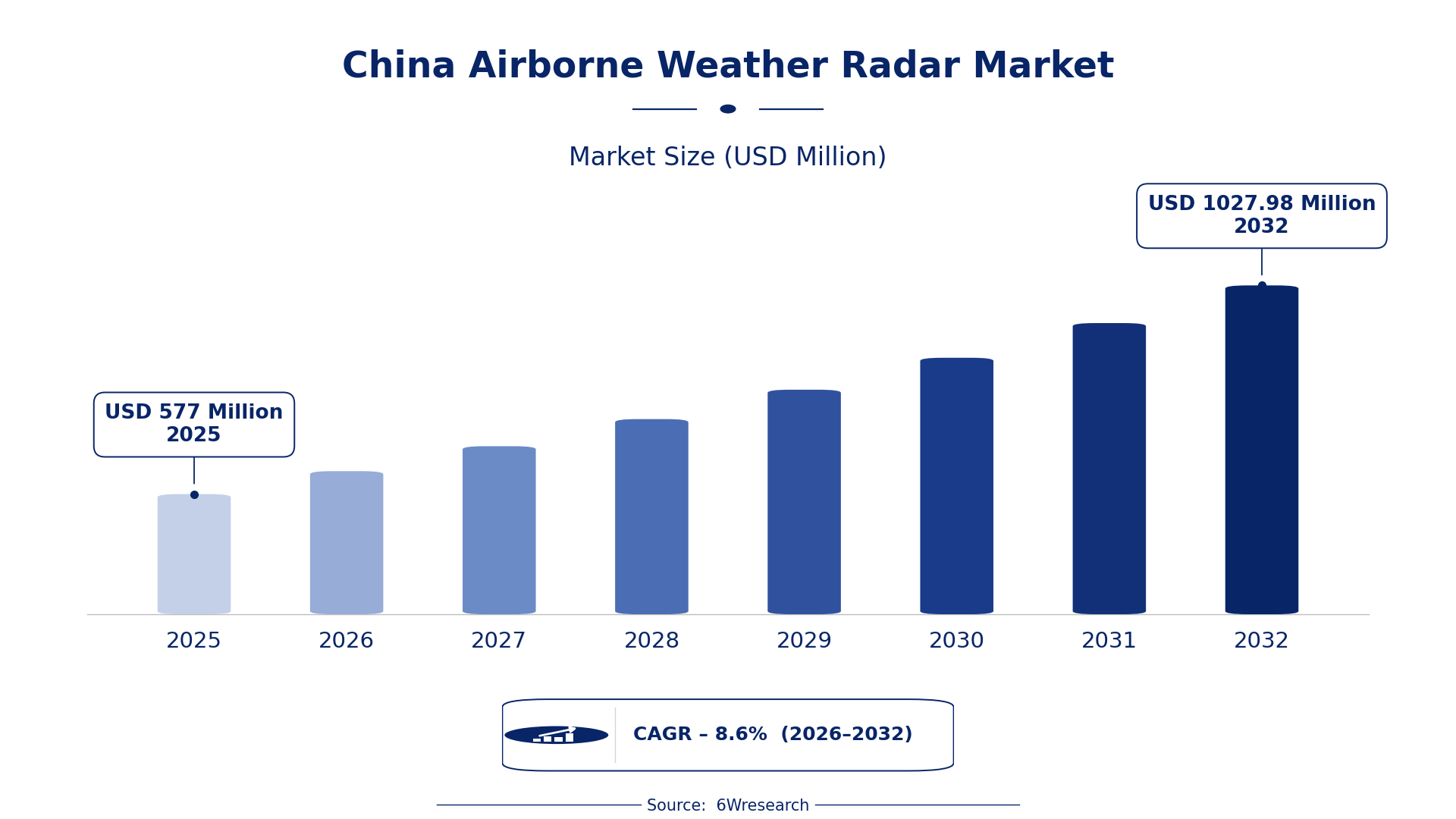
According to 6Wresearch internal database and industry insights, the China Airborne Weather Radar Market was valued at USD 577.0 million in 2025 and is projected to reach USD 1,027.98 million by 2032, growing at a CAGR of approximately 8.6% during 2026–2032.
China Airborne Weather Radar Market Highlights
| Report Metric | Details |
| Report Name | China Airborne Weather Radar Market |
| Market Size 2025 | USD 577.0 million |
| Market Size 2032 | USD 1,027.98 million |
| Absolute Growth 2025–2032 | USD 450.98 million |
| CAGR 2026–2032 | 8.6% |
| Peak Annual Growth | 10.5% in 2026 |
| Forecast Period | 2026–2032 |
| Historical Data | 2022–2025 |
| Base Year | 2025 |
| Leading Radar Type, 2025 | Pulse-Doppler Radar (41% share) |
| Leading Frequency Band, 2025 | X-band (42% share) |
| Leading Distribution Channel, 2025 | Radar OEMs (39% share) |
| Leading End User, 2025 | Commercial Airlines (37% share) |
| Fastest-Growing Radar Type | Dual-Polarization Radar (10.5% CAGR) |
| Fastest-Growing Frequency Band | C-band (10.6% CAGR) |
| Fastest-Growing Distribution Channel | Aerospace Integrators (11.1% CAGR) |
| Fastest-Growing End User | Meteorological Agencies (9.7% CAGR) |
| Growing Sector | Meteorological Agencies |
| Key End Users | Commercial Airlines, Meteorological Agencies, Defense Aviation Units, Helicopter Operators |
China Airborne Weather Radar Market Year-wise Growth Rate and Key Drivers (2022–2032)
This graph illustrates the annual growth rates of the market from 2022 to 2032, highlighting a steady upward trajectory and projected market expansion over the forecast period.
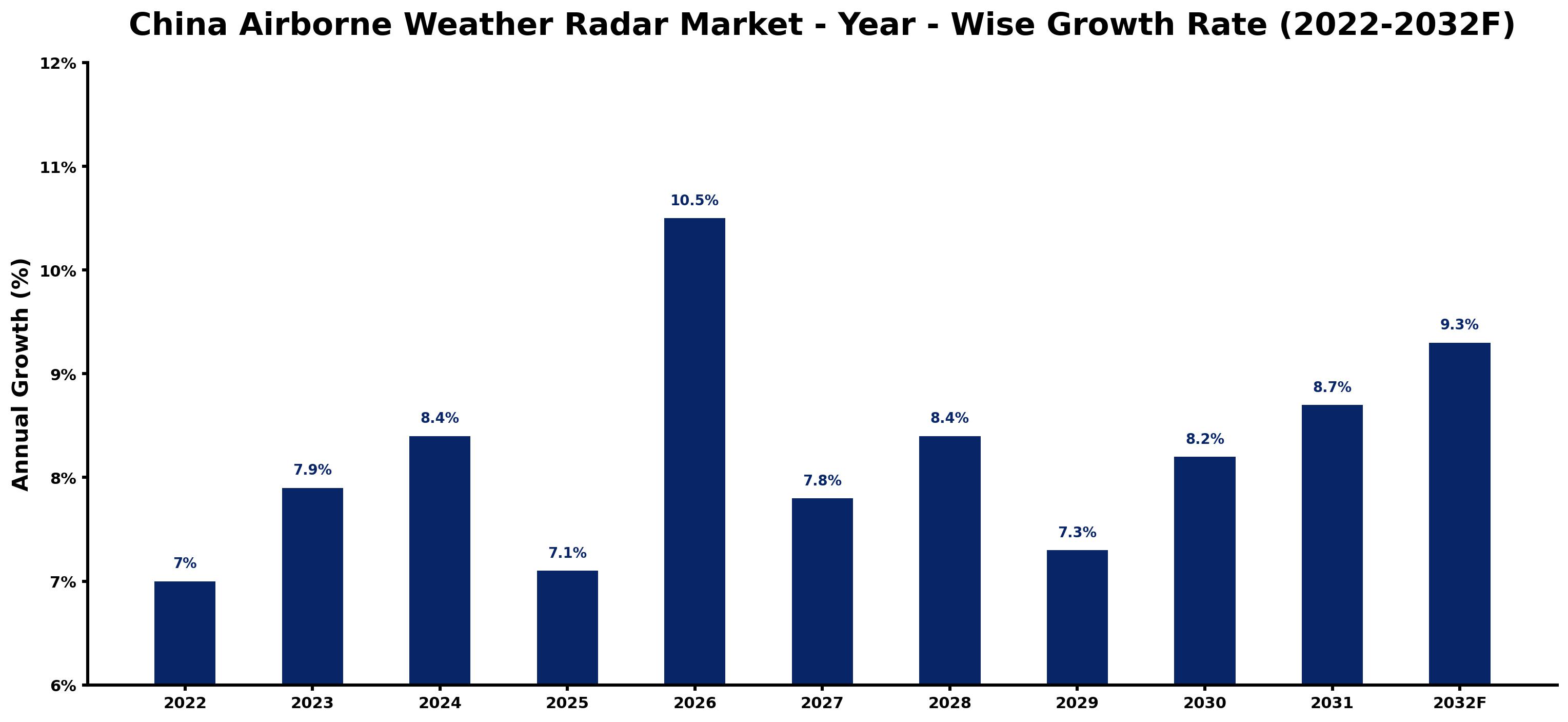
Annual growth estimates for each year appear below with the principal reason behind them, explaining the shifts that set the pace of the market.
| Year | Estimated Annual Growth (%) | Market Rationale |
| 2022 | 7.0 | The market experienced steady growth, supported by ongoing aviation safety improvements mandated by the Civil Aviation Administration. |
| 2023 | 7.9 | Demand increased due to the implementation of advanced radar technologies in commercial aviation, improving operational safety. |
| 2024 | 8.4 | Growth accelerated as the Civil Aviation Administration mandated enhanced radar systems for all commercial flights. |
| 2025 | 7.1 | A slight slowdown occurred as the market adjusted following rapid expansion in previous years. |
| 2026 | 10.5 | The market is expected to rebound with significant investments in radar technology upgrades from the Aerospace Industry Association. |
| 2027 | 7.8 | Growth is projected to slow as the market stabilises after a peak in demand for radar systems. |
| 2028 | 8.4 | Demand is expected to increase again due to rising meteorological data requirements from the National Meteorological Center. |
| 2029 | 7.3 | A slowdown is anticipated as the market adjusts to previous growth rates and demand stabilises. |
| 2030 | 8.2 | Growth is projected to resume as new radar technologies enter the market, improving capabilities. |
| 2031 | 8.7 | Demand will continue to rise with ongoing investments in aviation safety and radar technology. |
| 2032 | 9.3 | The market is expected to grow further, driven by technological advancements in radar systems. |
Note: Market size estimations and growth projections presented in this report are based on 6Wresearch's proprietary forecasting methodology, utilizing the latest available industry data, government publications, and primary research inputs.
China Airborne Weather Radar Market Synopsis
The Airborne Weather Radar Market in China encompasses systems designed for detecting and tracking weather phenomena from aircraft. These systems improve flight safety, provide real-time data to pilots, and support meteorological research. The market is growing due to increasing demand from commercial airlines and government agencies, with over 300 airports equipped with these systems. In 2023, radar data utilization for forecasting rose by 15%, reflecting the need for improved aviation safety measures and accurate weather information.
Market Dynamics Impact Analysis (2026–2032)
| Factor | Type | Impact | Primary Segment Affected |
| Increasing investments in radar technology upgrades | Driver | High | Pulse-Doppler Radar |
| Growing demand for accurate weather data in aviation | Driver | High | Dual-Polarization Radar |
| Investment opportunities in radar manufacturing | Opportunity | High | C-band |
| Expansion of meteorological services in rural areas | Opportunity | Medium | Meteorological Agencies |
| High costs associated with advanced radar systems | Restraint | High | Solid-State Radar |
| Limited integration of new technologies in existing systems | Restraint | Medium | Phased Array Radar |
| Challenges in meeting regulatory standards for radar systems | Challenge | High | Aviation Equipment Vendors |
| Competition from alternative weather tracking technologies | Challenge | Medium | Commercial Airlines |
Evaluation of Drivers in China Airborne Weather Radar Market (2026–2032)
The table below links each growth driver to the segment it affects and the evidence for it.
| Drivers | Primary Segment Affected | Why It Matters (Evidence) |
| Increased funding for radar technology improvements | Pulse-Doppler Radar | The Ministry of Industry and Information Technology allocated 500 million yuan to enhance radar technologies, prompting manufacturers to invest in advanced systems. |
| Rising demand from commercial aviation | Commercial Airlines | With over 300 commercial airports, the need for improved flight safety measures drives airlines to purchase advanced radar systems. |
| Technological advancements in radar systems | Dual-Polarization Radar | The National Standard of China mandates upgrades, leading to increased purchases as manufacturers enhance their offerings. |
| Expansion of meteorological services | Meteorological Agencies | The 2023 National Weather Service Program aims to improve radar coverage, resulting in higher demand for accurate weather data. |
| Growing investments in radar manufacturing | Aerospace Integrators | New manufacturing facilities in Guangdong are set to enhance production efficiency, supporting increased supply for the aviation sector. |
Market growth in China for Airborne Weather Radar rests on increased funding, rising end-use demand, and technological advancements. In 2022, substantial financial resources were allocated to improve radar technologies, which spurred demand from manufacturers. The expansion of commercial aviation infrastructure, with over 300 airports, has further stimulated investments in integrated radar systems.
Evaluation of Restraints in China Airborne Weather Radar Market
The following restraints limit how fast demand can grow.
| Market Restraint | Primary Segment Affected | Why It Matters (Evidence) |
| Intense competition from domestic manufacturers | Radar OEMs | Domestic manufacturers offer lower prices, impacting procurement decisions for buyers seeking cost-effective solutions. |
| Supply chain disruptions due to component reliance | Solid-State Radar | Dependence on specific components can cause delays in deployment for government agencies and aviation operators. |
| Technological upgrade requirements for existing systems | Pulse-Doppler Radar | Many existing radar systems require costly upgrades to meet the latest standards, increasing operational costs for users. |
| Limited awareness of advanced radar capabilities | Dual-Polarization Radar | Some potential buyers may not fully understand the benefits of advanced radar technologies, hindering adoption rates. |
| Regulatory compliance costs for manufacturers | X-band | Manufacturers face high costs associated with meeting stringent regulatory standards for radar systems. |
China Airborne Weather Radar Market Challenges
Buyers and suppliers in the China Airborne Weather Radar market encounter fierce competition as domestic manufacturers offer lower prices, prompting aviation operators to reassess procurement strategies. This competitive environment stems from the rapid growth of local production capabilities, which can prolong decision-making processes for buyers. Technological challenges persist, as many existing systems require upgrades to comply with the National Standard of China, resulting in higher operational costs for aviation operators. Supply chain disruptions frequently arise due to reliance on specific components, causing deployment delays for government agencies and ultimately affecting flight safety measures.
Trends in the China Airborne Weather Radar Market
Below mentioned are some of the trends shaping the China Airborne Weather Radar Market growth.
- Shift from Traditional to Advanced Radar Technologies: China is moving from traditional radar systems to advanced technologies like Dual-Polarization Radar. This transition began in 2022, driven by the demand for more accurate weather data, with a 15% increase in data utilisation reported in 2023.
- Increasing Integration of Radar Systems in Commercial Aviation: The integration of advanced radar systems in commercial aviation is becoming more common, especially in the Beijing-Tianjin-Hebei region. This trend is supported by regulations that require enhanced radar capabilities.
- Focus on Meteorological Research and Data Accuracy: The push for improved meteorological research has led to greater investment in radar technologies. The modernisation programme aims to upgrade 200 radar stations by 2025, improving data accuracy.
- Expansion of Radar Manufacturing Facilities in Guangdong: Guangdong is experiencing significant investment in radar manufacturing facilities, driven by the demand for advanced radar systems. This trend is expected to enhance production efficiency and meet growing market needs.
Investment Opportunities in the China Airborne Weather Radar Market
The following opportunities in the China Airborne Weather Radar Market pair current demand with a clear way in.
- Supply of Advanced Radar Systems: The demand for advanced radar systems is on the rise, particularly in the aviation sector. With over 300 airports in China, suppliers can collaborate with aviation equipment vendors to satisfy this demand.
- Investment in Radar Technology Upgrades: This is an ideal time for investments in radar technology upgrades, with a projected market size of USD 1,027.98 million by 2032. Partnering with aerospace integrators can ease market entry.
- Expansion of Manufacturing Facilities: There is a gap in manufacturing capacity for radar systems, especially in Guangdong. Suppliers can invest in local manufacturing facilities to address the increasing demand for advanced technologies.
- Partnerships for Meteorological Research Initiatives: Collaborating with meteorological agencies presents a valuable opportunity for suppliers. The modernisation programme aims to enhance radar capabilities, creating a demand for advanced systems.
Government Initiatives in the China Airborne Weather Radar Market
The Ministry of Industry and Information Technology oversees the 'Aerospace Development Plan', which focuses on enhancing radar technologies with a budget of 500 million yuan. This plan directly impacts Airborne Weather Radar producers by promoting technological advancements and encouraging investment in new systems. Additionally, the Civil Aviation Administration updated the 'Aviation Safety Regulations' in 2021 to mandate the use of advanced radar systems in commercial aviation, ensuring that all new aircraft are equipped with the latest technology.
The National Meteorological Center administers the 'Weather Radar Modernization Program', which aims to upgrade 200 radar stations by 2025. This program is essential for improving data accuracy and forecasting capabilities in the meteorological sector. Furthermore, the Ministry of Science and Technology initiated the 'National Radar Technology Innovation Strategy' in 2023 to support research and development in radar systems, fostering innovation and enhancing the capabilities of radar technologies in China.
Future Insight of the China Airborne Weather Radar Market
Several forward-looking factors are expected to support the China Airborne Weather Radar market in the coming years. The national plan launched in 2022 aims to improve meteorological services, driving demand for sophisticated radar systems. By 2023, radar data utilization for forecasting increased significantly, reflecting a rising need for accurate weather information. Investments in radar technology research will boost system capabilities, while new manufacturing facilities in Guangdong are set to enhance production efficiency and bolster the aviation sector.
Market Segmentation Analysis
The analysis below covers each segmentation, its leading category in 2025 and its fastest-growing category through 2032.
By Radar Type – Pulse-Doppler Radar Dominated, Dual-Polarization Radar Expected to Grow Fastest
According to Shubham Padhi, Research Analyst at 6Wresearch, the largest radar type category in 2025 was Pulse-Doppler Radar, with a 41% share of total revenue. Pulse-Doppler Radar leads the market share in China as it is crucial for precise weather tracking and turbulence detection, particularly in busy airspaces. Its extensive use in the Beijing-Tianjin-Hebei region highlights its importance for ensuring aviation safety. Dual-Polarization Radar is projected to grow fastest, at a CAGR of 10.5% during 2026–2032. The growth of Dual-Polarization Radar is propelled by its ability to enhance precipitation measurement accuracy, vital for meteorological agencies. The reported 15% increase in radar data utilisation for forecasting in 2023 indicates a rising demand for this technology. Suppliers should focus on advancing Dual-Polarization Radar to meet the growing requirements of meteorological agencies.
By Frequency Band – X-band Dominated, C-band Expected to Grow Fastest
X-band held a 42% share of the China Airborne Weather Radar Market by frequency band in 2025. X-band radar holds the largest market share due to its effectiveness in short-range weather observation, making it essential for commercial airports across China. Its prevalent use in coastal regions, where accurate weather data is critical, reinforces its dominant position. The quickest growth will come from C-band, forecast to expand at a CAGR of 10.6% between 2026 and 2032. C-band radar is experiencing rapid growth as it is increasingly recognised for its suitability in medium-range weather monitoring, essential for enhancing flight safety. The national plan initiated in 2022 to improve meteorological services supports this segment's expansion. Buyers should consider investing in C-band radar systems to leverage enhanced medium-range weather monitoring capabilities.
By Distribution Channel – Radar OEMs Dominated, Aerospace Integrators Expected to Grow Fastest
In 2025, Radar OEMs led the distribution channel split with a 39% share. Radar OEMs command the largest market share as they are the primary manufacturers of radar systems tailored for aviation, ensuring compliance with safety standards. Their established relationships with commercial airlines further strengthen their market position. Aerospace Integrators are set to record the highest CAGR in this split, 11.1% over 2026–2032. Aerospace Integrators are the fastest-growing segment due to their essential role in integrating radar systems into aircraft, improving operational efficiency. Ongoing investments in aviation technology in regions like Shanghai are driving this growth. Suppliers should partner with aerospace integrators to expand their market reach and enhance product offerings.
By End User – Commercial Airlines Dominated, Meteorological Agencies Expected to Grow Fastest
Commercial Airlines took a 37% share of end user in 2025, more than any other category. Commercial Airlines dominate the market share as they rely heavily on radar systems for safe flight operations and effective weather avoidance. The widespread deployment of these systems across over 300 commercial airports in China underscores their critical role. Over 2026–2032, Meteorological Agencies are expected to post the fastest growth, at a CAGR of 9.7%. Meteorological Agencies are experiencing the fastest growth, driven by their increasing dependence on radar data for accurate weather forecasting and research. The China Meteorological Administration's investment in upgrading radar networks in 2021 exemplifies this trend. Suppliers should tailor their solutions to meet the specific needs of meteorological agencies to capture this growing market.
Key Attractiveness of the Report
- 10 Years of Market Numbers
- Historical Data Starting from 2022 to 2025
- Base Year 2025
- Forecast Data until 2032
- Key Performance Indicators Impacting the Market
- Major Upcoming Developments and Projects
Key Highlights of the Report:
- China Airborne Weather Radar Market Outlook
- Market Size of China Airborne Weather Radar Market, 2025
- Forecast of China Airborne Weather Radar Market, 2032
- Historical Data and Forecast of China Airborne Weather Radar Revenues & Volume for the Period 2022 - 2032F
- China Airborne Weather Radar Market Trend Evolution
- China Airborne Weather Radar Market Drivers and Challenges
- China Airborne Weather Radar Price Trends
- China Airborne Weather Radar Porter's Five Forces
- China Airborne Weather Radar Industry Life Cycle
- Historical Data and Forecast of China Airborne Weather Radar Market Revenues & Volume By Radar Type for the Period 2022 - 2032F
- Historical Data and Forecast of China Airborne Weather Radar Market Revenues & Volume By Pulse-Doppler Radar for the Period 2022 - 2032F
- Historical Data and Forecast of China Airborne Weather Radar Market Revenues & Volume By Dual-Polarization Radar for the Period 2022 - 2032F
- Historical Data and Forecast of China Airborne Weather Radar Market Revenues & Volume By Phased Array Radar for the Period 2022 - 2032F
- Historical Data and Forecast of China Airborne Weather Radar Market Revenues & Volume By Solid-State Radar for the Period 2022 - 2032F
- Historical Data and Forecast of China Airborne Weather Radar Market Revenues & Volume By Frequency Band for the Period 2022 - 2032F
- Historical Data and Forecast of China Airborne Weather Radar Market Revenues & Volume By X-band for the Period 2022 - 2032F
- Historical Data and Forecast of China Airborne Weather Radar Market Revenues & Volume By C-band for the Period 2022 - 2032F
- Historical Data and Forecast of China Airborne Weather Radar Market Revenues & Volume By S-band for the Period 2022 - 2032F
- Historical Data and Forecast of China Airborne Weather Radar Market Revenues & Volume By L-band for the Period 2022 - 2032F
- Historical Data and Forecast of China Airborne Weather Radar Market Revenues & Volume By Distribution Channel for the Period 2022 - 2032F
- Historical Data and Forecast of China Airborne Weather Radar Market Revenues & Volume By Radar OEMs for the Period 2022 - 2032F
- Historical Data and Forecast of China Airborne Weather Radar Market Revenues & Volume By Aviation Equipment Vendors for the Period 2022 - 2032F
- Historical Data and Forecast of China Airborne Weather Radar Market Revenues & Volume By Aerospace Integrators for the Period 2022 - 2032F
- Historical Data and Forecast of China Airborne Weather Radar Market Revenues & Volume By Online Aviation Suppliers for the Period 2022 - 2032F
- Historical Data and Forecast of China Airborne Weather Radar Market Revenues & Volume By End User for the Period 2022 - 2032F
- Historical Data and Forecast of China Airborne Weather Radar Market Revenues & Volume By Commercial Airlines for the Period 2022 - 2032F
- Historical Data and Forecast of China Airborne Weather Radar Market Revenues & Volume By Meteorological Agencies for the Period 2022 - 2032F
- Historical Data and Forecast of China Airborne Weather Radar Market Revenues & Volume By Defense Aviation Units for the Period 2022 - 2032F
- Historical Data and Forecast of China Airborne Weather Radar Market Revenues & Volume By Helicopter Operators for the Period 2022 - 2032F
- China Airborne Weather Radar Import Export Trade Statistics
- Market Opportunity Assessment By Radar Type
- Market Opportunity Assessment By Frequency Band
- Market Opportunity Assessment By Distribution Channel
- Market Opportunity Assessment By End User
- China Airborne Weather Radar Top Companies Market Share
- China Airborne Weather Radar Competitive Benchmarking By Technical and Operational Parameters
- China Airborne Weather Radar Company Profiles
- China Airborne Weather Radar Key Strategic Recommendations
Market Covered
This report examines the market across the segments below.
By Radar Type
- Pulse-Doppler Radar
- Dual-Polarization Radar
- Phased Array Radar
- Solid-State Radar
By Frequency Band
- X-band
- C-band
- S-band
- L-band
By Distribution Channel
- Radar OEMs
- Aviation Equipment Vendors
- Aerospace Integrators
- Online Aviation Suppliers
By End User
- Commercial Airlines
- Meteorological Agencies
- Defense Aviation Units
- Helicopter Operators































