China Aircraft Automation Systems Market Size & Growth Rate
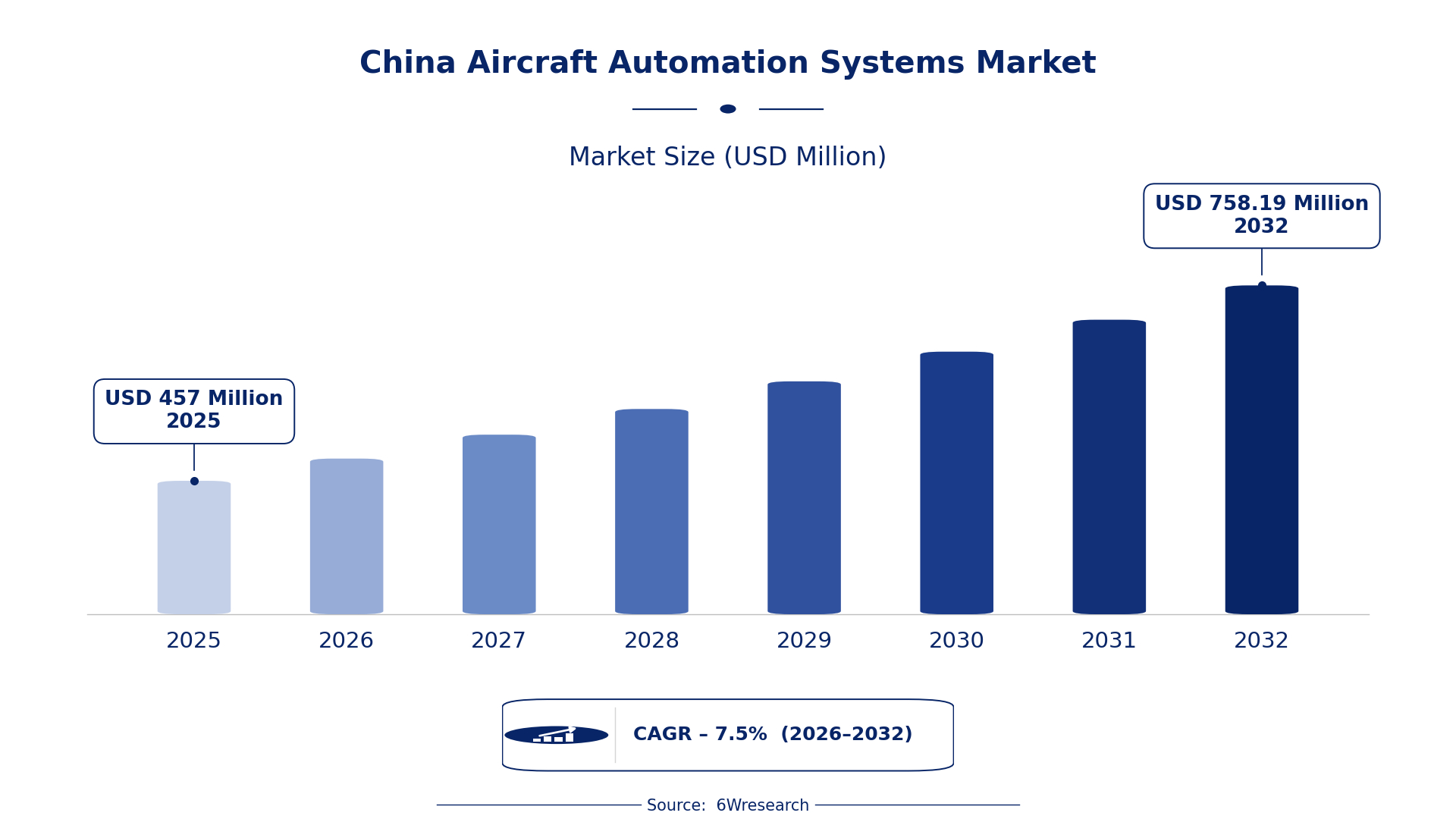
According to 6Wresearch internal database and industry insights, the China Aircraft Automation Systems Market was valued at USD 457.0 million in 2025 and is projected to reach USD 758.19 million by 2032, growing at a CAGR of approximately 7.5% during 2026–2032.
China Aircraft Automation Systems Market Highlights
| Report Metric | Details |
| Report Name | China Aircraft Automation Systems Market |
| Market Size 2025 | USD 457.0 million |
| Market Size 2032 | USD 758.19 million |
| Absolute Growth 2025–2032 | USD 301.19 million |
| CAGR 2026–2032 | 7.5% |
| Peak Annual Growth | 9.6% in 2028 |
| Forecast Period | 2026–2032 |
| Historical Data | 2022–2025 |
| Base Year | 2025 |
| Leading System Type, 2025 | Autopilot Systems (41% share) |
| Leading Technology Used, 2025 | AI/ML (43% share) |
| Leading Distribution Channel, 2025 | Aircraft System Suppliers (41% share) |
| Leading End User, 2025 | Commercial Jet Manufacturers (47% share) |
| Fastest-Growing System Type | Flight Management Systems (8.9% CAGR) |
| Fastest-Growing Technology Used | Real-Time Data (10.3% CAGR) |
| Fastest-Growing Distribution Channel | OEM Distributors (9.5% CAGR) |
| Fastest-Growing End User | Long-Haul Flight Operators (9.4% CAGR) |
| Growing Sector | aviation |
| Key End Users | Commercial Jet Manufacturers, Long-Haul Flight Operators, Military Aircraft Units |
China Aircraft Automation Systems Market Year-wise Growth Rate and Key Drivers (2022–2032)
This graph illustrates the annual growth rates of the market from 2022 to 2032, highlighting a steady upward trajectory and projected market expansion over the forecast period.
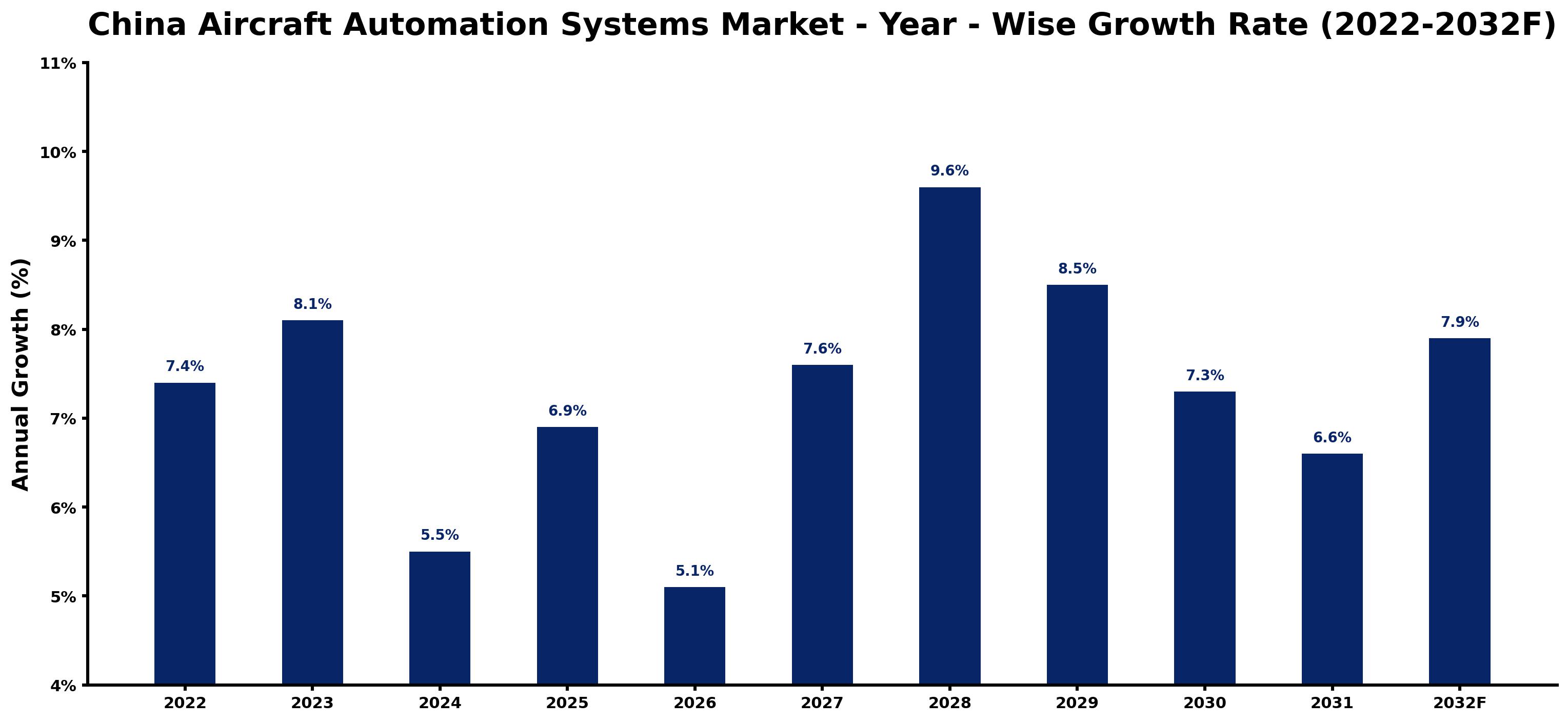
The table below sets out the estimated growth rate for each year and the main factor behind it.
| Year | Estimated Annual Growth (%) | Market Rationale |
| 2022 | 7.4 | The aviation sector experienced steady growth as demand for automation systems increased, driven by the expanding commercial aviation market. |
| 2023 | 8.1 | Growth accelerated due to rising passenger numbers and military expansion in aviation, particularly from the modernization program. |
| 2024 | 5.5 | A slowdown occurred as the market adjusted to previous growth rates and demand stabilised following rapid advancements. |
| 2025 | 6.9 | Demand increased again as investments in modernization and technology upgrades resumed, particularly in the Beijing-Tianjin-Hebei region. |
| 2026 | 5.1 | Growth is expected to slow as the market adjusts after previous peaks in demand, influenced by new regulations from the CAAC. |
| 2027 | 7.6 | A resurgence in demand is projected as technological advancements gain traction, particularly in fault detection systems. |
| 2028 | 9.6 | The market is expected to peak with substantial investments in automation systems and new projects driven by military needs. |
| 2029 | 8.5 | Growth is anticipated to slow slightly as the market adjusts to high demand levels from the previous year, especially in commercial jets. |
| 2030 | 7.3 | Another slowdown is expected as the market continues to stabilise after rapid growth, influenced by integration challenges. |
| 2031 | 6.6 | Demand growth is projected to slow further as the market matures and competition intensifies, particularly among suppliers. |
| 2032 | 7.9 | Growth is expected to rise again as new technologies and standards are adopted, particularly in navigation and guidance. |
Note: Market size estimations and growth projections presented in this report are based on 6Wresearch's proprietary forecasting methodology, utilizing the latest available industry data, government publications, and primary research inputs.
China Aircraft Automation Systems Market Synopsis
The China Aircraft Automation Systems Market includes cutting-edge technologies that improve flight safety and efficiency through the integration of software and hardware. These systems are crucial for functions such as autopilot, navigation assistance, and fault detection. Growth in this market is propelled by the expansion of the aviation sector, which is projected to accommodate 1.3 billion passengers by 2025, alongside investments surpassing 100 billion yuan in aviation technology development since 2020. Additionally, the military's modernisation programme is driving up demand for these automation systems.
Market Dynamics Impact Analysis (2026–2032)
| Factor | Type | Impact | Primary Segment Affected |
| Growing domestic demand for automation in military aviation. | Driver | High | Autopilot Systems |
| Increasing passenger traffic necessitating advanced flight management systems. | Driver | High | Flight Management Systems |
| Investment in R&D for automation technologies is rising. | Opportunity | High | Navigation & Guidance |
| Expansion of aircraft manufacturing facilities in key regions. | Opportunity | High | Fault Detection Systems |
| High costs associated with implementing new technologies. | Restraint | Medium | Autopilot Systems |
| Regulatory compliance requirements can delay system upgrades. | Restraint | Medium | Flight Management Systems |
| Talent shortages in automation technology can hinder development. | Challenge | High | Navigation & Guidance |
| Integration of new technologies into existing systems poses challenges. | Challenge | Medium | Fault Detection Systems |
Evaluation of Drivers in China Aircraft Automation Systems Market (2026–2032)
Below mentioned are some major drivers and their influence on market dynamics.
| Drivers | Primary Segment Affected | Why It Matters (Evidence) |
| Increasing passenger numbers drive demand for automation systems. | Autopilot Systems | China's aviation market is projected to reach 1.3 billion passengers by 2025. |
| Military expansion boosts demand for advanced automation technologies. | Flight Management Systems | The Chinese military's modernization program includes upgrading automation capabilities. |
| Investment in aviation technology improves system capabilities. | Navigation & Guidance | Over 100 billion yuan has been invested in aviation technology development since 2020. |
| Rising safety standards necessitate advanced fault detection systems. | Fault Detection Systems | The Civil Aviation Administration of China implemented new regulations for flight automation systems in 2023. |
| Growing aerospace supply chain focuses on automation and digitization. | Autopilot Systems | The National Development and Reform Commission supports aviation innovation initiatives. |
Market growth for Aircraft Automation Systems in China is supported by rising passenger numbers, military expansion, and considerable investments in aviation technology. The aviation market is set to reach 1.3 billion passengers by 2025, which will increase the demand for automation systems. Since 2020, over 100 billion yuan has been invested in aviation technology development, enhancing system capabilities. In 2023, new standards from the Civil Aviation Administration of China required advanced fault detection systems. The emphasis on automation and digitisation within the aerospace supply chain is boosting demand for sophisticated navigation technologies, especially among commercial jet manufacturers.
Evaluation of Restraints in China Aircraft Automation Systems Market
The table below lists the restraints and the evidence behind each.
| Market Restraint | Primary Segment Affected | Why It Matters (Evidence) |
| High costs associated with implementing new technologies can limit adoption. | Autopilot Systems | Investments in advanced systems can exceed budgets for many manufacturers. |
| Regulatory compliance requirements can delay system upgrades. | Flight Management Systems | New regulations from the Civil Aviation Administration of China require extensive testing. |
| Limited availability of skilled professionals in automation technology affects development. | Navigation & Guidance | Talent shortages hinder the timely implementation of advanced systems. |
| Integration of new technologies into existing systems poses challenges. | Fault Detection Systems | Legacy systems may not support new automation technologies effectively. |
| Market competition can drive prices down, impacting profitability. | Autopilot Systems | Increased competition among suppliers may lead to reduced margins. |
China Aircraft Automation Systems Market Challenges
The China Aircraft Automation Systems Market faces practical challenges. A lack of skilled workers in aviation technology leads to production delays of up to 20% for manufacturers, significantly raising operational costs. Rapid technological advancements create integration hurdles for suppliers, resulting in non-compliance with new regulations and potentially jeopardising safety for operators. Intense competition among domestic manufacturers drives prices down, which can squeeze profit margins for producers and restrict their capacity to invest in new developments. Buyers often struggle to source reliable automation solutions, as inconsistent quality can increase maintenance costs by 10%.
Trends in the China Aircraft Automation Systems Market
Several trends are reshaping the China Aircraft Automation Systems Market; the most important are set out below.
- Shift Towards Advanced Flight Management Systems: Long-Haul Flight Operators are increasingly embracing advanced flight management systems to boost efficiency. In 2023, the CAAC initiated a pilot programme integrating AI into these systems, highlighting a growing trend in automation.
- Transition to Advanced Navigation Technologies: The Aerospace Innovation Action Plan launched by the Ministry of Industry and Information Technology in 2022 encourages the adoption of advanced navigation technologies. This shift is apparent as Real-Time Data systems are anticipated to grow at a CAGR of 10.3%.
- Emergence of Smart Aviation Solutions: The Beijing-Tianjin-Hebei region is evolving into a centre for smart aviation solutions. With over 50 operational airports equipped with advanced automation systems, the region is at the forefront of technological adoption.
- Focus on Automation in Military Aviation: China's military aviation sector is prioritising improvements in automation. The modernisation programme includes substantial investments, with a budget exceeding 100 billion yuan since 2020.
Investment Opportunities in the China Aircraft Automation Systems Market
Investors looking at the China Aircraft Automation Systems Market should consider the following areas.
- Joint Ventures for Technology Development: Collaborating with local firms in the Tianjin Free Trade Zone can ease market entry. This region promotes foreign investment in aviation technology, presenting a timely opportunity as demand rises.
- Supplying Advanced Fault Detection Systems: With the CAAC's new regulations, there is an increasing need for advanced fault detection systems. Suppliers can target Commercial Jet Manufacturers, who are progressively investing in compliance.
- Investing in Navigation Technologies: Now is an opportune moment to invest in navigation technologies, as the market is expected to grow. Long-Haul Flight Operators are actively searching for innovative solutions to improve operational efficiency.
- Expanding into the Guangdong Province: The Guangdong province is a key hub for aircraft system suppliers. Establishing a presence here can provide access to a growing market, particularly with the anticipated increase in demand.
Government Initiatives in the China Aircraft Automation Systems Market
In 2021, the Civil Aviation Administration of China (CAAC) launched the "14th Five-Year Plan for Civil Aviation Development" to enhance automation and safety in aviation. This plan mandates upgrades in automation systems, ensuring adherence to new safety standards. The initiative aims to improve operational efficiency across the aviation sector, benefiting both manufacturers and operators. In 2023, the CAAC updated the "Regulations on the Management of Civil Aviation Equipment" to incorporate new standards for automation systems, further supporting compliance and safety.
The Ministry of Industry and Information Technology oversees the "Aerospace Innovation Action Plan," which advocates for advanced automation technologies in aircraft manufacturing. This initiative supports funding for research and development projects aimed at improving automation capabilities, focusing on cooperation between military and civilian sectors. The National Development and Reform Commission also announced a funding programme in 2022 to support R&D in aviation automation technologies, with a budget of 2 billion yuan, enabling manufacturers to enhance their systems.
Future Insight of the China Aircraft Automation Systems Market
The Aircraft Automation Systems market in China is set for substantial transformations by 2032, with a focus on government support and technological advancements. The Civil Aviation Administration of China plans to introduce new regulations aimed at improving safety and operational efficiency. The establishment of 10 new aerospace research centres by 2025 will allow suppliers to innovate and refine their product offerings. With over 100 billion yuan invested in aviation technology development since 2020, buyers can expect more advanced and reliable automation systems in the years to come.
Market Segmentation Analysis
The analysis below covers each segmentation, its leading category in 2025 and its fastest-growing category through 2032.
By System Type – Autopilot Systems Dominated, Flight Management Systems Expected to Grow Fastest
According to Shubham Padhi, Research Analyst at 6Wresearch, Autopilot Systems accounted for a 41% market share by system type in 2025. Autopilot Systems hold the largest share in the China Aircraft Automation Systems Market due to their critical role in ensuring safe and efficient automated flight control. The Civil Aviation Administration of China requires their implementation in commercial aircraft, leading to widespread adoption across the aviation sector. The quickest growth will come from Flight Management Systems, forecast to expand at a CAGR of 8.9% between 2026 and 2032. Flight Management Systems are experiencing the fastest growth as airlines increasingly prioritise optimising flight operations through advanced technologies. The CAAC's recent pilot program for integrating AI in these systems indicates a rising demand for innovation in this area. Suppliers should focus on enhancing their flight management system offerings to capture the growing market share.
By Technology Used – AI/ML Dominated, Real-Time Data Expected to Grow Fastest
With a 43% revenue share in 2025, AI/ML was the largest technology used category. AI/ML technology leads the market by significantly improving the capabilities of aircraft automation systems, which enhances overall performance and safety. The investment of over 100 billion yuan in aviation technology development since 2020 has accelerated the adoption of these solutions across the industry. Real-Time Data is projected to grow fastest, at a CAGR of 10.3% during 2026–2032. Real-Time Data is the fastest-growing technology segment, driven by the increasing need for timely decision-making in aviation operations. The integration of real-time data analytics in flight management systems underscores its essential role in modern aviation practices. Buyers should seek suppliers that provide robust real-time data solutions to maintain a competitive edge.
By Distribution Channel – Aircraft System Suppliers Dominated, OEM Distributors Expected to Grow Fastest
In 2025, Aircraft System Suppliers led the distribution channel split with a 41% share. Aircraft System Suppliers dominate the market due to their established relationships with manufacturers and their ability to deliver comprehensive automation solutions. This channel ensures a steady supply of advanced aircraft automation systems, catering to both commercial and military sectors throughout China. OEM Distributors are set to record the highest CAGR in this split, 9.5% over 2026–2032. OEM Distributors are the fastest-growing channel, as they streamline the procurement process for manufacturers upgrading their automation systems. The increase in new aircraft production further fuels this growth, creating additional opportunities for OEMs in the market. Suppliers need to strengthen partnerships with OEM distributors to enhance their market presence and accessibility.
By End User – Commercial Jet Manufacturers Dominated, Long-Haul Flight Operators Expected to Grow Fastest
The largest end user category in 2025 was Commercial Jet Manufacturers, with a 47% share of total revenue. Commercial Jet Manufacturers hold the largest market share, driven by strong demand for new aircraft in China's aviation sector. The projected growth in passenger numbers, expected to reach 1.3 billion by 2025, highlights the importance of this segment in the overall market. Over 2026–2032, Long-Haul Flight Operators are expected to post the fastest growth, at a CAGR of 9.4%. Long-Haul Flight Operators represent the fastest-growing end-user segment as they increasingly adopt advanced automation systems to enhance operational efficiency. The expansion of international routes and rising demand for long-haul travel contribute to this trend. Suppliers should tailor their products to meet the specific needs of long-haul flight operators to capture this expanding market segment.
Key Attractiveness of the Report
- 10 Years of Market Numbers
- Historical Data Starting from 2022 to 2025
- Base Year 2025
- Forecast Data until 2032
- Key Performance Indicators Impacting the Market
- Major Upcoming Developments and Projects
Key Highlights of the Report:
- China Aircraft Automation Systems Market Outlook
- Market Size of China Aircraft Automation Systems Market, 2025
- Forecast of China Aircraft Automation Systems Market, 2032
- Historical Data and Forecast of China Aircraft Automation Systems Revenues & Volume for the Period 2022 - 2032F
- China Aircraft Automation Systems Market Trend Evolution
- China Aircraft Automation Systems Market Drivers and Challenges
- China Aircraft Automation Systems Price Trends
- China Aircraft Automation Systems Porter's Five Forces
- China Aircraft Automation Systems Industry Life Cycle
- Historical Data and Forecast of China Aircraft Automation Systems Market Revenues & Volume By System Type for the Period 2022 - 2032F
- Historical Data and Forecast of China Aircraft Automation Systems Market Revenues & Volume By Autopilot Systems for the Period 2022 - 2032F
- Historical Data and Forecast of China Aircraft Automation Systems Market Revenues & Volume By Flight Management Systems for the Period 2022 - 2032F
- Historical Data and Forecast of China Aircraft Automation Systems Market Revenues & Volume By Navigation & Guidance for the Period 2022 - 2032F
- Historical Data and Forecast of China Aircraft Automation Systems Market Revenues & Volume By Fault Detection Systems for the Period 2022 - 2032F
- Historical Data and Forecast of China Aircraft Automation Systems Market Revenues & Volume By Technology Used for the Period 2022 - 2032F
- Historical Data and Forecast of China Aircraft Automation Systems Market Revenues & Volume By AI/ML for the Period 2022 - 2032F
- Historical Data and Forecast of China Aircraft Automation Systems Market Revenues & Volume By Real-Time Data for the Period 2022 - 2032F
- Historical Data and Forecast of China Aircraft Automation Systems Market Revenues & Volume By Satellite-Linked for the Period 2022 - 2032F
- Historical Data and Forecast of China Aircraft Automation Systems Market Revenues & Volume By Predictive Analytics for the Period 2022 - 2032F
- Historical Data and Forecast of China Aircraft Automation Systems Market Revenues & Volume By Distribution Channel for the Period 2022 - 2032F
- Historical Data and Forecast of China Aircraft Automation Systems Market Revenues & Volume By Aircraft System Suppliers for the Period 2022 - 2032F
- Historical Data and Forecast of China Aircraft Automation Systems Market Revenues & Volume By OEM Distributors for the Period 2022 - 2032F
- Historical Data and Forecast of China Aircraft Automation Systems Market Revenues & Volume By Government Vendors for the Period 2022 - 2032F
- Historical Data and Forecast of China Aircraft Automation Systems Market Revenues & Volume By Avionics Integrators for the Period 2022 - 2032F
- Historical Data and Forecast of China Aircraft Automation Systems Market Revenues & Volume By End User for the Period 2022 - 2032F
- Historical Data and Forecast of China Aircraft Automation Systems Market Revenues & Volume By Commercial Jet Manufacturers for the Period 2022 - 2032F
- Historical Data and Forecast of China Aircraft Automation Systems Market Revenues & Volume By Long-Haul Flight Operators for the Period 2022 - 2032F
- Historical Data and Forecast of China Aircraft Automation Systems Market Revenues & Volume By Military Aircraft Units for the Period 2022 - 2032F
- Historical Data and Forecast of China Aircraft Automation Systems Market Revenues & Volume By Cargo Aircraft Manufacturers for the Period 2022 - 2032F
- China Aircraft Automation Systems Import Export Trade Statistics
- Market Opportunity Assessment By System Type
- Market Opportunity Assessment By Technology Used
- Market Opportunity Assessment By Distribution Channel
- Market Opportunity Assessment By End User
- China Aircraft Automation Systems Top Companies Market Share
- China Aircraft Automation Systems Competitive Benchmarking By Technical and Operational Parameters
- China Aircraft Automation Systems Company Profiles
- China Aircraft Automation Systems Key Strategic Recommendations
Market Covered
The report offers an extensive study of the following market segments.
By System Type
- Autopilot Systems
- Flight Management Systems
- Navigation & Guidance
- Fault Detection Systems
By Technology Used
- AI/ML
- Real-Time Data
- Satellite-Linked
- Predictive Analytics
By Distribution Channel
- Aircraft System Suppliers
- OEM Distributors
- Government Vendors
- Avionics Integrators
By End User
- Commercial Jet Manufacturers
- Long-Haul Flight Operators
- Military Aircraft Units
- Cargo Aircraft Manufacturers































