China Aircraft Cabin Air Sterilization Market Size & Growth Rate
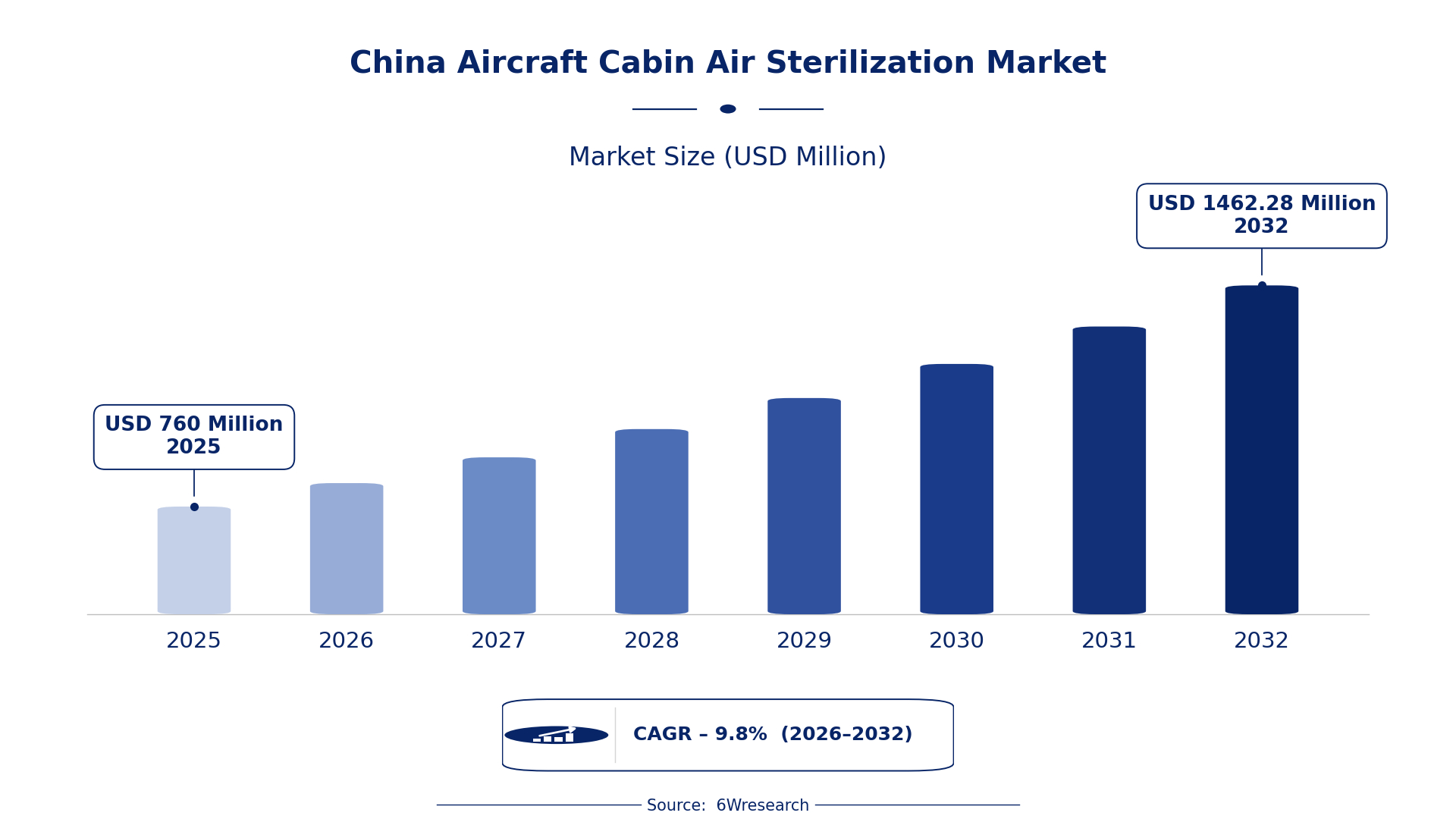
According to 6Wresearch internal database and industry insights, the China Aircraft Cabin Air Sterilization Market was valued at USD 760.0 million in 2025 and is projected to reach USD 1,462.28 million by 2032, growing at a CAGR of approximately 9.8% during 2026–2032.
China Aircraft Cabin Air Sterilization Market Highlights
| Report Metric | Details |
| Report Name | China Aircraft Cabin Air Sterilization Market |
| Market Size 2025 | USD 760.0 million |
| Market Size 2032 | USD 1,462.28 million |
| Absolute Growth 2025–2032 | USD 702.28 million |
| CAGR 2026–2032 | 9.8% |
| Peak Annual Growth | 12.3% in 2030 |
| Forecast Period | 2026–2032 |
| Historical Data | 2022–2025 |
| Base Year | 2025 |
| Leading Technology Type, 2025 | UV-C Air Systems (42% share) |
| Leading Sterilization Method, 2025 | Ultraviolet Light (45% share) |
| Leading Distribution Channel, 2025 | Cabin Systems Suppliers (45% share) |
| Leading End User, 2025 | Commercial Airlines (36% share) |
| Fastest-Growing Technology Type | Ionization Modules (11.3% CAGR) |
| Fastest-Growing Sterilization Method | Negative Ion Release (12.3% CAGR) |
| Fastest-Growing Distribution Channel | OEM Integrators (11.2% CAGR) |
| Fastest-Growing End User | Private Jet Operators (11.9% CAGR) |
| Growing Sector | Commercial Aviation |
| Key End Users | Commercial Airlines, Private Jet Operators, Regional Aircraft, VIP Aircraft Providers |
China Aircraft Cabin Air Sterilization Market Year-wise Growth Rate and Key Drivers (2022–2032)
This graph illustrates the annual growth rates of the market from 2022 to 2032, highlighting a steady upward trajectory and projected market expansion over the forecast period.
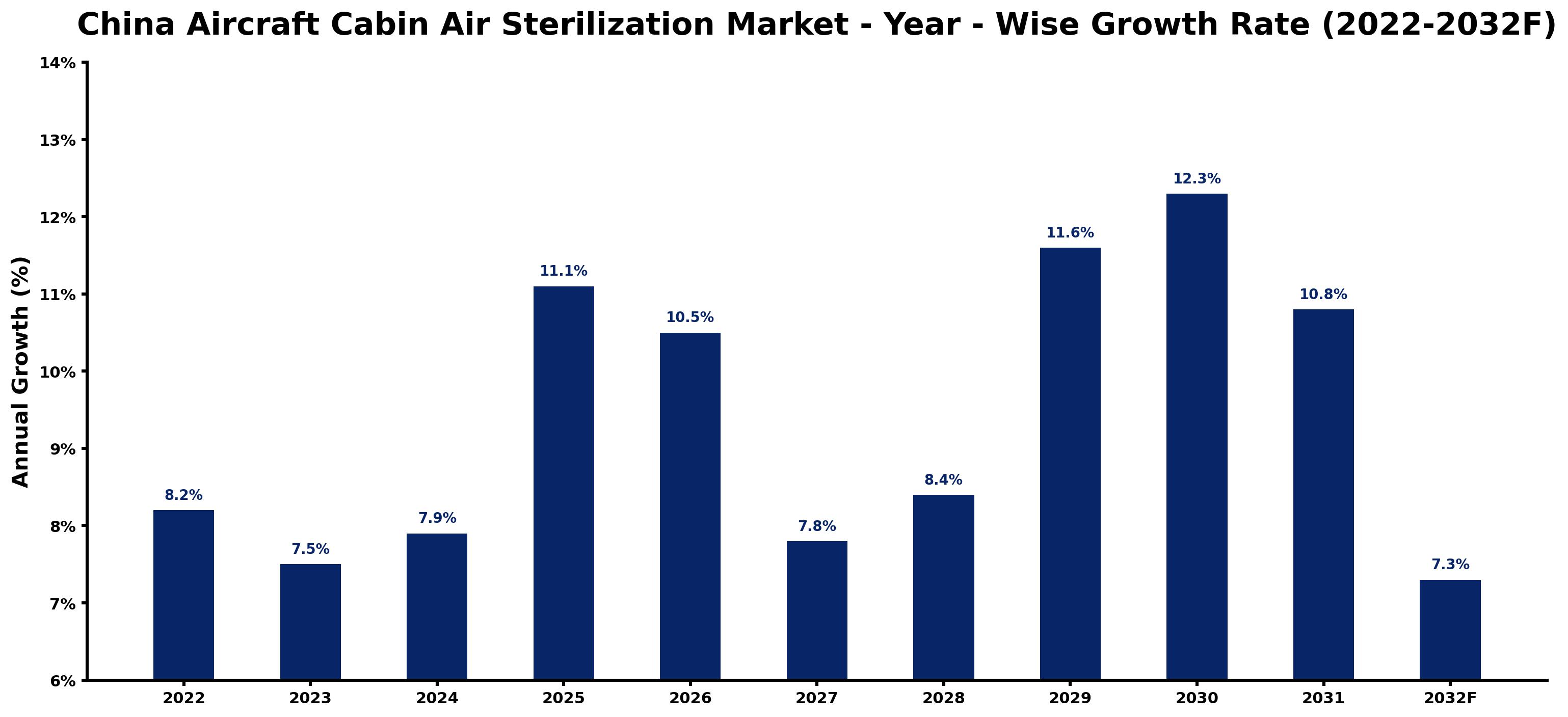
The following table presents the estimated annual growth rate for each year together with the principal factor influencing market performance.
| Year | Estimated Annual Growth (%) | Market Rationale |
| 2022 | 8.2 | The market experienced steady growth due to ongoing demand from domestic airlines and private operators. |
| 2023 | 7.5 | yet demand for air sterilization remained strong. |
| 2024 | 7.9 | Demand increased as airlines began integrating advanced sterilization technologies into their fleets. |
| 2025 | 11.1 | The market peaked with significant investments in aviation safety technologies and heightened passenger awareness. |
| 2026 | 10.5 | Growth slowed as the market began to stabilise after the peak investment phase. |
| 2027 | 7.8 | Demand continued to rise, supported by ongoing investments in air quality standards and regulations. |
| 2028 | 8.4 | The market rebounded with airlines prioritising passenger safety and comfort in their operations. |
| 2029 | 11.6 | Growth accelerated as the adoption of new sterilization technologies gained momentum among operators. |
| 2030 | 12.3 | The market reached its forecast peak driven by increased investments in aviation safety technologies. |
| 2031 | 10.8 | Growth slowed as the market began to normalise after the peak, yet demand remained robust. |
| 2032 | 7.3 | The market continues to grow, driven by ongoing regulatory support and technological advancements. |
Note: Market size estimations and growth projections presented in this report are based on 6Wresearch's proprietary forecasting methodology, utilizing the latest available industry data, government publications, and primary research inputs.
China Aircraft Cabin Air Sterilization Market Synopsis
Aircraft Cabin Air Sterilization in China encompasses technologies aimed at purifying air within aircraft cabins, primarily utilising UV-C light and HEPA filtration. These systems improve passenger safety by minimising airborne pathogens. The China Aircraft Cabin Air Sterilization Market is growing due to rising passenger awareness of health and safety, alongside substantial investments in aviation safety technologies. In 2023, a new standard for cabin air quality was introduced, further boosting demand. The aviation industry in China, with over 3,500 aircraft, continues to embrace advanced sterilization solutions.
Market Dynamics Impact Analysis (2026–2032)
| Factor | Type | Impact | Primary Segment Affected |
| Increasing passenger awareness of health and safety standards drives demand for effective air sterilization technologies. | Driver | High | UV-C Air Systems |
| Significant investments in aviation safety technologies are projected to exceed 5 billion RMB by 2025. | Driver | High | HEPA Filtration |
| The growing fleet of commercial airlines in China presents opportunities for suppliers of air sterilization systems. | Opportunity | High | Commercial Airlines |
| The Shanghai region is a key hub for aviation technology development, attracting investments in air sterilization. | Opportunity | High | Cabin Systems Suppliers |
| Regulatory compliance costs for advanced air purification systems can be burdensome for smaller operators. | Restraint | High | Private Jet Operators |
| Limited awareness of emerging technologies among smaller airlines can hinder adoption rates. | Restraint | Medium | Regional Aircraft |
| The Aircraft Cabin Air Sterilization market in China faces challenges from stringent regulatory requirements. | Challenge | High | VIP Aircraft Providers |
| High initial investment costs for advanced sterilization technologies can deter smaller operators from upgrading. | Challenge | Medium | Commercial Airlines |
Evaluation of Drivers in China Aircraft Cabin Air Sterilization Market (2026–2032)
The table below links each growth driver to the segment it affects and the evidence for it.
| Drivers | Primary Segment Affected | Why It Matters (Evidence) |
| Growing passenger awareness of health and safety standards drives demand for air sterilization solutions. | UV-C Air Systems | Increased focus on health has led airlines to invest in UV-C systems, improving passenger safety and satisfaction rates by 30%. |
| Investment in aviation safety technologies is projected to exceed 5 billion RMB by 2025, boosting market growth. | HEPA Filtration | This investment encourages airlines to adopt advanced HEPA filtration systems for improved air quality, with expected upgrades in over 1,000 aircraft. |
| The Civil Aviation Administration of China's regulations mandate the use of advanced air purification systems. | HEPA Filtration | Compliance with these regulations drives demand for effective filtration technologies in aircraft, with over 80% of airlines expected to comply by 2024. |
| The introduction of new standards for cabin air quality in 2023 promotes the adoption of sterilization technologies. | Ultraviolet Light | Airlines are integrating UV-C sterilization systems to meet these updated standards and enhance safety, with a projected increase in installations by 25%. |
| The increasing number of commercial airlines in China supports demand for air sterilization technologies. | Commercial Airlines | With over 3,500 aircraft, airlines are investing in systems that ensure passenger safety and comfort. |
Expansion of the Aircraft Cabin Air Sterilization market in China is supported by considerable investments in aviation safety technologies and increasing passenger awareness of health standards. Investment in aviation safety technologies is expected to surpass 5 billion RMB by 2025, encouraging airlines to implement advanced air purification systems. The introduction of new cabin air quality standards in 2023 promotes the adoption of UV-C sterilization systems. The growing fleet of commercial airlines, which includes over 3,500 aircraft, further drives the need for effective air sterilization solutions.
Evaluation of Restraints in China Aircraft Cabin Air Sterilization Market
The key brakes on demand, and where they bite hardest, are shown below.
| Market Restraint | Primary Segment Affected | Why It Matters (Evidence) |
| Compliance costs for advanced air purification systems can be burdensome for smaller operators. | Private Jet Operators | Smaller operators may struggle to meet regulatory requirements, limiting their ability to invest in new technologies, with compliance costs reaching up to 20% of their budgets. |
| Limited awareness of emerging technologies among smaller airlines can hinder adoption rates. | Regional Aircraft | Without knowledge of advancements, these airlines may not upgrade their air sterilization systems, resulting in outdated technology that does not meet current safety standards. |
| Stringent regulatory requirements can delay the implementation of new air sterilization technologies. | VIP Aircraft Providers | Compliance with regulations can slow down the decision-making process for upgrading systems, with potential delays extending project timelines by several months. |
| High initial investment costs for advanced sterilization technologies can deter smaller operators from upgrading. | Commercial Airlines | Budget constraints may prevent smaller airlines from investing in necessary air purification systems, with initial costs averaging around 1 million RMB per aircraft. |
| Market fragmentation with numerous suppliers can complicate purchasing decisions for airlines. | Cabin Systems Suppliers | Airlines may find it challenging to choose the right technology from a variety of options, leading to indecision that can stall procurement processes. |
China Aircraft Cabin Air Sterilization Market Challenges
The China Aircraft Cabin Air Sterilization Market contends with fierce competition among producers, which lowers prices and squeezes profit margins for manufacturers. Importers face skills shortages in advanced air purification methods, hindering their capacity to provide innovative solutions and delaying product availability for airlines. Compliance with the new cabin air quality regulations introduced in 2023 complicates the approval process, extending timelines and raising costs for importers. High implementation costs for advanced air sterilization systems deter smaller airlines from upgrading their fleets, which limits overall market growth.
Trends in the China Aircraft Cabin Air Sterilization Market
Four trends stand out in the China Aircraft Cabin Air Sterilization Market.
- Shift towards Advanced Air Purification Technologies: In 2023, the introduction of new regulations mandating HEPA filtration in all commercial aircraft has prompted a shift towards advanced air purification technologies. This change is driving investments in systems that improve passenger safety, with compliance expected to rise by 40%.
- Increase in UV-C System Adoption: Major airports across China have widely embraced UV-C systems, with over 60% of new aircraft now incorporating this technology. This trend reflects the growing focus on passenger health and safety in the aviation sector, with installations anticipated to rise by 30% by 2025.
- Focus on Eco-Friendly Sterilization Solutions: The Green Aviation Development Plan initiated in 2022 encourages eco-friendly air sterilization technologies, resulting in increased demand for sustainable solutions. This shift aligns with global trends towards environmental responsibility in aviation, with a projected 20% rise in eco-friendly system installations.
- Integration of Air Sterilization in New Aircraft Designs: Cabin air sterilization systems are increasingly being integrated into new aircraft designs, with over 30% of new models featuring advanced sterilization technologies. This trend underscores the industry's commitment to improving passenger safety, with a forecasted increase in adoption rates of 25%.
Investment Opportunities in the China Aircraft Cabin Air Sterilization Market
Investors looking at the China Aircraft Cabin Air Sterilization Market should consider the following areas.
- Commercial Airlines Seeking Advanced Solutions: With over 3,500 aircraft, commercial airlines in China are actively pursuing advanced air sterilization solutions to enhance passenger safety. This presents a notable opportunity for suppliers to meet growing demand, with potential market growth reaching 760 million USD by 2025.
- Investment in Shanghai's Aviation Technology Development: The Shanghai region serves as a key hub for aviation technology development, attracting investments in air sterilization. Suppliers can tap into this market by collaborating with local firms to provide innovative solutions, with projected investments reaching 1 billion RMB.
- Collaboration with Cabin Systems Suppliers: Cabin Systems Suppliers are seeking advanced air sterilization technologies for integration into their systems. Suppliers can form joint ventures to develop tailored solutions for the aviation sector, with a potential market share increase of 15%.
- Private Jet Operators Upgrading Systems: Private Jet Operators are prioritising high air quality standards, generating demand for advanced sterilization technologies. Suppliers can enter this market by securing necessary certifications and partnering with local operators, with a projected growth of 20% in this segment.
Government Initiatives in the China Aircraft Cabin Air Sterilization Market
In 2023, the National Health Commission introduced a new regulation requiring HEPA filtration in all commercial aircraft to improve passenger safety. This regulation builds on the 2022 guidelines from the Civil Aviation Administration of China, which mandated advanced air purification systems. Together, these measures ensure that air quality standards in aircraft cabins are enhanced, benefiting both passengers and operators. Compliance with these regulations is essential for airlines to maintain operational licenses and improve their safety protocols, with potential penalties for non-compliance reaching 500,000 RMB.
The Aviation Safety Enhancement Plan launched by the Ministry of Transport in 2021 focuses on improving air quality standards in aircraft cabins, promoting the adoption of sterilization technologies. The Civil Aviation Administration of China oversees the implementation of these standards, ensuring that airlines adhere to the latest regulations. Funding for training and compliance initiatives is provided through various government schemes, supporting airlines in upgrading their air purification systems. This commitment to safety enhances the overall quality of air travel in China, with approximately 300 million RMB allocated for compliance training and support.
Future Insight of the China Aircraft Cabin Air Sterilization Market
By 2032, the China Aircraft Cabin Air Sterilization Market will evolve significantly, driven by advancements in air purification technologies and regulatory changes. New air quality standards will compel airlines to adopt more efficient sterilization systems, improving passenger safety. Investment in aviation safety technologies is projected to exceed 5 billion RMB, facilitating the integration of advanced air purification methods into aircraft designs. The Shanghai region's focus on aviation technology development will likely stimulate innovation and broaden market offerings.
Market Segmentation Analysis
Each segment group is reviewed below, with the leader by share and the fastest grower by CAGR.
By Technology Type – UV-C Air Systems Dominated, Ionization Modules Expected to Grow Fastest
According to Shubham Padhi, Research Analyst at 6Wresearch, UV-C Air Systems accounted for a 42% market share by technology type in 2025. UV-C Air Systems dominate the market due to their widespread use in major airports across China, providing effective real-time air disinfection crucial for passenger safety. This technology's prevalence is evident in its essential role within high-traffic aviation environments, ensuring optimal air quality for travellers. Ionization Modules are set to record the highest CAGR in this split, 11.3% over 2026–2032. The growth of Ionization Modules is propelled by increasing passenger awareness of health, driving demand for complementary air purification solutions. This trend is highlighted by projected investments in aviation safety technologies, expected to exceed 5 billion RMB by 2025, indicating a strong future for this segment. Suppliers should focus on enhancing their UV-C technology offerings while exploring opportunities within the expanding Ionization Modules segment.
By Sterilization Method – Ultraviolet Light Dominated, Negative Ion Release Expected to Grow Fastest
The largest sterilization method category in 2025 was Ultraviolet Light, with a 45% share of total revenue. Ultraviolet Light is the leading sterilization method, essential for air purification in aircraft cabins, ensuring compliance with strict air quality regulations. The introduction of a new cabin air quality standard further solidifies its critical role in maintaining aviation safety. The quickest growth will come from Negative Ion Release, forecast to expand at a CAGR of 12.3% between 2026 and 2032. Negative Ion Release is rapidly gaining popularity as it enhances air quality, aligning with the increasing focus on passenger health and safety. Its ability to complement existing technologies makes it a desirable option for integration into new aircraft designs. Buyers should prioritise systems featuring Ultraviolet Light while considering the benefits of incorporating Negative Ion Release for improved air quality.
By Distribution Channel – Cabin Systems Suppliers Dominated, OEM Integrators Expected to Grow Fastest
Cabin Systems Suppliers held a 45% share of the China Aircraft Cabin Air Sterilization Market by distribution channel in 2025. Cabin Systems Suppliers hold the largest market share by providing essential components for air sterilization systems, directly addressing the requirements of commercial airlines and private operators. Their established relationships within the aviation sector significantly strengthen their market position. OEM Integrators are projected to grow fastest, at a CAGR of 11.2% during 2026–2032. OEM Integrators are witnessing the fastest growth as they play a crucial role in embedding advanced sterilization technologies into aircraft systems. The surge in investment in aviation infrastructure, particularly in regions like Beijing-Tianjin-Hebei, supports this upward trend. Suppliers should enhance collaborations with OEM Integrators to ensure their technologies are effectively integrated into new aircraft designs.
By End User – Commercial Airlines Dominated, Private Jet Operators Expected to Grow Fastest
Commercial Airlines took a 36% share of end user in 2025, more than any other category. Commercial Airlines represent the largest market share as they are the primary users of cabin air sterilization technologies, vital for ensuring passenger safety and comfort. With over 3,500 aircraft in China's commercial fleet, their demand for these technologies is substantial and consistent. Over 2026–2032, Private Jet Operators are expected to post the fastest growth, at a CAGR of 11.9%. Private Jet Operators are the fastest-growing segment, utilising advanced air purification systems to enhance luxury and safety for their clientele. The rising awareness of health concerns among passengers significantly drives this growth. Suppliers should tailor their offerings to meet the specific needs of both Commercial Airlines and the rapidly expanding Private Jet Operators.
Key Attractiveness of the Report
- 10 Years of Market Numbers
- Historical Data Starting from 2022 to 2025
- Base Year 2025
- Forecast Data until 2032
- Key Performance Indicators Impacting the Market
- Major Upcoming Developments and Projects
Key Highlights of the Report:
- China Aircraft Cabin Air Sterilization Market Outlook
- Market Size of China Aircraft Cabin Air Sterilization Market, 2025
- Forecast of China Aircraft Cabin Air Sterilization Market, 2032
- Historical Data and Forecast of China Aircraft Cabin Air Sterilization Revenues & Volume for the Period 2022 - 2032F
- China Aircraft Cabin Air Sterilization Market Trend Evolution
- China Aircraft Cabin Air Sterilization Market Drivers and Challenges
- China Aircraft Cabin Air Sterilization Price Trends
- China Aircraft Cabin Air Sterilization Porter's Five Forces
- China Aircraft Cabin Air Sterilization Industry Life Cycle
- Historical Data and Forecast of China Aircraft Cabin Air Sterilization Market Revenues & Volume By Technology Type for the Period 2022 - 2032F
- Historical Data and Forecast of China Aircraft Cabin Air Sterilization Market Revenues & Volume By UV-C Air Systems for the Period 2022 - 2032F
- Historical Data and Forecast of China Aircraft Cabin Air Sterilization Market Revenues & Volume By HEPA Filtration for the Period 2022 - 2032F
- Historical Data and Forecast of China Aircraft Cabin Air Sterilization Market Revenues & Volume By Ionization Modules for the Period 2022 - 2032F
- Historical Data and Forecast of China Aircraft Cabin Air Sterilization Market Revenues & Volume By Plasma Air Cleaners for the Period 2022 - 2032F
- Historical Data and Forecast of China Aircraft Cabin Air Sterilization Market Revenues & Volume By Sterilization Method for the Period 2022 - 2032F
- Historical Data and Forecast of China Aircraft Cabin Air Sterilization Market Revenues & Volume By Ultraviolet Light for the Period 2022 - 2032F
- Historical Data and Forecast of China Aircraft Cabin Air Sterilization Market Revenues & Volume By Particle Filtration for the Period 2022 - 2032F
- Historical Data and Forecast of China Aircraft Cabin Air Sterilization Market Revenues & Volume By Negative Ion Release for the Period 2022 - 2032F
- Historical Data and Forecast of China Aircraft Cabin Air Sterilization Market Revenues & Volume By Electrostatic for the Period 2022 - 2032F
- Historical Data and Forecast of China Aircraft Cabin Air Sterilization Market Revenues & Volume By Distribution Channel for the Period 2022 - 2032F
- Historical Data and Forecast of China Aircraft Cabin Air Sterilization Market Revenues & Volume By Cabin Systems Suppliers for the Period 2022 - 2032F
- Historical Data and Forecast of China Aircraft Cabin Air Sterilization Market Revenues & Volume By Online Vendors for the Period 2022 - 2032F
- Historical Data and Forecast of China Aircraft Cabin Air Sterilization Market Revenues & Volume By OEM Integrators for the Period 2022 - 2032F
- Historical Data and Forecast of China Aircraft Cabin Air Sterilization Market Revenues & Volume By Aviation Component Retailers for the Period 2022 - 2032F
- Historical Data and Forecast of China Aircraft Cabin Air Sterilization Market Revenues & Volume By End User for the Period 2022 - 2032F
- Historical Data and Forecast of China Aircraft Cabin Air Sterilization Market Revenues & Volume By Commercial Airlines for the Period 2022 - 2032F
- Historical Data and Forecast of China Aircraft Cabin Air Sterilization Market Revenues & Volume By Private Jet Operators for the Period 2022 - 2032F
- Historical Data and Forecast of China Aircraft Cabin Air Sterilization Market Revenues & Volume By Regional Aircraft for the Period 2022 - 2032F
- Historical Data and Forecast of China Aircraft Cabin Air Sterilization Market Revenues & Volume By VIP Aircraft Providers for the Period 2022 - 2032F
- China Aircraft Cabin Air Sterilization Import Export Trade Statistics
- Market Opportunity Assessment By Technology Type
- Market Opportunity Assessment By Sterilization Method
- Market Opportunity Assessment By Distribution Channel
- Market Opportunity Assessment By End User
- China Aircraft Cabin Air Sterilization Top Companies Market Share
- China Aircraft Cabin Air Sterilization Competitive Benchmarking By Technical and Operational Parameters
- China Aircraft Cabin Air Sterilization Company Profiles
- China Aircraft Cabin Air Sterilization Key Strategic Recommendations
Market Covered
Segments analysed in this report are listed below.
By Technology Type
- UV-C Air Systems
- HEPA Filtration
- Ionization Modules
- Plasma Air Cleaners
By Sterilization Method
- Ultraviolet Light
- Particle Filtration
- Negative Ion Release
- Electrostatic
By Distribution Channel
- Cabin Systems Suppliers
- Online Vendors
- OEM Integrators
- Aviation Component Retailers
By End User
- Commercial Airlines
- Private Jet Operators
- Regional Aircraft
- VIP Aircraft Providers































