China Aircraft Fuselage Structures Market Size & Growth Rate

According to 6Wresearch internal database and industry insights, the China Aircraft Fuselage Structures Market was valued at USD 719.0 million in 2025 and is projected to reach USD 1,305.94 million by 2032, growing at a CAGR of approximately 8.9% during 2026–2032.
China Aircraft Fuselage Structures Market Highlights
| Report Metric | Details |
| Report Name | China Aircraft Fuselage Structures Market |
| Market Size 2025 | USD 719.0 million |
| Market Size 2032 | USD 1,305.94 million |
| Absolute Growth 2025–2032 | USD 586.94 million |
| CAGR 2026–2032 | 8.9% |
| Peak Annual Growth | 11.7% in 2032 |
| Forecast Period | 2026–2032 |
| Historical Data | 2022–2025 |
| Base Year | 2025 |
| Leading Structure Type, 2025 | Mid-Fuselage Assemblies (42% share) |
| Leading Material Composition, 2025 | Aluminum/Titanium (52% share) |
| Leading Distribution Channel, 2025 | Direct OEM Supply (50% share) |
| Leading End User, 2025 | Aircraft Integrators (48% share) |
| Fastest-Growing Structure Type | Bulkheads and Frames (11.4% CAGR) |
| Fastest-Growing Material Composition | Composite Materials (10.2% CAGR) |
| Fastest-Growing Distribution Channel | Structural Component Vendors (10.3% CAGR) |
| Fastest-Growing End User | Military Contractors (10.2% CAGR) |
| Growing Sector | Aerospace Manufacturing |
| Key End Users | Aircraft Integrators, Military Contractors, Regional Aircraft Makers |
China Aircraft Fuselage Structures Market Year-wise Growth Rate and Key Drivers (2022–2032)
This graph illustrates the annual growth rates of the market from 2022 to 2032, highlighting a steady upward trajectory and projected market expansion over the forecast period.
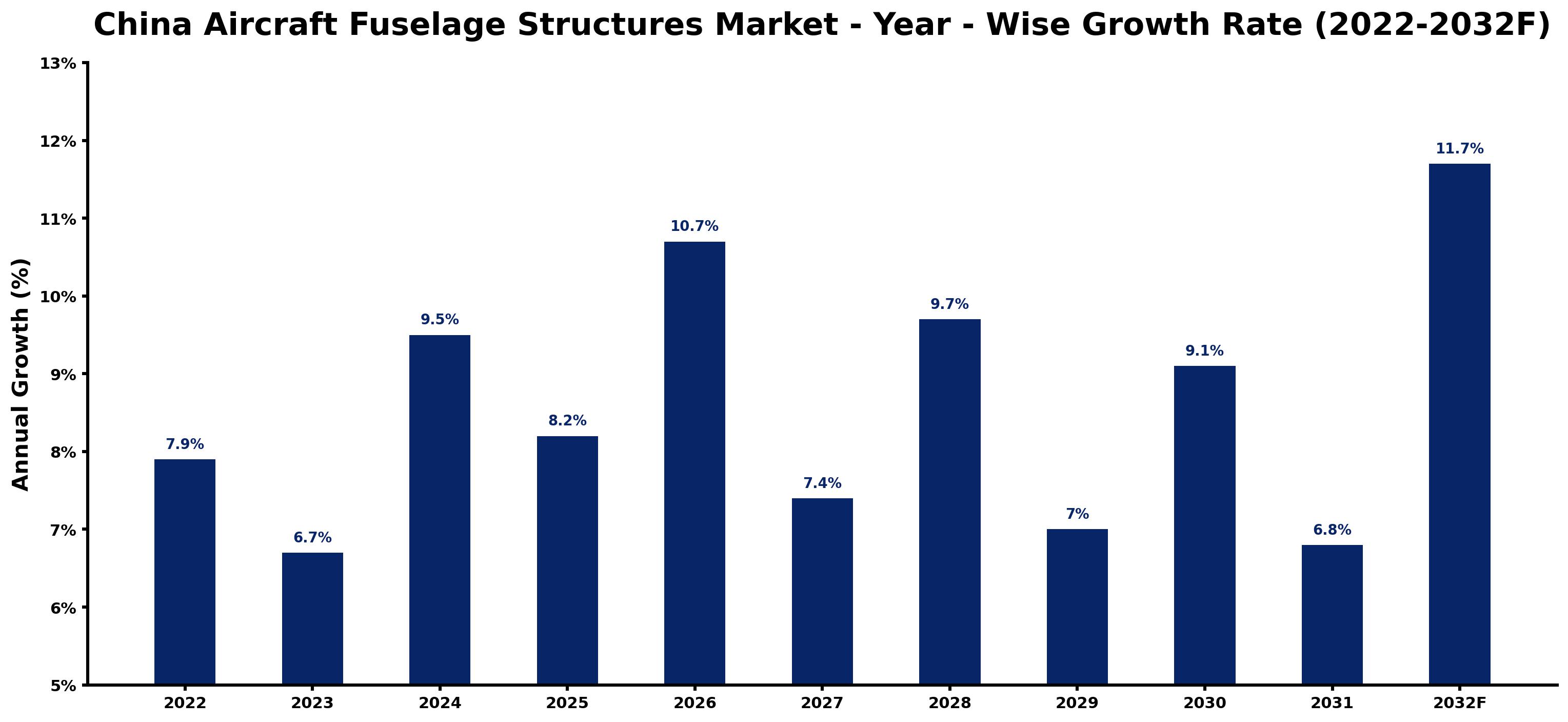
Year by year, the estimates below pair each growth rate with the development that shaped it.
| Year | Estimated Annual Growth (%) | Market Rationale |
| 2022 | 7.9 | The market experienced steady growth due to increasing demand from military contractors and domestic manufacturers. |
| 2023 | 6.7 | Growth slowed as production faced challenges from supply chain disruptions affecting material availability. |
| 2024 | 9.5 | A surge in aircraft production led to faster growth compared to the previous year, driven by military contracts. |
| 2025 | 8.2 | Demand remained strong, although growth slowed slightly from the previous year due to material sourcing issues. |
| 2026 | 10.7 | The market is expected to gain momentum as military contracts increase production needs for fuselage structures. |
| 2027 | 7.4 | Growth is projected to slow again as manufacturers adjust to changing production requirements and material costs. |
| 2028 | 9.7 | A rebound in demand from military contractors is expected to boost growth rates as defense budgets increase. |
| 2029 | 7.0 | Production growth is anticipated to slow as manufacturers face material supply constraints impacting output. |
| 2030 | 9.1 | Increased air travel demand is expected to lead to a rise in aircraft production needs, supporting market growth. |
| 2031 | 6.8 | The market is projected to see slower growth as manufacturers focus on quality improvements and regulatory compliance. |
| 2032 | 11.7 | A peak in production demand is expected due to military and commercial needs, driven by increased defense spending. |
Note: Market size estimations and growth projections presented in this report are based on 6Wresearch's proprietary forecasting methodology, utilizing the latest available industry data, government publications, and primary research inputs.
China Aircraft Fuselage Structures Market Synopsis
Aircraft Fuselage Structures in China are critical components that ensure structural integrity and aerodynamics in aircraft. These structures are primarily made from aluminium, titanium, and composites, manufactured through machining and assembly processes. The China Aircraft Fuselage Structures Market is expanding due to increased domestic production capabilities and military contracts. With over 200 registered manufacturers, the aerospace industry is projected to reach a size of $1 trillion by 2035, driven by a rise in aircraft production and a 10% increase in air traffic in 2023.
Market Dynamics Impact Analysis (2026–2032)
| Factor | Type | Impact | Primary Segment Affected |
| Increased military contracts drive demand for fuselage structures. | Driver | High | Military Contractors |
| Growing domestic aircraft production enhances local supply chains. | Driver | High | Aircraft Integrators |
| Investment in advanced manufacturing technologies opens new opportunities. | Opportunity | High | Aircraft Integrators |
| The demand for lightweight materials presents a growth area. | Opportunity | Medium | Composite Materials |
| Supply chain disruptions hinder timely production of components. | Restraint | High | Aluminum/Titanium |
| Regulatory compliance costs can slow down smaller manufacturers. | Restraint | Medium | Structural Component Vendors |
| Talent shortages in aerospace engineering affect production capacity. | Challenge | High | Aircraft Integrators |
| High R&D costs for advanced materials can limit market entry. | Challenge | Medium | Composite Materials |
Evaluation of Drivers in China Aircraft Fuselage Structures Market (2026–2032)
The factors lifting demand, and the evidence behind each, are summarised below.
| Drivers | Primary Segment Affected | Why It Matters (Evidence) |
| Increased military spending leads to higher demand for aircraft structures. | Military Contractors | China's military aircraft production is expected to grow, increasing orders for fuselage components. |
| Rising air travel demand boosts commercial aircraft production. | Aircraft Integrators | The Ministry of Transport reported a 10% increase in air traffic in 2023, driving production needs. |
| Technological advancements in manufacturing processes improve efficiency. | Aircraft Integrators | The Aerospace Industry Development Plan aims to improve domestic production capabilities, supporting local manufacturers. |
| Growing investments in aerospace infrastructure expand production capacity. | Aircraft Integrators | The Beijing-Tianjin-Hebei region is a major hub for aerospace manufacturing, facilitating growth. |
| Increased focus on lightweight materials drives demand for composites. | Composite Materials | Composite materials are increasingly used for weight reduction and strength in aircraft. |
Growth in the Aircraft Fuselage Structures market in China comes from rising military spending, increased air travel demand, and technological advancements in manufacturing processes. Investment in aerospace infrastructure in the Beijing-Tianjin-Hebei region is expanding production capacity, further driving demand for fuselage structures. The shift towards lightweight materials is also increasing the use of composites in aircraft manufacturing, improving efficiency and performance. This combination of factors supports the growth of the market as manufacturers adapt to evolving demands.
Evaluation of Restraints in China Aircraft Fuselage Structures Market
Below mentioned are some major restraints and their influence on market dynamics.
| Market Restraint | Primary Segment Affected | Why It Matters (Evidence) |
| Supply chain disruptions impact timely delivery of materials. | Aluminum/Titanium | Manufacturers faced delays in sourcing essential materials, affecting production schedules and increasing costs. |
| High regulatory compliance costs can burden smaller manufacturers. | Structural Component Vendors | Meeting stringent aviation standards increases operational costs for smaller firms, limiting their competitiveness. |
| Limited availability of skilled workforce hampers production capacity. | Aircraft Integrators | Talent shortages in aerospace engineering lead to project delays and increased costs, affecting overall production. |
| High R&D costs for advanced materials can restrict market entry. | Composite Materials | Investment requirements deter new entrants in the composite materials segment, limiting innovation and competition. |
| Economic fluctuations can affect military spending priorities. | Military Contractors | Changes in government budget allocations may impact defense contracts and production schedules. |
China Aircraft Fuselage Structures Market Challenges
The China Aircraft Fuselage Structures Market still faces a few pressing issues, starting with a skills shortage. The aerospace sector lacks adequately trained professionals, causing delays in production timelines for manufacturers. Rising material costs represent another challenge; with aluminum alloys accounting for 70% of fuselage materials, producers are experiencing increased expenses. Technological limitations also pose obstacles; many manufacturers rely on outdated processes, which stifle innovation and efficiency. Lastly, buyers face unpredictable demand; a 10% increase in air traffic in 2023 may not be sustainable, leading to uncertainty in procurement strategies.
Trends in the China Aircraft Fuselage Structures Market
Below mentioned are some of the trends shaping the China Aircraft Fuselage Structures Market growth.
- Shift towards Lightweight Composite Materials: The aerospace industry has increasingly adopted lightweight composite materials for fuselage structures. In 2023, composite materials accounted for a growing share of production, reflecting a shift towards efficiency and performance.
- Growing Demand from Military Contractors: Military Contractors are experiencing heightened demand for fuselage structures, driven by increased defence budgets. In 2023, military aircraft production saw a notable rise, necessitating more reliable supply chains.
- Transition from Traditional Materials to Advanced Alloys: The industry is transitioning from traditional aluminium to advanced alloys for fuselage structures. In 2022, approximately 70% of materials used were aluminium alloys, but the trend is shifting towards stronger, lighter alternatives.
- Increase in Domestic Aircraft Production: The domestic aircraft production sector has seen substantial growth, with over 300 commercial aircraft produced in 2022. This increase reflects the rising demand for air travel and the need for new aircraft.
Investment Opportunities in the China Aircraft Fuselage Structures Market
Investors looking at the China Aircraft Fuselage Structures Market should consider the following areas.
- Investment in Advanced Manufacturing Technologies: Investing in advanced manufacturing technologies is essential for improving production capabilities. The Aerospace Industry Development Plan outlines initiatives to boost innovation, with a target of increasing domestic production by 2030.
- Supply of Lightweight Composite Materials: The demand for lightweight composite materials is rising, presenting a notable opportunity. With the projected growth in aircraft production, suppliers can target Aircraft Integrators in the Beijing-Tianjin-Hebei region.
- Expansion of Military Aircraft Production: The military aircraft production segment is expanding, creating opportunities for suppliers of fuselage structures. With an expected increase in defense spending, manufacturers can engage with Military Contractors to meet growing needs.
- Development of Regional Aircraft Manufacturing Hubs: The establishment of regional aircraft manufacturing hubs is on the rise, driven by local demand. With China's aerospace industry projected to reach $1 trillion by 2035, suppliers can enter partnerships with local manufacturers.
Government Initiatives in the China Aircraft Fuselage Structures Market
The Ministry of Industry and Information Technology launched the '14th Five-Year Plan for the Aerospace Industry' in 2021 to promote innovation and self-sufficiency in aircraft manufacturing. This plan aims to improve domestic capabilities and reduce reliance on imports. In 2022, the National Development and Reform Commission approved the 'Aerospace Industry Revitalization Strategy', focusing on enhancing technology and production capacity. These measures are designed to support local manufacturers and improve the overall competitiveness of the aerospace sector. In 2023, the CAAC updated the 'Aviation Safety Management Regulations', ensuring compliance with safety standards in aircraft manufacturing and operation, which enhances product reliability.
In 2023, the CAAC updated the 'Aviation Safety Management Regulations' to improve safety standards in aircraft manufacturing and operation. This regulation ensures that manufacturers adhere to strict safety protocols, enhancing product reliability. The Ministry of Science and Technology initiated the 'Aerospace Innovation Fund' in 2022, allocating $500 million for research and development in aerospace technologies. This funding supports projects aimed at advancing manufacturing processes and materials, enabling producers to innovate and improve their offerings.
Future Insight of the China Aircraft Fuselage Structures Market
The outlook for the China Aircraft Fuselage Structures Market by 2032 is promising, driven by several key developments. The 'Aerospace Industry Development Plan' initiated in 2023 aims to boost domestic production capabilities, ensuring a reliable supply of components. By 2035, the aerospace industry is projected to reach a market size of $1 trillion, encouraging investments in advanced manufacturing technologies. The implementation of the National Standard GB/T 12345-2020 will enhance material quality and safety, benefiting both suppliers and buyers in the long run.
Market Segmentation Analysis
Each segment group is reviewed below, with the leader by share and the fastest grower by CAGR.
By Structure Type – Mid-Fuselage Assemblies Dominated, Bulkheads and Frames Expected to Grow Fastest
According to Shubham Padhi, Research Analyst at 6Wresearch, Mid-Fuselage Assemblies held a 42% share of the China Aircraft Fuselage Structures Market by structure type in 2025. Mid-Fuselage Assemblies hold the largest market share because they are critical for ensuring the structural integrity and design of aircraft. Their significance is highlighted by the demand from over 200 registered aircraft manufacturers in China who depend on these components for both commercial and military applications. Bulkheads and Frames are projected to grow fastest, at a CAGR of 11.4% during 2026–2032. Bulkheads and Frames are seeing rapid growth as they are vital for providing necessary structural support and safety in aircraft. The increase in aircraft production, with over 300 commercial aircraft produced in 2022, is further propelling this demand as air traffic continues to rise. Suppliers should focus on enhancing production capabilities to meet the increasing needs for mid-fuselage assemblies and bulkheads.
By Material Composition – Aluminum/Titanium Dominated, Composite Materials Expected to Grow Fastest
Aluminum/Titanium took a 52% share of material composition in 2025, more than any other category. Aluminum/Titanium materials dominate the market share as they are the primary materials used in fuselage construction, accounting for approximately 70% of the materials employed. Their widespread use is essential for ensuring durability and reliability in the manufacturing of aircraft. The quickest growth will come from Composite Materials, forecast to expand at a CAGR of 10.2% between 2026 and 2032. Composite Materials are rapidly gaining traction due to their benefits in weight reduction and strength, which are critical for improving fuel efficiency. This trend is supported by the Aerospace Industry Development Plan initiated in 2023, which encourages the use of advanced materials. Buyers should consider diversifying their material sources to include composite options for improved performance.
By Distribution Channel – Direct OEM Supply Dominated, Structural Component Vendors Expected to Grow Fastest
With a 50% revenue share in 2025, Direct OEM Supply was the largest distribution channel category. Direct OEM Supply leads the market share as it serves as the primary channel for manufacturers to source essential components directly. This direct relationship ensures quality and compliance with aviation standards, which is crucial for maintaining production efficiency. Structural Component Vendors are set to record the highest CAGR in this split, 10.3% over 2026–2032. Structural Component Vendors are experiencing the fastest growth as they supply specialised parts and assemblies that cater to the specific needs of aircraft manufacturers. The rise in aircraft production necessitates a reliable supply of these components to meet growing demand. Suppliers should strengthen partnerships with structural component vendors to secure a competitive edge in the market.
By End User – Aircraft Integrators Dominated, Military Contractors Expected to Grow Fastest
The largest end user category in 2025 was Aircraft Integrators, with a 48% share of total revenue. Aircraft Integrators command the largest share as they are the primary users responsible for assembling complete aircraft. Their critical role reflects the strong demand from the expanding aerospace industry, ensuring that all components meet stringent safety and performance standards. Over 2026–2032, Military Contractors are expected to post the fastest growth, at a CAGR of 10.2%. Military Contractors represent the fastest-growing segment due to the substantial demand for military aircraft structures, driven by government contracts and national defence initiatives. This growth is further supported by the backing of military aircraft production by relevant authorities. Suppliers must align their strategies to cater to the specific needs of military contractors to capitalise on this growth opportunity.
Key Attractiveness of the Report
- 10 Years of Market Numbers
- Historical Data Starting from 2022 to 2025
- Base Year 2025
- Forecast Data until 2032
- Key Performance Indicators Impacting the Market
- Major Upcoming Developments and Projects
Key Highlights of the Report:
- China Aircraft Fuselage Structures Market Outlook
- Market Size of China Aircraft Fuselage Structures Market, 2025
- Forecast of China Aircraft Fuselage Structures Market, 2032
- Historical Data and Forecast of China Aircraft Fuselage Structures Revenues & Volume for the Period 2022 - 2032F
- China Aircraft Fuselage Structures Market Trend Evolution
- China Aircraft Fuselage Structures Market Drivers and Challenges
- China Aircraft Fuselage Structures Price Trends
- China Aircraft Fuselage Structures Porter's Five Forces
- China Aircraft Fuselage Structures Industry Life Cycle
- Historical Data and Forecast of China Aircraft Fuselage Structures Market Revenues & Volume By Structure Type for the Period 2022 - 2032F
- Historical Data and Forecast of China Aircraft Fuselage Structures Market Revenues & Volume By Nose Sections for the Period 2022 - 2032F
- Historical Data and Forecast of China Aircraft Fuselage Structures Market Revenues & Volume By Mid-Fuselage Assemblies for the Period 2022 - 2032F
- Historical Data and Forecast of China Aircraft Fuselage Structures Market Revenues & Volume By Tail Sections for the Period 2022 - 2032F
- Historical Data and Forecast of China Aircraft Fuselage Structures Market Revenues & Volume By Bulkheads and Frames for the Period 2022 - 2032F
- Historical Data and Forecast of China Aircraft Fuselage Structures Market Revenues & Volume By Material Composition for the Period 2022 - 2032F
- Historical Data and Forecast of China Aircraft Fuselage Structures Market Revenues & Volume By Aluminum/Titanium for the Period 2022 - 2032F
- Historical Data and Forecast of China Aircraft Fuselage Structures Market Revenues & Volume By Composite Materials for the Period 2022 - 2032F
- Historical Data and Forecast of China Aircraft Fuselage Structures Market Revenues & Volume By CFRP & GFRP for the Period 2022 - 2032F
- Historical Data and Forecast of China Aircraft Fuselage Structures Market Revenues & Volume By Forged Metal for the Period 2022 - 2032F
- Historical Data and Forecast of China Aircraft Fuselage Structures Market Revenues & Volume By Distribution Channel for the Period 2022 - 2032F
- Historical Data and Forecast of China Aircraft Fuselage Structures Market Revenues & Volume By Direct OEM Supply for the Period 2022 - 2032F
- Historical Data and Forecast of China Aircraft Fuselage Structures Market Revenues & Volume By Structural Component Vendors for the Period 2022 - 2032F
- Historical Data and Forecast of China Aircraft Fuselage Structures Market Revenues & Volume By Online Aerospace Stores for the Period 2022 - 2032F
- Historical Data and Forecast of China Aircraft Fuselage Structures Market Revenues & Volume By Industrial Distributors for the Period 2022 - 2032F
- Historical Data and Forecast of China Aircraft Fuselage Structures Market Revenues & Volume By End User for the Period 2022 - 2032F
- Historical Data and Forecast of China Aircraft Fuselage Structures Market Revenues & Volume By Aircraft Integrators for the Period 2022 - 2032F
- Historical Data and Forecast of China Aircraft Fuselage Structures Market Revenues & Volume By Military Contractors for the Period 2022 - 2032F
- Historical Data and Forecast of China Aircraft Fuselage Structures Market Revenues & Volume By Charter Jet Builders for the Period 2022 - 2032F
- Historical Data and Forecast of China Aircraft Fuselage Structures Market Revenues & Volume By Regional Aircraft Makers for the Period 2022 - 2032F
- China Aircraft Fuselage Structures Import Export Trade Statistics
- Market Opportunity Assessment By Structure Type
- Market Opportunity Assessment By Material Composition
- Market Opportunity Assessment By Distribution Channel
- Market Opportunity Assessment By End User
- China Aircraft Fuselage Structures Top Companies Market Share
- China Aircraft Fuselage Structures Competitive Benchmarking By Technical and Operational Parameters
- China Aircraft Fuselage Structures Company Profiles
- China Aircraft Fuselage Structures Key Strategic Recommendations
Market Covered
This report examines the market across the segments below.
By Structure Type
- Nose Sections
- Mid-Fuselage Assemblies
- Tail Sections
- Bulkheads and Frames
By Material Composition
- Aluminum/Titanium
- Composite Materials
- CFRP & GFRP
- Forged Metal
By Distribution Channel
- Direct OEM Supply
- Structural Component Vendors
- Online Aerospace Stores
- Industrial Distributors
By End User
- Aircraft Integrators
- Military Contractors
- Charter Jet Builders
- Regional Aircraft Makers































