China Business Intelligence and Analytics Software Market Size & Growth Rate (2026-2032)
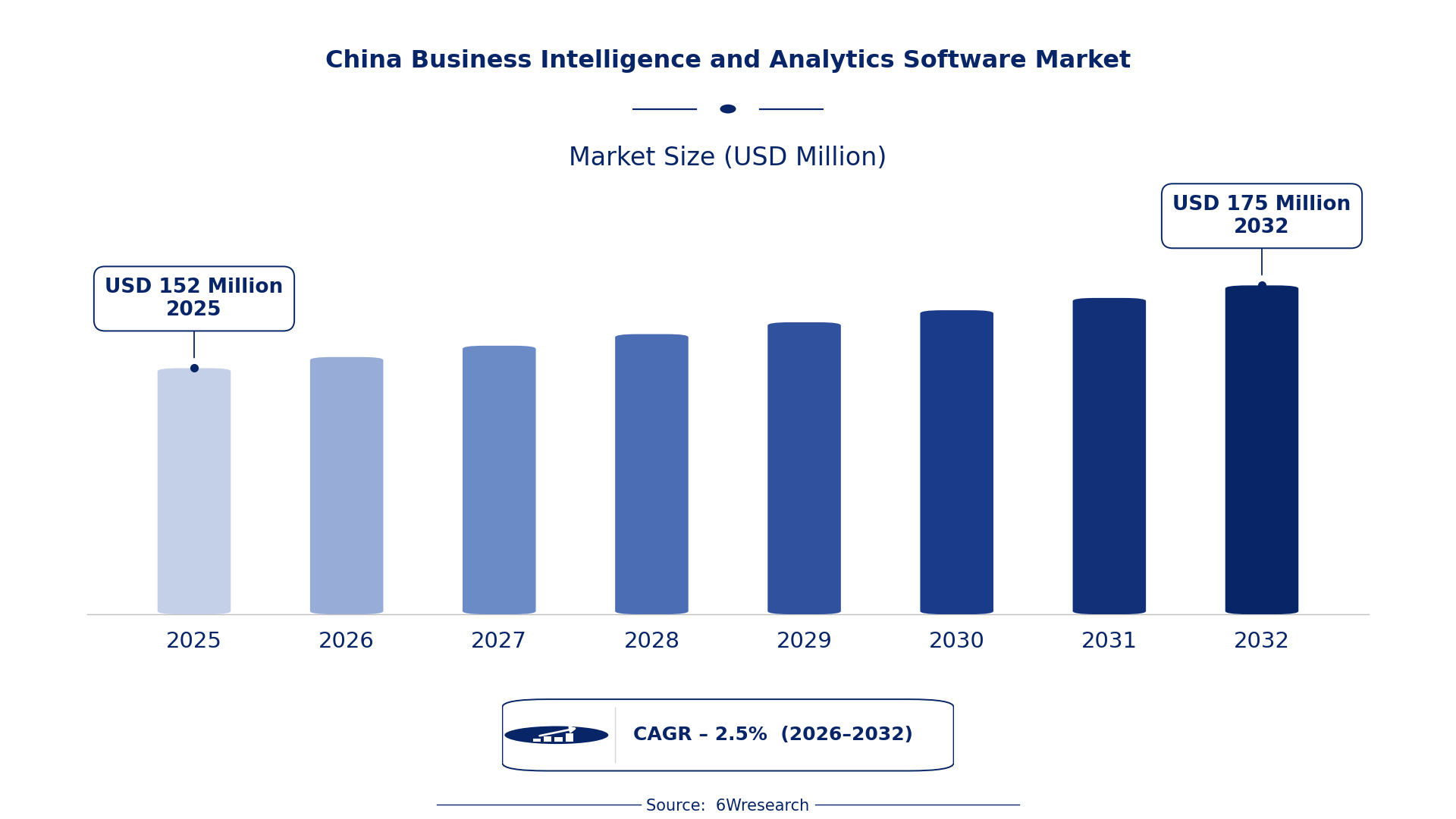
The China Business Intelligence and Analytics Software Market was estimated at USD 152 Million in 2025 and is projected to reach USD 175 Million by 2032, growing at a CAGR of 2.5% from 2026 to 2032.
China Business Intelligence and Analytics Software Market Synopsis
In recent years, the China Business Intelligence and Analytics Software Market has experienced considerable growth, driven by an increasing demand for data-driven insights across various sectors. However, as the market matures, organizations are beginning to face challenges that could influence future expansion.
While the adoption of advanced analytics and AI technologies has facilitated better decision-making, the sector is becoming saturated with options. Companies must now differentiate themselves and prove their value to avoid falling into the trap of complexity without measurable benefits.
China Business Intelligence and Analytics Software Market Year-wise Growth Rate and Key Drivers
This graph illustrates the annual growth rates of the China Business Intelligence and Analytics Software Market from 2021 to 2032, highlighting a steady upward trajectory and projected expansion over the forecast period.
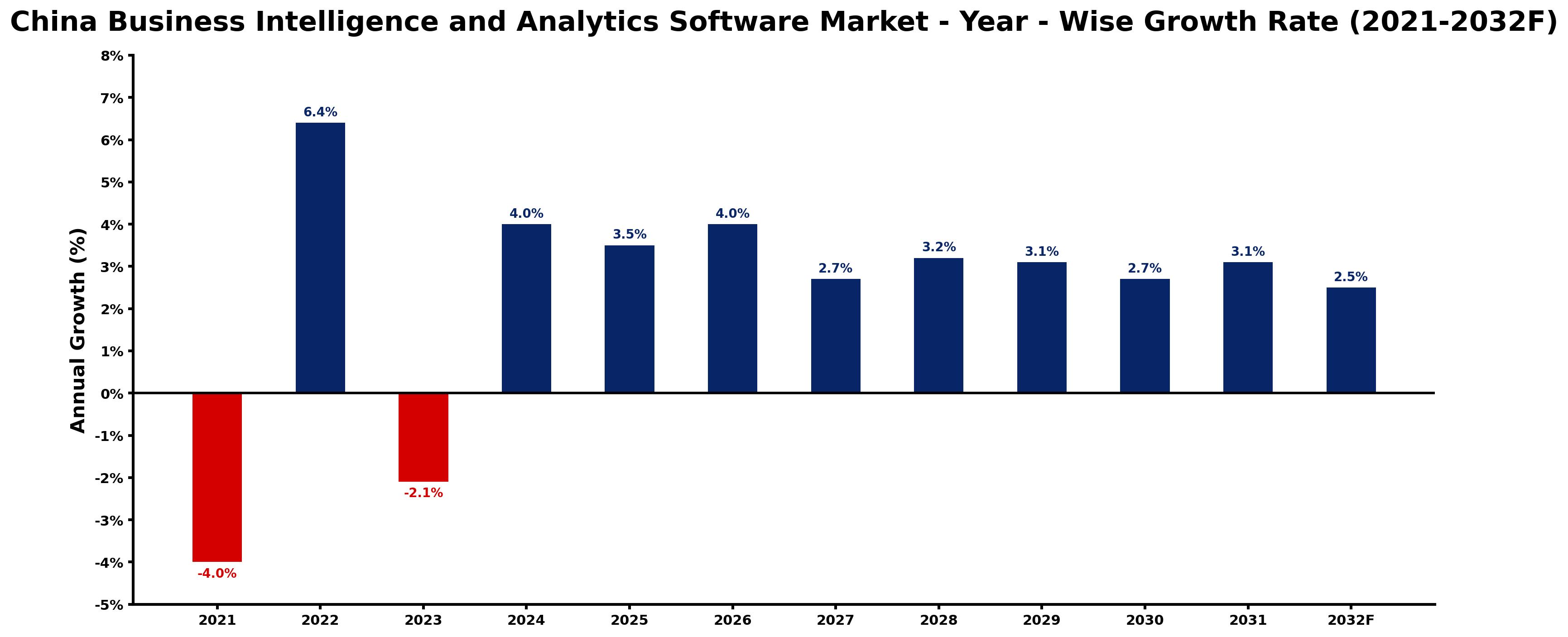
The table below presents the year‑wise growth rates along with the key drivers influencing the market
| Year | Growth Rate | Major Drivers |
| 2021 | -4.0% | Tighter regulations on data privacy by Chinese authorities |
| 2022 | 6.4% | Surge in digital transformation initiatives by Chinese businesses. |
| 2023 | -2.1% | Increased reliance on domestic competitors like Alibaba Cloud |
| 2024 | 4.0% | Government support for AI integration in business operations. |
| 2025 | 3.5% | Growth in e-commerce driving advanced analytics needs. |
| 2026 | 4.0% | Rise in data privacy regulations boosting BI software demand. |
| 2027 | 2.7% | Emerging sectors requiring enhanced competitive intelligence analysis. |
| 2028 | 3.2% | Financial services investing in real-time data analytics solutions. |
| 2029 | 3.1% | Manufacturing sector adopting predictive analytics for efficiency. |
| 2030 | 2.7% | Telecom companies leveraging analytics for customer insights. |
| 2031 | 3.1% | Health sector increasingly reliant on data visualization tools. |
| 2032 | 2.5% | Retail transformation spurring demand for customer behavior analytics. |
Note: Market size estimations and growth projections presented in this report are based on 6Wresearch's proprietary forecasting methodology, utilizing the latest available industry data, government publications, and primary research inputs.
China Business Intelligence and Analytics Software Market Key Takeaways
Below are some of the specific key takeaways from the market, including:
- Data-driven decision-making is increasingly essential for competitive advantage.
- The market is being shaped by the growing availability of cloud-based solutions.
- Self-service BI tools are gaining traction, allowing users to generate insights independently.
- AI and machine learning are enhancing traditional BI software capabilities.
- High acquisition costs remain a barrier for many small and medium-sized enterprises.
Evaluation of Restraints in China Business Intelligence and Analytics Software Market
The high costs associated with acquiring and implementing business intelligence software are among the most pressing restraints. Many organizations, especially smaller firms, struggle to justify these expenses, which can deter investment in necessary tools. on top of that, the rapid pace of technological advancement means companies must frequently adapt or upgrade their software, creating additional financial pressure. Coupled with the complexity often inherent in these solutions, resistance to adoption can stifle growth within the sector.
China Business Intelligence and Analytics Software Market Trends
Several key trends are shaping the China Business Intelligence and Analytics Software Market. The emphasis on self-service analytics is becoming a game-changer as organizations seek to empower their employees with insights without relying heavily on IT departments. on top of that, the integration of AI and machine learning capabilities is enabling more sophisticated predictive analytics, allowing businesses to foresee trends and make proactive decisions. There is also a notable shift toward cloud-based solutions that offer scalability and flexibility, meeting the needs of both large enterprises and small businesses.
China Business Intelligence and Analytics Software Market Opportunities
Opportunities for growth in this market are abundant. The ongoing digital transformation initiatives across industries are pushing companies to invest in analytics capabilities. Additionally, the rise of remote work has accelerated the adoption of cloud solutions, creating a demand for business intelligence tools that are accessible from anywhere. Firms that can offer affordable, user-friendly software solutions tailored to specific industries are likely to find significant market potential.
Government Initiatives in the China Business Intelligence and Analytics Software Market
Chinese government policies are actively promoting the growth of the business intelligence and analytics software sector. Initiatives aimed at fostering the digital economy and integrating advanced technologies into business processes are paramount. These policies not only provide funding support for research and development but also encourage companies to adopt digital tools that enhance operational efficiency.
- A national digital infrastructure upgrade programme is currently in its rollout phase, aimed at improving data accessibility across regions.
- The "Internet Plus" initiative, which integrates internet technologies with traditional industries, is actively boosting the adoption of BI solutions.
- Recent subsidies for technology research and development have been allocated to firms investing in innovative analytics software.
- Ongoing efforts to create a regulatory framework that promotes data transparency and security are expected to enhance market confidence.
- A planned public-private initiative is anticipated to encourage collaboration between tech firms and government entities, expected to launch by 2026.
Future Insights of the China Business Intelligence and Analytics Software Market
Looking ahead, the China Business Intelligence and Analytics Software Market is expected to evolve significantly. As organizations continue to prioritize data-driven strategies, the demand for intuitive, cost-effective analytics tools will grow. Companies that adapt quickly to technological advancements and address the needs of diverse customer segments will likely thrive. The increasing integration of AI and machine learning into BI platforms will also play a crucial role in shaping the future landscape, providing users with deeper insights and predictive capabilities.
China Business Intelligence and Analytics Software Market Latest Developments
In the past year, the China Business Intelligence and Analytics Software Market has seen a flurry of activity as firms respond to the pressing need for advanced analytics capabilities. The competitive landscape is heating up, with a focus on enhancing software features and user experiences. Companies are investing in innovative solutions that cater to the unique demands of their target markets.
- A major technology vendor launched a new AI-powered analytics platform in early 2025, aimed at providing small businesses with affordable access to advanced insights.
- In mid-2025, a leading regional operator introduced a self-service BI tool that simplifies data visualization for non-technical users, which is currently gaining traction.
- Several firms are currently undergoing a collaborative initiative to develop a standardized framework for data sharing, expected to enhance interoperability among BI tools.
- A rollout of a cloud-based analytics solution is planned for Q3 2026, targeting medium-sized enterprises seeking scalable options.
- By late 2025, a consortium of companies is expected to complete a project focused on integrating BI tools with existing enterprise resource planning systems.
China Business Intelligence and Analytics Software Market - Key Attractiveness of the Report
- 10 Years of Market Numbers
- Historical Data Starting from 2022 to 2025
- Base Year: 2025
- Forecast Data until 2032
- Key Performance Indicators Impacting the Market
- Major Upcoming Developments and Projects
The Chinese government promotes the digital economy through various initiatives, including subsidies for technology R&D and the "Internet Plus" initiative, which integrates internet technologies into traditional sectors.
Key Highlights of the Report:
- China Business Intelligence and Analytics Software Market Outlook
- Market Size of China Business Intelligence and Analytics Software Market, 2025
- Forecast of China Business Intelligence and Analytics Software Market, 2032
- Historical Data and Forecast of China Business Intelligence and Analytics Software Revenues & Volume for the Period 2022-2032F
- China Business Intelligence and Analytics Software Market Trend Evolution
- China Business Intelligence and Analytics Software Market Drivers and Challenges
- China Business Intelligence and Analytics Software Price Trends
- China Business Intelligence and Analytics Software Porter's Five Forces
- China Business Intelligence and Analytics Software Industry Life Cycle
- Historical Data and Forecast of China Business Intelligence and Analytics Software Market Revenues & Volume By Segment for the Period 2022-2032F
- Historical Data and Forecast of China Business Intelligence and Analytics Software Market Revenues & Volume By Business Intelligence (BI) Platforms for the Period 2022-2032F
- Historical Data and Forecast of China Business Intelligence and Analytics Software Market Revenues & Volume By Corporate Performance Management (CPM) Suite for the Period 2022-2032F
- Historical Data and Forecast of China Business Intelligence and Analytics Software Market Revenues & Volume By Advanced and Predictive Analytics for the Period 2022-2032F
- Historical Data and Forecast of China Business Intelligence and Analytics Software Market Revenues & Volume By Content Analytics for the Period 2022-2032F
- Historical Data and Forecast of China Business Intelligence and Analytics Software Market Revenues & Volume By Analytics Application for the Period 2022-2032F
- Historical Data and Forecast of China Business Intelligence and Analytics Software Market Revenues & Volume By Deployment Modes for the Period 2022-2032F
- Historical Data and Forecast of China Business Intelligence and Analytics Software Market Revenues & Volume By On-premise for the Period 2022-2032F
- Historical Data and Forecast of China Business Intelligence and Analytics Software Market Revenues & Volume By Cloud for the Period 2022-2032F
- Historical Data and Forecast of China Business Intelligence and Analytics Software Market Revenues & Volume By Organization Size for the Period 2022-2032F
- Historical Data and Forecast of China Business Intelligence and Analytics Software Market Revenues & Volume By Small Medium Business (SMB??s) for the Period 2022-2032F
- Historical Data and Forecast of China Business Intelligence and Analytics Software Market Revenues & Volume By Large enterprises for the Period 2022-2032F
- Historical Data and Forecast of China Business Intelligence and Analytics Software Market Revenues & Volume By Deployment Mode for the Period 2022-2032F
- Historical Data and Forecast of China Business Intelligence and Analytics Software Market Revenues & Volume By On-premise for the Period 2022-2032F
- Historical Data and Forecast of China Business Intelligence and Analytics Software Market Revenues & Volume By Cloud for the Period 2022-2032F
- Historical Data and Forecast of China Business Intelligence and Analytics Software Market Revenues & Volume By Verticals for the Period 2022-2032F
- Historical Data and Forecast of China Business Intelligence and Analytics Software Market Revenues & Volume By Banking, Financial Services, and Insurance (BFSI) for the Period 2022-2032F
- Historical Data and Forecast of China Business Intelligence and Analytics Software Market Revenues & Volume By Healthcare for the Period 2022-2032F
- Historical Data and Forecast of China Business Intelligence and Analytics Software Market Revenues & Volume By IT & Telecom for the Period 2022-2032F
- Historical Data and Forecast of China Business Intelligence and Analytics Software Market Revenues & Volume By Retail for the Period 2022-2032F
- Historical Data and Forecast of China Business Intelligence and Analytics Software Market Revenues & Volume By Manufacturing for the Period 2022-2032F
- Historical Data and Forecast of China Business Intelligence and Analytics Software Market Revenues & Volume By Education for the Period 2022-2032F
- Historical Data and Forecast of China Business Intelligence and Analytics Software Market Revenues & Volume By Government for the Period 2022-2032F
- Historical Data and Forecast of China Business Intelligence and Analytics Software Market Revenues & Volume By Energy and Power for the Period 2022-2032F
- China Business Intelligence and Analytics Software Import Export Trade Statistics
- Market Opportunity Assessment By Segment
- Market Opportunity Assessment By Deployment Modes
- Market Opportunity Assessment By Organization Size
- Market Opportunity Assessment By Deployment Mode
- Market Opportunity Assessment By Verticals
- China Business Intelligence and Analytics Software Top Companies Market Share
- China Business Intelligence and Analytics Software Competitive Benchmarking By Technical and Operational Parameters
- China Business Intelligence and Analytics Software Company Profiles
- China Business Intelligence and Analytics Software Key Strategic Recommendations






































