China Data Historian Market Size & Growth Rate (2026-2032)
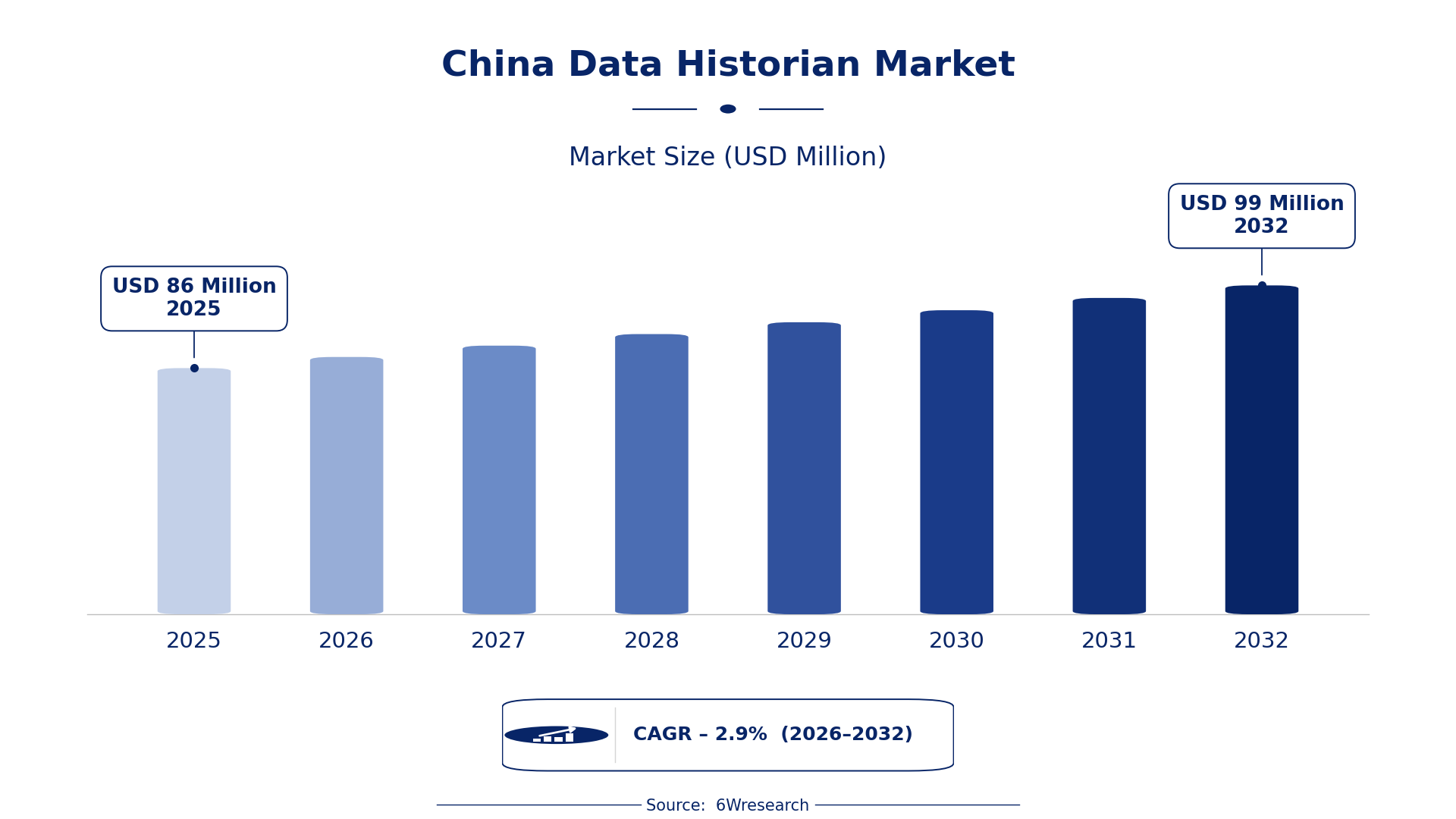
The China Data Historian Market was estimated at USD 86 Million in 2025 and is projected to reach USD 99 Million by 2032, growing at a CAGR of 2.9% from 2026 to 2032.
China Data Historian Market Synopsis
The surge in industrial automation is the most influential factor currently driving the China Data Historian Market. As manufacturing, energy, and utilities sectors increasingly rely on automated processes, the demand for reliable data management solutions has intensified, compelling organizations to invest in data historians.
Cloud-based data historian solutions are gaining traction, offering enhanced accessibility and scalability. This shift reflects the growing recognition of the need for real-time data analysis to streamline operations and improve decision-making across industries in China.
China Data Historian Market Year-wise Growth Rate and Key Drivers
This graph illustrates the annual growth rates of the China Data Historian Market from 2021 to 2032, highlighting a steady upward trajectory and projected expansion over the forecast period.
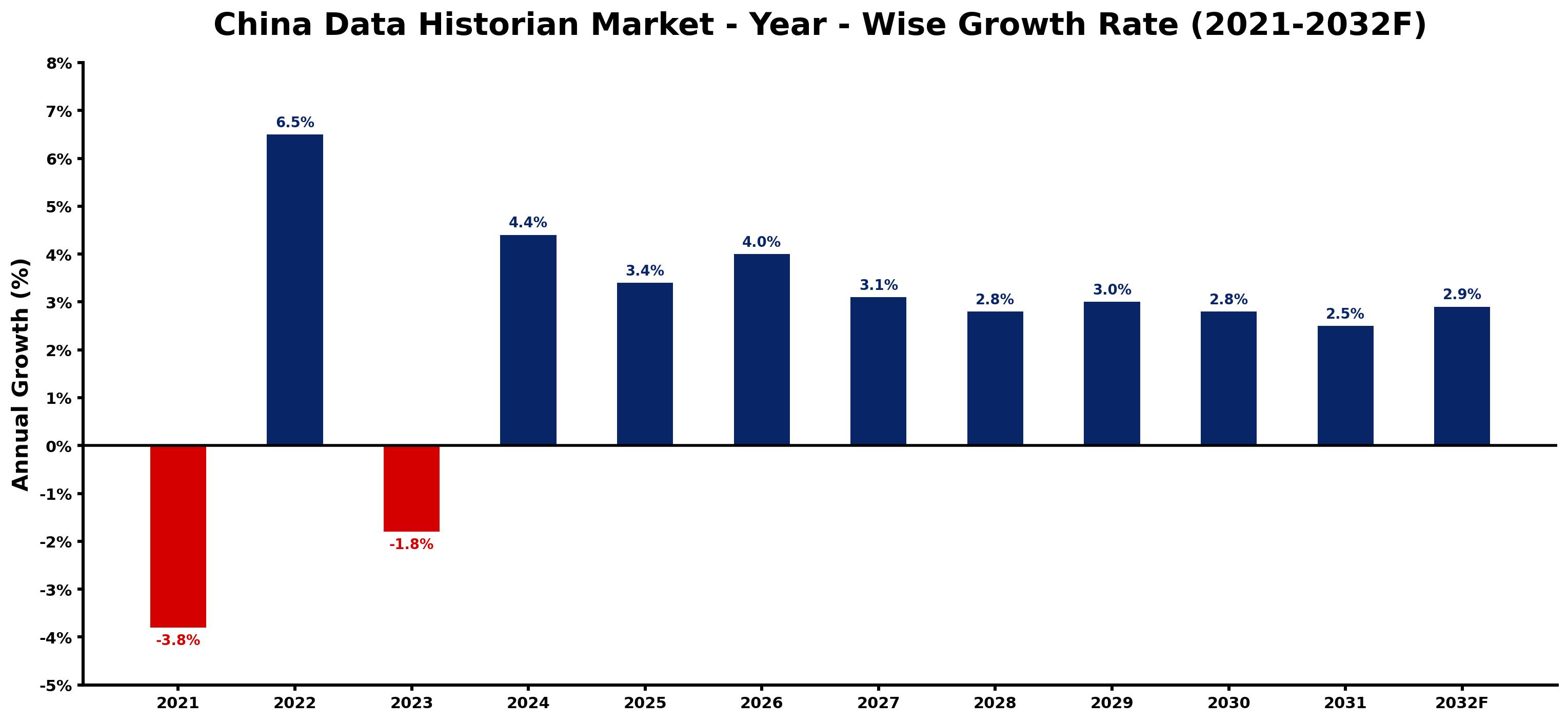
The table below presents the year‑wise growth rates along with the key drivers influencing the market
| Year | Growth Rate | Major Drivers |
| 2021 | -3.8% | Zhongguancun competition pressures from emerging AI startups |
| 2022 | 6.5% | Increased demand for real-time data analytics in manufacturing. |
| 2023 | -1.8% | Chinese government limits data storage regulations impacting demand |
| 2024 | 4.4% | Supportive policies for smart factory transformations by government. |
| 2025 | 3.4% | Growth in IoT device deployment across urban sectors. |
| 2026 | 4.0% | Rising adoption of Industry 4.0 initiatives nationwide. |
| 2027 | 3.1% | Enhanced cybersecurity regulations driving data protection requirements. |
| 2028 | 2.8% | Focus on big data integration within financial services. |
| 2029 | 3.0% | Local tech advancements in data storage solutions emerging. |
| 2030 | 2.8% | Increased investments in AI and machine learning capabilities. |
| 2031 | 2.5% | National efforts to digitize traditional industries boosting demand. |
| 2032 | 2.9% | Growing need for compliance with data governance frameworks. |
Note: Market size estimations and growth projections presented in this report are based on 6Wresearch's proprietary forecasting methodology, utilizing the latest available industry data, government publications, and primary research inputs.
China Data Historian Market Key Takeaways
Below are some of the specific key takeaways from the market, including:
- The market is heavily influenced by the shift towards industrial automation.
- Cloud-based solutions are becoming the standard for data management in industries.
- Integration of AI and machine learning is enhancing the capabilities of data historians.
- Regulatory compliance around data security is a critical concern for providers.
- Investment in predictive analytics is rising, driven by the need for proactive maintenance solutions.
Evaluation of Restraints in China Data Historian Market
Despite the growth potential, several restraints hinder the progress of the China Data Historian Market. A primary challenge is the overwhelming volume of data generated by industrial processes, which complicates effective management and analysis. Companies often grapple with integrating these solutions into their existing infrastructure, particularly with legacy systems that may not support modern data historian technologies.
on top of that, the stringent data localization laws in China present hurdles for data historian providers, as they must navigate complex regulations while ensuring data security and compliance. The shortage of skilled professionals who can adeptly manage and interpret data remains a significant barrier as well.
China Data Historian Market Trends
The integration of Industrial Internet of Things (IIoT) solutions is reshaping the demand for data historians. Industries are recognizing the value of real-time data collection and analysis to optimize performance and minimize operational downtime. This trend is closely tied to the growing need for predictive maintenance, driven by advancements in AI and machine learning technologies.
Another notable trend is the increasing reliance on cloud-based data historian solutions, which allow organizations to access and analyze data remotely. This shift not only enhances scalability but also reduces costs, making these solutions more attractive to businesses aiming to modernize their operations.
China Data Historian Market Opportunities
The China Data Historian Market is ripe with investment opportunities. As industries strive for operational excellence, there is a pressing need for advanced data historian technologies that can manage vast amounts of data efficiently. Sectors like manufacturing and utilities are particularly focused on adopting innovative solutions that can enhance regulatory compliance and boost productivity.
Investors should consider partnerships with local technology firms to tap into the regional expertise, as well as invest in startups that are pioneering cutting-edge data management solutions. The ongoing push towards smart manufacturing under the Industry 4.0 initiative further supports this growth potential.
Government Initiatives in the China Data Historian Market
Government policies are shaping the operational framework for the China Data Historian Market. With a focus on data security and privacy, regulations are becoming stricter, compelling businesses to adhere to localized data storage requirements. Such measures not only protect sensitive information but also promote a culture of compliance within the industry.
- A regulatory framework mandating data localization was implemented in 2023, requiring companies to store data within China's borders.
- Currently, an initiative to enhance cybersecurity measures is underway, aimed at preventing data breaches in critical sectors.
- A national digital transformation program is planned for rollout by 2026, focusing on modernizing infrastructure for data management.
- The government is currently evaluating new guidelines for data collection and usage, expected to be released by late 2025.
- Ongoing public-private partnerships are being established to improve the accessibility of data analytics tools across various industries.
Future Insights of the China Data Historian Market
Looking ahead to 2026-2032, the China Data Historian Market is set to flourish as organizations increasingly recognize the value of data-driven decision-making. The push for digital transformation is likely to accelerate, with companies prioritizing investments in data historian solutions that offer advanced analytics capabilities.
As technologies evolve, the integration of predictive analytics will become essential for maintaining a competitive edge. The market's growth trajectory will be supported by an expanding manufacturing base and continuous government initiatives promoting automation and data security.
China Data Historian Market Latest Developments
Recent activity within the China Data Historian Market has showcased a strong commitment to innovation and modernization. Over the past year, organizations have increasingly focused on enhancing their data management capabilities through advanced technologies, setting the stage for future growth.
- A major technology vendor launched a new cloud-based data historian solution in Q1 2025, designed to streamline data analysis for industrial applications.
- In mid-2025, a leading regional operator began an initiative to integrate AI-driven predictive maintenance tools into their existing data historian systems, currently underway.
- A partnership was announced in early 2025 between a prominent software company and a local manufacturer to develop customized data historian solutions, with implementation expected by late 2025.
- An ongoing project aims to upgrade data security protocols across several industries, initiated in early 2025 and expected to continue through 2026.
China Data Historian Market - Key Attractiveness of the Report
- 10 Years of Market Numbers
- Historical Data Starting from 2022 to 2025
- Base Year: 2025
- Forecast Data until 2032
- Key Performance Indicators Impacting the Market
- Major Upcoming Developments and Projects
Key Highlights of the Report:
- China Data Historian Market Outlook
- Market Size of China Data Historian Market, 2025
- Forecast of China Data Historian Market, 2032
- Historical Data and Forecast of China Data Historian Revenues & Volume for the Period 2022-2032F
- China Data Historian Market Trend Evolution
- China Data Historian Market Drivers and Challenges
- China Data Historian Price Trends
- China Data Historian Porter's Five Forces
- China Data Historian Industry Life Cycle
- Historical Data and Forecast of China Data Historian Market Revenues & Volume By Application for the Period 2022-2032F
- Historical Data and Forecast of China Data Historian Market Revenues & Volume By Production Tracking for the Period 2022-2032F
- Historical Data and Forecast of China Data Historian Market Revenues & Volume By Environmental Auditing for the Period 2022-2032F
- Historical Data and Forecast of China Data Historian Market Revenues & Volume By Asset Performance Management for the Period 2022-2032F
- Historical Data and Forecast of China Data Historian Market Revenues & Volume By GRC Management for the Period 2022-2032F
- Historical Data and Forecast of China Data Historian Market Revenues & Volume By Predictive Maintenance for the Period 2022-2032F
- Historical Data and Forecast of China Data Historian Market Revenues & Volume By Others (security and quality control management) for the Period 2022-2032F
- Historical Data and Forecast of China Data Historian Market Revenues & Volume By Deployment Mode for the Period 2022-2032F
- Historical Data and Forecast of China Data Historian Market Revenues & Volume By On-premises for the Period 2022-2032F
- Historical Data and Forecast of China Data Historian Market Revenues & Volume By Cloud for the Period 2022-2032F
- Historical Data and Forecast of China Data Historian Market Revenues & Volume By Organization Size for the Period 2022-2032F
- Historical Data and Forecast of China Data Historian Market Revenues & Volume By SMEs for the Period 2022-2032F
- Historical Data and Forecast of China Data Historian Market Revenues & Volume By Large Enterprises for the Period 2022-2032F
- Historical Data and Forecast of China Data Historian Market Revenues & Volume By End User for the Period 2022-2032F
- Historical Data and Forecast of China Data Historian Market Revenues & Volume By Oil and Gas for the Period 2022-2032F
- Historical Data and Forecast of China Data Historian Market Revenues & Volume By Marine for the Period 2022-2032F
- Historical Data and Forecast of China Data Historian Market Revenues & Volume By Chemicals and Petrochemicals for the Period 2022-2032F
- Historical Data and Forecast of China Data Historian Market Revenues & Volume By Paper and Pulp for the Period 2022-2032F
- Historical Data and Forecast of China Data Historian Market Revenues & Volume By Metal and Mining for the Period 2022-2032F
- Historical Data and Forecast of China Data Historian Market Revenues & Volume By Power and Utilities for the Period 2022-2032F
- Historical Data and Forecast of China Data Historian Market Revenues & Volume By Others for the Period 2022-2032F
- Historical Data and Forecast of China Data Historian Market Revenues & Volume By Component for the Period 2022-2032F
- Historical Data and Forecast of China Data Historian Market Revenues & Volume By Software/Tools for the Period 2022-2032F
- Historical Data and Forecast of China Data Historian Market Revenues & Volume By Services for the Period 2022-2032F
- China Data Historian Import Export Trade Statistics
- Market Opportunity Assessment By Application
- Market Opportunity Assessment By Deployment Mode
- Market Opportunity Assessment By Organization Size
- Market Opportunity Assessment By End User
- Market Opportunity Assessment By Component
- China Data Historian Top Companies Market Share
- China Data Historian Competitive Benchmarking By Technical and Operational Parameters
- China Data Historian Company Profiles
- China Data Historian Key Strategic Recommendations






































