China In-Car Entertainment Market Size & Growth Rate
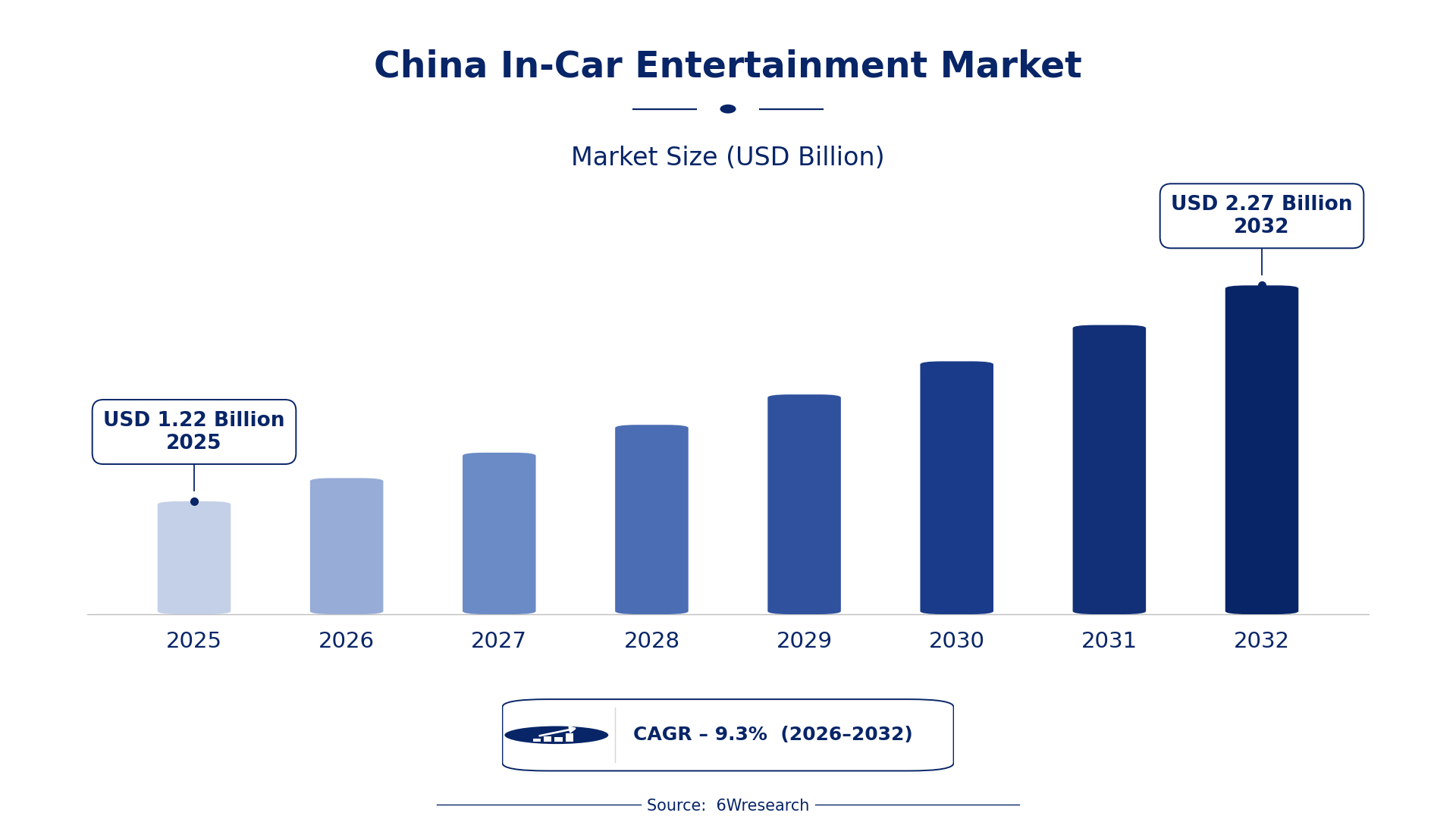
According to 6Wresearch internal database and industry insights, the China In-Car Entertainment Market was valued at USD 1.22 billion in 2025 and is projected to reach USD 2.27 billion by 2032, growing at a CAGR of approximately 9.3% during 2026–2032.
China In-Car Entertainment Market Highlights
| Report Metric | Details |
| Report Name | China In-Car Entertainment Market |
| Market Size 2025 | USD 1.22 billion |
| Market Size 2032 | USD 2.27 billion |
| Absolute Growth 2025–2032 | USD 1.05 billion |
| CAGR 2026–2032 | 9.3% |
| Peak Annual Growth | 11.7% in 2028 |
| Forecast Period | 2026–2032 |
| Historical Data | 2022–2025 |
| Base Year | 2025 |
| Leading Content Type, 2025 | Streaming Media (39% share) |
| Leading Source/Platform, 2025 | USB (38% share) |
| Leading Delivery Mode, 2025 | App-Based Over Cellular (41% share) |
| Leading End User, 2025 | Passenger Vehicles (49% share) |
| Fastest-Growing Content Type | Gaming Integration (11.0% CAGR) |
| Fastest-Growing Source/Platform | Cloud-Based Games (11.7% CAGR) |
| Fastest-Growing Delivery Mode | Mobile Network (10.4% CAGR) |
| Fastest-Growing End User | EV & Tech Car Makers (10.4% CAGR) |
| Growing Sector | EV & Tech Car Makers |
| Key End Users | Passenger Vehicles, Luxury & Family Cars, Infotainment System OEMs, EV & Tech Car Makers |
China In-Car Entertainment Market Year-wise Growth Rate and Key Drivers (2022–2032)
This graph illustrates the annual growth rates of the market from 2022 to 2032, highlighting a steady upward trajectory and projected market expansion over the forecast period.
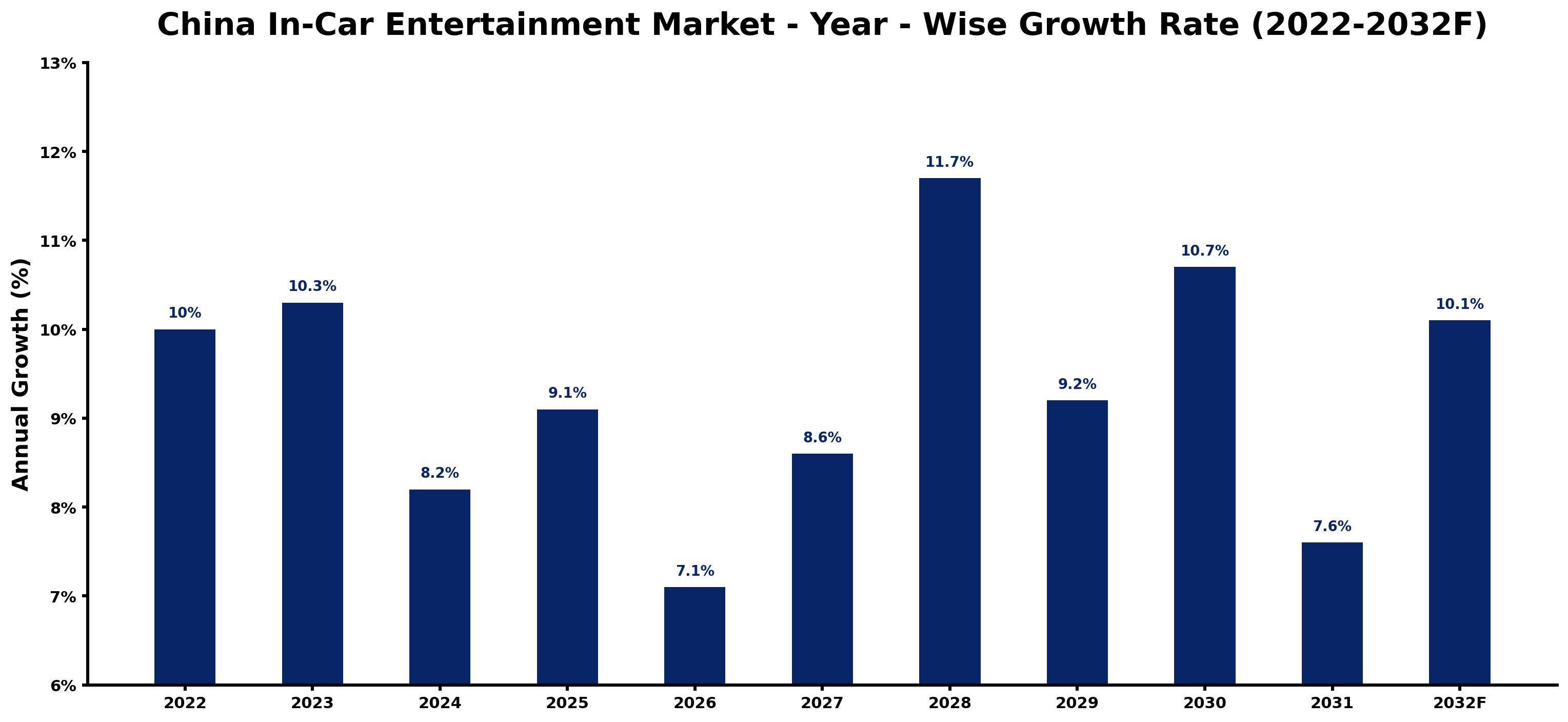
The table below sets out the estimated growth rate for each year and the main factor behind it.
| Year | Estimated Annual Growth (%) | Market Rationale |
| 2022 | 10.0 | The automotive market in China was strong, with over 25 million units sold, boosting in-car entertainment demand. |
| 2023 | 10.3 | Demand for rear-seat entertainment systems grew by 15% in luxury vehicles, reflecting a trend towards improved passenger experiences. |
| 2024 | 8.2 | Growth slowed as consumers became more selective about in-car technology features and entertainment options. |
| 2025 | 9.1 | The introduction of new vehicle connectivity standards spurred interest in advanced in-car entertainment systems. |
| 2026 | 7.1 | Market growth is expected to decelerate as competition intensifies among entertainment service providers and technology integrators. |
| 2027 | 8.6 | Increased investment in electric vehicles will drive demand for integrated entertainment systems in tech-focused cars. |
| 2028 | 11.7 | The peak growth year will be driven by a surge in luxury vehicle sales equipped with advanced infotainment systems. |
| 2029 | 9.2 | Growth is projected to slow as the market begins to stabilise with established players solidifying their positions. |
| 2030 | 10.7 | A resurgence in demand for cloud-based gaming in vehicles will contribute to market expansion. |
| 2031 | 7.6 | The market is expected to see slower growth as consumers evaluate the value of new entertainment features in vehicles. |
| 2032 | 10.1 | In-car entertainment systems will continue to evolve, driven by advancements in connectivity and user experience. |
Note: Market size estimations and growth projections presented in this report are based on 6Wresearch's proprietary forecasting methodology, utilizing the latest available industry data, government publications, and primary research inputs.
China In-Car Entertainment Market Synopsis
The In-Car Entertainment market in China encompasses advanced multimedia platforms integrated into vehicles, providing audio, video, and interactive services. These systems improve passenger experiences during travel and support navigation and communication features. The market is growing due to a strong automotive sector, with over 25 million units sold in 2022, and a rise in tech-savvy consumers. The increasing demand for luxury vehicles equipped with advanced infotainment systems is further driving this growth. Government initiatives to promote vehicle connectivity are stimulating new demand.
Market Dynamics Impact Analysis (2026–2032)
| Factor | Type | Impact | Primary Segment Affected |
| Rising demand for luxury vehicles equipped with advanced infotainment systems | Driver | High | Passenger Vehicles |
| Growing number of mobile internet users enhancing streaming service accessibility | Driver | High | Streaming Media |
| Increasing interest in electric vehicles with integrated entertainment features | Opportunity | High | EV & Tech Car Makers |
| Expansion of rear-seat entertainment systems in luxury vehicles | Opportunity | Medium | Rear-Seat Entertainment |
| Intense competition among entertainment service providers limiting market share | Restraint | High | Streaming Media |
| Consumer hesitance towards new technology adoption due to cost concerns | Restraint | Medium | Luxury & Family Cars |
| The In-Car Entertainment Market in China faces challenges from high competition | Challenge | High | Passenger Vehicles |
| Rapid technological advancements may outpace consumer adoption rates | Challenge | Medium | EV & Tech Car Makers |
Evaluation of Drivers in China In-Car Entertainment Market (2026–2032)
The table below links each growth driver to the segment it affects and the evidence for it.
| Drivers | Primary Segment Affected | Why It Matters (Evidence) |
| Increased investment in luxury vehicles with advanced infotainment systems | Passenger Vehicles | The average price of luxury cars in China is around 500,000 CNY, driving demand for high-end entertainment features. |
| Rising mobile internet penetration boosting streaming service usage | Streaming Media | China's internet penetration rate is approximately 70%, enabling more users to access streaming services in vehicles. |
| The growing number of electric vehicles promoting tech integration | EV & Tech Car Makers | China's EV market is projected to exceed 10 million units by 2025, increasing demand for integrated entertainment systems. |
| Expansion of rear-seat entertainment systems in luxury vehicles | Rear-Seat Entertainment | In 2022, the demand for rear-seat entertainment systems grew by 15% in luxury vehicles, improving passenger experiences. |
| The introduction of new vehicle connectivity standards | Infotainment System OEMs | In 2023, the Ministry of Industry and Information Technology launched a plan to enhance vehicle connectivity standards. |
Expansion of the In-Car Entertainment market in China is backed by increased investment in luxury vehicles with advanced infotainment systems, as the average price of luxury cars is around 500,000 CNY. Rising mobile internet penetration, with approximately 70% of the population online, boosts streaming service usage in vehicles. The growing number of electric vehicles, projected to exceed 10 million units by 2025, promotes the integration of tech features. The introduction of new vehicle connectivity standards in 2023 further supports the adoption of advanced in-car entertainment systems. Demand for integrated entertainment systems is also driven by the increasing average age of car buyers, which is around 30 years, indicating a tech-savvy consumer base.
Evaluation of Restraints in China In-Car Entertainment Market
Below mentioned are some major restraints and their influence on market dynamics.
| Market Restraint | Primary Segment Affected | Why It Matters (Evidence) |
| Intense competition among entertainment service providers | Streaming Media | With numerous players in the streaming market, maintaining market share becomes challenging, impacting revenue for providers. |
| Consumer hesitance towards new technology adoption due to cost concerns | Luxury & Family Cars | High costs associated with advanced entertainment systems deter some consumers from upgrading their vehicles. |
| Limited awareness of advanced features among traditional car buyers | Passenger Vehicles | Many traditional car buyers may not fully understand the benefits of integrated entertainment systems, slowing adoption. |
| Rapid technological advancements may outpace consumer adoption rates | EV & Tech Car Makers | As technology evolves quickly, some consumers may delay purchases to wait for the latest features, affecting sales. |
| Regulatory challenges in standardising entertainment features across vehicles | Infotainment System OEMs | The need for compliance with national standards can slow down product development and market entry. |
China In-Car Entertainment Market Challenges
Buyers in the China In-Car Entertainment market encounter supply chain disruptions due to semiconductor shortages, which delay production timelines for infotainment systems. This challenge arises from a global surge in chip demand, extending lead times by up to 12 weeks and limiting vehicle availability for consumers. Increasing component costs burden manufacturers, with prices for essential hardware rising by 20% over the past year, forcing producers to pass these costs onto buyers. Additionally, fierce competition among tech providers leads to price wars, diminishing profitability for suppliers and restricting the variety of quality options accessible to consumers.
Trends in the China In-Car Entertainment Market
Four trends stand out in the China In-Car Entertainment Market.
- Shift towards Improved Rear-Seat Entertainment: In 2022, demand for rear-seat entertainment systems in luxury vehicles increased by 15%, indicating a shift towards enhanced passenger experiences. This trend is likely to persist as more manufacturers prioritise the integration of advanced entertainment options.
- Rise of Streaming Services in Vehicles: The growing number of mobile internet users, exceeding 400 million in 2023, is driving the adoption of streaming services in cars. This shift is transforming how passengers consume media while travelling.
- Growth of Electric Vehicles with Advanced Tech Integration: China's EV market is anticipated to exceed 10 million units by 2025, resulting in heightened demand for integrated entertainment systems. This growth reflects the increasing emphasis on technology in modern vehicles.
- Expansion of Mobile Network Connectivity: With the rising adoption of App-Based Over Cellular services, the market is experiencing a shift towards improved connectivity in vehicles. This change facilitates better streaming and communication for passengers.
Investment Opportunities in the China In-Car Entertainment Market
Investors looking at the China In-Car Entertainment Market should consider the following areas.
- Luxury Vehicle Manufacturers Seeking Advanced Systems: Luxury vehicle manufacturers are increasingly looking for advanced in-car entertainment systems to improve passenger experiences. With the average price of luxury cars around 500,000 CNY, there is a strong opportunity for suppliers to meet this demand.
- Electric Vehicle Market Expansion: The growing electric vehicle market in China, projected to exceed 10 million units by 2025, presents an opportunity for suppliers of integrated entertainment systems. Collaborating with EV manufacturers can facilitate market entry.
- Partnerships with Infotainment System OEMs: Forming partnerships with infotainment system OEMs can provide access to a broader customer base. As the demand for advanced multimedia platforms rises, local partnerships will be essential for success.
- Investment in Cloud-Based Gaming Solutions: With the demand for cloud-based gaming in vehicles projected to grow significantly, investing in this technology now can yield high returns. Engaging with tech-savvy consumers will be essential for capturing this market.
Government Initiatives in the China In-Car Entertainment Market
The 'Smart Vehicle Innovation and Development Strategy' launched by the Ministry of Industry and Information Technology in 2023 aims to promote advanced in-car technologies and connectivity solutions. This initiative encourages manufacturers to invest in modern infotainment systems that enhance user experience. Furthermore, the updated 'National Standards for Vehicle Multimedia Systems' in 2021 standardises features across vehicles, ensuring safety and compatibility. These policies support the growth of the in-car entertainment market by establishing clear guidelines for manufacturers and boosting consumer trust.
In 2023, the Ministry of Science and Technology initiated the 'Intelligent Connected Vehicle Technology Research Program' to support advancements in automotive technology. This programme allocates funding for research and development, focusing on improving vehicle connectivity and entertainment features. The China Automotive Technology and Research Center (CATARC) oversees automotive technology standards and innovations, ensuring compliance with national regulations. These initiatives encourage the development of advanced in-car entertainment systems and motivate manufacturers to adopt new technologies.
Future Insight of the China In-Car Entertainment Market
The China In-Car Entertainment market is poised for substantial advancements by 2032, primarily driven by the integration of AI technologies in vehicles. The introduction of new connectivity standards will improve user experiences, allowing seamless interaction with diverse media sources. Demand for cloud-based gaming in vehicles is projected to rise significantly, with a notable increase expected by 2025, aligning with the preferences of tech-savvy consumers. The government's subsidy programme for EV buyers will accelerate the adoption of vehicles equipped with advanced infotainment systems, reshaping the market.
Market Segmentation Analysis
The analysis below covers each segmentation, its leading category in 2025 and its fastest-growing category through 2032.
By Content Type – Streaming Media Dominated, Gaming Integration Expected to Grow Fastest
According to Sachin Kumar Rai, Senior Research Analyst at 6Wresearch, Streaming Media took a 39% share of content type in 2025, more than any other category. Streaming media holds the largest share in the China In-Car Entertainment market because it is widely used for entertainment during travel, appealing to a broad audience. The increasing number of active mobile internet users, which surpassed 400 million in 2023, significantly fuels this demand. The quickest growth will come from Gaming Integration, forecast to expand at a CAGR of 11.0% between 2026 and 2032. Gaming integration is experiencing rapid growth as tech-savvy consumers seek advanced entertainment options in vehicles, with a notable rise in demand for cloud-based gaming expected by 2025. This trend indicates that streaming media's lead will continue to widen as it adapts to evolving consumer preferences. Suppliers should focus on enhancing streaming capabilities to meet the rising expectations of consumers in the in-car entertainment market.
By Source/Platform – USB Dominated, Cloud-Based Games Expected to Grow Fastest
With a 38% revenue share in 2025, USB was the largest source/platform category. USB is the predominant source for in-car entertainment systems, recognised for its commonality in media playback and ease of integration into vehicles. This widespread utilisation reflects the automotive sector's focus on user-friendly technology. Cloud-Based Games are set to record the highest CAGR in this split, 11.7% over 2026–2032. Cloud-based games are emerging as a rapidly growing platform, driven by increasing consumer interest in interactive entertainment options. As more vehicles are equipped with advanced connectivity features, this segment is positioned for swift growth. Buyers will enjoy a broader array of entertainment options as suppliers invest in cloud-based technologies for in-car systems.
By Delivery Mode – App-Based Over Cellular Dominated, Mobile Network Expected to Grow Fastest
In 2025, App-Based Over Cellular led the delivery mode split with a 41% share. App-based over cellular is the primary delivery mode for streaming services in the China In-Car Entertainment market, providing seamless access to content while on the move. This method aligns with the increasing consumer demand for connectivity and convenience in vehicles. Mobile Network is projected to grow fastest, at a CAGR of 10.4% during 2026–2032. Mobile networks are enabling quicker streaming and connectivity in vehicles, making them the fastest-growing delivery mode. As automotive technology advances, reliance on mobile networks is anticipated to increase significantly. Suppliers must ensure strong mobile network compatibility to improve user experience in in-car entertainment systems.
By End User – Passenger Vehicles Dominated, EV & Tech Car Makers Expected to Grow Fastest
The largest end user category in 2025 was Passenger Vehicles, with a 49% share of total revenue. Passenger vehicles represent the largest end-user segment for in-car entertainment, driven by high automotive sales in China, which exceeded 25 million units in 2022. This segment's growth is supported by the rising integration of advanced multimedia systems in everyday vehicles. Over 2026–2032, EV & Tech Car Makers are expected to post the fastest growth, at a CAGR of 10.4%. EV and tech car makers are emerging as the fastest-growing end-user group, concentrating on incorporating cutting-edge technology into their vehicles. The electric vehicle market is projected to surpass 10 million units by 2025, further accelerating this trend. Suppliers should target EV and tech car manufacturers to capitalise on the growing demand for advanced in-car entertainment solutions.
Key Attractiveness of the Report
- 10 Years of Market Numbers
- Historical Data Starting from 2022 to 2025
- Base Year 2025
- Forecast Data until 2032
- Key Performance Indicators Impacting the Market
- Major Upcoming Developments and Projects
Key Highlights of the Report:
- China In-Car Entertainment Market Outlook
- Market Size of China In-Car Entertainment Market, 2025
- Forecast of China In-Car Entertainment Market, 2032
- Historical Data and Forecast of China In-Car Entertainment Revenues & Volume for the Period 2022 - 2032F
- China In-Car Entertainment Market Trend Evolution
- China In-Car Entertainment Market Drivers and Challenges
- China In-Car Entertainment Price Trends
- China In-Car Entertainment Porter's Five Forces
- China In-Car Entertainment Industry Life Cycle
- Historical Data and Forecast of China In-Car Entertainment Market Revenues & Volume By Content Type for the Period 2022 - 2032F
- Historical Data and Forecast of China In-Car Entertainment Market Revenues & Volume By Streaming Media for the Period 2022 - 2032F
- Historical Data and Forecast of China In-Car Entertainment Market Revenues & Volume By Local Media Playback for the Period 2022 - 2032F
- Historical Data and Forecast of China In-Car Entertainment Market Revenues & Volume By Rear-Seat Entertainment for the Period 2022 - 2032F
- Historical Data and Forecast of China In-Car Entertainment Market Revenues & Volume By Gaming Integration for the Period 2022 - 2032F
- Historical Data and Forecast of China In-Car Entertainment Market Revenues & Volume By Source/Platform for the Period 2022 - 2032F
- Historical Data and Forecast of China In-Car Entertainment Market Revenues & Volume By Netflix, YouTube, Spotify for the Period 2022 - 2032F
- Historical Data and Forecast of China In-Car Entertainment Market Revenues & Volume By USB, CD/DVD, SD Card for the Period 2022 - 2032F
- Historical Data and Forecast of China In-Car Entertainment Market Revenues & Volume By Screens + Headsets for the Period 2022 - 2032F
- Historical Data and Forecast of China In-Car Entertainment Market Revenues & Volume By Cloud-Based Games for the Period 2022 - 2032F
- Historical Data and Forecast of China In-Car Entertainment Market Revenues & Volume By Delivery Mode for the Period 2022 - 2032F
- Historical Data and Forecast of China In-Car Entertainment Market Revenues & Volume By App-Based Over Cellular for the Period 2022 - 2032F
- Historical Data and Forecast of China In-Car Entertainment Market Revenues & Volume By Offline Playback for the Period 2022 - 2032F
- Historical Data and Forecast of China In-Car Entertainment Market Revenues & Volume By Individual Controls for the Period 2022 - 2032F
- Historical Data and Forecast of China In-Car Entertainment Market Revenues & Volume By Mobile Network for the Period 2022 - 2032F
- Historical Data and Forecast of China In-Car Entertainment Market Revenues & Volume By End User for the Period 2022 - 2032F
- Historical Data and Forecast of China In-Car Entertainment Market Revenues & Volume By Infotainment System OEMs for the Period 2022 - 2032F
- Historical Data and Forecast of China In-Car Entertainment Market Revenues & Volume By Passenger Vehicles for the Period 2022 - 2032F
- Historical Data and Forecast of China In-Car Entertainment Market Revenues & Volume By Luxury & Family Cars for the Period 2022 - 2032F
- Historical Data and Forecast of China In-Car Entertainment Market Revenues & Volume By EV & Tech Car Makers for the Period 2022 - 2032F
- China In-Car Entertainment Import Export Trade Statistics
- Market Opportunity Assessment By Content Type
- Market Opportunity Assessment By Source/Platform
- Market Opportunity Assessment By Delivery Mode
- Market Opportunity Assessment By End User
- China In-Car Entertainment Top Companies Market Share
- China In-Car Entertainment Competitive Benchmarking By Technical and Operational Parameters
- China In-Car Entertainment Company Profiles
- China In-Car Entertainment Key Strategic Recommendations
Market Covered
This report examines the market across the segments below.
By Content Type
- Streaming Media
- Local Media Playback
- Rear-Seat Entertainment
- Gaming Integration
By Source/Platform
- Netflix
- YouTube
- Spotify
- USB
- CD/DVD
- SD Card
- Screens + Headsets
- Cloud-Based Games
By Delivery Mode
- App-Based Over Cellular
- Offline Playback
- Individual Controls
- Mobile Network
By End User
- Infotainment System OEMs
- Passenger Vehicles
- Luxury & Family Cars
- EV & Tech Car Makers































