China Indoor Air Quality Market Size & Growth Rate
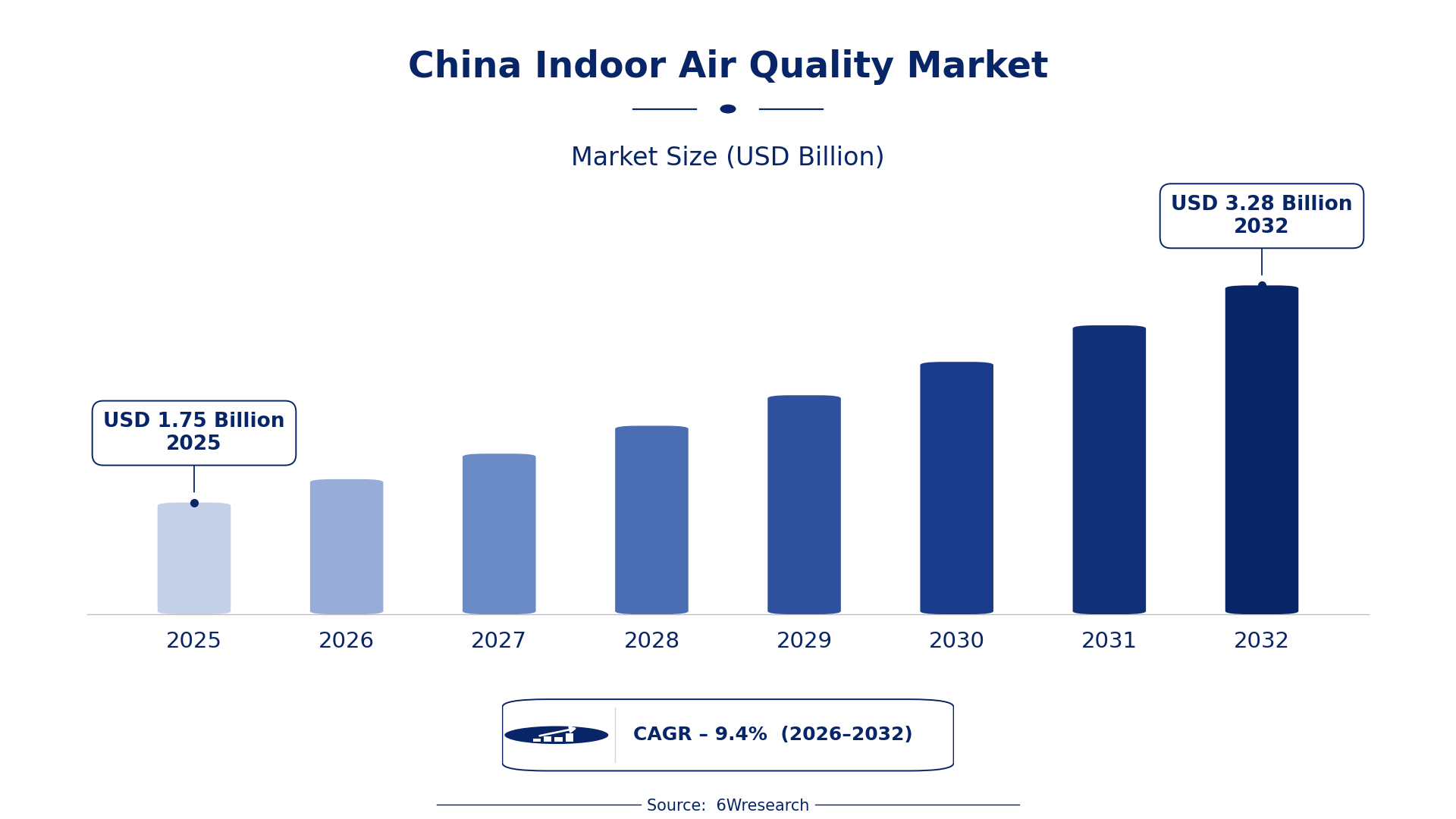
According to 6Wresearch internal database and industry insights, the China Indoor Air Quality Market was valued at USD 1.75 billion in 2025 and is projected to reach USD 3.28 billion by 2032, growing at a CAGR of approximately 9.4% during 2026–2032.
China Indoor Air Quality Market Highlights
| Report Metric | Details |
| Report Name | China Indoor Air Quality Market |
| Market Size 2025 | USD 1.75 billion |
| Market Size 2032 | USD 3.28 billion |
| Absolute Growth 2025–2032 | USD 1.53 billion |
| CAGR 2026–2032 | 9.4% |
| Peak Annual Growth | 10.9% in 2031 |
| Forecast Period | 2026–2032 |
| Historical Data | 2022–2025 |
| Base Year | 2025 |
| Leading Product Type, 2025 | Air Purifiers (46% share) |
| Leading Air Concern Focus, 2025 | PM (38% share) |
| Leading Technology Used, 2025 | HEPA (38% share) |
| Leading End User, 2025 | Homes & Offices (38% share) |
| Fastest-Growing Product Type | Integrated IAQ Systems (11.6% CAGR) |
| Fastest-Growing Air Concern Focus | Multi-pollutant (11.6% CAGR) |
| Fastest-Growing Technology Used | Smart Sensors (11.0% CAGR) |
| Fastest-Growing End User | Smart Building Projects (11.7% CAGR) |
| Growing Sector | Smart Building Projects |
| Key End Users | Homes & Offices, Hospitals, Hotels |
China Indoor Air Quality Market Year-wise Growth Rate and Key Drivers (2022–2032)
This graph illustrates the annual growth rates of the market from 2022 to 2032, highlighting a steady upward trajectory and projected market expansion over the forecast period.
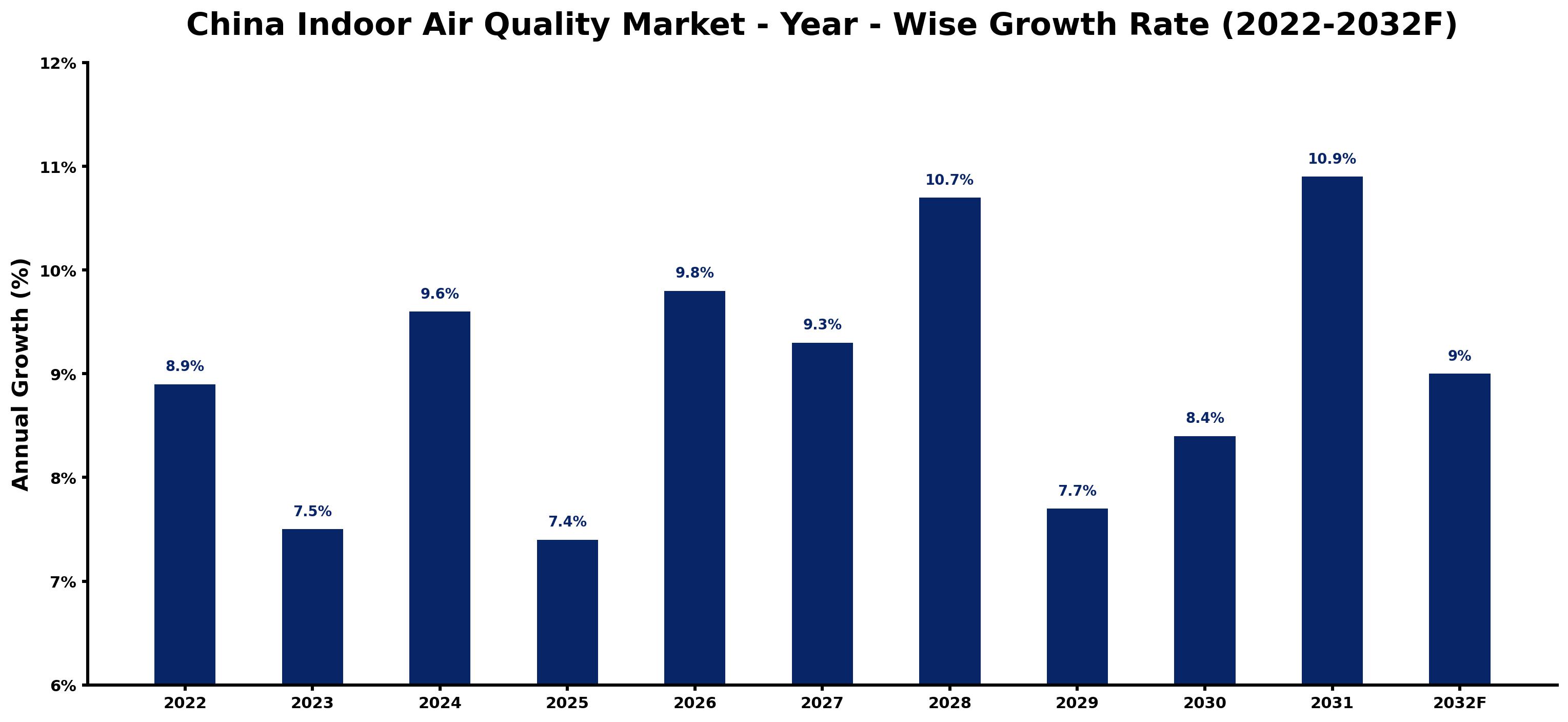
Each row of the following table gives one year's estimated growth and the event or demand shift that explains it.
| Year | Estimated Annual Growth (%) | Market Rationale |
| 2022 | 8.9 | The market experienced steady growth due to the 'Air Quality Improvement Action Plan' focusing on urban residential areas. |
| 2023 | 7.5 | Growth slowed as consumers adjusted to the 'Clean Air Action Plan' and product availability. |
| 2024 | 9.6 | Demand surged with heightened concerns over particulate matter from the national standard GB/T 18883-2002. |
| 2025 | 7.4 | Growth slowed as market saturation began to impact new purchases of air quality solutions. |
| 2026 | 9.8 | The market is expected to rebound with increased investment in integrated IAQ systems for new buildings. |
| 2027 | 9.3 | Growth is projected to slow as competition intensifies among air quality product providers. |
| 2028 | 10.7 | Demand is expected to accelerate with the integration of smart technologies in IAQ solutions. |
| 2029 | 7.7 | Growth is projected to slow as consumers become more discerning about product effectiveness and value. |
| 2030 | 8.4 | Demand is expected to rise with the emphasis on health standards in residential and commercial spaces. |
| 2031 | 10.9 | The market is projected to peak as urban areas implement stricter air quality regulations. |
| 2032 | 9.0 | Growth is expected to slow as the market stabilises following rapid expansion in previous years. |
Note: Market size estimations and growth projections presented in this report are based on 6Wresearch's proprietary forecasting methodology, utilizing the latest available industry data, government publications, and primary research inputs.
China Indoor Air Quality Market Synopsis
Indoor Air Quality in China encompasses the condition of air within buildings, focusing on health and comfort. Achieved through technologies like air purifiers and ventilation systems, it addresses pollutants effectively. The China Indoor Air Quality Market is expanding due to urbanisation, with the urban population reaching 900 million in 2023. Increased awareness of health issues linked to air pollution drives demand for solutions such as HEPA filters and integrated systems. The government's initiatives, such as the 'Clean Air Action Plan', further stimulate market growth.
Market Dynamics Impact Analysis (2026–2032)
| Factor | Type | Impact | Primary Segment Affected |
| Rising urban population drives demand for air quality solutions. | Driver | High | Air Purifiers |
| Increased health awareness leads to higher demand for IAQ solutions. | Driver | High | Integrated IAQ Systems |
| Growing urbanisation creates opportunities for smart building projects. | Opportunity | High | Smart Building Projects |
| Investment in advanced IAQ technologies is increasing. | Opportunity | High | Integrated IAQ Systems |
| High costs of advanced IAQ technologies may limit accessibility. | Restraint | Medium | Dehumidifiers |
| Regulatory compliance can create delays in product approvals. | Restraint | Medium | Ventilation Systems |
| Intense competition among suppliers may drive prices down. | Challenge | Medium | Air Purifiers |
| Supply chain disruptions can delay product availability. | Challenge | Medium | Integrated IAQ Systems |
Evaluation of Drivers in China Indoor Air Quality Market (2026–2032)
Key forces behind demand, with the segment each one moves most, are listed below.
| Drivers | Primary Segment Affected | Why It Matters (Evidence) |
| Urban population growth increases demand for air purifiers. | Air Purifiers | With 900 million urban residents, the need for effective air cleaning solutions rises. |
| Health concerns boost demand for integrated IAQ systems. | Integrated IAQ Systems | The emphasis on health in urban areas drives investment in air quality solutions, projected to grow at a CAGR of 11.6% from 2026 to 2032. |
| Regulatory standards encourage adoption of advanced filtration technologies. | HEPA | The national standard GB/T 18883-2002 mandates improved air quality, promoting HEPA filter use, which captures over 99% of PM2.5. |
| Smart building initiatives enhance demand for IAQ technologies. | Smart Building Projects | Cities like Shenzhen are integrating advanced air quality technologies into new constructions, increasing overall market growth. |
| Increased humidity levels necessitate dehumidifier installation. | Dehumidifiers | The average humidity in southern China creates a strong demand for humidity control solutions. |
Urbanisation has reached 900 million residents, driving the need for effective air cleaning solutions. Heightened health concerns in urban environments have led to a surge in integrated IAQ systems, projected to grow at a CAGR of 11.6% from 2026 to 2032. The national standard GB/T 18883-2002 mandates improved air quality, which is driving the adoption of HEPA filters, known for their over 99% efficiency for PM2.5. Smart building projects in regions like Shenzhen are integrating advanced IAQ technologies, further boosting market growth.
Evaluation of Restraints in China Indoor Air Quality Market
Below mentioned are some major restraints and their influence on market dynamics.
| Market Restraint | Primary Segment Affected | Why It Matters (Evidence) |
| High costs of advanced air quality technologies limit consumer access. | Dehumidifiers | The pricing of advanced dehumidifiers can deter budget-conscious consumers from purchasing. |
| Regulatory compliance creates delays in product approvals. | Ventilation Systems | Manufacturers face lengthy approval processes under national standards, affecting market entry. |
| Market saturation leads to reduced sales growth. | Air Purifiers | As the installed base exceeds 50 million units, new customer acquisition becomes challenging. |
| Supply chain disruptions impact product availability. | Integrated IAQ Systems | Global supply chain issues can delay the delivery of essential components for IAQ systems. |
| Consumer awareness of product effectiveness varies widely. | Smart Building Projects | Inconsistent knowledge about IAQ solutions can hinder purchasing decisions among potential buyers. |
China Indoor Air Quality Market Challenges
The China Indoor Air Quality market faces immediate challenges due to rapid urbanisation that overwhelms existing infrastructure. Buyers experience delays in obtaining effective air quality solutions, as the installed base of air purifiers only covers a small portion of the needs of 900 million urban residents. Regulatory compliance with the national standard GB/T 18883-2002 complicates matters for suppliers, as adherence to stringent guidelines can extend product approval times by up to six months. Rising costs for HEPA filters, essential for capturing PM2.5, inflate the prices of air quality products, making them less accessible for consumers. Supply chain disruptions for materials like activated carbon can lead to shortages, delaying product availability for buyers.
Trends in the China Indoor Air Quality Market
Four trends stand out in the China Indoor Air Quality Market.
- Shift towards Integrated IAQ Systems: The 'Green Building Action Plan' launched in 2023 promotes the integration of IAQ solutions in new constructions. This shift is reflected in the projected CAGR of 11.6% for integrated systems through 2032.
- Increased Adoption of Smart Technologies: Since 2023, smart sensors have gained traction in IAQ systems, enhancing monitoring capabilities. This trend is underscored by a projected CAGR of 11.0% for smart sensor technology in the coming years.
- Focus on VOC Removal Solutions: The demand for VOC removal solutions has surged due to stricter regulations on indoor air quality. This trend is supported by increasing implementation of standards requiring effective VOC management.
- Emphasis on Health in Hospitals: In 2023, the National Health Commission highlighted the importance of IAQ in hospitals. This focus aims to reduce infection rates, reflecting a growing trend towards prioritising health in healthcare environments.
Investment Opportunities in the China Indoor Air Quality Market
Below are the investment opportunities with the strongest case in the China Indoor Air Quality Market.
- Investment in Smart Building Technologies: With the urban population reaching 900 million, there is a gap in smart building technologies. Investing in these solutions can cater to the growing demand, particularly in urban areas like Shenzhen.
- Expansion of Integrated IAQ Systems: The construction of smart homes in Beijing is expected to include integrated IAQ systems by 2025. Suppliers can enter this market by partnering with local builders to meet this demand.
- Development of Advanced Dehumidifiers: The average humidity level in southern China necessitates advanced dehumidifiers. This presents an opportunity for manufacturers to innovate and supply effective solutions to residential buildings.
- Focus on Healthcare IAQ Solutions: The National Health Commission's 'Healthy China 2030' initiative aims to improve IAQ in healthcare facilities. This creates a significant opportunity for suppliers of advanced IAQ technologies.
Government Initiatives in the China Indoor Air Quality Market
In 2021, the Ministry of Ecology and Environment launched the 'Air Quality Improvement Action Plan', which mandates stricter compliance for new constructions, ensuring better ventilation systems and air quality monitoring. This builds on previous regulations and aims to improve indoor air quality standards in urban residential areas. The initiative has led to increased funding for projects that enhance air quality in public buildings, benefiting both producers and consumers.
The 'Healthy China 2030' initiative includes measures to improve indoor air quality in healthcare facilities, aiming for compliance by 2025. The National Health Commission, along with the Ministry of Housing and Urban-Rural Development, funds projects to enhance ventilation and air quality in hospitals, allowing producers to meet new standards and improve health outcomes for patients.
Future Insight of the China Indoor Air Quality Market
The China Indoor Air Quality market will transform by 2032, driven by advancements in smart technologies and strong regulatory support. The 'Clean Air Action Plan' will enhance compliance requirements, benefiting suppliers who meet these standards. By 2025, smart homes in Beijing are set to integrate advanced IAQ systems, improving air quality management. The demand for VOC removal solutions will rise as regulations tighten, with the National Health Commission advocating for better IAQ in healthcare settings. These shifts will open new avenues for buyers and suppliers in the market.
Market Segmentation Analysis
The analysis below covers each segmentation, its leading category in 2025 and its fastest-growing category through 2032.
By Product Type – Air Purifiers Dominated, Integrated IAQ Systems Expected to Grow Fastest
According to Sachin Kumar Rai, Senior Research Analyst at 6Wresearch, Air Purifiers accounted for a 46% market share by product type in 2025. Air purifiers hold the largest market share in China due to their essential role in removing airborne pollutants, with over 50 million units installed by 2022. Their widespread adoption in urban homes and offices highlights the critical demand for enhanced indoor air quality solutions. Integrated IAQ Systems are projected to grow fastest, at a CAGR of 11.6% during 2026–2032. Integrated IAQ systems are witnessing rapid growth as urbanisation drives the construction of smart homes, expected to feature these systems by 2025. This trend towards comprehensive air quality solutions indicates a shift in consumer preferences towards more advanced technologies. Suppliers should focus on developing integrated IAQ solutions to meet the rising demand for advanced indoor air quality technologies.
By Air Concern Focus – PM Dominated, Multi-pollutant Expected to Grow Fastest
In 2025, PM led the air concern focus split with a 38% share. Particulate matter (PM) is the leading air quality concern in China, capturing a significant market share as urban air quality deteriorates. The high levels of PM pollution necessitate effective filtration solutions, making it a priority for consumers and regulators alike. Multi-pollutant is set to record the highest CAGR in this split, 11.6% over 2026–2032. The multi-pollutant focus is rapidly gaining traction as consumers increasingly seek systems that address various air quality issues simultaneously, driven by heightened health awareness. Stricter regulations on indoor air quality further fuel the demand for comprehensive solutions. Buyers should consider investing in multi-pollutant solutions that provide extensive protection against a range of air quality threats.
By Technology Used – HEPA Dominated, Smart Sensors Expected to Grow Fastest
HEPA held a 38% share of the China Indoor Air Quality Market by technology used in 2025. HEPA technology dominates the market due to its proven efficiency in air purifiers, achieving over 99% filtration efficiency for PM2.5. This high-performance standard is crucial for consumers prioritising health and comfort in their indoor environments. Over 2026–2032, Smart Sensors are expected to post the fastest growth, at a CAGR of 11.0%. Smart sensors are gaining popularity as they enhance IAQ systems by enabling real-time monitoring and adjustments. Their integration into existing systems is driving growth as consumers increasingly seek smarter air quality management solutions. Suppliers should incorporate smart sensor technology into their products to align with consumer preferences for enhanced functionality.
By End User – Homes & Offices Dominated, Smart Building Projects Expected to Grow Fastest
With a 38% revenue share in 2025, Homes & Offices was the largest end user category. Homes and offices represent the largest market share, driven by the need for improved indoor air quality to ensure health and comfort. The growing urban population, which reached 900 million in 2023, significantly amplifies this demand. The quickest growth will come from Smart Building Projects, forecast to expand at a CAGR of 11.7% between 2026 and 2032. Smart building projects are expanding rapidly as modern construction increasingly incorporates advanced IAQ technologies. This trend reflects a commitment to sustainable practices and improved occupant health, aligning with changing consumer preferences. Investing in solutions tailored for smart building projects will strategically position suppliers in a transforming market.
Key Attractiveness of the Report
- 10 Years of Market Numbers
- Historical Data Starting from 2022 to 2025
- Base Year 2025
- Forecast Data until 2032
- Key Performance Indicators Impacting the Market
- Major Upcoming Developments and Projects
Key Highlights of the Report:
- China Indoor Air Quality Market Outlook
- Market Size of China Indoor Air Quality Market, 2025
- Forecast of China Indoor Air Quality Market, 2032
- Historical Data and Forecast of China Indoor Air Quality Revenues & Volume for the Period 2022 - 2032F
- China Indoor Air Quality Market Trend Evolution
- China Indoor Air Quality Market Drivers and Challenges
- China Indoor Air Quality Price Trends
- China Indoor Air Quality Porter's Five Forces
- China Indoor Air Quality Industry Life Cycle
- Historical Data and Forecast of China Indoor Air Quality Market Revenues & Volume By Product Type for the Period 2022 - 2032F
- Historical Data and Forecast of China Indoor Air Quality Market Revenues & Volume By Air Purifiers for the Period 2022 - 2032F
- Historical Data and Forecast of China Indoor Air Quality Market Revenues & Volume By Dehumidifiers for the Period 2022 - 2032F
- Historical Data and Forecast of China Indoor Air Quality Market Revenues & Volume By Ventilation Systems for the Period 2022 - 2032F
- Historical Data and Forecast of China Indoor Air Quality Market Revenues & Volume By Integrated IAQ Systems for the Period 2022 - 2032F
- Historical Data and Forecast of China Indoor Air Quality Market Revenues & Volume By Air Concern Focus for the Period 2022 - 2032F
- Historical Data and Forecast of China Indoor Air Quality Market Revenues & Volume By PM, VOC, CO for the Period 2022 - 2032F
- Historical Data and Forecast of China Indoor Air Quality Market Revenues & Volume By Mold/Mildew for the Period 2022 - 2032F
- Historical Data and Forecast of China Indoor Air Quality Market Revenues & Volume By CO , VOC for the Period 2022 - 2032F
- Historical Data and Forecast of China Indoor Air Quality Market Revenues & Volume By Multi-pollutant for the Period 2022 - 2032F
- Historical Data and Forecast of China Indoor Air Quality Market Revenues & Volume By Technology Used for the Period 2022 - 2032F
- Historical Data and Forecast of China Indoor Air Quality Market Revenues & Volume By HEPA, Activated Carbon for the Period 2022 - 2032F
- Historical Data and Forecast of China Indoor Air Quality Market Revenues & Volume By Refrigerant/Desiccant for the Period 2022 - 2032F
- Historical Data and Forecast of China Indoor Air Quality Market Revenues & Volume By Smart Sensors for the Period 2022 - 2032F
- Historical Data and Forecast of China Indoor Air Quality Market Revenues & Volume By IoT HVAC Integration for the Period 2022 - 2032F
- Historical Data and Forecast of China Indoor Air Quality Market Revenues & Volume By End User for the Period 2022 - 2032F
- Historical Data and Forecast of China Indoor Air Quality Market Revenues & Volume By Homes & Offices for the Period 2022 - 2032F
- Historical Data and Forecast of China Indoor Air Quality Market Revenues & Volume By Hospitals, Hotels for the Period 2022 - 2032F
- Historical Data and Forecast of China Indoor Air Quality Market Revenues & Volume By Smart Building Projects for the Period 2022 - 2032F
- Historical Data and Forecast of China Indoor Air Quality Market Revenues & Volume By Smart Home Builders for the Period 2022 - 2032F
- China Indoor Air Quality Import Export Trade Statistics
- Market Opportunity Assessment By Product Type
- Market Opportunity Assessment By Air Concern Focus
- Market Opportunity Assessment By Technology Used
- Market Opportunity Assessment By End User
- China Indoor Air Quality Top Companies Market Share
- China Indoor Air Quality Competitive Benchmarking By Technical and Operational Parameters
- China Indoor Air Quality Company Profiles
- China Indoor Air Quality Key Strategic Recommendations
Market Covered
This report examines the market across the segments below.
By Product Type
- Air Purifiers
- Dehumidifiers
- Ventilation Systems
- Integrated IAQ Systems
By Air Concern Focus
- PM
- VOC
- CO₂
- Mold/Mildew
- Multi-pollutant
By Technology Used
- HEPA
- Activated Carbon
- Refrigerant/Desiccant
- Smart Sensors
- IoT + HVAC Integration
By End User
- Homes & Offices
- Hospitals
- Hotels
- Smart Building Projects
- Smart Home Builders































