China Indoor Fitness Equipment Market Size & Growth Rate
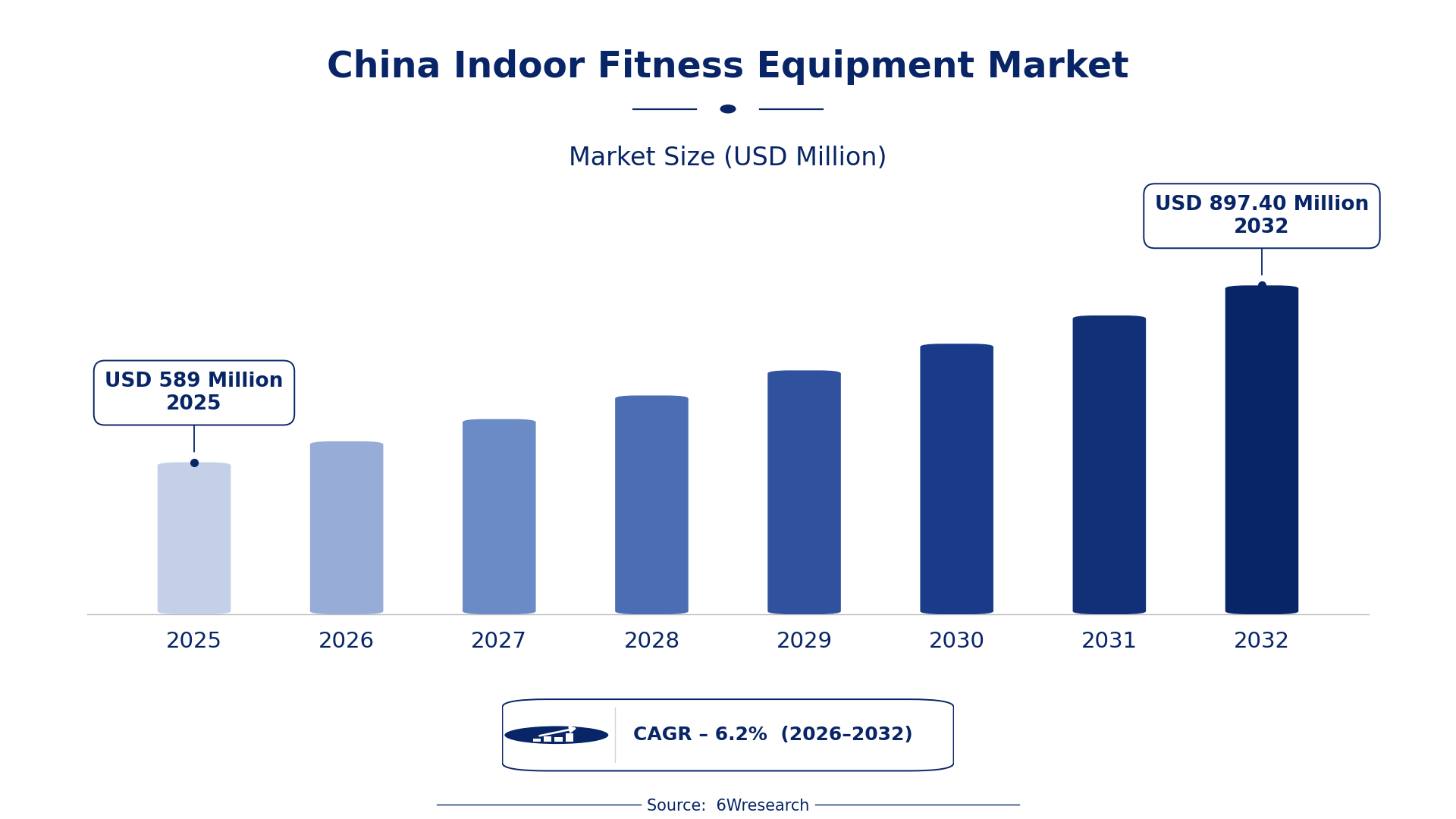
According to 6Wresearch internal database and industry insights, the China Indoor Fitness Equipment Market was valued at USD 589.0 million in 2025 and is projected to reach USD 897.40 million by 2032, growing at a CAGR of approximately 6.2% during 2026–2032.
China Indoor Fitness Equipment Market Highlights
| Report Metric | Details |
| Report Name | China Indoor Fitness Equipment Market |
| Market Size 2025 | USD 589.0 million |
| Market Size 2032 | USD 897.40 million |
| Absolute Growth 2025–2032 | USD 308.40 million |
| CAGR 2026–2032 | 6.2% |
| Peak Annual Growth | 8.5% in 2028 |
| Forecast Period | 2026–2032 |
| Historical Data | 2022–2025 |
| Base Year | 2025 |
| Leading Equipment Type, 2025 | Treadmills (40% share) |
| Leading Training Focus, 2025 | Cardio (39% share) |
| Leading Connectivity, 2025 | Smart App Integration (42% share) |
| Leading End User, 2025 | Home Users (41% share) |
| Fastest-Growing Equipment Type | Multi-Gyms (8.4% CAGR) |
| Fastest-Growing Training Focus | Strength (7.6% CAGR) |
| Fastest-Growing Connectivity | Manual (8.5% CAGR) |
| Fastest-Growing End User | Fitness Clubs (8.6% CAGR) |
| Growing Sector | Home Fitness Equipment |
| Key End Users | Home Users, Fitness Clubs, Boutique Fitness Studios |
China Indoor Fitness Equipment Market Year-wise Growth Rate and Key Drivers (2022–2032)
This graph illustrates the annual growth rates of the market from 2022 to 2032, highlighting a steady upward trajectory and projected market expansion over the forecast period.
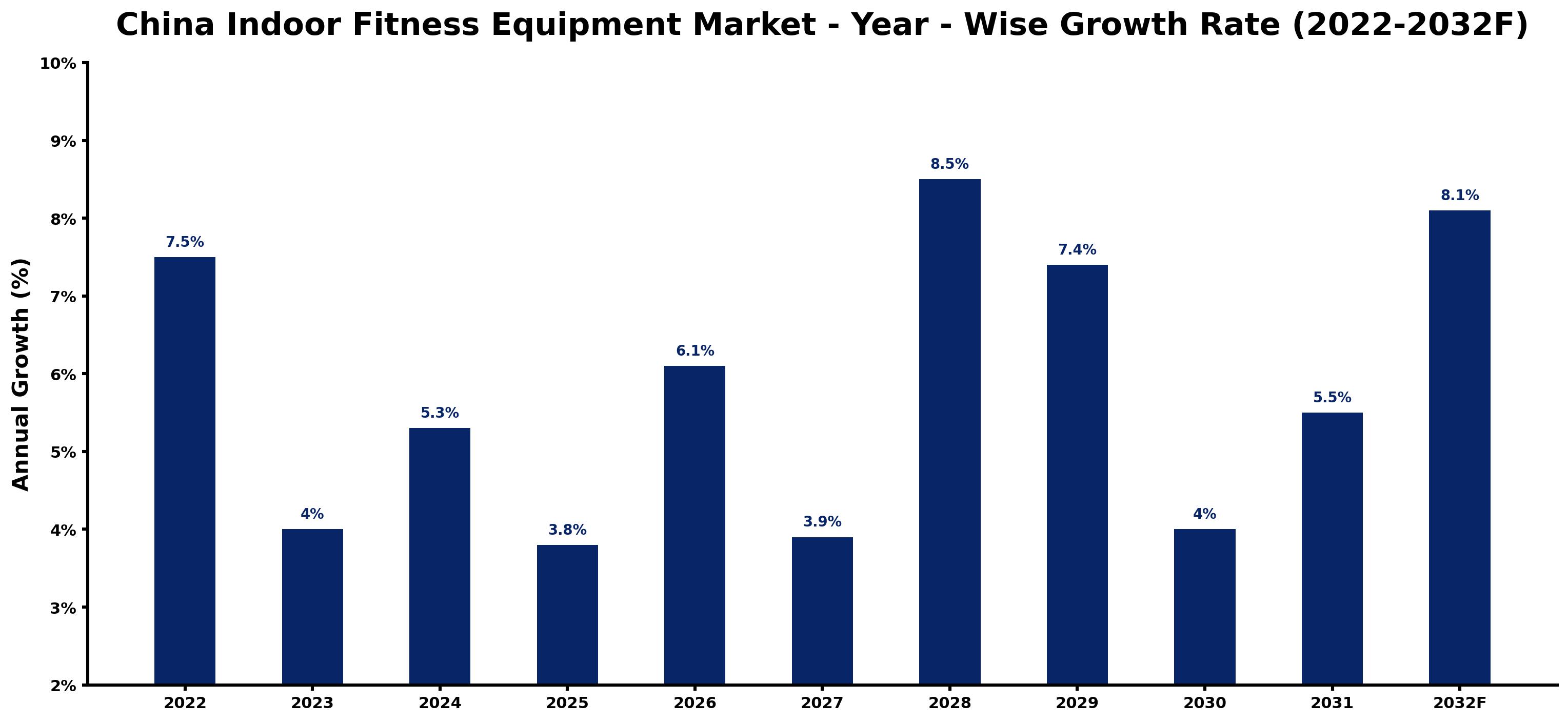
Each row of the following table gives one year's estimated growth and the event or demand shift that explains it.
| Year | Estimated Annual Growth (%) | Market Rationale |
| 2022 | 7.5 | The market showed strong activity with high consumer engagement in fitness activities, driven by the 'Healthy China 2030' initiative. |
| 2023 | 4.0 | Growth slowed as consumer preferences shifted towards more affordable fitness equipment options, impacting demand for premium products. |
| 2024 | 5.3 | Demand increased as more consumers sought home fitness solutions amid ongoing health awareness, particularly in urban areas. |
| 2025 | 3.8 | Growth slowed again as market saturation began to affect new purchases, especially in major cities like Shanghai and Beijing. |
| 2026 | 6.1 | The market rebounded as fitness clubs expanded their offerings and memberships increased, leading to higher equipment purchases. |
| 2027 | 3.9 | Growth slowed slightly due to heightened competition among fitness equipment brands, affecting pricing strategies. |
| 2028 | 8.5 | A surge in demand occurred as smart fitness equipment gained popularity among consumers, enhancing their workout experiences. |
| 2029 | 7.4 | Growth slowed as the market began to stabilise after rapid expansion in prior years, particularly in the home user segment. |
| 2030 | 4.0 | The market maintained steady growth as new fitness trends emerged among consumers, influenced by social media and online platforms. |
| 2031 | 5.5 | Demand increased again as fitness clubs upgraded their equipment to attract new members, responding to changing consumer preferences. |
| 2032 | 8.1 | Growth accelerated as the adoption of smart technology in fitness equipment became mainstream, appealing to tech-savvy buyers. |
Note: Market size estimations and growth projections presented in this report are based on 6Wresearch's proprietary forecasting methodology, utilizing the latest available industry data, government publications, and primary research inputs.
China Indoor Fitness Equipment Market Synopsis
Indoor Fitness Equipment in China encompasses machines and tools designed for indoor exercise, including treadmills, stationary bikes, and multi-gyms. These products are essential for personal fitness, rehabilitation, and professional training. The China Indoor Fitness Equipment Market is expanding due to a health-conscious population and rising disposable incomes. Over 300 million people engage in regular fitness activities, and the government promotes wellness through initiatives like 'Healthy China 2030'. This sector is expected to thrive further as consumer demand continues to rise.
Market Dynamics Impact Analysis (2026–2032)
| Factor | Type | Impact | Primary Segment Affected |
| Increasing health awareness among the population drives demand for fitness equipment. | Driver | High | Cardio |
| Rising disposable incomes enable consumers to invest in home fitness solutions. | Driver | High | Home Users |
| Growing number of fitness clubs creates demand for new equipment installations. | Opportunity | High | Fitness Clubs |
| Expansion of boutique fitness studios presents a niche market for specialized equipment. | Opportunity | Medium | Boutique Fitness Studios |
| Market saturation limits growth potential for new entrants and existing brands. | Restraint | High | Multi-Gyms |
| High competition among brands can lead to price wars, affecting profitability. | Restraint | Medium | Stationary Bikes |
| Challenges in supply chain logistics can delay equipment delivery to buyers. | Challenge | High | Treadmills |
| Rapid technological advancements require continuous investment from producers. | Challenge | Medium | Smart App Integration |
Evaluation of Drivers in China Indoor Fitness Equipment Market (2026–2032)
Below mentioned are some major drivers and their influence on market dynamics.
| Drivers | Primary Segment Affected | Why It Matters (Evidence) |
| Health-conscious consumers increasingly seek effective fitness solutions. | Treadmills | With over 300 million people engaging in fitness, demand for cardio equipment rises. |
| Rising disposable incomes allow more households to invest in fitness equipment. | Multi-Gyms | The average annual spending on fitness equipment per household is around 1,500 yuan. |
| Fitness clubs are expanding their facilities to attract more members. | Fitness Clubs | Membership in fitness clubs reached 20 million in 2023, driving equipment purchases. |
| Smart technology integration improves user experience and engagement. | Smart App Integration | Adoption of smart fitness equipment is projected to rise by 15% annually until 2025. |
| Government initiatives promote public fitness and wellness. | Home Users | The 'Healthy China 2030' initiative encourages more people to engage in fitness activities. |
Market growth in China for Indoor Fitness Equipment rests on rising health awareness, increasing disposable incomes, and expanding fitness club memberships. With over 300 million individuals engaging in fitness activities, the demand for cardio equipment, particularly treadmills, is substantial. The average household spends around 1,500 yuan annually on fitness equipment, allowing more families to invest in multi-gyms. Membership in fitness clubs reached 20 million in 2023, prompting these clubs to purchase new machines. The adoption of smart fitness equipment is projected to rise by 15% annually until 2025, which improves user experience and tracking capabilities.
Evaluation of Restraints in China Indoor Fitness Equipment Market
Below mentioned are some major restraints and their influence on market dynamics.
| Market Restraint | Primary Segment Affected | Why It Matters (Evidence) |
| Market saturation limits growth potential for new entrants. | Multi-Gyms | As the market matures, fewer consumers are willing to invest in new equipment, particularly in saturated urban areas. |
| High competition among brands can lead to price wars. | Stationary Bikes | This competition affects profit margins and can deter new investments in the market, particularly among smaller brands. |
| Supply chain logistics challenges delay equipment delivery. | Treadmills | Delays can frustrate buyers and lead to lost sales opportunities for suppliers, especially during peak seasons. |
| Technological advancements require continuous investment from producers. | Smart App Integration | Producers must keep up with trends, which can strain financial resources and affect product development timelines. |
| Consumer preferences shift rapidly, complicating product offerings. | Fitness Clubs | Clubs must adapt quickly to new trends or risk losing members to competitors, impacting their revenue streams. |
China Indoor Fitness Equipment Market Challenges
The China Indoor Fitness Equipment Market encounters several practical issues, beginning with supply chain disruptions that raise costs for producers. Delays in sourcing steel and electronic components can extend production times by up to 20%, which forces manufacturers to increase prices and affects buyers seeking affordable options. Technology integration poses a challenge, as many producers find it difficult to incorporate smart features into their equipment, resulting in a loss of market share to competitors offering advanced solutions. Compliance with the national standard GB/T 19858-2018 adds complexity, leading to additional costs for producers in safety testing and certification, which can delay product launches by several months.
Trends in the China Indoor Fitness Equipment Market
The trends below show where the China Indoor Fitness Equipment Market is heading.
- Shift from Traditional to Smart Fitness Equipment: Since 2020, there has been a clear shift towards smart fitness equipment in China. Smart app integration leads the market with a 42% share, and this trend is likely to persist as technology improves user experience and engagement.
- Rise of Boutique Fitness Studios: The number of boutique fitness studios in China has surged by 30% since 2020. This growth reflects a shift towards specialised fitness experiences, attracting consumers seeking unique training options and community engagement.
- Growing Engagement in Home Fitness: In 2023, over 300 million people in China participate in regular fitness activities, highlighting a trend towards home fitness solutions. This shift drives demand for equipment designed for personal use, particularly among urban households.
- Expansion of Fitness Club Memberships: Fitness club membership reached 20 million in 2023, indicating a growing trend in communal fitness engagement. This expansion presents opportunities for equipment suppliers to meet rising demand, especially in metropolitan areas.
Investment Opportunities in the China Indoor Fitness Equipment Market
Some of the investment opportunities in the China Indoor Fitness Equipment Market are mentioned below.
- Investment in Smart Fitness Technology: With smart fitness equipment adoption projected to rise by 15% annually until 2025, suppliers should concentrate on integrating technology into their products. Fitness clubs are key buyers, and local partnerships can facilitate market entry and growth.
- Expansion of Boutique Fitness Studios: The 30% increase in boutique fitness studios since 2020 provides a prime opportunity for specialised equipment suppliers. Targeting these studios with tailored products can yield substantial returns and strengthen market presence.
- Growth in Home Fitness Solutions: As more consumers invest in home fitness, the average annual spending on equipment is around 1,500 yuan. Suppliers can penetrate this market by forming joint ventures with local distributors to effectively reach home users.
- Government Support for Public Fitness Facilities: The government allocated 500 million yuan in 2023 to support public fitness facilities, creating opportunities for suppliers of fitness equipment. Engaging with local authorities can help secure contracts and improve community access.
Government Initiatives in the China Indoor Fitness Equipment Market
The national standard GB/T 19858-2018, established to ensure safety for fitness equipment, has shaped production practices since its implementation in 2018. Additionally, the 'Healthy China 2030' initiative, launched in 2016, promotes fitness and wellness across the population, influencing consumer behaviour and demand for fitness products. These measures have encouraged manufacturers to adhere to safety standards and innovate in product design to meet growing consumer expectations and preferences.
In 2023, the government allocated 500 million yuan to support public fitness facilities, administered by the National Sports Administration. This funding aims to improve community access to fitness resources, driving demand for fitness equipment in public spaces. The initiative encourages local governments to invest in fitness infrastructure, which will further stimulate market growth and create opportunities for suppliers to engage with communities.
Future Insight of the China Indoor Fitness Equipment Market
The China Indoor Fitness Equipment Market is poised for evolution by 2032, driven by the 'Healthy China 2030' initiative and increased government funding for public fitness facilities. Smart fitness equipment adoption will see a notable rise, with an expected annual growth rate of 15% until 2025, improving user engagement. By 2025, fitness clubs will install over 1 million new machines, significantly broadening access for consumers. The growing health-conscious population, with over 20 million fitness club memberships, will further fuel demand for diverse indoor fitness solutions.
Market Segmentation Analysis
Each segment group is reviewed below, with the leader by share and the fastest grower by CAGR.
By Equipment Type – Treadmills Dominated, Multi-Gyms Expected to Grow Fastest
According to Sachin Kumar Rai, Senior Research Analyst at 6Wresearch, Treadmills took a 40% share of equipment type in 2025, more than any other category. Treadmills hold the largest share in the China Indoor Fitness Equipment Market as they are widely used for cardio workouts, appealing to a health-conscious demographic. The demand is particularly strong in urban areas like Shanghai and Beijing, where fitness culture is thriving. Over 2026–2032, Multi-Gyms are expected to post the fastest growth, at a CAGR of 8.4%. Multi-gyms are the fastest-growing segment due to their versatility for strength training at home, catering to the increasing number of fitness club memberships that reached 20 million in 2023. This growth indicates a shift towards multifunctional equipment that can accommodate various workout routines. Suppliers should prioritise the development of multi-gyms to capitalise on the rising trend of home fitness solutions.
By Training Focus – Cardio Dominated, Strength Expected to Grow Fastest
The largest training focus category in 2025 was Cardio, with a 39% share of total revenue. Cardio holds the largest market share due to its essential role in aerobic fitness routines, appealing to a wide demographic prioritising health. The 'Healthy China 2030' initiative actively supports cardiovascular activities, solidifying its position in the fitness equipment market. Strength is set to record the highest CAGR in this split, 7.6% over 2026–2032. Strength training is witnessing the fastest growth as more individuals focus on muscle building and toning, driven by the increase in fitness club memberships. This trend indicates a shift towards more comprehensive training regimens that include strength components. Suppliers should expand their strength training product lines to meet the rising demand from fitness enthusiasts.
By Connectivity – Smart App Integration Dominated, Manual Expected to Grow Fastest
With a 42% revenue share in 2025, Smart App Integration was the largest connectivity category. Smart app integration dominates the connectivity segment by enhancing user experience and tracking capabilities, which are increasingly important for fitness enthusiasts. This trend aligns with the projected 15% annual growth in smart fitness equipment adoption until 2025. The quickest growth will come from Manual, forecast to expand at a CAGR of 8.5% between 2026 and 2032. Manual connectivity is growing rapidly as it provides basic functionality without the complexities of advanced technology, appealing to users who prefer simplicity. This trend particularly resonates with budget-conscious consumers looking for straightforward fitness solutions. Suppliers need to offer a range of connectivity options to accommodate diverse consumer preferences.
By End User – Home Users Dominated, Fitness Clubs Expected to Grow Fastest
Home Users held a 41% share of the China Indoor Fitness Equipment Market by end user in 2025. Home users represent the largest segment in the market, driven by the convenience of exercising at home. The average annual spending on fitness equipment per household, around 1,500 yuan, reflects the commitment of consumers to their fitness journeys. Fitness Clubs are projected to grow fastest, at a CAGR of 8.6% during 2026–2032. Fitness clubs are the fastest-growing end user segment, as they are the primary market for equipment sales. The expected installation of over 1 million new machines by 2025 indicates strong demand for high-quality fitness equipment in these facilities. Suppliers should prioritise partnerships with fitness clubs to capitalise on the increasing demand for new equipment.
Key Attractiveness of the Report
- 10 Years of Market Numbers
- Historical Data Starting from 2022 to 2025
- Base Year 2025
- Forecast Data until 2032
- Key Performance Indicators Impacting the Market
- Major Upcoming Developments and Projects
Key Highlights of the Report:
- China Indoor Fitness Equipment Market Outlook
- Market Size of China Indoor Fitness Equipment Market, 2025
- Forecast of China Indoor Fitness Equipment Market, 2032
- Historical Data and Forecast of China Indoor Fitness Equipment Revenues & Volume for the Period 2022 - 2032F
- China Indoor Fitness Equipment Market Trend Evolution
- China Indoor Fitness Equipment Market Drivers and Challenges
- China Indoor Fitness Equipment Price Trends
- China Indoor Fitness Equipment Porter's Five Forces
- China Indoor Fitness Equipment Industry Life Cycle
- Historical Data and Forecast of China Indoor Fitness Equipment Market Revenues & Volume By Equipment Type for the Period 2022 - 2032F
- Historical Data and Forecast of China Indoor Fitness Equipment Market Revenues & Volume By Treadmills for the Period 2022 - 2032F
- Historical Data and Forecast of China Indoor Fitness Equipment Market Revenues & Volume By Multi-Gyms for the Period 2022 - 2032F
- Historical Data and Forecast of China Indoor Fitness Equipment Market Revenues & Volume By Stationary Bikes for the Period 2022 - 2032F
- Historical Data and Forecast of China Indoor Fitness Equipment Market Revenues & Volume By Rowing Machines for the Period 2022 - 2032F
- Historical Data and Forecast of China Indoor Fitness Equipment Market Revenues & Volume By Training Focus for the Period 2022 - 2032F
- Historical Data and Forecast of China Indoor Fitness Equipment Market Revenues & Volume By Cardio for the Period 2022 - 2032F
- Historical Data and Forecast of China Indoor Fitness Equipment Market Revenues & Volume By Strength for the Period 2022 - 2032F
- Historical Data and Forecast of China Indoor Fitness Equipment Market Revenues & Volume By Cycling for the Period 2022 - 2032F
- Historical Data and Forecast of China Indoor Fitness Equipment Market Revenues & Volume By Full Body for the Period 2022 - 2032F
- Historical Data and Forecast of China Indoor Fitness Equipment Market Revenues & Volume By Connectivity for the Period 2022 - 2032F
- Historical Data and Forecast of China Indoor Fitness Equipment Market Revenues & Volume By Smart App Integration for the Period 2022 - 2032F
- Historical Data and Forecast of China Indoor Fitness Equipment Market Revenues & Volume By Manual for the Period 2022 - 2032F
- Historical Data and Forecast of China Indoor Fitness Equipment Market Revenues & Volume By Virtual Training Platforms for the Period 2022 - 2032F
- Historical Data and Forecast of China Indoor Fitness Equipment Market Revenues & Volume By Data Analytics + Bluetooth for the Period 2022 - 2032F
- Historical Data and Forecast of China Indoor Fitness Equipment Market Revenues & Volume By End User for the Period 2022 - 2032F
- Historical Data and Forecast of China Indoor Fitness Equipment Market Revenues & Volume By Home Users for the Period 2022 - 2032F
- Historical Data and Forecast of China Indoor Fitness Equipment Market Revenues & Volume By Fitness Clubs for the Period 2022 - 2032F
- Historical Data and Forecast of China Indoor Fitness Equipment Market Revenues & Volume By Boutique Fitness Studios for the Period 2022 - 2032F
- Historical Data and Forecast of China Indoor Fitness Equipment Market Revenues & Volume By Premium Home Gyms for the Period 2022 - 2032F
- China Indoor Fitness Equipment Import Export Trade Statistics
- Market Opportunity Assessment By Equipment Type
- Market Opportunity Assessment By Training Focus
- Market Opportunity Assessment By Connectivity
- Market Opportunity Assessment By End User
- China Indoor Fitness Equipment Top Companies Market Share
- China Indoor Fitness Equipment Competitive Benchmarking By Technical and Operational Parameters
- China Indoor Fitness Equipment Company Profiles
- China Indoor Fitness Equipment Key Strategic Recommendations
Market Covered
This report examines the market across the segments below.
By Equipment Type
- Treadmills
- Multi-Gyms
- Stationary Bikes
- Rowing Machines
By Training Focus
- Cardio
- Strength
- Cycling
- Full Body
By Connectivity
- Smart App Integration
- Manual
- Virtual Training Platforms
- Data Analytics + Bluetooth
By End User
- Home Users
- Fitness Clubs
- Boutique Fitness Studios
- Premium Home Gyms































