China Industrial Heat Sink Market Size & Growth Rate
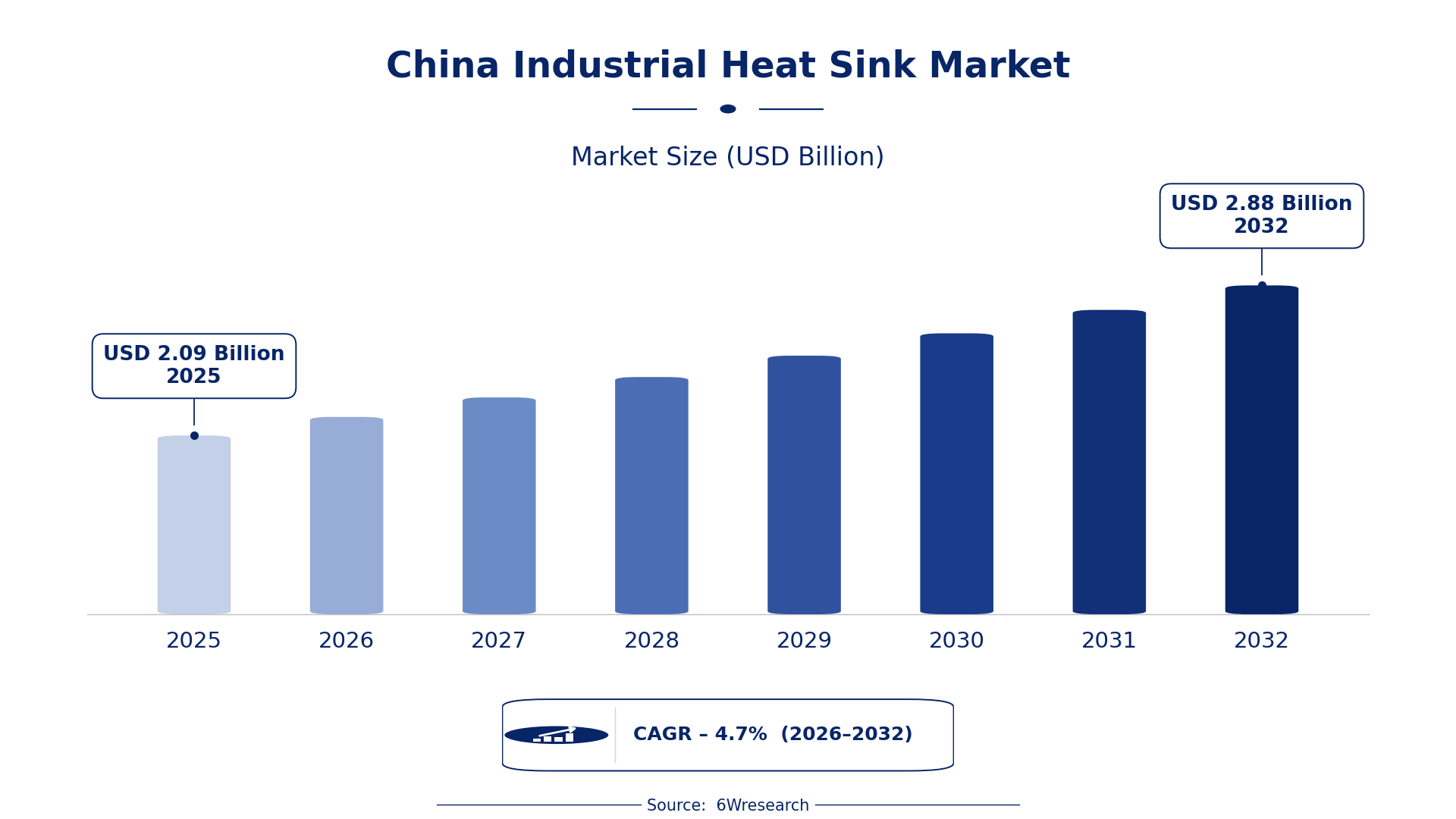
According to 6Wresearch internal database and industry insights, the China Industrial Heat Sink Market was valued at USD 2.09 billion in 2025 and is projected to reach USD 2.88 billion by 2032, growing at a CAGR of approximately 4.7% during 2026–2032.
China Industrial Heat Sink Market Highlights
| Report Metric | Details |
| Report Name | China Industrial Heat Sink Market |
| Market Size 2025 | USD 2.09 billion |
| Market Size 2032 | USD 2.88 billion |
| Absolute Growth 2025–2032 | USD 0.79 billion |
| CAGR 2026–2032 | 4.7% |
| Peak Annual Growth | 6.9% in 2027 |
| Forecast Period | 2026–2032 |
| Historical Data | 2022–2025 |
| Base Year | 2025 |
| Leading Heat Sink Type, 2025 | Passive Heat Sinks (33% share) |
| Leading Material Type, 2025 | Aluminum (43% share) |
| Leading Cooling Method, 2025 | Natural Convection (36% share) |
| Leading End User, 2025 | Power Electronics (47% share) |
| Fastest-Growing Heat Sink Type | Active Heat Sinks (5.9% CAGR) |
| Fastest-Growing Material Type | Copper (7.4% CAGR) |
| Fastest-Growing Cooling Method | Forced Air Cooling (7.5% CAGR) |
| Fastest-Growing End User | Computing Servers (7.4% CAGR) |
| Growing Sector | Electronics Manufacturing |
| Key End Users | Power Electronics, Computing Servers, Automotive Control Units |
China Industrial Heat Sink Market Year-wise Growth Rate and Key Drivers (2022–2032)
This graph illustrates the annual growth rates of the market from 2022 to 2032, highlighting a steady upward trajectory and projected market expansion over the forecast period.
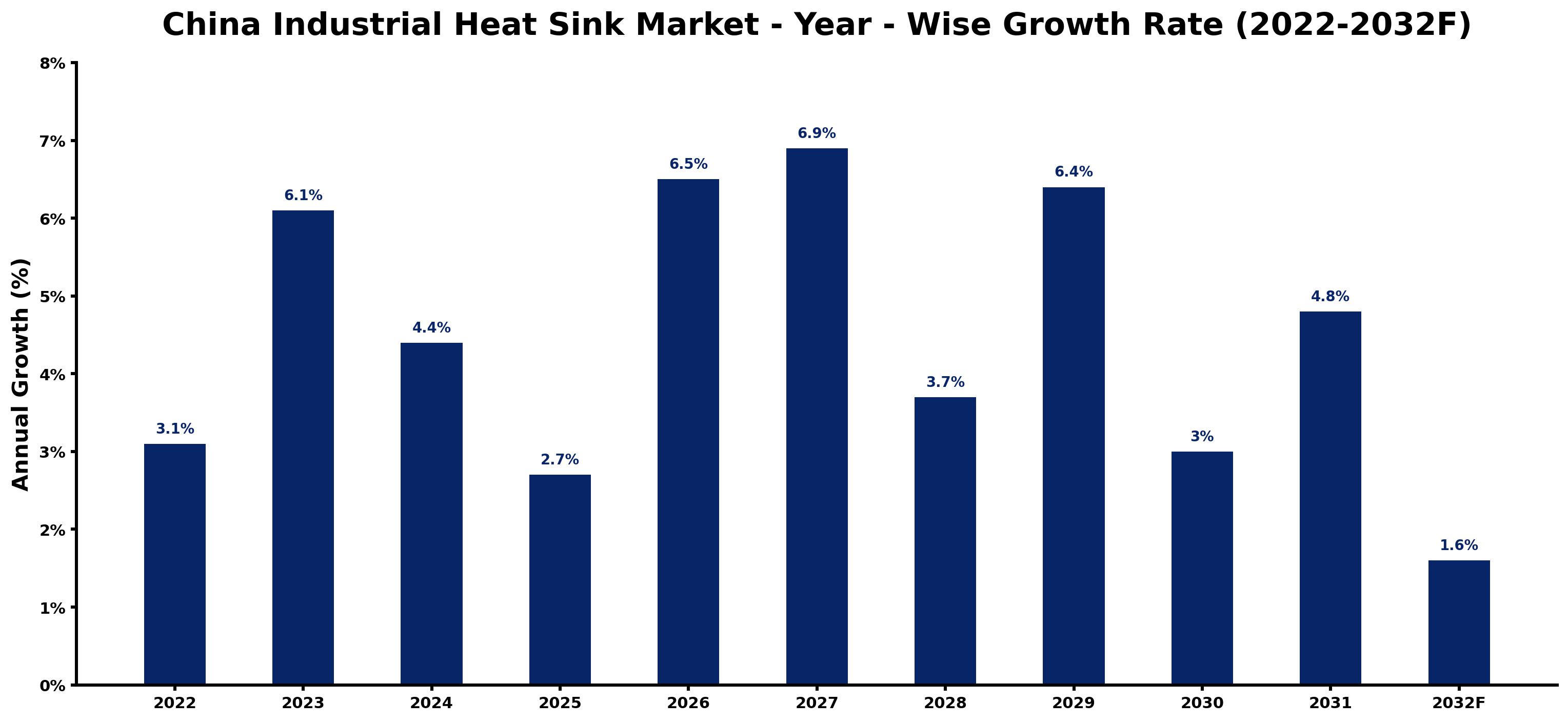
The following table presents the estimated annual growth rate for each year together with the principal factor influencing market performance.
| Year | Estimated Annual Growth (%) | Market Rationale |
| 2022 | 3.1 | Demand for industrial heat sinks remained stable due to ongoing electronics production in the country. |
| 2023 | 6.1 | The electronics manufacturing sector saw a surge, boosting heat sink requirements, particularly in Guangdong province. |
| 2024 | 4.4 | Growth slowed as the market adjusted to previous high demand levels in automotive production. |
| 2025 | 2.7 | Continued expansion in automotive production led to further heat sink needs for automotive control units. |
| 2026 | 6.5 | Demand is expected to accelerate with the introduction of new high-performance computing servers in the market. |
| 2027 | 6.9 | The market is projected to peak as automotive electronics drive unprecedented heat sink sales. |
| 2028 | 3.7 | Growth is expected to decelerate as supply chain constraints begin to affect availability of materials. |
| 2029 | 6.4 | Increased production of computing servers is projected to revitalise demand for heat sinks in the electronics sector. |
| 2030 | 3.0 | Market growth is expected to slow again as manufacturers face rising material costs for aluminum. |
| 2031 | 4.8 | Demand will rebound as new automotive technologies require advanced thermal management solutions for control units. |
| 2032 | 1.6 | Growth is expected to continue slowing as the '14th Five-Year Plan for Industrial Development' matures. |
Note: Market size estimations and growth projections presented in this report are based on 6Wresearch's proprietary forecasting methodology, utilizing the latest available industry data, government publications, and primary research inputs.
China Industrial Heat Sink Market Synopsis
Industrial heat sinks in China are thermal management devices designed to dissipate heat from electronic components. These devices, primarily made from aluminum and copper, are essential in cooling power electronics, computing servers, and automotive control units. The China Industrial Heat Sink Market is projected to grow due to the booming electronics manufacturing sector, valued at over 1 trillion CNY, alongside increased automotive production, which produced over 26 million vehicles in 2022. Demand is further driven by initiatives like 'Made in China 2025', aimed at improving thermal management technologies.
Market Dynamics Impact Analysis (2026–2032)
| Factor | Type | Impact | Primary Segment Affected |
| Rising electronics manufacturing output drives demand for effective heat dissipation solutions. | Driver | High | Power Electronics |
| Growing adoption of advanced computing servers necessitates improved thermal management. | Driver | High | Computing Servers |
| Investment in high-tech manufacturing facilities creates opportunities for suppliers of heat sinks. | Opportunity | High | Active Heat Sinks |
| The shift towards energy-efficient automotive systems increases demand for specialized heat sinks. | Opportunity | High | Automotive Control Units |
| Fluctuating raw material prices impact manufacturing costs for heat sinks. | Restraint | High | Aluminum |
| Supply chain disruptions have delayed the availability of critical components for production. | Restraint | Medium | Copper |
| Regulatory compliance can slow down the approval process for new heat sink designs. | Challenge | High | Liquid-Cooled Heat Sinks |
| Technological advancements require continuous investment in R&D, straining smaller manufacturers. | Challenge | Medium | Fan-Assisted |
Evaluation of Drivers in China Industrial Heat Sink Market (2026–2032)
Key forces behind demand, with the segment each one moves most, are listed below.
| Drivers | Primary Segment Affected | Why It Matters (Evidence) |
| Increased production of computing servers requires more efficient cooling solutions. | Computing Servers | In 2022, the installed base reached approximately 5 million units, driving heat sink demand. |
| The automotive industry's growth leads to higher demand for advanced thermal management. | Automotive Control Units | Over 26 million vehicles were produced in 2022, necessitating effective heat dissipation. |
| The rise of high-performance electronics boosts the need for active heat sinks. | Active Heat Sinks | The 'Made in China 2025' initiative promotes advanced thermal management technologies. |
| Natural convection heat sinks are essential for cooling in consumer electronics. | Natural Convection | Over 1 billion consumer electronics units were produced in 2022, increasing demand. |
| The growing LED market drives the need for high-power heat sinks. | High-Power LED Systems | The Chinese LED market is projected to grow to 1 trillion CNY by 2025. |
Growth in the Industrial Heat Sink market in China stems from increased electronics manufacturing output, the rising adoption of advanced computing servers, and a surge in automotive production. The electronics sector was valued at over 1 trillion CNY in 2022, driving the need for heat sinks. The installed base of computing servers reached around 5 million units, creating a demand for efficient cooling solutions. The production of over 26 million vehicles in 2022 generated a substantial market for automotive control units that require effective thermal management.
Evaluation of Restraints in China Industrial Heat Sink Market
Below mentioned are some major restraints and their influence on market dynamics.
| Market Restraint | Primary Segment Affected | Why It Matters (Evidence) |
| Fluctuating aluminum prices affect production costs for heat sinks. | Aluminum | In 2022, aluminum heat sinks accounted for about 60% of the market share, making cost fluctuations impactful. |
| Supply chain disruptions have delayed the availability of components needed for production. | Copper | In 2022, manufacturers faced challenges in sourcing materials, slowing down production timelines. |
| Compliance with updated national standards can extend product approval timelines. | Liquid-Cooled Heat Sinks | The updated GB/T 2423.1-2008 standard requires thorough testing before market entry. |
| Limited access to advanced manufacturing technologies can hinder production efficiency. | Active Heat Sinks | Investment in new technologies is crucial for competitiveness in the market. |
| High competition among manufacturers pressures pricing strategies. | Fan-Assisted | With many players in the market, maintaining margins becomes increasingly difficult. |
China Industrial Heat Sink Market Challenges
The China Industrial Heat Sink Market encounters rising material costs, particularly for aluminum, which holds a 60% market share. This increase can lead to production expenses rising by 15%, compelling manufacturers to elevate prices for their heat sink solutions. Supply chain disruptions also affect availability, as delays in sourcing raw materials can extend lead times by up to three weeks, impacting production schedules for electronics manufacturers. Rapid technological advancements in thermal management place pressure on suppliers to innovate, resulting in higher R&D costs that are frequently passed on to buyers. Intense competition among local manufacturers can lead to price wars, potentially compromising product quality for end-users.
Trends in the China Industrial Heat Sink Market
The trends below show where the China Industrial Heat Sink Market is heading.
- Shift Towards Advanced Cooling Technologies: In 2023, the focus on advanced cooling technologies intensified, particularly in Guangdong province, a major electronics manufacturing hub. This shift is reflected in the production of over 1 billion consumer electronics units in the region.
- Emergence of Forced Air Cooling: Since 2026, forced air cooling has gained traction as a preferred method, particularly in high-performance computing applications. This trend is supported by a CAGR of 7.5% in this segment, indicating a strong market shift.
- Increased Use of Natural Convection: Natural convection heat sinks remain dominant, accounting for 36% of the market share in 2025. Their widespread use is seen in consumer electronics, where production exceeded 1 billion units in 2022.
- Growth in High-Power LED Systems: The Chinese LED market is projected to grow to 1 trillion CNY by 2025, driving demand for high-power LED heat sinks essential for managing heat in lighting applications.
Investment Opportunities in the China Industrial Heat Sink Market
Several openings in the China Industrial Heat Sink Market merit attention from investors.
- Guangdong Province's Electronics Manufacturing: Guangdong province stands out as a key area for electronics manufacturing, with a sector value exceeding 1 trillion CNY. Suppliers can tap into this market through local partnerships to address the growing demand for heat sinks, particularly in consumer electronics.
- Joint Ventures in High-Tech Manufacturing: Forming joint ventures with local manufacturers can ease entry into the high-tech sector, which will receive 500 million CNY in government support in 2023 for thermal management solutions.
- Automotive Electronics Demand: The automotive control units sector is rapidly expanding, presenting opportunities for heat sink suppliers. Collaborating with automotive manufacturers can strengthen market presence, especially given the rising vehicle production.
- Investment in Active a leading supplier: Investing in active heat sink technologies aligns with the increasing need for advanced thermal management solutions, particularly in computing servers, which are expected to see substantial growth.
Government Initiatives in the China Industrial Heat Sink Market
The 'Made in China 2025' initiative, launched by the Ministry of Industry and Information Technology in 2020, aims to enhance domestic manufacturing capabilities in thermal management technologies. This initiative promotes innovation and investment in advanced materials and manufacturing processes for heat sinks. Additionally, the National Development and Reform Commission's '14th Five-Year Plan for Industrial Development', introduced in 2021, highlights the importance of innovation in electronic cooling solutions, further supporting market growth. In 2022, the Ministry of Science and Technology initiated the 'National Key R&D Program', focusing on advanced materials for heat dissipation with a budget of 1 billion CNY, benefiting manufacturers in the thermal management sector.
The State Administration for Market Regulation updated the national standard GB/T 2423.1-2008 in 2021 to enhance thermal performance requirements. This ensures that heat sinks meet modern efficiency standards, enabling producers to comply with the latest regulations and improve their product offerings. Furthermore, the Ministry of Ecology and Environment's 'Green Manufacturing Program', launched in 2020, encourages sustainable practices in heat sink production, motivating manufacturers to adopt environmentally friendly processes.
Future Insight of the China Industrial Heat Sink Market
Several forward-looking factors should support the China Industrial Heat Sink Market in the coming years. The government's 'Made in China 2025' initiative will drive advancements in thermal management technologies, improving product efficiency. The automotive industry, which produced over 26 million vehicles in 2022, will require more effective heat dissipation solutions, boosting demand for industrial heat sinks. The Chinese LED market is anticipated to reach 1 trillion CNY by 2025, creating new opportunities for suppliers to cater to high-power LED applications.
Market Segmentation Analysis
The analysis below covers each segmentation, its leading category in 2025 and its fastest-growing category through 2032.
By Heat Sink Type – Passive Heat Sinks Dominated, Active Heat Sinks Expected to Grow Fastest
According to Sachin Kumar Rai, Senior Research Analyst at 6Wresearch, in 2025, Passive Heat Sinks led the heat sink type split with a 33% share. Passive heat sinks command the largest share in the market as they are extensively used for cooling electronic components across various applications, including consumer electronics. Their effectiveness and simplicity in designs, particularly for the installed base of computing servers, solidify their leading position. Over 2026–2032, Active Heat Sinks are expected to post the fastest growth, at a CAGR of 5.9%. Active heat sinks are experiencing swift growth due to their adoption in high-performance systems that necessitate advanced cooling solutions. The increasing demand for efficient thermal management in sectors like computing servers is propelling this segment's rapid expansion. Suppliers should prioritise the development of active heat sinks to cater to the growing need for advanced cooling in high-tech applications.
By Material Type – Aluminum Dominated, Copper Expected to Grow Fastest
Aluminum accounted for a 43% market share by material type in 2025. Aluminum holds the largest market share due to its lightweight and cost-effective properties, making it ideal for a variety of industrial heat sinks. Its extensive application in power electronics and computing sectors reinforces its dominant position in the market. Copper is projected to grow fastest, at a CAGR of 7.4% during 2026–2032. Copper is experiencing rapid growth as it is favoured for its superior thermal conductivity, particularly in high-performance applications. The ongoing demand for effective thermal management solutions in critical environments is propelling its adoption. Suppliers should consider expanding their copper heat sink offerings to capitalise on the growing need for high-performance thermal management.
By Cooling Method – Natural Convection Dominated, Forced Air Cooling Expected to Grow Fastest
Natural Convection held a 36% share of the China Industrial Heat Sink Market by cooling method in 2025. Natural convection is the leading cooling method, essential for passive heat sink designs that are widely used in electronic applications. Its reliability and simplicity make it a preferred choice for cooling power electronics, solidifying its market position. Forced Air Cooling is set to record the highest CAGR in this split, 7.5% over 2026–2032. Forced air cooling is gaining momentum as it is extensively utilised in electronic cooling solutions that require enhanced performance. The complexity of modern electronic systems, particularly in computing servers, is driving the increased demand for effective cooling methods like forced air. Manufacturers should prioritise advancements in forced air cooling technologies to satisfy the rising demands of high-performance electronic systems.
By End User – Power Electronics Dominated, Computing Servers Expected to Grow Fastest
The largest end user category in 2025 was Power Electronics, with a 47% share of total revenue. Power electronics represent the largest end-user segment, requiring effective heat dissipation for optimal performance across various applications. The significant installed base in industries such as automotive and manufacturing contributes to this segment's substantial market share. The quickest growth will come from Computing Servers, forecast to expand at a CAGR of 7.4% between 2026 and 2032. Computing servers are the fastest-growing end-user segment, driven by the increasing need for reliable and efficient cooling solutions in data centres and cloud computing. The rapid expansion of the computing sector, with millions of servers in operation, is fuelling this segment's growth. Vendors should customise their products to meet the specific cooling needs of computing servers, considering the sector's rapid growth.
Key Attractiveness of the Report
- 10 Years of Market Numbers
- Historical Data Starting from 2022 to 2025
- Base Year 2025
- Forecast Data until 2032
- Key Performance Indicators Impacting the Market
- Major Upcoming Developments and Projects
Key Highlights of the Report:
- China Industrial Heat Sink Market Outlook
- Market Size of China Industrial Heat Sink Market, 2025
- Forecast of China Industrial Heat Sink Market, 2032
- Historical Data and Forecast of China Industrial Heat Sink Revenues & Volume for the Period 2022 - 2032F
- China Industrial Heat Sink Market Trend Evolution
- China Industrial Heat Sink Market Drivers and Challenges
- China Industrial Heat Sink Price Trends
- China Industrial Heat Sink Porter's Five Forces
- China Industrial Heat Sink Industry Life Cycle
- Historical Data and Forecast of China Industrial Heat Sink Market Revenues & Volume By Heat Sink Type for the Period 2022 - 2032F
- Historical Data and Forecast of China Industrial Heat Sink Market Revenues & Volume By Passive Heat Sinks for the Period 2022 - 2032F
- Historical Data and Forecast of China Industrial Heat Sink Market Revenues & Volume By Active Heat Sinks for the Period 2022 - 2032F
- Historical Data and Forecast of China Industrial Heat Sink Market Revenues & Volume By Liquid-Cooled Heat Sinks for the Period 2022 - 2032F
- Historical Data and Forecast of China Industrial Heat Sink Market Revenues & Volume By Folded Fin Heat Sinks for the Period 2022 - 2032F
- Historical Data and Forecast of China Industrial Heat Sink Market Revenues & Volume By Material Type for the Period 2022 - 2032F
- Historical Data and Forecast of China Industrial Heat Sink Market Revenues & Volume By Aluminum, Copper for the Period 2022 - 2032F
- Historical Data and Forecast of China Industrial Heat Sink Market Revenues & Volume By Fan-Assisted for the Period 2022 - 2032F
- Historical Data and Forecast of China Industrial Heat Sink Market Revenues & Volume By Copper Tubing for the Period 2022 - 2032F
- Historical Data and Forecast of China Industrial Heat Sink Market Revenues & Volume By Stamped/Fabricated for the Period 2022 - 2032F
- Historical Data and Forecast of China Industrial Heat Sink Market Revenues & Volume By Cooling Method for the Period 2022 - 2032F
- Historical Data and Forecast of China Industrial Heat Sink Market Revenues & Volume By Natural Convection for the Period 2022 - 2032F
- Historical Data and Forecast of China Industrial Heat Sink Market Revenues & Volume By Forced Air Cooling for the Period 2022 - 2032F
- Historical Data and Forecast of China Industrial Heat Sink Market Revenues & Volume By Pump Circulation for the Period 2022 - 2032F
- Historical Data and Forecast of China Industrial Heat Sink Market Revenues & Volume By Surface Area Expansion for the Period 2022 - 2032F
- Historical Data and Forecast of China Industrial Heat Sink Market Revenues & Volume By End User for the Period 2022 - 2032F
- Historical Data and Forecast of China Industrial Heat Sink Market Revenues & Volume By Power Electronics for the Period 2022 - 2032F
- Historical Data and Forecast of China Industrial Heat Sink Market Revenues & Volume By Computing Servers for the Period 2022 - 2032F
- Historical Data and Forecast of China Industrial Heat Sink Market Revenues & Volume By High-Power LED Systems for the Period 2022 - 2032F
- Historical Data and Forecast of China Industrial Heat Sink Market Revenues & Volume By Automotive Control Units for the Period 2022 - 2032F
- China Industrial Heat Sink Import Export Trade Statistics
- Market Opportunity Assessment By Heat Sink Type
- Market Opportunity Assessment By Material Type
- Market Opportunity Assessment By Cooling Method
- Market Opportunity Assessment By End User
- China Industrial Heat Sink Top Companies Market Share
- China Industrial Heat Sink Competitive Benchmarking By Technical and Operational Parameters
- China Industrial Heat Sink Company Profiles
- China Industrial Heat Sink Key Strategic Recommendations
Market Covered
Segments analysed in this report are listed below.
By Heat Sink Type
- Passive Heat Sinks
- Active Heat Sinks
- Liquid-Cooled Heat Sinks
- Folded Fin Heat Sinks
By Material Type
- Aluminum
- Copper
- Fan-Assisted
- Copper Tubing
- Stamped/Fabricated
By Cooling Method
- Natural Convection
- Forced Air Cooling
- Pump Circulation
- Surface Area Expansion
By End User
- Power Electronics
- Computing Servers
- High-Power LED Systems
- Automotive Control Units































