China Industrial IoT Connectivity Market Size & Growth Rate
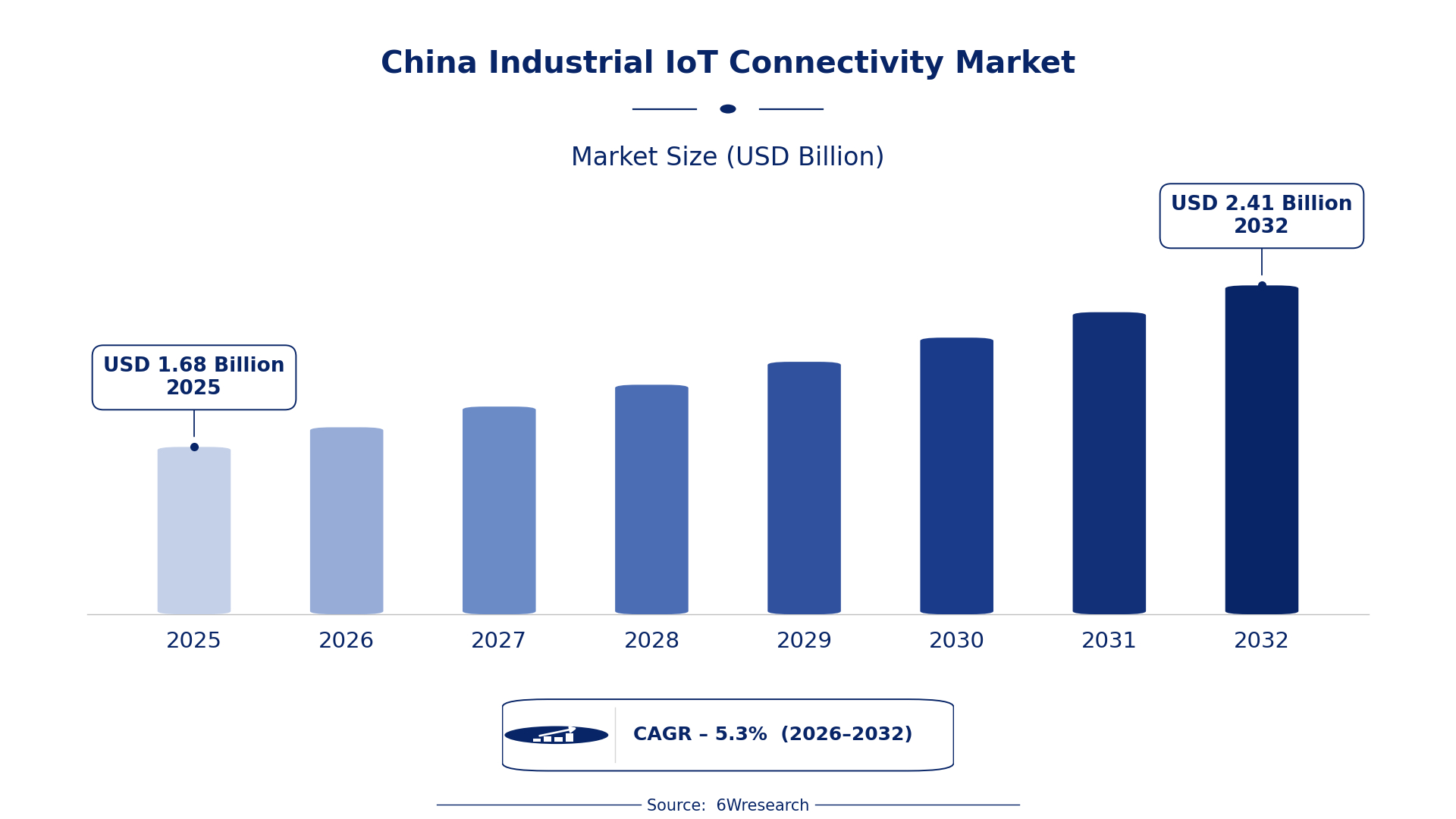
According to 6Wresearch internal database and industry insights, the China Industrial IoT Connectivity Market was valued at USD 1.68 billion in 2025 and is projected to reach USD 2.41 billion by 2032, growing at a CAGR of approximately 5.3% during 2026–2032.
China Industrial IoT Connectivity Market Highlights
| Report Metric | Details |
| Report Name | China Industrial IoT Connectivity Market |
| Market Size 2025 | USD 1.68 billion |
| Market Size 2032 | USD 2.41 billion |
| Absolute Growth 2025–2032 | USD 0.73 billion |
| CAGR 2026–2032 | 5.3% |
| Peak Annual Growth | 7.7% in 2028 |
| Forecast Period | 2026–2032 |
| Historical Data | 2022–2025 |
| Base Year | 2025 |
| Leading Connectivity Type, 2025 | 5G Connectivity (38% share) |
| Leading Network Protocol, 2025 | Low Latency (42% share) |
| Leading Coverage Range, 2025 | Long Range (39% share) |
| Leading End User, 2025 | Smart Factories (34% share) |
| Fastest-Growing Connectivity Type | LPWAN (LoRa/Sigfox) (6.7% CAGR) |
| Fastest-Growing Network Protocol | Low Power (7.2% CAGR) |
| Fastest-Growing End User | Smart Agriculture (7.7% CAGR) |
| Growing Sector | Smart Manufacturing |
| Key End Users | manufacturers, agricultural producers, logistics companies, mining operations |
China Industrial IoT Connectivity Market Year-wise Growth Rate and Key Drivers (2022–2032)
This graph illustrates the annual growth rates of the market from 2022 to 2032, highlighting a steady upward trajectory and projected market expansion over the forecast period.
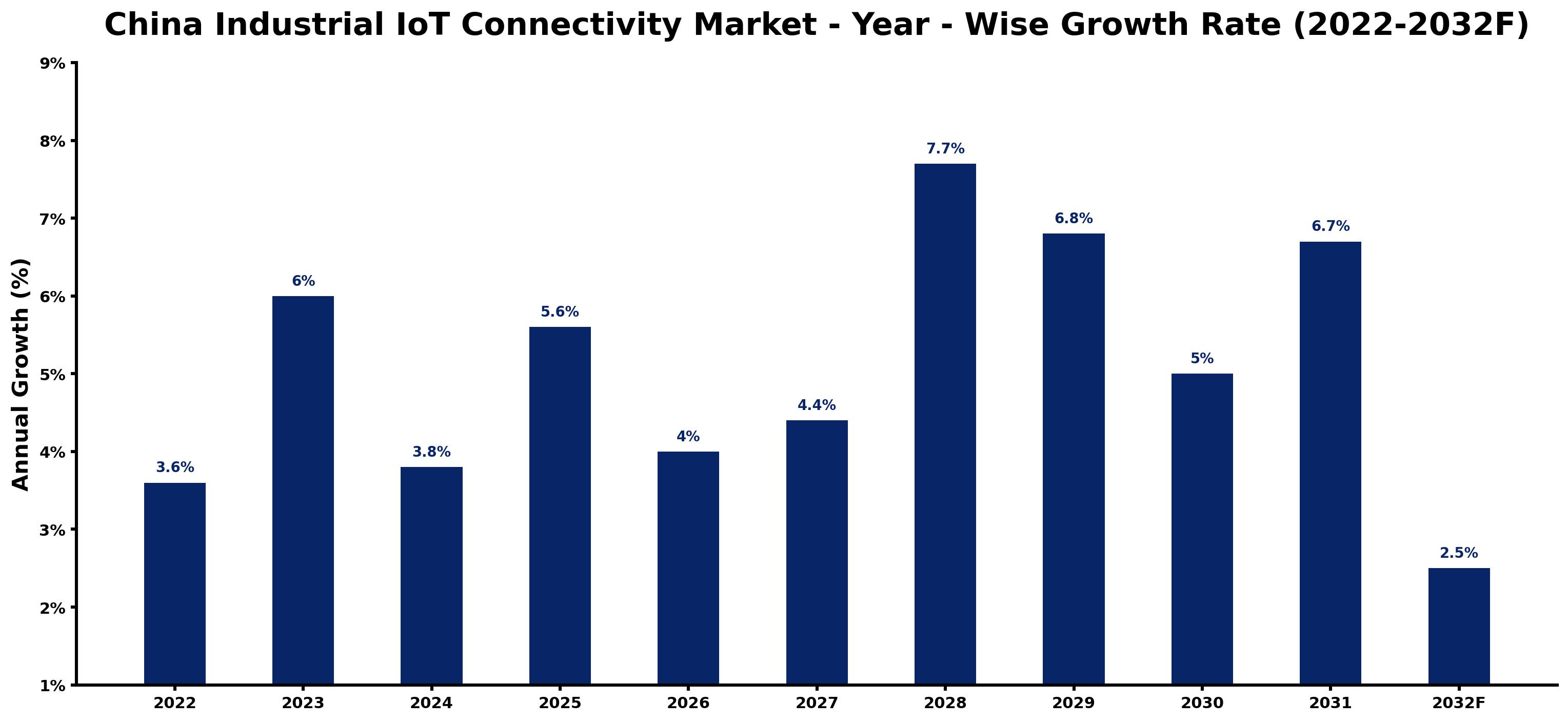
Annual growth estimates for each year appear below with the principal reason behind them, explaining the shifts that set the pace of the market.
| Year | Estimated Annual Growth (%) | Market Rationale |
| 2022 | 3.6 | The market experienced steady growth as industrial users began integrating IoT solutions. |
| 2023 | 6.0 | Demand surged due to the increasing establishment of smart factories across the country. |
| 2024 | 3.8 | Growth slowed as some sectors adjusted to the rapid adoption of new technologies. |
| 2025 | 5.6 | The market saw a rebound as investments in IoT infrastructure gained momentum. |
| 2026 | 4.0 | Growth is expected to decelerate as the market normalises after previous years of high expansion. |
| 2027 | 4.4 | Demand is projected to increase as industries adopt more advanced automation and connectivity solutions. |
| 2028 | 7.7 | The market will reach its peak growth due to heightened investments in smart manufacturing. |
| 2029 | 6.8 | Demand will continue to grow as the market begins to stabilise following peak adoption rates. |
| 2030 | 5.0 | Growth will remain positive, albeit at a slower pace, as IoT applications mature. |
| 2031 | 6.7 | The market is projected to experience a resurgence as new technologies enter the industrial sector. |
| 2032 | 2.5 | Growth is expected to decelerate as the market approaches saturation in key areas. |
Note: Market size estimations and growth projections presented in this report are based on 6Wresearch's proprietary forecasting methodology, utilizing the latest available industry data, government publications, and primary research inputs.
China Industrial IoT Connectivity Market Synopsis
Industrial IoT Connectivity in China includes technologies that enable devices to communicate over the internet, primarily through wireless networks. This encompasses communication protocols like LPWAN, 5G, and Wi-Fi, which improve operational efficiency in sectors such as manufacturing and logistics. The China Industrial IoT Connectivity Market is expanding due to the increasing number of smart factories and initiatives like the 'Smart Manufacturing Initiative'. With total investment in IoT infrastructure projected to reach 1 trillion CNY by 2025, demand is anticipated to rise across various sectors.
Market Dynamics Impact Analysis (2026–2032)
| Factor | Type | Impact | Primary Segment Affected |
| Increased investment in smart factories enhances connectivity needs. | Driver | High | Smart Factories |
| The rise of smart city initiatives boosts demand for IoT solutions. | Driver | High | Smart Agriculture |
| A gap in high-speed connectivity solutions exists in rural areas. | Opportunity | Medium | LPWAN (LoRa/Sigfox) |
| Growing demand for secure networks creates opportunities for Private LTE. | Opportunity | Medium | Private LTE Networks |
| High costs of IoT implementation can deter smaller manufacturers. | Restraint | High | Smart Factories |
| Limited infrastructure in some regions restricts IoT adoption. | Restraint | Medium | Smart Agriculture |
| The Industrial IoT Connectivity market faces challenges from regulatory compliance. | Challenge | High | 5G Connectivity |
| Technological integration issues can delay deployment in factories. | Challenge | Medium | Warehouse Automation |
Evaluation of Drivers in China Industrial IoT Connectivity Market (2026–2032)
The main growth drivers and the segments they affect most are set out below.
| Drivers | Primary Segment Affected | Why It Matters (Evidence) |
| The establishment of over 1,000 smart factories drives demand for connectivity solutions. | Smart Factories | This trend encourages manufacturers to adopt IoT technologies for improved operational efficiency. |
| 5G coverage in industrial parks reached 70%, facilitating faster connections. | 5G Connectivity | This expansion allows industries to implement real-time data processing and automation. |
| The 'Smart Manufacturing Initiative' promotes IoT integration in manufacturing processes. | LPWAN (LoRa/Sigfox) | This initiative supports the adoption of low-power, long-range communication technologies. |
| Private LTE networks are being deployed in 50% of major mining operations. | Private LTE Networks | This ensures secure and reliable connectivity for critical industrial operations. |
| The 'Digital China' initiative aims to integrate IoT in urban management by 2025. | Smart Agriculture | This initiative is projected to improve precision farming and monitoring capabilities. |
With 70% of industrial parks covered by 5G, industries are increasingly adopting real-time data processing capabilities. Private LTE networks are being deployed in major mining operations, ensuring secure connectivity for critical applications. The total investment in IoT infrastructure is expected to reach 1 trillion CNY by 2025, driving demand across multiple sectors.
Evaluation of Restraints in China Industrial IoT Connectivity Market
The main factors holding the market back are set out below.
| Market Restraint | Primary Segment Affected | Why It Matters (Evidence) |
| High implementation costs deter smaller manufacturers from adopting IoT solutions. | Smart Factories | This limits the market's growth potential as smaller players struggle to invest. |
| Limited infrastructure in rural areas restricts the adoption of IoT technologies. | Smart Agriculture | This creates a barrier for farmers looking to implement smart farming solutions. |
| Regulatory compliance issues can complicate the integration of new technologies. | 5G Connectivity | This may delay the deployment of essential IoT solutions in various sectors. |
| Technological integration challenges can lead to deployment delays in factories. | Warehouse Automation | This affects the efficiency and effectiveness of logistics operations. |
| Concerns over data security may hinder the adoption of IoT solutions. | Private LTE Networks | This creates hesitation among potential users regarding connectivity investments. |
China Industrial IoT Connectivity Market Challenges
The China Industrial IoT Connectivity market encounters a significant technological hurdle in unifying diverse communication protocols, which hampers device interoperability for manufacturers. This fragmentation can lead to project delays, costing factories up to 20% in potential efficiency gains. The competitive landscape is fierce, with over 1,000 smart factories vying for market presence, resulting in price reductions that squeeze margins for suppliers. A lack of skilled workers further complicates the situation, as the swift adoption of IoT technologies outstrips the training of qualified personnel, increasing operational costs for companies. The anticipated investment of 1 trillion CNY in IoT infrastructure by 2025 poses a financial challenge for smaller enterprises aiming to implement these technologies.
Trends in the China Industrial IoT Connectivity Market
The trends below show where the China Industrial IoT Connectivity Market is heading.
- Shift towards Smart Manufacturing: The 'Smart Manufacturing Initiative' launched in 2021 is driving the adoption of IoT technologies in factories. As of 2023, over 1,000 smart factories are operational, increasing demand for connectivity solutions.
- Transition to 5G Connectivity: The adoption of 5G technology is accelerating in industrial parks, with coverage reaching 70% in 2023. This shift enables faster and more reliable data transmission, improving operational efficiency.
- Emergence of Private LTE Networks: Private LTE networks are increasingly being deployed in major mining operations, with 50% adoption reported in 2023. This trend ensures secure and reliable connectivity for critical industrial applications.
- Focus on Smart Agriculture: The 'Digital China' initiative aims to integrate IoT technologies in urban management and agriculture by 2025. This focus is expected to improve precision farming and monitoring capabilities.
Investment Opportunities in the China Industrial IoT Connectivity Market
Some of the investment opportunities in the China Industrial IoT Connectivity Market are mentioned below.
- Investment in IoT Infrastructure: With an estimated investment of 1 trillion CNY by 2025, there is an opportunity to supply IoT infrastructure solutions. Smart factories are a key buyer group looking to improve operational efficiency.
- Supply of LPWAN Solutions: The rising demand for low-power, long-range communication presents an opportunity to supply LPWAN technologies. Smart Agriculture is a growing sector that requires these solutions for precision farming.
- Partnerships for Private LTE Deployment: The deployment of Private LTE networks in mining operations offers an opportunity for joint ventures. Mining companies are seeking reliable connectivity solutions to improve operational safety and efficiency.
- Expansion of 5G Solutions: As 5G coverage expands, there is a growing need for advanced connectivity solutions. Smart Factories are actively seeking suppliers to improve automation and data processing capabilities.
Government Initiatives in the China Industrial IoT Connectivity Market
The 'Smart Manufacturing Initiative' launched by the National Development and Reform Commission in 2021 encourages the integration of IoT technologies in manufacturing processes. This initiative motivates manufacturers to adopt advanced connectivity solutions, improving operational efficiency. Additionally, the '14th Five-Year Plan for the Development of the Digital Economy' introduced by the Ministry of Industry and Information Technology in 2022 aims to strengthen IoT infrastructure across various sectors, paving the way for increased adoption of these technologies.
The Ministry of Industry and Information Technology oversees the execution of the 'IoT Development Action Plan' issued by the State Council in 2021. This plan aims to boost IoT application in various sectors by 2025, providing funding for research and development projects. In 2023, a budget of 500 million CNY was announced for IoT initiatives, supporting companies in their efforts to integrate these technologies.
Future Insight of the China Industrial IoT Connectivity Market
The China Industrial IoT Connectivity market will undergo substantial changes by 2032, driven by initiatives like the 'Smart Manufacturing Initiative' and the 'Digital China' programme. These efforts will improve IoT integration in manufacturing and urban management, benefiting both buyers and suppliers. The installed base of industrial IoT devices is expected to exceed 1 billion by 2024, reflecting strong market demand. The establishment of uniform standards by the National IoT Standardization Work Group will streamline operations, allowing companies to adopt IoT solutions with greater efficiency.
Market Segmentation Analysis
The report offers a comprehensive study of the following market segments and their leading categories in the market.
By Connectivity Type – 5G Connectivity Dominated, LPWAN (LoRa/Sigfox) Expected to Grow Fastest
According to Sachin Kumar Rai, Senior Research Analyst at 6Wresearch, 5G Connectivity took a 38% share of connectivity type in 2025, more than any other category. 5G Connectivity holds the largest share as it is essential for high-speed, low-latency communication in smart factories, facilitating automation and efficiency. The extensive adoption, evidenced by 70% coverage in industrial parks as of 2023, highlights its critical role among industrial users. The quickest growth will come from LPWAN (LoRa/Sigfox), forecast to expand at a CAGR of 6.7% between 2026 and 2032. LPWAN is experiencing rapid growth due to its effectiveness in low-power, long-range communication, particularly for remote monitoring applications. The increasing deployment of LPWAN technologies in various industrial sectors is further propelling this segment's expansion. Suppliers should focus on enhancing their 5G offerings while also investing in LPWAN solutions to address the diverse needs of industrial users.
By Network Protocol – Low Latency Dominated, Low Power Expected to Grow Fastest
With a 42% revenue share in 2025, Low Latency was the largest network protocol category. Low Latency leads the market as it is crucial for real-time data processing in industrial automation, ensuring seamless operations in smart factories. Its importance is underscored by the reliance on immediate data feedback, making it a preferred choice among industrial users. Low Power is set to record the highest CAGR in this split, 7.2% over 2026–2032. Low Power is witnessing swift growth because it is vital for battery-operated devices in remote locations, which are increasingly prevalent in industrial applications. The rising demand for energy-efficient solutions is driving this segment's rapid expansion. Buyers should prioritise low latency solutions for critical applications, while suppliers must develop low power options to meet the changing market needs.
By Coverage Range – Long Range Dominated and Is Expected to Record the Fastest Growth
The largest coverage range category in 2025 was Long Range, with a 39% share of total revenue. Long Range dominates the market share as it is vital for connecting devices over large distances, especially in rural areas where industrial IoT applications are expanding. This capability is crucial for sectors like agriculture that require extensive coverage for effective operations. Its lead should widen, with a projected CAGR of 7.1% during 2026–2032, the highest in this split. Long Range is also the fastest-growing segment, driven by the increasing demand for connectivity in remote locations. The proliferation of IoT devices that necessitate long-range communication supports this upward trend. Suppliers must ensure their offerings include robust long-range solutions to capitalise on the growing demand across various sectors.
By End User – Smart Factories Dominated, Smart Agriculture Expected to Grow Fastest
Smart Factories accounted for a 34% market share by end user in 2025. Smart Factories account for the largest share due to their essential role in automating production lines and enhancing operational efficiency across industries. The establishment of over 1,000 smart factories in China illustrates their significance in the industrial landscape. Over 2026–2032, Smart Agriculture is expected to post the fastest growth, at a CAGR of 7.7%. Smart Agriculture is the fastest-growing end user, propelled by the increasing need for precision farming and effective crop health monitoring. The surge in investments in smart agriculture technologies is driving this segment's rapid growth. Suppliers should tailor their solutions to meet the specific needs of smart factories while also exploring opportunities within the expanding smart agriculture sector.
Key Attractiveness of the Report
- 10 Years of Market Numbers
- Historical Data Starting from 2022 to 2025
- Base Year 2025
- Forecast Data until 2032
- Key Performance Indicators Impacting the Market
- Major Upcoming Developments and Projects
Key Highlights of the Report:
- China Industrial IoT Connectivity Market Outlook
- Market Size of China Industrial IoT Connectivity Market, 2025
- Forecast of China Industrial IoT Connectivity Market, 2032
- Historical Data and Forecast of China Industrial IoT Connectivity Revenues & Volume for the Period 2022 - 2032F
- China Industrial IoT Connectivity Market Trend Evolution
- China Industrial IoT Connectivity Market Drivers and Challenges
- China Industrial IoT Connectivity Price Trends
- China Industrial IoT Connectivity Porter's Five Forces
- China Industrial IoT Connectivity Industry Life Cycle
- Historical Data and Forecast of China Industrial IoT Connectivity Market Revenues & Volume By Connectivity Type for the Period 2022 - 2032F
- Historical Data and Forecast of China Industrial IoT Connectivity Market Revenues & Volume By LPWAN (LoRa/Sigfox) for the Period 2022 - 2032F
- Historical Data and Forecast of China Industrial IoT Connectivity Market Revenues & Volume By 5G Connectivity for the Period 2022 - 2032F
- Historical Data and Forecast of China Industrial IoT Connectivity Market Revenues & Volume By Wi-Fi 6 Industrial for the Period 2022 - 2032F
- Historical Data and Forecast of China Industrial IoT Connectivity Market Revenues & Volume By Private LTE Networks for the Period 2022 - 2032F
- Historical Data and Forecast of China Industrial IoT Connectivity Market Revenues & Volume By Network Protocol for the Period 2022 - 2032F
- Historical Data and Forecast of China Industrial IoT Connectivity Market Revenues & Volume By Low Power for the Period 2022 - 2032F
- Historical Data and Forecast of China Industrial IoT Connectivity Market Revenues & Volume By High Bandwidth for the Period 2022 - 2032F
- Historical Data and Forecast of China Industrial IoT Connectivity Market Revenues & Volume By Low Latency for the Period 2022 - 2032F
- Historical Data and Forecast of China Industrial IoT Connectivity Market Revenues & Volume By Secure/Customizable for the Period 2022 - 2032F
- Historical Data and Forecast of China Industrial IoT Connectivity Market Revenues & Volume By Coverage Range for the Period 2022 - 2032F
- Historical Data and Forecast of China Industrial IoT Connectivity Market Revenues & Volume By Long Range for the Period 2022 - 2032F
- Historical Data and Forecast of China Industrial IoT Connectivity Market Revenues & Volume By Short to Mid for the Period 2022 - 2032F
- Historical Data and Forecast of China Industrial IoT Connectivity Market Revenues & Volume By Indoor for the Period 2022 - 2032F
- Historical Data and Forecast of China Industrial IoT Connectivity Market Revenues & Volume By Campus-Wide for the Period 2022 - 2032F
- Historical Data and Forecast of China Industrial IoT Connectivity Market Revenues & Volume By End User for the Period 2022 - 2032F
- Historical Data and Forecast of China Industrial IoT Connectivity Market Revenues & Volume By Smart Agriculture for the Period 2022 - 2032F
- Historical Data and Forecast of China Industrial IoT Connectivity Market Revenues & Volume By Smart Factories for the Period 2022 - 2032F
- Historical Data and Forecast of China Industrial IoT Connectivity Market Revenues & Volume By Warehouse Automation for the Period 2022 - 2032F
- Historical Data and Forecast of China Industrial IoT Connectivity Market Revenues & Volume By Mining Sites for the Period 2022 - 2032F
- China Industrial IoT Connectivity Import Export Trade Statistics
- Market Opportunity Assessment By Connectivity Type
- Market Opportunity Assessment By Network Protocol
- Market Opportunity Assessment By Coverage Range
- Market Opportunity Assessment By End User
- China Industrial IoT Connectivity Top Companies Market Share
- China Industrial IoT Connectivity Competitive Benchmarking By Technical and Operational Parameters
- China Industrial IoT Connectivity Company Profiles
- China Industrial IoT Connectivity Key Strategic Recommendations
Market Covered
Segments analysed in this report are listed below.
By Connectivity Type
- LPWAN (LoRa/Sigfox)
- 5G Connectivity
- Wi-Fi 6 Industrial
- Private LTE Networks
By Network Protocol
- Low Power
- High Bandwidth
- Low Latency
- Secure/Customizable
By Coverage Range
- Long Range
- Short to Mid
- Indoor
- Campus-Wide
By End User
- Smart Agriculture
- Smart Factories
- Warehouse Automation
- Mining Sites































