China Industrial IoT Sensor AI Market Size & Growth Rate
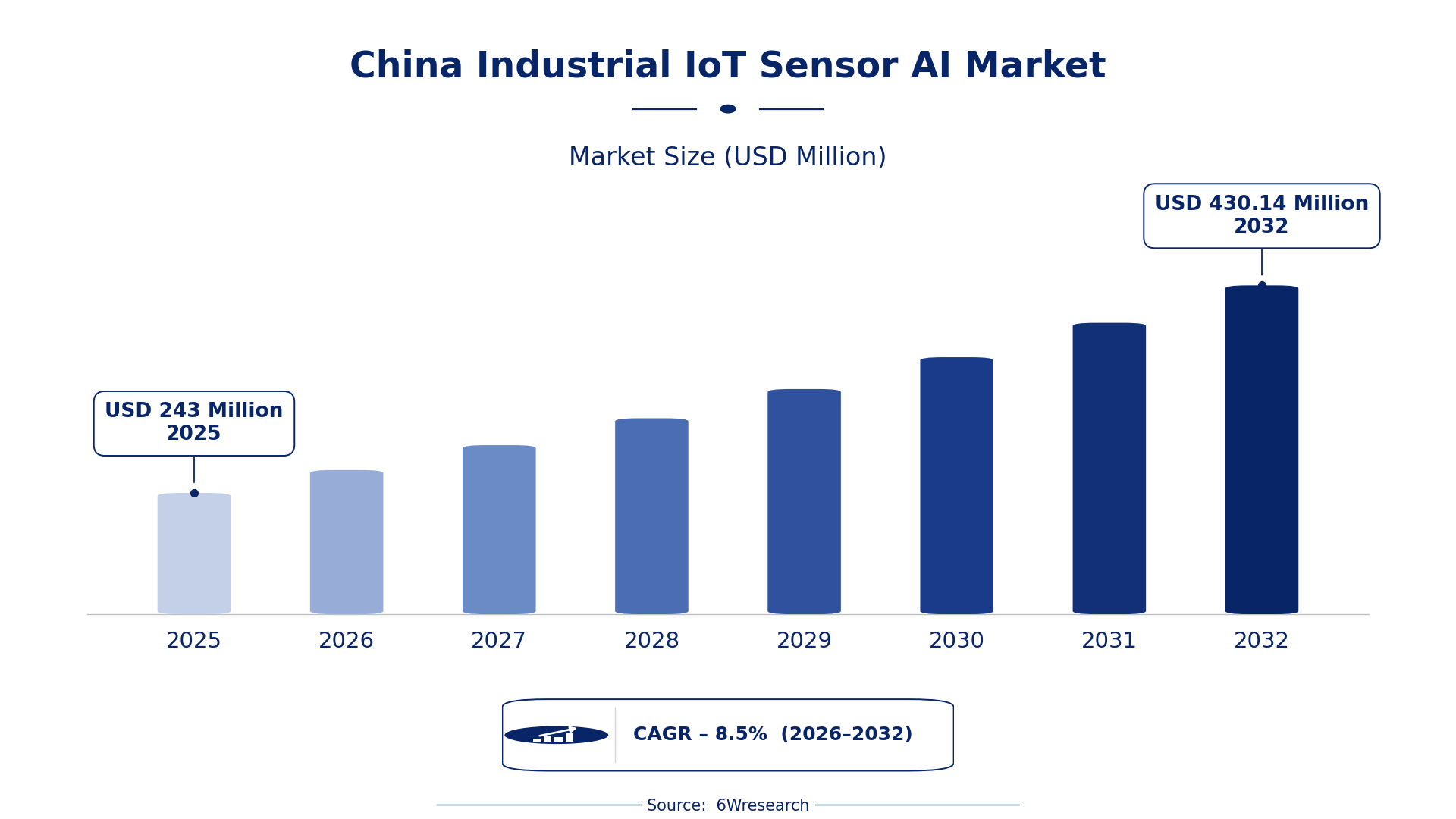
According to 6Wresearch internal database and industry insights, the China Industrial IoT Sensor AI Market was valued at USD 243.0 million in 2025 and is projected to reach USD 430.14 million by 2032, growing at a CAGR of approximately 8.5% during 2026–2032.
China Industrial IoT Sensor AI Market Highlights
| Report Metric | Details |
| Report Name | China Industrial IoT Sensor AI Market |
| Market Size 2025 | USD 243.0 million |
| Market Size 2032 | USD 430.14 million |
| Absolute Growth 2025–2032 | USD 187.14 million |
| CAGR 2026–2032 | 8.5% |
| Peak Annual Growth | 11.0% in 2026 |
| Forecast Period | 2026–2032 |
| Historical Data | 2022–2025 |
| Base Year | 2025 |
| Leading Sensor Type, 2025 | Vibration Sensors + AI (36% share) |
| Leading AI Capability, 2025 | Predictive Analysis (37% share) |
| Leading Application Area, 2025 | Motor Monitoring (43% share) |
| Leading End User, 2025 | Smart Factories (44% share) |
| Fastest-Growing Sensor Type | Multi-Sensor AI Platforms (11.2% CAGR) |
| Fastest-Growing Application Area | Process Automation (10.4% CAGR) |
| Fastest-Growing End User | Oil Refineries (10.5% CAGR) |
| Growing Sector | Smart Factories |
| Key End Users | Manufacturers, Oil Refineries, Data Centers, Industrial Automation |
China Industrial IoT Sensor AI Market Year-wise Growth Rate and Key Drivers (2022–2032)
This graph illustrates the annual growth rates of the market from 2022 to 2032, highlighting a steady upward trajectory and projected market expansion over the forecast period.
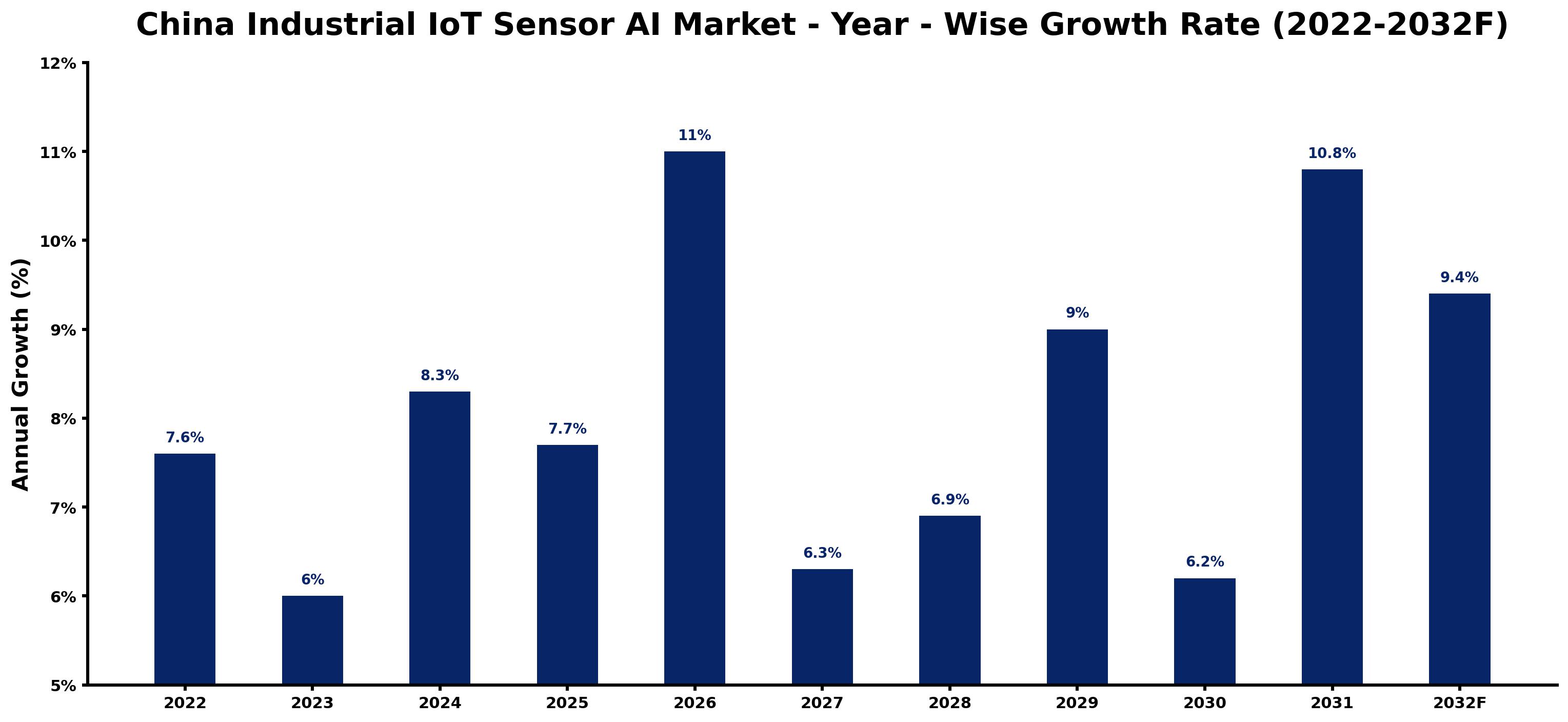
Each row of the following table gives one year's estimated growth and the event or demand shift that explains it.
| Year | Estimated Annual Growth (%) | Market Rationale |
| 2022 | 7.6 | The market showed steady growth, driven by increasing adoption of IoT technologies. |
| 2023 | 6.0 | Growth slowed as companies adjusted to the 'Smart Manufacturing 2025' initiative and investment patterns. |
| 2024 | 8.3 | Demand increased as manufacturers focused on predictive maintenance to improve efficiency. |
| 2025 | 7.7 | A slight slowdown occurred as some projects faced funding challenges amid rising costs. |
| 2026 | 11.0 | The market is expected to peak due to the launch of new smart factory initiatives and increased investment. |
| 2027 | 6.3 | Growth is projected to slow as the market begins to stabilise following rapid expansion in previous years. |
| 2028 | 6.9 | Demand is expected to rise again, supported by the 'AI 2.0 Plan' aiming for greater AI integration with IoT. |
| 2029 | 9.0 | The market will continue to grow as more sectors adopt automation technologies and smart solutions. |
| 2030 | 6.2 | Growth is projected to slow as the market matures and competition intensifies in the industrial sector. |
| 2031 | 10.8 | Demand is expected to rebound as companies invest in upgrading existing systems and technologies. |
| 2032 | 9.4 | A slight slowdown is projected as the market reaches a more stable phase with mature technologies. |
Note: Market size estimations and growth projections presented in this report are based on 6Wresearch's proprietary forecasting methodology, utilizing the latest available industry data, government publications, and primary research inputs.
China Industrial IoT Sensor AI Market Synopsis
The Industrial IoT Sensor AI market in China integrates sensors with artificial intelligence to monitor and analyse industrial processes. These sensors enable predictive maintenance and optimise operational efficiency. The market is expanding due to rising demand from smart factories and the manufacturing sector. Initiatives like 'Smart Manufacturing 2025' are driving investment and adoption of IoT technologies. With over 70% of factories adopting IoT, the market is set for substantial growth.
Market Dynamics Impact Analysis (2026–2032)
| Factor | Type | Impact | Primary Segment Affected |
| Rising adoption of predictive maintenance technologies in manufacturing. | Driver | High | Predictive Analysis |
| Increased investment in smart factory projects across various sectors. | Driver | High | Smart Factories |
| Growing demand for efficient manufacturing processes in Guangdong province. | Opportunity | High | Motor Monitoring |
| The need for real-time data analytics in oil refineries is increasing. | Opportunity | High | Oil Refineries |
| Challenges in integrating legacy systems with new IoT technologies. | Restraint | Medium | Industrial Automation |
| High costs associated with implementing advanced sensor technologies. | Restraint | Medium | Multi-Sensor AI Platforms |
| Limited skilled workforce to manage complex IoT systems. | Challenge | High | Vibration Sensors + AI |
| Regulatory hurdles in sensor approvals can delay market entry. | Challenge | Medium | Vibration Sensors + AI |
Evaluation of Drivers in China Industrial IoT Sensor AI Market (2026–2032)
The table below links each growth driver to the segment it affects and the evidence for it.
| Drivers | Primary Segment Affected | Why It Matters (Evidence) |
| Increased focus on predictive maintenance to reduce downtime. | Predictive Analysis | This drives demand as manufacturers seek to avoid costly equipment failures, with over 70% of factories adopting IoT technologies. |
| Investment in smart factories to improve operational efficiency. | Smart Factories | This leads to higher purchases of advanced sensor technologies, as manufacturers aim to boost productivity. |
| Growing need for real-time monitoring in oil refineries. | Oil Refineries | This results in increased demand for thermal and pressure sensors to ensure optimal operations. |
| Expansion of manufacturing capabilities in Guangdong province. | Motor Monitoring | This boosts the need for advanced monitoring solutions, supporting local manufacturers in enhancing efficiency. |
| Rising adoption of IoT technologies in data centers. | Data Centers | This encourages investments in environmental monitoring sensors to maintain operational efficiency. |
The Industrial IoT Sensor AI market in China is expanding as manufacturers increasingly prioritise predictive maintenance, which reduces downtime and costs. In 2023, over 70% of factories adopted IoT technologies, fuelling demand for advanced sensors. The oil refinery sector is expected to grow by 10.5% annually, driving the need for thermal and pressure sensors. Consequently, various sectors are prompting investments in industrial IoT sensors to enhance operational capabilities. The rising focus on smart factories further supports this trend, with considerable investments anticipated in the coming years.
Evaluation of Restraints in China Industrial IoT Sensor AI Market
The table below lists the restraints and the evidence behind each.
| Market Restraint | Primary Segment Affected | Why It Matters (Evidence) |
| High costs of implementing advanced sensor technologies. | Multi-Sensor AI Platforms | This limits adoption among smaller manufacturers who struggle with budgets, affecting their competitiveness. |
| Integration challenges with existing legacy systems. | Vibration Sensors + AI | This hampers the ability of companies to fully utilise IoT capabilities, affecting overall productivity. |
| Concerns over data security and privacy in IoT systems. | Predictive Analysis | This can deter companies from adopting new technologies, limiting market growth opportunities. |
| Regulatory hurdles in sensor approvals can slow market entry. | Vibration Sensors + AI | These delays can affect project timelines and increase costs, impacting manufacturers' ability to innovate. |
| Limited awareness of IoT benefits among smaller firms. | Smart Factories | This restricts the growth potential as many companies are hesitant to invest in new technologies. |
China Industrial IoT Sensor AI Market Challenges
In China, the supply of Industrial IoT Sensor AI faces constraints due to a shortage of high-quality semiconductor materials, which delays production timelines and raises costs for manufacturers. Buyers in the industrial sector struggle to integrate these sensors because of a lack of standardisation, leading to increased operational costs of around 15% for factories. Technological hurdles arise from the rapid pace of AI advancements, creating compatibility issues that can waste investments for producers. Competition is intense, with over 70% of factories adopting IoT technologies, compelling suppliers to reduce prices and eroding profit margins.
Trends in the China Industrial IoT Sensor AI Market
Several trends are reshaping the China Industrial IoT Sensor AI Market; the most important are set out below.
- Shift to Smart Factories in Guangdong: Guangdong province is rapidly adopting smart factory technologies, with over 70% of factories implementing IoT solutions. This shift is driving further investments in industrial IoT sensors, improving operational efficiency.
- Emergence of Predictive Maintenance Standards: The 'Smart Manufacturing 2025' initiative is promoting predictive maintenance standards across industries. This programme aims for a 30% increase in IoT adoption by 2025, driving demand for predictive analysis sensors.
- Focus on Environmental Monitoring in Data Centers: Data centers are increasingly prioritising environmental monitoring to ensure operational efficiency. With a projected growth rate of 15% annually, this trend is driving demand for advanced sensor technologies.
- Integration of AI in Industrial Automation: The 'AI 2.0 Plan' aims for 50% adoption of AI technologies in manufacturing by 2025. This initiative is expected to improve the capabilities of industrial IoT sensors, creating new opportunities for suppliers.
Investment Opportunities in the China Industrial IoT Sensor AI Market
Investors looking at the China Industrial IoT Sensor AI Market should consider the following areas.
- Gap in Smart Factory Technologies: With China's industrial IoT market expected to reach 1 trillion yuan by 2025, there is a significant opportunity for investment in smart factory technologies. Manufacturers in Guangdong province are particularly well-positioned to benefit from this trend.
- Need for Predictive Maintenance Solutions: Now is the time to invest in predictive maintenance solutions, as over 70% of factories are adopting IoT technologies. Targeting smart factories can lead to substantial growth in sensor sales.
- Demand for Advanced Monitoring in Oil Refineries: The oil refinery sector is increasingly looking for advanced monitoring solutions, with a projected growth of 10.5% in the coming years. Suppliers can enter this market by forming partnerships with local facilities.
- Investment in Data Center Technologies: Data centers are projected to grow by 15% annually, creating a demand for environmental monitoring sensors. Companies can enter this market by collaborating with data management facilities.
Government Initiatives in the China Industrial IoT Sensor AI Market
The Ministry of Industry and Information Technology's 'Industrial Internet Innovation and Development Strategy' launched in 2022 aims to improve IoT integration in manufacturing. This complements the '14th Five-Year Plan for the Development of the Digital Economy' from 2021, which targets a 30% increase in IoT adoption by 2025, facilitating a more connected industrial environment. These measures enhance the capabilities of producers, enabling them to adopt advanced technologies and improve operational efficiencies. The 'New Infrastructure' initiative, launched in 2020, prioritises the development of IoT networks across industrial sectors to boost efficiency and connectivity.
The National Development and Reform Commission's subsidy program for smart factory projects, approved in 2023, allocates 5 billion yuan to support IoT implementations. This funding enables manufacturers to adopt advanced technologies and improve operational efficiencies, allowing them to compete effectively in the market. The Ministry of Science and Technology's 'AI 2.0 Plan' aims to integrate AI with IoT in manufacturing, targeting 50% adoption by 2025. This initiative provides a framework for companies to enhance their operational capabilities through AI integration.
Future Insight of the China Industrial IoT Sensor AI Market
The China Industrial IoT Sensor AI market is set for significant changes by 2032, driven by initiatives like 'Smart Manufacturing 2025' and 'Digital China', which focus on improving digital infrastructure. The installed base of industrial sensors is expected to surpass 600 million units, facilitating enhanced operational efficiency in various sectors. Advances in AI integration will enable more effective predictive maintenance solutions, allowing factories to reduce downtime. The growing role of the Industrial Internet Consortium will also contribute to establishing clear standards that promote the adoption of new technologies.
Market Segmentation Analysis
The report offers a comprehensive study of the following market segments and their leading categories in the market.
By Sensor Type – Vibration Sensors + AI Dominated, Multi-Sensor AI Platforms Expected to Grow Fastest
According to Sachin Kumar Rai, Senior Research Analyst at 6Wresearch, in 2025, Vibration Sensors + AI led the sensor type split with a 36% share. Vibration Sensors hold the largest market share due to their critical role in monitoring machinery health and preventing failures in various industrial settings. Their importance is highlighted by the extensive installed base of over 300 million industrial sensors in China, ensuring operational reliability across the sector. Multi-Sensor AI Platforms are set to record the highest CAGR in this split, 11.2% over 2026–2032. Multi-Sensor Platforms are witnessing rapid growth because they aggregate data from multiple sensors, allowing for comprehensive monitoring and analysis. This surge is driven by the adoption of IoT technologies in over 70% of Chinese factories, which enhances overall operational efficiency. Suppliers should focus on developing advanced multi-sensor solutions to meet the increasing demand in the industrial sector.
By AI Capability – Predictive Analysis Dominated and Is Expected to Record the Fastest Growth
Predictive Analysis held a 37% share of the China Industrial IoT Sensor AI Market by ai capability in 2025. Predictive Analysis leads the market as it is essential for forecasting equipment failures and scheduling maintenance, thereby optimising operational efficiency. This capability is highly sought after as industries aim to minimise downtime and enhance productivity, making it a key focus area. The same category is also set to grow fastest, at a CAGR of 10.4% during 2026–2032. Predictive Analysis is also the fastest-growing segment due to its proven effectiveness in improving maintenance strategies. Initiatives like 'Smart Manufacturing 2025' are further stimulating this growth by encouraging the integration of advanced technologies in industrial processes. Buyers will gain significant advantages by investing in predictive analysis technologies to enhance their maintenance operations and reduce unexpected failures.
By Application Area – Motor Monitoring Dominated, Process Automation Expected to Grow Fastest
Motor Monitoring accounted for a 43% market share by application area in 2025. Motor Monitoring is the leading application area, crucial for ensuring the reliability of motors in various industrial applications. The significance of motor health is underscored by the employment of over 100 million workers in China's manufacturing sector, highlighting the necessity for operational reliability. The quickest growth will come from Process Automation, forecast to expand at a CAGR of 10.4% between 2026 and 2032. Process Automation is the fastest-growing application area, as it is vital for automating industrial processes to achieve improved efficiency. The push for digital transformation, particularly through initiatives like 'Digital China', is driving this rapid adoption across industries. Suppliers should prioritise solutions that enhance process automation capabilities to align with market demands.
By End User – Smart Factories Dominated, Oil Refineries Expected to Grow Fastest
With a 44% revenue share in 2025, Smart Factories was the largest end user category. Smart Factories dominate the market as they significantly enhance automation and efficiency in production processes. This trend is reinforced by government initiatives promoting the adoption of advanced manufacturing technologies across various sectors, positioning smart factories at the forefront of industrial IoT. Over 2026–2032, Oil Refineries are expected to post the fastest growth, at a CAGR of 10.5%. Oil Refineries represent the fastest-growing end user segment, as they are critical for monitoring processes and ensuring safety in operations. The increasing emphasis on operational safety and efficiency in the oil sector is propelling this growth forward. Suppliers should tailor their offerings to meet the specific needs of oil refineries, focusing on safety and process monitoring.
Key Attractiveness of the Report
- 10 Years of Market Numbers
- Historical Data Starting from 2022 to 2025
- Base Year 2025
- Forecast Data until 2032
- Key Performance Indicators Impacting the Market
- Major Upcoming Developments and Projects
Key Highlights of the Report:
- China Industrial IoT Sensor AI Market Outlook
- Market Size of China Industrial IoT Sensor AI Market, 2025
- Forecast of China Industrial IoT Sensor AI Market, 2032
- Historical Data and Forecast of China Industrial IoT Sensor AI Revenues & Volume for the Period 2022 - 2032F
- China Industrial IoT Sensor AI Market Trend Evolution
- China Industrial IoT Sensor AI Market Drivers and Challenges
- China Industrial IoT Sensor AI Price Trends
- China Industrial IoT Sensor AI Porter's Five Forces
- China Industrial IoT Sensor AI Industry Life Cycle
- Historical Data and Forecast of China Industrial IoT Sensor AI Market Revenues & Volume By Sensor Type for the Period 2022 - 2032F
- Historical Data and Forecast of China Industrial IoT Sensor AI Market Revenues & Volume By Vibration Sensors + AI for the Period 2022 - 2032F
- Historical Data and Forecast of China Industrial IoT Sensor AI Market Revenues & Volume By Pressure Sensors + AI for the Period 2022 - 2032F
- Historical Data and Forecast of China Industrial IoT Sensor AI Market Revenues & Volume By Thermal Sensors + AI for the Period 2022 - 2032F
- Historical Data and Forecast of China Industrial IoT Sensor AI Market Revenues & Volume By Multi-Sensor AI Platforms for the Period 2022 - 2032F
- Historical Data and Forecast of China Industrial IoT Sensor AI Market Revenues & Volume By AI Capability for the Period 2022 - 2032F
- Historical Data and Forecast of China Industrial IoT Sensor AI Market Revenues & Volume By Predictive Analysis for the Period 2022 - 2032F
- Historical Data and Forecast of China Industrial IoT Sensor AI Market Revenues & Volume By Anomaly Detection for the Period 2022 - 2032F
- Historical Data and Forecast of China Industrial IoT Sensor AI Market Revenues & Volume By Pattern Recognition for the Period 2022 - 2032F
- Historical Data and Forecast of China Industrial IoT Sensor AI Market Revenues & Volume By Sensor Fusion for the Period 2022 - 2032F
- Historical Data and Forecast of China Industrial IoT Sensor AI Market Revenues & Volume By Application Area for the Period 2022 - 2032F
- Historical Data and Forecast of China Industrial IoT Sensor AI Market Revenues & Volume By Motor Monitoring for the Period 2022 - 2032F
- Historical Data and Forecast of China Industrial IoT Sensor AI Market Revenues & Volume By Process Automation for the Period 2022 - 2032F
- Historical Data and Forecast of China Industrial IoT Sensor AI Market Revenues & Volume By Fire Prevention for the Period 2022 - 2032F
- Historical Data and Forecast of China Industrial IoT Sensor AI Market Revenues & Volume By Machine Health for the Period 2022 - 2032F
- Historical Data and Forecast of China Industrial IoT Sensor AI Market Revenues & Volume By End User for the Period 2022 - 2032F
- Historical Data and Forecast of China Industrial IoT Sensor AI Market Revenues & Volume By Smart Factories for the Period 2022 - 2032F
- Historical Data and Forecast of China Industrial IoT Sensor AI Market Revenues & Volume By Oil Refineries for the Period 2022 - 2032F
- Historical Data and Forecast of China Industrial IoT Sensor AI Market Revenues & Volume By Data Centers for the Period 2022 - 2032F
- Historical Data and Forecast of China Industrial IoT Sensor AI Market Revenues & Volume By Industrial Automation for the Period 2022 - 2032F
- China Industrial IoT Sensor AI Import Export Trade Statistics
- Market Opportunity Assessment By Sensor Type
- Market Opportunity Assessment By AI Capability
- Market Opportunity Assessment By Application Area
- Market Opportunity Assessment By End User
- China Industrial IoT Sensor AI Top Companies Market Share
- China Industrial IoT Sensor AI Competitive Benchmarking By Technical and Operational Parameters
- China Industrial IoT Sensor AI Company Profiles
- China Industrial IoT Sensor AI Key Strategic Recommendations
Market Covered
The report offers an extensive study of the following market segments.
By Sensor Type
- Vibration Sensors + AI
- Pressure Sensors + AI
- Thermal Sensors + AI
- Multi-Sensor AI Platforms
By AI Capability
- Predictive Analysis
- Anomaly Detection
- Pattern Recognition
- Sensor Fusion
By Application Area
- Motor Monitoring
- Process Automation
- Fire Prevention
- Machine Health
By End User
- Smart Factories
- Oil Refineries
- Data Centers
- Industrial Automation































