China Industrial Logistics Market Size & Growth Rate
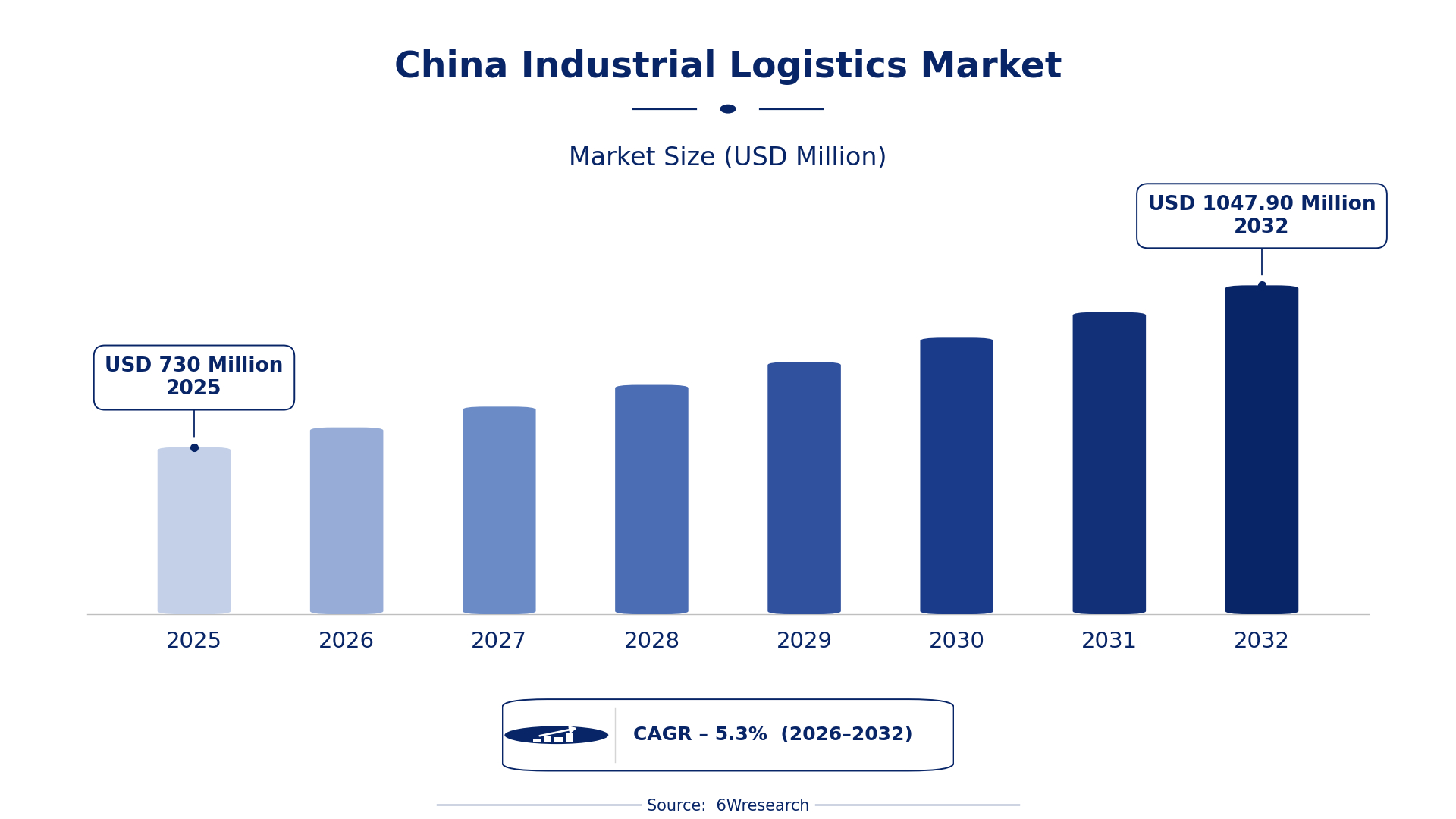
According to 6Wresearch internal database and industry insights, the China Industrial Logistics Market was valued at USD 730.0 million in 2025 and is projected to reach USD 1,047.90 million by 2032, growing at a CAGR of approximately 5.3% during 2026–2032.
China Industrial Logistics Market Highlights
| Report Metric | Details |
| Report Name | China Industrial Logistics Market |
| Market Size 2025 | USD 730.0 million |
| Market Size 2032 | USD 1,047.90 million |
| Absolute Growth 2025–2032 | USD 317.90 million |
| CAGR 2026–2032 | 5.3% |
| Peak Annual Growth | 7.5% in 2028 |
| Forecast Period | 2026–2032 |
| Historical Data | 2022–2025 |
| Base Year | 2025 |
| Leading Service Type, 2025 | Warehousing (46% share) |
| Leading Delivery Mode, 2025 | Centralized/Decentralized (52% share) |
| Leading Technology Used, 2025 | RFID/Barcode (48% share) |
| Leading End User, 2025 | E-commerce Distribution (40% share) |
| Fastest-Growing Service Type | Freight Transportation (7.6% CAGR) |
| Fastest-Growing Delivery Mode | Road/Rail/Air (7.8% CAGR) |
| Fastest-Growing Technology Used | GPS / Telematics (7.4% CAGR) |
| Fastest-Growing End User | Heavy Equipment Firms (6.5% CAGR) |
| Growing Sector | E-commerce Distribution |
| Key End Users | E-commerce companies, food distributors, pharmaceutical firms, manufacturing industries |
China Industrial Logistics Market Year-wise Growth Rate and Key Drivers (2022–2032)
This graph illustrates the annual growth rates of the market from 2022 to 2032, highlighting a steady upward trajectory and projected market expansion over the forecast period.
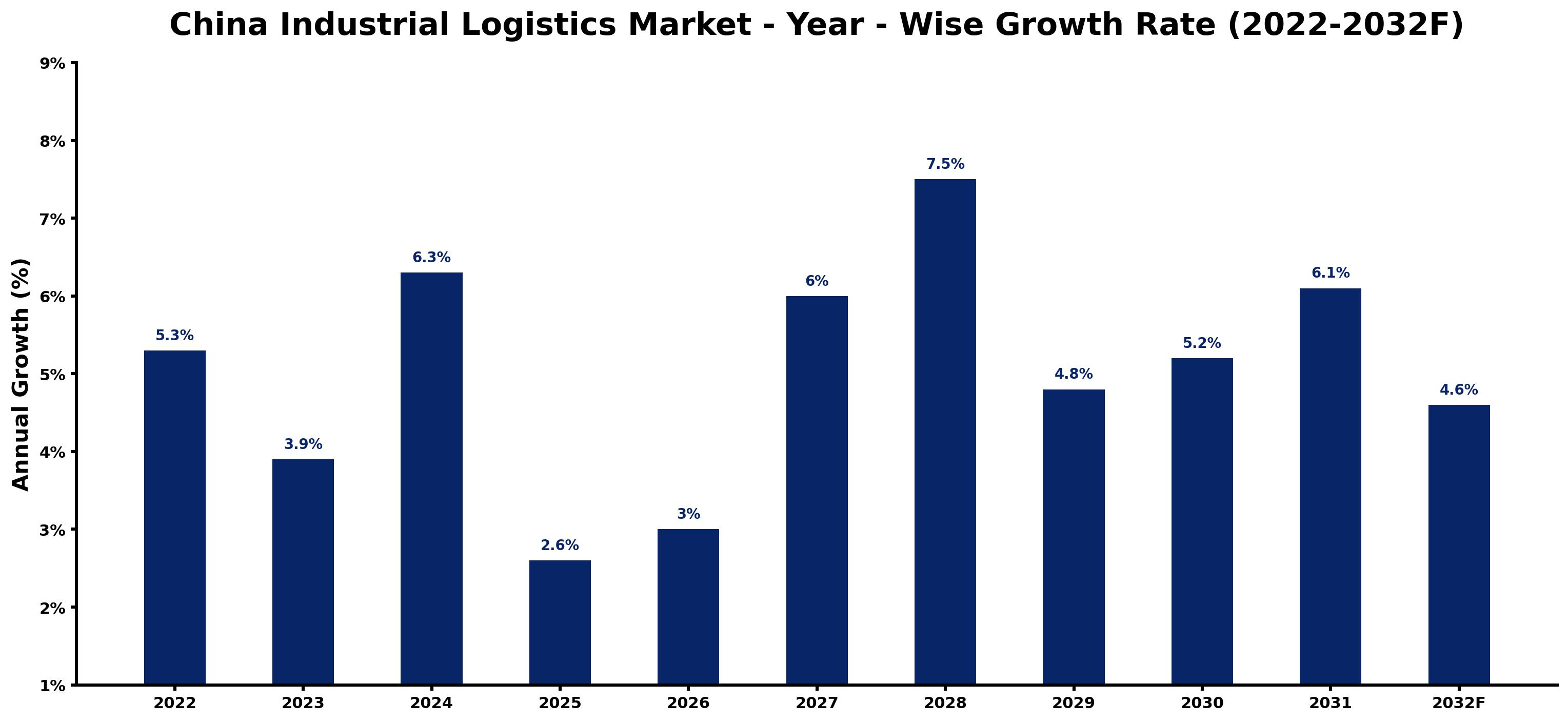
Annual growth estimates for each year appear below with the principal reason behind them, explaining the shifts that set the pace of the market.
| Year | Estimated Annual Growth (%) | Market Rationale |
| 2022 | 5.3 | The market experienced steady demand due to ongoing urbanisation and e-commerce growth. |
| 2023 | 3.9 | Growth slowed as logistics infrastructure faced challenges in meeting rising demand. |
| 2024 | 6.3 | Increased investments in logistics technology boosted efficiency and service levels. |
| 2025 | 2.6 | A slowdown in growth was noted as logistics costs began to rise. |
| 2026 | 3.0 | Improvements in rural logistics networks are expected to enhance overall efficiency. |
| 2027 | 6.0 | Demand from e-commerce is projected to continue driving growth in logistics services. |
| 2028 | 7.5 | The peak growth rate reflects strong investments in logistics infrastructure. |
| 2029 | 4.8 | A slowdown occurred as logistics performance faced global competition. |
| 2030 | 5.2 | Technological advancements are expected to support logistics operations through better integration of IoT solutions. |
| 2031 | 6.1 | Increased urbanisation is anticipated to further drive logistics demand, particularly in metropolitan areas. |
| 2032 | 4.6 | Growth will slow as the market matures and competition intensifies, especially in e-commerce logistics. |
Note: Market size estimations and growth projections presented in this report are based on 6Wresearch's proprietary forecasting methodology, utilizing the latest available industry data, government publications, and primary research inputs.
China Industrial Logistics Market Synopsis
Industrial Logistics in China encompasses the management and movement of goods, including warehousing, transportation, and distribution. This sector is vital for supporting e-commerce, manufacturing, and food distribution. The China Industrial Logistics Market is valued at over 4 trillion yuan as of 2023, reflecting strong domestic demand. The market is growing due to the expanding e-commerce sector, which accounts for approximately 30% of total logistics demand. Initiatives like the 'Made in China 2025' programme are improving logistics efficiency across the country.
Market Dynamics Impact Analysis (2026–2032)
| Factor | Type | Impact | Primary Segment Affected |
| Growing e-commerce distribution is driving demand for logistics services. | Driver | High | E-commerce Distribution |
| The rise of cold chain logistics is essential for food safety and pharmaceuticals. | Driver | High | Cold Chain Logistics |
| Investment in logistics parks creates opportunities for service providers. | Opportunity | High | Warehousing |
| The increasing urbanisation rate presents a demand gap in logistics services. | Opportunity | High | Freight Transportation |
| Rising logistics costs may limit profitability for logistics providers. | Restraint | High | Freight Transportation |
| Competition from international logistics firms can pressure local players. | Restraint | Medium | Warehousing |
| Talent shortages in logistics management hinder operational efficiency. | Challenge | High | Cold Chain Logistics |
| Technological integration challenges can delay logistics operations. | Challenge | Medium | E-commerce Distribution |
Evaluation of Drivers in China Industrial Logistics Market (2026–2032)
The main growth drivers and the segments they affect most are set out below.
| Drivers | Primary Segment Affected | Why It Matters (Evidence) |
| Increased e-commerce activity drives demand for logistics services. | E-commerce Distribution | E-commerce accounts for approximately 30% of total logistics demand in China. |
| Cold chain logistics is critical for food and pharmaceuticals. | Cold Chain Logistics | Cold chain logistics accounted for 15% of the total logistics market in 2022. |
| Investment in logistics parks expands service capacity. | Warehousing | China has over 200 logistics parks across major cities and provinces. |
| Technological advancements improve logistics efficiency. | RFID/Barcode | The use of IoT in logistics is projected to grow by 20% annually until 2025. |
| Urbanisation increases demand for logistics services. | Freight Transportation | China's urbanisation rate reached 64% in 2023, boosting logistics needs. |
Expansion of the Industrial Logistics market in China is backed by rising e-commerce activity, increased urbanisation, and technological advancements. E-commerce accounts for approximately 30% of total logistics demand, prompting logistics providers to improve their services. The urbanisation rate reached 64% in 2023, further driving logistics needs across the country. The integration of IoT technologies is anticipated to grow by 20% annually until 2025, facilitating better tracking and management capabilities. Investments in logistics parks, with over 200 established, are also expanding service capacity to meet this demand.
Evaluation of Restraints in China Industrial Logistics Market
The table below lists the restraints and the evidence behind each.
| Market Restraint | Primary Segment Affected | Why It Matters (Evidence) |
| Rising logistics costs may limit profitability for providers. | Freight Transportation | China aims to reduce logistics costs by 15% by 2025, indicating current high costs. |
| Competition from international firms pressures local players. | Warehousing | Local firms face challenges against established international logistics providers. |
| Talent shortages in logistics management hinder efficiency. | Cold Chain Logistics | The logistics industry employs over 10 million people, but skilled talent is scarce. |
| Technological integration challenges can delay operations. | E-commerce Distribution | Adoption of new technologies can be slow due to high initial costs. |
| Regulatory compliance can increase operational complexity. | Cold Chain Logistics | The Cold Chain Logistics Development Plan requires strict adherence to safety standards. |
China Industrial Logistics Market Challenges
The China Industrial Logistics Market still faces several challenges, with rising costs for buyers being a primary concern. Logistics expenses have surged, driven by e-commerce demand, which constitutes around 30% of total logistics activity, squeezing profit margins for retailers. Technology adoption remains a hurdle, as many logistics firms struggle to implement IoT solutions, projected to grow by 20% annually, leading to inefficiencies and delays in service delivery. Regulatory hurdles are also significant, with the Logistics Industry Development Plan imposing strict compliance requirements that can extend project timelines and inflate costs for logistics providers.
Trends in the China Industrial Logistics Market
Four trends stand out in the China Industrial Logistics Market.
- E-commerce Distribution Rising in Urban Areas: E-commerce distribution is increasingly concentrated in urban areas, driven by the growing urbanisation rate of 64% in 2023. This shift increases logistics demand, particularly in metropolitan regions.
- Cold Chain Logistics Expanding for Food Safety: The Cold Chain Logistics Development Plan issued in 2020 aims to improve food safety across China. As a result, cold chain logistics accounted for 15% of the total logistics market in 2022.
- Technological Advancements in Logistics: The integration of IoT technologies is transforming logistics operations, with a projected growth rate of 20% annually until 2025. This trend is improving real-time tracking and management capabilities.
- Investment in Logistics Parks Increasing: China's logistics parks are expanding, with over 200 parks established across major cities. This investment supports the growing demand for efficient logistics services.
Investment Opportunities in the China Industrial Logistics Market
Some of the investment opportunities in the China Industrial Logistics Market are mentioned below.
- Investment Gap in Logistics Infrastructure: With the logistics market valued at over 4 trillion yuan, there is an investment gap in infrastructure. E-commerce companies are looking to improve their logistics capabilities to meet demand.
- Supply Chain Technology Solutions Needed: The growing use of IoT and RFID technologies presents an opportunity to supply innovative tracking solutions. Logistics firms are increasingly seeking technology partners to improve efficiency.
- Rural Logistics Networks Require Development: Partnerships with local firms can facilitate entry into rural logistics, addressing a gap in service delivery.
- Cold Chain Logistics Services in Demand: The increasing focus on food safety creates a demand for cold chain logistics services, particularly in urban areas. Suppliers can enter this market by obtaining necessary certifications.
Government Initiatives in the China Industrial Logistics Market
The Logistics Industry Development Plan (2021-2025) aims to improve logistics efficiency and reduce costs. This plan builds on previous regulations by setting clear targets for infrastructure development and service quality improvements. The government allocated 50 billion yuan for logistics infrastructure development in 2023, supporting the growth of the sector.
E-commerce companies benefit from the National Development and Reform Commission's initiatives to improve logistics networks. The Ministry of Transport oversees the implementation of these initiatives, focusing on enhancing logistics in rural areas, which will facilitate better access to services for consumers. In 2021, the Ministry launched a program to enhance logistics networks, aiming to improve service delivery in underdeveloped regions.
Future Insight of the China Industrial Logistics Market
Several forward-looking factors should support the China Industrial Logistics Market in the coming years. The 'Made in China 2025' initiative will improve operational efficiency, while the government's allocation of 50 billion yuan for infrastructure development will enhance connectivity across regions. By 2025, a target to reduce logistics costs by 15% will benefit buyers through lower operational expenses. Additionally, the Cold Chain Logistics Development Plan will improve food safety, creating new opportunities for suppliers in the sector.
Market Segmentation Analysis
The analysis below covers each segmentation, its leading category in 2025 and its fastest-growing category through 2032.
By Service Type – Warehousing Dominated, Freight Transportation Expected to Grow Fastest
According to Sachin Kumar Rai, Senior Research Analyst at 6Wresearch, with a 46% revenue share in 2025, Warehousing was the largest service type category. Warehousing holds the largest share in China's logistics market due to its critical role in storing goods before distribution. With e-commerce driving demand, urban logistics parks are increasingly relying on efficient warehousing solutions to meet consumer needs. The quickest growth will come from Freight Transportation, forecast to expand at a CAGR of 7.6% between 2026 and 2032. Freight Transportation is experiencing rapid growth as it is essential for moving products across regions efficiently. The urbanization rate of 64% in 2023 has intensified the need for effective freight solutions to support logistics operations. Suppliers should focus on enhancing warehousing capabilities to meet the rising demand from the e-commerce sector.
By Delivery Mode – Centralized/Decentralized Dominated, Road/Rail/Air Expected to Grow Fastest
Centralized/Decentralized held a 52% share of the China Industrial Logistics Market by delivery mode in 2025. The Centralized/Decentralized delivery mode leads the market as it significantly impacts the efficiency and management of logistics operations. Companies are increasingly adopting these models to streamline processes and improve service delivery. Road/Rail/Air is projected to grow fastest, at a CAGR of 7.8% during 2026–2032. Road/Rail/Air delivery modes are growing swiftly due to their necessity in transporting goods over long distances. Government investments in logistics infrastructure are further accelerating the expansion of these transportation modes. Buyers must adopt logistics strategies that incorporate efficient delivery modes to optimise their supply chains.
By Technology Used – RFID/Barcode Dominated, GPS / Telematics Expected to Grow Fastest
In 2025, RFID/Barcode led the technology used split with a 48% share. RFID/Barcode technology commands the largest share as it is vital for tracking and inventory management in logistics. Its widespread adoption among logistics providers enhances operational efficiency and accuracy in handling inventory. Over 2026–2032, GPS / Telematics are expected to post the fastest growth, at a CAGR of 7.4%. GPS / Telematics technology is rapidly expanding, significantly improving tracking and efficiency in logistics operations. As logistics providers aim to elevate service levels, the integration of GPS solutions is becoming increasingly crucial. Suppliers should invest in advanced tracking technologies to maintain competitiveness in the logistics market.
By End User – E-commerce Distribution Dominated, Heavy Equipment Firms Expected to Grow Fastest
E-commerce Distribution accounted for a 40% market share by end user in 2025. E-commerce Distribution is the largest end-user segment, driving substantial logistics demand in China. The surge in online shopping has created a pressing need for robust logistics solutions to ensure timely deliveries to consumers. Heavy Equipment Firms are set to record the highest CAGR in this split, 6.5% over 2026–2032. Heavy Equipment Firms represent the fastest-growing segment as logistics support becomes increasingly critical for their operations. The demand for efficient logistics solutions to manage heavy equipment distribution is rising due to ongoing infrastructure projects. Buyers in the heavy equipment sector should seek logistics partnerships that enhance their distribution capabilities.
Key Attractiveness of the Report
- 10 Years of Market Numbers
- Historical Data Starting from 2022 to 2025
- Base Year 2025
- Forecast Data until 2032
- Key Performance Indicators Impacting the Market
- Major Upcoming Developments and Projects
Key Highlights of the Report:
- China Industrial Logistics Market Outlook
- Market Size of China Industrial Logistics Market, 2025
- Forecast of China Industrial Logistics Market, 2032
- Historical Data and Forecast of China Industrial Logistics Revenues & Volume for the Period 2022 - 2032F
- China Industrial Logistics Market Trend Evolution
- China Industrial Logistics Market Drivers and Challenges
- China Industrial Logistics Price Trends
- China Industrial Logistics Porter's Five Forces
- China Industrial Logistics Industry Life Cycle
- Historical Data and Forecast of China Industrial Logistics Market Revenues & Volume By Service Type for the Period 2022 - 2032F
- Historical Data and Forecast of China Industrial Logistics Market Revenues & Volume By Warehousing for the Period 2022 - 2032F
- Historical Data and Forecast of China Industrial Logistics Market Revenues & Volume By Freight Transportation for the Period 2022 - 2032F
- Historical Data and Forecast of China Industrial Logistics Market Revenues & Volume By Reverse Logistics for the Period 2022 - 2032F
- Historical Data and Forecast of China Industrial Logistics Market Revenues & Volume By Cold Chain Logistics for the Period 2022 - 2032F
- Historical Data and Forecast of China Industrial Logistics Market Revenues & Volume By Delivery Mode for the Period 2022 - 2032F
- Historical Data and Forecast of China Industrial Logistics Market Revenues & Volume By Centralized/Decentralized for the Period 2022 - 2032F
- Historical Data and Forecast of China Industrial Logistics Market Revenues & Volume By Road/Rail/Air for the Period 2022 - 2032F
- Historical Data and Forecast of China Industrial Logistics Market Revenues & Volume By Return & Repair for the Period 2022 - 2032F
- Historical Data and Forecast of China Industrial Logistics Market Revenues & Volume By Temperature Controlled for the Period 2022 - 2032F
- Historical Data and Forecast of China Industrial Logistics Market Revenues & Volume By Technology Used for the Period 2022 - 2032F
- Historical Data and Forecast of China Industrial Logistics Market Revenues & Volume By RFID/Barcode for the Period 2022 - 2032F
- Historical Data and Forecast of China Industrial Logistics Market Revenues & Volume By GPS / Telematics for the Period 2022 - 2032F
- Historical Data and Forecast of China Industrial Logistics Market Revenues & Volume By Cloud Platforms for the Period 2022 - 2032F
- Historical Data and Forecast of China Industrial Logistics Market Revenues & Volume By IoT Monitored for the Period 2022 - 2032F
- Historical Data and Forecast of China Industrial Logistics Market Revenues & Volume By End User for the Period 2022 - 2032F
- Historical Data and Forecast of China Industrial Logistics Market Revenues & Volume By E-commerce Distribution for the Period 2022 - 2032F
- Historical Data and Forecast of China Industrial Logistics Market Revenues & Volume By Heavy Equipment Firms for the Period 2022 - 2032F
- Historical Data and Forecast of China Industrial Logistics Market Revenues & Volume By Electronics Manufacturers for the Period 2022 - 2032F
- Historical Data and Forecast of China Industrial Logistics Market Revenues & Volume By Food & Pharmaceuticals for the Period 2022 - 2032F
- China Industrial Logistics Import Export Trade Statistics
- Market Opportunity Assessment By Service Type
- Market Opportunity Assessment By Delivery Mode
- Market Opportunity Assessment By Technology Used
- Market Opportunity Assessment By End User
- China Industrial Logistics Top Companies Market Share
- China Industrial Logistics Competitive Benchmarking By Technical and Operational Parameters
- China Industrial Logistics Company Profiles
- China Industrial Logistics Key Strategic Recommendations
Market Covered
This report examines the market across the segments below.
By Service Type
- Warehousing
- Freight Transportation
- Reverse Logistics
- Cold Chain Logistics
By Delivery Mode
- Centralized/Decentralized
- Road/Rail/Air
- Return & Repair
- Temperature Controlled
By Technology Used
- RFID/Barcode
- GPS / Telematics
- Cloud Platforms
- IoT Monitored
By End User
- E-commerce Distribution
- Heavy Equipment Firms
- Electronics Manufacturers
- Food & Pharmaceuticals































