China Industrial Lubricant Additives Market Size & Growth Rate
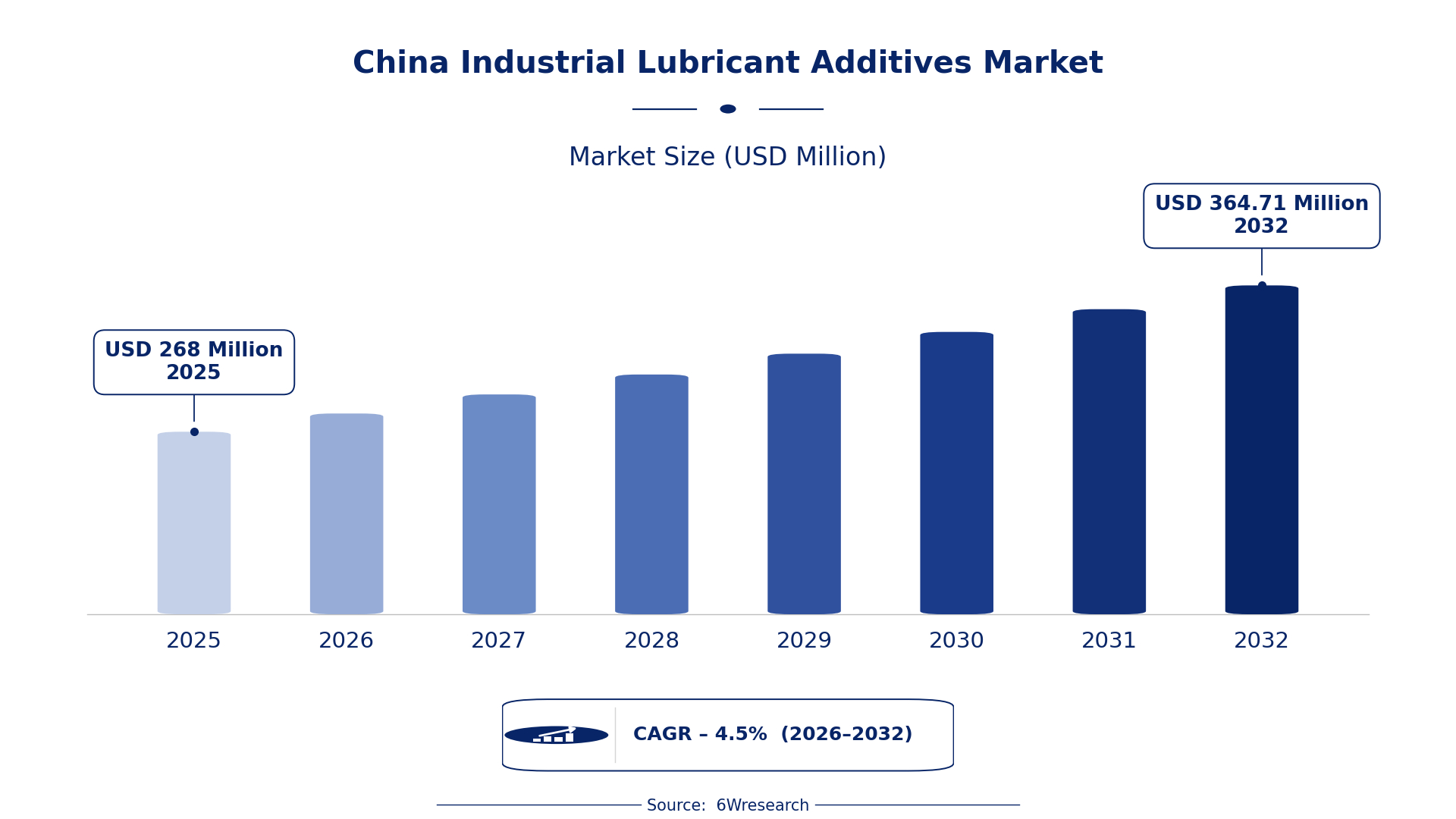
According to 6Wresearch internal database and industry insights, the China Industrial Lubricant Additives Market was valued at USD 268.0 million in 2025 and is projected to reach USD 364.71 million by 2032, growing at a CAGR of approximately 4.5% during 2026–2032.
China Industrial Lubricant Additives Market Highlights
| Report Metric | Details |
| Report Name | China Industrial Lubricant Additives Market |
| Market Size 2025 | USD 268.0 million |
| Market Size 2032 | USD 364.71 million |
| Absolute Growth 2025–2032 | USD 96.71 million |
| CAGR 2026–2032 | 4.5% |
| Peak Annual Growth | 6.5% in 2028 |
| Forecast Period | 2026–2032 |
| Historical Data | 2022–2025 |
| Base Year | 2025 |
| Leading Additive Type, 2025 | Detergents/Dispersants (41% share) |
| Leading Application Property, 2025 | Friction Reduction (38% share) |
| Leading Base Oil Compatibility, 2025 | Synthetic Oils (47% share) |
| Leading End User, 2025 | Automotive Parts Plants (32% share) |
| Fastest-Growing Additive Type | Viscosity Modifiers (5.7% CAGR) |
| Fastest-Growing Application Property | Cleanliness Control (6.8% CAGR) |
| Fastest-Growing End User | Industrial Engines (6.6% CAGR) |
| Growing Sector | automotive |
| Key End Users | automotive parts manufacturers, industrial machinery producers, marine engine manufacturers |
China Industrial Lubricant Additives Market Year-wise Growth Rate and Key Drivers (2022–2032)
This graph illustrates the annual growth rates of the market from 2022 to 2032, highlighting a steady upward trajectory and projected market expansion over the forecast period.
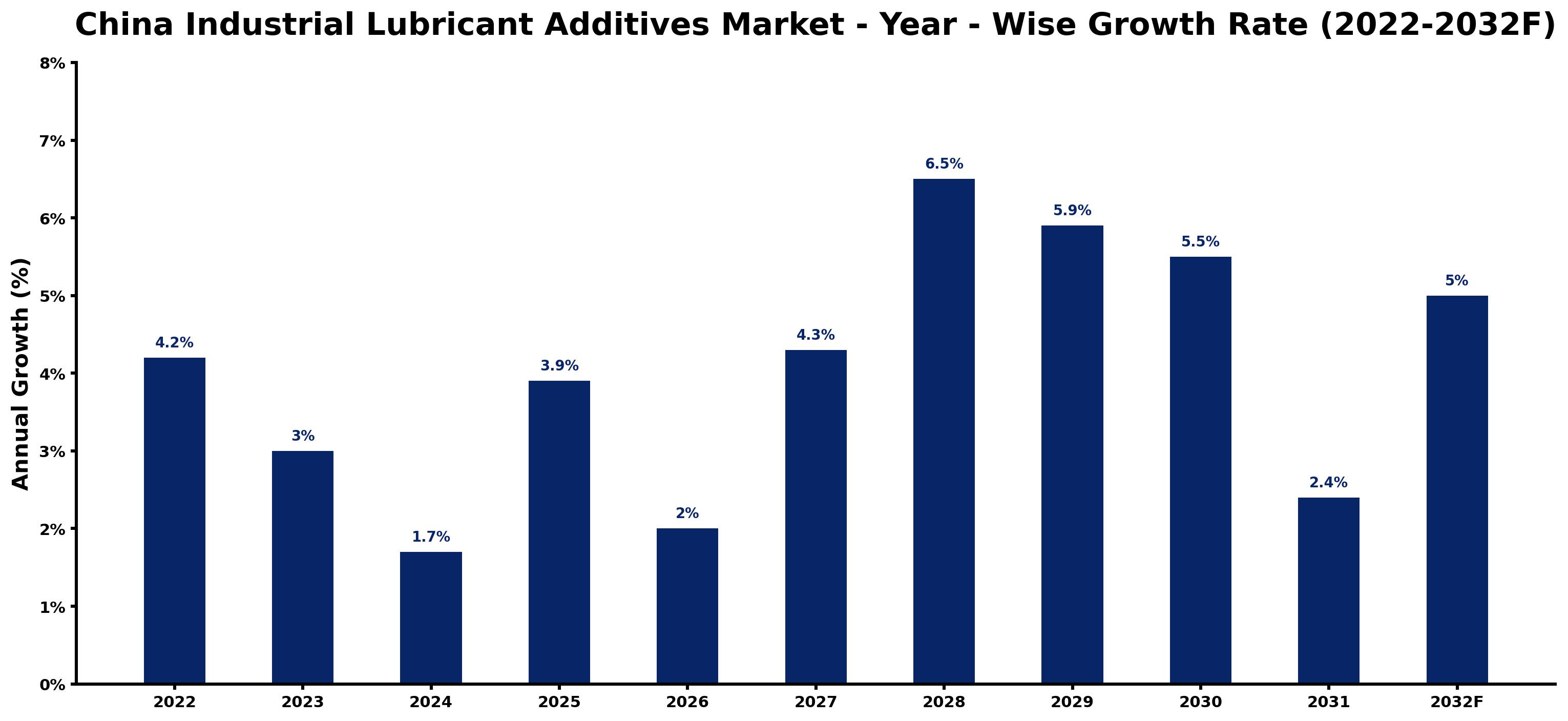
Below, each year's estimated growth is shown next to the factor that most influenced it.
| Year | Estimated Annual Growth (%) | Market Rationale |
| 2022 | 4.2 | The automotive sector's demand for lubricant additives remained strong, driving market activity. |
| 2023 | 3.0 | The automotive sector faced challenges, leading to slower growth compared to the previous year. |
| 2024 | 1.7 | Demand continued to slow as manufacturers adjusted to market conditions and production capabilities. |
| 2025 | 3.9 | The automotive industry showed signs of recovery, boosting demand for lubricant additives. |
| 2026 | 2.0 | Growth is expected to slow again as manufacturers face supply chain challenges and fluctuating demand. |
| 2027 | 4.3 | Increased industrial activity in key sectors is projected to spur demand for lubricant additives, reversing the slowdown. |
| 2028 | 6.5 | The market is expected to peak as the automotive sector expands rapidly, driving significant demand for additives. |
| 2029 | 5.9 | Growth will moderate slightly as the market adjusts after the peak demand year. |
| 2030 | 5.5 | Demand is projected to continue slowing as manufacturers focus on efficiency and cost control measures. |
| 2031 | 2.4 | The market will experience further slowdown as demand stabilises after previous fluctuations. |
| 2032 | 5.0 | Growth is expected to recover as new automotive projects and standards drive additive consumption. |
Note: Market size estimations and growth projections presented in this report are based on 6Wresearch's proprietary forecasting methodology, utilizing the latest available industry data, government publications, and primary research inputs.
China Industrial Lubricant Additives Market Synopsis
The China Industrial Lubricant Additives Market encompasses chemical compounds that improve lubricant performance. These additives enhance lubrication properties, reduce wear, and prevent oxidation, primarily used in the automotive sector. The market is expanding due to strong demand from over 1,000 automotive parts manufacturers in Guangdong province and the ongoing 'Made in China 2025' initiative, which prioritises high-performance lubricants.
Market Dynamics Impact Analysis (2026–2032)
| Factor | Type | Impact | Primary Segment Affected |
| Strong demand from the automotive sector drives the need for high-performance lubricant additives. | Driver | High | Friction Reduction |
| Increasing production of automotive components necessitates advanced lubricant formulations. | Driver | High | Detergents/Dispersants |
| Investment in environmentally friendly formulations creates opportunities for suppliers. | Opportunity | High | Synthetic Oils |
| The growing industrial engine market presents a chance for additive manufacturers to expand. | Opportunity | High | Industrial Engines |
| Stricter quality standards may limit the number of compliant products in the market. | Restraint | High | Antioxidants |
| The complexity of formulating high-performance additives may hinder smaller manufacturers. | Restraint | Medium | Viscosity Modifiers |
| The Industrial Lubricant Additives Market in China faces significant regulatory hurdles. | Challenge | High | Friction Reduction |
| Rising raw material costs can impact pricing strategies for lubricant additives. | Challenge | Medium | Detergents/Dispersants |
Evaluation of Drivers in China Industrial Lubricant Additives Market (2026–2032)
The main growth drivers and the segments they affect most are set out below.
| Drivers | Primary Segment Affected | Why It Matters (Evidence) |
| Increased automotive production drives demand for high-performance lubricant additives. | Detergents/Dispersants | The automotive sector, accounting for approximately 30% of demand, necessitates superior additives. |
| Growing industrial activity boosts the need for effective lubrication solutions. | Industrial Engines | The installed base of industrial engines in China reached 10 million units in 2022. |
| The push for environmentally friendly products creates new market opportunities. | Synthetic Oils | The 'Green Manufacturing Program' launched in 2023 promotes sustainable lubricant formulations. |
| Technological advancements in lubricant formulations improve performance characteristics. | Friction Reduction | ISO 6743-9:2018 provides guidelines for improved lubricant additives in industrial applications. |
| Rising demand for cleaner engine operations drives the need for effective detergents. | Antioxidants | The automotive industry employs over 4 million people, increasing demand for effective additives. |
Growth across the Industrial Lubricant Additives market in China is anchored in rising automotive production, increasing industrial activity, and the push for sustainable formulations. The automotive sector, which accounts for approximately 30% of demand, necessitates high-performance additives, driving purchases. In 2022, the installed base of industrial engines reached 10 million units, further boosting demand for effective lubrication solutions. Technological advancements guided by ISO 6743-9:2018 improve performance characteristics, leading to increased purchases from automotive parts manufacturers.
Evaluation of Restraints in China Industrial Lubricant Additives Market
The main factors holding the market back are set out below.
| Market Restraint | Primary Segment Affected | Why It Matters (Evidence) |
| Stricter quality standards may limit the number of compliant products in the market. | Antioxidants | The updated 'Product Quality Law' in 2023 enforces stricter standards for lubricant additives. |
| The complexity of formulating high-performance additives may hinder smaller manufacturers. | Viscosity Modifiers | Smaller manufacturers often lack the resources to meet stringent formulation requirements. |
| Increased regulatory scrutiny can delay product approvals for new additives. | Friction Reduction | The Ministry of Industry and Information Technology oversees compliance, impacting time-to-market. |
| Limited access to advanced technology can restrict innovation in additive formulations. | Synthetic Oils | Manufacturers without the latest technology may struggle to compete in the market. |
| Fluctuating prices of key raw materials can impact pricing strategies for lubricant additives. | Detergents/Dispersants | Rising raw material costs affect overall production expenses. |
China Industrial Lubricant Additives Market Challenges
The China Industrial Lubricant Additives market encounters a skills shortage, as the rapid growth of the automotive sector requires specialised expertise that is currently insufficient. This labour gap delays production timelines for producers, complicating efforts to meet the 30% demand from automotive manufacturers. Technological constraints also present challenges, as many suppliers depend on outdated manufacturing processes, leading to operational inefficiencies that increase costs. Buyers face pressure from rising prices due to heightened competition among producers, with costs for high-performance additives climbing by up to 15%, straining their operational budgets.
Trends in the China Industrial Lubricant Additives Market
Several trends are reshaping the China Industrial Lubricant Additives Market; the most important are set out below.
- Shift in Automotive Parts Manufacturing: Automotive parts manufacturers in Guangdong province are increasingly adopting high-performance lubricant additives, with demand rising by about 30% in 2022. This shift reflects the industry's commitment to product quality.
- Transition to Environmentally Friendly Formulations: The 'Green Manufacturing Program' launched in 2023 is encouraging manufacturers to embrace sustainable lubricant formulations, with an estimated 20% increase in eco-friendly products anticipated by 2025.
- Emergence of Advanced Lubrication Technologies: The introduction of ISO 6743-9:2018 guidelines is promoting the adoption of advanced lubrication technologies across various sectors, leading to a projected 15% increase in additive performance by 2026.
- Growing Demand for Synthetic Oils: Since 2022, the demand for synthetic oils has surged, with a 5.7% CAGR expected through 2032 as manufacturers pursue superior performance characteristics.
Investment Opportunities in the China Industrial Lubricant Additives Market
Below are the investment opportunities with the strongest case in the China Industrial Lubricant Additives Market.
- Joint Ventures for Sustainable Additives: Now is an opportune moment for joint ventures focusing on sustainable lubricant formulations, with the market gap for eco-friendly products estimated at USD 50 million. Collaborating with automotive parts manufacturers can facilitate market entry.
- Investment in High-Performance Additives: With the automotive sector projected to expand, there is a pressing need for high-performance additives. Investing in R&D for new formulations can attract automotive parts manufacturers seeking quality improvements.
- Approval Pathways for New Products: The current regulatory environment presents opportunities for new product approvals, particularly for innovative additives. Engaging with the Ministry of Industry and Information Technology can streamline this process.
- Supply of Eco-Friendly Additives: The demand for environmentally friendly additives is increasing, with a market potential of USD 30 million. Suppliers can enter by aligning with the 'Green Manufacturing Program' and prioritising sustainable practices.
Government Initiatives in the China Industrial Lubricant Additives Market
The updated 'Product Quality Law' in 2023 enforces stricter quality standards for lubricant additives, impacting producers in the market. This law mandates rigorous testing and certification processes, ensuring that all products meet specified performance criteria. Compliance with these standards is essential for manufacturers to maintain their market presence and credibility. Additionally, the 'Circular Economy Development Strategy' launched in 2021 promotes sustainable practices, encouraging producers to innovate in their formulations and reduce environmental impact.
In 2022, the 'Energy Efficiency Improvement Plan' initiated by the National Development and Reform Commission aims to improve the performance of industrial lubricants. This plan supports manufacturers in adopting energy-efficient technologies and practices, ultimately benefiting buyers through improved product performance. The Ministry of Industry and Information Technology oversees the implementation of these initiatives, ensuring that industry standards are met and promoting sustainable development in the lubricant additives sector. The plan targets a 10% improvement in energy efficiency by 2025.
Future Insight of the China Industrial Lubricant Additives Market
The China Industrial Lubricant Additives market is poised for transformation by 2032, primarily driven by the 'Green Manufacturing Program', which will encourage the development of environmentally friendly formulations. The installed base of industrial engines is projected to exceed 12 million units, leading to increased demand for advanced lubricant additives. The 'Made in China 2025' initiative will further underscore the need for cutting-edge lubricant technologies in manufacturing. Adherence to updated standards like GB/T 7631-2020 will improve product quality and safety, benefiting both buyers and suppliers.
Market Segmentation Analysis
The report offers a comprehensive study of the following market segments and their leading categories in the market.
By Additive Type – Detergents/Dispersants Dominated, Viscosity Modifiers Expected to Grow Fastest
According to Sachin Kumar Rai, Senior Research Analyst at 6Wresearch, Detergents/Dispersants held a 41% share of the China Industrial Lubricant Additives Market by additive type in 2025. Detergents and dispersants dominate the market share in China due to their critical function in maintaining engine cleanliness and preventing harmful deposits. This is especially vital for the automotive industry, which is a major consumer of lubricant additives, accounting for approximately 30% of overall demand. Viscosity Modifiers are set to record the highest CAGR in this split, 5.7% over 2026–2032. Viscosity modifiers are projected to grow rapidly as they are essential for maintaining lubricant viscosity across varying temperatures, a key requirement for the expanding automotive sector. With over 1,000 automotive parts manufacturers located in Guangdong province, their demand is expected to surge. Suppliers should prioritise the development of effective viscosity modifiers to cater to the increasing requirements from the automotive industry.
By Application Property – Friction Reduction Dominated, Cleanliness Control Expected to Grow Fastest
In 2025, Friction Reduction led the application property split with a 38% share. Friction reduction commands the largest market share due to its critical role in enhancing machinery efficiency across diverse industrial applications. The automotive sector's focus on performance optimisation drives the demand for additives that effectively minimise friction. Cleanliness Control is projected to grow fastest, at a CAGR of 6.8% during 2026–2032. Cleanliness control is the fastest-growing segment as it is essential for keeping engine components clean and ensuring optimal functionality. With the rise in industrial activity, the need for effective cleanliness measures in machinery will further propel this segment's growth. This trend signals to suppliers that there is a growing need for advanced cleanliness control additives to meet the increasing performance standards in the industrial sector.
By Base Oil Compatibility – Synthetic Oils Dominated and Is Expected to Record the Fastest Growth
With a 47% revenue share in 2025, Synthetic Oils was the largest base oil compatibility category. Synthetic oils dominate the market share owing to their superior performance characteristics, which are increasingly favoured across various applications. Their effectiveness under extreme conditions is particularly advantageous in the industrial sector, leading to widespread adoption. Its lead should widen, with a projected CAGR of 5.7% during 2026–2032, the highest in this split. Synthetic oils are also the fastest-growing segment, driven by ongoing advancements in lubricant technology that enhance their performance capabilities. This dual position as both leader and fastest-growing segment indicates that their market share will likely continue to expand. Suppliers should prioritise the ongoing development of synthetic oils to sustain their competitive edge and address the evolving demands of customers.
By End User – Automotive Parts Plants Dominated, Industrial Engines Expected to Grow Fastest
The largest end user category in 2025 was Automotive Parts Plants, with a 32% share of total revenue. Automotive parts plants occupy the largest share of the market as they are essential for the production of automotive components, which are in high demand. The automotive sector's growth directly influences the consumption of lubricant additives, solidifying this segment's position. The quickest growth will come from Industrial Engines, forecast to expand at a CAGR of 6.6% between 2026 and 2032. Industrial engines represent the fastest-growing end-user segment, driven by the increasing need for heavy machinery in various industries. As industrial activities ramp up, the demand for additives tailored for industrial engines will see substantial growth. This growth signals to suppliers the importance of tailoring their products to meet the specific needs of industrial engine applications.
Key Attractiveness of the Report
- 10 Years of Market Numbers
- Historical Data Starting from 2022 to 2025
- Base Year 2025
- Forecast Data until 2032
- Key Performance Indicators Impacting the Market
- Major Upcoming Developments and Projects
Key Highlights of the Report:
- China Industrial Lubricant Additives Market Outlook
- Market Size of China Industrial Lubricant Additives Market, 2025
- Forecast of China Industrial Lubricant Additives Market, 2032
- Historical Data and Forecast of China Industrial Lubricant Additives Revenues & Volume for the Period 2022 - 2032F
- China Industrial Lubricant Additives Market Trend Evolution
- China Industrial Lubricant Additives Market Drivers and Challenges
- China Industrial Lubricant Additives Price Trends
- China Industrial Lubricant Additives Porter's Five Forces
- China Industrial Lubricant Additives Industry Life Cycle
- Historical Data and Forecast of China Industrial Lubricant Additives Market Revenues & Volume By Additive Type for the Period 2022 - 2032F
- Historical Data and Forecast of China Industrial Lubricant Additives Market Revenues & Volume By Anti-Wear Agents for the Period 2022 - 2032F
- Historical Data and Forecast of China Industrial Lubricant Additives Market Revenues & Volume By Viscosity Modifiers for the Period 2022 - 2032F
- Historical Data and Forecast of China Industrial Lubricant Additives Market Revenues & Volume By Detergents/Dispersants for the Period 2022 - 2032F
- Historical Data and Forecast of China Industrial Lubricant Additives Market Revenues & Volume By Antioxidants for the Period 2022 - 2032F
- Historical Data and Forecast of China Industrial Lubricant Additives Market Revenues & Volume By Application Property for the Period 2022 - 2032F
- Historical Data and Forecast of China Industrial Lubricant Additives Market Revenues & Volume By Friction Reduction for the Period 2022 - 2032F
- Historical Data and Forecast of China Industrial Lubricant Additives Market Revenues & Volume By Temperature Stability for the Period 2022 - 2032F
- Historical Data and Forecast of China Industrial Lubricant Additives Market Revenues & Volume By Cleanliness Control for the Period 2022 - 2032F
- Historical Data and Forecast of China Industrial Lubricant Additives Market Revenues & Volume By Oxidation Prevention for the Period 2022 - 2032F
- Historical Data and Forecast of China Industrial Lubricant Additives Market Revenues & Volume By Base Oil Compatibility for the Period 2022 - 2032F
- Historical Data and Forecast of China Industrial Lubricant Additives Market Revenues & Volume By Mineral/Synthetic for the Period 2022 - 2032F
- Historical Data and Forecast of China Industrial Lubricant Additives Market Revenues & Volume By Group I V Oils for the Period 2022 - 2032F
- Historical Data and Forecast of China Industrial Lubricant Additives Market Revenues & Volume By Gasoline/Diesel for the Period 2022 - 2032F
- Historical Data and Forecast of China Industrial Lubricant Additives Market Revenues & Volume By Synthetic Oils for the Period 2022 - 2032F
- Historical Data and Forecast of China Industrial Lubricant Additives Market Revenues & Volume By End User for the Period 2022 - 2032F
- Historical Data and Forecast of China Industrial Lubricant Additives Market Revenues & Volume By Automotive Parts Plants for the Period 2022 - 2032F
- Historical Data and Forecast of China Industrial Lubricant Additives Market Revenues & Volume By Marine Engines for the Period 2022 - 2032F
- Historical Data and Forecast of China Industrial Lubricant Additives Market Revenues & Volume By Industrial Engines for the Period 2022 - 2032F
- Historical Data and Forecast of China Industrial Lubricant Additives Market Revenues & Volume By Power Plant Turbines for the Period 2022 - 2032F
- China Industrial Lubricant Additives Import Export Trade Statistics
- Market Opportunity Assessment By Additive Type
- Market Opportunity Assessment By Application Property
- Market Opportunity Assessment By Base Oil Compatibility
- Market Opportunity Assessment By End User
- China Industrial Lubricant Additives Top Companies Market Share
- China Industrial Lubricant Additives Competitive Benchmarking By Technical and Operational Parameters
- China Industrial Lubricant Additives Company Profiles
- China Industrial Lubricant Additives Key Strategic Recommendations
Market Covered
Segments analysed in this report are listed below.
By Additive Type
- Anti-Wear Agents
- Viscosity Modifiers
- Detergents/Dispersants
- Antioxidants
By Application Property
- Friction Reduction
- Temperature Stability
- Cleanliness Control
- Oxidation Prevention
By Base Oil Compatibility
- Mineral/Synthetic
- Group I–V Oils
- Gasoline/Diesel
- Synthetic Oils
By End User
- Automotive Parts Plants
- Marine Engines
- Industrial Engines
- Power Plant Turbines































