India Industrial Lubricant Additives Market Size & Growth Rate
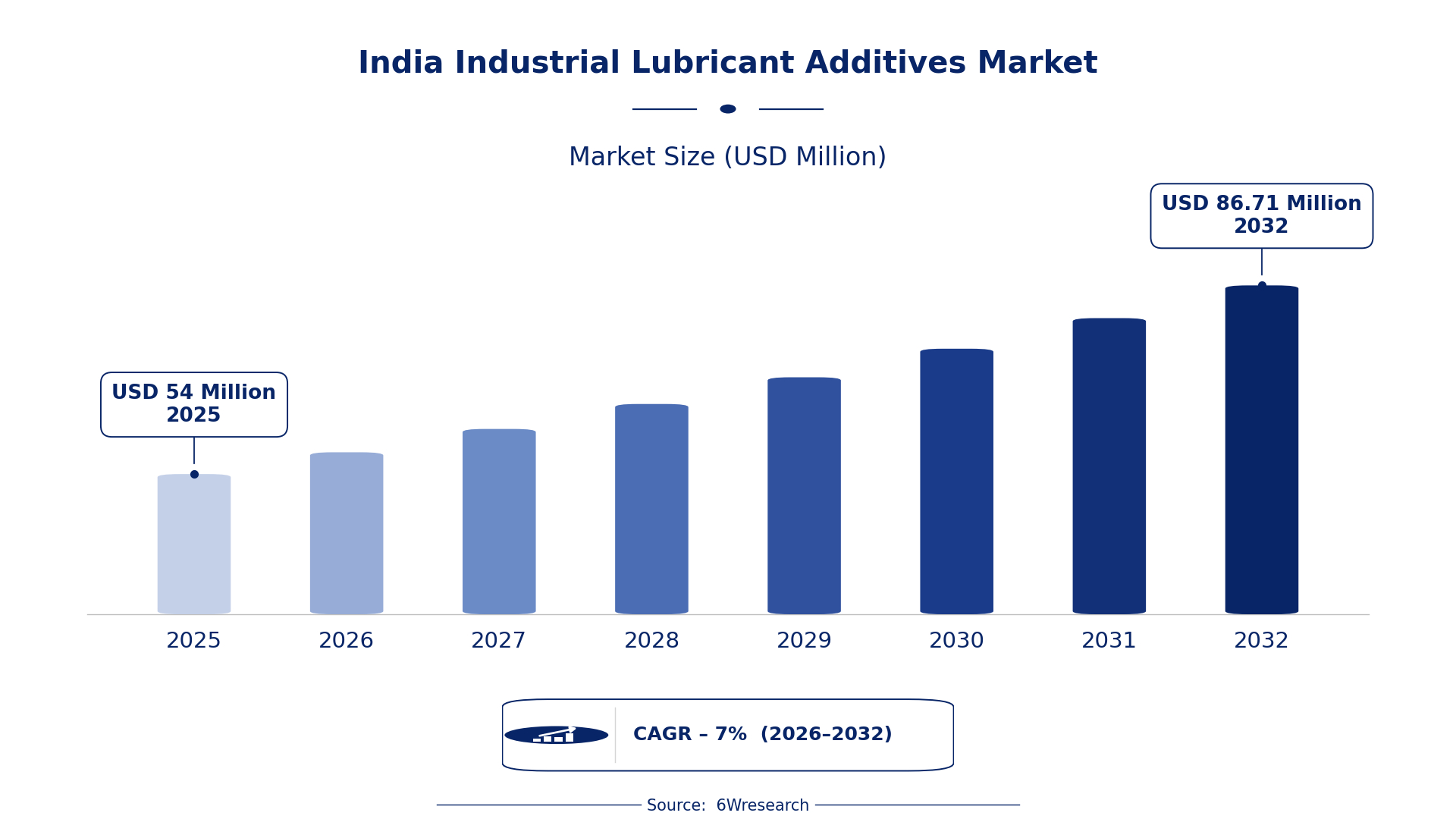
According to 6Wresearch internal database and industry insights, the India Industrial Lubricant Additives Market was valued at USD 54.0 million in 2025 and is projected to reach USD 86.71 million by 2032, growing at a CAGR of approximately 7% during 2026–2032.
India Industrial Lubricant Additives Market Highlights
| Report Metric | Details |
| Report Name | India Industrial Lubricant Additives Market |
| Market Size 2025 | USD 54.0 million |
| Market Size 2032 | USD 86.71 million |
| Absolute Growth 2025–2032 | USD 32.71 million |
| CAGR 2026–2032 | 7% |
| Peak Annual Growth | 9.2% in 2027 |
| Forecast Period | 2026–2032 |
| Historical Data | 2022–2025 |
| Base Year | 2025 |
| Leading Additive Type, 2025 | Detergents/Dispersants (34% share) |
| Leading Application Property, 2025 | Friction Reduction (40% share) |
| Leading Base Oil Compatibility, 2025 | Synthetic Oils (46% share) |
| Leading End User, 2025 | Automotive Parts Plants (42% share) |
| Fastest-Growing Additive Type | Viscosity Modifiers (9.4% CAGR) |
| Fastest-Growing Application Property | Cleanliness Control (9.4% CAGR) |
| Fastest-Growing End User | Industrial Engines (9.1% CAGR) |
| Growing Sector | Automotive Parts Manufacturing |
| Key End Users | Automotive Parts Plants, Industrial Engines, Marine Engines, Power Plant Turbines |
India Industrial Lubricant Additives Market Year-wise Growth Rate and Key Drivers (2022–2032)
This graph illustrates the annual growth rates of the market from 2022 to 2032, highlighting a steady upward trajectory and projected market expansion over the forecast period.
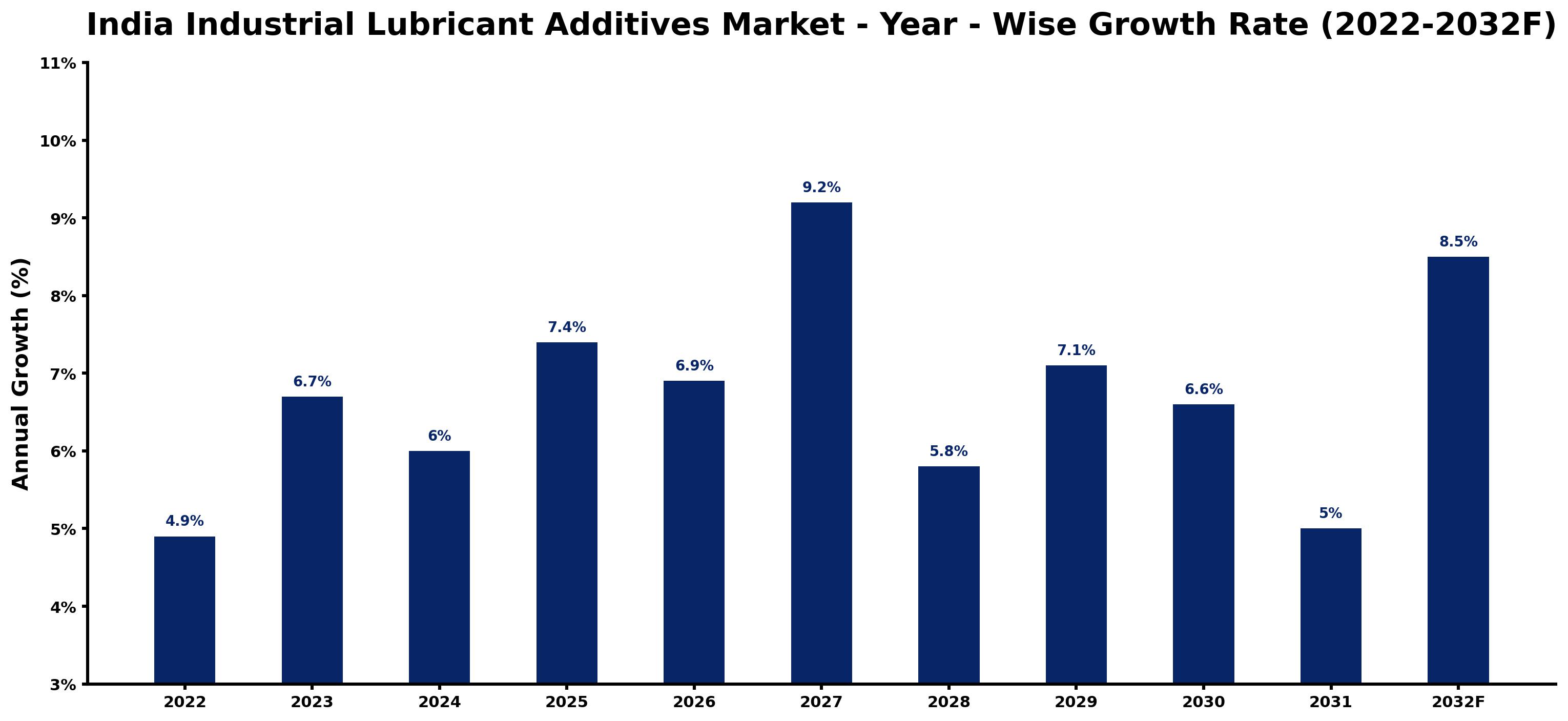
Year by year, the estimates below pair each growth rate with the development that shaped it.
| Year | Estimated Annual Growth (%) | Market Rationale |
| 2022 | 4.9 | The market experienced steady growth due to increased demand from the automotive sector, which produced 2 million tons of lubricants. |
| 2023 | 6.7 | Growth accelerated as the automotive industry projected a 10% increase, driving higher demand for lubricant additives. |
| 2024 | 6.0 | The growth rate slowed as manufacturers adjusted to the previous year's surge in production and demand. |
| 2025 | 7.4 | A faster growth rate was achieved as local production ramped up to meet rising automotive sector needs. |
| 2026 | 6.9 | The market saw a slowdown as the transition towards synthetic oils required time for manufacturers to adapt. |
| 2027 | 9.2 | Growth surged as the automotive sector expanded, increasing the need for high-performance lubricant additives. |
| 2028 | 5.8 | The growth rate declined as the market stabilised after the previous year's peak in demand. |
| 2029 | 7.1 | An increase in growth was noted as industrial activities expanded, further driving additive demand. |
| 2030 | 6.6 | The market experienced a slowdown as manufacturers faced challenges in sourcing raw materials amid rising costs. |
| 2031 | 5.0 | Growth continued to decelerate as the market adjusted to the evolving regulatory landscape and competitive pressures. |
| 2032 | 8.5 | A faster growth rate is anticipated as innovations in synthetic oils and local manufacturing capabilities enhance product offerings. |
Note: Market size estimations and growth projections presented in this report are based on 6Wresearch's proprietary forecasting methodology, utilizing the latest available industry data, government publications, and primary research inputs.
India Industrial Lubricant Additives Market Synopsis
Industrial Lubricant Additives in India are chemical compounds that improve lubricant performance across various applications. These additives play a key role in reducing friction, preventing wear, and enhancing lubricant stability. The India Industrial Lubricant Additives Market is expanding due to increased automotive production and the 'Make in India' initiative. With the automotive industry projected to grow by 10% in 2023, the demand for high-performance lubricants is set to rise significantly. Furthermore, the shift towards synthetic oils is shaping additive formulations, creating new investment opportunities.
Market Dynamics Impact Analysis (2026–2032)
| Factor | Type | Impact | Primary Segment Affected |
| Rising automotive production and local manufacturing initiatives | Driver | High | Friction Reduction |
| Growing demand for high-performance lubricants in industrial applications | Driver | High | Detergents/Dispersants |
| Investment in local manufacturing capabilities for lubricant additives | Opportunity | High | Anti-Wear Agents |
| Increased focus on bio-lubricants due to environmental regulations | Opportunity | Medium | Synthetic Oils |
| Challenges in meeting stringent quality standards set by regulatory bodies | Restraint | High | Viscosity Modifiers |
| Supply chain disruptions affecting raw material availability | Restraint | Medium | Antioxidants |
| Buyers face difficulties in sourcing high-quality additives | Challenge | High | Industrial Engines |
| Suppliers encounter delays in production linked to regulatory compliance | Challenge | Medium | Marine Engines |
Evaluation of Drivers in India Industrial Lubricant Additives Market (2026–2032)
The table below links each growth driver to the segment it affects and the evidence for it.
| Drivers | Primary Segment Affected | Why It Matters (Evidence) |
| Increased automotive production | Friction Reduction | The automotive industry's growth, projected to rise by 10% in 2023, boosts demand for additives that improve lubricant performance. |
| Growing industrial activities | Detergents/Dispersants | With 2 million tons of lubricants produced in 2022, demand for additives that keep engines clean is rising. |
| Investment in local manufacturing | Anti-Wear Agents | The 'Atmanirbhar Bharat' initiative promotes local production, increasing the need for wear-reducing additives. |
| Shift towards synthetic oils | Synthetic Oils | The Indian lubricant market is transitioning to synthetic oils, necessitating advanced additives for optimal performance. |
| Focus on quality certifications | Viscosity Modifiers | ISO 9001 certification is pursued by manufacturers, improving the quality of viscosity-modifying additives. |
Market growth for Industrial Lubricant Additives in India is driven by rising automotive production, expanding industrial activities, and substantial investments in local manufacturing. The automotive sector is expected to grow by 10% in 2023, leading to a greater need for high-performance lubricants. In 2022, India produced 2 million tons of lubricants, a considerable portion of which was industrial lubricants. The transition towards synthetic oils is influencing additive formulations, necessitating advanced products that align with evolving industry standards.
Evaluation of Restraints in India Industrial Lubricant Additives Market
The main factors holding the market back are set out below.
| Market Restraint | Primary Segment Affected | Why It Matters (Evidence) |
| Challenges in meeting quality standards | Viscosity Modifiers | The Bureau of Indian Standards sets stringent benchmarks, making compliance difficult for manufacturers. |
| Supply chain disruptions | Antioxidants | Raw material shortages have delayed production schedules, affecting availability for buyers. |
| High production costs for advanced additives | Anti-Wear Agents | Manufacturers face rising costs due to the need for quality certifications and compliance. |
| Limited awareness of bio-lubricants | Synthetic Oils | Buyers are often unaware of the benefits of bio-lubricants, hindering market growth. |
| Regulatory compliance costs | Detergents/Dispersants | Adhering to updated regulations increases operational costs for producers. |
India Industrial Lubricant Additives Market Challenges
Buyers and suppliers in the India Industrial Lubricant Additives market encounter supply chain disruptions, as local production struggles to meet the automotive sector's demand, which produced 2 million tons of lubricants in 2022. This shortfall delays production timelines for manufacturers, compelling them to seek imports that can take weeks to arrive. Rising costs burden buyers, as the government's $1 billion allocation for the automotive sector intensifies competition for raw materials, driving up prices. Regulatory standards from the Bureau of Indian Standards complicate compliance for producers, resulting in additional costs that ultimately affect pricing for end-users.
Trends in the India Industrial Lubricant Additives Market
Buyers and suppliers in the India Industrial Lubricant Additives Market are adjusting to the following trends.
- Shift towards Synthetic Oils: Since 2022, the Indian lubricant market has experienced a shift towards synthetic oils, driven by their superior performance. The automotive sector is projected to grow by 10% in 2023, increasing the demand for these advanced lubricants.
- Increased Focus on Bio-Lubricants: In 2022, the launch of the 'National Biofuel Policy' promoted the use of bio-lubricants, impacting the additive market. This initiative aims to improve sustainability in the automotive sector.
- Rise of Local Manufacturing: The 'Make in India' initiative, launched in 2014, has encouraged local manufacturing of lubricant additives. This has resulted in a production of 2 million tons of lubricants in 2022, boosting domestic supply.
- Enhanced Quality Standards: The Bureau of Indian Standards updated the IS 1448 standard in 2021, affecting lubricant testing quality. This change has prompted manufacturers to improve their additive formulations to meet new benchmarks.
Investment Opportunities in the India Industrial Lubricant Additives Market
Investors looking at the India Industrial Lubricant Additives Market should consider the following areas.
- Timing for Investment in Additives: With the Indian automotive industry projected to grow by 10% in 2023, now is an ideal time to invest in lubricant additives. Local automotive parts plants are major consumers, creating a demand gap that can be filled.
- Entry through Local Partnerships: Investing in joint ventures with local manufacturers can facilitate entry into the lubricant additive market. The automotive parts manufacturing sector in Maharashtra offers a strategic location for such partnerships.
- Gap in High-Performance Additives: The market gap for high-performance lubricant additives is clear, with a projected market size of USD 86.71 million by 2032. Targeting automotive parts plants can yield substantial returns for suppliers.
- Focus on Bio-Lubricants: The National Biofuel Policy promotes bio-lubricants, creating an opportunity for suppliers to develop eco-friendly additives. Engaging with local manufacturers can ease market entry.
Government Initiatives in the India Industrial Lubricant Additives Market
The Bureau of Indian Standards updated the IS 1448 standard for lubricant testing in 2021, impacting the quality benchmarks for lubricant additives. This measure ensures that manufacturers adhere to stringent testing protocols, improving product reliability and performance. Compliance with these standards is essential for producers aiming to maintain market competitiveness and meet buyer expectations. The 'Atmanirbhar Bharat' initiative, introduced in 2020, promotes self-reliance in manufacturing, influencing the lubricant additive industry by encouraging local production and innovation.
The Ministry of Heavy Industries oversees the production-linked incentive scheme, which allocates $1 billion for the development of the automotive sector. This funding supports local manufacturing of automotive components, including lubricant additives, thereby boosting production capabilities and ensuring a steady supply for buyers. The initiative aims to promote self-reliance in the industry and encourage innovation in additive formulations. Additionally, the National Automotive Testing and R&D Infrastructure Project (NATRiP) supports the development of automotive technologies, improving testing capabilities for lubricant additives.
Future Insight of the India Industrial Lubricant Additives Market
The India Industrial Lubricant Additives market is set to evolve by 2032, driven by the shift towards synthetic oils and enhanced local manufacturing under the 'Make in India' initiative. The automotive industry's projected 10% growth will necessitate higher performance additives, prompting suppliers to innovate their formulations. The National Automotive Testing and R&D Infrastructure Project will improve testing capabilities, ensuring better quality standards. By 2032, the focus on ISO 9001 certification will elevate product quality, benefiting both producers and buyers.
Market Segmentation Analysis
The report offers a comprehensive study of the following market segments and their leading categories in the market.
By Additive Type – Detergents/Dispersants Dominated, Viscosity Modifiers Expected to Grow Fastest
According to Sachin Kumar Rai, Senior Research Analyst at 6Wresearch, in 2025, Detergents/Dispersants led the additive type split with a 34% share. Detergents/Dispersants command a substantial market share due to their critical function in maintaining engine cleanliness, particularly in the automotive sector. Their widespread use in India's automotive industry, which produced 2 million tons of lubricants in 2022, underscores their importance. Viscosity Modifiers are set to record the highest CAGR in this split, 9.4% over 2026–2032. Viscosity Modifiers are experiencing rapid growth as they play a crucial role in adjusting lubricant viscosity for high-performance applications. With the automotive industry projected to grow by 10% in 2023, the demand for these additives is expected to rise significantly, reinforcing their market position. Suppliers should focus on enhancing Viscosity Modifiers to meet the increasing performance requirements of the automotive sector.
By Application Property – Friction Reduction Dominated, Cleanliness Control Expected to Grow Fastest
The largest application property category in 2025 was Friction Reduction, with a 40% share of total revenue. Friction Reduction leads in market share as it directly minimises friction in moving parts, essential for the efficiency of machinery and vehicles alike. The automotive industry's heavy reliance on these additives highlights their vital role in enhancing operational performance. Cleanliness Control is projected to grow fastest, at a CAGR of 9.4% during 2026–2032. Cleanliness Control is the fastest-growing application property, driven by the need to keep engine components free from deposits, which is increasingly crucial in modern engines. The shift towards synthetic oils is anticipated to boost the demand for additives that prioritise cleanliness. Buyers should focus on additives that enhance cleanliness control to ensure optimal engine performance and longevity.
By Base Oil Compatibility – Synthetic Oils Dominated and Is Expected to Record the Fastest Growth
Synthetic Oils accounted for a 46% market share by base oil compatibility in 2025. Synthetic Oils dominate the market share due to their superior performance in high-demand applications, making them the preferred choice for many manufacturers. Their compatibility with various additive formulations positions them as a staple in the lubricant industry. The same category are also set to grow fastest, at a CAGR of 8.4% during 2026–2032. Synthetic Oils are also the fastest-growing segment, as the shift towards synthetic formulations in the lubricant market continues to gain momentum. This trend is expected to widen the gap between synthetic and traditional oils, reinforcing their market position. Suppliers must invest in developing advanced synthetic oil formulations to capitalise on this growing trend.
By End User – Automotive Parts Plants Dominated, Industrial Engines Expected to Grow Fastest
Automotive Parts Plants took a 42% share of end user in 2025, more than any other category. Automotive Parts Plants represent the largest market share as they are key consumers of lubricant additives necessary for optimal performance in automotive component production. Their essential role in the automotive supply chain significantly drives the demand for high-quality additives. Over 2026–2032, Industrial Engines are expected to post the fastest growth, at a CAGR of 9.1%. Industrial Engines are the fastest-growing end user segment, as the need for effective lubrication in heavy machinery becomes more critical. This growth is supported by the ongoing expansion of industrial activities across India. Manufacturers should tailor their products to meet the specific needs of industrial engine applications to take advantage of this expanding market.
Key Attractiveness of the Report
- 10 Years of Market Numbers
- Historical Data Starting from 2022 to 2025
- Base Year 2025
- Forecast Data until 2032
- Key Performance Indicators Impacting the Market
- Major Upcoming Developments and Projects
Key Highlights of the Report:
- India Industrial Lubricant Additives Market Outlook
- Market Size of India Industrial Lubricant Additives Market, 2025
- Forecast of India Industrial Lubricant Additives Market, 2032
- Historical Data and Forecast of India Industrial Lubricant Additives Revenues & Volume for the Period 2022 - 2032F
- India Industrial Lubricant Additives Market Trend Evolution
- India Industrial Lubricant Additives Market Drivers and Challenges
- India Industrial Lubricant Additives Price Trends
- India Industrial Lubricant Additives Porter's Five Forces
- India Industrial Lubricant Additives Industry Life Cycle
- Historical Data and Forecast of India Industrial Lubricant Additives Market Revenues & Volume By Additive Type for the Period 2022 - 2032F
- Historical Data and Forecast of India Industrial Lubricant Additives Market Revenues & Volume By Anti-Wear Agents for the Period 2022 - 2032F
- Historical Data and Forecast of India Industrial Lubricant Additives Market Revenues & Volume By Viscosity Modifiers for the Period 2022 - 2032F
- Historical Data and Forecast of India Industrial Lubricant Additives Market Revenues & Volume By Detergents/Dispersants for the Period 2022 - 2032F
- Historical Data and Forecast of India Industrial Lubricant Additives Market Revenues & Volume By Antioxidants for the Period 2022 - 2032F
- Historical Data and Forecast of India Industrial Lubricant Additives Market Revenues & Volume By Application Property for the Period 2022 - 2032F
- Historical Data and Forecast of India Industrial Lubricant Additives Market Revenues & Volume By Friction Reduction for the Period 2022 - 2032F
- Historical Data and Forecast of India Industrial Lubricant Additives Market Revenues & Volume By Temperature Stability for the Period 2022 - 2032F
- Historical Data and Forecast of India Industrial Lubricant Additives Market Revenues & Volume By Cleanliness Control for the Period 2022 - 2032F
- Historical Data and Forecast of India Industrial Lubricant Additives Market Revenues & Volume By Oxidation Prevention for the Period 2022 - 2032F
- Historical Data and Forecast of India Industrial Lubricant Additives Market Revenues & Volume By Base Oil Compatibility for the Period 2022 - 2032F
- Historical Data and Forecast of India Industrial Lubricant Additives Market Revenues & Volume By Mineral/Synthetic for the Period 2022 - 2032F
- Historical Data and Forecast of India Industrial Lubricant Additives Market Revenues & Volume By Group I V Oils for the Period 2022 - 2032F
- Historical Data and Forecast of India Industrial Lubricant Additives Market Revenues & Volume By Gasoline/Diesel for the Period 2022 - 2032F
- Historical Data and Forecast of India Industrial Lubricant Additives Market Revenues & Volume By Synthetic Oils for the Period 2022 - 2032F
- Historical Data and Forecast of India Industrial Lubricant Additives Market Revenues & Volume By End User for the Period 2022 - 2032F
- Historical Data and Forecast of India Industrial Lubricant Additives Market Revenues & Volume By Automotive Parts Plants for the Period 2022 - 2032F
- Historical Data and Forecast of India Industrial Lubricant Additives Market Revenues & Volume By Marine Engines for the Period 2022 - 2032F
- Historical Data and Forecast of India Industrial Lubricant Additives Market Revenues & Volume By Industrial Engines for the Period 2022 - 2032F
- Historical Data and Forecast of India Industrial Lubricant Additives Market Revenues & Volume By Power Plant Turbines for the Period 2022 - 2032F
- India Industrial Lubricant Additives Import Export Trade Statistics
- Market Opportunity Assessment By Additive Type
- Market Opportunity Assessment By Application Property
- Market Opportunity Assessment By Base Oil Compatibility
- Market Opportunity Assessment By End User
- India Industrial Lubricant Additives Top Companies Market Share
- India Industrial Lubricant Additives Competitive Benchmarking By Technical and Operational Parameters
- India Industrial Lubricant Additives Company Profiles
- India Industrial Lubricant Additives Key Strategic Recommendations
Market Covered
Segments analysed in this report are listed below.
By Additive Type
- Anti-Wear Agents
- Viscosity Modifiers
- Detergents/Dispersants
- Antioxidants
By Application Property
- Friction Reduction
- Temperature Stability
- Cleanliness Control
- Oxidation Prevention
By Base Oil Compatibility
- Mineral/Synthetic
- Group I–V Oils
- Gasoline/Diesel
- Synthetic Oils
By End User
- Automotive Parts Plants
- Marine Engines
- Industrial Engines
- Power Plant Turbines































