China Industrial RFID Market Size & Growth Rate
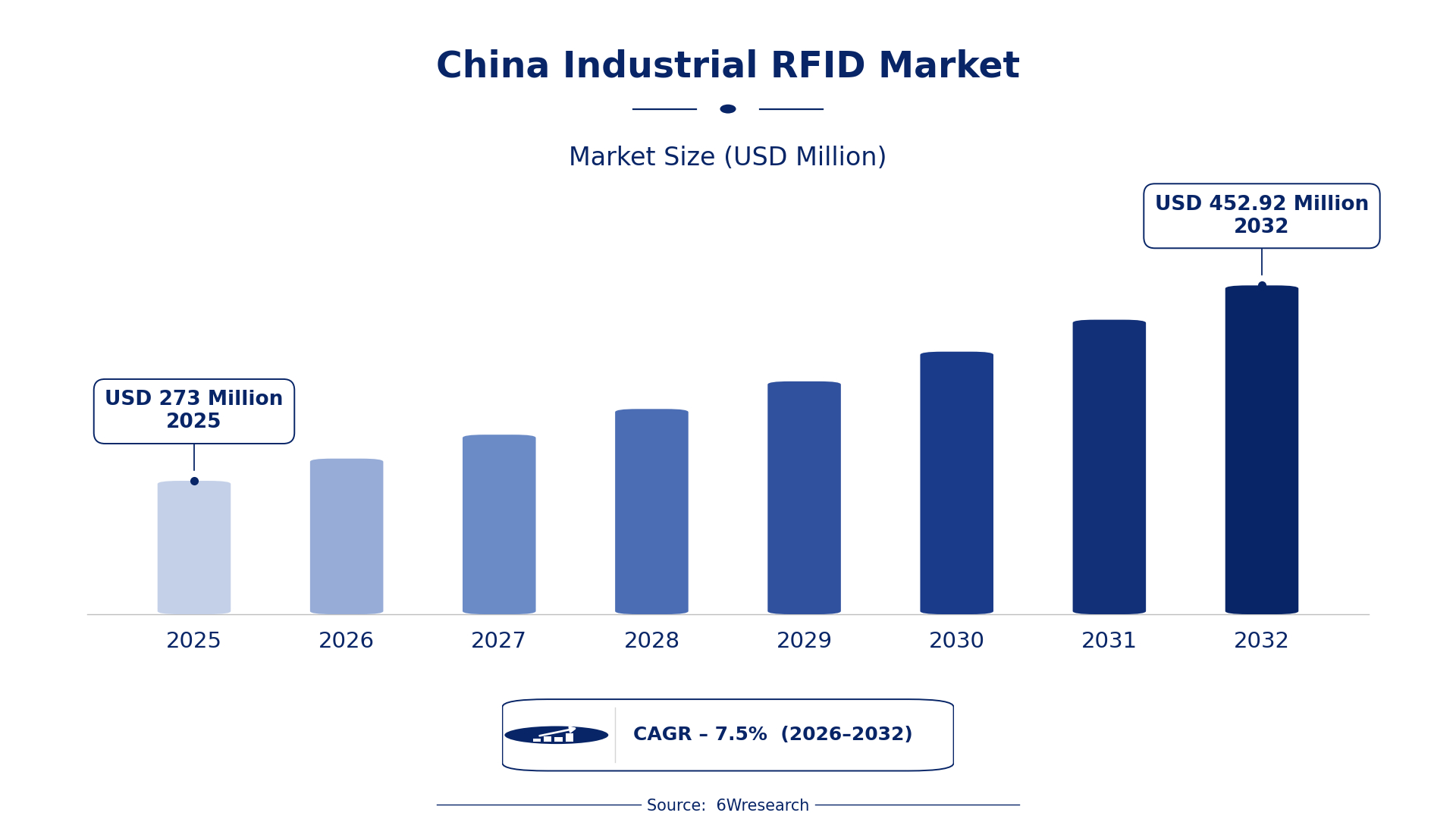
According to 6Wresearch internal database and industry insights, the China Industrial RFID Market was valued at USD 273.0 million in 2025 and is projected to reach USD 452.92 million by 2032, growing at a CAGR of approximately 7.5% during 2026–2032.
China Industrial RFID Market Highlights
| Report Metric | Details |
| Report Name | China Industrial RFID Market |
| Market Size 2025 | USD 273.0 million |
| Market Size 2032 | USD 452.92 million |
| Absolute Growth 2025–2032 | USD 179.92 million |
| CAGR 2026–2032 | 7.5% |
| Peak Annual Growth | 10.3% in 2032 |
| Forecast Period | 2026–2032 |
| Historical Data | 2022–2025 |
| Base Year | 2025 |
| Leading RFID Type, 2025 | Passive RFID (46% share) |
| Leading Frequency Band, 2025 | UHF (860–960 MHz) (47% share) |
| Leading Form Factor, 2025 | Tag & Label (51% share) |
| Leading Application Area, 2025 | Asset Tracking (39% share) |
| Leading End User Industry, 2025 | Logistics (36% share) |
| Fastest-Growing RFID Type | Active RFID (8.8% CAGR) |
| Fastest-Growing Form Factor | Beacon/Transmitter (9.2% CAGR) |
| Fastest-Growing Application Area | Warehouse Automation (8.7% CAGR) |
| Fastest-Growing End User Industry | Manufacturing (9.3% CAGR) |
| Growing Sector | Logistics |
| Key End Users | Logistics providers, manufacturers, healthcare facilities, warehouse operators |
China Industrial RFID Market Year-wise Growth Rate and Key Drivers (2022–2032)
This graph illustrates the annual growth rates of the market from 2022 to 2032, highlighting a steady upward trajectory and projected market expansion over the forecast period.
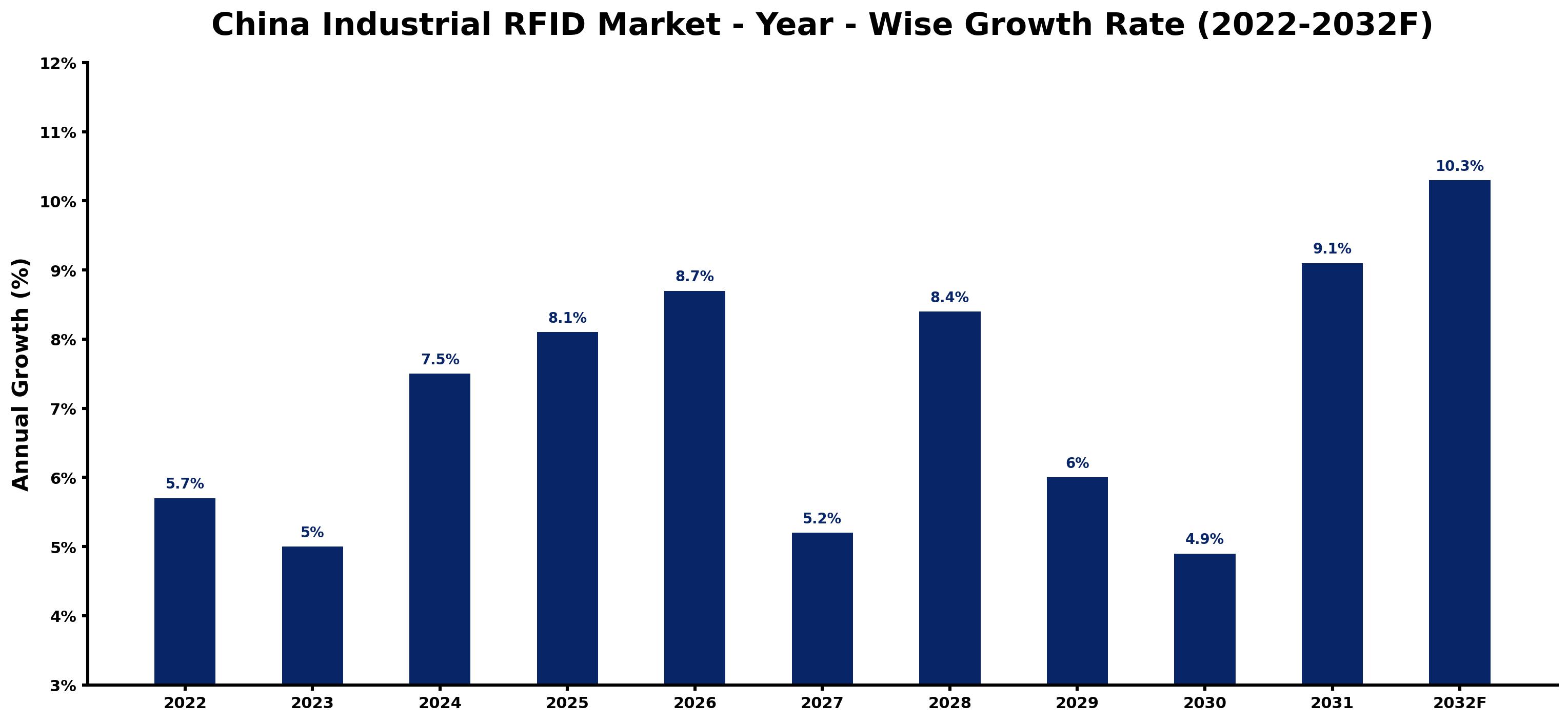
The table below sets out the estimated growth rate for each year and the main factor behind it.
| Year | Estimated Annual Growth (%) | Market Rationale |
| 2022 | 5.7 | The market experienced steady growth due to increased adoption of RFID technology in logistics and manufacturing sectors, driven by the '13th Five-Year Plan'. |
| 2023 | 5.0 | Growth slowed as manufacturers adjusted to supply chain disruptions and fluctuating demand for RFID solutions. |
| 2024 | 7.5 | A resurgence in investment in automation and efficiency drove faster growth in the market, particularly in logistics. |
| 2025 | 8.1 | The market peaked with strong demand from logistics, contributing to the highest growth rate, supported by the 'Smart Manufacturing Promotion Program'. |
| 2026 | 8.7 | Continued investment in RFID technology in manufacturing sectors is expected to support further growth, particularly from the 'Made in China 2025' initiative. |
| 2027 | 5.2 | Growth is projected to slow as market maturity begins to set in, affecting new investments in RFID solutions. |
| 2028 | 8.4 | An increase in warehouse automation initiatives will lead to a rebound in growth rates, enhancing operational efficiency. |
| 2029 | 6.0 | Demand is anticipated to slow as market saturation begins to impact new project launches, particularly in logistics. |
| 2030 | 4.9 | The market growth rate is expected to decrease as companies focus on optimising existing systems and technologies. |
| 2031 | 9.1 | A renewed focus on supply chain efficiency will lead to a surge in demand for RFID solutions, particularly in manufacturing. |
| 2032 | 10.3 | The market is projected to peak with strong investments in smart logistics and manufacturing, driven by the 'Smart Logistics Development Plan'. |
Note: Market size estimations and growth projections presented in this report are based on 6Wresearch's proprietary forecasting methodology, utilizing the latest available industry data, government publications, and primary research inputs.
China Industrial RFID Market Synopsis
Industrial RFID in China encompasses technology that uses radio waves for automatic identification and tracking of objects. This technology is produced through the integration of microchips and antennas, primarily used in asset tracking, inventory management, and access control. The China Industrial RFID Market is growing due to increasing demand from logistics and manufacturing sectors, driven by initiatives like the 'Smart Logistics Development Plan' and the 'Made in China 2025' initiative.
Market Dynamics Impact Analysis (2026–2032)
| Factor | Type | Impact | Primary Segment Affected |
| Growing investment in automation and smart logistics solutions drives demand for RFID technology. | Driver | High | Logistics |
| Increased adoption of RFID technology in manufacturing enhances production efficiency. | Driver | High | Manufacturing |
| The logistics sector's projected 60% utilization of RFID technology by 2025 presents significant opportunities. | Opportunity | High | Logistics |
| The rise in warehouse automation creates demand for advanced RFID solutions. | Opportunity | High | Warehouse Automation |
| Supply chain disruptions have caused delays in RFID implementation across sectors. | Restraint | Medium | Manufacturing |
| High initial costs of RFID systems can deter smaller companies from adoption. | Restraint | Medium | Logistics |
| The Industrial RFID market in China faces challenges related to technology integration and standardisation. | Challenge | High | Manufacturing |
| Competition among over 1,000 RFID manufacturers creates pricing pressures in the market. | Challenge | Medium | Logistics |
Evaluation of Drivers in China Industrial RFID Market (2026–2032)
The table below links each growth driver to the segment it affects and the evidence for it.
| Drivers | Primary Segment Affected | Why It Matters (Evidence) |
| Increased investment in smart logistics systems drives demand for RFID solutions. | Logistics | The logistics sector is projected to utilize 60% of RFID technology by 2025, leading to more purchases. |
| Adoption of RFID in manufacturing enhances production efficiency and tracking. | Manufacturing | The 'Made in China 2025' initiative promotes RFID integration, increasing demand from manufacturers. |
| Growing warehouse automation initiatives boost the need for RFID technology. | Warehouse Automation | The average adoption rate of RFID in Chinese warehouses is around 30%, driving further purchases. |
| Real-time location tracking applications are gaining traction in high-value asset management. | Active RFID | The installed base of RFID readers is estimated to exceed 10 million units by 2025, increasing demand. |
| The healthcare sector's adoption of RFID for patient tracking is expanding. | Passive RFID | Over 500 hospitals in China have implemented RFID technology, creating a new demand segment. |
The logistics sector is set to utilize 60% of RFID technology by 2025, driving demand. The average adoption rate of RFID in Chinese warehouses is around 30%, further boosting demand. Real-time location tracking applications are gaining traction, with an estimated installed base of RFID readers exceeding 10 million units by 2025, improving tracking capabilities.
Evaluation of Restraints in China Industrial RFID Market
The key brakes on demand, and where they bite hardest, are shown below.
| Market Restraint | Primary Segment Affected | Why It Matters (Evidence) |
| Supply chain disruptions have delayed RFID implementations across multiple sectors. | Manufacturing | These disruptions have caused uncertainty, creating hesitance in new RFID investments. |
| High initial costs of RFID systems deter smaller companies from adopting the technology. | Logistics | Smaller firms may struggle to justify the investment, limiting market growth. |
| Integration challenges with existing systems can slow down RFID adoption. | Warehouse Automation | Companies encounter difficulties in aligning new RFID technology with legacy systems. |
| Lack of standardisation in RFID technology can create confusion among buyers. | Passive RFID | This inconsistency may result in hesitance in investment decisions. |
| Intense competition among manufacturers can lead to pricing pressures. | Logistics | Over 1,000 RFID manufacturers in China create a crowded market, affecting profit margins. |
China Industrial RFID Market Challenges
The China Industrial RFID market faces a few practical problems, and the first is cost. High initial investments in RFID infrastructure can deter small manufacturers, resulting in an adoption rate of only 30% in warehouses. Limited technological integration occurs because many suppliers struggle to keep pace with rapid advancements in RFID capabilities, which hampers operational efficiency. Frequent supply chain disruptions arise from reliance on a limited number of component suppliers, causing delays and increasing costs for manufacturers. Skills shortages in RFID technology restrict operational effectiveness, leaving many buyers without adequate expertise to fully utilise the technology.
Trends in the China Industrial RFID Market
Several trends are reshaping the China Industrial RFID Market; the most important are set out below.
- Launch of the Smart Logistics Development Plan: In 2023, the Ministry of Industry and Information Technology initiated the 'Smart Logistics Development Plan', which aims to improve logistics efficiency through advanced RFID technology. This plan is expected to drive investments in RFID solutions, improving operational capabilities.
- Increased Adoption of RFID in Healthcare: China's healthcare sector is increasingly adopting RFID for patient tracking, with over 500 hospitals implementing the technology. This shift is anticipated to improve patient management and operational efficiency, benefiting both providers and patients.
- Growth in Warehouse Automation: The average adoption rate of RFID in Chinese warehouses is around 30%, indicating a shift towards automated inventory management. This trend is supported by rising demand for efficiency in logistics operations, improving overall productivity.
- Expansion of RFID Applications in Retail: In 2023, the China RFID Industry Alliance reported a 25% growth in RFID applications in retail. This growth reflects a broader trend towards improving inventory accuracy and customer experience, driving further investments.
Investment Opportunities in the China Industrial RFID Market
Below are the investment opportunities with the strongest case in the China Industrial RFID Market.
- Partnerships with Logistics Providers: Collaborating with logistics providers can open new markets for RFID solutions, especially as the sector is set to utilise 60% of RFID technology by 2025. Establishing local partnerships can facilitate market entry and improve service offerings.
- Investment in Warehouse Automation Technologies: With an average RFID adoption rate of 30% in warehouses, there is a notable gap for advanced RFID solutions. Targeting warehouse operators can lead to promising opportunities in this growing market, driving efficiency and accuracy.
- Focus on Healthcare RFID Solutions: The healthcare sector's increasing adoption of RFID for patient tracking presents a valuable opportunity. With over 500 hospitals implementing the technology, suppliers can benefit from tailored solutions that improve operational efficiency.
- Engagement with Manufacturing Initiatives: The 'Made in China 2025' initiative emphasises RFID adoption in manufacturing, creating opportunities for suppliers. Collaborating with manufacturers can improve product offerings and market presence, driving growth in this sector.
Government Initiatives in the China Industrial RFID Market
The 'National RFID Technology Development Plan' launched by the National Development and Reform Commission in 2021 aims to improve domestic production capabilities. This plan supports the growth of RFID manufacturers and encourages innovation in technology development. It sets clear targets for increasing production efficiency and quality standards in RFID technology, benefiting both producers and buyers. The initiative is expected to allocate substantial funding to enhance research and development in RFID applications, focusing on improving domestic capabilities.
The Ministry of Industry and Information Technology's 'Smart Manufacturing Promotion Program' integrates RFID technology in factories. This program funds projects aimed at improving manufacturing processes through automation and efficiency, enabling manufacturers to adopt RFID solutions more readily. It supports various initiatives that boost productivity and competitiveness in the manufacturing sector, benefiting a wide range of producers and leading to increased efficiency.
Future Insight of the China Industrial RFID Market
Several forward-looking factors should support the China Industrial RFID market over the coming years. The 'Smart Logistics Development Plan' will improve logistics efficiency and drive further adoption of RFID technology. By 2025, the healthcare sector is expected to implement RFID in over 500 hospitals, broadening application areas. The 'Made in China 2025' initiative will promote RFID integration in manufacturing processes, encouraging innovation and efficiency. Increased demand for efficient tracking solutions will further enhance the market's growth potential.
Market Segmentation Analysis
The analysis below covers each segmentation, its leading category in 2025 and its fastest-growing category through 2032.
By RFID Type – Passive RFID Dominated, Active RFID Expected to Grow Fastest
According to Sachin Kumar Rai, Senior Research Analyst at 6Wresearch, Passive RFID took a 46% share of rfid type in 2025, more than any other category. Passive RFID dominates the market share in China due to its widespread application in asset tracking and inventory management. Its essential role in logistics operations, particularly in large distribution centres, solidifies its position as the preferred technology for businesses. Over 2026–2032, Active RFID is expected to post the fastest growth, at a CAGR of 8.8%. Active RFID is witnessing rapid growth as it offers real-time location tracking for high-value assets, particularly in sectors such as healthcare where precise tracking is crucial. This increasing demand for enhanced tracking capabilities will likely expand its market presence further. Suppliers should prioritise the development of active RFID solutions to capitalise on the growing need for real-time tracking technologies.
By Frequency Band – UHF (860–960 MHz) Dominated and Is Expected to Record the Fastest Growth
UHF (860–960 MHz) accounted for a 47% market share by frequency band in 2025. UHF dominates the market share as it is widely used in logistics for long-range identification, facilitating efficient tracking of shipments. This frequency band is essential for operations that require quick and reliable data transmission over distances. The same category is also set to grow fastest, at a CAGR of 8.7% during 2026–2032. UHF is also the fastest-growing segment, driven by its increasing adoption in various sectors, particularly logistics. As businesses expand their operations, the demand for long-range identification solutions will continue to rise, solidifying UHF's position. Suppliers should prioritise UHF technology in their product lines to capitalise on its growth potential in the logistics sector.
By Form Factor – Tag & Label Dominated, Beacon/Transmitter Expected to Grow Fastest
The largest form factor category in 2025 was Tag & Label, with a 51% share of total revenue. Tag & Label holds the largest market share, primarily due to their critical function in inventory and asset management across various sectors. Their effectiveness in tracking and versatility make them indispensable for businesses striving for operational efficiency. The quickest growth will come from Beacon/Transmitter, forecast to expand at a CAGR of 9.2% between 2026 and 2032. Beacon/Transmitter is the fastest-growing form factor, driven by its application in real-time location services within warehouses. As the trend towards warehouse automation accelerates, the demand for these devices will continue to rise, boosting their market share. Suppliers should expand their product lines to include Beacon/Transmitter solutions to meet the increasing demand in automated warehouse environments.
By Application Area – Asset Tracking Dominated, Warehouse Automation Expected to Grow Fastest
Asset Tracking held a 39% share of the China Industrial RFID Market by application area in 2025. Asset Tracking is the leading application area, vital for logistics and supply chain management where accurate shipment tracking is essential. The growing emphasis on operational efficiency in logistics further reinforces its dominant market share. Warehouse Automation is projected to grow fastest, at a CAGR of 8.7% during 2026–2032. Warehouse Automation is the fastest-growing application area, propelled by the need to streamline inventory processes and enhance operational efficiency. As more companies invest in automation technologies, the demand for RFID solutions in this sector will significantly increase. Suppliers should focus on developing RFID solutions specifically for warehouse automation to align with the industry's push for greater efficiency.
By End User Industry – Logistics Dominated, Manufacturing Expected to Grow Fastest
In 2025, Logistics led the end user industry split with a 36% share. Logistics is the dominant end-user industry, extensively utilising RFID technology for tracking shipments and managing inventory. Its critical reliance on efficient tracking solutions ensures a substantial market share within the RFID sector. Over 2026–2032, Manufacturing is expected to post the fastest growth, at a CAGR of 9.3%. Manufacturing is the fastest-growing end-user industry, increasingly adopting RFID technology to improve production line efficiency. The ongoing transition towards smarter manufacturing processes will drive heightened demand for RFID solutions in this sector. Suppliers should target the manufacturing sector with customised RFID solutions to leverage its rapid growth and evolving requirements.
Key Attractiveness of the Report
- 10 Years of Market Numbers
- Historical Data Starting from 2022 to 2025
- Base Year 2025
- Forecast Data until 2032
- Key Performance Indicators Impacting the Market
- Major Upcoming Developments and Projects
Key Highlights of the Report:
- China Industrial RFID Market Outlook
- Market Size of China Industrial RFID Market, 2025
- Forecast of China Industrial RFID Market, 2032
- Historical Data and Forecast of China Industrial RFID Revenues & Volume for the Period 2022 - 2032F
- China Industrial RFID Market Trend Evolution
- China Industrial RFID Market Drivers and Challenges
- China Industrial RFID Price Trends
- China Industrial RFID Porter's Five Forces
- China Industrial RFID Industry Life Cycle
- Historical Data and Forecast of China Industrial RFID Market Revenues & Volume By RFID Type for the Period 2022 - 2032F
- Historical Data and Forecast of China Industrial RFID Market Revenues & Volume By Passive RFID for the Period 2022 - 2032F
- Historical Data and Forecast of China Industrial RFID Market Revenues & Volume By Active RFID for the Period 2022 - 2032F
- Historical Data and Forecast of China Industrial RFID Market Revenues & Volume By NFC for the Period 2022 - 2032F
- Historical Data and Forecast of China Industrial RFID Market Revenues & Volume By Dual-Frequency RFID for the Period 2022 - 2032F
- Historical Data and Forecast of China Industrial RFID Market Revenues & Volume By Frequency Band for the Period 2022 - 2032F
- Historical Data and Forecast of China Industrial RFID Market Revenues & Volume By UHF (860 960 MHz) for the Period 2022 - 2032F
- Historical Data and Forecast of China Industrial RFID Market Revenues & Volume By 2.4 GHz for the Period 2022 - 2032F
- Historical Data and Forecast of China Industrial RFID Market Revenues & Volume By HF (13.56 MHz) for the Period 2022 - 2032F
- Historical Data and Forecast of China Industrial RFID Market Revenues & Volume By UHF HF for the Period 2022 - 2032F
- Historical Data and Forecast of China Industrial RFID Market Revenues & Volume By Form Factor for the Period 2022 - 2032F
- Historical Data and Forecast of China Industrial RFID Market Revenues & Volume By Tag & Label for the Period 2022 - 2032F
- Historical Data and Forecast of China Industrial RFID Market Revenues & Volume By Beacon/Transmitter for the Period 2022 - 2032F
- Historical Data and Forecast of China Industrial RFID Market Revenues & Volume By Card/Sticker for the Period 2022 - 2032F
- Historical Data and Forecast of China Industrial RFID Market Revenues & Volume By Hybrid Tags for the Period 2022 - 2032F
- Historical Data and Forecast of China Industrial RFID Market Revenues & Volume By Application Area for the Period 2022 - 2032F
- Historical Data and Forecast of China Industrial RFID Market Revenues & Volume By Asset Tracking for the Period 2022 - 2032F
- Historical Data and Forecast of China Industrial RFID Market Revenues & Volume By Real-Time Location for the Period 2022 - 2032F
- Historical Data and Forecast of China Industrial RFID Market Revenues & Volume By Access Control for the Period 2022 - 2032F
- Historical Data and Forecast of China Industrial RFID Market Revenues & Volume By Warehouse Automation for the Period 2022 - 2032F
- Historical Data and Forecast of China Industrial RFID Market Revenues & Volume By End User Industry for the Period 2022 - 2032F
- Historical Data and Forecast of China Industrial RFID Market Revenues & Volume By Logistics for the Period 2022 - 2032F
- Historical Data and Forecast of China Industrial RFID Market Revenues & Volume By Manufacturing for the Period 2022 - 2032F
- Historical Data and Forecast of China Industrial RFID Market Revenues & Volume By Telecom & ICT for the Period 2022 - 2032F
- Historical Data and Forecast of China Industrial RFID Market Revenues & Volume By Retail & Distribution for the Period 2022 - 2032F
- China Industrial RFID Import Export Trade Statistics
- Market Opportunity Assessment By RFID Type
- Market Opportunity Assessment By Frequency Band
- Market Opportunity Assessment By Form Factor
- Market Opportunity Assessment By Application Area
- Market Opportunity Assessment By End User Industry
- China Industrial RFID Top Companies Market Share
- China Industrial RFID Competitive Benchmarking By Technical and Operational Parameters
- China Industrial RFID Company Profiles
- China Industrial RFID Key Strategic Recommendations
Market Covered
Segments analysed in this report are listed below.
By RFID Type
- Passive RFID
- Active RFID
- NFC
- Dual-Frequency RFID
By Frequency Band
- UHF (860–960 MHz)
- 2.4 GHz
- HF (13.56 MHz)
- UHF + HF
By Form Factor
- Tag & Label
- Beacon/Transmitter
- Card/Sticker
- Hybrid Tags
By Application Area
- Asset Tracking
- Real-Time Location
- Access Control
- Warehouse Automation
By End User Industry
- Logistics
- Manufacturing
- Telecom & ICT
- Retail & Distribution































