China Infant Beverage Market Size & Growth Rate
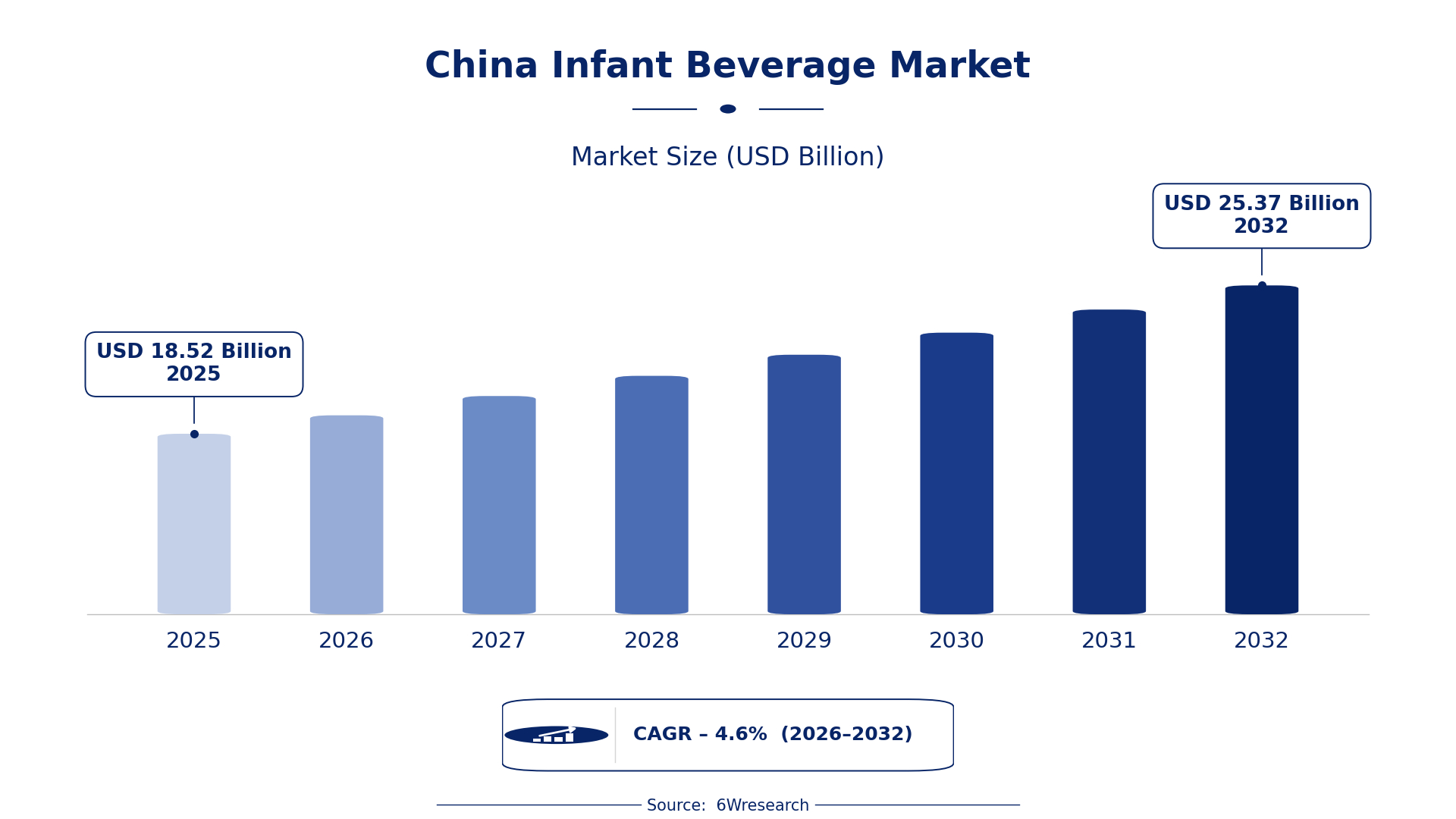
According to 6Wresearch internal database and industry insights, the China Infant Beverage Market was valued at USD 18.52 billion in 2025 and is projected to reach USD 25.37 billion by 2032, growing at a CAGR of approximately 4.6% during 2026–2032.
China Infant Beverage Market Highlights
| Report Metric | Details |
| Report Name | China Infant Beverage Market |
| Market Size 2025 | USD 18.52 billion |
| Market Size 2032 | USD 25.37 billion |
| Absolute Growth 2025–2032 | USD 6.85 billion |
| CAGR 2026–2032 | 4.6% |
| Peak Annual Growth | 7.1% in 2032 |
| Forecast Period | 2026–2032 |
| Historical Data | 2022–2025 |
| Base Year | 2025 |
| Leading Infant Beverage, 2025 | Infant Formula Drinks (37% share) |
| Leading Product Type, 2025 | Milk-Based (44% share) |
| Leading Packaging Type, 2025 | Cans/Tetra Packs (41% share) |
| Leading Sales Channel, 2025 | Supermarkets (50% share) |
| Leading End User Group, 2025 | Infants (6–12 months) (42% share) |
| Fastest-Growing Infant Beverage | Organic Infant Juice (6.0% CAGR) |
| Fastest-Growing Product Type | Fruit-Based (7.1% CAGR) |
| Fastest-Growing Sales Channel | Online Retail (6.1% CAGR) |
| Fastest-Growing End User Group | Lactose-Intolerant Infants (6.8% CAGR) |
| Growing Sector | Infant nutrition |
| Key End Users | Urban parents, healthcare providers, supermarkets, online retailers |
China Infant Beverage Market Year-wise Growth Rate and Key Drivers (2022–2032)
This graph illustrates the annual growth rates of the market from 2022 to 2032, highlighting a steady upward trajectory and projected market expansion over the forecast period.
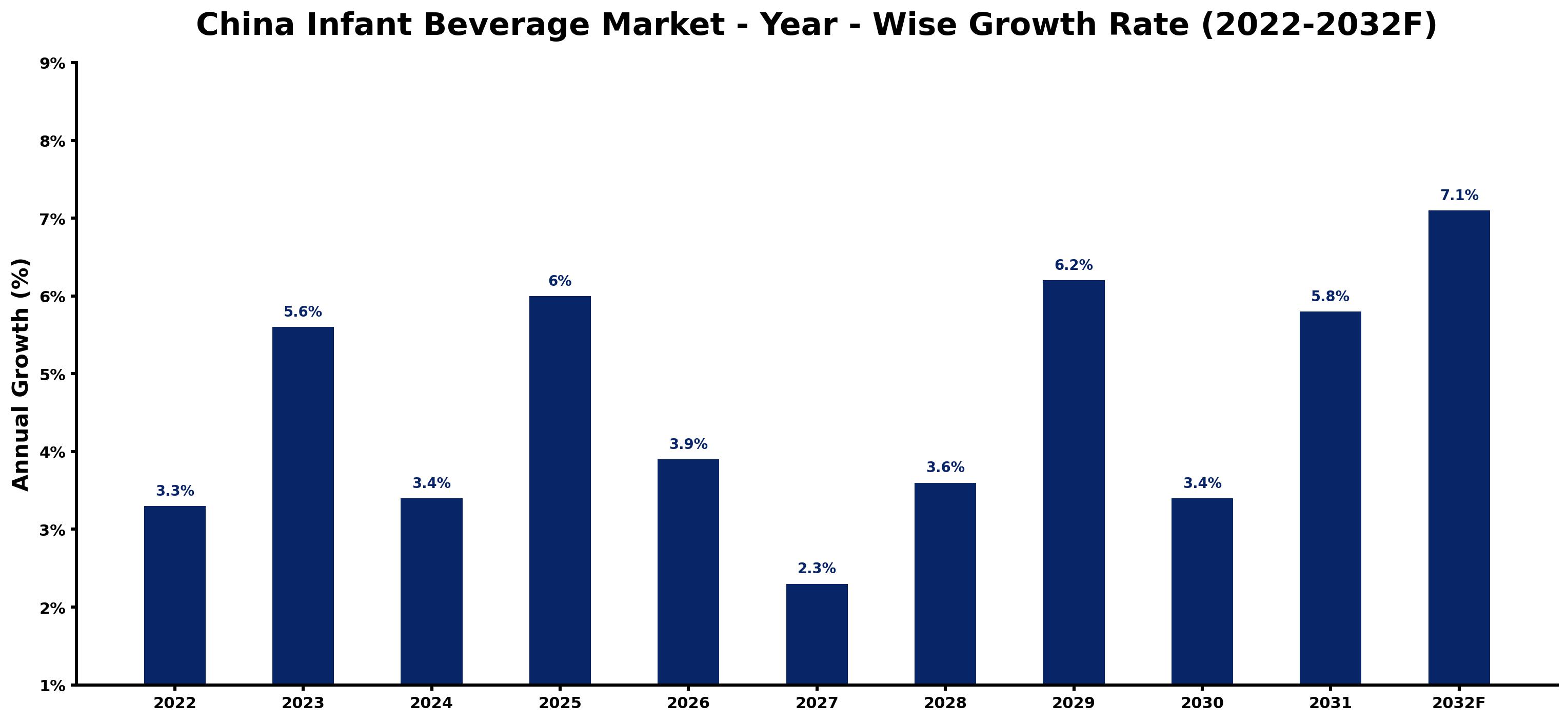
The table below sets out the estimated growth rate for each year and the main factor behind it.
| Year | Estimated Annual Growth (%) | Market Rationale |
| 2022 | 3.3 | The birth rate was approximately 9.56 births per 1,000 people, influencing infant beverage demand. |
| 2023 | 5.6 | Sales of organic infant juice grew by 15% in urban areas, boosting market growth. |
| 2024 | 3.4 | Growth slowed as the 'Healthy Infants Initiative' began to influence purchasing patterns. |
| 2025 | 6.0 | The market experienced faster growth due to increasing health initiatives and urban demand. |
| 2026 | 3.9 | Growth is expected to slow again as consumer preferences shift towards premium products. |
| 2027 | 2.3 | The market is projected to continue growing slowly as urban parents focus on health trends. |
| 2028 | 3.6 | Growth is expected to accelerate as demand for plant-based options increases in urban centres. |
| 2029 | 6.2 | The market is projected to see faster growth driven by rising awareness of lactose-free products. |
| 2030 | 3.4 | Growth is expected to slow as competition intensifies among established brands and new entrants. |
| 2031 | 5.8 | Faster growth is projected to resume due to renewed health campaigns targeting infant nutrition. |
| 2032 | 7.1 | The market is expected to peak with a rise in demand for organic and plant-based beverages. |
Note: Market size estimations and growth projections presented in this report are based on 6Wresearch's proprietary forecasting methodology, utilizing the latest available industry data, government publications, and primary research inputs.
China Infant Beverage Market Synopsis
Infant Beverage in China encompasses specialized drinks designed for infants, including infant formula drinks, organic juices, and plant-based options. These beverages are crafted with high-quality ingredients to meet infants' nutritional needs. The China Infant Beverage Market is expanding, driven by urban health awareness, increasing birth rates, and government health initiatives. Urban areas, particularly Shanghai and Beijing, are key markets, with consumption expected to reach 20 million liters by 2025. The ongoing push for improved infant nutrition standards further fuels this market's growth.
Market Dynamics Impact Analysis (2026–2032)
| Factor | Type | Impact | Primary Segment Affected |
| Increasing health awareness among urban parents drives demand for nutritious infant beverages. | Driver | High | Infant Formula Drinks |
| The rise in lactose intolerance among infants creates demand for lactose-free options. | Driver | High | Plant-Based Milk |
| The growing trend towards organic products presents opportunities for new entrants in the market. | Opportunity | High | Organic Infant Juice |
| Urban areas are increasingly adopting online retail channels for convenience in purchasing infant beverages. | Opportunity | Medium | Online Retail |
| Stricter regulations on labeling and quality control may pose challenges for producers. | Restraint | High | Infant Formula Drinks |
| High competition among brands can lead to price wars, impacting profit margins. | Restraint | Medium | Organic Infant Juice |
| The China Infant Beverage Market faces challenges from evolving consumer preferences and health trends. | Challenge | High | Plant-Based Milk |
| Supply chain disruptions can delay product availability and affect sales. | Challenge | Medium | Infant Formula Drinks |
Evaluation of Drivers in China Infant Beverage Market (2026–2032)
The table below links each growth driver to the segment it affects and the evidence for it.
| Drivers | Primary Segment Affected | Why It Matters (Evidence) |
| Rising health awareness among parents leads to increased purchases of nutritious infant beverages. | Infant Formula Drinks | In 2022, over 70% of parents reported using online platforms for purchasing infant beverages. |
| The growing trend of lactose intolerance among infants drives demand for lactose-free products. | Plant-Based Milk | Lactose-free infant formula is increasingly adopted, especially in urban centres. |
| Health initiatives targeting urban populations are encouraging the consumption of organic products. | Organic Infant Juice | In 2023, the government allocated 500 million yuan to support infant health programs. |
| Urbanisation is leading to a higher birth rate and increased demand for infant beverages. | Infant Formula Drinks | The average age of first-time mothers in urban China is 29 years, influencing demand. |
| The installed base of hospitals providing infant nutrition guidance supports product sales. | Infant Formula Drinks | There are over 1,500 hospitals nationwide offering infant nutrition guidance. |
In 2022, over 70% of parents reported using online platforms for purchasing infant beverages, reflecting a shift towards convenience. The average age of first-time mothers in urban China is 29 years, influencing demand for nutritious options. More than 1,500 hospitals provide nutrition guidance, further driving consumption of infant beverages.
Evaluation of Restraints in China Infant Beverage Market
The main factors holding the market back are set out below.
| Market Restraint | Primary Segment Affected | Why It Matters (Evidence) |
| Stricter regulations on labeling and quality control may pose challenges for producers. | Infant Formula Drinks | In 2022, the State Administration for Market Regulation enforced stricter labeling requirements. |
| High competition among brands can lead to price wars, impacting profit margins. | Organic Infant Juice | The market for organic products is expanding rapidly, causing intense competition. |
| Supply chain disruptions can delay product availability and affect sales. | Infant Formula Drinks | Logistical challenges for distribution networks have arisen due to recent global events. |
| Consumer preferences are rapidly evolving, making it difficult for brands to keep up. | Plant-Based Milk | Health trends are shifting towards organic and plant-based options, complicating brand strategies. |
| The average price of infant formula ranges from 200 to 500 yuan per unit, affecting affordability. | Infant Formula Drinks | Price sensitivity among consumers can limit market growth. |
China Infant Beverage Market Challenges
The China Infant Beverage Market encounters several practical issues, with cost being a primary concern. In 2022, the average price of infant formula in supermarkets ranged from 200 to 500 yuan per unit, which strains budgets for many families. Technological limitations also impede producers; the demand for advanced processing methods to ensure quality can delay product launches, affecting market responsiveness. Regulatory compliance poses another challenge; adherence to GB 4806.1-2016 standards can prolong time-to-market for new products, impacting supply for buyers. Urban parents increasingly favour online platforms for purchasing, with over 70% using them, pressuring traditional retailers to adapt to changing consumer behaviours.
Trends in the China Infant Beverage Market
Four trends stand out in the China Infant Beverage Market.
- Shift towards Organic Products in Urban Areas: Urban consumers are increasingly choosing organic infant beverages, reflecting a growing health consciousness. In 2023, organic infant juice sales rose by 15% in urban areas, indicating a change in preferences.
- Growth of Online Retail Channels: Parents are turning to online platforms for purchasing infant beverages due to convenience. In 2022, over 70% of parents reported using these platforms, showcasing a trend towards digital shopping.
- Rise of Lactose-Free Options: The demand for lactose-free infant beverages is increasing, particularly among urban parents. Lactose-free infant formula is gaining traction, highlighting a shift in dietary needs.
- Increased Focus on Nutrition Awareness: The 'Healthy Infants Initiative' launched in 2023 aims to elevate nutrition standards. With a budget of 300 million yuan, this programme is designed to raise awareness among parents.
Investment Opportunities in the China Infant Beverage Market
Below are the investment opportunities with the strongest case in the China Infant Beverage Market.
- Growing Demand for Organic Products: With organic infant juice sales growing by 15% in urban areas, there is an opportunity for producers to invest in organic lines. Urban health-conscious parents are seeking these options.
- Expansion of Online Retail Channels: The increasing preference for online shopping presents an opportunity for retailers to strengthen their digital presence. Urban parents are driving this trend, looking for convenience in purchasing.
- Investment in Lactose-Free Products: The rising demand for lactose-free infant beverages creates an opportunity for manufacturers to develop targeted products. Urban centres are particularly receptive to these alternatives.
- Focus on Nutrition Improvement Programs: The government's allocation of 500 million yuan for infant health programs presents an opportunity for stakeholders to align with these initiatives. This funding supports health-focused product development.
Government Initiatives in the China Infant Beverage Market
In 2023, the National Health Commission launched the 'Healthy Infants Initiative' with a budget of 300 million yuan to improve nutrition standards for infants. This initiative builds on previous efforts to promote infant nutrition awareness and access to quality products. The introduction of this measure reflects the government's commitment to ensuring better health outcomes for infants across the country.
The 'Organic Product Certification' program was updated in 2021 by the Ministry of Agriculture to improve quality control for organic infant beverages. This program ensures that organic products meet stringent safety and quality standards, benefiting both producers and consumers. Additionally, the China Food and Drug Administration oversees safety regulations for infant beverages, ensuring compliance with national standards.
Future Insight of the China Infant Beverage Market
The China Infant Beverage Market is set for transformation by 2032, driven by several key factors. The Ministry of Health's campaign to raise infant nutrition awareness is likely to increase demand for high-quality products. By 2025, infant beverage consumption is expected to reach 20 million litres, indicating robust market growth. The introduction of a subsidy programme for organic infant food producers will encourage suppliers to innovate and diversify their offerings. The rising trend of lactose-free infant formula will also influence product development, particularly in urban areas.
Market Segmentation Analysis
The report offers a comprehensive study of the following market segments and their leading categories in the market.
By Infant Beverage – Infant Formula Drinks Dominated, Organic Infant Juice Expected to Grow Fastest
According to Sachin Kumar Rai, Senior Research Analyst at 6Wresearch, with a 37% revenue share in 2025, Infant Formula Drinks was the largest infant beverage category. Infant formula drinks dominate the market due to their essential role in providing vital nutrition for infants, particularly in urban areas where health awareness is elevated. The support from over 1,500 hospitals offering infant nutrition guidance further solidifies the significance of this segment in meeting parental needs. Organic Infant Juice is projected to grow fastest, at a CAGR of 6.0% during 2026–2032. The organic infant juice segment is experiencing rapid growth, evidenced by a 15% increase in urban areas in 2022 as health-conscious parents seek natural hydration options. This trend is expected to persist as consumers increasingly prioritise organic choices for their infants' diets. Suppliers should enhance their organic product offerings to align with the growing demand for health-focused infant beverages.
By Product Type – Milk-Based Dominated, Fruit-Based Expected to Grow Fastest
Milk-Based held a 44% share of the China Infant Beverage Market by product type in 2025. Milk-based products lead the market as they serve as the primary source of essential nutrition for infants, ensuring proper growth and development. The average price of infant formula in supermarkets, ranging from 200 to 500 yuan per unit, highlights the strong consumer investment in this category. The quickest growth will come from Fruit-Based, forecast to expand at a CAGR of 7.1% between 2026 and 2032. Fruit-based infant beverages are gaining traction as they provide supplemental vitamins and hydration, appealing to parents seeking variety in their infants' diets. This growth is evident as families increasingly incorporate these beverages alongside traditional milk-based options. Manufacturers should diversify their product lines to include fruit-based options to cater to changing consumer preferences.
By Packaging Type – Cans/Tetra Packs Dominated and Is Expected to Record the Fastest Growth
In 2025, Cans/Tetra Packs led the packaging type split with a 41% share. Cans and Tetra packs are the leading packaging types due to their convenience and safety, making them highly preferred by parents. This packaging format aligns with consumer expectations for easy storage and handling, especially for busy families. Its lead should widen, with a projected CAGR of 6.1% during 2026–2032, the highest in this split. The same Cans and Tetra packs are also the fastest-growing packaging type, as they continue to meet the demands for convenience in busy urban lifestyles. Their widespread acceptance suggests that this trend will persist, reinforcing their market dominance. Suppliers should ensure their products are available in these popular packaging formats to align with consumer preferences.
By Sales Channel – Supermarkets Dominated, Online Retail Expected to Grow Fastest
Supermarkets accounted for a 50% market share by sales channel in 2025. Supermarkets are the leading sales channel for infant beverages, offering consumers convenient access to a diverse range of products. This channel's prominence is highlighted by the fact that over 70% of parents reported using online platforms for purchasing infant beverages, indicating strong competition. Online Retail is set to record the highest CAGR in this split, 6.1% over 2026–2032. Online retail is the fastest-growing sales channel, reflecting a shift towards convenience and variety in purchasing habits. As parents increasingly embrace online shopping, this channel is expected to expand significantly, complementing traditional retail outlets. Retailers should invest in enhancing their online presence to capture the growing segment of parents preferring digital shopping.
By End User Group – Infants (6–12 months) Dominated, Lactose-Intolerant Infants Expected to Grow Fastest
The largest end user group category in 2025 was Infants (6–12 months), with a 42% share of total revenue. Infants aged 6 to 12 months represent the largest consumer group for infant beverages, as this age range is crucial for nutrition and development. Targeting this demographic is essential for manufacturers aiming to meet the specific dietary needs of growing infants. Lactose-Intolerant Infants are projected to grow fastest, at a CAGR of 6.8% during 2026–2032. Lactose-intolerant infants are the fastest-growing segment, as awareness of dietary restrictions increases among parents. This trend highlights the need for tailored products that cater to specific health requirements, ensuring all infants receive adequate nutrition. Suppliers should develop specialized products for lactose-intolerant infants to address this emerging market need.
Key Attractiveness of the Report
- 10 Years of Market Numbers
- Historical Data Starting from 2022 to 2025
- Base Year 2025
- Forecast Data until 2032
- Key Performance Indicators Impacting the Market
- Major Upcoming Developments and Projects
Key Highlights of the Report:
- China Infant Beverage Market Outlook
- Market Size of China Infant Beverage Market, 2025
- Forecast of China Infant Beverage Market, 2032
- Historical Data and Forecast of China Infant Beverage Revenues & Volume for the Period 2022 - 2032F
- China Infant Beverage Market Trend Evolution
- China Infant Beverage Market Drivers and Challenges
- China Infant Beverage Price Trends
- China Infant Beverage Porter's Five Forces
- China Infant Beverage Industry Life Cycle
- Historical Data and Forecast of China Infant Beverage Market Revenues & Volume By Infant Beverage for the Period 2022 - 2032F
- Historical Data and Forecast of China Infant Beverage Market Revenues & Volume By Infant Formula Drinks for the Period 2022 - 2032F
- Historical Data and Forecast of China Infant Beverage Market Revenues & Volume By Organic Infant Juice for the Period 2022 - 2032F
- Historical Data and Forecast of China Infant Beverage Market Revenues & Volume By Electrolyte Drinks for the Period 2022 - 2032F
- Historical Data and Forecast of China Infant Beverage Market Revenues & Volume By Plant-Based Milk for the Period 2022 - 2032F
- Historical Data and Forecast of China Infant Beverage Market Revenues & Volume By Product Type for the Period 2022 - 2032F
- Historical Data and Forecast of China Infant Beverage Market Revenues & Volume By Milk-Based for the Period 2022 - 2032F
- Historical Data and Forecast of China Infant Beverage Market Revenues & Volume By Fruit-Based for the Period 2022 - 2032F
- Historical Data and Forecast of China Infant Beverage Market Revenues & Volume By Mineral-Based for the Period 2022 - 2032F
- Historical Data and Forecast of China Infant Beverage Market Revenues & Volume By Soy/Almond/Coconut for the Period 2022 - 2032F
- Historical Data and Forecast of China Infant Beverage Market Revenues & Volume By Packaging Type for the Period 2022 - 2032F
- Historical Data and Forecast of China Infant Beverage Market Revenues & Volume By Cans/Tetra Packs for the Period 2022 - 2032F
- Historical Data and Forecast of China Infant Beverage Market Revenues & Volume By PET Bottles for the Period 2022 - 2032F
- Historical Data and Forecast of China Infant Beverage Market Revenues & Volume By Sachets for the Period 2022 - 2032F
- Historical Data and Forecast of China Infant Beverage Market Revenues & Volume By Glass Bottles for the Period 2022 - 2032F
- Historical Data and Forecast of China Infant Beverage Market Revenues & Volume By Sales Channel for the Period 2022 - 2032F
- Historical Data and Forecast of China Infant Beverage Market Revenues & Volume By Pharmacy Chains for the Period 2022 - 2032F
- Historical Data and Forecast of China Infant Beverage Market Revenues & Volume By Online Retail for the Period 2022 - 2032F
- Historical Data and Forecast of China Infant Beverage Market Revenues & Volume By Hospitals & Clinics for the Period 2022 - 2032F
- Historical Data and Forecast of China Infant Beverage Market Revenues & Volume By Supermarkets for the Period 2022 - 2032F
- Historical Data and Forecast of China Infant Beverage Market Revenues & Volume By End User Group for the Period 2022 - 2032F
- Historical Data and Forecast of China Infant Beverage Market Revenues & Volume By Newborns (0 6 months) for the Period 2022 - 2032F
- Historical Data and Forecast of China Infant Beverage Market Revenues & Volume By Infants (6 12 months) for the Period 2022 - 2032F
- Historical Data and Forecast of China Infant Beverage Market Revenues & Volume By Dehydrated Infants for the Period 2022 - 2032F
- Historical Data and Forecast of China Infant Beverage Market Revenues & Volume By Lactose-Intolerant Infants for the Period 2022 - 2032F
- China Infant Beverage Import Export Trade Statistics
- Market Opportunity Assessment By Infant Beverage
- Market Opportunity Assessment By Product Type
- Market Opportunity Assessment By Packaging Type
- Market Opportunity Assessment By Sales Channel
- Market Opportunity Assessment By End User Group
- China Infant Beverage Top Companies Market Share
- China Infant Beverage Competitive Benchmarking By Technical and Operational Parameters
- China Infant Beverage Company Profiles
- China Infant Beverage Key Strategic Recommendations
Market Covered
Segments analysed in this report are listed below.
By Infant Beverage
- Infant Formula Drinks
- Organic Infant Juice
- Electrolyte Drinks
- Plant-Based Milk
By Product Type
- Milk-Based
- Fruit-Based
- Mineral-Based
- Soy/Almond/Coconut
By Packaging Type
- Cans/Tetra Packs
- PET Bottles
- Sachets
- Glass Bottles
By Sales Channel
- Pharmacy Chains
- Online Retail
- Hospitals & Clinics
- Supermarkets
By End User Group
- Newborns (0–6 months)
- Infants (6–12 months)
- Dehydrated Infants
- Lactose-Intolerant Infants































