China Infant Feeding Market Size & Growth Rate
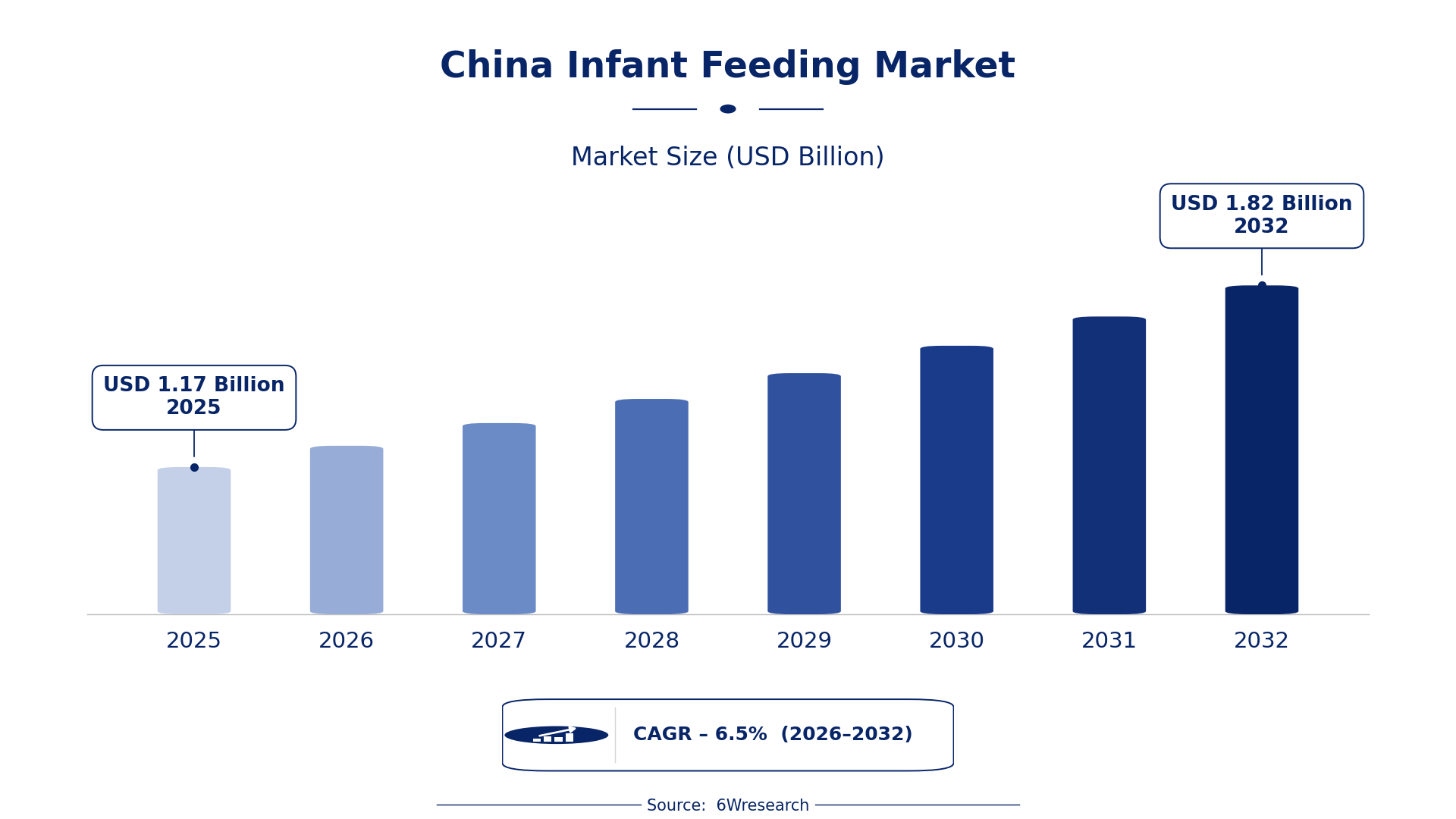
According to 6Wresearch internal database and industry insights, the China Infant Feeding Market was valued at USD 1.17 billion in 2025 and is projected to reach USD 1.82 billion by 2032, growing at a CAGR of approximately 6.5% during 2026–2032.
China Infant Feeding Market Highlights
| Report Metric | Details |
| Report Name | China Infant Feeding Market |
| Market Size 2025 | USD 1.17 billion |
| Market Size 2032 | USD 1.82 billion |
| Absolute Growth 2025–2032 | USD 0.65 billion |
| CAGR 2026–2032 | 6.5% |
| Peak Annual Growth | 8.6% in 2032 |
| Forecast Period | 2026–2032 |
| Historical Data | 2022–2025 |
| Base Year | 2025 |
| Leading Product Type, 2025 | Infant Formula (55% share) |
| Leading Food Format, 2025 | Powder / Liquid (41% share) |
| Leading Age Group, 2025 | 0–12 Months (35% share) |
| Leading Distribution Channel, 2025 | Grocery Chains (48% share) |
| Fastest-Growing Product Type | Purees & Pouches (8.1% CAGR) |
| Fastest-Growing Food Format | Fruit/Vegetable-Based (7.8% CAGR) |
| Fastest-Growing Age Group | 6–18 Months (7.7% CAGR) |
| Fastest-Growing Distribution Channel | Online Grocery Retailers (8.2% CAGR) |
| Growing Sector | Infant Formula |
| Key End Users | Parents, caregivers, healthcare providers, nutritionists |
China Infant Feeding Market Year-wise Growth Rate and Key Drivers (2022–2032)
This graph illustrates the annual growth rates of the market from 2022 to 2032, highlighting a steady upward trajectory and projected market expansion over the forecast period.
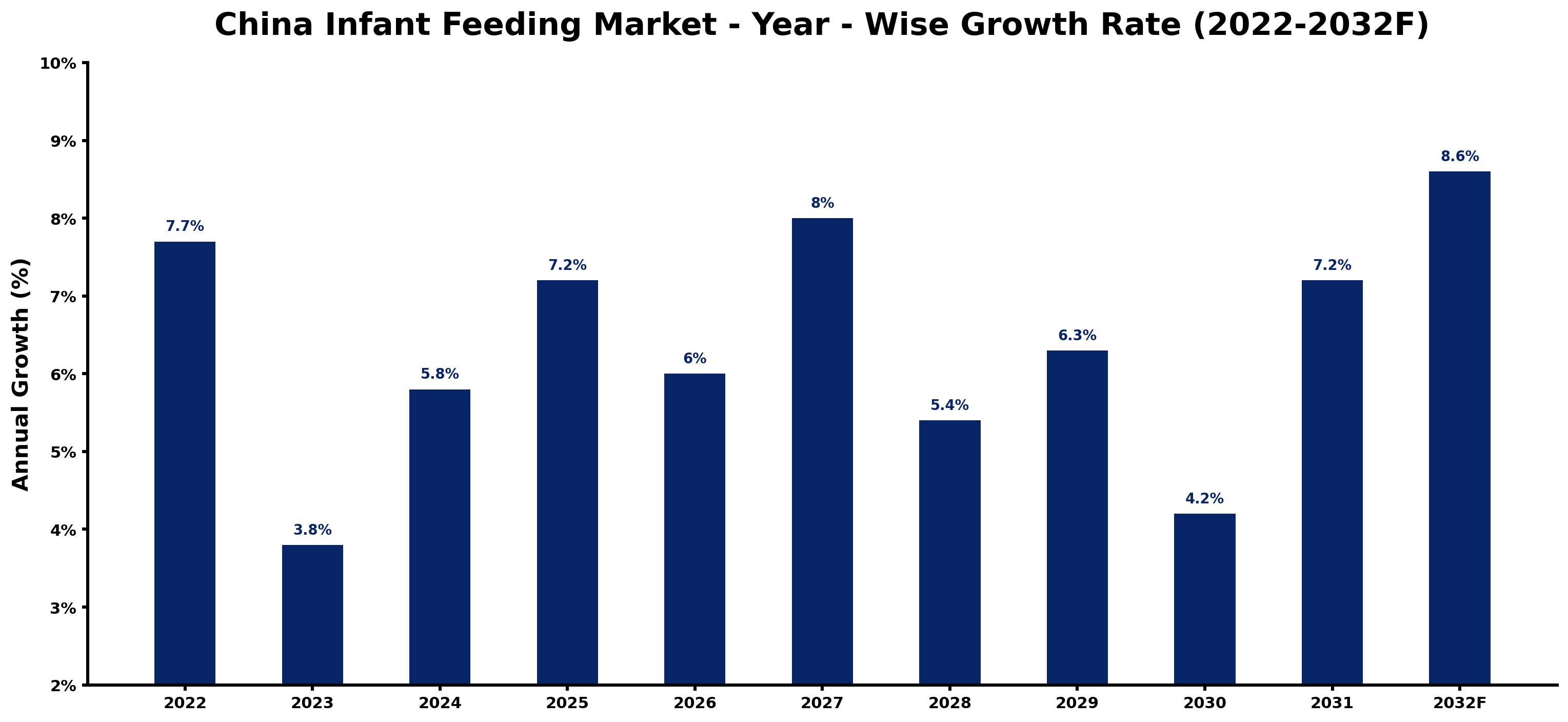
Annual growth estimates for each year appear below with the principal reason behind them, explaining the shifts that set the pace of the market.
| Year | Estimated Annual Growth (%) | Market Rationale |
| 2022 | 7.7 | The market experienced strong demand due to high birth rates and increased health awareness among parents. |
| 2023 | 3.8 | Growth slowed as parents adjusted to rising prices and supply chain challenges affected product availability. |
| 2024 | 5.8 | Demand increased as urban parents introduced solid foods earlier, reflecting changing feeding practices. |
| 2025 | 7.2 | Growth accelerated with the introduction of new organic infant food products appealing to health-conscious parents. |
| 2026 | 6.0 | A slowdown occurred as competition intensified among brands, affecting pricing strategies and consumer choices. |
| 2027 | 8.0 | Demand surged as online grocery shopping became more popular, making infant products more accessible. |
| 2028 | 5.4 | Growth slowed as parents became more selective in brand choices, impacting overall sales. |
| 2029 | 6.3 | Increased health awareness among parents drove demand for fortified infant cereals, boosting sales. |
| 2030 | 4.2 | Growth slowed as the market adjusted to consumer preferences shifting towards organic options. |
| 2031 | 7.2 | Demand increased as initiatives promoting breastfeeding and balanced diets gained traction among new parents. |
| 2032 | 8.6 | The market is expected to peak as innovations in infant feeding products align with evolving consumer preferences. |
Note: Market size estimations and growth projections presented in this report are based on 6Wresearch's proprietary forecasting methodology, utilizing the latest available industry data, government publications, and primary research inputs.
China Infant Feeding Market Synopsis
The China Infant Feeding Market includes products tailored for infants and toddlers, such as infant formula, purees, and cereals. These items, crafted from milk, fruits, and grains, deliver crucial nutrition for growth and development. In 2022, around 9.56 million infants were born in China, further increasing demand for these products. Continuous investments in food safety and quality standards are driving market growth and product innovation.
Market Dynamics Impact Analysis (2026–2032)
| Factor | Type | Impact | Primary Segment Affected |
| Increased birth rates drive demand for infant formula and related products. | Driver | High | Infant Formula |
| Growing preference for organic products encourages innovation in infant food offerings. | Driver | High | Purees & Pouches |
| The rise of online grocery shopping presents opportunities for convenience-focused brands. | Opportunity | High | Online Grocery Retailers |
| Health-conscious parents seek fortified products, creating demand for nutritious options. | Opportunity | High | Cereals |
| Intense competition among brands can lead to price wars, affecting profit margins. | Restraint | Medium | Infant Formula |
| Supply chain disruptions can delay product availability, impacting sales. | Restraint | Medium | Purees & Pouches |
| Regulatory compliance can increase production costs for manufacturers. | Challenge | Medium | Cereals |
| Changing consumer preferences may lead to rapid shifts in product demand. | Challenge | Medium | Snacks & Finger Foods |
Evaluation of Drivers in China Infant Feeding Market (2026–2032)
The table below links each growth driver to the segment it affects and the evidence for it.
| Drivers | Primary Segment Affected | Why It Matters (Evidence) |
| Increased birth rates lead to higher demand for infant formula. | Infant Formula | In 2022, approximately 9.56 million infants were born, driving purchases of infant formula. |
| Growing health awareness drives demand for nutritious infant cereals. | Cereals | The infant cereal segment has seen growth due to rising health awareness among parents, with a focus on nutrition. |
| The rise of online grocery shopping improves product accessibility. | Online Grocery Retailers | Over 70% of parents in China prefer online grocery shopping for infant products, improving convenience. |
| Investments in organic food production boost product offerings. | Purees & Pouches | The 'Organic Food Development Plan' aims for a 30% increase in organic infant foods by 2025. |
| New guidelines for infant nutrition standards encourage product innovation. | Infant Formula | The National Health Commission's guidelines set improved nutrition standards for infant products. |
Expansion of the Infant Feeding market in China is backed by rising birth rates, increasing health awareness, and growing online shopping. In 2022, approximately 9.56 million infants were born, boosting demand for infant formula. The infant cereal segment has seen growth as parents prioritise nutritious options for their children. Over 70% of parents prefer online grocery shopping, improving product accessibility and convenience. The 'Organic Food Development Plan' aims for a 30% increase in organic infant foods by 2025, encouraging innovation and investment in this segment.
Evaluation of Restraints in China Infant Feeding Market
The main factors holding the market back are set out below.
| Market Restraint | Primary Segment Affected | Why It Matters (Evidence) |
| Intense competition can lead to price wars among brands. | Infant Formula | This competition affects profit margins, making it challenging for smaller brands to survive. |
| Supply chain disruptions can delay product availability. | Purees & Pouches | These delays can lead to stock shortages, impacting sales and customer satisfaction. |
| Regulatory compliance increases production costs for manufacturers. | Cereals | Manufacturers must invest in testing and certification to meet safety standards. |
| Changing consumer preferences can shift demand rapidly. | Snacks & Finger Foods | Brands may struggle to keep up with evolving tastes and preferences among parents. |
| Rising costs of raw materials can impact pricing strategies. | Infant Formula | Higher costs may lead to increased retail prices, affecting consumer purchasing decisions. |
China Infant Feeding Market Challenges
The China Infant Feeding Market encounters a skills shortage among producers, hindering the development of new infant feeding products and delaying their launch, which costs suppliers potential revenue. Supply chain disruptions complicate the sourcing of quality ingredients, resulting in inconsistent availability of formulated foods and affecting retailers' ability to satisfy consumer demand. Rising raw material costs, especially for milk and grains, have driven average household spending on infant food to around 2,000 yuan annually, straining budgets for many families. Intense competition from both domestic and international brands exerts pricing pressures, compelling suppliers to reduce margins and limiting their capacity to invest in quality improvements.
Trends in the China Infant Feeding Market
Buyers and suppliers in the China Infant Feeding Market are adjusting to the following trends.
- Launch of Organic Infant Foods: The 'Organic Food Development Plan' initiated in 2022 aims to increase organic infant food production by 30% by 2025. This trend reflects growing health consciousness among parents.
- Shift Towards Online Grocery Shopping: Parents are increasingly opting for online grocery shopping, with over 70% preferring this channel for infant products. This shift improves convenience and accessibility, reshaping purchasing habits.
- Focus on Nutritional Standards: The National Health Commission's updated guidelines for infant nutrition standards in 2021 have led to a greater emphasis on product quality and safety. This change is driving manufacturers to innovate and improve their offerings.
- Rise of Fortified Infant Cereals: The infant cereal segment is experiencing growth due to rising health awareness among parents. This trend is reflected in the increasing demand for iron-fortified products.
Investment Opportunities in the China Infant Feeding Market
Investors looking at the China Infant Feeding Market should consider the following areas.
- Partnerships for Organic Product Development: Local partnerships are essential for brands looking to enter the organic infant food market, which is expected to grow. The 'Organic Food Development Plan' aims for a 30% increase in organic production by 2025.
- Expanding Online Retail Channels: Online grocery retailers are experiencing rapid growth, with over 70% of parents preferring this shopping method. Brands should invest in e-commerce strategies to capture this growing market segment.
- Investment in Fortified Products: There is a growing demand for fortified infant cereals, with parents prioritising nutrition. Brands can capitalise on this trend by developing products that meet these nutritional needs.
- Focus on Urban Markets: Urban areas like Shanghai and Guangdong are leading regions for infant food manufacturing. Targeting these markets can yield substantial returns, given the high concentration of young families.
Government Initiatives in the China Infant Feeding Market
In 2021, the National Health Commission implemented the 'Guidelines for Infant and Young Child Feeding' to improve nutrition standards for infants and toddlers. This initiative mandates that manufacturers adhere to specific nutritional guidelines, ensuring better health outcomes for infants. The 'Food Safety Standards for Infant Formula' were updated in 2020 by the State Administration for Market Regulation, enforcing stricter quality controls. Additionally, the 'Organic Food Development Plan' initiated by the Ministry of Agriculture in 2022 aims to increase organic food production, targeting a 30% increase by 2025.
In 2023, the Ministry of Health launched the 'Breastfeeding Promotion Program' to encourage breastfeeding practices among new mothers across urban hospitals. This program aims to improve infant nutrition and health, ensuring that mothers receive the necessary support. The China Food and Drug Administration established the 'Infant Food Safety Monitoring Program' in 2022 to enhance oversight of infant food products. This program ensures that manufacturers comply with safety standards, protecting consumers and promoting confidence in the market.
Future Insight of the China Infant Feeding Market
By 2032, the China Infant Feeding Market will undergo substantial changes, driven by several key initiatives. The Healthy China 2030 initiative aims to improve nutrition standards for children under five, promoting better dietary practices among parents. Advances in organic food production will likely increase the availability of high-quality infant feeding options. In 2023, a government initiative promoted breastfeeding awareness in urban hospitals, shaping consumer preferences and influencing purchasing decisions. These elements will collectively improve the market environment, benefiting both buyers and suppliers.
Market Segmentation Analysis
The analysis below covers each segmentation, its leading category in 2025 and its fastest-growing category through 2032.
By Product Type – Infant Formula Dominated, Purees & Pouches Expected to Grow Fastest
According to Shubham Deep, Research Manager at 6Wresearch, Infant Formula held a 55% share of the China Infant Feeding Market by product type in 2025. Infant formula dominates the China Infant Feeding Market because it is essential for providing balanced nutrition to infants. This segment's substantial market share is supported by the National Health Commission's guidelines for infant nutrition standards, which parents rely on for quality assurance. Over 2026–2032, Purees & Pouches are expected to post the fastest growth, at a CAGR of 8.1%. The purees and pouches segment is rapidly growing as parents increasingly demand convenient feeding options for their infants. This trend aligns with the average age of introducing solid foods around six months, highlighting the need for easy-to-use products. Suppliers must prioritise infant formula while also expanding their range of purees and pouches to seize emerging market opportunities.
By Food Format – Powder / Liquid Dominated, Fruit/Vegetable-Based Expected to Grow Fastest
In 2025, Powder / Liquid led the food format split with a 41% share. The powder and liquid formats dominate the market as they are the primary forms for delivering infant formula, which is essential for infant nutrition. Their widespread availability and ease of use contribute to their leading share in the infant feeding market. Fruit/Vegetable-Based is projected to grow fastest, at a CAGR of 7.8% during 2026–2032. Fruit and vegetable-based formats are rapidly gaining traction as parents increasingly prefer these natural ingredients for purees. This shift is supported by rising health awareness among parents, further driving the growth of this segment. Suppliers should consider diversifying their product lines to include more fruit and vegetable-based options to meet evolving consumer preferences.
By Age Group – 0–12 Months Dominated, 6–18 Months Expected to Grow Fastest
0–12 Months took a 35% share of age group in 2025, more than any other category. The 0–12 months age group commands the largest market share as it directly targets the primary consumers of infant feeding products. With approximately 9.56 million infants born in 2022, this segment sees substantial demand for nutrition tailored to their developmental needs. The quickest growth will come from 6–18 Months, forecast to expand at a CAGR of 7.7% between 2026 and 2032. The 6–18 months age group is witnessing the fastest growth due to its critical role in introducing solid foods to infants. As parents increasingly prioritise health and nutrition, this segment is set for notable expansion in the coming years. Suppliers should tailor their offerings to meet the specific nutritional requirements of the 6–18 months age group to capture this growth opportunity.
By Distribution Channel – Grocery Chains Dominated, Online Grocery Retailers Expected to Grow Fastest
The largest distribution channel category in 2025 was Grocery Chains, with a 48% share of total revenue. Grocery chains dominate the distribution channels for infant products, offering parents convenient access to a diverse range of infant feeding options. Their established network in urban areas positions them as a preferred choice for purchasing essential nutrition products. Online Grocery Retailers are set to record the highest CAGR in this split, 8.2% over 2026–2032. Online grocery retailers are the fastest-growing distribution channel, aligning with the preference of over 70% of parents who favour the convenience of online shopping for infant products. This trend highlights a shift towards digital platforms for fulfilling nutritional needs. Suppliers must enhance their online strategies and partnerships with grocery retailers to leverage the growing trend of online purchasing.
Key Attractiveness of the Report
- 10 Years of Market Numbers
- Historical Data Starting from 2022 to 2025
- Base Year 2025
- Forecast Data until 2032
- Key Performance Indicators Impacting the Market
- Major Upcoming Developments and Projects
Key Highlights of the Report:
- China Infant Feeding Market Outlook
- Market Size of China Infant Feeding Market, 2025
- Forecast of China Infant Feeding Market, 2032
- Historical Data and Forecast of China Infant Feeding Revenues & Volume for the Period 2022 - 2032F
- China Infant Feeding Market Trend Evolution
- China Infant Feeding Market Drivers and Challenges
- China Infant Feeding Price Trends
- China Infant Feeding Porter's Five Forces
- China Infant Feeding Industry Life Cycle
- Historical Data and Forecast of China Infant Feeding Market Revenues & Volume By Product Type for the Period 2022 - 2032F
- Historical Data and Forecast of China Infant Feeding Market Revenues & Volume By Infant Formula for the Period 2022 - 2032F
- Historical Data and Forecast of China Infant Feeding Market Revenues & Volume By Purees & Pouches for the Period 2022 - 2032F
- Historical Data and Forecast of China Infant Feeding Market Revenues & Volume By Cereals for the Period 2022 - 2032F
- Historical Data and Forecast of China Infant Feeding Market Revenues & Volume By Snacks & Finger Foods for the Period 2022 - 2032F
- Historical Data and Forecast of China Infant Feeding Market Revenues & Volume By Food Format for the Period 2022 - 2032F
- Historical Data and Forecast of China Infant Feeding Market Revenues & Volume By Powder / Liquid for the Period 2022 - 2032F
- Historical Data and Forecast of China Infant Feeding Market Revenues & Volume By Fruit/Vegetable-Based for the Period 2022 - 2032F
- Historical Data and Forecast of China Infant Feeding Market Revenues & Volume By Iron-Fortified for the Period 2022 - 2032F
- Historical Data and Forecast of China Infant Feeding Market Revenues & Volume By Meltable / Organic for the Period 2022 - 2032F
- Historical Data and Forecast of China Infant Feeding Market Revenues & Volume By Age Group for the Period 2022 - 2032F
- Historical Data and Forecast of China Infant Feeding Market Revenues & Volume By 0 12 Months for the Period 2022 - 2032F
- Historical Data and Forecast of China Infant Feeding Market Revenues & Volume By 6 18 Months for the Period 2022 - 2032F
- Historical Data and Forecast of China Infant Feeding Market Revenues & Volume By 6 Months for the Period 2022 - 2032F
- Historical Data and Forecast of China Infant Feeding Market Revenues & Volume By Toddlers for the Period 2022 - 2032F
- Historical Data and Forecast of China Infant Feeding Market Revenues & Volume By Distribution Channel for the Period 2022 - 2032F
- Historical Data and Forecast of China Infant Feeding Market Revenues & Volume By Grocery Chains for the Period 2022 - 2032F
- Historical Data and Forecast of China Infant Feeding Market Revenues & Volume By Online Grocery Retailers for the Period 2022 - 2032F
- Historical Data and Forecast of China Infant Feeding Market Revenues & Volume By Supermarkets for the Period 2022 - 2032F
- Historical Data and Forecast of China Infant Feeding Market Revenues & Volume By Health Food Stores for the Period 2022 - 2032F
- China Infant Feeding Import Export Trade Statistics
- Market Opportunity Assessment By Product Type
- Market Opportunity Assessment By Food Format
- Market Opportunity Assessment By Age Group
- Market Opportunity Assessment By Distribution Channel
- China Infant Feeding Top Companies Market Share
- China Infant Feeding Competitive Benchmarking By Technical and Operational Parameters
- China Infant Feeding Company Profiles
- China Infant Feeding Key Strategic Recommendations
Market Covered
Segments analysed in this report are listed below.
By Product Type
- Infant Formula
- Purees & Pouches
- Cereals
- Snacks & Finger Foods
By Food Format
- Powder / Liquid
- Fruit/Vegetable-Based
- Iron-Fortified
- Meltable / Organic
By Age Group
- 0–12 Months
- 6–18 Months
- 6+ Months
- Toddlers
By Distribution Channel
- Grocery Chains
- Online Grocery Retailers
- Supermarkets
- Health Food Stores































