China Infectious Disease Preparedness Market Size & Growth Rate
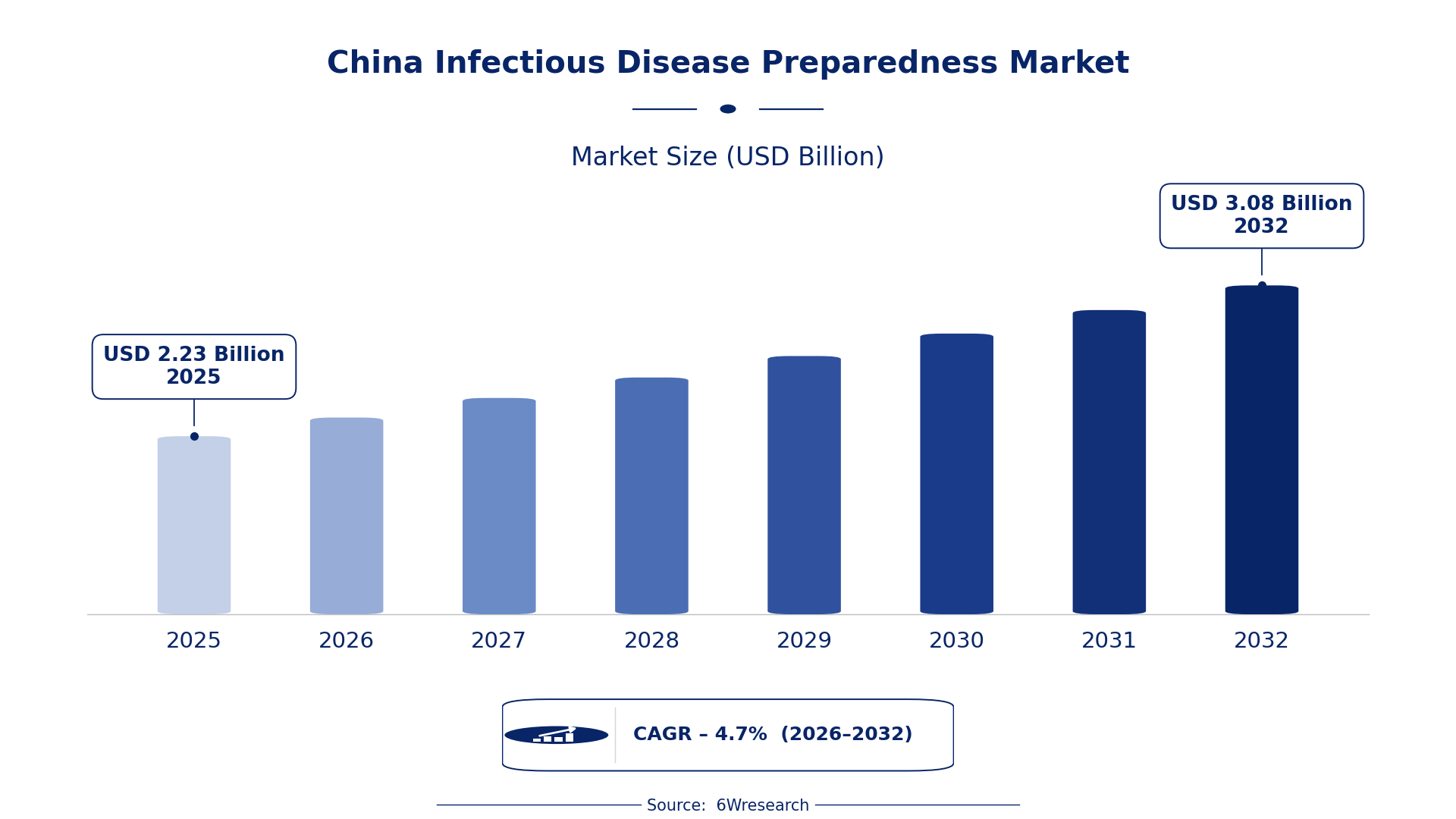
According to 6Wresearch internal database and industry insights, the China Infectious Disease Preparedness Market was valued at USD 2.23 billion in 2025 and is projected to reach USD 3.08 billion by 2032, growing at a CAGR of approximately 4.7% during 2026–2032.
China Infectious Disease Preparedness Market Highlights
| Report Metric | Details |
| Report Name | China Infectious Disease Preparedness Market |
| Market Size 2025 | USD 2.23 billion |
| Market Size 2032 | USD 3.08 billion |
| Absolute Growth 2025–2032 | USD 0.85 billion |
| CAGR 2026–2032 | 4.7% |
| Peak Annual Growth | 6.9% in 2028 |
| Forecast Period | 2026–2032 |
| Historical Data | 2022–2025 |
| Base Year | 2025 |
| Leading Preparedness Element, 2025 | Stockpiling Programs (42% share) |
| Leading Focus Area, 2025 | Vaccines (43% share) |
| Leading Use Context, 2025 | Pandemic Readiness (46% share) |
| Leading Distribution Channel, 2025 | Government Procurement (36% share) |
| Fastest-Growing Preparedness Element | Mobile Response Units (6.4% CAGR) |
| Fastest-Growing Use Context | Early Outbreak Detection (5.8% CAGR) |
| Fastest-Growing Distribution Channel | National Health Agencies (6.6% CAGR) |
| Growing Sector | Public Health |
| Key End Users | National Health Agencies, Hospitals, Emergency Medical Services, Government Procurement |
China Infectious Disease Preparedness Market Year-wise Growth Rate and Key Drivers (2022–2032)
This graph illustrates the annual growth rates of the market from 2022 to 2032, highlighting a steady upward trajectory and projected market expansion over the forecast period.
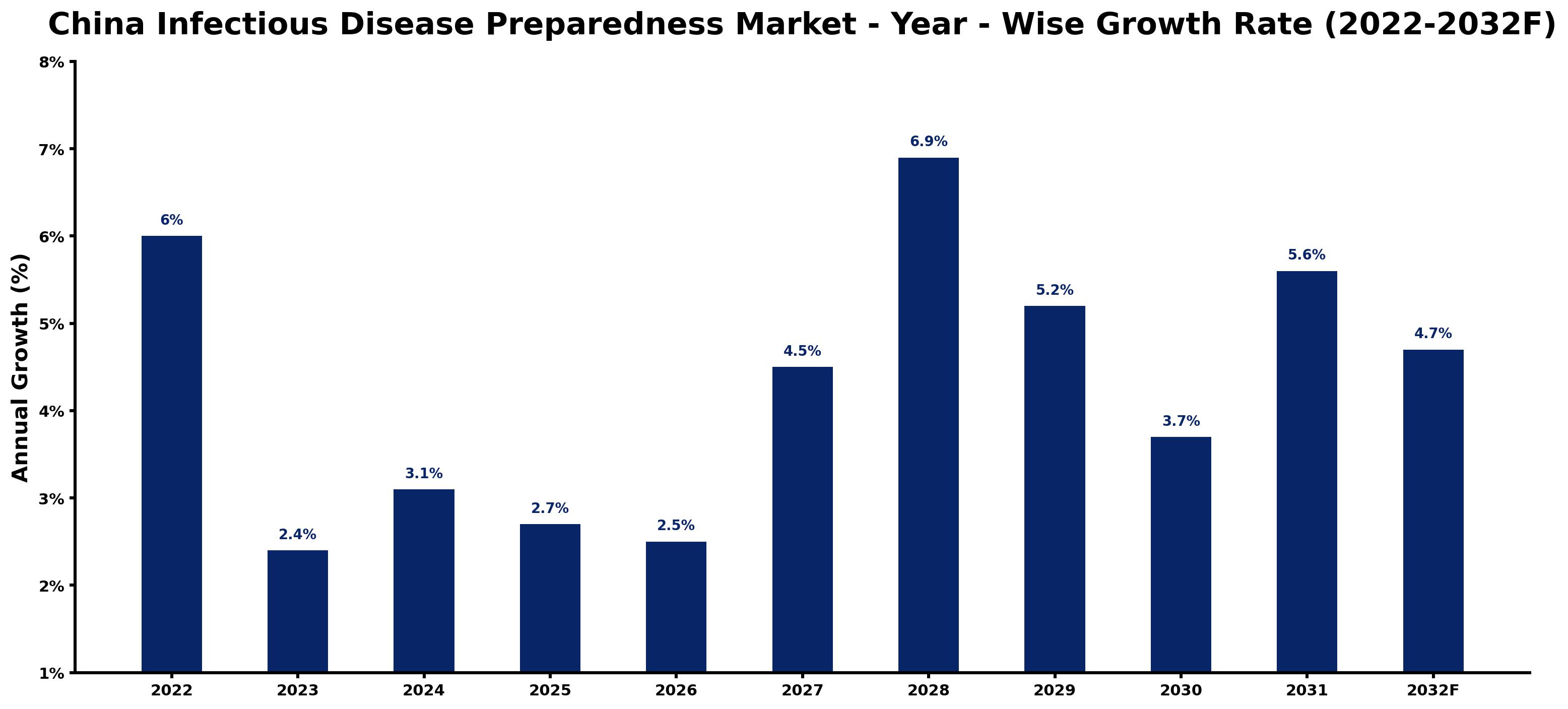
The table below sets out the estimated growth rate for each year and the main factor behind it.
| Year | Estimated Annual Growth (%) | Market Rationale |
| 2022 | 6.0 | The market experienced strong growth due to increased government funding for preparedness initiatives. |
| 2023 | 2.4 | Funding growth slowed as agencies adjusted to new public health strategies and priorities. |
| 2024 | 3.1 | Demand rose as hospitals improved their outbreak readiness through enhanced training programs. |
| 2025 | 2.7 | A slight slowdown occurred as the focus shifted towards long-term preparedness planning. |
| 2026 | 2.5 | Growth is expected to slow further as agencies begin implementing new response protocols and standards. |
| 2027 | 4.5 | Demand is projected to increase as mobile response units become more widely deployed across urban areas. |
| 2028 | 6.9 | The market is expected to peak as the National Infectious Disease Preparedness Strategy is fully implemented. |
| 2029 | 5.2 | Growth is anticipated to slow as agencies focus on refining existing preparedness measures and resources. |
| 2030 | 3.7 | A further slowdown is expected as the market stabilises after the peak growth year. |
| 2031 | 5.6 | Demand is projected to rebound as hospitals expand their simulation training programs for infectious disease scenarios. |
| 2032 | 4.7 | Growth is expected to slow again as the market adjusts to new regulatory frameworks and standards. |
Note: Market size estimations and growth projections presented in this report are based on 6Wresearch's proprietary forecasting methodology, utilizing the latest available industry data, government publications, and primary research inputs.
China Infectious Disease Preparedness Market Synopsis
Infectious Disease Preparedness in China encompasses strategies and resources aimed at managing outbreaks effectively. This includes stockpiling medical supplies, establishing surveillance systems, and conducting training simulations. Key factors include the implementation of the National Infectious Disease Prevention and Control Plan and the establishment of mobile response units across major cities.
Market Dynamics Impact Analysis (2026–2032)
| Factor | Type | Impact | Primary Segment Affected |
| Increased government funding for preparedness initiatives | Driver | High | Stockpiling Programs |
| Expansion of mobile response units in urban areas | Driver | High | Mobile Response Units |
| Growing need for pandemic readiness resources | Opportunity | High | Pandemic Readiness |
| Rising demand for surveillance systems to monitor disease spread | Opportunity | Medium | Surveillance Systems |
| Challenges in coordinating among various health agencies | Restraint | High | Government Procurement |
| Limited public awareness about infectious disease preparedness | Restraint | Medium | Simulation Training |
| Inadequate infrastructure in remote epidemic zones | Challenge | High | Remote Epidemic Zones |
| Shortage of trained healthcare professionals for emergency response | Challenge | Medium | Hospital and EMS |
Evaluation of Drivers in China Infectious Disease Preparedness Market (2026–2032)
Key forces behind demand, with the segment each one moves most, are listed below.
| Drivers | Primary Segment Affected | Why It Matters (Evidence) |
| Increased funding for infectious disease preparedness initiatives | Stockpiling Programs | In 2022, the Ministry of Health reported a 20% increase in funding for preparedness initiatives, enabling more stockpiling of essential medical supplies. |
| Deployment of mobile response units across major cities | Mobile Response Units | China established over 100 mobile response units to ensure rapid deployment during outbreaks, improving response capabilities. |
| Implementation of the National Infectious Disease Prevention and Control Plan | Pandemic Readiness | In 2023, the government launched a plan with a budget of $300 million to improve outbreak readiness. |
| Adoption of ISO 22320:2018 for emergency management | Surveillance Systems | Chinese agencies utilise this standard to improve surveillance and response capabilities during outbreaks. |
| Growing focus on simulation training programs in hospitals | Simulation Training | In 2023, 60% of hospitals reported having simulation training programs, improving preparedness for infectious disease scenarios. |
Market growth in China for Infectious Disease Preparedness rests on increased funding for preparedness initiatives, the deployment of mobile response units, and the implementation of the National Infectious Disease Prevention and Control Plan. In 2022, the Ministry of Health reported a 20% increase in funding for preparedness initiatives, enabling more stockpiling of essential medical supplies. China established over 100 mobile response units to ensure rapid deployment during outbreaks, improving response capabilities. The government launched a plan in 2023 with a budget of $300 million to improve outbreak readiness. In 2023, 60% of hospitals reported having simulation training programs, which are vital for effective response during infectious disease scenarios.
Evaluation of Restraints in China Infectious Disease Preparedness Market
The following restraints limit how fast demand can grow.
| Market Restraint | Primary Segment Affected | Why It Matters (Evidence) |
| Coordination challenges among various health agencies | Government Procurement | The approval process for preparedness resources is often delayed due to bureaucratic hurdles, impacting timely procurement. |
| Limited public awareness about infectious disease preparedness | Simulation Training | Many healthcare professionals lack training in infectious disease scenarios, hindering effective response during outbreaks. |
| Inadequate infrastructure in remote epidemic zones | Remote Epidemic Zones | Infrastructure deficits in these areas delay the deployment of necessary resources during outbreaks. |
| Shortage of trained healthcare professionals for emergency response | Hospital and EMS | The healthcare workforce includes over 4 million professionals, but many are not trained specifically for emergency response. |
| Insufficient funding for ongoing preparedness initiatives | Pandemic Readiness | Despite increased funding, many programs still face budget constraints that limit their effectiveness. |
China Infectious Disease Preparedness Market Challenges
The China Infectious Disease Preparedness market still has to solve a few problems, beginning with technology integration. Many hospitals lack advanced systems for real-time outbreak monitoring, which delays response times for health agencies. Buyers face issues with inconsistent supplies of personal protective equipment, leading to potential shortages during emergencies. Cost management is a concern, as funding for preparedness initiatives increased by 20% in 2022, yet 40% of facilities still report inadequate resources for effective response. Suppliers encounter logistical challenges, as urban congestion can impede timely delivery of essential medical supplies to hospitals.
Trends in the China Infectious Disease Preparedness Market
The trends below show where the China Infectious Disease Preparedness Market is heading.
- Shift from Traditional to Mobile Response Units: In 2023, China established over 100 mobile response units across major cities to improve outbreak management. This shift allows for quicker deployment during emergencies, enhancing overall response times.
- Increased Focus on Simulation Training: In 2023, 60% of hospitals reported having simulation training programs for infectious disease scenarios. This focus on training prepares healthcare professionals for effective response during outbreaks.
- Growing Emphasis on Surveillance Systems: The National Health Commission's 2023 strategy prioritises the establishment of advanced surveillance systems. This initiative aims to improve early outbreak detection and response capabilities.
- Enhanced Vaccine Production Capabilities: The updated National Vaccine Development Plan aims to increase vaccine production capacity by 50% by 2025. This improvement is essential for ensuring vaccine availability during outbreaks.
Investment Opportunities in the China Infectious Disease Preparedness Market
The following opportunities in the China Infectious Disease Preparedness Market pair current demand with a clear way in.
- Gap in Readiness Resources: With a projected USD 3.08 billion market size by 2032, there is an opportunity to supply readiness resources to hospitals and health agencies. Engaging with local partners can facilitate market entry.
- Demand for Surveillance Systems: The growing need for effective surveillance systems presents an opportunity to supply advanced monitoring technologies. National health agencies are key buyers, and partnerships can ease market entry.
- Investment in Mobile Response Units: The establishment of mobile response units across urban areas creates a demand for suppliers of rapid deployment equipment. Collaborating with local governments can enhance market penetration.
- Expansion of Simulation Training Programs: As hospitals increasingly adopt simulation training, there is a chance to provide training solutions and technologies. Engaging with medical simulation firms can open new market avenues.
Government Initiatives in the China Infectious Disease Preparedness Market
The 'Infectious Disease Control and Prevention Act' was revised in 2021 to strengthen legal frameworks for infectious disease preparedness. This law mandates that all hospitals develop response plans by 2024, ensuring that they are equipped to handle outbreaks effectively. Additionally, the 'Emergency Management Law' was revised in 2020 to improve the legal framework for public health emergencies, requiring local governments to establish response protocols. These measures impact how hospitals and health agencies prepare for and respond to infectious disease threats.
The National Health Commission oversees the implementation of the 'National Infectious Disease Preparedness Strategy', which allocates $300 million for improving surveillance and response capabilities. This agency is responsible for approving preparedness initiatives and funding essential programs. Furthermore, the Ministry of Health issues guidelines for emergency preparedness, mandating hospitals to develop response plans. These guidelines ensure that healthcare facilities are prepared for infectious disease outbreaks, improving overall public health response.
Future Insight of the China Infectious Disease Preparedness Market
The China Infectious Disease Preparedness market is expected to evolve significantly by 2032, driven by several key factors. The establishment of over 100 mobile response units will facilitate rapid deployment during outbreaks. The updated Emergency Response Plan for Public Health Emergencies will improve coordination among agencies. With the government allocating $500 million for public health infrastructure improvements in 2023, buyers and suppliers will benefit from better preparedness and resource availability.
Market Segmentation Analysis
The analysis below covers each segmentation, its leading category in 2025 and its fastest-growing category through 2032.
By Preparedness Element – Stockpiling Programs Dominated, Mobile Response Units Expected to Grow Fastest
According to Shubham Deep, Research Manager at 6Wresearch, Stockpiling Programs held a 42% share of the China Infectious Disease Preparedness Market by preparedness element in 2025. Stockpiling programs hold the largest share as they are essential for rapid response during outbreaks, ensuring that medical supplies are readily available. With over 30,000 hospitals in China, many have implemented these programs to enhance their preparedness capabilities. The quickest growth will come from Mobile Response Units, forecast to expand at a CAGR of 6.4% between 2026 and 2032. Mobile response units are experiencing the fastest growth due to their necessity for quick deployment in outbreaks, with over 100 units established across major cities. This trend reflects the increasing emphasis on agile response mechanisms in public health. Suppliers should focus on enhancing stockpiling solutions and mobile unit capabilities to meet the growing demand in China's infectious disease preparedness market.
By Focus Area – Vaccines Dominated and Is Expected to Record the Fastest Growth
Vaccines accounted for a 43% market share by focus area in 2025. Vaccines dominate the market share as they are fundamental for preventing infectious diseases, supported by the National Vaccine Development Plan aiming to boost production capabilities by 2025. This focus on vaccination is critical in a country with a population of approximately 1.4 billion. Vaccines are also forecast to expand faster than any other category, at a CAGR of 6.2% over 2026–2032. The vaccine sector is also the fastest-growing area, driven by the ongoing commitment to enhance pandemic preparedness and response strategies. As the government allocates more resources, the demand for vaccines will continue to rise. Buyers and suppliers must align their strategies with the increasing focus on vaccine development and distribution in the infectious disease preparedness market.
By Use Context – Pandemic Readiness Dominated, Early Outbreak Detection Expected to Grow Fastest
Pandemic Readiness took a 46% share of use context in 2025, more than any other category. Pandemic readiness is the leading focus area, being the core of preparedness efforts in response to the high population density and potential outbreak risks in China. The National Health Conference underscores this priority, highlighting the need for robust strategies. Over 2026–2032, Early Outbreak Detection is expected to post the fastest growth, at a CAGR of 5.8%. Early outbreak detection is the fastest-growing context, crucial for timely intervention and minimising the impact of infectious diseases. The integration of advanced surveillance systems is driving this growth, ensuring rapid identification of potential threats. Stakeholders should prioritise investments in technologies and practices that enhance early outbreak detection capabilities within the infectious disease preparedness framework.
By Distribution Channel – Government Procurement Dominated, National Health Agencies Expected to Grow Fastest
With a 36% revenue share in 2025, Government Procurement was the largest distribution channel category. Government procurement leads the market share as the primary channel for acquiring preparedness resources, reflecting the central role of public health agencies in managing infectious disease strategies. This channel ensures that necessary supplies are efficiently distributed across healthcare facilities. National Health Agencies are set to record the highest CAGR in this split, 6.6% over 2026–2032. National health agencies are the fastest-growing distribution channel, as they spearhead preparedness initiatives and streamline resource allocation for infectious disease management. Their increasing influence is reshaping procurement processes in the healthcare sector. Vendors should strengthen relationships with national health agencies to effectively navigate the evolving distribution landscape in the infectious disease preparedness market.
Key Attractiveness of the Report
- 10 Years of Market Numbers
- Historical Data Starting from 2022 to 2025
- Base Year 2025
- Forecast Data until 2032
- Key Performance Indicators Impacting the Market
- Major Upcoming Developments and Projects
Key Highlights of the Report:
- China Infectious Disease Preparedness Market Outlook
- Market Size of China Infectious Disease Preparedness Market, 2025
- Forecast of China Infectious Disease Preparedness Market, 2032
- Historical Data and Forecast of China Infectious Disease Preparedness Revenues & Volume for the Period 2022 - 2032F
- China Infectious Disease Preparedness Market Trend Evolution
- China Infectious Disease Preparedness Market Drivers and Challenges
- China Infectious Disease Preparedness Price Trends
- China Infectious Disease Preparedness Porter's Five Forces
- China Infectious Disease Preparedness Industry Life Cycle
- Historical Data and Forecast of China Infectious Disease Preparedness Market Revenues & Volume By Preparedness Element for the Period 2022 - 2032F
- Historical Data and Forecast of China Infectious Disease Preparedness Market Revenues & Volume By Stockpiling Programs for the Period 2022 - 2032F
- Historical Data and Forecast of China Infectious Disease Preparedness Market Revenues & Volume By Surveillance Systems for the Period 2022 - 2032F
- Historical Data and Forecast of China Infectious Disease Preparedness Market Revenues & Volume By Simulation Training for the Period 2022 - 2032F
- Historical Data and Forecast of China Infectious Disease Preparedness Market Revenues & Volume By Mobile Response Units for the Period 2022 - 2032F
- Historical Data and Forecast of China Infectious Disease Preparedness Market Revenues & Volume By Focus Area for the Period 2022 - 2032F
- Historical Data and Forecast of China Infectious Disease Preparedness Market Revenues & Volume By Vaccines, PPE for the Period 2022 - 2032F
- Historical Data and Forecast of China Infectious Disease Preparedness Market Revenues & Volume By Digital + Manual for the Period 2022 - 2032F
- Historical Data and Forecast of China Infectious Disease Preparedness Market Revenues & Volume By Mock Response Scenarios for the Period 2022 - 2032F
- Historical Data and Forecast of China Infectious Disease Preparedness Market Revenues & Volume By Portable Isolation Units for the Period 2022 - 2032F
- Historical Data and Forecast of China Infectious Disease Preparedness Market Revenues & Volume By Use Context for the Period 2022 - 2032F
- Historical Data and Forecast of China Infectious Disease Preparedness Market Revenues & Volume By Pandemic Readiness for the Period 2022 - 2032F
- Historical Data and Forecast of China Infectious Disease Preparedness Market Revenues & Volume By Early Outbreak Detection for the Period 2022 - 2032F
- Historical Data and Forecast of China Infectious Disease Preparedness Market Revenues & Volume By Hospital and EMS for the Period 2022 - 2032F
- Historical Data and Forecast of China Infectious Disease Preparedness Market Revenues & Volume By Remote Epidemic Zones for the Period 2022 - 2032F
- Historical Data and Forecast of China Infectious Disease Preparedness Market Revenues & Volume By Distribution Channel for the Period 2022 - 2032F
- Historical Data and Forecast of China Infectious Disease Preparedness Market Revenues & Volume By Government Procurement for the Period 2022 - 2032F
- Historical Data and Forecast of China Infectious Disease Preparedness Market Revenues & Volume By National Health Agencies for the Period 2022 - 2032F
- Historical Data and Forecast of China Infectious Disease Preparedness Market Revenues & Volume By Medical Simulation Firms for the Period 2022 - 2032F
- Historical Data and Forecast of China Infectious Disease Preparedness Market Revenues & Volume By Humanitarian Suppliers for the Period 2022 - 2032F
- China Infectious Disease Preparedness Import Export Trade Statistics
- Market Opportunity Assessment By Preparedness Element
- Market Opportunity Assessment By Focus Area
- Market Opportunity Assessment By Use Context
- Market Opportunity Assessment By Distribution Channel
- China Infectious Disease Preparedness Top Companies Market Share
- China Infectious Disease Preparedness Competitive Benchmarking By Technical and Operational Parameters
- China Infectious Disease Preparedness Company Profiles
- China Infectious Disease Preparedness Key Strategic Recommendations
Market Covered
This report examines the market across the segments below.
By Preparedness Element
- Stockpiling Programs
- Surveillance Systems
- Simulation Training
- Mobile Response Units
By Focus Area
- Vaccines
- PPE
- Digital + Manual
- Mock Response Scenarios
- Portable Isolation Units
By Use Context
- Pandemic Readiness
- Early Outbreak Detection
- Hospital and EMS
- Remote Epidemic Zones
By Distribution Channel
- Government Procurement
- National Health Agencies
- Medical Simulation Firms
- Humanitarian Suppliers































