China Molecular Spectroscopy Market Size, Share & Growth Rate
The China Molecular Spectroscopy Market was estimated at USD 224 Million in 2025 and is projected to reach USD 259 Million by 2032, growing at a CAGR of 2.1% from 2026 to 2032. This upward trajectory is primarily fueled by the surging investments in R&D, especially within the pharmaceutical and biotechnology sectors. Furthermore, the increasing need for precise analytical technologies across various industries is enhancing market dynamics and encouraging stakeholders to innovate.
China Molecular Spectroscopy Market Year-wise Growth Rate and Key Drivers
This graph highlights how the China Molecular Spectroscopy Market has steadily grown over the years, supported by major growth factors.
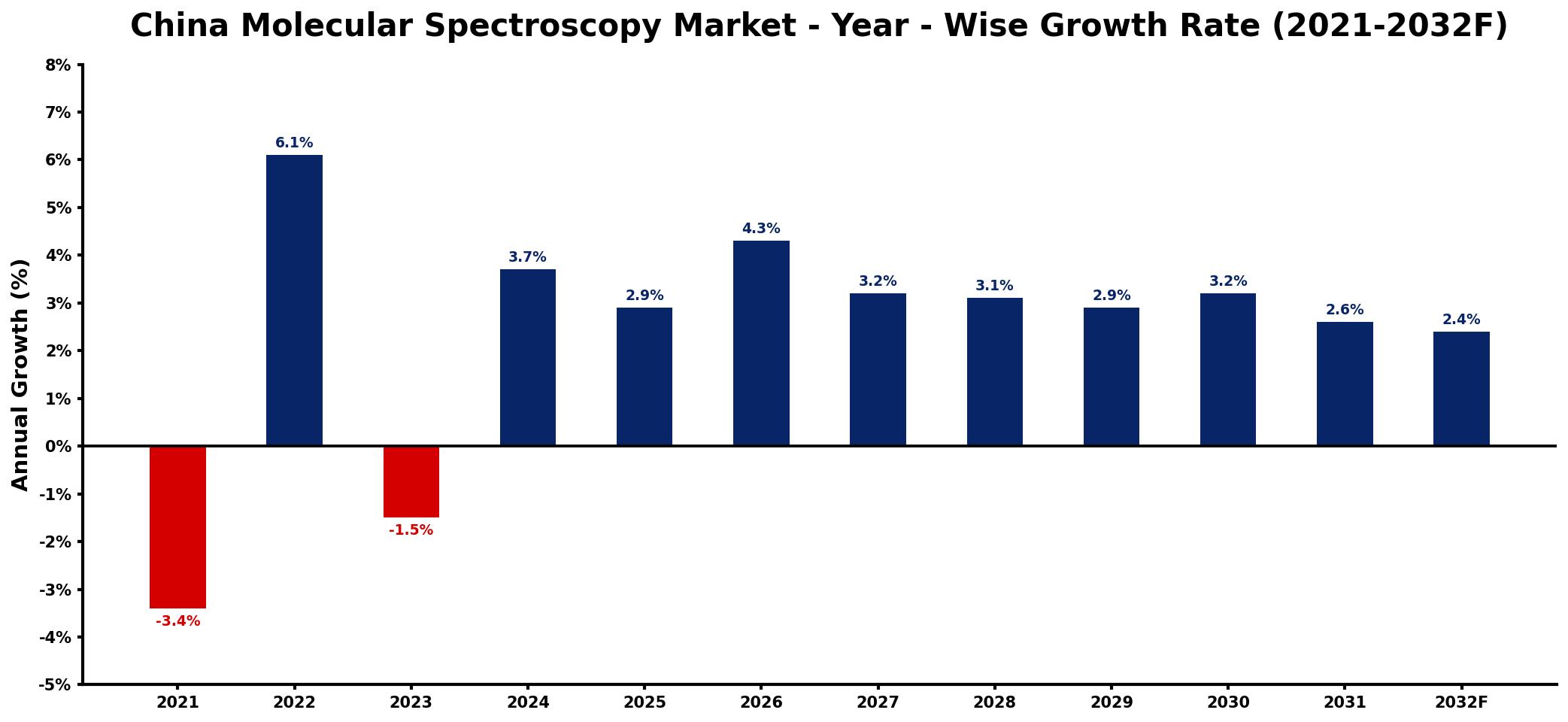
The table below presents the year‑wise growth rates along with the key drivers influencing the market
| Year | Growth Rate | Major Drivers |
| 2021 | -3.4% | decreased investment in research funding |
| 2022 | 6.1% | increased adoption in pharmaceuticals |
| 2023 | -1.5% | reduction in industrial applications |
| 2024 | 3.7% | growing demand in environmental monitoring |
| 2025 | 2.9% | expansion in academic research initiatives |
| 2026 | 4.3% | rising interest in food safety |
| 2027 | 3.2% | increased utilization in healthcare diagnostics |
| 2028 | 3.1% | growing focus on quality control |
| 2029 | 2.9% | expansion of laboratory capabilities |
| 2030 | 3.2% | increased funding for technological advancements |
| 2031 | 2.6% | growing applications in biotechnology |
| 2032 | 2.4% | rising demand for educational purposes |
Note: Market size estimations and growth projections presented in this report are based on 6Wresearch's proprietary forecasting methodology, utilizing the latest available industry data, government publications, and primary research inputs.
China Molecular Spectroscopy Market Synopsis
The China Molecular Spectroscopy Market is currently witnessing robust growth due to significant advancements in analytical technologies. This momentum is expected to evolve as industries seek more tailored and effective solutions for quality control and research applications. As organizations in sectors such as healthcare and environmental testing invest in high-performance spectroscopic tools, the market is positioned for substantial expansion.
While traditional methods have dominated the landscape, there is a marked shift towards modern techniques like Raman and NIR spectroscopy, which offer faster and non-destructive analysis. This shift underscores an exciting phase in the market, suggesting a future where integration and automation are key themes in spectroscopic applications across various domains.
China Molecular Spectroscopy Market Key Takeaways
- The market is projected to grow steadily at a CAGR of 2.1% from 2026 to 2032, driven by technological advancements and increasing demand.
- Research and development activities are rapidly expanding within the pharmaceutical and biotechnology sectors, enhancing market opportunities.
- There is a notable trend towards portable and handheld spectroscopy devices, reflecting the demand for user-friendly analytical tools.
- Integration of AI and machine learning in spectroscopic instruments is revolutionizing data analysis and operational efficiency.
- Strategic partnerships and innovations are critical to maintaining competitiveness in the dynamic market landscape.
Evaluation of Restraints in China Molecular Spectroscopy Market
Despite its robust growth trajectory, the China Molecular Spectroscopy Market faces several constraints. The competitive landscape is intense, forcing companies to continually innovate to keep pace with rapid technological advancements. Moreover, the high costs associated with sophisticated instruments may deter smaller enterprises from entering the market. Additionally, navigating regulatory complexities can pose challenges, impacting the speed and feasibility of bringing new products to market. Workforce limitations, particularly the shortage of skilled professionals trained in advanced spectroscopic techniques, may further inhibit market potential.
China Molecular Spectroscopy Market Trends
The market is experiencing a transformative shift with the growing adoption of advanced technologies, particularly Raman and near-infrared spectroscopy. These methods are becoming increasingly favored due to their rapid analysis capabilities and non-destructive nature. Additionally, there is a rising trend toward automation, with companies increasingly integrating spectroscopy systems with other analytical tools to enhance data accuracy and operational efficiency. Portable spectroscopy devices are gaining traction in fields such as food safety testing and environmental analysis, reflecting the industrys demand for versatility and accessibility.
China Molecular Spectroscopy Market Opportunities
The China Molecular Spectroscopy Market presents abundant investment opportunities across various segments. Key areas include nuclear magnetic resonance (NMR), infrared (IR), UV-Vis, and fluorescence spectroscopy, driven by the growing need for advanced analytical instruments. Furthermore, the Chinese government's commitment to fostering research and development initiatives offers a conducive environment for stakeholders. Companies that focus on developing localized solutions and strategic partnerships with research institutions are likely to find significant growth prospects, especially as the emphasis on quality control and regulatory compliance increases.
Government Initiatives in the China Molecular Spectroscopy Market
The Chinese government is actively supporting the growth of the Molecular Spectroscopy Market through various initiatives. These policies include financial incentives aimed at fostering innovation in spectroscopy technologies and subsidies for the acquisition of advanced equipment. The government also emphasizes collaboration between industry and academia, encouraging partnerships that can lead to technological advancements. By setting rigorous standards and guidelines, the government aims to ensure product quality and safety, further bolstering market growth.
Future Insights of the China Molecular Spectroscopy Market
Looking ahead to 2026-2032, the China Molecular Spectroscopy Market is expected to continue its growth trajectory, driven by increased investments in R&D and the expanding applications across various sectors. The rising importance of environmental monitoring, food safety testing, and materials analysis will further catalyze the demand for sophisticated analytical technologies. With ongoing advancements in instrument portability and user-friendliness, the market is set to evolve, creating exciting opportunities for innovation and expansion.
China Molecular Spectroscopy Market Latest Developments (2025 - 2026)
Recent developments in the China Molecular Spectroscopy Market indicate a growing focus on integrating artificial intelligence and machine learning into analytical instruments. Several companies are exploring collaborations with tech firms to enhance the capabilities of their spectroscopic tools. The trend of developing portable and compact devices is gaining momentum, appealing to industries requiring on-site analysis. Furthermore, regulatory bodies are establishing more streamlined processes to facilitate innovation and bring new technologies to market more efficiently.
China Molecular Spectroscopy Market - Key Attractiveness of the Report
- 10 Years of Market Numbers
- Historical Data Starting from 2022 to 2025
- Base Year: 2025
- Forecast Data until 2032
- Key Performance Indicators Impacting the Market
- Major Upcoming Developments and Projects
Key Highlights of the Report:
- China Molecular Spectroscopy Market Outlook
- Market Size of China Molecular Spectroscopy Market, 2025
- Forecast of China Molecular Spectroscopy Market, 2032
- Historical Data and Forecast of China Molecular Spectroscopy Revenues & Volume for the Period 2022-2032F
- China Molecular Spectroscopy Market Trend Evolution
- China Molecular Spectroscopy Market Drivers and Challenges
- China Molecular Spectroscopy Price Trends
- China Molecular Spectroscopy Porter's Five Forces
- China Molecular Spectroscopy Industry Life Cycle
- Historical Data and Forecast of China Molecular Spectroscopy Market Revenues & Volume By Type of Spectroscopy for the Period 2022-2032F
- Historical Data and Forecast of China Molecular Spectroscopy Market Revenues & Volume By NMR Spectroscopy for the Period 2022-2032F
- Historical Data and Forecast of China Molecular Spectroscopy Market Revenues & Volume By Raman Spectroscopy for the Period 2022-2032F
- Historical Data and Forecast of China Molecular Spectroscopy Market Revenues & Volume By UV-visible Spectroscopy for the Period 2022-2032F
- Historical Data and Forecast of China Molecular Spectroscopy Market Revenues & Volume By Mass Spectroscopy for the Period 2022-2032F
- Historical Data and Forecast of China Molecular Spectroscopy Market Revenues & Volume By Infrared Spectroscopy for the Period 2022-2032F
- Historical Data and Forecast of China Molecular Spectroscopy Market Revenues & Volume By Near-infrared Spectroscopy for the Period 2022-2032F
- Historical Data and Forecast of China Molecular Spectroscopy Market Revenues & Volume By Others for the Period 2022-2032F
- Historical Data and Forecast of China Molecular Spectroscopy Market Revenues & Volume By Application for the Period 2022-2032F
- Historical Data and Forecast of China Molecular Spectroscopy Market Revenues & Volume By Pharmaceutical Applications for the Period 2022-2032F
- Historical Data and Forecast of China Molecular Spectroscopy Market Revenues & Volume By Food and Beverage Testing for the Period 2022-2032F
- Historical Data and Forecast of China Molecular Spectroscopy Market Revenues & Volume By Biotechnology and Biopharmaceutical Applications for the Period 2022-2032F
- Historical Data and Forecast of China Molecular Spectroscopy Market Revenues & Volume By Environmental Testing for the Period 2022-2032F
- Historical Data and Forecast of China Molecular Spectroscopy Market Revenues & Volume By Academic Research for the Period 2022-2032F
- Historical Data and Forecast of China Molecular Spectroscopy Market Revenues & Volume By Other for the Period 2022-2032F
- China Molecular Spectroscopy Import Export Trade Statistics
- Market Opportunity Assessment By Type of Spectroscopy
- Market Opportunity Assessment By Application
- China Molecular Spectroscopy Top Companies Market Share
- China Molecular Spectroscopy Competitive Benchmarking By Technical and Operational Parameters
- China Molecular Spectroscopy Company Profiles
- China Molecular Spectroscopy Key Strategic Recommendations






































