China Oil Country Tubular Goods Market Size, Share & Growth Rate
The China Oil Country Tubular Goods Market was estimated at USD 190 Million in 2025 and is projected to reach USD 220 Million by 2032, growing at a CAGR of 2.1% from 2026 to 2032. This upward trajectory is primarily fueled by Chinas vigorous efforts to expand its oil and gas exploration activities, especially in untapped regions. The ongoing government initiatives to bolster domestic production and an increasing focus on energy security further underpin this anticipated growth.
China Oil Country Tubular Goods Market Year-wise Growth Rate and Key Drivers
This graph highlights how the China Oil Country Tubular Goods Market has steadily grown over the years, supported by major growth factors.
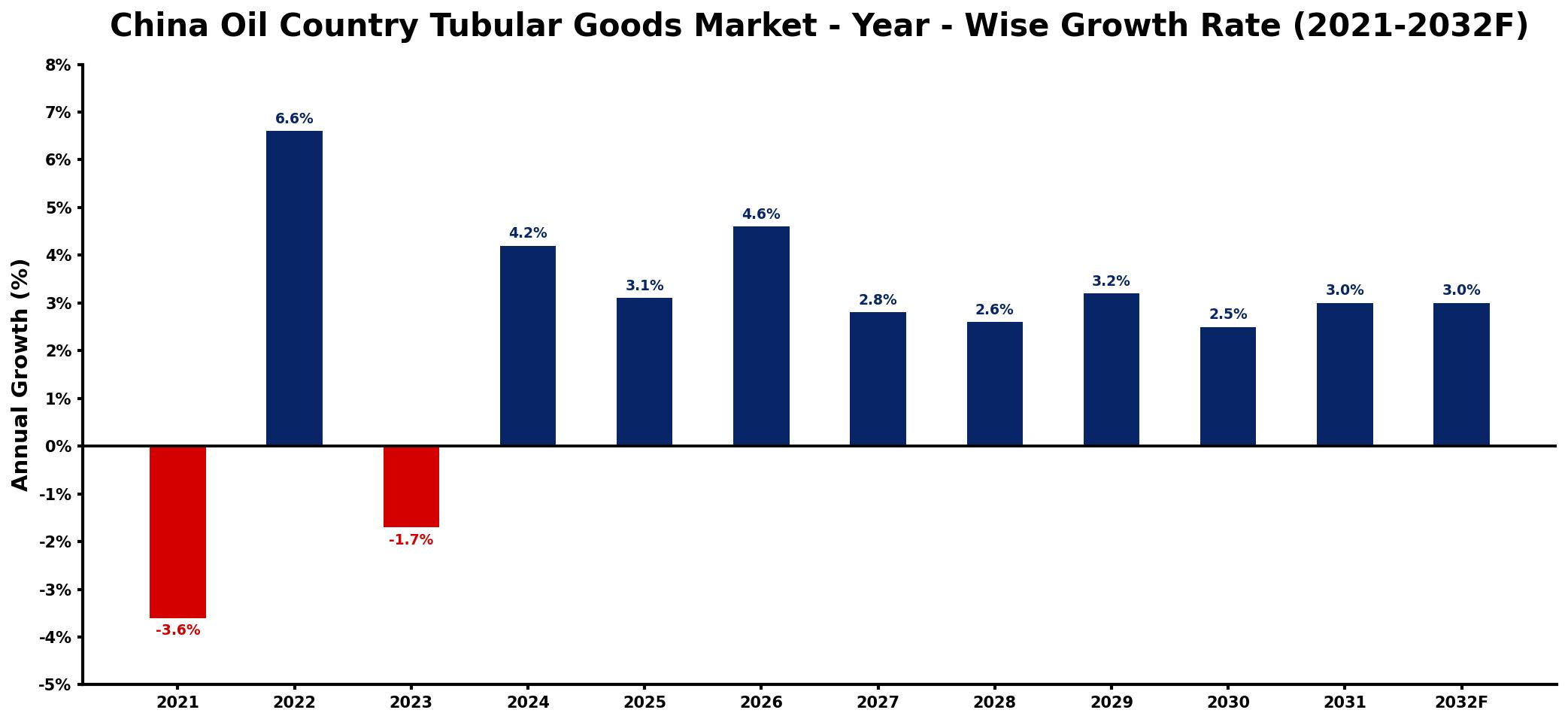
The table below presents the year‑wise growth rates along with the key drivers influencing the market
| Year | Growth Rate | Major Drivers |
| 2021 | -3.6% | Decreased industrial production levels |
| 2022 | 6.6% | Rising energy sector investments |
| 2023 | -1.7% | Lower exploration activities reported |
| 2024 | 4.2% | Expansion in renewable energy projects |
| 2025 | 3.1% | Increased infrastructure development plans |
| 2026 | 4.6% | Growth in domestic manufacturing capacity |
| 2027 | 2.8% | Higher global energy demand projections |
| 2028 | 2.6% | Enhanced technological innovations emerging |
| 2029 | 3.2% | Strengthened international trade agreements |
| 2030 | 2.5% | Growing urbanization trends observed |
| 2031 | 3.0% | Increased government policy support |
| 2032 | 3.0% | Emergence of new market players |
Note: Market size estimations and growth projections presented in this report are based on 6Wresearch's proprietary forecasting methodology, utilizing the latest available industry data, government publications, and primary research inputs.
China Oil Country Tubular Goods Market Synopsis
In the China Oil Country Tubular Goods (OCTG) market, the escalating demand for high-quality casing, tubing, and drill pipes is evident. With the country positioning itself as a leader in energy consumption, the need for reliable OCTG solutions is more critical than ever, particularly in enhancing production efficiency.
This market is characterized by a blend of local and international suppliers, each striving to capture a share of the rapidly growing sector. The competitive landscape is intensifying as manufacturers pivot toward innovative technologies and premium product offerings to meet the evolving demands of the energy industry.
China Oil Country Tubular Goods Market Key Takeaways
- The market is projected to grow steadily, driven by increasing oil and gas exploration activities.
- Technological advancements in manufacturing are reshaping product offerings and operational efficiencies.
- There is a significant shift toward premium OCTG products due to efficiency and sustainability concerns.
- Government policies are supportive, aiming to enhance domestic production and energy security.
- The market landscape is highly competitive, with local manufacturers competing alongside international firms.
Evaluation of Restraints in China Oil Country Tubular Goods Market
Despite its promising growth potential, the China Oil Country Tubular Goods market contends with several restraints. Overcapacity in production has led to aggressive price competition among manufacturers, squeezing profit margins and hindering sustainable growth. Moreover, the market is sensitive to fluctuating global oil prices and geopolitical tensions, which can impact demand unpredictably. Stringent environmental regulations also necessitate continuous adaptation by manufacturers, requiring investments in technology and processes that may not be immediately feasible for all players.
China Oil Country Tubular Goods Market Trends
Currently, the market is seeing a growing demand for premium OCTG products. This trend is largely attributed to the need for improved efficiency and reduced environmental impact in oil and gas operations. Simultaneously, manufacturers are increasingly embracing automation and digital technologies, which enhance product quality and lower production costs. There is also a noticeable shift toward eco-friendly materials and sustainable manufacturing practices, reflecting a broader industry commitment to environmental stewardship.
China Oil Country Tubular Goods Market Opportunities
Investment opportunities abound within the China Oil Country Tubular Goods market, particularly in the manufacturing sector. Companies can explore partnerships with domestic firms to leverage local market knowledge and distribution networks. Furthermore, investments in research and development focused on innovative OCTG technologies will not only enhance operational efficiencies but also align with sustainability goals, presenting a strategic advantage in an increasingly eco-conscious market landscape.
Government Initiatives in the China Oil Country Tubular Goods Market
The Chinese government has introduced a variety of policies aimed at fostering a robust environment for the Oil Country Tubular Goods market. These initiatives include protective measures for domestic manufacturers, such as export restrictions and anti-dumping duties on imported OCTG products. Additionally, subsidies for local manufacturers are in place to enhance competitiveness, while ongoing efforts to promote energy conservation underscore the administration's commitment to sustainable development within the industry.
Future Insights of the China Oil Country Tubular Goods Market
Looking ahead to 2026-2032, the China Oil Country Tubular Goods market is poised for steady growth, driven by robust oil and gas exploration and continued infrastructure development. As China pursues a greater share of unconventional energy resources, particularly shale gas, the demand for innovative OCTG solutions will intensify. However, stakeholders must remain vigilant regarding potential fluctuations in oil prices and evolving regulatory landscapes, which could introduce volatility to market dynamics.
China Oil Country Tubular Goods Market Latest Developments (2025 - 2026)
The recent trajectory of the China Oil Country Tubular Goods market has been marked by increasing collaboration between domestic and international suppliers, aimed at leveraging advanced technologies and enhancing production capabilities. Manufacturers are actively engaging in strategic partnerships to develop eco-friendly OCTG solutions, responding to both market demand and regulatory pressures. Innovations in automation are also becoming more prevalent as companies seek to improve operational efficiencies amidst competitive pricing challenges.
China Oil Country Tubular Goods Market - Key Attractiveness of the Report
- 10 Years of Market Numbers
- Historical Data Starting from 2022 to 2025
- Base Year: 2025
- Forecast Data until 2032
- Key Performance Indicators Impacting the Market
- Major Upcoming Developments and Projects
Key Highlights of the Report:
- China Oil Country Tubular Goods Market Outlook
- Market Size of China Oil Country Tubular Goods Market, 2025
- Forecast of China Oil Country Tubular Goods Market, 2032
- Historical Data and Forecast of China Oil Country Tubular Goods Revenues & Volume for the Period 2022-2032F
- China Oil Country Tubular Goods Market Trend Evolution
- China Oil Country Tubular Goods Market Drivers and Challenges
- China Oil Country Tubular Goods Price Trends
- China Oil Country Tubular Goods Porter's Five Forces
- China Oil Country Tubular Goods Industry Life Cycle
- Historical Data and Forecast of China Oil Country Tubular Goods Market Revenues & Volume By Manufacturing Process for the Period 2022-2032F
- Historical Data and Forecast of China Oil Country Tubular Goods Market Revenues & Volume By Seamless for the Period 2022-2032F
- Historical Data and Forecast of China Oil Country Tubular Goods Market Revenues & Volume By Electric Resistance Welded for the Period 2022-2032F
- Historical Data and Forecast of China Oil Country Tubular Goods Market Revenues & Volume By Grade for the Period 2022-2032F
- Historical Data and Forecast of China Oil Country Tubular Goods Market Revenues & Volume By Premium Grade for the Period 2022-2032F
- Historical Data and Forecast of China Oil Country Tubular Goods Market Revenues & Volume By API Grade for the Period 2022-2032F
- China Oil Country Tubular Goods Import Export Trade Statistics
- Market Opportunity Assessment By Manufacturing Process
- Market Opportunity Assessment By Grade
- China Oil Country Tubular Goods Top Companies Market Share
- China Oil Country Tubular Goods Competitive Benchmarking By Technical and Operational Parameters
- China Oil Country Tubular Goods Company Profiles
- China Oil Country Tubular Goods Key Strategic Recommendations






































