China Ready‑to‑Drink (Non-Alcoholic) Market Size & Growth Rate
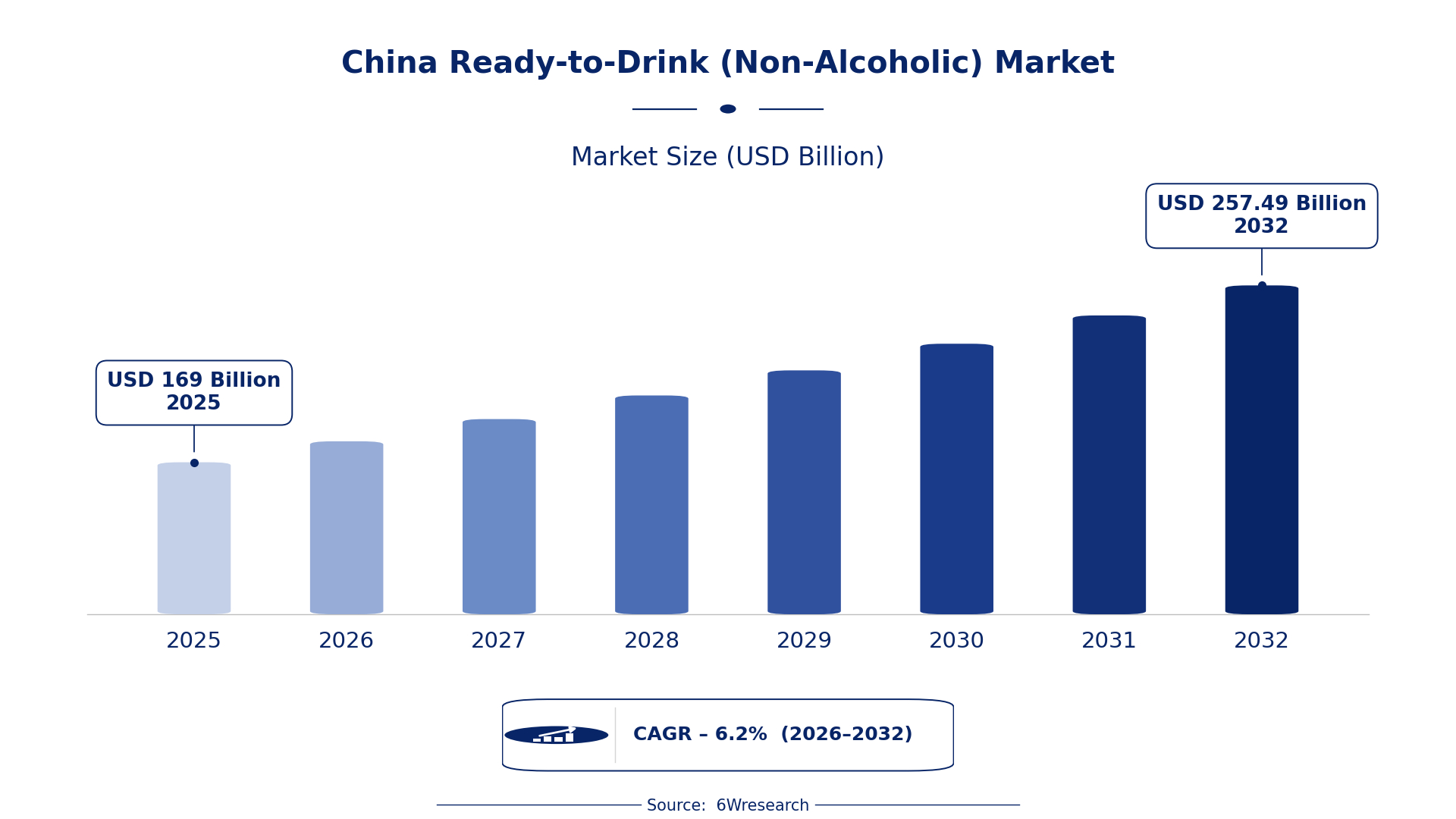
According to 6Wresearch internal database and industry insights, the China Ready‑to‑Drink (Non-Alcoholic) Market was valued at USD 169.0 billion in 2025 and is projected to reach USD 257.49 billion by 2032, growing at a CAGR of approximately 6.2% during 2026–2032.
China Ready‑to‑Drink (Non-Alcoholic) Market Highlights
| Report Metric | Details |
| Report Name | China Ready‑to‑Drink (Non-Alcoholic) Market |
| Market Size 2025 | USD 169.0 billion |
| Market Size 2032 | USD 257.49 billion |
| Absolute Growth 2025–2032 | USD 88.49 billion |
| CAGR 2026–2032 | 6.2% |
| Peak Annual Growth | 8.5% in 2027 |
| Forecast Period | 2026–2032 |
| Historical Data | 2022–2025 |
| Base Year | 2025 |
| Leading Beverage Category, 2025 | Functional Drinks (44% share) |
| Leading Flavor Profile, 2025 | Electrolytes/Vitamins (35% share) |
| Leading Packaging Type, 2025 | Bottles (500 mL) (47% share) |
| Leading End User, 2025 | Health-Conscious Consumers (50% share) |
| Fastest-Growing Flavor Profile | Citrus/Herbal (7.6% CAGR) |
| Fastest-Growing Packaging Type | Cans/Bottles (8.4% CAGR) |
| Fastest-Growing End User | Fitness Enthusiasts (8.5% CAGR) |
| Growing Sector | Fitness Enthusiasts |
| Key End Users | Health-Conscious Consumers, Fitness Enthusiasts, Urban Professionals, Family Households |
China Ready‑to‑Drink (Non-Alcoholic) Market Year-wise Growth Rate and Key Drivers (2022–2032)
This graph illustrates the annual growth rates of the market from 2022 to 2032, highlighting a steady upward trajectory and projected market expansion over the forecast period.
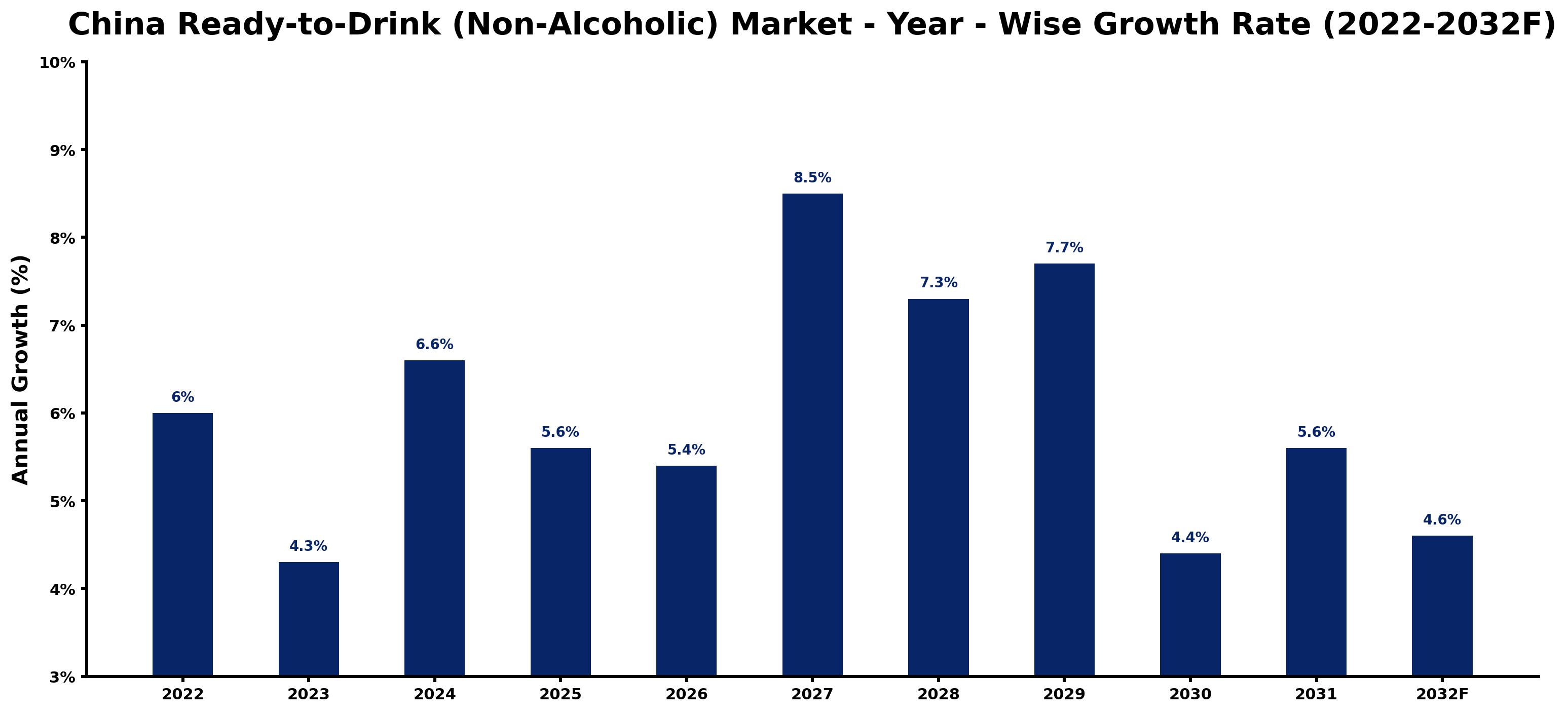
The table below sets out the estimated growth rate for each year and the main factor behind it.
| Year | Estimated Annual Growth (%) | Market Rationale |
| 2022 | 6.0 | The market showed strong consumer interest in convenient beverage options. |
| 2023 | 4.3 | Demand growth slowed as health-conscious consumers began seeking lower-calorie alternatives. |
| 2024 | 6.6 | A resurgence in consumer spending on functional drinks boosted market performance. |
| 2025 | 5.6 | Health trends continued to influence consumer choices, impacting growth rates. |
| 2026 | 5.4 | The market experienced a slowdown as consumers shifted focus to price-sensitive options. |
| 2027 | 8.5 | A peak in demand for functional drinks drove significant market growth. |
| 2028 | 7.3 | Growth decelerated as competition intensified among beverage producers. |
| 2029 | 7.7 | An increase in health awareness among consumers spurred renewed interest in functional beverages. |
| 2030 | 4.4 | The market slowed as consumers became more discerning about beverage choices. |
| 2031 | 5.6 | A rise in disposable income led to increased spending on premium beverages. |
| 2032 | 4.6 | Growth moderated as consumers continued to prioritise health and wellness. |
Note: Market size estimations and growth projections presented in this report are based on 6Wresearch's proprietary forecasting methodology, utilizing the latest available industry data, government publications, and primary research inputs.
China Ready‑to‑Drink (Non-Alcoholic) Market Synopsis
The Ready-to-Drink (Non-Alcoholic) Market in China includes a diverse range of pre-packaged beverages intended for immediate consumption. These drinks, primarily water-based, incorporate various flavours, vitamins, and other ingredients aimed at hydration and nutritional support. Growth in this market is propelled by increasing health consciousness and a demand for convenient options. In 2022, the market was valued at approximately 300 billion CNY, with health-aware consumers driving the trend towards low-calorie beverages. The ongoing shift towards functional drinks is likely to further accelerate market growth.
Market Dynamics Impact Analysis (2026–2032)
| Factor | Type | Impact | Primary Segment Affected |
| Rising health awareness among consumers drives demand for functional drinks. | Driver | High | Functional Drinks |
| Urban consumers increasingly prefer convenient beverage options, boosting sales. | Driver | High | Flavored Water |
| Growing demand for low-calorie beverages presents opportunities for innovation. | Opportunity | High | Functional Drinks |
| The trend towards organic ingredients in beverages opens new market segments. | Opportunity | Medium | Juice Blends |
| Regulatory compliance costs can strain smaller producers in the market. | Restraint | High | Cold Brew Teas & Coffees |
| Competition from imported beverages may limit local producers' market share. | Restraint | Medium | Flavored Water |
| Supply chain disruptions can delay product availability for consumers. | Challenge | High | Functional Drinks |
| Rising raw material costs affect pricing strategies for beverage producers. | Challenge | Medium | Juice Blends |
Evaluation of Drivers in China Ready‑to‑Drink (Non-Alcoholic) Market (2026–2032)
The main growth drivers and the segments they affect most are set out below.
| Drivers | Primary Segment Affected | Why It Matters (Evidence) |
| Increasing health consciousness among consumers leads to higher demand for functional drinks. | Functional Drinks | In 2022, the health-conscious consumer segment grew rapidly, influencing purchasing decisions. |
| Urbanisation drives demand for convenient and ready-to-drink options. | Flavored Water | Urban households spend approximately 500 CNY monthly on non-alcoholic beverages. |
| The popularity of low-calorie options is reshaping consumer preferences. | Juice Blends | Families are increasingly choosing nutritious beverages for children. |
| The rise of cold brew teas and coffees appeals to young professionals. | Cold Brew Teas & Coffees | This segment is trending due to its refreshing caffeine options. |
| The 500 mL bottle format is preferred for its convenience. | Bottles (500 mL) | This packaging size holds a 47% market share in 2025. |
Market growth in China for Ready-to-Drink (Non-Alcoholic) is underpinned by increasing health awareness, urbanisation, and shifting consumer preferences. The health-conscious consumer base is expanding, with urban households spending around 500 CNY monthly on non-alcoholic beverages. This trend fuels the demand for functional drinks, which are expected to gain popularity, especially among families in search of nutritious options. The preference for convenient packaging, such as 500 mL bottles, supports higher purchase volumes. Cold brew teas and coffees are becoming popular among young professionals, further shaping market trends.
Evaluation of Restraints in China Ready‑to‑Drink (Non-Alcoholic) Market
The following restraints limit how fast demand can grow.
| Market Restraint | Primary Segment Affected | Why It Matters (Evidence) |
| Regulatory compliance costs can limit the ability of smaller producers to compete effectively. | Cold Brew Teas & Coffees | Producers must adhere to stringent food safety standards, increasing operational costs. |
| Competition from imported beverages may restrict local producers' market growth. | Flavored Water | Imported options often attract consumers seeking variety and quality. |
| Supply chain disruptions can hinder product availability and affect sales. | Functional Drinks | Logistical challenges can delay distribution to retail outlets. |
| Rising raw material costs impact pricing strategies for beverage producers. | Juice Blends | Increased costs can lead to higher retail prices, affecting consumer purchasing. |
| Consumer preferences may shift rapidly, making it difficult for producers to adapt. | Flavored Water | Producers must continuously innovate to meet changing tastes. |
China Ready‑to‑Drink (Non-Alcoholic) Market Challenges
A lack of skilled workers in the China Ready-to-Drink (Non-Alcoholic) market hampers production efficiency, leading to potential revenue losses of up to 10% for producers. Regulatory hurdles, such as compliance with ISO 22000, increase operational costs, which can raise prices for buyers by around 5%. Supply chain issues, particularly in sourcing ingredients for flavored beverages, can cause delivery delays of up to three weeks, impacting retailers' inventory levels and customer satisfaction. Intense competition from both local and international brands drives prices down, squeezing margins for producers and limiting their capacity to invest in innovation.
Trends in the China Ready‑to‑Drink (Non-Alcoholic) Market
The trends below show where the China Ready‑to‑Drink (Non-Alcoholic) Market is heading.
- Health-Conscious Consumers Prioritising Low-Calorie Options: Health-conscious consumers in China are increasingly choosing low-calorie beverages, driven by heightened health awareness. In 2022, the health-conscious segment experienced rapid growth, contributing to market expansion.
- Functional Drinks Gaining Popularity: Functional drinks are becoming a staple among urban professionals, particularly in tier-1 cities. This segment is projected to grow at a CAGR of 8.2% from 2026 to 2032.
- Shift Towards Convenient Packaging: Consumers are opting for convenient packaging options, such as 500 mL bottles, which dominate the market. This format accounted for 47% of the market share in 2025, reflecting changing consumer preferences.
- Emergence of Cold Brew Beverages: Cold brew teas and coffees are trending among young professionals seeking refreshing caffeine options. This segment is gaining traction, appealing to a growing demographic looking for convenience.
Investment Opportunities in the China Ready‑to‑Drink (Non-Alcoholic) Market
Some of the investment opportunities in the China Ready‑to‑Drink (Non-Alcoholic) Market are mentioned below.
- Guangdong Province as a Production Hub: Guangdong province is emerging as a key production hub for ready-to-drink beverages, with substantial investment in facilities. This region is expected to experience a 20% increase in production capacity by 2025.
- Investment in Functional Beverage Innovation: The rising demand for functional beverages creates opportunities for investment in new products. Health-conscious consumers are driving this trend, particularly in urban areas where the average household spends around 500 CNY monthly on non-alcoholic beverages.
- Expanding Organic Beverage Offerings: The trend towards organic ingredients in beverages opens new market segments. Producers can capitalise on this demand by aligning with the Green Food Program, aiming for 30% organic products by 2025.
- Focus on Nutritional Beverages for Families: Families are increasingly looking for nutritious beverage options for children, presenting a market opportunity. Producers can meet this demand by developing juice blends that comply with health standards.
Government Initiatives in the China Ready‑to‑Drink (Non-Alcoholic) Market
The framework for the Ready-to-Drink (Non-Alcoholic) market in China is shaped by several key policies. The 'Healthy China 2030' initiative, launched by the National Health Commission in 2021, aims to increase the consumption of low-sugar drinks by 20% by 2025. Additionally, the 'Beverage Industry Development Plan (2021-2025)' from the Ministry of Industry and Information Technology focuses on innovation and sustainability in beverage production, particularly in reducing sugar content. In 2022, the State Administration for Market Regulation updated the 'Food Safety Standards for Non-Alcoholic Beverages' to enhance quality control, ensuring that producers adhere to stringent safety measures. These policies drive improvements in product quality and consumer health outcomes.
In 2023, the National Standardization Administration released guidelines for labelling nutritional information on ready-to-drink beverages, aiming to improve consumer awareness and choice. The Ministry of Agriculture and Rural Affairs has also been active, promoting the 'Green Food Program' initiated in 2020, which encourages the use of organic ingredients in beverage production. This program targets a goal of having 30% of products meet green food standards by 2025. Funding for these initiatives is crucial, with the government allocating resources to support compliance and innovation in the beverage sector. These measures not only enhance product safety but also align with changing consumer preferences towards healthier options.
Future Insight of the China Ready‑to‑Drink (Non-Alcoholic) Market
By 2032, buyers and suppliers in the China Ready-to-Drink (Non-Alcoholic) market can expect a shift towards healthier beverage options driven by rising health awareness. The National Health Commission's initiative to promote healthy beverage consumption will encourage new product innovations. Advances in production technology will streamline processes, enabling suppliers to reduce costs and improve profitability. Urban households currently spend around 500 CNY monthly on non-alcoholic beverages, prompting producers to adjust their offerings to meet evolving consumer preferences.
Market Segmentation Analysis
Each segment group is reviewed below, with the leader by share and the fastest grower by CAGR.
By Beverage Category – Functional Drinks Dominated and Is Expected to Record the Fastest Growth
According to Ravi Bhandari, Research Head at 6Wresearch, Functional Drinks held a 44% share of the China Ready‑to‑Drink (Non-Alcoholic) Market by beverage category in 2025. Functional drinks dominate the market due to their appeal among health-conscious consumers seeking energy and health benefits. This segment's strong presence is highlighted by the growing trend of low-calorie options, which resonates particularly well in urban areas. Functional Drinks are also forecast to expand faster than any other category, at a CAGR of 8.2% over 2026–2032. The increasing health awareness among consumers is propelling the growth of functional drinks, as they are perceived as essential for maintaining wellness. With the National Health Commission promoting healthy beverage consumption, this segment is set to expand further. Suppliers should focus on developing and marketing functional drinks to align with health trends and consumer preferences.
By Flavor Profile – Electrolytes/Vitamins Dominated, Citrus/Herbal Expected to Grow Fastest
The largest flavor profile category in 2025 was Electrolytes/Vitamins, with a 35% share of total revenue. Electrolytes and vitamins lead the flavor profile segment due to their vital importance in hydration and recovery, appealing to a broad consumer base. Their relevance is particularly highlighted among athletes who depend on these beverages to restore lost nutrients after exercise. Citrus/Herbal is projected to grow fastest, at a CAGR of 7.6% during 2026–2032. Citrus and herbal flavours are quickly becoming popular for their refreshing taste and perceived health benefits, particularly among younger urban consumers. This trend is likely to persist as brands increasingly explore unique flavour combinations that attract health-conscious individuals. Suppliers should consider expanding their flavour offerings to include more citrus and herbal options, aligning with consumer preferences for refreshing and health-focused beverages.
By Packaging Type – Bottles (500 mL) Dominated, Cans/Bottles Expected to Grow Fastest
Bottles (500 mL) took a 47% share of packaging type in 2025, more than any other category. Bottles, particularly the 500 mL size, are the preferred packaging for ready-to-drink beverages, offering convenience for on-the-go consumers. This format is widely accepted and trusted, making it a staple in retail environments across China. Cans/Bottles are set to record the highest CAGR in this split, 8.4% over 2026–2032. Cans and bottles are becoming increasingly popular due to their convenience and ability to preserve beverage quality, appealing to a broader audience. As more consumers seek portable options, this segment is expected to grow rapidly. Suppliers should consider diversifying their packaging options to include cans, catering to the rising demand for convenient beverage formats.
By End User – Health-Conscious Consumers Dominated, Fitness Enthusiasts Expected to Grow Fastest
Health-Conscious Consumers accounted for a 50% market share by end user in 2025. Health-conscious consumers command the largest market share, driven by their growing demand for nutritional and low-calorie beverage options. This segment significantly influences market trends as they prioritise products that align with their health and wellness objectives. Over 2026–2032, Fitness Enthusiasts are expected to post the fastest growth, at a CAGR of 8.5%. Fitness enthusiasts are driving rapid growth in this segment, actively searching for beverages that support hydration and recovery post-workout. The increasing interest in fitness and wellness activities is expected to sustain this growth in the future. Suppliers should tailor their product offerings and marketing strategies to effectively engage fitness enthusiasts, highlighting the hydration and recovery advantages of their beverages.
Key Attractiveness of the Report
- 10 Years of Market Numbers
- Historical Data Starting from 2022 to 2025
- Base Year 2025
- Forecast Data until 2032
- Key Performance Indicators Impacting the Market
- Major Upcoming Developments and Projects
Key Highlights of the Report:
- China Ready to Drink (Non-Alcoholic) ) ) ) ) ) Market Outlook
- Market Size of China Ready to Drink (Non-Alcoholic) ) ) ) ) ) Market, 2025
- Forecast of China Ready to Drink (Non-Alcoholic) ) ) ) ) ) Market, 2032
- Historical Data and Forecast of China Ready to Drink (Non-Alcoholic) ) ) ) ) ) Revenues & Volume for the Period 2022 - 2032F
- China Ready to Drink (Non-Alcoholic) ) ) ) ) ) Market Trend Evolution
- China Ready to Drink (Non-Alcoholic) ) ) ) ) ) Market Drivers and Challenges
- China Ready to Drink (Non-Alcoholic) ) ) ) ) ) Price Trends
- China Ready to Drink (Non-Alcoholic) ) ) ) ) ) Porter's Five Forces
- China Ready to Drink (Non-Alcoholic) ) ) ) ) ) Industry Life Cycle
- Historical Data and Forecast of China Ready to Drink (Non-Alcoholic) ) ) ) ) ) Market Revenues & Volume By Beverage Category for the Period 2022 - 2032F
- Historical Data and Forecast of China Ready to Drink (Non-Alcoholic) ) ) ) ) ) Market Revenues & Volume By Flavored Water for the Period 2022 - 2032F
- Historical Data and Forecast of China Ready to Drink (Non-Alcoholic) ) ) ) ) ) Market Revenues & Volume By Functional Drinks for the Period 2022 - 2032F
- Historical Data and Forecast of China Ready to Drink (Non-Alcoholic) ) ) ) ) ) Market Revenues & Volume By Cold Brew Teas & Coffees for the Period 2022 - 2032F
- Historical Data and Forecast of China Ready to Drink (Non-Alcoholic) ) ) ) ) ) Market Revenues & Volume By Juice Blends for the Period 2022 - 2032F
- Historical Data and Forecast of China Ready to Drink (Non-Alcoholic) ) ) ) ) ) Market Revenues & Volume By Flavor Profile for the Period 2022 - 2032F
- Historical Data and Forecast of China Ready to Drink (Non-Alcoholic) ) ) ) ) ) Market Revenues & Volume By Citrus/Herbal for the Period 2022 - 2032F
- Historical Data and Forecast of China Ready to Drink (Non-Alcoholic) ) ) ) ) ) Market Revenues & Volume By Electrolytes/Vitamins for the Period 2022 - 2032F
- Historical Data and Forecast of China Ready to Drink (Non-Alcoholic) ) ) ) ) ) Market Revenues & Volume By Black/Green/Herbal for the Period 2022 - 2032F
- Historical Data and Forecast of China Ready to Drink (Non-Alcoholic) ) ) ) ) ) Market Revenues & Volume By Fruit/Veggie Mixes for the Period 2022 - 2032F
- Historical Data and Forecast of China Ready to Drink (Non-Alcoholic) ) ) ) ) ) Market Revenues & Volume By Packaging Type for the Period 2022 - 2032F
- Historical Data and Forecast of China Ready to Drink (Non-Alcoholic) ) ) ) ) ) Market Revenues & Volume By Bottles (500 mL) for the Period 2022 - 2032F
- Historical Data and Forecast of China Ready to Drink (Non-Alcoholic) ) ) ) ) ) Market Revenues & Volume By Pouches/Bottles for the Period 2022 - 2032F
- Historical Data and Forecast of China Ready to Drink (Non-Alcoholic) ) ) ) ) ) Market Revenues & Volume By Cans/Bottles for the Period 2022 - 2032F
- Historical Data and Forecast of China Ready to Drink (Non-Alcoholic) ) ) ) ) ) Market Revenues & Volume By Tetra Pack for the Period 2022 - 2032F
- Historical Data and Forecast of China Ready to Drink (Non-Alcoholic) ) ) ) ) ) Market Revenues & Volume By End User for the Period 2022 - 2032F
- Historical Data and Forecast of China Ready to Drink (Non-Alcoholic) ) ) ) ) ) Market Revenues & Volume By Fitness Enthusiasts for the Period 2022 - 2032F
- Historical Data and Forecast of China Ready to Drink (Non-Alcoholic) ) ) ) ) ) Market Revenues & Volume By Health-Conscious Consumers for the Period 2022 - 2032F
- Historical Data and Forecast of China Ready to Drink (Non-Alcoholic) ) ) ) ) ) Market Revenues & Volume By Urban Professionals for the Period 2022 - 2032F
- Historical Data and Forecast of China Ready to Drink (Non-Alcoholic) ) ) ) ) ) Market Revenues & Volume By Family Households for the Period 2022 - 2032F
- China Ready to Drink (Non-Alcoholic) ) ) ) ) ) Import Export Trade Statistics
- Market Opportunity Assessment By Beverage Category
- Market Opportunity Assessment By Flavor Profile
- Market Opportunity Assessment By Packaging Type
- Market Opportunity Assessment By End User
- China Ready to Drink (Non-Alcoholic) ) ) ) ) ) Top Companies Market Share
- China Ready to Drink (Non-Alcoholic) ) ) ) ) ) Competitive Benchmarking By Technical and Operational Parameters
- China Ready to Drink (Non-Alcoholic) ) ) ) ) ) Company Profiles
- China Ready to Drink (Non-Alcoholic) ) ) ) ) ) Key Strategic Recommendations
Market Covered
The report offers an extensive study of the following market segments.
By Beverage Category
- Flavored Water
- Functional Drinks
- Cold Brew Teas & Coffees
- Juice Blends
By Flavor Profile
- Citrus/Herbal
- Electrolytes/Vitamins
- Black/Green/Herbal
- Fruit/Veggie Mixes
By Packaging Type
- Bottles (500 mL)
- Pouches/Bottles
- Cans/Bottles
- Tetra Pack
By End User
- Fitness Enthusiasts
- Health-Conscious Consumers
- Urban Professionals
- Family Households































