China Rebar Manufacturing Market Size & Growth Rate
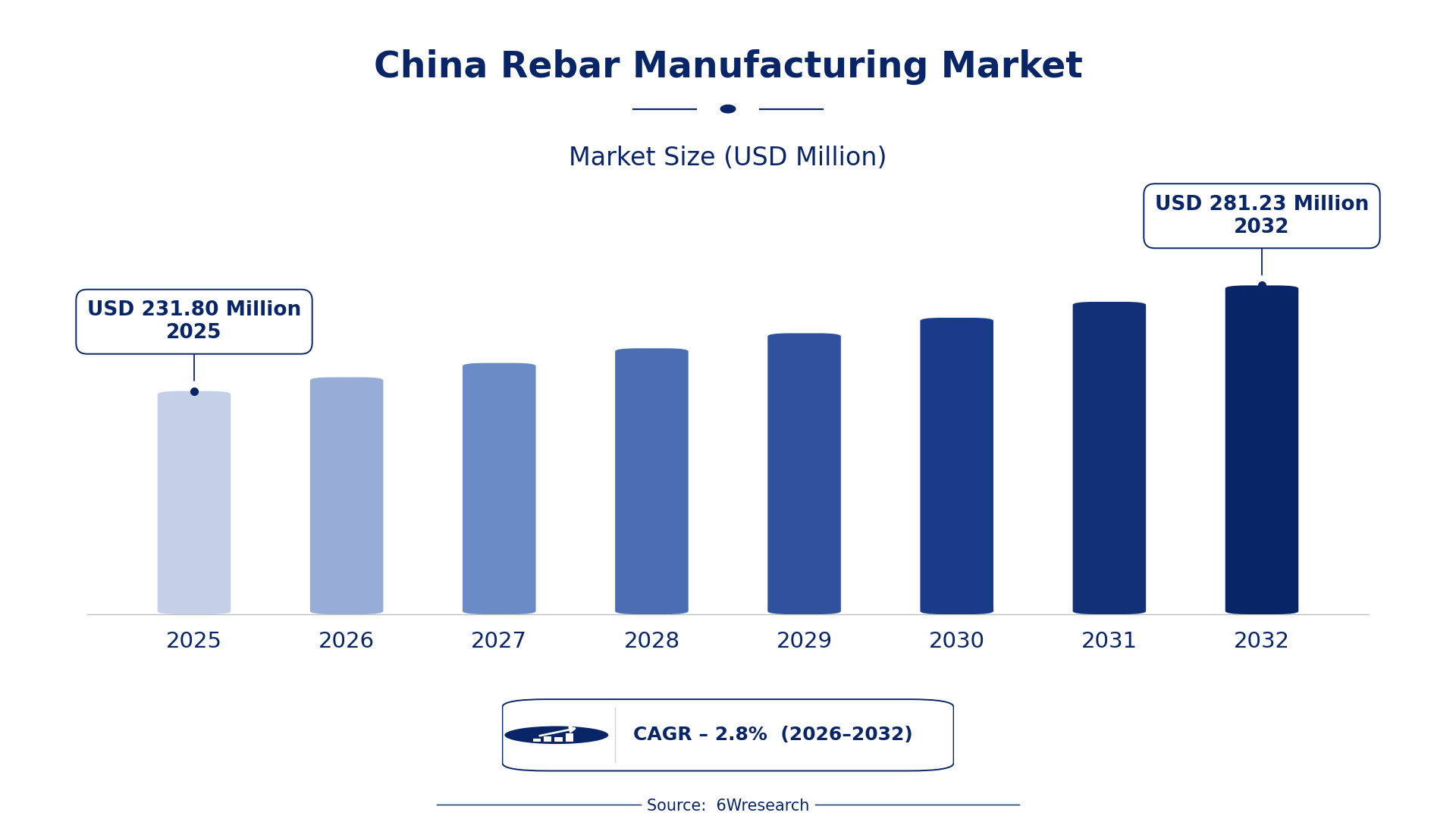
According to 6Wresearch internal database and industry insights, the China Rebar Manufacturing Market was valued at USD 231.8 million in 2025 and is projected to reach USD 281.23 million by 2032, growing at a CAGR of approximately 2.8% during 2026–2032.
China Rebar Manufacturing Market Highlights
| Report Metric | Details |
| Report Name | China Rebar Manufacturing Market |
| Market Size 2025 | USD 231.8 million |
| Market Size 2032 | USD 281.23 million |
| Absolute Growth 2025–2032 | USD 49.43 million |
| CAGR 2026–2032 | 2.8% |
| Peak Annual Growth | 5.3% in 2028 |
| Forecast Period | 2026–2032 |
| Historical Data | 2022–2025 |
| Base Year | 2025 |
| Leading Product Type, 2025 | Deformed Bar (40% share) |
| Leading Steel Grade, 2025 | Fe 500D/550D (41% share) |
| Leading Process, 2025 | Hot-Rolled (35% share) |
| Leading End User, 2025 | Construction Firms (46% share) |
| Fastest-Growing Product Type | Epoxy-Coated Rebar (4.9% CAGR) |
| Fastest-Growing Steel Grade | Anti-Corrosive Coated (5.0% CAGR) |
| Fastest-Growing Process | Thermo-Mechanical (4.6% CAGR) |
| Fastest-Growing End User | Infrastructure Developers (4.6% CAGR) |
| Growing Sector | Infrastructure Development |
| Key End Users | Construction Firms, Infrastructure Developers, Marine Construction |
China Rebar Manufacturing Market Year-wise Growth Rate and Key Drivers (2022–2032)
This graph illustrates the annual growth rates of the market from 2022 to 2032, highlighting a steady upward trajectory and projected market expansion over the forecast period.
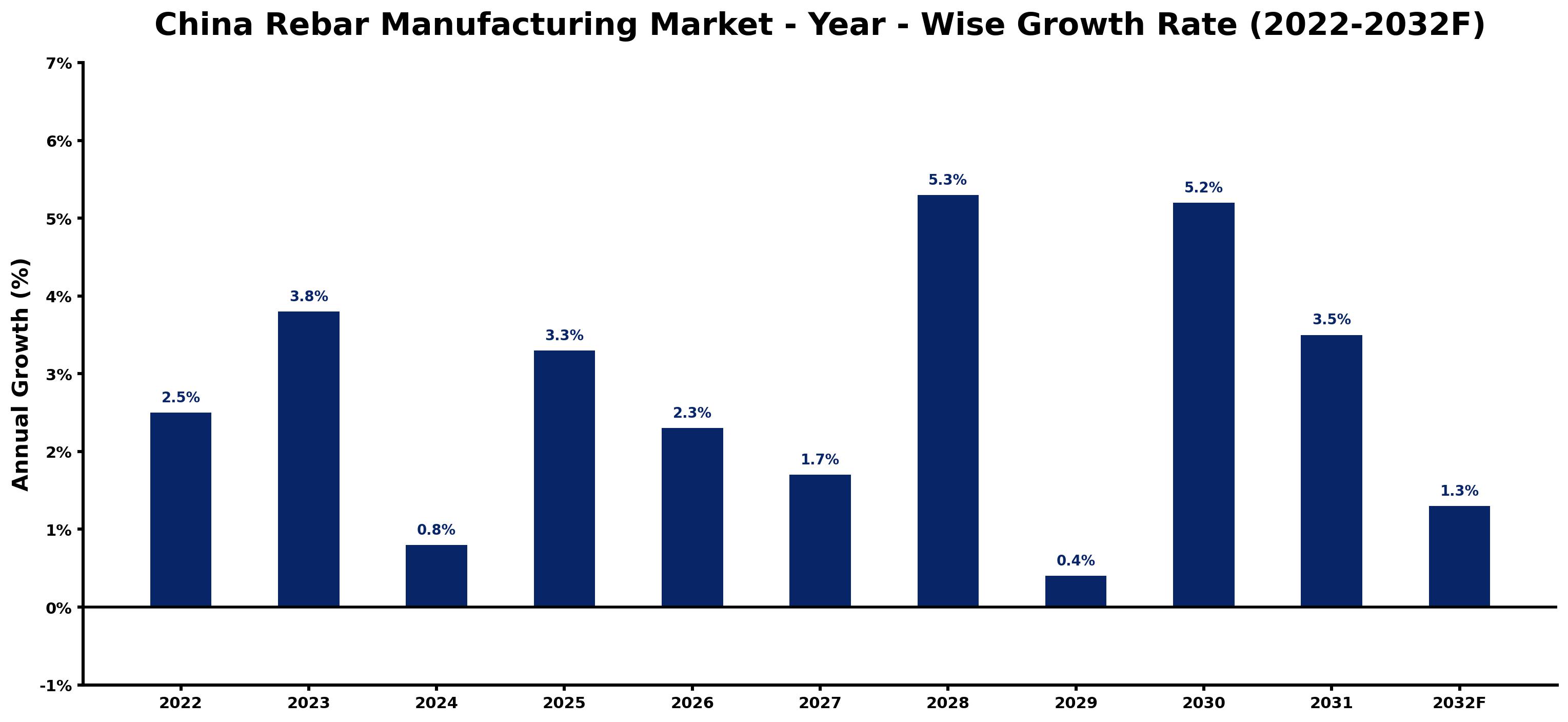
The table below sets out the estimated growth rate for each year and the main factor behind it.
| Year | Estimated Annual Growth (%) | Market Rationale |
| 2022 | 2.5 | The market experienced steady growth, supported by ongoing construction projects across urban areas. |
| 2023 | 3.8 | Demand surged due to increased infrastructure investments and urbanisation initiatives. |
| 2024 | 0.8 | Growth slowed as construction activity faced temporary setbacks in project approvals. |
| 2025 | 3.3 | A rebound occurred as construction firms ramped up projects following regulatory improvements. |
| 2026 | 2.3 | The market saw a slowdown as infrastructure investments began to stabilise. |
| 2027 | 1.7 | Demand continued to decelerate amid tighter regulations affecting steel production. |
| 2028 | 5.3 | A significant uptick in growth was driven by major infrastructure projects in urban areas. |
| 2029 | 0.4 | Growth slowed again as project completions reduced immediate demand for rebar. |
| 2030 | 5.2 | The market rebounded with increased demand from ongoing infrastructure developments. |
| 2031 | 3.5 | Growth slowed as the market adjusted to new production regulations and standards. |
| 2032 | 1.3 | Demand continued to grow, albeit at a slower pace as projects reached completion. |
Note: Market size estimations and growth projections presented in this report are based on 6Wresearch's proprietary forecasting methodology, utilizing the latest available industry data, government publications, and primary research inputs.
China Rebar Manufacturing Market Synopsis
Rebar Manufacturing in China focuses on producing steel bars primarily used for reinforcing concrete in construction. The process involves hot rolling and thermo-mechanical treatment, with rebar crucial for the structural integrity of buildings and infrastructure. The China Rebar Manufacturing Market is on an upward path due to substantial investments in infrastructure and construction, with annual demand projected to reach 300 million tons. Key drivers include urbanisation and government initiatives aimed at improving infrastructure quality.
Market Dynamics Impact Analysis (2026–2032)
| Factor | Type | Impact | Primary Segment Affected |
| Increased urbanisation driving construction projects | Driver | High | Deformed Bar |
| Growing demand for high-strength materials in construction | Driver | High | Fe 500D/550D |
| Rising infrastructure investments in urban areas | Opportunity | High | Infrastructure Developers |
| Demand for eco-friendly construction materials | Opportunity | High | Construction Firms |
| Regulatory challenges impacting production processes | Restraint | Medium | Hot-Rolled |
| Fluctuating raw material prices affecting profitability | Restraint | Medium | Thermo-Mechanical |
| Tightening environmental regulations on emissions | Challenge | High | Anti-Corrosive Coated |
| Competition from alternative construction materials | Challenge | Medium | Plain Bar |
Evaluation of Drivers in China Rebar Manufacturing Market (2026–2032)
Key forces behind demand, with the segment each one moves most, are listed below.
| Drivers | Primary Segment Affected | Why It Matters (Evidence) |
| Urbanisation driving construction demand | Deformed Bar | In urban areas, the average annual consumption of rebar per capita is estimated at 1.5 tons, prompting increased purchases by construction firms. |
| Infrastructure projects boosting rebar consumption | Fe 500D/550D | The construction of the Xiong'an New Area is projected to generate rebar demand of around 50 million tons annually. |
| Government initiatives for quality improvement | Thermo-Mechanical | The Quality Improvement Program for Urban Infrastructure enhances standards, increasing demand for high-quality rebar. |
| Rising demand for corrosion-resistant materials | Anti-Corrosive Coated | Coastal construction projects increasingly specify Anti-Corrosive Coated rebar, resulting in higher purchases from marine construction firms. |
| Technological advancements in manufacturing processes | Hot-Rolled | Investment in advanced manufacturing standards promotes higher quality, driving demand from infrastructure developers. |
In 2023, the construction sector employed around 50 million workers, driving demand for rebar. The construction of the Xiong'an New Area is expected to generate rebar demand of about 50 million tons annually. The average annual consumption of rebar per capita in urban areas is estimated at 1.5 tons, leading to increased purchases by construction firms.
Evaluation of Restraints in China Rebar Manufacturing Market
The main factors holding the market back are set out below.
| Market Restraint | Primary Segment Affected | Why It Matters (Evidence) |
| Regulatory compliance costs impacting production | Hot-Rolled | New regulations from the Ministry of Ecology and Environment have increased compliance costs for manufacturers, affecting their profit margins. |
| Volatility in raw material prices | Thermo-Mechanical | Fluctuating prices of steel and other raw materials have created uncertainty, impacting purchasing decisions for manufacturers. |
| Environmental regulations limiting production capacity | Anti-Corrosive Coated | Tighter emissions regulations from the Ministry of Ecology and Environment restrict production capabilities, affecting supply. |
| Competition from alternative materials | Plain Bar | The rise of alternative construction materials has created challenges for traditional rebar producers, impacting market share. |
| Market saturation in urban areas | Deformed Bar | High competition in urban markets has led to price pressures, affecting profitability for rebar manufacturers. |
China Rebar Manufacturing Market Challenges
The China Rebar Manufacturing Market faces a few practical problems, and the first is rising input costs. In 2023, the construction sector employed approximately 50 million workers, raising labour expenses for buyers and affecting project budgets. Limited access to advanced manufacturing technology leads to inefficiencies, causing production delays that can extend timelines for suppliers. Skills shortages in the workforce hinder recruitment efforts, making it challenging for producers to find qualified personnel, which subsequently slows down output. Supply chain disruptions can delay deliveries, impacting project timelines for construction firms that depend on timely rebar supplies.
Trends in the China Rebar Manufacturing Market
Below mentioned are some of the trends shaping the China Rebar Manufacturing Market growth.
- Shift towards Eco-Friendly Rebar: The Chinese government has launched a subsidy program for green building materials, including eco-friendly rebar, aiming to reduce carbon emissions by 30% by 2030. This trend is changing purchasing preferences among construction firms.
- Increased Use of High-Strength Rebar: The Ministry of Transport has mandated the use of high-strength rebar in major highway projects, boosting demand for Fe 500D/550D. This shift supports the construction of durable infrastructure across the country.
- Growing Popularity of Thermo-Mechanical Rebar: Thermo-Mechanical rebar is becoming more popular in seismic zones due to its performance. This trend is noticeable in regions prone to earthquakes, where safety standards are tightening.
- Expansion of Infrastructure Development in Urban Areas: The Yangtze River Delta region is experiencing a surge in infrastructure development, with total investments reaching 4 trillion yuan in 2023. This growth is driving demand for rebar across various construction projects.
Investment Opportunities in the China Rebar Manufacturing Market
Several openings in the China Rebar Manufacturing Market merit attention from investors.
- Projected Demand Growth in Infrastructure: With infrastructure investments reaching 4 trillion yuan in 2023, there is an opportunity for suppliers to meet demand from infrastructure developers, necessitating partnerships for effective market entry.
- Growing Interest in Eco-Friendly Rebar: The government's push for green building materials presents an opportunity for suppliers of eco-friendly rebar. Construction firms are increasingly looking for sustainable options, creating a market for innovative products.
- Expansion in Coastal Construction Projects: The demand for Anti-Corrosive Coated rebar is growing due to coastal construction projects. Suppliers can enter this market by forming joint ventures with local construction firms to meet specific requirements.
- Technological Advancements in Manufacturing: Investment in advanced manufacturing technologies is essential as the market shifts towards higher quality standards. Collaborating with technology providers can enhance production efficiency for manufacturers.
Government Initiatives in the China Rebar Manufacturing Market
The 'Steel Industry Green Development Action Plan' launched in 2021 aims for a 30% reduction in carbon emissions by 2030. This plan requires producers to adopt greener practices, impacting rebar manufacturing processes. The '14th Five-Year Plan for the Development of the Steel Industry' approved in 2022 focuses on technological innovation and sustainable practices, which directly affects rebar production standards. In 2023, the 'Quality Improvement Program for Urban Infrastructure' was initiated, improving standards for construction materials including rebar. This program aims to enhance the quality of materials used in infrastructure projects. The Ministry of Ecology and Environment has set new regulations for emissions from steel production, impacting rebar manufacturing processes and requiring compliance from producers.
The National Development and Reform Commission funds several major infrastructure projects, boosting rebar demand. In 2023, the Ministry of Housing and Urban-Rural Development approved initiatives to enhance infrastructure quality, benefiting rebar producers. The Ministry of Industry and Information Technology supports advancements in manufacturing standards, allowing producers to meet evolving market needs. The total investment in infrastructure projects reached 4 trillion yuan in 2023, creating opportunities for rebar suppliers. The Ministry of Ecology and Environment oversees compliance with emissions regulations, ensuring sustainable practices in rebar manufacturing.
Future Insight of the China Rebar Manufacturing Market
The China Rebar Manufacturing Market will undergo notable changes by 2032, driven by several key factors. The Ministry of Housing and Urban-Rural Development's initiative to improve infrastructure quality will boost rebar demand, particularly in urban areas. The government's goal to reduce carbon emissions from steel production by 30% by 2030 will encourage the adoption of eco-friendly rebar solutions. The construction of the Xiong'an New Area is expected to elevate annual rebar demand to around 300 million tons, creating new opportunities for suppliers.
Market Segmentation Analysis
The report offers a comprehensive study of the following market segments and their leading categories in the market.
By Product Type – Deformed Bar Dominated, Epoxy-Coated Rebar Expected to Grow Fastest
According to Ravi Bhandari, Research Head at 6Wresearch, Deformed Bar held a 40% share of the China Rebar Manufacturing Market by product type in 2025. Deformed Bar holds the largest market share because it is extensively used in construction for its superior bonding with concrete. Its compliance with the National Standard GB 1499.2-2018 further solidifies its critical role in structural applications across various projects. Epoxy-Coated Rebar is set to record the highest CAGR in this split, 4.9% over 2026–2032. Epoxy-Coated Rebar is rapidly gaining traction as the need for corrosion-resistant materials rises, particularly in coastal regions. The increasing focus on durability in infrastructure projects, especially those sanctioned by the National Development and Reform Commission, is propelling this segment's growth. Suppliers should enhance production capabilities for Epoxy-Coated Rebar to meet the growing demand from the construction and infrastructure sectors.
By Steel Grade – Fe 500D/550D Dominated, Anti-Corrosive Coated Expected to Grow Fastest
With a 41% revenue share in 2025, Fe 500D/550D was the largest steel grade category. Fe 500D/550D commands the largest share in the market as it is favoured for high-strength applications, especially in urban construction projects. Its robustness makes it a staple for major developments, including high-rise buildings and critical infrastructure. Over 2026–2032, Anti-Corrosive Coated is expected to post the fastest growth, at a CAGR of 5.0%. The Anti-Corrosive Coated segment is expanding rapidly due to its essential role in ensuring durability in harsh conditions, particularly for coastal constructions. The increasing focus on long-lasting materials in infrastructure projects is driving this growth. Buyers should prioritise Anti-Corrosive Coated rebar for projects in challenging environments to ensure longevity and compliance with evolving standards.
By Process – Hot-Rolled Dominated, Thermo-Mechanical Expected to Grow Fastest
In 2025, Hot-Rolled led the process split with a 35% share. Hot-Rolled rebar dominates the market share as it is the primary method for producing rebar, ensuring consistent quality and performance. This process is widely adopted in various construction projects, making it a reliable choice for builders. The quickest growth will come from Thermo-Mechanical, forecast to expand at a CAGR of 4.6% between 2026 and 2032. Thermo-Mechanical rebar is witnessing the fastest growth due to its enhanced strength and ductility, which are crucial for seismic zones. The increasing frequency of infrastructure projects in earthquake-prone areas is significantly boosting its demand. Suppliers should invest in Thermo-Mechanical production capabilities to cater to the rising demand for high-performance rebar in critical construction areas.
By End User – Construction Firms Dominated, Infrastructure Developers Expected to Grow Fastest
Construction Firms took a 46% share of end user in 2025, more than any other category. Construction Firms represent the largest share of the market as they are the primary consumers of rebar for various projects. The construction sector in China employs approximately 50 million workers, highlighting the extensive use of rebar in ongoing developments. Infrastructure Developers are projected to grow fastest, at a CAGR of 4.6% during 2026–2032. Infrastructure Developers are the fastest-growing segment, driven by substantial investments in major infrastructure projects approved by the government. The total investment in infrastructure projects reached 4 trillion yuan in 2023, significantly increasing rebar demand. Suppliers should align their strategies with Infrastructure Developers to capitalise on the growing demand for rebar in large-scale projects.
Key Attractiveness of the Report
- 10 Years of Market Numbers
- Historical Data Starting from 2022 to 2025
- Base Year 2025
- Forecast Data until 2032
- Key Performance Indicators Impacting the Market
- Major Upcoming Developments and Projects
Key Highlights of the Report:
- China Rebar Manufacturing Market Outlook
- Market Size of China Rebar Manufacturing Market, 2025
- Forecast of China Rebar Manufacturing Market, 2032
- Historical Data and Forecast of China Rebar Manufacturing Revenues & Volume for the Period 2022 - 2032F
- China Rebar Manufacturing Market Trend Evolution
- China Rebar Manufacturing Market Drivers and Challenges
- China Rebar Manufacturing Price Trends
- China Rebar Manufacturing Porter's Five Forces
- China Rebar Manufacturing Industry Life Cycle
- Historical Data and Forecast of China Rebar Manufacturing Market Revenues & Volume By Product Type for the Period 2022 - 2032F
- Historical Data and Forecast of China Rebar Manufacturing Market Revenues & Volume By Plain Bar for the Period 2022 - 2032F
- Historical Data and Forecast of China Rebar Manufacturing Market Revenues & Volume By Deformed Bar for the Period 2022 - 2032F
- Historical Data and Forecast of China Rebar Manufacturing Market Revenues & Volume By Epoxy-Coated Rebar for the Period 2022 - 2032F
- Historical Data and Forecast of China Rebar Manufacturing Market Revenues & Volume By Welded Mesh for the Period 2022 - 2032F
- Historical Data and Forecast of China Rebar Manufacturing Market Revenues & Volume By Steel Grade for the Period 2022 - 2032F
- Historical Data and Forecast of China Rebar Manufacturing Market Revenues & Volume By Fe 415/500 for the Period 2022 - 2032F
- Historical Data and Forecast of China Rebar Manufacturing Market Revenues & Volume By Fe 500D/550D for the Period 2022 - 2032F
- Historical Data and Forecast of China Rebar Manufacturing Market Revenues & Volume By Anti-Corrosive Coated for the Period 2022 - 2032F
- Historical Data and Forecast of China Rebar Manufacturing Market Revenues & Volume By Grade A III for the Period 2022 - 2032F
- Historical Data and Forecast of China Rebar Manufacturing Market Revenues & Volume By Process for the Period 2022 - 2032F
- Historical Data and Forecast of China Rebar Manufacturing Market Revenues & Volume By Hot-Rolled for the Period 2022 - 2032F
- Historical Data and Forecast of China Rebar Manufacturing Market Revenues & Volume By Thermo-Mechanical for the Period 2022 - 2032F
- Historical Data and Forecast of China Rebar Manufacturing Market Revenues & Volume By Cold-Coating for the Period 2022 - 2032F
- Historical Data and Forecast of China Rebar Manufacturing Market Revenues & Volume By Laser-Welded Mesh for the Period 2022 - 2032F
- Historical Data and Forecast of China Rebar Manufacturing Market Revenues & Volume By End User for the Period 2022 - 2032F
- Historical Data and Forecast of China Rebar Manufacturing Market Revenues & Volume By Construction Firms for the Period 2022 - 2032F
- Historical Data and Forecast of China Rebar Manufacturing Market Revenues & Volume By Infrastructure Developers for the Period 2022 - 2032F
- Historical Data and Forecast of China Rebar Manufacturing Market Revenues & Volume By Marine Construction for the Period 2022 - 2032F
- Historical Data and Forecast of China Rebar Manufacturing Market Revenues & Volume By Precast Segment Makers for the Period 2022 - 2032F
- China Rebar Manufacturing Import Export Trade Statistics
- Market Opportunity Assessment By Product Type
- Market Opportunity Assessment By Steel Grade
- Market Opportunity Assessment By Process
- Market Opportunity Assessment By End User
- China Rebar Manufacturing Top Companies Market Share
- China Rebar Manufacturing Competitive Benchmarking By Technical and Operational Parameters
- China Rebar Manufacturing Company Profiles
- China Rebar Manufacturing Key Strategic Recommendations
Market Covered
This report examines the market across the segments below.
By Product Type
- Plain Bar
- Deformed Bar
- Epoxy-Coated Rebar
- Welded Mesh
By Steel Grade
- Fe 415/500
- Fe 500D/550D
- Anti-Corrosive Coated
- Grade A III
By Process
- Hot-Rolled
- Thermo-Mechanical
- Cold-Coating
- Laser-Welded Mesh
By End User
- Construction Firms
- Infrastructure Developers
- Marine Construction
- Precast Segment Makers































