China Refractory Raw Materials Market Size & Growth Rate
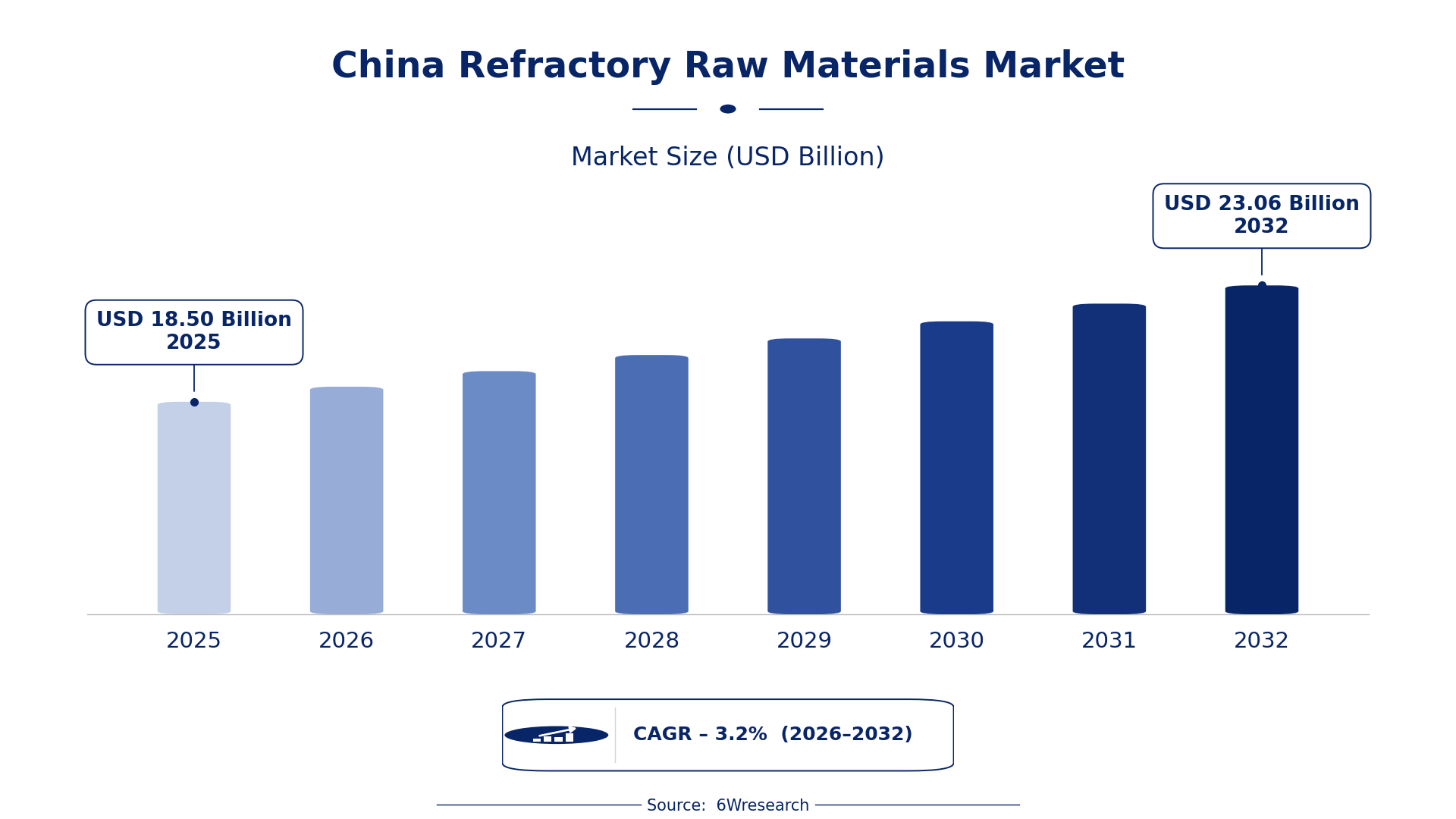
According to 6Wresearch internal database and industry insights, the China Refractory Raw Materials Market was valued at USD 18.5 billion in 2025 and is projected to reach USD 23.06 billion by 2032, growing at a CAGR of approximately 3.2% during 2026–2032.
China Refractory Raw Materials Market Highlights
| Report Metric | Details |
| Report Name | China Refractory Raw Materials Market |
| Market Size 2025 | USD 18.5 billion |
| Market Size 2032 | USD 23.06 billion |
| Absolute Growth 2025–2032 | USD 4.56 billion |
| CAGR 2026–2032 | 3.2% |
| Peak Annual Growth | 4.8% in 2027 |
| Forecast Period | 2026–2032 |
| Historical Data | 2022–2025 |
| Base Year | 2025 |
| Leading Material Type, 2025 | Alumina (47% share) |
| Leading Chemical Composition, 2025 | Al₂O₃ (48% share) |
| Leading Product Form, 2025 | Bricks/Linings (46% share) |
| Leading End User, 2025 | Steel Mills (44% share) |
| Fastest-Growing Material Type | Magnesia (5.4% CAGR) |
| Fastest-Growing Chemical Composition | MgO (4.2% CAGR) |
| Fastest-Growing Product Form | Dead Burnt Bricks (5.3% CAGR) |
| Fastest-Growing End User | Cement Kilns (4.4% CAGR) |
| Growing Sector | Steel Production |
| Key End Users | Steel Mills, Cement Kilns, Glass Furnaces |
China Refractory Raw Materials Market Year-wise Growth Rate and Key Drivers (2022–2032)
This graph illustrates the annual growth rates of the market from 2022 to 2032, highlighting a steady upward trajectory and projected market expansion over the forecast period.
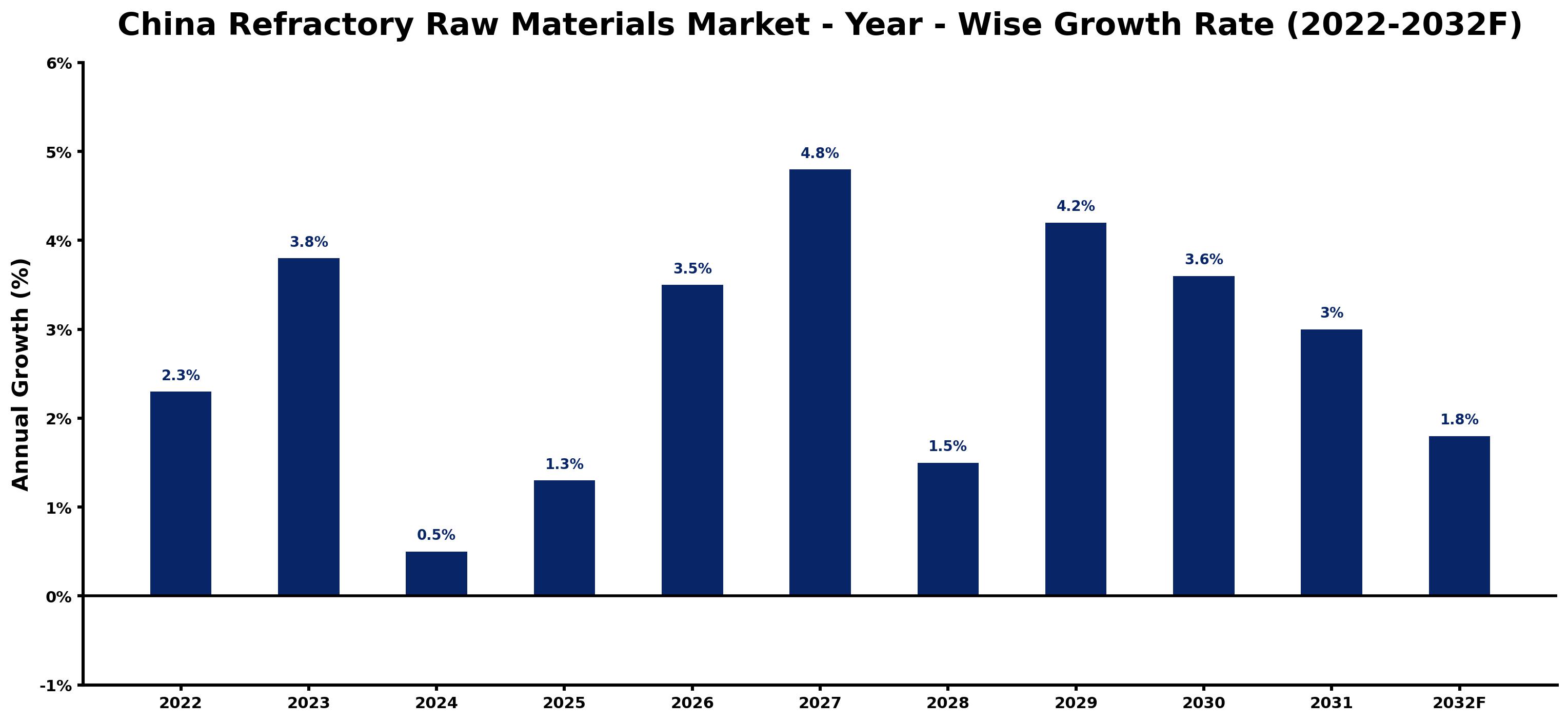
The following table presents the estimated annual growth rate for each year together with the principal factor influencing market performance.
| Year | Estimated Annual Growth (%) | Market Rationale |
| 2022 | 2.3 | The market experienced steady demand from steel mills and cement kilns. |
| 2023 | 3.8 | Growth was driven by increased production in the steel industry and rising refractory consumption. |
| 2024 | 0.5 | Demand growth slowed due to reduced steel output and the impact of the National Standard GB/T 2007-2017. |
| 2025 | 1.3 | The market saw a resurgence as infrastructure projects boosted steel and cement production. |
| 2026 | 3.5 | Demand is expected to rise with ongoing investments in new steel manufacturing facilities. |
| 2027 | 4.8 | The peak growth year will be supported by high steel production levels and exports. |
| 2028 | 1.5 | Growth will slow as market conditions normalise after the peak demand period. |
| 2029 | 4.2 | Increased demand from cement kilns will drive market growth faster than in previous years. |
| 2030 | 3.6 | Growth is projected to slow as the market stabilises after rapid expansion. |
| 2031 | 3.0 | Demand will continue to grow, albeit at a slower rate due to market maturity. |
| 2032 | 1.8 | The market is expected to maintain growth, driven by steady demand from the glass industry. |
Note: Market size estimations and growth projections presented in this report are based on 6Wresearch's proprietary forecasting methodology, utilizing the latest available industry data, government publications, and primary research inputs.
China Refractory Raw Materials Market Synopsis
Refractory Raw Materials in China are high-temperature resistant materials essential for industrial applications such as steel production and cement manufacturing. These materials are produced through the mining and refining of various minerals. The China Refractory Raw Materials Market is expanding due to strong domestic demand from steel mills and cement kilns, supported by substantial investments in infrastructure. The steel industry alone consumed approximately 60 million tons of refractories in 2022, highlighting the robust demand. Additionally, the 'Refractory Industry Development Plan' launched in 2021 aims to promote sustainable practices in production.
Market Dynamics Impact Analysis (2026–2032)
| Factor | Type | Impact | Primary Segment Affected |
| Rising steel production drives demand for refractory materials used in steelmaking processes. | Driver | High | Steel Mills |
| Increased infrastructure projects lead to higher consumption of refractories in cement kilns. | Driver | High | Cement Kilns |
| Investment in eco-friendly refractory materials presents opportunities for manufacturers. | Opportunity | High | Bricks/Linings |
| Growing demand for magnesia refractories offers a chance for suppliers to expand. | Opportunity | Medium | Magnesia |
| High production costs can limit profitability for refractory manufacturers. | Restraint | High | Alumina |
| Supply chain disruptions may affect the availability of key raw materials. | Restraint | Medium | Alumina |
| Regulatory hurdles can delay the approval of new refractory products in the market. | Challenge | High | Alumina |
| Competition from imported refractory materials can pressure local producers. | Challenge | Medium | Alumina |
Evaluation of Drivers in China Refractory Raw Materials Market (2026–2032)
The factors lifting demand, and the evidence behind each, are summarised below.
| Drivers | Primary Segment Affected | Why It Matters (Evidence) |
| Increased steel production drives demand for refractories. | Steel Mills | The steel industry consumed approximately 60 million tons of refractories in 2022, leading to higher purchases. |
| Infrastructure investments boost cement production, increasing refractory needs. | Cement Kilns | China's ongoing infrastructure projects have raised the demand for cement, thus driving refractory purchases. |
| Growing focus on eco-friendly materials encourages innovation in refractory production. | Bricks/Linings | The 'Green Manufacturing' initiative promotes the use of sustainable materials, increasing demand for eco-friendly refractories. |
| Rising demand for magnesia refractories supports market expansion. | Magnesia | The demand for magnesia refractories is expected to grow due to increased steel production in 2023. |
| Technological advancements in refractory production improve product performance. | Alumina | The 'Made in China 2025' plan emphasises advancements in refractory technologies for high-performance applications. |
The Refractory Raw Materials market in China is growing as end-use demand from steel mills and cement kilns rises. In 2022, the steel industry consumed approximately 60 million tons of refractories, boosting purchases. Infrastructure investments are expected to increase cement production, leading to higher refractory needs. Rising demand for magnesia refractories is projected to support market growth, reflecting the ongoing increase in steel production.
Evaluation of Restraints in China Refractory Raw Materials Market
The table below lists the restraints and the evidence behind each.
| Market Restraint | Primary Segment Affected | Why It Matters (Evidence) |
| High production costs limit profitability for manufacturers. | Alumina | Manufacturers face rising costs of raw materials, impacting their ability to maintain competitive pricing. |
| Supply chain disruptions affect the availability of key raw materials. | Alumina | Logistical challenges have led to delays in sourcing essential materials for refractory production. |
| Regulatory hurdles delay the approval of new refractory products. | Alumina | Stringent regulations require extensive testing and certification, slowing product time-to-market. |
| Competition from imported refractory materials pressures local producers. | Alumina | Imported products often offer lower prices, challenging local manufacturers to remain competitive. |
| Market saturation in certain refractory segments limits growth potential. | Alumina | As the market matures, growth opportunities become more challenging to identify and exploit. |
China Refractory Raw Materials Market Challenges
In the China refractory raw materials market, producers encounter intense competition that erodes profit margins. This situation stems from a high concentration of manufacturers in regions like Zhejiang, causing price reductions that can lower earnings by 15% annually. Regulatory compliance poses another hurdle, as meeting the National Standard GB/T 2007-2017 necessitates rigorous quality checks, which can delay production timelines by several weeks and disrupt supply chains for buyers. Buyers face challenges with inconsistent demand from the steel sector, which consumed approximately 60 million tons of refractories in 2022, complicating inventory management and risking stockouts. Additionally, skills shortages in advanced refractory technologies force producers to allocate about 10% of their annual budgets towards training, further straining operational efficiency.
Trends in the China Refractory Raw Materials Market
The trends below show where the China Refractory Raw Materials Market is heading.
- Shift towards Eco-Friendly Refractory Materials: China's refractory industry is increasingly adopting eco-friendly materials, driven by the 'Green Manufacturing' initiative. This shift is expected to result in a 15% rise in the use of sustainable refractories by 2025.
- Transition from Traditional to Advanced Refractory Technologies: Since 2021, the focus on advanced refractory technologies has intensified, supported by the 'Made in China 2025' plan. This trend is projected to improve performance and efficiency in refractory applications.
- Emergence of Magnesia Refractories: Magnesia refractories are gaining traction, particularly in steel production, with a projected growth rate of 5.4% from 2026 to 2032. This trend reflects the increasing need for high-performance materials.
- Growth of Custom Refractory Shapes: The demand for custom refractory shapes is rising, driven by specific industrial needs. This segment is expected to grow as industries seek tailored solutions for unique applications.
Investment Opportunities in the China Refractory Raw Materials Market
Investors looking at the China Refractory Raw Materials Market should consider the following areas.
- Timing for Eco-Friendly Refractory Materials: With rising environmental concerns, now is the time to invest in eco-friendly refractory materials. The 'Green Manufacturing' initiative supports this shift, creating opportunities for suppliers to meet new standards.
- Supply of Magnesia Refractories: The growing demand for magnesia refractories presents a strong opportunity for manufacturers. Suppliers can target steel mills, which are expected to increase their refractory purchases in the coming years.
- Investment in Custom Refractory Solutions: The demand for custom refractory shapes is increasing, driven by specific industrial requirements. Suppliers can enter this market by partnering with manufacturers in key regions like Zhejiang.
- Gap in High-Performance Refractories: There is a gap in the supply of high-performance refractories in China. Suppliers can capitalise on this by investing in advanced technologies and targeting sectors like glass manufacturing.
Government Initiatives in the China Refractory Raw Materials Market
The 'Refractory Industry Development Plan' launched by the Ministry of Industry and Information Technology in 2021 aims to promote sustainable practices in the refractory sector. This plan builds on existing regulations, such as National Standard GB/T 2007-2017, which outlines quality requirements for refractory materials. The new plan encourages manufacturers to adopt eco-friendly practices and improve product quality, ultimately benefiting buyers seeking sustainable options.
Buyers in the refractory market benefit from the 'Refractory Industry Development Plan' as it provides guidelines for sourcing sustainable materials. The Ministry of Industry and Information Technology oversees the implementation of this plan, ensuring that manufacturers adhere to quality standards. This initiative also supports funding for research and development projects aimed at improving refractory technologies, which can lead to enhanced product offerings for end-users.
Future Insight of the China Refractory Raw Materials Market
By 2032, buyers and suppliers in the China refractory raw materials market can expect significant advancements driven by the 'Made in China 2025' plan, which prioritises improvements in refractory technologies for high-performance applications. The 'Refractory Industry Development Plan' will encourage sustainable practices, promoting eco-friendly materials in production processes. The glass industry is projected to increase its refractory material consumption to 15 million tons by 2025, indicating a positive trend. ISO 9001 certification will continue to be a standard practice, ensuring quality management among manufacturers and enhancing buyer trust.
Market Segmentation Analysis
The analysis below covers each segmentation, its leading category in 2025 and its fastest-growing category through 2032.
By Material Type – Alumina Dominated, Magnesia Expected to Grow Fastest
According to Ravi Bhandari, Research Head at 6Wresearch, Alumina took a 47% share of material type in 2025, more than any other category. Alumina holds the largest share in the China Refractory Raw Materials Market due to its essential role in high-temperature applications, particularly in steel production. The substantial consumption of approximately 60 million tons of refractories in 2022 underscores the extensive reliance on alumina-based products in this sector. The quickest growth will come from Magnesia, forecast to expand at a CAGR of 5.4% between 2026 and 2032. The magnesia segment is witnessing rapid growth, primarily driven by the anticipated increase in steel production in 2023. This rising demand for magnesia refractories is crucial for both steelmaking and cement production, indicating a widening lead for alumina as the dominant material type. Suppliers should focus on enhancing their magnesia offerings to capitalise on the increasing demand from the steel sector.
By Chemical Composition – Al₂O₃ Dominated, MgO Expected to Grow Fastest
With a 48% revenue share in 2025, Al₂O₃ was the largest chemical composition category. Al₂O₃ dominates the market share as it is the primary component in many refractory products, making it indispensable for various industrial applications. Its widespread use in the steel industry further solidifies its leading position in the market. MgO is projected to grow fastest, at a CAGR of 4.2% during 2026–2032. MgO is projected to experience swift growth due to its critical role in basic refractories used in steel and cement production. The expected rise in steel output in 2023 will significantly elevate the demand for MgO-based refractories, reinforcing Al₂O₃'s lead. Buyers should consider sourcing more MgO-based refractories to meet the rising demands of the steel and cement industries.
By Product Form – Bricks/Linings Dominated, Dead Burnt Bricks Expected to Grow Fastest
Bricks/Linings held a 46% share of the China Refractory Raw Materials Market by product form in 2025. Bricks/Linings command the largest market share as they are extensively used for furnace linings in heavy industries, especially in steel and cement production. Their established presence in the market highlights their significance in high-temperature applications. Dead Burnt Bricks are set to record the highest CAGR in this split, 5.3% over 2026–2032. Dead Burnt Bricks are set for rapid growth, driven by their crucial role in high-temperature applications. As industries seek more efficient materials, the demand for Dead Burnt Bricks is expected to rise, further solidifying the position of Bricks/Linings. Suppliers must ensure a robust supply of Dead Burnt Bricks to meet the increasing demands of high-temperature applications.
By End User – Steel Mills Dominated, Cement Kilns Expected to Grow Fastest
Steel Mills accounted for a 44% market share by end user in 2025. Steel Mills are the largest consumers of refractory materials, representing a substantial share of the market due to their extensive use in steel production processes. The scale of consumption in this sector is pivotal for the overall demand for refractories. Over 2026–2032, Cement Kilns are expected to post the fastest growth, at a CAGR of 4.4%. Cement Kilns are experiencing the fastest growth as they increasingly depend on refractory materials for efficient operation. The projected expansion of the cement industry will drive higher demand for refractories tailored for kiln applications, indicating a continued strong position for Steel Mills. Suppliers should target the cement kiln segment to leverage the growing demand for refractory materials in this sector.
Key Attractiveness of the Report
- 10 Years of Market Numbers
- Historical Data Starting from 2022 to 2025
- Base Year 2025
- Forecast Data until 2032
- Key Performance Indicators Impacting the Market
- Major Upcoming Developments and Projects
Key Highlights of the Report:
- China Refractory Raw Materials Market Outlook
- Market Size of China Refractory Raw Materials Market, 2025
- Forecast of China Refractory Raw Materials Market, 2032
- Historical Data and Forecast of China Refractory Raw Materials Revenues & Volume for the Period 2022 - 2032F
- China Refractory Raw Materials Market Trend Evolution
- China Refractory Raw Materials Market Drivers and Challenges
- China Refractory Raw Materials Price Trends
- China Refractory Raw Materials Porter's Five Forces
- China Refractory Raw Materials Industry Life Cycle
- Historical Data and Forecast of China Refractory Raw Materials Market Revenues & Volume By Material Type for the Period 2022 - 2032F
- Historical Data and Forecast of China Refractory Raw Materials Market Revenues & Volume By Alumina for the Period 2022 - 2032F
- Historical Data and Forecast of China Refractory Raw Materials Market Revenues & Volume By Magnesia for the Period 2022 - 2032F
- Historical Data and Forecast of China Refractory Raw Materials Market Revenues & Volume By Silica for the Period 2022 - 2032F
- Historical Data and Forecast of China Refractory Raw Materials Market Revenues & Volume By Zirconia for the Period 2022 - 2032F
- Historical Data and Forecast of China Refractory Raw Materials Market Revenues & Volume By Chemical Composition for the Period 2022 - 2032F
- Historical Data and Forecast of China Refractory Raw Materials Market Revenues & Volume By Al O for the Period 2022 - 2032F
- Historical Data and Forecast of China Refractory Raw Materials Market Revenues & Volume By MgO for the Period 2022 - 2032F
- Historical Data and Forecast of China Refractory Raw Materials Market Revenues & Volume By SiO for the Period 2022 - 2032F
- Historical Data and Forecast of China Refractory Raw Materials Market Revenues & Volume By ZrO for the Period 2022 - 2032F
- Historical Data and Forecast of China Refractory Raw Materials Market Revenues & Volume By Product Form for the Period 2022 - 2032F
- Historical Data and Forecast of China Refractory Raw Materials Market Revenues & Volume By Bricks/Linings for the Period 2022 - 2032F
- Historical Data and Forecast of China Refractory Raw Materials Market Revenues & Volume By Dead Burnt Bricks for the Period 2022 - 2032F
- Historical Data and Forecast of China Refractory Raw Materials Market Revenues & Volume By Castables for the Period 2022 - 2032F
- Historical Data and Forecast of China Refractory Raw Materials Market Revenues & Volume By Powder/Refractory Shapes for the Period 2022 - 2032F
- Historical Data and Forecast of China Refractory Raw Materials Market Revenues & Volume By End User for the Period 2022 - 2032F
- Historical Data and Forecast of China Refractory Raw Materials Market Revenues & Volume By Steel Mills for the Period 2022 - 2032F
- Historical Data and Forecast of China Refractory Raw Materials Market Revenues & Volume By Cement Kilns for the Period 2022 - 2032F
- Historical Data and Forecast of China Refractory Raw Materials Market Revenues & Volume By Glass Furnaces for the Period 2022 - 2032F
- Historical Data and Forecast of China Refractory Raw Materials Market Revenues & Volume By Nuclear & Combustion Furnaces for the Period 2022 - 2032F
- China Refractory Raw Materials Import Export Trade Statistics
- Market Opportunity Assessment By Material Type
- Market Opportunity Assessment By Chemical Composition
- Market Opportunity Assessment By Product Form
- Market Opportunity Assessment By End User
- China Refractory Raw Materials Top Companies Market Share
- China Refractory Raw Materials Competitive Benchmarking By Technical and Operational Parameters
- China Refractory Raw Materials Company Profiles
- China Refractory Raw Materials Key Strategic Recommendations
Market Covered
Segments analysed in this report are listed below.
By Material Type
- Alumina
- Magnesia
- Silica
- Zirconia
By Chemical Composition
- Al₂O₃
- MgO
- SiO₂
- ZrO₂
By Product Form
- Bricks/Linings
- Dead Burnt Bricks
- Castables
- Powder/Refractory Shapes
By End User
- Steel Mills
- Cement Kilns
- Glass Furnaces
- Nuclear & Combustion Furnaces































