India Refractory Raw Materials Market Size & Growth Rate
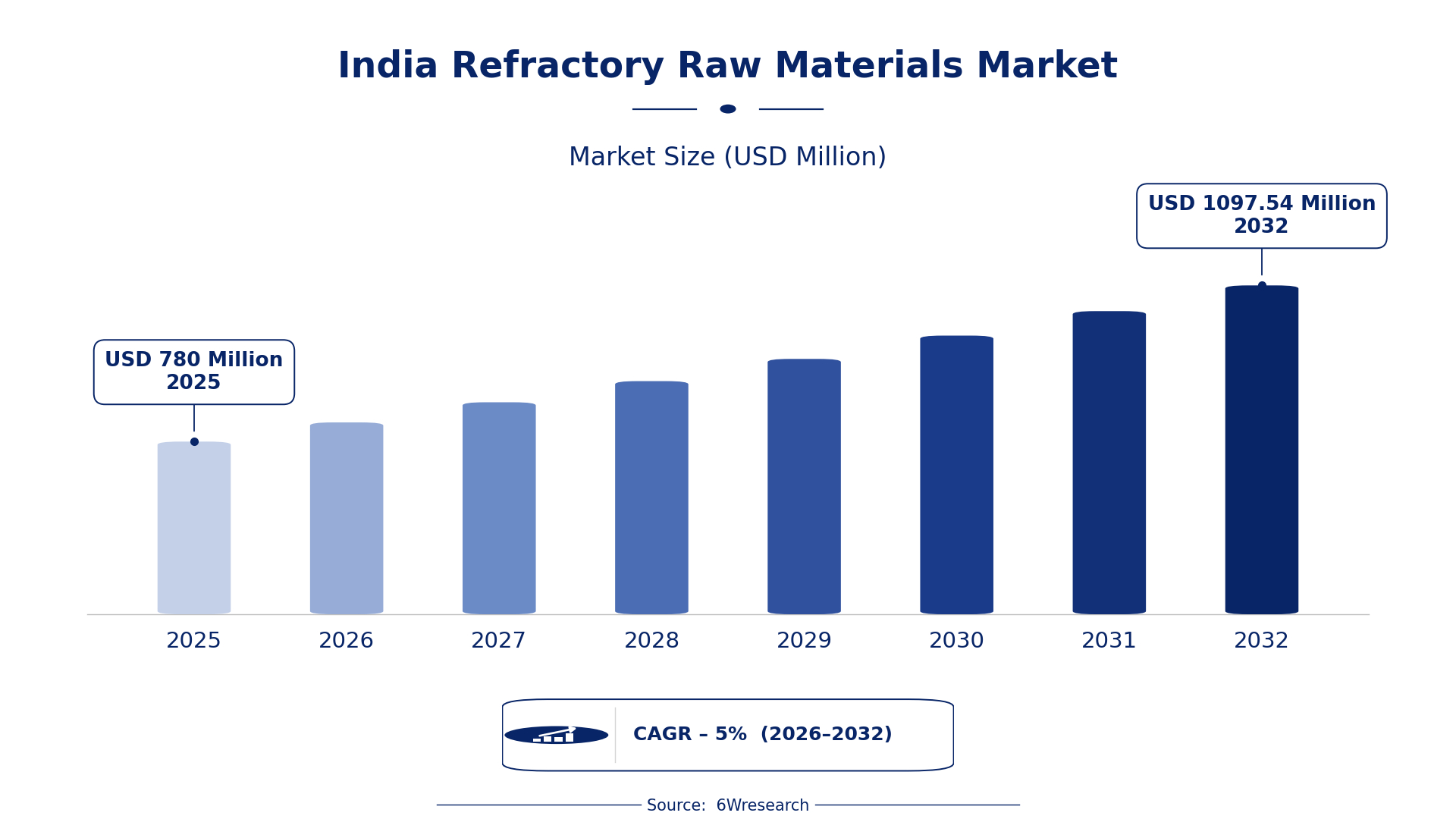
According to 6Wresearch internal database and industry insights, the India Refractory Raw Materials Market was valued at USD 780 million in 2025 and is projected to reach USD 1,097.54 million by 2032, growing at a CAGR of approximately 5% during 2026–2032.
India Refractory Raw Materials Market Highlights
| Report Metric | Details |
| Report Name | India Refractory Raw Materials Market |
| Market Size 2025 | USD 780 million |
| Market Size 2032 | USD 1,097.54 million |
| Absolute Growth 2025–2032 | USD 317.54 million |
| CAGR 2026–2032 | 5% |
| Peak Annual Growth | 7.2% in 2031 |
| Forecast Period | 2026–2032 |
| Historical Data | 2022–2025 |
| Base Year | 2025 |
| Leading Material Type, 2025 | Alumina (37% share) |
| Leading Chemical Composition, 2025 | Al₂O₃ (41% share) |
| Leading Product Form, 2025 | Bricks/Linings (42% share) |
| Leading End User, 2025 | Steel Mills (48% share) |
| Fastest-Growing Material Type | Magnesia (6.1% CAGR) |
| Fastest-Growing Chemical Composition | MgO (7.8% CAGR) |
| Fastest-Growing Product Form | Castables (7.1% CAGR) |
| Fastest-Growing End User | Cement Kilns (7.6% CAGR) |
| Growing Sector | Steel Mills |
| Key End Users | Steel Mills, Cement Kilns, Glass Furnaces |
India Refractory Raw Materials Market Year-wise Growth Rate and Key Drivers (2022–2032)
This graph illustrates the annual growth rates of the market from 2022 to 2032, highlighting a steady upward trajectory and projected market expansion over the forecast period.
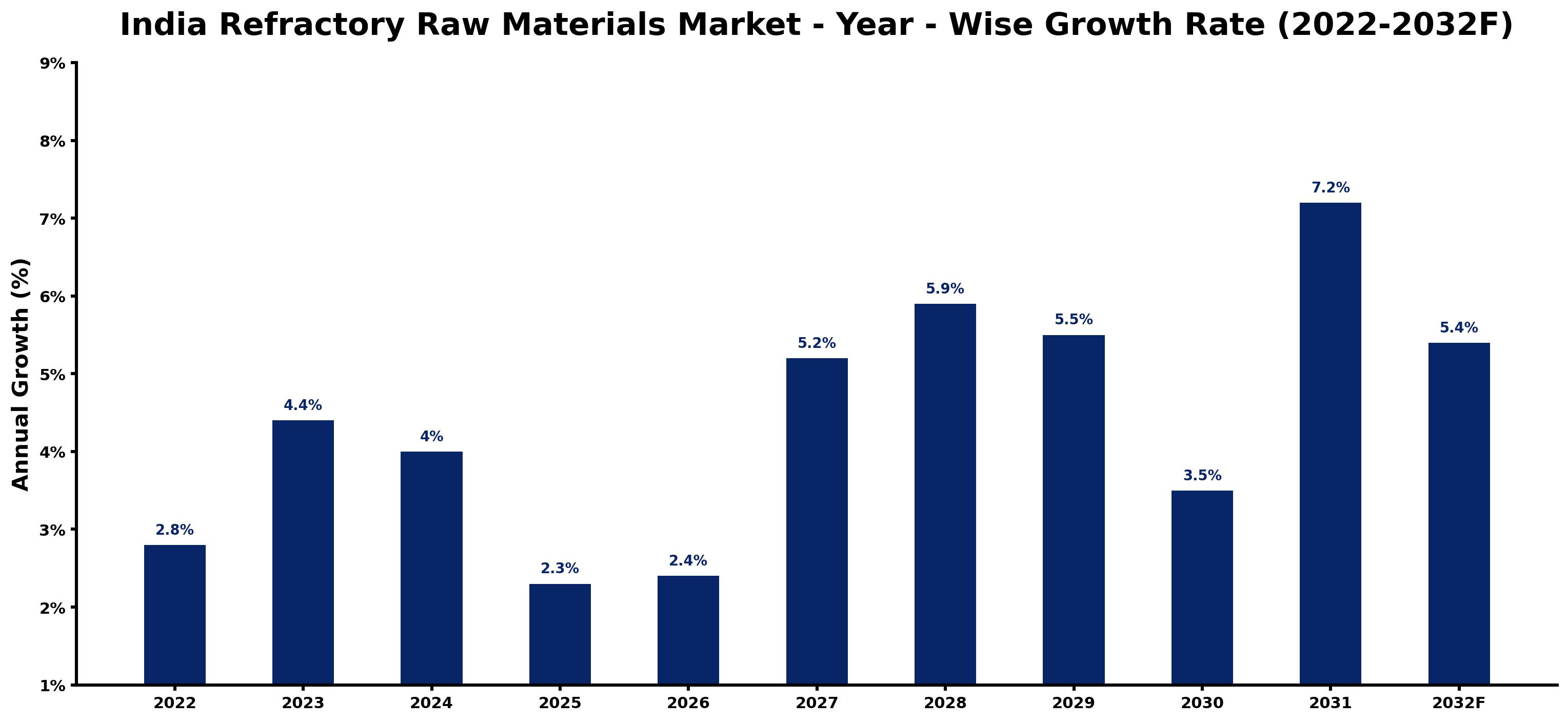
The following table presents the estimated annual growth rate for each year together with the principal factor influencing market performance.
| Year | Estimated Annual Growth (%) | Market Rationale |
| 2022 | 2.8 | The market experienced steady demand from the steel industry, which is the largest consumer of refractories. |
| 2023 | 4.4 | Increased production in the steel sector led to a surge in refractory material requirements. |
| 2024 | 4.0 | Demand growth slowed as the National Steel Policy 2017 stabilised steel production after a strong previous year. |
| 2025 | 2.3 | Refractory demand continued to grow, albeit at a slower pace due to infrastructure project delays. |
| 2026 | 2.4 | A recovery in infrastructure projects is expected to boost refractory demand once again. |
| 2027 | 5.2 | Growing investments in cement production are likely to increase the need for refractories. |
| 2028 | 5.9 | The rise in construction activities will further drive demand for refractory materials. |
| 2029 | 5.5 | Demand is expected to slow slightly as market conditions normalise after rapid growth. |
| 2030 | 3.5 | Infrastructure development will support steady growth in refractory usage, particularly in cement kilns. |
| 2031 | 7.2 | A peak in demand is anticipated as steel production reaches new heights, driven by the National Steel Policy 2017. |
| 2032 | 5.4 | The market will stabilise as growth rates normalise following the peak demand year. |
Note: Market size estimations and growth projections presented in this report are based on 6Wresearch's proprietary forecasting methodology, utilizing the latest available industry data, government publications, and primary research inputs.
India Refractory Raw Materials Market Synopsis
Refractory Raw Materials in India are high-temperature resistant materials essential for lining furnaces, kilns, and reactors in industries like steel and cement. The market is expanding due to increasing infrastructure projects and industrialisation, with the steel industry accounting for over 60% of demand. In 2022, India produced approximately 10 million tons of refractories, reflecting strong domestic demand driven by these key industries. The National Steel Policy 2017 supports this growth by aiming to increase steel production capacity.
Market Dynamics Impact Analysis (2026–2032)
| Factor | Type | Impact | Primary Segment Affected |
| Rising steel production capacity driven by the National Steel Policy 2017 | Driver | High | Steel Mills |
| Increasing cement production due to the total installed capacity reaching 550 million tons | Driver | High | Cement Kilns |
| Investment in advanced refractory materials for glass production | Opportunity | Medium | Glass Furnaces |
| Growing demand for high-alumina refractories in steelmaking | Opportunity | Medium | Alumina |
| Regulatory challenges in sourcing raw materials for refractories | Restraint | High | Magnesia |
| Quality assurance requirements under ISO 9001 certification | Restraint | Medium | Bricks/Linings |
| Supply chain disruptions affecting refractory material availability | Challenge | High | Castables |
| High production costs impacting profit margins for manufacturers | Challenge | Medium | Powder/Refractory Shapes |
Evaluation of Drivers in India Refractory Raw Materials Market (2026–2032)
Below mentioned are some major drivers and their influence on market dynamics.
| Drivers | Primary Segment Affected | Why It Matters (Evidence) |
| Increased steel production capacity due to the National Steel Policy 2017 | Steel Mills | This policy aims to boost steel production to 300 million tons by 2030, increasing refractory demand. |
| Rising cement production capacity reaching 550 million tons | Cement Kilns | The increase in cement manufacturing directly correlates with higher refractory usage in kilns. |
| Growing infrastructure projects leading to higher refractory demand | Glass Furnaces | Infrastructure development increases the need for advanced refractory materials in glass production. |
| Investment in high-alumina refractories for steelmaking | Alumina | The steel industry’s focus on efficiency drives demand for high-performance refractory materials. |
| Expansion of domestic production capabilities under the Make in India initiative | Magnesia | This initiative encourages local sourcing, reducing reliance on imports and boosting local suppliers. |
The Refractory Raw Materials market in India is growing on the back of rising steel production capacity, increasing cement production, and expanding infrastructure projects. In 2022, India produced approximately 10 million tons of refractories, with the steel industry accounting for over 60% of demand. Cement production capacity reached 550 million tons in 2023, which boosts refractory usage. Investments in high-alumina refractories are increasing due to the industry's focus on efficiency and performance.
Evaluation of Restraints in India Refractory Raw Materials Market
The main factors holding the market back are set out below.
| Market Restraint | Primary Segment Affected | Why It Matters (Evidence) |
| Regulatory challenges in sourcing raw materials for refractories | Magnesia | Compliance with mining regulations can delay sourcing, impacting production timelines. |
| Quality assurance requirements under ISO 9001 certification | Bricks/Linings | Manufacturers must invest in quality control processes, increasing operational costs. |
| Supply chain disruptions affecting refractory material availability | Castables | Logistical issues can lead to delays in material delivery, affecting project timelines. |
| High production costs impacting profit margins for manufacturers | Powder/Refractory Shapes | Rising raw material prices can squeeze margins, making it difficult for suppliers to compete. |
| Limited availability of skilled workforce in refractory manufacturing | Alumina | The shortage of trained personnel can hinder production efficiency and quality. |
India Refractory Raw Materials Market Challenges
Buyers and suppliers in the India refractory raw materials market encounter notable challenges, starting with outdated production technology that reduces efficiency and extends lead times. Many manufacturers rely on traditional methods, causing delays for steel and cement producers who require timely deliveries. Limited access to quality raw materials, particularly bauxite, disrupts supply chains, raising procurement costs by up to 15% for manufacturers. A shortage of skilled workers exacerbates these issues, increasing operational costs by approximately 10% for refractory producers. Additionally, fluctuating raw material prices compel buyers to revise budgets, potentially delaying essential projects.
Trends in the India Refractory Raw Materials Market
Buyers and suppliers in the India Refractory Raw Materials Market are adjusting to the following trends.
- Shift from Traditional to Advanced Refractory Materials: Since 2020, the Indian Glass Manufacturers Federation has promoted advanced refractory materials, resulting in a 10% increase in their adoption in glass furnaces.
- Transition from Local Sourcing to Sustainable Practices: The National Mineral Policy 2019 encourages sustainable mining, increasing local sourcing of refractory materials, which is expected to rise by 15% by 2025.
- Cement Kilns Prioritising High-Performance Refractories: Cement kilns are increasingly using high-performance refractories, with a projected growth in demand due to rising production needs by 2032.
- Steel Mills Adopting Innovative Refractory Solutions: In 2023, steel mills began adopting innovative refractory solutions, resulting in a 5% increase in efficiency and a corresponding rise in refractory demand.
Investment Opportunities in the India Refractory Raw Materials Market
Some of the investment opportunities in the India Refractory Raw Materials Market are mentioned below.
- Supply of High-Alumina Refractories: With the steel industry focusing on efficiency, there is a growing need for high-alumina refractories, particularly in Odisha and Chhattisgarh, where production is concentrated.
- Investment in Advanced Refractory Manufacturing Facilities: Cement manufacturers in India are looking to invest in advanced refractory production facilities, particularly in states with high cement output like Gujarat, to meet rising demand.
- Market for Sustainable Refractory Materials: The shift towards sustainable practices opens opportunities for suppliers of eco-friendly refractories, particularly for glass manufacturers in Maharashtra, who are adopting greener materials.
- Partnerships for Local Production: Collaboration with local manufacturers under the Make in India initiative can facilitate entry into the refractory market, particularly for foreign investors.
Government Initiatives in the India Refractory Raw Materials Market
The 'National Steel Policy 2017' by the Ministry of Steel aims to increase steel production capacity to 300 million tons by 2030, which will boost refractory demand. Additionally, the 'National Mineral Policy 2019' focuses on sustainable mining practices for minerals used in refractories, enhancing local sourcing and production capabilities. These policies create a regulatory framework that supports the growth of the refractory industry in India, ensuring compliance with safety and quality standards. The 'Make in India' initiative encourages domestic production of refractory materials, reducing reliance on imports and promoting local suppliers.
The Ministry of Steel oversees the implementation of the National Steel Policy, which funds projects aimed at increasing production capacity. The 'Skill India' program, initiated in 2015, aims to train workers in manufacturing sectors, including refractory production, enhancing workforce capabilities. Furthermore, the Bureau of Indian Standards (BIS) sets quality standards for refractory materials, ensuring that producers meet necessary requirements for market entry. The 'Atmanirbhar Bharat' initiative promotes self-reliance in manufacturing, including refractories, launched by the Government of India in 2020.
Future Insight of the India Refractory Raw Materials Market
The India refractory raw materials market will evolve by 2032, driven by advancements in production technology and the government's focus on industrialisation. The National Steel Policy 2017 will boost demand, with the cement sector's total installed capacity projected to reach 600 million tons. Stricter quality standards from the Bureau of Indian Standards will enhance product consistency, benefiting both buyers and suppliers. As infrastructure projects expand, there will be a notable shift towards advanced refractory materials, particularly in high-end applications.
Market Segmentation Analysis
The report offers a comprehensive study of the following market segments and their leading categories in the market.
By Material Type – Alumina Dominated, Magnesia Expected to Grow Fastest
According to Ravi Bhandari, Research Head at 6Wresearch, with a 37% revenue share in 2025, Alumina was the largest material type category. Alumina holds the largest share in the India Refractory Raw Materials Market due to its indispensable role in high-alumina refractories, particularly for steelmaking. Its extensive use in steel production processes highlights its significance and solidifies its leading position. The quickest growth will come from Magnesia, forecast to expand at a CAGR of 6.1% between 2026 and 2032. Magnesia is experiencing the fastest growth as it is crucial for basic refractories widely used in both the steel and cement sectors. The surge in infrastructure projects is significantly driving the demand for magnesia, which will likely widen its lead in the future. Suppliers must focus on enhancing their magnesia product lines to meet the growing needs of the refractory market.
By Chemical Composition – Al₂O₃ Dominated, MgO Expected to Grow Fastest
In 2025, Al₂O₃ led the chemical composition split with a 41% share. Al₂O₃ commands the largest market share as it is the primary component in alumina refractories specifically designed for steel mills. Its critical application in this vital industry reinforces its dominant position in the market. MgO is projected to grow fastest, at a CAGR of 7.8% during 2026–2032. MgO is witnessing rapid growth due to its essential function in basic refractories for various high-temperature applications. The ongoing industrialisation in India is significantly boosting the demand for MgO-based materials, ensuring its continued expansion. Buyers should consider increasing their procurement of MgO materials to address the rising demands for high-temperature applications.
By Product Form – Bricks/Linings Dominated, Castables Expected to Grow Fastest
Bricks/Linings accounted for a 42% market share by product form in 2025. Bricks/Linings command the largest share in the market because they are commonly used in furnaces and kilns across multiple industries. Their established presence in steel and cement production solidifies their leading position. Castables are set to record the highest CAGR in this split, 7.1% over 2026–2032. Castables are growing at the fastest rate due to their versatility and widespread use in various furnace linings. The adaptability of castables to different applications is driving their increased adoption in the industry. Manufacturers should invest in developing advanced castable solutions to meet the evolving needs of refractory applications.
By End User – Steel Mills Dominated, Cement Kilns Expected to Grow Fastest
Steel Mills took a 48% share of end user in 2025, more than any other category. Steel Mills are the largest consumer group in the India Refractory Raw Materials Market, accounting for over 60% of total demand. Their reliance on refractories for high-temperature processes ensures a strong market share for this segment. Over 2026–2032, Cement Kilns are expected to post the fastest growth, at a CAGR of 7.6%. Cement Kilns are the fastest-growing end user of refractories, with a reported 5% increase in demand in 2023. The expansion of cement production capacity in India is a key factor driving this growth. Suppliers should strategically focus on the cement industry to capitalise on the increasing demand for refractories in kiln applications.
Key Attractiveness of the Report
- 10 Years of Market Numbers
- Historical Data Starting from 2022 to 2025
- Base Year 2025
- Forecast Data until 2032
- Key Performance Indicators Impacting the Market
- Major Upcoming Developments and Projects
Key Highlights of the Report:
- India Refractory Raw Materials Market Outlook
- Market Size of India Refractory Raw Materials Market, 2025
- Forecast of India Refractory Raw Materials Market, 2032
- Historical Data and Forecast of India Refractory Raw Materials Revenues & Volume for the Period 2022 - 2032F
- India Refractory Raw Materials Market Trend Evolution
- India Refractory Raw Materials Market Drivers and Challenges
- India Refractory Raw Materials Price Trends
- India Refractory Raw Materials Porter's Five Forces
- India Refractory Raw Materials Industry Life Cycle
- Historical Data and Forecast of India Refractory Raw Materials Market Revenues & Volume By Material Type for the Period 2022 - 2032F
- Historical Data and Forecast of India Refractory Raw Materials Market Revenues & Volume By Alumina for the Period 2022 - 2032F
- Historical Data and Forecast of India Refractory Raw Materials Market Revenues & Volume By Magnesia for the Period 2022 - 2032F
- Historical Data and Forecast of India Refractory Raw Materials Market Revenues & Volume By Silica for the Period 2022 - 2032F
- Historical Data and Forecast of India Refractory Raw Materials Market Revenues & Volume By Zirconia for the Period 2022 - 2032F
- Historical Data and Forecast of India Refractory Raw Materials Market Revenues & Volume By Chemical Composition for the Period 2022 - 2032F
- Historical Data and Forecast of India Refractory Raw Materials Market Revenues & Volume By Al O for the Period 2022 - 2032F
- Historical Data and Forecast of India Refractory Raw Materials Market Revenues & Volume By MgO for the Period 2022 - 2032F
- Historical Data and Forecast of India Refractory Raw Materials Market Revenues & Volume By SiO for the Period 2022 - 2032F
- Historical Data and Forecast of India Refractory Raw Materials Market Revenues & Volume By ZrO for the Period 2022 - 2032F
- Historical Data and Forecast of India Refractory Raw Materials Market Revenues & Volume By Product Form for the Period 2022 - 2032F
- Historical Data and Forecast of India Refractory Raw Materials Market Revenues & Volume By Bricks/Linings for the Period 2022 - 2032F
- Historical Data and Forecast of India Refractory Raw Materials Market Revenues & Volume By Dead Burnt Bricks for the Period 2022 - 2032F
- Historical Data and Forecast of India Refractory Raw Materials Market Revenues & Volume By Castables for the Period 2022 - 2032F
- Historical Data and Forecast of India Refractory Raw Materials Market Revenues & Volume By Powder/Refractory Shapes for the Period 2022 - 2032F
- Historical Data and Forecast of India Refractory Raw Materials Market Revenues & Volume By End User for the Period 2022 - 2032F
- Historical Data and Forecast of India Refractory Raw Materials Market Revenues & Volume By Steel Mills for the Period 2022 - 2032F
- Historical Data and Forecast of India Refractory Raw Materials Market Revenues & Volume By Cement Kilns for the Period 2022 - 2032F
- Historical Data and Forecast of India Refractory Raw Materials Market Revenues & Volume By Glass Furnaces for the Period 2022 - 2032F
- Historical Data and Forecast of India Refractory Raw Materials Market Revenues & Volume By Nuclear & Combustion Furnaces for the Period 2022 - 2032F
- India Refractory Raw Materials Import Export Trade Statistics
- Market Opportunity Assessment By Material Type
- Market Opportunity Assessment By Chemical Composition
- Market Opportunity Assessment By Product Form
- Market Opportunity Assessment By End User
- India Refractory Raw Materials Top Companies Market Share
- India Refractory Raw Materials Competitive Benchmarking By Technical and Operational Parameters
- India Refractory Raw Materials Company Profiles
- India Refractory Raw Materials Key Strategic Recommendations
Market Covered
The report offers an extensive study of the following market segments.
By Material Type
- Alumina
- Magnesia
- Silica
- Zirconia
By Chemical Composition
- Al₂O₃
- MgO
- SiO₂
- ZrO₂
By Product Form
- Bricks/Linings
- Dead Burnt Bricks
- Castables
- Powder/Refractory Shapes
By End User
- Steel Mills
- Cement Kilns
- Glass Furnaces
- Nuclear & Combustion Furnaces































